Quadrupole and quadratic-in-spin effects in quasicircular, spinning, asymmetric binaries
Pith reviewed 2026-06-30 08:44 UTC · model grok-4.3
The pith
Energy fluxes for small-mass-ratio binaries include quadratic-in-spin and quadrupole contributions computed relativistically on Kerr backgrounds.
A machine-rendered reading of the paper's core claim, the machinery that carries it, and where it could break.
Core claim
We calculate the energy fluxes including quadratic-in-secondary-spin terms, spin-induced quadrupole terms, and tidally induced quadrupole terms for quasicircular inspirals of a small companion into a Kerr black hole, formulated within the multiscale self-force framework together with a derived energy-balance law that enables construction of waveform models.
What carries the argument
Multiscale waveform-generation framework in self-force theory, used to compute the energy fluxes and derive the energy-balance law for asymmetric binaries.
If this is right
- The fluxes enable development of self-contained waveform models for asymmetric binaries involving stars orbiting black holes.
- Results can be used to improve other families of waveform models across all mass ratios.
- Numerical data on the Chebyshev grid supports high-accuracy interpolation for waveform generation.
- Analytical post-Newtonian expansions to sixth order provide benchmarks for other approximation methods.
Where Pith is reading between the lines
- These fluxes could be combined with existing self-force results to model extreme-mass-ratio inspirals observable by future space-based detectors.
- The same framework might be extended to include higher-order finite-size effects or non-quasicircular orbits with additional computational effort.
- Validation against full numerical simulations at moderate mass ratios would test the range of applicability beyond the strict small-mass-ratio limit.
Load-bearing premise
The multiscale self-force framework accurately models quasicircular orbits and the energy-balance law holds for producing self-contained waveform models.
What would settle it
Direct comparison of the computed energy fluxes against independent numerical-relativity simulations of the same quasicircular spinning systems at small but finite mass ratio would show disagreement if the results are incorrect.
Figures
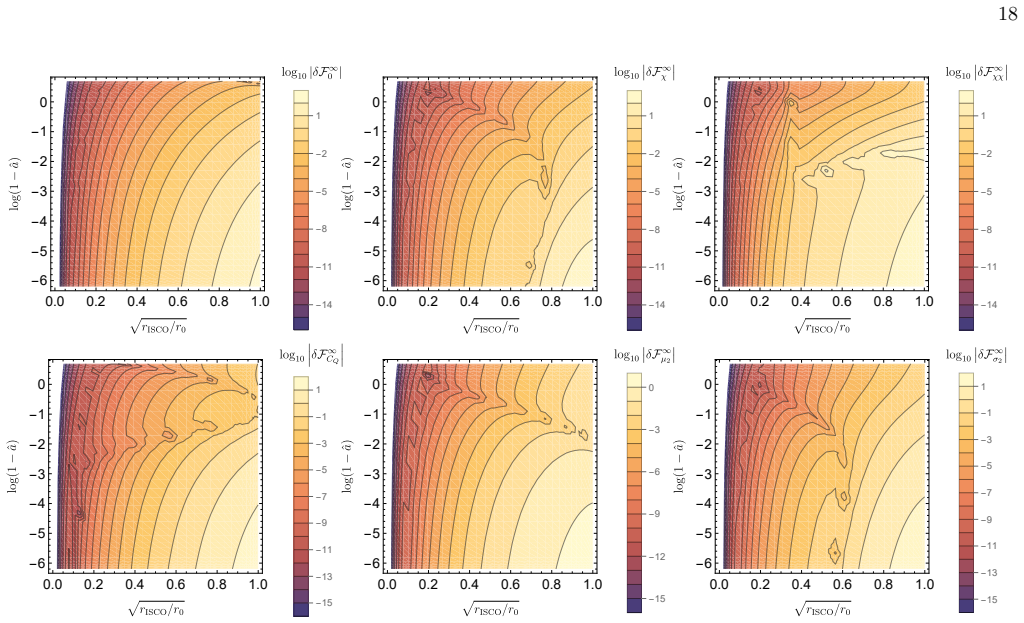
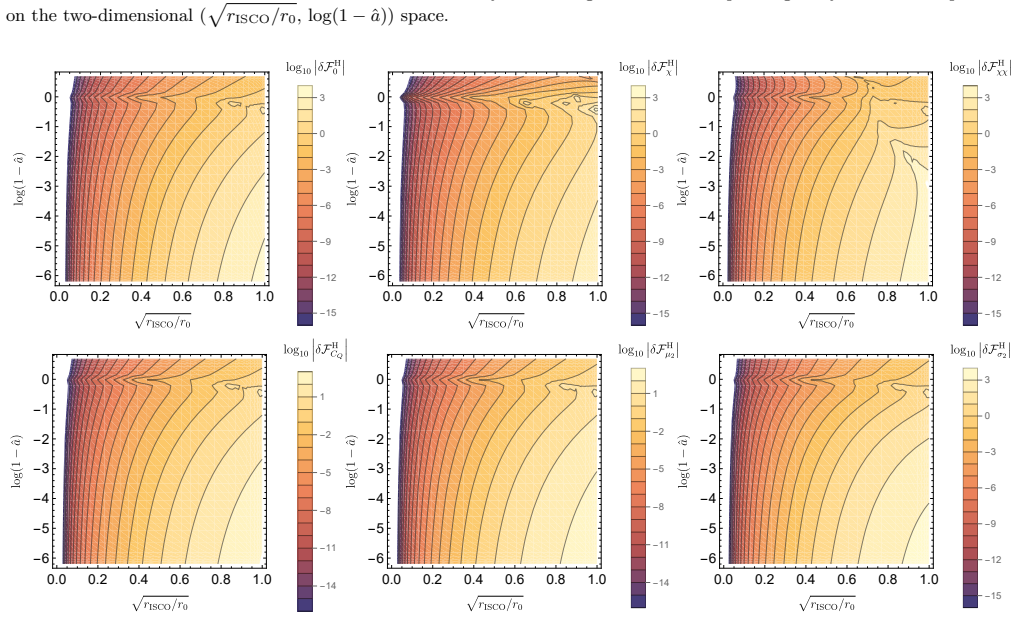
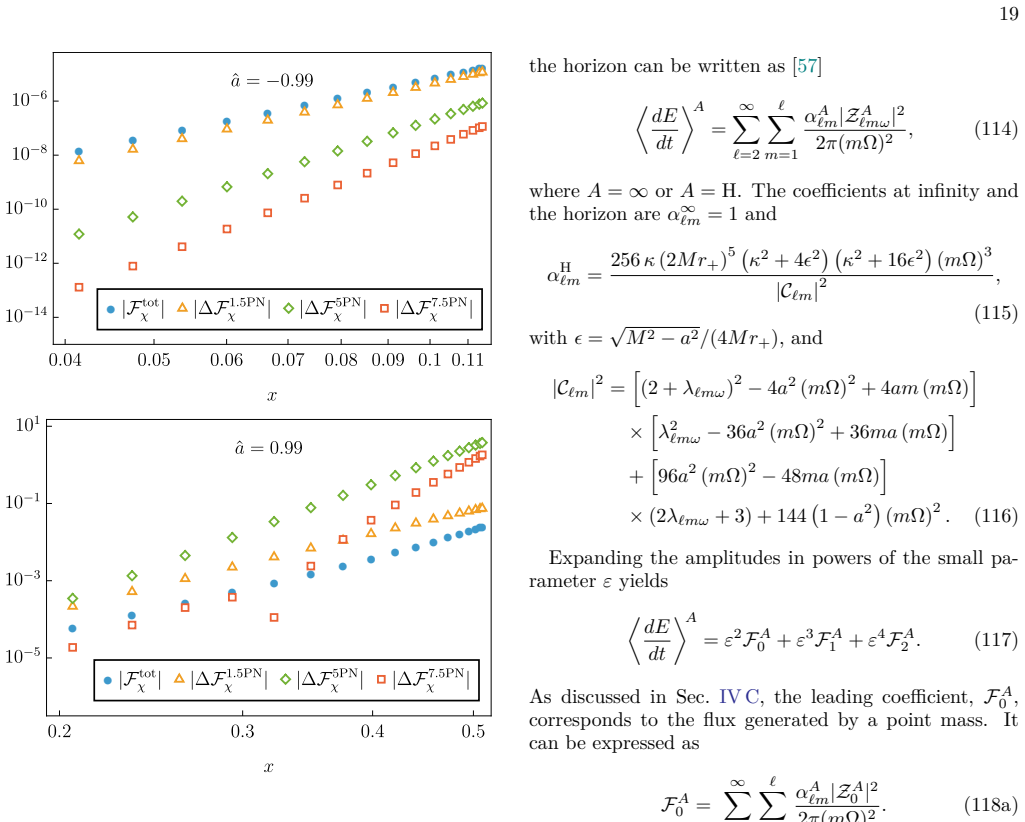
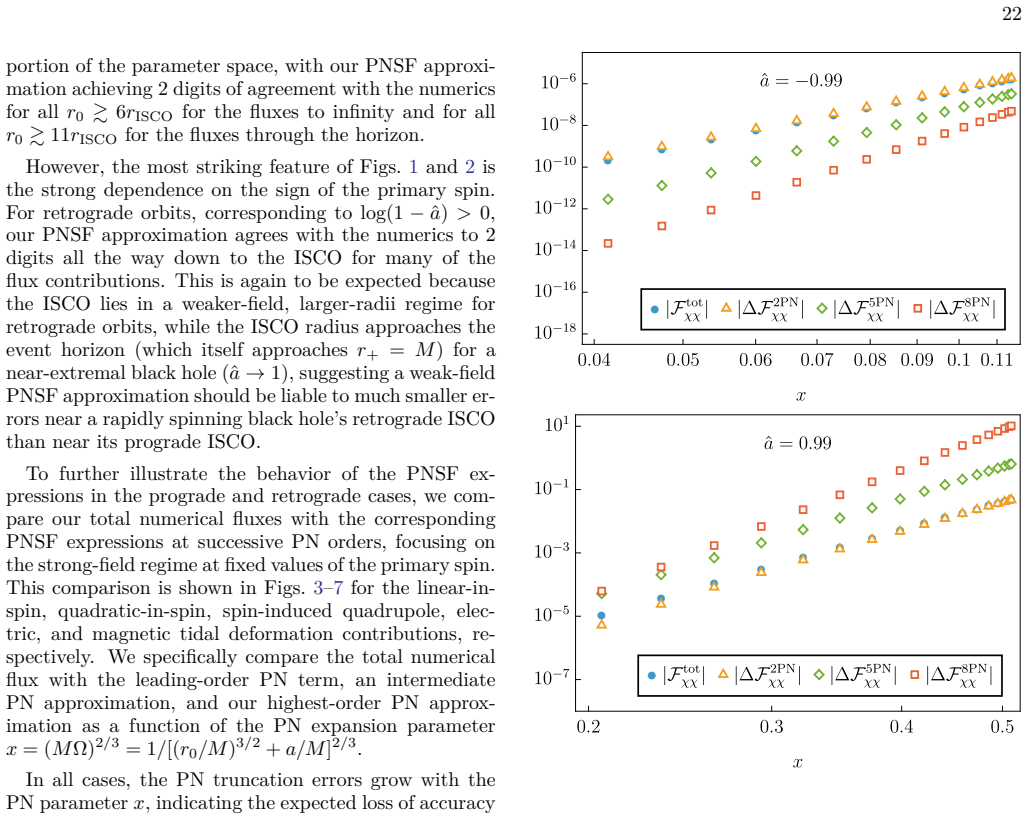
read the original abstract
Next-generation gravitational-wave detectors will require significant improvements in current theoretical waveform models, particularly in the case of asymmetric-mass binaries. Here we provide one such improvement by calculating fully relativistic finite-size effects for small mass ratios -- primarily, fluxes of energy -- including quadratic-in-secondary-spin terms, spin-induced quadrupole terms, and tidally induced quadrupole terms, for quasicircular inspirals of a small companion into a Kerr black hole. We formulate these calculations within a multiscale waveform-generation framework in self-force theory, which could be used, with an energy-balance law we derive, to develop self-contained waveform models for asymmetric binaries involving stars orbiting black holes. Our results could additionally be used to improve other families of waveform models across all mass ratios. We present results both as complete numerical data sets on a Chebyshev grid and as analytical post-Newtonian expansions (to sixth PN order relative to the leading term in each contribution to the flux).
Editorial analysis
A structured set of objections, weighed in public.
Referee Report
Summary. The manuscript calculates fully relativistic finite-size effects—primarily energy fluxes—for quasicircular inspirals of a small spinning companion into a Kerr black hole. It includes quadratic-in-secondary-spin terms, spin-induced quadrupole terms, and tidally induced quadrupole terms. Calculations are performed inside a multiscale waveform-generation framework from self-force theory; an energy-balance law is derived to support self-contained waveform models. Results are supplied both as complete numerical data sets on a Chebyshev grid and as analytical post-Newtonian expansions to sixth PN order relative to the leading term of each contribution.
Significance. If the central calculations hold, the work supplies concrete, usable data for improving extreme-mass-ratio-inspiral waveform models needed by next-generation detectors. The complete numerical data sets on a Chebyshev grid constitute a reproducible resource that can be directly ingested by other modeling efforts. The derivation of the energy-balance law and the dual numerical-plus-analytic presentation are additional strengths that increase the paper’s immediate utility across mass-ratio regimes.
major comments (1)
- [section deriving the energy-balance law and framework justification] The central claim that the computed fluxes can be turned into self-contained waveform models rests on the validity of the multiscale framework’s scale-separation and averaging assumptions once quadratic-in-spin and quadrupole contributions are retained, together with the correctness of the derived energy-balance law. The manuscript must demonstrate explicitly that no additional dissipative or conservative corrections arise at the stated orders; without such a demonstration the numerical data sets and PN expansions cannot be used for the advertised purpose.
minor comments (1)
- The abstract states that expansions reach “sixth PN order relative to the leading term in each contribution”; the main text should state the explicit leading-order scaling for the quadratic-spin, spin-induced quadrupole, and tidally induced quadrupole pieces so that readers can immediately verify the quoted PN orders.
Simulated Author's Rebuttal
We thank the referee for their careful reading of the manuscript and for highlighting the importance of the energy-balance law and framework assumptions. We respond to the single major comment below.
read point-by-point responses
-
Referee: [section deriving the energy-balance law and framework justification] The central claim that the computed fluxes can be turned into self-contained waveform models rests on the validity of the multiscale framework’s scale-separation and averaging assumptions once quadratic-in-spin and quadrupole contributions are retained, together with the correctness of the derived energy-balance law. The manuscript must demonstrate explicitly that no additional dissipative or conservative corrections arise at the stated orders; without such a demonstration the numerical data sets and PN expansions cannot be used for the advertised purpose.
Authors: We agree that an explicit demonstration is required. In the section deriving the energy-balance law we show that the multiscale framework remains valid because all finite-size contributions (quadratic-in-spin, spin-induced quadrupole, and tidal quadrupole) enter perturbatively at O(ε) or higher in the mass ratio ε and do not generate new dissipative channels or conservative corrections at the orders retained in the fluxes. The averaging over the fast orbital timescale is justified by the same scale separation used in the linear-in-spin case, with the additional terms contributing only to the slow evolution of the orbital parameters. To make this demonstration fully explicit we will add a dedicated subsection that (i) lists every possible coupling at the relevant PN orders, (ii) verifies that none produce extra dissipative or conservative pieces, and (iii) confirms the energy-balance law closes without remainder terms. This revision will be included in the next version of the manuscript. revision: yes
Circularity Check
No significant circularity; derivations are independent within self-force theory
full rationale
The paper computes new finite-size flux contributions (quadratic-in-spin, spin-induced quadrupole, tidally induced quadrupole) inside the established multiscale self-force framework and derives an energy-balance law from the resulting fluxes. These steps produce explicit numerical data sets on a Chebyshev grid and sixth-order PN expansions that are not obtained by fitting parameters to the target outputs or by renaming prior results. No load-bearing premise reduces to a self-citation chain or to a definition that already encodes the claimed fluxes; the framework assumptions and balance law are standard inputs whose validity is external to the present calculations.
Axiom & Free-Parameter Ledger
axioms (1)
- standard math General relativity and self-force theory for small mass ratios
Reference graph
Works this paper leans on
-
[1]
[70] to 2PA order, including all quadratic-in-χand spin- induced quadrupole effects
extended the multiscale expansion of Refs. [70] to 2PA order, including all quadratic-in-χand spin- induced quadrupole effects. Like in Refs. [70], this expansion is formulated in a fixed-frequency gauge that simplifies many calculations
-
[2]
Though this is a 4PA term, it involves new physical deformability param- eters, making it qualitatively distinct from the 3PA and other 4PA terms we neglect
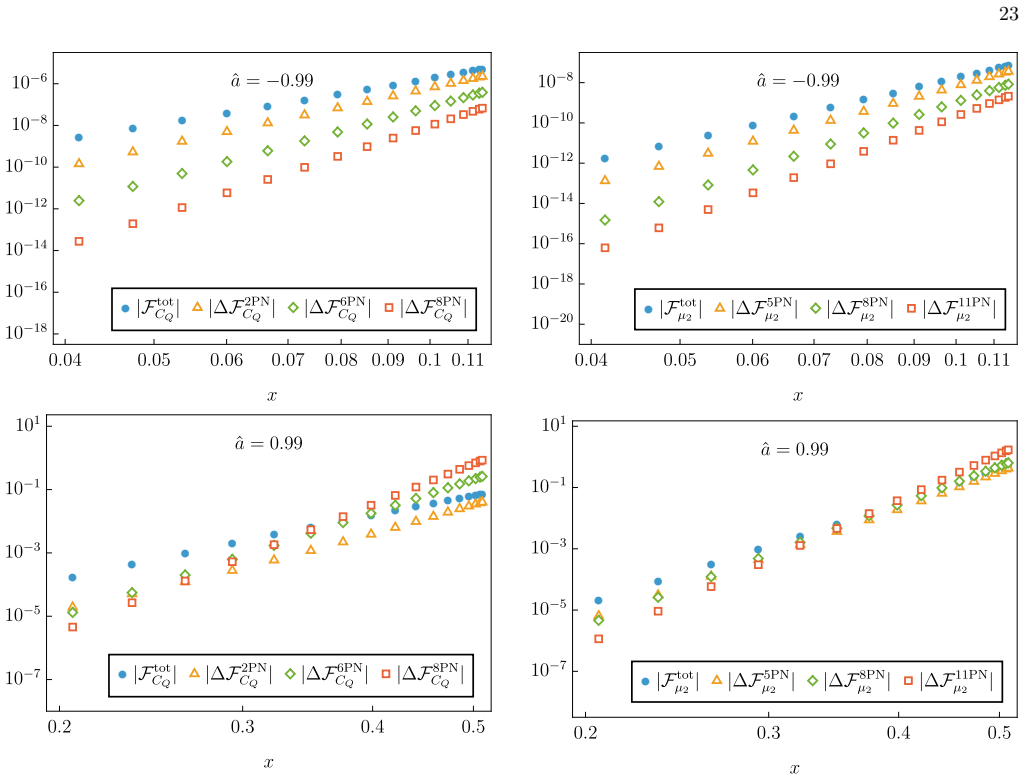
incorporated the effects of a tidally induced quadrupole on the secondary. Though this is a 4PA term, it involves new physical deformability param- eters, making it qualitatively distinct from the 3PA and other 4PA terms we neglect. ● ● ● ● ● ● ● ● ● ● ● ● ●●●● ● ● ● ● ● ● ● ● ● ● ● ● ● ●●●●● ● FIG. 6. Comparison of the total numerical electric tidal flux...
-
[3]
In practice this substantially simplifies waveform gen- eration as it circumvents the need for calculations of local forces
derived a balance law relating the emitted gravitational-wave fluxes to the secondary’s loss of mechanical energy and angular momentum. In practice this substantially simplifies waveform gen- eration as it circumvents the need for calculations of local forces
-
[4]
analytically derived the fixed-frequency expansions of the conserved energy and angular momentum with a tidally induced quadrupole, completing the earlier calculations for the spin-induced quadrupole in Ref. [108]
-
[5]
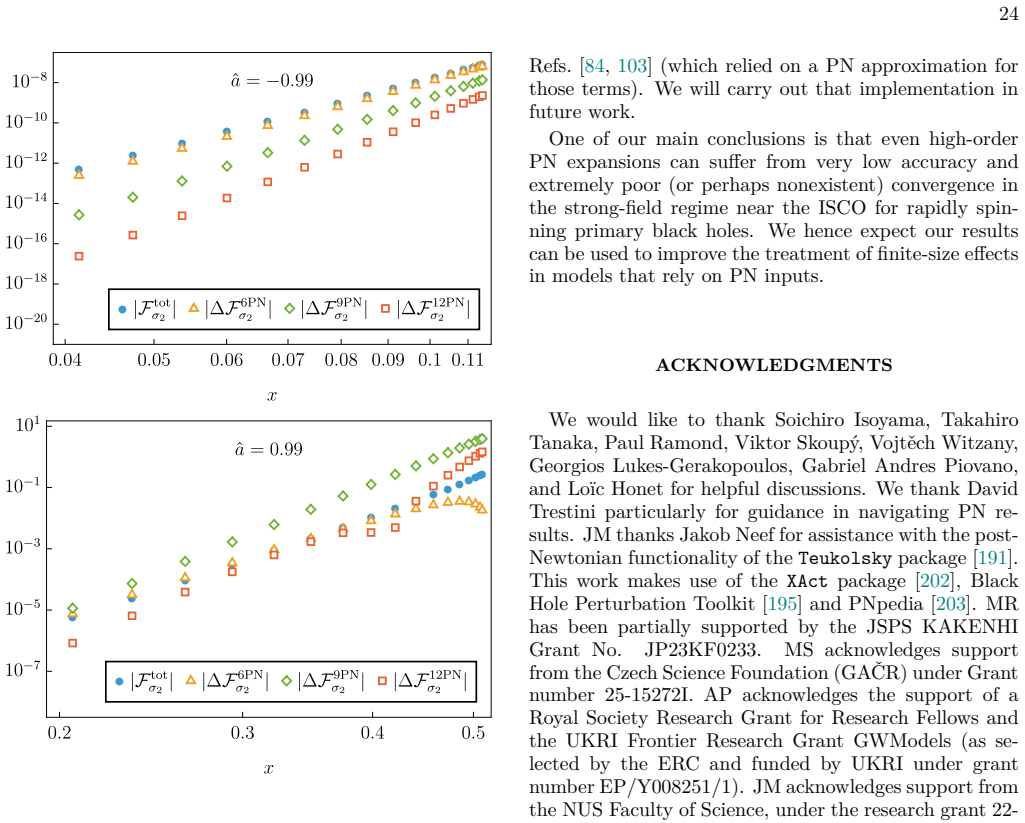
numerically computed the energy fluxes (to infinity and through the primary’s horizon) proportional toχ2 and to each of the secondary’s quadrupole 24 ● ● ● ● ● ● ● ● ● ● ● ● ●●●● ● ● ● ● ● ● ● ● ● ● ● ● ● ●●●●● ● FIG. 7. Comparison of the total numerical magnetic tidal flux correction,F tot σ2 , with the corresponding PN approxima- tions at6PN (leading or...
-
[6]
These expressions identically recover and extend the 4PN results in the literature
analytically calculated the same fluxes in a weak- field (PNSF) expansion through 6PN order rela- tive to the leading order of each individual term in the total flux. These expressions identically recover and extend the 4PN results in the literature. We have made our analytical and numerical re- sults available in the Black Hole Perturbation Toolkit PostN...
-
[7]
Teukolsky source For a generic stress-energy tensor, the source term for the radial Teukolsky equation (102a) is given by [69] Jlmω= ∫ dtdθdϕ∆2ei(ωt−mϕ)(Jnn +Jmn +Jmm), (B1) where the integrands are constructed from projections of Tαβonto a complex null tetrad{lµ, nµ, mµ, mµ}: Jnn = [ f(0) nnTnn ] ,J mn =∂r [ f(1) mnTmn ] + [ f(0) mnTmn ] , Jmm =∂2 r [ f(...
-
[8]
Teukolsky amplitudes Finally, the amplitudesZH,∞ ℓmωm are given by the follow- ing relation: ZH,∞ ℓmωm =C H,∞ ℓmωm ∫ ∞ r+ drRup,in ℓmωJℓmωm ∆ 2 , =C H,∞ ℓmωm IH,∞ ℓmωm , (B24) where IH,∞ ℓmωm = ∫ ∞ r+ dr [ A0δr +A 1δ′ r +A 2δ′′ r +A 3δ(3) r +A 4δ(4) r ] Rup,in ℓmωm (B25) = 4∑ j=0 [ Ajδ(j) r ] Rup,in ℓmωm (r),(B26) with A0 = ˜J (0) nn + ˜J (0) mn + ˜J (0) ...
-
[9]
B. P. Abbottet al.(LIGO Scientific, Virgo), Obser- vation of Gravitational Waves from a Binary Black Hole Merger, Phys. Rev. Lett.116, 061102 (2016), arXiv:1602.03837 [gr-qc]
work page internal anchor Pith review Pith/arXiv arXiv 2016
-
[10]
A. G. Abacet al.(LIGO Scientific, VIRGO, KAGRA), GWTC-4.0: Updating the Gravitational-Wave Tran- sient Catalog with Observations from the First Part of the Fourth LIGO-Virgo-KAGRA Observing Run, (2025), arXiv:2508.18082 [gr-qc]
work page internal anchor Pith review Pith/arXiv arXiv 2025
-
[11]
GWTC-5.0: An Introduction to Version 5.0 of the Gravitational-Wave Transient Catalog
N. Abacet al.(LIGO Scientific, VIRGO, KA- GRA), GWTC-5.0: An Introduction to Version 5.0 of the Gravitational-Wave Transient Catalog, (2026), arXiv:2605.27223 [gr-qc]
work page internal anchor Pith review Pith/arXiv arXiv 2026
-
[12]
B.P.Abbottet al.(LIGOScientific, Virgo),GW170817: Observation of Gravitational Waves from a Binary Neu- tron Star Inspiral, Phys. Rev. Lett.119, 161101 (2017), arXiv:1710.05832 [gr-qc]
work page internal anchor Pith review Pith/arXiv arXiv 2017
-
[13]
Gravitational-wave constraints on the neutron-star-matter Equation of State
E. Annala, T. Gorda, A. Kurkela, and A. Vuori- nen, Gravitational-wave constraints on the neutron- star-matter Equation of State, Phys. Rev. Lett.120, 172703 (2018), arXiv:1711.02644 [astro-ph.HE]
work page internal anchor Pith review Pith/arXiv arXiv 2018
- [14]
-
[15]
R. Das, N. V. Krishnendu, M. Saleem, C. K. Mishra, andK.G.Arun,TestingtheKerrhypothesisbeyondthe quadrupole with GW241011, (2026), arXiv:2604.09828 [gr-qc]
work page internal anchor Pith review Pith/arXiv arXiv 2026
-
[16]
A. G. Abacet al.(LIGO Scientific, Virgo, KAGRA), GW250114: Testing Hawking’s Area Law and the Kerr Nature of Black Holes, Phys. Rev. Lett.135, 111403 (2025), arXiv:2509.08054 [gr-qc]
work page internal anchor Pith review Pith/arXiv arXiv 2025
- [17]
-
[18]
P. A. Seoaneet al.(LISA), Astrophysics with the Laser Interferometer Space Antenna, Living Rev. Rel.26, 2 (2023), arXiv:2203.06016 [gr-qc]
work page internal anchor Pith review Pith/arXiv arXiv 2023
-
[19]
M. Colpiet al.(LISA), LISA Definition Study Report, (2024), arXiv:2402.07571 [astro-ph.CO]
work page internal anchor Pith review Pith/arXiv arXiv 2024
-
[20]
The Science of the Einstein Telescope
A. Abacet al.(ET), The Science of the Einstein Tele- scope, JCAP03, 081, arXiv:2503.12263 [gr-qc]
work page internal anchor Pith review Pith/arXiv arXiv
-
[21]
M. Pürrer and C.-J. Haster, Gravitational waveform ac- curacy requirements for future ground-based detectors, Phys. Rev. Res.2, 023151 (2020), arXiv:1912.10055 [gr- qc]
- [22]
-
[23]
Waveform Modelling for the Laser Interferometer Space Antenna
N. Afshordiet al.(LISA Consortium Waveform Work- ing Group), Waveform modelling for the Laser Interfer- ometer Space Antenna, Living Rev. Rel.28, 9 (2025), arXiv:2311.01300 [gr-qc]
work page internal anchor Pith review Pith/arXiv arXiv 2025
- [24]
-
[25]
R. S. Chandramouli, K. Prokup, E. Berti, and N. Yunes, Systematic biases due to waveform mismodeling in parametrized post-Einsteinian tests of general relativ- ity: The impact of neglecting spin precession and higher modes, Phys. Rev. D111, 044026 (2025), arXiv:2410.06254 [gr-qc]
-
[26]
P. Mahapatra, J. E. Thompson, E. Fauchon-Jones, and M. Hannam, The High-Mass-Ratio Challenge in Gravi- tationalWaveformModelling, (2026),arXiv:2603.26521 [gr-qc]
-
[27]
S. Marsat, Cubic order spin effects in the dynam- ics and gravitational wave energy flux of compact ob- ject binaries, Class. Quant. Grav.32, 085008 (2015), 30 arXiv:1411.4118 [gr-qc]
work page internal anchor Pith review Pith/arXiv arXiv 2015
-
[28]
A. Bohé, G. Faye, S. Marsat, and E. K. Porter, Quadratic-in-spin effects in the orbital dynamics and gravitational-wave energy flux of compact binaries at the 3PN order, Class. Quant. Grav.32, 195010 (2015), arXiv:1501.01529 [gr-qc]
work page internal anchor Pith review Pith/arXiv arXiv 2015
-
[29]
M. Levi and J. Steinhoff, Complete conservative dy- namics for inspiralling compact binaries with spins at the fourth post-Newtonian order, JCAP09, 029, arXiv:1607.04252 [gr-qc]
-
[30]
N. Siemonsen, J. Steinhoff, and J. Vines, Gravitational waves from spinning binary black holes at the leading post-Newtonian orders at all orders in spin, Phys. Rev. D97, 124046 (2018), arXiv:1712.08603 [gr-qc]
work page internal anchor Pith review Pith/arXiv arXiv 2018
-
[31]
Testing the multipole structure of compact binaries using gravitational wave observations
S. Kastha, A. Gupta, K. G. Arun, B. S. Sathyaprakash, and C. Van Den Broeck, Testing the multipole structure of compact binaries using gravitational wave observa- tions,Phys.Rev.D98,124033(2018),arXiv:1809.10465 [gr-qc]
work page internal anchor Pith review Pith/arXiv arXiv 2018
-
[32]
S. Kastha, A. Gupta, K. G. Arun, B. S. Sathyaprakash, and C. Van Den Broeck, Testing the multipole struc- ture and conservative dynamics of compact binaries us- ing gravitational wave observations: The spinning case, Phys. Rev. D100, 044007 (2019), arXiv:1905.07277 [gr- qc]
- [33]
-
[34]
Q. Henry, G. Faye, and L. Blanchet, Tidal effects in the gravitational-wave phase evolution of compact bi- narysystemstonext-to-next-to-leadingpost-Newtonian order, Phys. Rev. D102, 044033 (2020), [Erratum: Phys.Rev.D 108, 089901 (2023), Erratum: Phys.Rev.D 111, 029901 (2025)], arXiv:2005.13367 [gr-qc]
- [35]
-
[36]
L. Blanchet, G. Faye, Q. Henry, F. Larrouturou, and D. Trestini, Gravitational-wave flux and quadrupole modes from quasicircular nonspinning compact binaries to the fourth post-Newtonian order, Phys. Rev. D108, 064041 (2023), arXiv:2304.11186 [gr-qc]
-
[37]
L. Blanchet, G. Faye, Q. Henry, F. Larrouturou, and D. Trestini, Gravitational-Wave Phasing of Quasicircu- lar Compact Binary Systems to the Fourth-and-a-Half Post-Newtonian Order, Phys. Rev. Lett.131, 121402 (2023), arXiv:2304.11185 [gr-qc]
- [38]
- [39]
-
[40]
C. Cheung and M. P. Solon, Tidal Effects in the Post- Minkowskian Expansion, Phys. Rev. Lett.125, 191601 (2020), arXiv:2006.06665 [hep-th]
- [41]
- [42]
-
[43]
Modeling the dynamics of tidally-interacting binary neutron stars up to merger
S. Bernuzzi, A. Nagar, T. Dietrich, and T. Damour, Modeling the Dynamics of Tidally Interacting Binary Neutron Stars up to the Merger, Phys. Rev. Lett.114, 161103 (2015), arXiv:1412.4553 [gr-qc]
work page internal anchor Pith review Pith/arXiv arXiv 2015
-
[44]
Dynamical Tides in General Relativity: Effective Action and Effective-One-Body Hamiltonian
J. Steinhoff, T. Hinderer, A. Buonanno, and A. Tarac- chini, Dynamical Tides in General Relativity: Effec- tive Action and Effective-One-Body Hamiltonian, Phys. Rev. D94, 104028 (2016), arXiv:1608.01907 [gr-qc]
work page internal anchor Pith review Pith/arXiv arXiv 2016
-
[45]
B. D. Lackey, M. Pürrer, A. Taracchini, and S. Marsat, Surrogate model for an aligned-spin effective one body waveform model of binary neutron star inspirals using Gaussian process regression, Phys. Rev. D100, 024002 (2019), arXiv:1812.08643 [gr-qc]
work page internal anchor Pith review Pith/arXiv arXiv 2019
-
[46]
A. Nagar, F. Messina, P. Rettegno, D. Bini, T. Damour, A. Geralico, S. Akcay, and S. Bernuzzi, Nonlinear-in- spin effects in effective-one-body waveform models of spin-aligned, inspiralling, neutron star binaries, Phys. Rev. D99, 044007 (2019), arXiv:1812.07923 [gr-qc]
work page internal anchor Pith review Pith/arXiv arXiv 2019
- [47]
- [48]
-
[49]
N. Williams, P. Schmidt, and G. Pratten, Phenomeno- logical model of gravitational self-force enhanced tides in inspiraling binary neutron stars, Phys. Rev. D110, 104013 (2024), arXiv:2407.08538 [gr-qc]
-
[50]
M. Haberland, A. Buonanno, and J. Steinhoff, Model- ing matter in seobnrv5thm: Generating fast and accu- rate effective-one-body waveforms for spin-aligned bi- nary neutron stars, Phys. Rev. D112, 084024 (2025), arXiv:2503.18934 [gr-qc]
-
[51]
S. Albanesi, R. Gamba, S. Bernuzzi, J. Fontbuté, A. Gonzalez, and A. Nagar, Effective-one-body mod- eling for generic compact binaries with arbitrary orbits, Phys. Rev. D112, L121503 (2025), arXiv:2503.14580 [gr-qc]
-
[52]
High-order effective-one-body tidal interactions and gravitational scattering
M. Schulze, S. Bernuzzi, P. Rettegno, J. Fontbuté, A. Placidi, and T. Damour, High-order effective-one- body tidal interactions and gravitational scattering, Phys. Rev. D113, 104027 (2026), arXiv:2603.22467 [gr- qc]
work page internal anchor Pith review Pith/arXiv arXiv 2026
-
[53]
A. Gamboaet al., Accurate waveforms for generic planar-orbit binary black holes: The multipolar effective-one-body model SEOBNRv6EHM, (2026), arXiv:2605.28715 [gr-qc]
work page internal anchor Pith review Pith/arXiv arXiv 2026
-
[54]
F. A. Ramis Vidal, A. Abac, M. Colleoni, T. Dietrich, P. Mourier, A. Gonzalez, I. Markin, and A. Puecher, Fast gravitational waveform models for quasi-circular coalescencesofneutronstar–blackholebinaries, (2026), arXiv:2606.04810 [gr-qc]
work page internal anchor Pith review Pith/arXiv arXiv 2026
- [55]
-
[56]
Estelléset al., A Detailed Analysis of GW190521 with Phenomenological Waveform Models, Astrophys
H. Estelléset al., A Detailed Analysis of GW190521 with Phenomenological Waveform Models, Astrophys. J.924, 79 (2022), arXiv:2105.06360 [gr-qc]
- [57]
-
[58]
A. G. Abacet al.(LIGO Scientific, VIRGO, KAGRA), GW231123: A Binary Black Hole Merger with Total Mass 190–265 M⊙, Astrophys. J. Lett.993, L25 (2025), arXiv:2507.08219 [astro-ph.HE]
work page internal anchor Pith review Pith/arXiv arXiv 2025
-
[59]
M. van de Meent and H. P. Pfeiffer, Intermediate mass- ratio black hole binaries: Applicability of small mass- ratio perturbation theory, Phys. Rev. Lett.125, 181101 (2020), arXiv:2006.12036 [gr-qc]
-
[60]
K. Rink, R. Bachhar, T. Islam, N. E. M. Rifat, K. Gonzalez-Quesada, S. E. Field, G. Khanna, S. A. Hughes, and V. Varma, Gravitational wave surrogate model for spinning, intermediate mass ratio binaries based on perturbation theory and numerical relativity, Phys. Rev. D110, 124069 (2024), arXiv:2407.18319 [gr- qc]
work page internal anchor Pith review Pith/arXiv arXiv 2024
-
[61]
S. Kumar, M. Melching, F. Ohme, H. Narola, T. Dooney, and C. Van Den Broeck, Mitigating System- atic Errors in Parameter Estimation of Binary Black Hole Mergers in O1-O3 LIGO-Virgo Data, (2026), arXiv:2604.21859 [astro-ph.HE]
work page internal anchor Pith review Pith/arXiv arXiv 2026
-
[62]
Y. Mino, M. Sasaki, and T. Tanaka, Gravitational ra- diation reaction to a particle motion, Phys. Rev. D55, 3457 (1997), arXiv:gr-qc/9606018
work page internal anchor Pith review Pith/arXiv arXiv 1997
-
[63]
The motion of point particles in curved spacetime
E. Poisson, A. Pound, and I. Vega, The Motion of point particles in curved spacetime, Living Rev. Rel.14, 7 (2011), arXiv:1102.0529 [gr-qc]
work page internal anchor Pith review Pith/arXiv arXiv 2011
-
[64]
Self-force and radiation reaction in general relativity
L. Barack and A. Pound, Self-force and radiation reac- tion in general relativity, Rept. Prog. Phys.82, 016904 (2019), arXiv:1805.10385 [gr-qc]
work page internal anchor Pith review Pith/arXiv arXiv 2019
-
[65]
A. Pound and B. Wardell, Black Hole Perturbation The- ory and Gravitational Self-Force, inHandbook of Grav- itational Wave Astronomy(2022) p. 38, 2101.04592
-
[66]
B. Wardell, A. Pound, N. Warburton, J. Miller, L. Durkan, and A. Le Tiec, Gravitational Wave- forms for Compact Binaries from Second-Order Self- Force Theory, Phys. Rev. Lett.130, 241402 (2023), arXiv:2112.12265 [gr-qc]
-
[67]
Post-adiabatic self-force waveforms: slowly spinning primary and precessing secondary
J. Mathews, B. Wardell, A. Pound, and N. Warbur- ton, Postadiabatic self-force waveforms: Slowly spin- ning primary and precessing secondary, Phys. Rev. D 113, 064034 (2026), arXiv:2510.16113 [gr-qc]
work page internal anchor Pith review Pith/arXiv arXiv 2026
- [68]
-
[69]
L. Speri, M. L. Katz, A. J. K. Chua, S. A. Hughes, N. Warburton, J. E. Thompson, C. E. A. Chapman- Bird, and J. R. Gair, Fast and Fourier: Extreme Mass Ratio Inspiral Waveforms in the Frequency Domain 10.3389/fams.2023.1266739 (2023), arXiv:2307.12585 [gr-qc]
-
[70]
Z. Nasipak, Adiabatic gravitational waveform model for compact objects undergoing quasicircular inspirals into rotating massive black holes, Phys. Rev. D109, 044020 (2024), arXiv:2310.19706 [gr-qc]
-
[71]
C. E. A. Chapman-Birdet al., Efficient waveforms for asymmetric-mass eccentric equatorial inspirals into rapidly spinning black holes, Phys. Rev. D112, 104023 (2025), arXiv:2506.09470 [gr-qc]
work page internal anchor Pith review Pith/arXiv arXiv 2025
-
[72]
U. Ruangsri, S. J. Vigeland, and S. A. Hughes, Gyro- scopes orbiting black holes: A frequency-domain ap- proach to precession and spin-curvature coupling for spinning bodies on generic Kerr orbits, Phys. Rev. D 94, 044008 (2016), arXiv:1512.00376 [gr-qc]
Pith/arXiv arXiv 2016
-
[73]
E. Harms, G. Lukes-Gerakopoulos, S. Bernuzzi, and A. Nagar, Asymptotic gravitational wave fluxes from a spinning particle in circular equatorial orbits around a rotating black hole, Phys. Rev. D93, 044015 (2016), [Addendum: Phys.Rev.D 100, 129901 (2019)], arXiv:1510.05548 [gr-qc]
-
[74]
Evolution of small-mass-ratio binaries with a spinning secondary
N. Warburton, T. Osburn, and C. R. Evans, Evolution of small-mass-ratio binaries with a spinning secondary, Phys. Rev. D96, 084057 (2017), arXiv:1708.03720 [gr- qc]
work page internal anchor Pith review Pith/arXiv arXiv 2017
-
[75]
M. van de Meent, Analytic solutions for paral- lel transport along generic bound geodesics in Kerr spacetime, Class. Quant. Grav.37, 145007 (2020), arXiv:1906.05090 [gr-qc]
arXiv 2020
-
[76]
V. Witzany, Hamilton-Jacobi equation for spinning par- ticlesnearblackholes,Phys.Rev.D100,104030(2019), arXiv:1903.03651 [gr-qc]
- [77]
-
[78]
J. Mathews, A. Pound, and B. Wardell, Self-force cal- culations with a spinning secondary, Phys. Rev. D105, 084031 (2022), arXiv:2112.13069 [gr-qc]
-
[79]
V. Skoupý and G. Lukes-Gerakopoulos, Adiabatic equa- torial inspirals of a spinning body into a Kerr black hole, Phys. Rev. D105, 084033 (2022), arXiv:2201.07044 [gr- qc]
- [80]
discussion (0)
Sign in with ORCID, Apple, or X to comment. Anyone can read and Pith papers without signing in.