Neutron stars as thermometers for reheating induced dipole dark matter
Pith reviewed 2026-07-03 19:25 UTC · model grok-4.3
The pith
Dipole dark matter with momentum-dependent interactions is captured efficiently by neutron stars, turning their heating into a probe of reheating scenarios.
A machine-rendered reading of the paper's core claim, the machinery that carries it, and where it could break.
Core claim
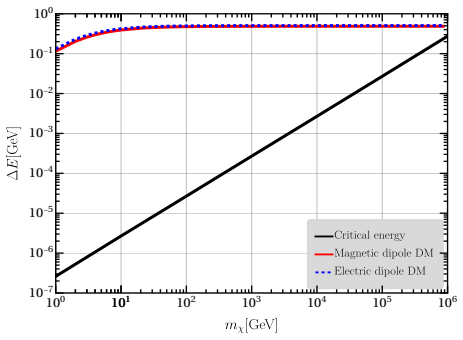
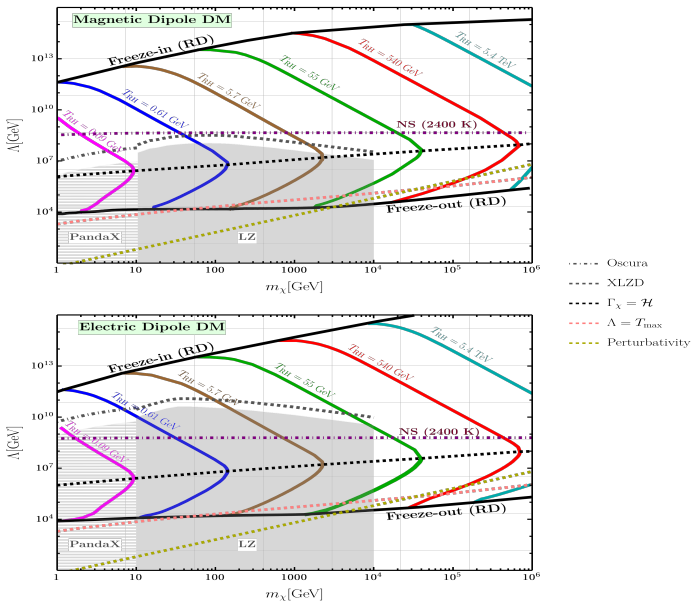
Due to the momentum-dependent nature of the interaction, dipole DM is captured efficiently by neutron stars, thereby making neutron star heating a sensitive probe of the dipole DM parameter space.
What carries the argument
The momentum-dependent electromagnetic dipole interaction in the effective field theory that sets both production rates and neutron-star capture cross sections.
If this is right
- Neutron-star temperature data exclude portions of the dipole dark matter parameter space that survive reheating dilution.
- The same capture mechanism tightens bounds on couplings that direct detection experiments reach only at higher masses.
- Reheating histories that dilute the relic density produce correspondingly lower neutron-star heating signals.
- Future direct detection runs will test overlapping but not identical slices of the same parameter space.
Where Pith is reading between the lines
- Cooling curves of old, isolated neutron stars could be re-analyzed specifically for a dipole-dark-matter contribution.
- White-dwarf heating offers a parallel probe if the same momentum-dependent capture applies at lower densities.
- If multiple reheating models predict different dilution factors, neutron-star data could help rank those models.
Load-bearing premise
The dipole interaction remains valid and momentum-dependent at the velocities and densities inside neutron stars without being screened or modified by strong-field effects.
What would settle it
A set of neutron-star temperature measurements that show no excess heating above standard cooling models for dipole strengths and masses allowed by direct detection would falsify the efficient-capture prediction.
Figures
read the original abstract
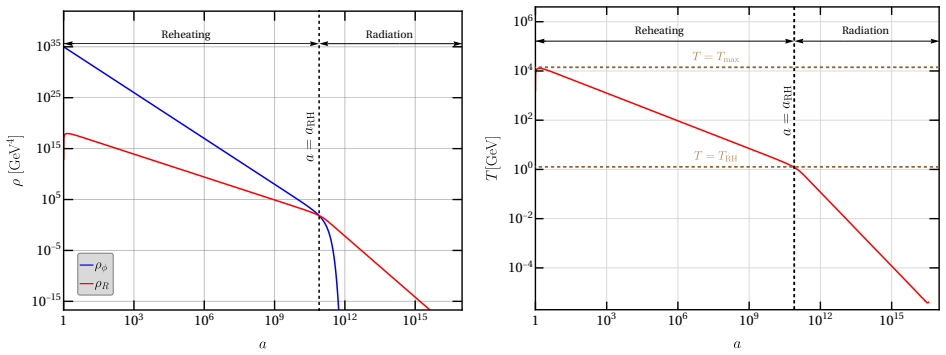
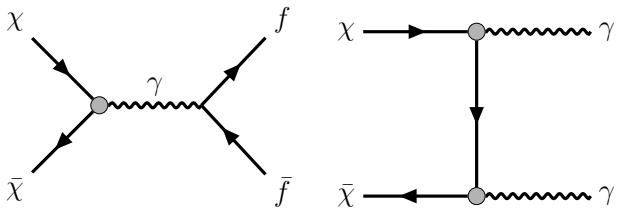
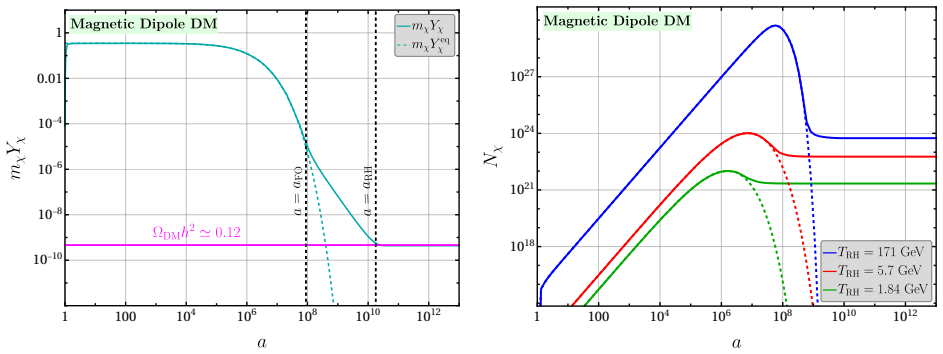
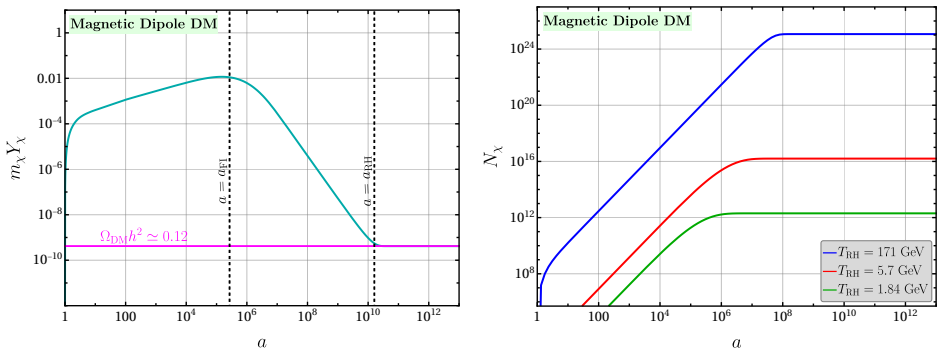
We investigate the electromagnetic interactions of dipole dark matter (DM) within an effective field theory framework, considering both standard and non-standard cosmological scenarios. We first study the prospects of DM production via both the freeze-out and freeze-in mechanisms within the standard radiation-domination. We then investigate how the viable DM parameter space is modified in a non-standard cosmological scenario due to entropy dilution during reheating. Existing constraints on the parameter space are discussed, and we highlight the discovery potential of future direct detection experiments to probe these scenarios. We further investigate the implications of neutron star heating for dipole DM. Due to the momentum-dependent nature of the interaction, dipole DM is captured efficiently by neutron stars, thereby making neutron star heating a sensitive probe of the dipole DM parameter space.
Editorial analysis
A structured set of objections, weighed in public.
Referee Report
Summary. The paper examines dipole dark matter in an EFT framework, computing its thermal production via freeze-out and freeze-in under standard radiation domination and under entropy dilution from reheating. It reviews existing bounds, forecasts direct-detection reach, and argues that the momentum-dependent dipole operator enables efficient neutron-star capture, positioning NS heating as a sensitive probe of the DM parameter space even after reheating-induced dilution.
Significance. Should the capture-rate calculation prove robust, the work supplies a concrete astrophysical channel that can test dipole DM at masses and couplings complementary to terrestrial experiments, while the inclusion of reheating scenarios usefully maps how early-universe entropy injection reshapes the viable parameter space.
major comments (1)
- [Neutron-star capture section] Neutron-star capture section: the central claim that the momentum-dependent dipole interaction yields efficient capture (and thus observable heating) rests on the assumption that the EFT remains valid at typical NS kinematics (q ~ few × 100 MeV, v_esc ~ 0.5c, nuclear density). No explicit comparison of these scales to the EFT cutoff or discussion of possible in-medium screening is provided, rendering the sensitivity claim load-bearing but unverified.
minor comments (1)
- [Abstract] Abstract and title: the phrasing 'reheating induced dipole dark matter' is slightly misleading; the DM is not induced by reheating but its abundance is diluted by it. A minor rewording would improve clarity.
Simulated Author's Rebuttal
We thank the referee for their careful reading and for highlighting this important point regarding the neutron-star capture analysis. We address the comment below and will revise the manuscript accordingly.
read point-by-point responses
-
Referee: [Neutron-star capture section] Neutron-star capture section: the central claim that the momentum-dependent dipole interaction yields efficient capture (and thus observable heating) rests on the assumption that the EFT remains valid at typical NS kinematics (q ~ few × 100 MeV, v_esc ~ 0.5c, nuclear density). No explicit comparison of these scales to the EFT cutoff or discussion of possible in-medium screening is provided, rendering the sensitivity claim load-bearing but unverified.
Authors: We agree that an explicit discussion of EFT validity at neutron-star scales is necessary to support the capture-rate claims. In the revised manuscript we will add a dedicated paragraph in the neutron-star section that (i) compares the typical momentum transfer q ∼ 100–300 MeV (set by nuclear density and v_esc ≈ 0.5c) to the cutoff scale of the dipole operator (taken to lie above several GeV throughout our parameter space to ensure perturbativity), (ii) notes that the dimension-5 suppression remains under control for the quoted range of couplings, and (iii) briefly addresses in-medium effects, arguing that the momentum dependence of the operator limits the impact of plasma screening on the capture cross section. These additions will be included without changing any numerical results or conclusions. revision: yes
Circularity Check
No significant circularity; derivation relies on independent EFT and cosmological calculations
full rationale
The paper computes DM relic density via standard freeze-out/freeze-in in radiation domination, then modifies it with entropy dilution from reheating, and derives NS capture rates from the momentum-dependent dipole operator in EFT. None of these steps reduce by construction to fitted parameters or self-citations; the NS heating sensitivity is an output of the cross-section kinematics applied to escape velocity and nuclear density, using external benchmarks rather than redefining the input interaction. The EFT validity assumption is an unverified modeling choice but does not create a definitional loop or rename a known result.
Axiom & Free-Parameter Ledger
free parameters (3)
- dipole moment strength
- DM mass
- reheating temperature or entropy dilution factor
axioms (2)
- domain assumption Effective field theory description of dipole DM remains valid at neutron-star densities and velocities.
- standard math Standard Boltzmann-equation treatment of freeze-out and freeze-in applies in both radiation and reheating eras.
Reference graph
Works this paper leans on
-
[1]
Zwicky,Die Rotverschiebung von extragalaktischen Nebeln,Helv
F. Zwicky,Die Rotverschiebung von extragalaktischen Nebeln,Helv. Phys. Acta6 (1933) 110
1933
-
[2]
V. C. Rubin, N. Thonnard and W. K. Ford, Jr.,Rotational properties of 21 SC galaxies with a large range of luminosities and radii, from NGC 4605 /R = 4kpc/ to UGC 2885 /R = 122 kpc/,Astrophys. J.238(1980) 471
1980
-
[3]
D. J. Schlegel, D. P. Finkbeiner and M. Davis,Maps of dust IR emission for use in estimation of reddening and CMBR foregrounds,Astrophys. J.500(1998) 525 [astro-ph/9710327]. 16
work page internal anchor Pith review Pith/arXiv arXiv 1998
-
[4]
Particle Dark Matter: Evidence, Candidates and Constraints
G. Bertone, D. Hooper and J. Silk,Particle dark matter: Evidence, candidates and constraints,Phys. Rept.405(2005) 279 [hep-ph/0404175]
work page internal anchor Pith review Pith/arXiv arXiv 2005
-
[5]
M. Cirelli, A. Strumia and J. Zupan,Dark Matter,2406.01705. [6]Planckcollaboration,Planck 2018 results. VI. Cosmological parameters,Astron. Astrophys.641(2020) A6 [1807.06209]
work page internal anchor Pith review Pith/arXiv arXiv 2018
-
[6]
B. W. Lee and S. Weinberg,Cosmological Lower Bound on Heavy Neutrino Masses, Phys. Rev. Lett.39(1977) 165
1977
-
[7]
Gondolo and G
P. Gondolo and G. Gelmini,Cosmic abundances of stable particles: Improved analysis, Nucl. Phys. B360(1991) 145
1991
-
[8]
G. Jungman, M. Kamionkowski and K. Griest,Supersymmetric dark matter,Phys. Rept.267(1996) 195 [hep-ph/9506380]
work page internal anchor Pith review Pith/arXiv arXiv 1996
-
[9]
L. J. Hall, K. Jedamzik, J. March-Russell and S. M. West,Freeze-In Production of FIMP Dark Matter,JHEP03(2010) 080 [0911.1120]
work page internal anchor Pith review Pith/arXiv arXiv 2010
-
[10]
F. Elahi, C. Kolda and J. Unwin,UltraViolet Freeze-in,JHEP03(2015) 048 [1410.6157]
work page internal anchor Pith review Pith/arXiv arXiv 2015
-
[11]
The Dawn of FIMP Dark Matter: A Review of Models and Constraints
N. Bernal, M. Heikinheimo, T. Tenkanen, K. Tuominen and V. Vaskonen,The Dawn of FIMP Dark Matter: A Review of Models and Constraints,Int. J. Mod. Phys. A32 (2017) 1730023 [1706.07442]
work page internal anchor Pith review Pith/arXiv arXiv 2017
-
[12]
R. Allahverdi et al.,The First Three Seconds: a Review of Possible Expansion Histories of the Early Universe,Open J. Astrophys.4(2021) astro.2006.16182 [2006.16182]
-
[13]
B. Batell et al.,Conversations and deliberations: Non-standard cosmological epochs and expansion histories,Int. J. Mod. Phys. A40(2025) 2530004 [2411.04780]
-
[14]
Big Bang nucleosynthesis and physics beyond the Standard Model
S. Sarkar,Big bang nucleosynthesis and physics beyond the standard model,Rept. Prog. Phys.59(1996) 1493 [hep-ph/9602260]
work page internal anchor Pith review Pith/arXiv arXiv 1996
-
[15]
MeV-scale Reheating Temperature and Thermalization of Neutrino Background
M. Kawasaki, K. Kohri and N. Sugiyama,MeV scale reheating temperature and thermalization of neutrino background,Phys. Rev. D62(2000) 023506 [astro-ph/0002127]
work page internal anchor Pith review Pith/arXiv arXiv 2000
-
[16]
What is the lowest possible reheating temperature?
S. Hannestad,What is the lowest possible reheating temperature?,Phys. Rev. D70 (2004) 043506 [astro-ph/0403291]
work page internal anchor Pith review Pith/arXiv arXiv 2004
-
[17]
De Bernardis, L
F. De Bernardis, L. Pagano and A. Melchiorri,New constraints on the reheating temperature of the universe after WMAP-5,Astropart. Phys.30(2008) 192
2008
-
[18]
P. F. de Salas, M. Lattanzi, G. Mangano, G. Miele, S. Pastor and O. Pisanti,Bounds on very low reheating scenarios after Planck,Phys. Rev. D92(2015) 123534 [1511.00672]
work page internal anchor Pith review Pith/arXiv arXiv 2015
-
[19]
N. Bernal and Y. Xu,WIMPs during reheating,JCAP12(2022) 017 [2209.07546]
- [20]
-
[21]
S. Bhattacharya, A. Ghosh, N. Mondal and A. Sarkar,Lepton Collider as a Window to Reheating via Freezing Out Dark Matter Detection,2509.14340
- [22]
- [23]
-
[24]
From WIMP to FIMP during reheating: collider vs non-collider probes for p-wave annihilation
D. Pradhan, N. Mondal, A. Sarkar, A. Ghosh, S. Sharma, M. Thomas Arun et al., From WIMP to FIMP during reheating: collider vs non-collider probes for p-wave annihilation,2605.27521
work page internal anchor Pith review Pith/arXiv arXiv
- [25]
- [26]
- [27]
- [28]
- [29]
- [30]
- [31]
- [32]
- [33]
-
[34]
G. B´ elanger, N. Bernal and A. Pukhov,Z’-mediated dark matter with low-temperature reheating,JHEP03(2025) 079 [2412.12303]
- [35]
- [36]
- [37]
-
[38]
Seasons of Dark Matter Freeze-In Shaped by the Weather of the Early Universe
F. D’Eramo, A. Lenoci and T. Sassi,Seasons of dark matter freeze-in shaped by the weather of the early Universe,Phys. Rev. D113(2026) 083502 [2511.07511]
work page internal anchor Pith review Pith/arXiv arXiv 2026
-
[39]
Thermal effects on Dark Matter production during cosmic reheating
M. Drewes, Y. Georis, M. A. S. Mohammed and S. Zell,Thermal effects on Dark Matter production during cosmic reheating,2604.16085
work page internal anchor Pith review Pith/arXiv arXiv
-
[40]
Kaon Portal to Freeze-in Dark Matter
M. Endo and T. Yamanaka,Kaon Portal to Freeze-in Dark Matter,2605.05947
work page internal anchor Pith review Pith/arXiv arXiv
-
[41]
Dark-Matter Electric and Magnetic Dipole Moments
K. Sigurdson, M. Doran, A. Kurylov, R. R. Caldwell and M. Kamionkowski, Dark-matter electric and magnetic dipole moments,Phys. Rev. D70(2004) 083501 [astro-ph/0406355]
work page internal anchor Pith review Pith/arXiv arXiv 2004
-
[42]
E. Masso, S. Mohanty and S. Rao,Dipolar Dark Matter,Phys. Rev. D80(2009) 036009 [0906.1979]. 18
work page internal anchor Pith review Pith/arXiv arXiv 2009
-
[43]
Dark Kinetic Heating of Neutron Stars and An Infrared Window On WIMPs, SIMPs, and Pure Higgsinos
M. Baryakhtar, J. Bramante, S. W. Li, T. Linden and N. Raj,Dark Kinetic Heating of Neutron Stars and An Infrared Window On WIMPs, SIMPs, and Pure Higgsinos, Phys. Rev. Lett.119(2017) 131801 [1704.01577]
work page internal anchor Pith review Pith/arXiv arXiv 2017
-
[44]
A. Joglekar, N. Raj, P. Tanedo and H.-B. Yu,Relativistic capture of dark matter by electrons in neutron stars,Phys. Lett. B809(2020) 135767 [1911.13293]
- [45]
- [46]
-
[47]
J. P. Gardner et al.,The James Webb Space Telescope,Space Sci. Rev.123(2006) 485 [astro-ph/0606175]
work page internal anchor Pith review Pith/arXiv arXiv 2006
-
[48]
G. B. Gelmini and P. Gondolo,Neutralino with the right cold dark matter abundance in (almost) any supersymmetric model,Phys. Rev. D74(2006) 023510 [hep-ph/0602230]
work page internal anchor Pith review Pith/arXiv arXiv 2006
-
[49]
The Effects of QCD Equation of State on the Relic Density of WIMP Dark Matter
M. Drees, F. Hajkarim and E. R. Schmitz,The Effects of QCD Equation of State on the Relic Density of WIMP Dark Matter,JCAP06(2015) 025 [1503.03513]. [51]BICEP, Keckcollaboration,Improved Constraints on Primordial Gravitational Waves using Planck, WMAP, and BICEP/Keck Observations through the 2018 Observing Season,Phys. Rev. Lett.127(2021) 151301 [2110.00483]
work page internal anchor Pith review Pith/arXiv arXiv 2015
-
[50]
B. Barman and N. Bernal,Gravitational SIMPs,JCAP06(2021) 011 [2104.10699]
-
[51]
Dark Matter Production in Late Time Reheating
K. Harigaya, M. Kawasaki, K. Mukaida and M. Yamada,Dark Matter Production in Late Time Reheating,Phys. Rev. D89(2014) 083532 [1402.2846]
work page internal anchor Pith review Pith/arXiv arXiv 2014
-
[52]
K. Harigaya, K. Mukaida and M. Yamada,Dark Matter Production during the Thermalization Era,JHEP07(2019) 059 [1901.11027]
-
[53]
M. Drees and B. Najjari,Energy spectrum of thermalizing high energy decay products in the early universe,JCAP10(2021) 009 [2105.01935]
-
[54]
M. Drees and B. Najjari,Multi-species thermalization cascade of energetic particles in the early universe,JCAP08(2023) 037 [2205.07741]
-
[55]
K. Mukaida and M. Yamada,Cascades of high-energy SM particles in the primordial thermal plasma,JHEP10(2022) 116 [2208.11708]
-
[56]
Direct Detection of Sub-GeV Dark Matter
R. Essig, J. Mardon and T. Volansky,Direct Detection of Sub-GeV Dark Matter, Phys. Rev. D85(2012) 076007 [1108.5383]. [59]XENONcollaboration,Light Dark Matter Search with Ionization Signals in XENON1T,Phys. Rev. Lett.123(2019) 251801 [1907.11485]. [60]PandaXcollaboration,Search for Light Dark Matter with Ionization Signals in the PandaX-4T Experiment,Phys...
work page internal anchor Pith review Pith/arXiv arXiv 2012
-
[57]
P. J. Fox, R. Harnik, J. Kopp and Y. Tsai,LEP Shines Light on Dark Matter,Phys. Rev. D84(2011) 014028 [1103.0240]
work page internal anchor Pith review Pith/arXiv arXiv 2011
-
[58]
Collider Constraints on Dipole-Interacting Dark Matter
J.-F. Fortin and T. M. P. Tait,Collider Constraints on Dipole-Interacting Dark Matter,Phys. Rev. D85(2012) 063506 [1103.3289]. [72]CMScollaboration,Search for new physics in final states with an energetic jet or a hadronically decayingWorZboson and transverse momentum imbalance at√s= 13 TeV,Phys. Rev. D97(2018) 092005 [1712.02345]
work page internal anchor Pith review Pith/arXiv arXiv 2012
- [59]
-
[60]
A. Joglekar, N. Raj, P. Tanedo and H.-B. Yu,Dark kinetic heating of neutron stars from contact interactions with relativistic targets,Phys. Rev. D102(2020) 123002 [2004.09539]
- [61]
-
[62]
J. Bramante, A. Delgado and A. Martin,Multiscatter stellar capture of dark matter, Phys. Rev. D96(2017) 063002 [1703.04043]
-
[63]
B. Dasgupta, A. Gupta and A. Ray,Dark matter capture in celestial objects: Improved treatment of multiple scattering and updated constraints from white dwarfs,JCAP08 (2019) 018 [1906.04204]
- [64]
-
[65]
The physics of dense hadronic matter and compact stars
A. Sedrakian,The Physics of dense hadronic matter and compact stars,Prog. Part. Nucl. Phys.58(2007) 168 [nucl-th/0601086]
work page internal anchor Pith review Pith/arXiv arXiv 2007
-
[66]
D. Crampton, L. Simard and D. Silva,TMT Science and Instruments,Astrophys. Space Sci. Proc.(2009) 279 [0801.3634]
work page internal anchor Pith review Pith/arXiv arXiv 2009
-
[67]
A Community Science Case for E-ELT HIRES
R. Maiolino et al.,A Community Science Case for E-ELT HIRES,1310.3163
work page internal anchor Pith review Pith/arXiv arXiv
-
[68]
S. Chatterjee, R. Garani, R. K. Jain, B. Kanodia, M. S. N. Kumar and S. K. Vempati, Faint light of old neutron stars and detectability at the James Webb Space Telescope, Phys. Rev. D108(2023) L021301 [2205.05048]
-
[69]
N. F. Bell, G. Busoni and S. Robles,Heating up Neutron Stars with Inelastic Dark Matter,JCAP09(2018) 018 [1807.02840]. 20
work page internal anchor Pith review Pith/arXiv arXiv 2018
-
[70]
N. F. Bell, G. Busoni and S. Robles,Capture of Leptophilic Dark Matter in Neutron Stars,JCAP06(2019) 054 [1904.09803]
work page internal anchor Pith review Pith/arXiv arXiv 2019
- [71]
-
[72]
Griest and M
K. Griest and M. Kamionkowski,Unitarity Limits on the Mass and Radius of Dark Matter Particles,Phys. Rev. Lett.64(1990) 615
1990
- [73]
-
[74]
J. Fuentes-Mart´ ın, M. K¨ onig, J. Pag` es, A. E. Thomsen and F. Wilsch,A proof of concept for matchete: an automated tool for matching effective theories,Eur. Phys. J. C83(2023) 662 [2212.04510]. 21
discussion (0)
Sign in with ORCID, Apple, or X to comment. Anyone can read and Pith papers without signing in.