Artificial Intelligence · arXiv:2610.15938 v1 · submitted 11 Oct 2026 · 59 references
The Anatomy of a Blind Spot: What an LLM Judge Must Be Shown, and How Much
The paper says
“Evaluation of text generated by large language models (LLMs) is increasingly delegated to LLMs acting as judges, yet what such a judge must be shown remains unresolved.”
more of the abstract
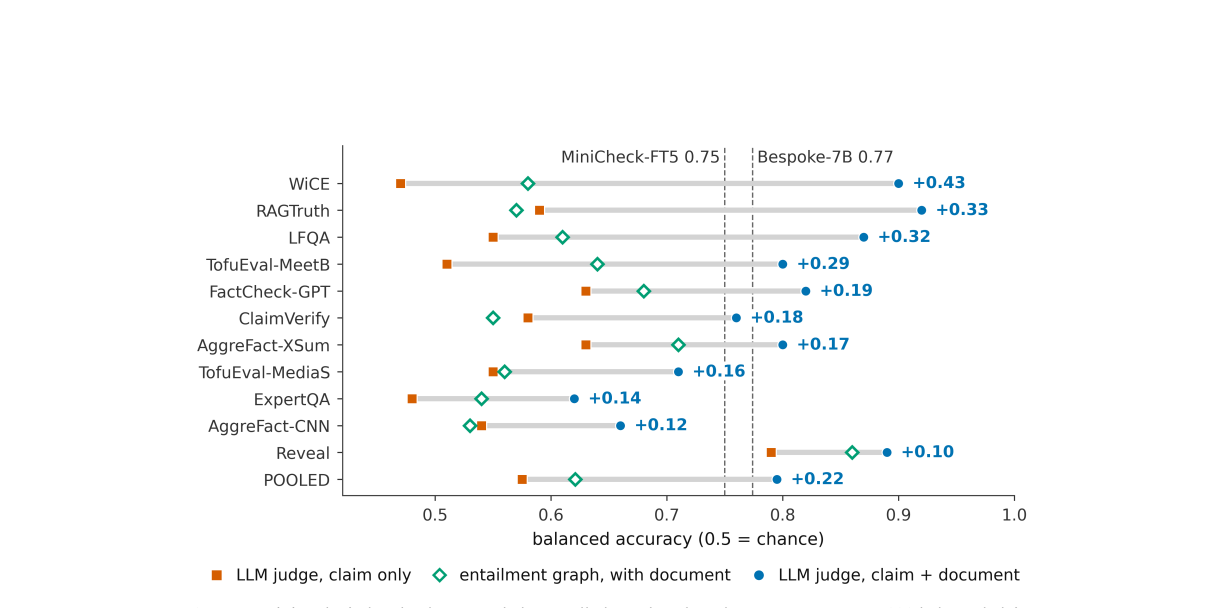
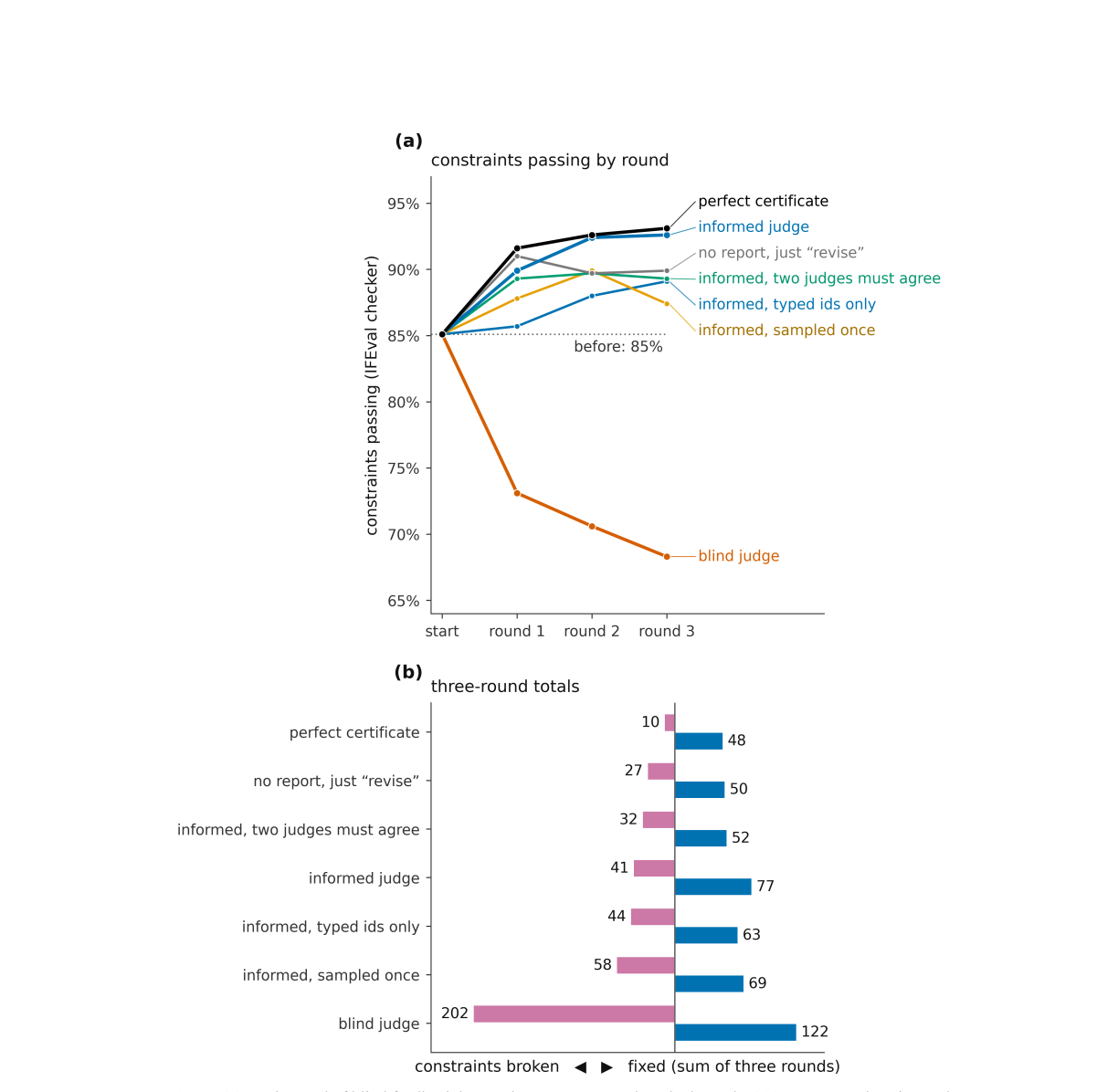
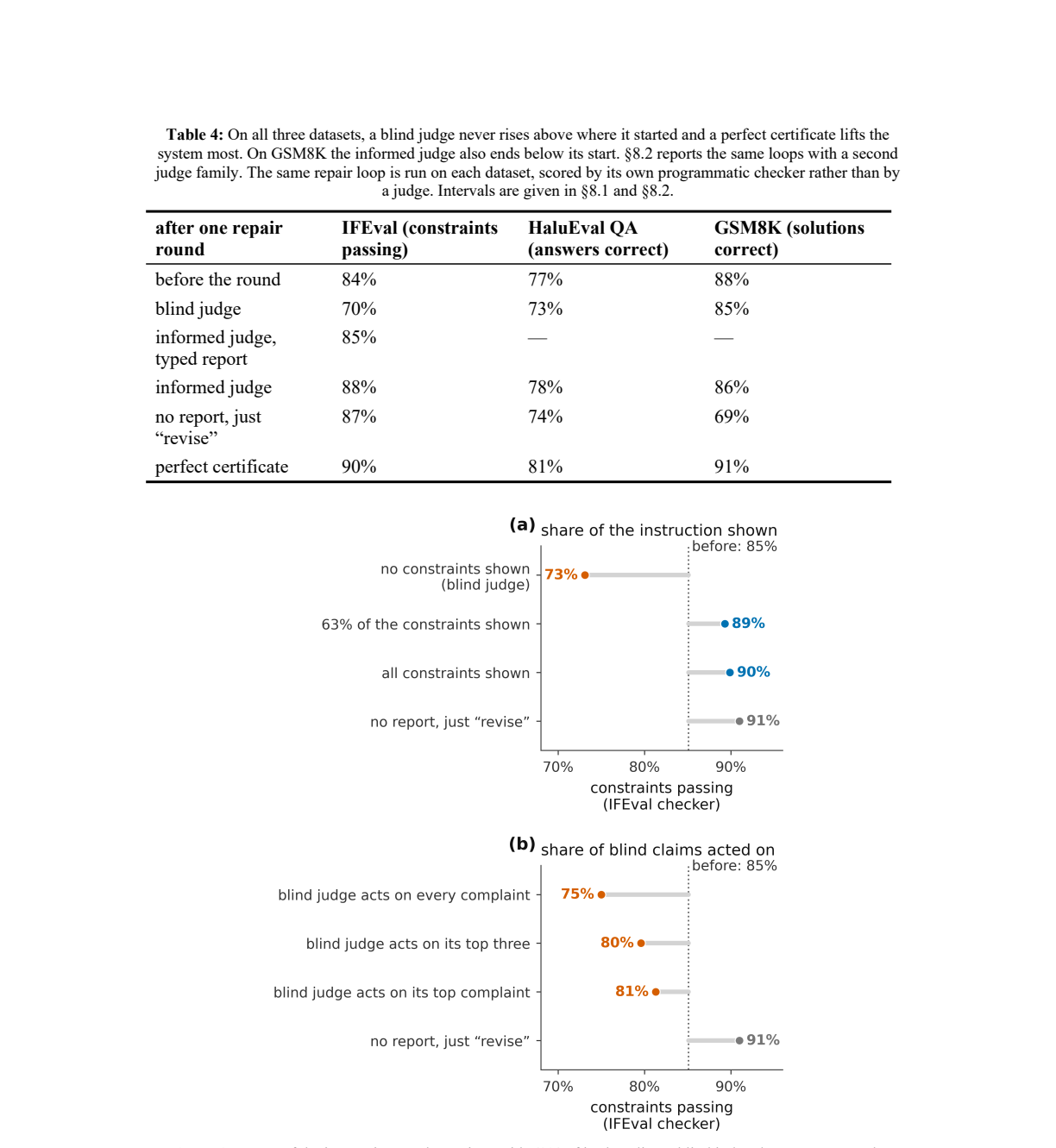
We treat a judge whose reports are acted on as a regulator, in the sense of cybernetics, and ask what it must be shown, how much, in what form, and what its reports must get right. On seven public benchmarks we varied only what the judge was shown. Across three judges whose prices differ 10- to 17-fold, what the judge was shown mattered more than which judge it was. When a system revised its answers on feedback from a judge denied the material they had to respect, it ended below its starting point on instruction following and question answering. On instruction following the loss grew with each round, and it persisted when the judge saw the user's request but not the constraints and with a second judge family. On news summarisation, a correct reference summary beside the source undid most of the source's contribution, whereas on single-answer questions a reference helped. About a tenth of the source did almost all of its work, and a small entailment graph matched an LLM judge at finding errors in grounded text. We committed 83 testable clauses before running; of the 81 that ran, 32 met their bar and 50 went in the predicted direction, and most quantitative predictions from the theory failed. We report every shortfall and derive design rules tied to measured effects.
from the abstract
Pith says
Machine review · deepseek-v4-flash · 14 Oct 2026 · what was read was not recorded · not checked by a person
It can be wrong. Challenge this review or reply to it.
Holds up. Solid empirical study on what an LLM judge must see, with a clear closed-loop safety finding. This line is wrong
3 major objections · 7 minor
How often objections from reviews like this one are right: not yet measured
Not checked: figures, code, what the 59 references say.
The paper says, at §3.6, §4
The review did not quote this passage.
Pith says: Objection 1 of 3 · major
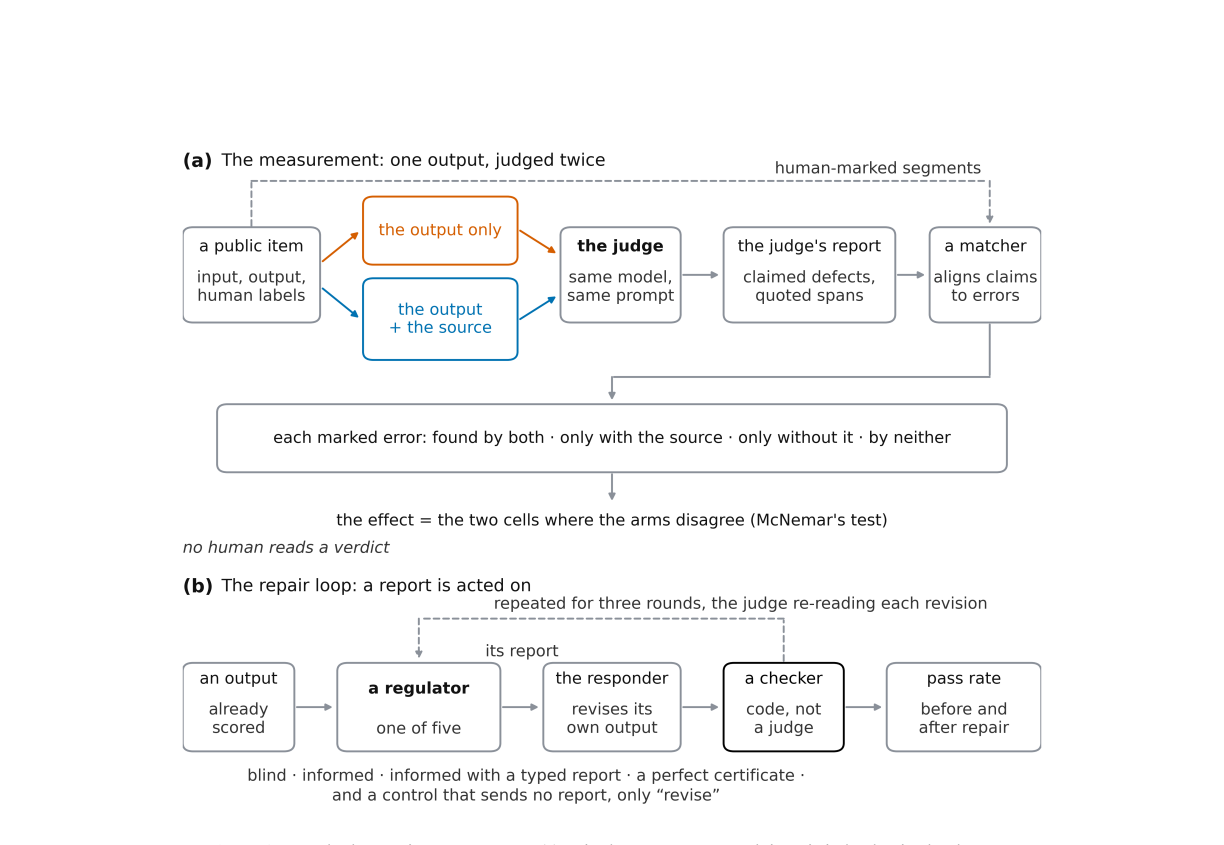
The RAGTruth span-level recall gains (e.g., the '40% more errors' claim, recall-by-error-type breakdowns, factorial decomposition) rely entirely on the generous matcher, which disagrees with the strict route in sign for the paired contrast (+0.263 vs -0.028). The authors provide a mechanical audit but no human has inspected any matcher decision.
more of objection 1
While the main claims of the paper are supported by matcher-free ladders and closed-loop results, the paper should state more explicitly in §4 that the span-level effect sizes on RAGTruth are contingent on the matcher choice and should be interpreted with caution, not just in §3.6 and §11.
The paper says, at §5
The review did not quote this passage.
Pith says: Objection 2 of 3 · major
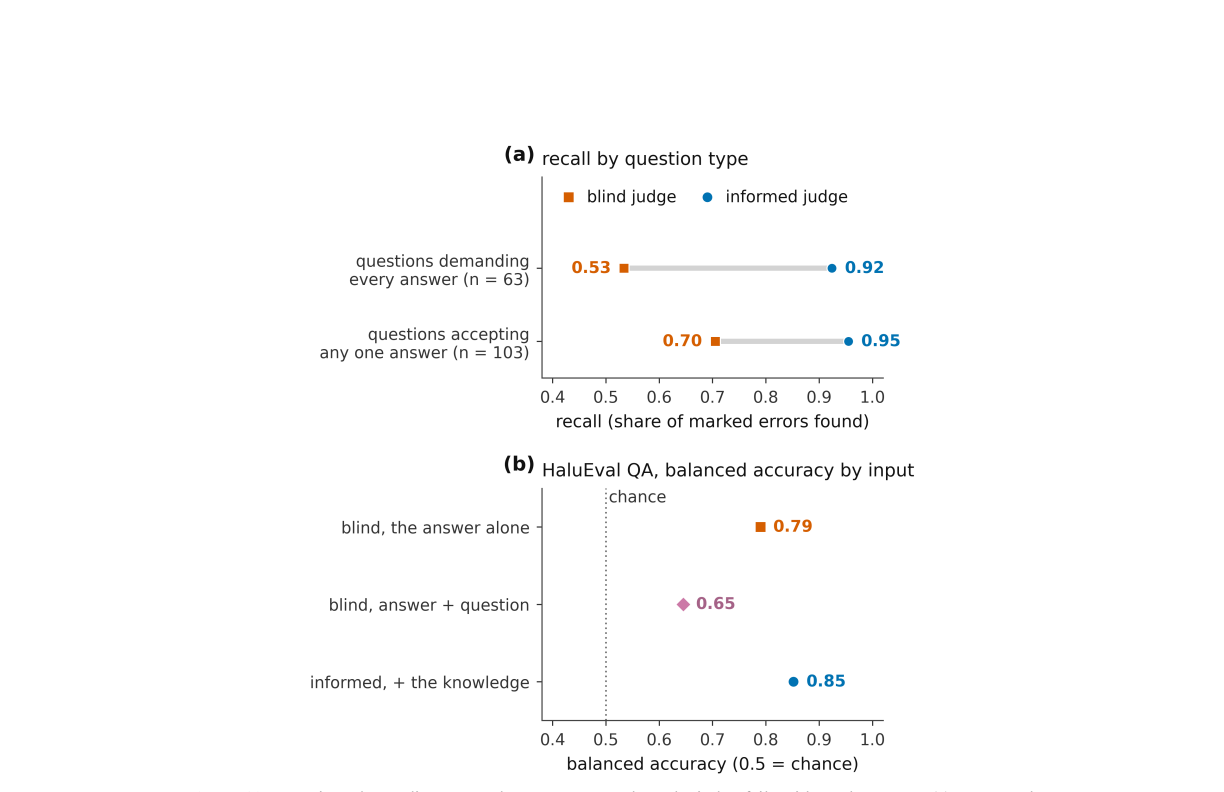
The reference-answer result on HaluEval QA (balanced accuracy 0.919 with reference vs 0.852 with knowledge) is presented as an important nuance showing that a reference helps on single-answer tasks, but it is based on one dataset and one judge, even if run three times. This should be explicitly noted as preliminary and requiring replication across more QA datasets and judges before it can be relied upon as a design rule.
The paper says, at §8.2
The review did not quote this passage.
Pith says: Objection 3 of 3 · major
The primary committed closed-loop results (P24, P25, P35) rely on a single feedback judge family (Gemini 2.5 Flash). The exploratory replication with Claude Haiku 4.5 keeps signs but is not a committed prediction. The paper should state more prominently in §8 that the quantitative evidence for the harm from blind feedback comes from one judge family and one set of responders, and that the exploratory replication supports but does not independently confirm the pattern.
7 minor objections
The paper says, at §4, Figure 8
Pith says: minor objection 1 of 7
The 49 annotation categories in Figure 8 are unlabeled. Provide a legend, a table linking category codes to names, or a note about the datasets to improve interpretability.
The paper says, at §3.6
Pith says: minor objection 2 of 7
The sentence 'No human reads a verdict in either design' (b255) could be misinterpreted as saying no human ever inspects outputs. Clarify that this refers to the scoring pipeline (no human reads the judge's verdict or the matched decisions), not the overall experimental process.
show 5 more
The paper says, at §3.8
Pith says: minor objection 3 of 7
The summary of committed clause outcomes currently appears only in §10.2. Move a brief summary (e.g., '32 of 81 running clauses met their bar, 50 went in the predicted direction') to §3.8 when describing the pre-commitment ledger, so that readers have context earlier.
The paper says, at §4, §5, Figure captions
Pith says: minor objection 4 of 7
The figure captions for Figures 4, 5, and 6 refer to 'generous route' and 'strict route' without recapping the definitions. Add a brief reminder (e.g., 'generous route: small LM decides match; strict route: quote-overlap only') in each relevant caption.
The paper says, at §3.6
Pith says: minor objection 5 of 7
The term 'matcher' is used both for the alignment component and for the decision process. Consider distinguishing 'matcher algorithm' from 'scoring protocol' to avoid confusion when discussing the two routes.
The paper says, at Throughout, e.g. §3.8, §4, §6
Pith says: minor objection 6 of 7
When referencing a committed prediction (P1, P14, etc.), include a one-line summary of the prediction bar in parentheses, because the full definitions are only in Appendix A. For example: 'P14(a) predicted the four-factor Shapley ordering on recall (source largest, then typed requirements, then question, instrument |φ_I| ≤ 0.05).'
The paper says, at §8.1, Table 4
Pith says: minor objection 7 of 7
The no-report control on IFEval gains +0.025 on the full 1,080-response set but +0.059 on the 300-response subset. Note this discrepancy and discuss possible causes (e.g., subset selection, sampling noise) in §8 or §11 to avoid reader confusion.
What would settle it
Randomly sample 200 RAGTruth response–marked-segment pairs where the generous and strict matchers disagree (100 from the blind arm, 100 from the informed arm). For each, have three expert annotators judge whether the LM judge's complaint actually identifies the marked error. Compare the human verdict to both matchers. If the generous matcher's agreement with humans on these disagreements is significantly lower than the strict matcher's (or vice versa), then the true paired recall gain may be closer to one route's estimate. The result would bound the asymmetry and tell readers which matcher to trust, directly addressing the paper's expressed inability to bound its size (b273).
from the skeptic's reading
How the review went
4 readings by deepseek-v4-flash · 14 Oct 2026
- Reader holds up
- Skeptic agrees
- Editor wrote the verdict above
- Referee minor revision: 3 major objections, 7 minor
Not run on this paper: the simulated authors' defence.
Pith did not check this review's objections against the paper.
The review in full
The review in brief, machine-written
This paper is worth your time. It systematically varies what an LLM judge is shown — output only, output plus source, plus reference, partial source — across seven benchmarks, and measures the effect. The central result that matters for practice is the closed-loop one: when a system revises its answers based on feedback from a judge that cannot see the material the answer had to respect, it ends up worse than where it started, and worse than a no-report control on instruction following. The loss compounds over rounds. That's a direct safety finding for anyone deploying self-improvement loops.
What the paper does well: the design is clean, the pre-commitments are thorough (83 clauses, 37 predictions), and every failure is reported honestly, including the theoretical predictions that didn't pan out. The matcher-free results (corpus-protocol on RAGTruth, labels on LLM-AggreFact, checker-scored closed loops) are independent of the contentious matcher. The authors scope their claims carefully and state limitations plainly.
The soft spot is the matcher. On RAGTruth the two routes to match a judge's complaint to a human-marked defect disagree in sign (+0.263 vs -0.028). The authors acknowledge this and provide a mechanical audit, but no human has inspected a single decision. This means the fine-grained recall-by-error-type numbers and the factorial decomposition (which depend on the matcher) carry that uncertainty. I also note that the committed closed-loop experiments used Gemini 2.5 Flash as the sole feedback judge; the replication with Claude Haiku 4.5 keeps the signs but was exploratory. Neither concern threatens the main conclusion, because the core paired deficit is supported by matcher-free ladders and the closed-loop harm replicates across a second judge family, but they do affect precision and generalizability claims.
Who is this for: anyone building or trusting LLM-based evaluation pipelines, especially those that close the loop. The design rules in Table 5 are actionable even if the Ashby framing is more organizational than predictive.
Recommendation: I would send this to peer review. The central claims are important and supported by multiple independent lines of evidence. The matcher uncertainty needs more transparent treatment — either a human audit or a stronger disclaimer on the numbers that depend on it. The paper deserves careful reading, not a desk reject.
The strongest objection
The paper's paired recall gain on RAGTruth (a central quantitative claim for RQ1's narrative that the judge finds 40% more errors when shown the source) depends entirely on the generous matcher — a small LM that decides whether a complaint points at a marked segment. Under the strict (quote-overlap) route the paired difference reverses to −0.028 (p=0.076). The authors acknowledge the asymmetry (b273) and provide a mechanical audit with a second LM matcher and a permuted control, but no human has inspected any decision. Because the two routes disagree in sign for the very contrast that motivates the 'what you show matters' claim on this corpus, and because the matcher is used for all RAGTruth span-level results in §4–§6 (recall by error type, per-category gains, factorial outcomes), the numeric strength of the RAGTruth evidence is uncertain. The core claim (blind vs informed difference) is independently supported by matcher-free results (corpus-protocol ladder, LLM-AggreFact), so the concern does not threaten the paper's main conclusion, but it does affect the precision with which the improvement is measured and the reliability of the more fine-grained analyses that depend on the matcher.
The reader's weakest_assumption listed matcher reliability as the second assumption, noting the sign reversal and lack of human audit. I agree that this is the most load-bearing concern among those identified, because it affects the quantitative interpretation of several results (paired recall gain, per-category gains, factorial analysis on RAGTruth) that the paper uses to support its narrative. However, the paper's central claim — that what the judge is shown binds harder than which judge it is — rests on matcher-free evidence (corpus-protocol ladder on RAGTruth and LLM-AggreFact balanced accuracy ladder) which is robust. The matcher-dependent results add nuance but are not the sole support for the main conclusion. Therefore the verdict should remain unchanged; the paper's own limitations section already acknowledges the uncertainty. The concrete test of human auditing would resolve this particular concern without altering the paper's overall assessment.
The referee's report
The paper makes a strong empirical case that the limiting factor in LLM-as-a-judge evaluation is the information provided to the judge, not the judge's capability. The closed-loop finding—that acting on feedback from a blind judge can cause harm that accumulates—has direct practical implications for any system that uses LLM judges for self-correction, prompt optimization, or agent loops. The paper also contributes design rules grounded in measurements, and it is unusually transparent about pre-commitments, failures of theoretical predictions, and limitations. If the results hold, the paper provides a necessary correction to the prevailing focus on judge capability rather than judge input. The multi-corpora design, matcher-free ladders, and checker-scored closed loops give the core claims robustness despite the matcher uncertainties on span-level RAGTruth analyses.
Pith's reading of the paper (a machine's summary, not the authors')
This paper establishes that the limiting factor in LLM-based evaluation is whether the evaluator has access to the material (the 'world') the output was supposed to respect, not which judge model is deployed. Across seven benchmarks and three judges spanning a 10- to 17-fold price range, what the judge was shown mattered more than which judge it was. A judge denied that material (a 'blind' judge) cannot detect defects whose evidence lies outside the output, and when its reports are acted on in a closed loop, the system ends up below its starting point on instruction following and question answering, and below a no-report control on instruction following. The paper derives four design rules for what a judge must be shown, how much, in what form, and what its reports must achieve to be safe and effective.
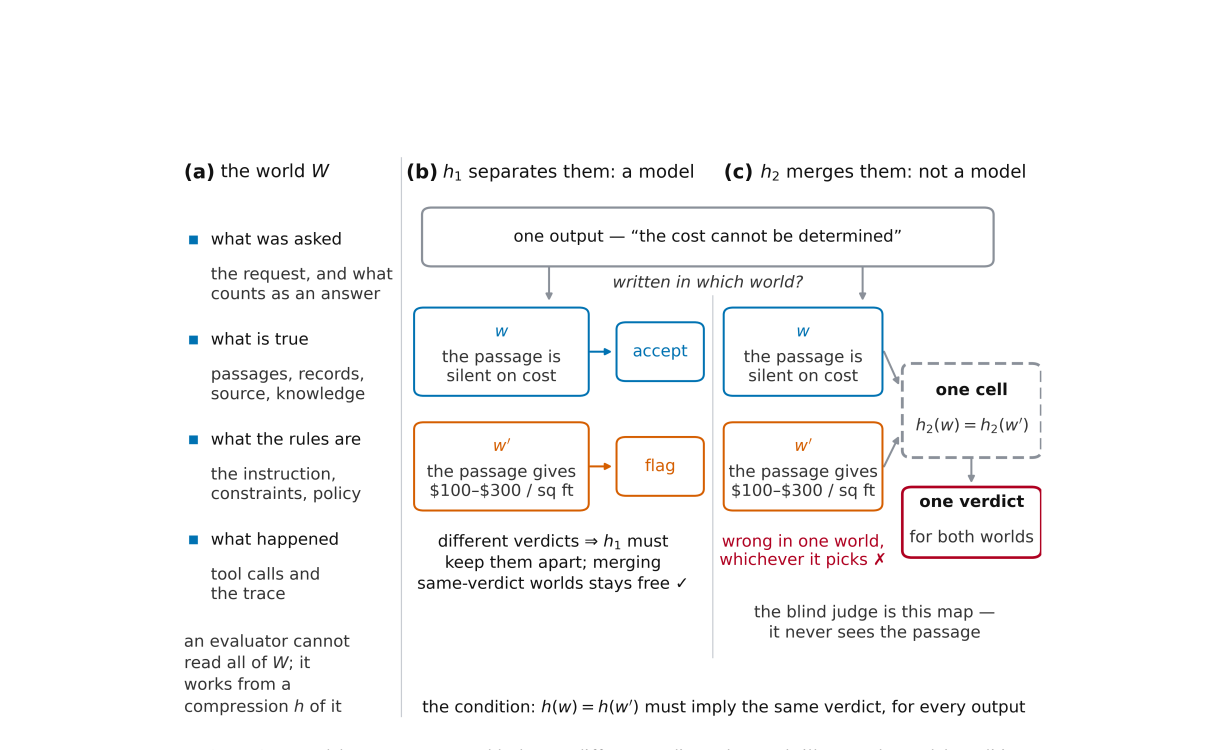
What carries the argument. Ashby's regulator framework, as formalized in the Conant-Ashby good regulator theorem and the law of requisite variety. The central distinction is between an error-controlled regulator (blind judge, shown only the output) and a cause-controlled regulator (informed judge, shown the world W: the material the output was supposed to respect). The paper operationalizes W as the variable manipulated across experiments, holding the judge fixed. The key identity is that a judge's ability to discriminate defects is bounded by what its input carries, a consequence of the data-processing inequality.
Core claim. The paper argues that an LLM judge functions as a regulator in Ashby's cybernetic sense: a judge shown only the output is error-controlled and cannot see defects whose evidence lies in the world that output was meant to respect. No matter how capable the judge, it cannot recover information its input channel does not carry. Across multiple benchmarks, the improvement from showing the judge the source material far exceeded the improvement from using a more capable judge (blind F1 0.217 vs. informed 0.476 for the best judge, under RAGTruth's protocol). In closed-loop experiments where the system revised based on the judge's feedback, a blind judge left the system below its starting point on instruction following and question answering, and below a no-report control on instruction following, with losses compounding over rounds. The paper measures what material must be shown, how much of it, in what form, and what the judge's reports must get right once a system acts on them.
The premise it rests on. The span-level results depend on a matcher (a small language model deciding whether a judge's complaint points at a marked segment) whose strict and generous versions disagree in sign on one dataset, and whose decisions no human has audited.
If the paper is right (Pith's inferences, not the authors')
Deployers must provide the evaluator with the system's own source material, not a reference answer, on open-ended tasks; a reference on summarisation removed 82% of the precision gain from the article.
Closed-loop evaluation with a blind judge can actively degrade system performance, and the harm compounds over multiple rounds of revision.
A judge's report precision matters more than recall for safe closed-loop operation; the most precise regulator (a certificate naming only actual defects) produced the largest net gains.
About a tenth of the source material (the sentences nearest each claim) does almost all the work, so routing claims to relevant evidence can reduce cost without sacrificing detection.
The same rules govern the generator: an agent's output quality depends primarily on the material it is given, with irrelevant material producing worse accuracy than no material at all.
Current practice of using LLM judges without providing system prompts, retrieved documents, or tool outputs appears systematically flawed; such blind judges are likely to produce misleading evaluation scores and harmful feedback loops in deployed systems.
The results imply a need for evaluation infrastructure that tracks what material a system uses and ensures evaluators have access to it; API-based evaluators that only see the final output are insufficient.
The per-item sufficiency sensor the paper calls for but does not build would be a high-value target: a dynamic measure of whether the judge's information is adequate for the verdict, enabling adaptive routing and safe automated revision.
The finding that a reference answer helps on single-answer tasks but harms on open-ended tasks suggests that evaluation pipelines must be task-aware rather than using a fixed judge configuration.
Check this review
Pith stored no record of this review's passes and took no fingerprint of it. Reviews made by code from 13 Nov 2026 on carry both.
How often reviews like this one are right
Reviews like this one: written by deepseek-v4-flash, where what was read was not recorded.
How often objections from reviews like this one are right: not yet measured
Reviews by people
This review was written by a machine. No person has reviewed this paper on Pith yet. A scientist listed on Pith can review it for a fee, and their review is published here whatever it concludes.
The paper
Abstract
Evaluation of text generated by large language models (LLMs) is increasingly delegated to LLMs acting as judges, yet what such a judge must be shown remains unresolved. We treat a judge whose reports are acted on as a regulator, in the sense of cybernetics, and ask what it must be shown, how much, in what form, and what its reports must get right. On seven public benchmarks we varied only what the judge was shown. Across three judges whose prices differ 10- to 17-fold, what the judge was shown mattered more than which judge it was. When a system revised its answers on feedback from a judge denied the material they had to respect, it ended below its starting point on instruction following and question answering. On instruction following the loss grew with each round, and it persisted when the judge saw the user's request but not the constraints and with a second judge family. On news summarisation, a correct reference summary beside the source undid most of the source's contribution, whereas on single-answer questions a reference helped. About a tenth of the source did almost all of its work, and a small entailment graph matched an LLM judge at finding errors in grounded text. We committed 83 testable clauses before running; of the 81 that ran, 32 met their bar and 50 went in the predicted direction, and most quantitative predictions from the theory failed. We report every shortfall and derive design rules tied to measured effects.
The paper's own sentences, arranged, kept beside the review and separate from it. Each label is drawn from a closed vocabulary; the number beside it is the probability the classifier gave that label. No sentence in this record was written by a model.
abstract compiled · 2026-10-14
The authors' main claim, as the classifier picked it out 1.00
“Across three judges whose prices differ 10- to 17-fold, what the judge was shown mattered more than which judge it was.”
How the main claim is stated: asserted 1.00
What the abstract itself states, as probabilities: claims first 0.05 · states limitation 0.92 · human participants 0.06 · controlled comparison 0.73 · randomized assignment 0.04 · states quantitative result 0.98 · compares with prior results 0.73 · mentions code or data availability 0.05
The abstract, sentence by sentence
This table labels the abstract only (arXiv listing abstract v1). The number is the probability the classifier gave the label.
| Sentence | Role | The authors' own work | States the main conclusion | Strength |
|---|---|---|---|---|
| Evaluation of text generated by large language models (LLMs) is increasingly delegated to LLMs acting as judges, yet what such a judge must be shown remains unresolved. | gap 0.81 | 0.07 | 0.05 | asserted 1.00 |
| We treat a judge whose reports are acted on as a regulator, in the sense of cybernetics, and ask what it must be shown, how much, in what form, and what its reports must get right. | contribution 0.84 | 0.58 | 0.08 | asserted 0.69 |
| On seven public benchmarks we varied only what the judge was shown. | method 0.95 | 0.96 | 0.04 | asserted 0.98 |
| Across three judges whose prices differ 10- to 17-fold, what the judge was shown mattered more than which judge it was. | result 1.00 | 0.95 | 0.48 | asserted 1.00 |
| When a system revised its answers on feedback from a judge denied the material they had to respect, it ended below its starting point on instruction following and question answering. | result 1.00 | 0.93 | 0.13 | asserted 1.00 |
| On instruction following the loss grew with each round, and it persisted when the judge saw the user's request but not the constraints and with a second judge family. | result 1.00 | 0.94 | 0.09 | asserted 1.00 |
| On news summarisation, a correct reference summary beside the source undid most of the source's contribution, whereas on single-answer questions a reference helped. | result 1.00 | 0.94 | 0.07 | asserted 1.00 |
| About a tenth of the source did almost all of its work, and a small entailment graph matched an LLM judge at finding errors in grounded text. | result 1.00 | 0.90 | 0.08 | asserted 0.99 |
| We committed 83 testable clauses before running; of the 81 that ran, 32 met their bar and 50 went in the predicted direction, and most quantitative predictions from the theory failed. | result 0.76 | 0.97 | 0.13 | asserted 1.00 |
| We report every shortfall and derive design rules tied to measured effects. | contribution 0.83 | 0.96 | 0.11 | asserted 0.98 |
What kind of paper the classifier reports this is: empirical study 1.00 · evidence from observation or experiment 1.00
What was examined, and what was not
Sources read
- arXiv listing abstract v1
Not examined
- full text
- figures and tables
- references and citing sentences
- relations to other papers
Levels run
- P abstract
Not run
- S sections
- T body sentences
- C citations
- R cross-paper relations
How the labels were made
Compiled by classifier-1.13.0 via TypeSafe API, question bank abstract-p1-20260923, 2026-10-14: 1 request, 7,595 input tokens.
Every quoted sentence on this record is the authors'. Every label is from Pith's closed vocabulary, with the probability shown beside it. This record as JSON
Figures (19)









Figures are the authors', reproduced from the paper.
References (59)
- [1] Thompson, B., Dhaliwal, M. P., Frisch, P., Domhan, T., & Federico, M. (2024). A shocking amount of the web is machine translated: Insights from multi-way parallelism. Findings of ACL 2024. arXiv:2401.05749 on PithPith's reviewarXiv
- [2] Liang, W., Zhang, Y., Wu, Z., Lepp, H., Ji, W., Zhao, X., Cao, H., Liu, S., He, S., Huang, Z., Yang, D., Potts, C., Manning, C. D., & Zou, J. Y. (2024). Mapping the increasing use of LLMs in scientific papers. COLM 2024. arXiv:2404.01268 on PithPith's reviewarXiv
- [3] Zheng, L., Chiang, W.-L., Sheng, Y., Zhuang, S., Wu, Z., Zhuang, Y., Lin, Z., Li, Z., Li, D., Xing, E. P., Zhang, H., Gonzalez, J. E., & Stoica, I. (2023). Judging LLM-as-a-judge with MT-Bench and Chatbot Arena. NeurIPS 2023 Datasets and Benchmarks Track. arXiv:2306.05685 on PithPith's reviewarXiv
- [4] Dubois, Y., Galambosi, B., Liang, P., & Hashimoto, T. B. (2024). Length-controlled AlpacaEval: A simple way to debias automatic evaluators. COLM 2024. arXiv:2404.04475 on PithPith's reviewarXiv
- [5] Li, T., Chiang, W.-L., Frick, E., Dunlap, L., Wu, T., Zhu, B., Gonzalez, J. E., & Stoica, I. (2024). From crowdsourced data to high-quality benchmarks: Arena-Hard and BenchBuilder pipeline. arXiv:2406.11939 on PithPith's reviewarXiv
- [6] Kim, S., Suk, J., Longpre, S., Lin, B. Y., Shin, J., Welleck, S., Neubig, G., Lee, M., Lee, K., & Seo, M. (2024). Prometheus 2: An open source language model specialized in evaluating other language models. EMNLP 2024. arXiv:2405.01535 on PithPith's reviewarXiv
- [7] Laban, P., Schnabel, T., Bennett, P. N., & Hearst, M. A. (2022). SummaC: Re-visiting NLI- based models for inconsistency detection in summarization. Transactions of the ACL, 10, 163–177. doi:10.1162/tacl_a_00453. arXiv:2111.09525 on PithPith's reviewarXiv
- [8] Tang, L., Laban, P., & Durrett, G. (2024). MiniCheck: Efficient fact-checking of LLMs on grounding documents. EMNLP 2024, 8818–8847. doi:10.18653/v1/2024.emnlp-main.499. arXiv:2404.10774 on PithPith's reviewarXiv
- [9] Es, S., James, J., Espinosa-Anke, L., & Schockaert, S. (2024). Ragas: Automated evaluation of retrieval augmented generation. EACL 2024, System Demonstrations. arXiv:2309.15217 on PithPith's reviewarXiv
- [10] Saad-Falcon, J., Khattab, O., Potts, C., & Zaharia, M. (2024). ARES: An automated evaluation framework for retrieval-augmented generation systems. NAACL 2024. arXiv:2311.09476 on PithPith's reviewarXiv
- [11] Zhuge, M., Zhao, C., Ashley, D., Wang, W., Khizbullin, D., Xiong, Y., Liu, Z., Chang, E., Krishnamoorthi, R., Tian, Y., Shi, Y., Chandra, V., & Schmidhuber, J. (2024). Agent-as-a- Judge: Evaluate agents with agents. arXiv:2410.10934 on PithPith's reviewarXiv
- [12] Yao, S., Shinn, N., Razavi, P., & Narasimhan, K. (2024). τ-bench: A benchmark for tool- agent-user interaction in real-world domains. arXiv:2406.12045 on PithPith's reviewarXiv
- [13] Yehudai, A., Eden, L., Li, A., Uziel, G., Zhao, Y., Bar-Haim, R., Cohan, A., & Shmueli- Scheuer, M. (2025). Survey on evaluation of LLM-based agents. Findings of ACL 2025. arXiv:2503.16416 on PithPith's reviewarXiv
- [14] Xu, A., Bansal, S., Ming, Y., Yavuz, S., & Joty, S. (2025). Does context matter? ContextualJudgeBench for evaluating LLM-based judges in contextual settings. ACL 2025, 9541–9564. doi:10.18653/v1/2025.acl-long.470. arXiv:2503.15620 on PithPith's reviewarXiv
- [15] Madaan, A., Tandon, N., Gupta, P., Hallinan, S., Gao, L., Wiegreffe, S., Alon, U., Dziri, N., Prabhumoye, S., Yang, Y., Gupta, S., Majumder, B. P., Hermann, K., Welleck, S., Yazdanbakhsh, A., & Clark, P. (2023). Self-Refine: Iterative refinement with self-feedback. NeurIPS 202... on PithPith's reviewarXiv
- [16] Shinn, N., Cassano, F., Berman, E., Gopinath, A., Narasimhan, K., & Yao, S. (2023). Reflexion: Language agents with verbal reinforcement learning. NeurIPS 2023. arXiv:2303.11366 on PithPith's reviewarXiv
- [17] Pryzant, R., Iter, D., Li, J., Lee, Y. T., Zhu, C., & Zeng, M. (2023). Automatic prompt optimization with “gradient descent” and beam search. EMNLP 2023. arXiv:2305.03495. 42 on PithPith's reviewarXiv
- [18] Yuksekgonul, M., Bianchi, F., Boen, J., Liu, S., Lu, P., Huang, Z., Guestrin, C., & Zou, J. (2025). Optimizing generative AI by backpropagating language model feedback. Nature, 639, 609–616. doi:10.1038/s41586-025-08661-4. arXiv:2406.07496 on PithPith's reviewarXiv
- [19] Huang, J., Chen, X., Mishra, S., Zheng, H. S., Yu, A. W., Song, X., & Zhou, D. (2024). Large language models cannot self-correct reasoning yet. ICLR 2024. arXiv:2310.01798 on PithPith's reviewarXiv
- [20] Kamoi, R., Zhang, Y., Zhang, N., Han, J., & Zhang, R. (2024). When can LLMs actually correct their own mistakes? A critical survey of self-correction of LLMs. Transactions of the ACL, 12, 1417–1440. doi:10.1162/tacl_a_00713. arXiv:2406.01297 on PithPith's reviewarXiv
show 39 more
- [21] Stechly, K., Valmeekam, K., & Kambhampati, S. (2024). On the self-verification limitations of large language models on reasoning and planning tasks. arXiv:2402.08115 on PithPith's reviewarXiv
- [22] Gao, L., Schulman, J., & Hilton, J. (2023). Scaling laws for reward model overoptimization. ICML 2023. arXiv:2210.10760 on PithPith's reviewarXiv
- [23] Wen, J., Zhong, R., Khan, A., Perez, E., Steinhardt, J., Huang, M., Bowman, S. R., He, H., & Feng, S. (2025). Language models learn to mislead humans via RLHF. ICLR 2025. arXiv:2409.12822 on PithPith's reviewarXiv
- [24] Pan, A., Jones, E., Jagadeesan, M., & Steinhardt, J. (2024). Feedback loops with language models drive in-context reward hacking. ICML 2024. arXiv:2402.06627 on PithPith's reviewarXiv
- [25] Niu, C., Wu, Y., Zhu, J., Xu, S., Shum, K., Zhong, R., Song, J., & Zhang, T. (2024). RAGTruth: A hallucination corpus for developing trustworthy retrieval-augmented language models. ACL 2024. doi:10.18653/v1/2024.acl-long.585. arXiv:2401.00396 on PithPith's reviewarXiv
- [26] Ashby, W. R. (1956). An Introduction to Cybernetics. London: Chapman & Hall on Pith
- [27] Conant, R. C., & Ashby, W. R. (1970). Every good regulator of a system must be a model of that system. International Journal of Systems Science, 1(2), 89–97. doi:10.1080/00207727008920220 on Pithdoi:10.1080/00207727008920220
- [28] Cover, T. M., & Thomas, J. A. (2006). Elements of Information Theory (2nd ed.). Wiley. doi:10.1002/047174882X on Pithdoi:10.1002/047174882x
- [29] Liu, Y., Iter, D., Xu, Y., Wang, S., Xu, R., & Zhu, C. (2023). G-Eval: NLG evaluation using GPT-4 with better human alignment. EMNLP 2023. doi:10.18653/v1/2023.emnlp-main.153. arXiv:2303.16634 on PithPith's reviewarXiv
- [30] Shannon, C. E. (1948). A mathematical theory of communication. Bell System Technical Journal, 27, 379–423, 623–656. doi:10.1002/j.1538-7305.1948.tb01338.x on Pithdoi:10.1002/j.1538-7305.1948.tb01338.x
- [31] Richens, J., Abel, D., Bellot, A., & Everitt, T. (2025). General agents contain world models. ICML 2025. arXiv:2506.01622 on PitharXiv
- [32] Alicea, B., Hough, M., Nelson, A., & Parent, J. (2025). A “good” regulator may provide a world model for intelligent systems. arXiv:2506.23032 on PitharXiv
- [33] Virgo, N., Biehl, M., Baltieri, M., & Capucci, M. (2025). A “good regulator theorem” for embodied agents. arXiv:2508.06326 on PithPith's reviewarXiv
- [34] Li, D., Jiang, B., Huang, L., Beigi, A., Zhao, C., Tan, Z., Bhattacharjee, A., Jiang, Y., Chen, C., Wu, T., Shu, K., Cheng, L., & Liu, H. (2025). From generation to judgment: Opportunities and challenges of LLM-as-a-judge. EMNLP 2025. arXiv:2411.16594 on PitharXiv
- [35] Norman, J. D., Rivera, M. U., & Hughes, D. A. (2026). Reliability without validity: A systematic, large-scale evaluation of LLM-as-a-judge models across agreement, consistency, and bias. arXiv:2606.19544 on PithPith's reviewarXiv
- [36] Zhao, J., Bhattacharjee, H., Korevaar, H., Radharapu, B., & El-Arini, K. (2026). Jagged judges: Epistemic stability under perturbation, pressure, and persistence. arXiv:2608.12645 on PithPith's reviewarXiv
- [37] Alloula, A., Licini, F., Batchkala, A., & Goldfarb-Tarrant, S. (2026). Safety is contextual, LLM-judges are not: Navigating the rigid priors of evaluators. arXiv:2606.07874 on PithPith's reviewarXiv
- [38] Kryściński, W., McCann, B., Xiong, C., & Socher, R. (2020). Evaluating the factual consistency of abstractive text summarization. EMNLP 2020. doi:10.18653/v1/2020.emnlp- main.750. arXiv:1910.12840. 43 on PithPith's reviewarXiv
- [39] Zha, Y., Yang, Y., Li, R., & Hu, Z. (2023). AlignScore: Evaluating factual consistency with a unified alignment function. ACL 2023. doi:10.18653/v1/2023.acl-long.634. arXiv:2305.16739 on PithPith's reviewarXiv
- [40] Khan, A., Hughes, J., Valentine, D., Ruis, L., Sachan, K., Radhakrishnan, A., Grefenstette, E., Bowman, S. R., Rocktäschel, T., & Perez, E. (2024). Debating with more persuasive LLMs leads to more truthful answers. arXiv:2402.06782 on PithPith's reviewarXiv
- [41] Kenton, Z., Siegel, N. Y., Kramár, J., Brown-Cohen, J., Albanie, S., Bulian, J., Agarwal, R., Lindner, D., Tang, Y., Goodman, N. D., & Shah, R. (2024). On scalable oversight with weak LLMs judging strong LLMs. arXiv:2407.04622 on PithPith's reviewarXiv
- [42] Janssen, J. (2026). From runtime records to legal findings: An evidentiary-adequacy criterion for agentic AI oversight. arXiv:2607.00941 on PithPith's reviewarXiv
- [43] Honovich, O., Aharoni, R., Herzig, J., Taitelbaum, H., Kukliansky, D., Cohen, V., Scialom, T., Szpektor, I., Hassidim, A., & Matias, Y. (2022). TRUE: Re-evaluating factual consistency evaluation. NAACL 2022, 3905–3920. doi:10.18653/v1/2022.naacl-main.287. arXiv:2204.04991 on PithPith's reviewarXiv
- [44] Freitag, M., Foster, G., Grangier, D., Ratnakar, V., Tan, Q., & Macherey, W. (2021). Experts, errors, and context: A large-scale study of human evaluation for machine translation. Transactions of the ACL, 9, 1460–1474. doi:10.1162/tacl_a_00437. arXiv:2104.14478 on PithPith's reviewarXiv
- [45] Pagnoni, A., Balachandran, V., & Tsvetkov, Y. (2021). Understanding factuality in abstractive summarization with FRANK: A benchmark for factuality metrics. NAACL-HLT 2021, 4812–4829. doi:10.18653/v1/2021.naacl-main.383. arXiv:2104.13346 on PithPith's reviewarXiv
- [46] Zhou, J., Lu, T., Mishra, S., Brahma, S., Basu, S., Luan, Y., Zhou, D., & Hou, L. (2023). Instruction-following evaluation for large language models. arXiv:2311.07911 on PithPith's reviewarXiv
- [47] Li, J., Cheng, X., Zhao, W. X., Nie, J.-Y., & Wen, J.-R. (2023). HaluEval: A large-scale hallucination evaluation benchmark for large language models. EMNLP 2023. doi:10.18653/v1/2023.emnlp-main.397. arXiv:2305.11747 on PithPith's reviewarXiv
- [48] Cobbe, K., Kosaraju, V., Bavarian, M., Chen, M., Jun, H., Kaiser, L., Plappert, M., Tworek, J., Hilton, J., Nakano, R., Hesse, C., & Schulman, J. (2021). Training verifiers to solve math word problems. arXiv:2110.14168 on PithPith's reviewarXiv
- [49] He, P., Gao, J., & Chen, W. (2023). DeBERTaV3: Improving DeBERTa using ELECTRA- style pre-training with gradient-disentangled embedding sharing. ICLR 2023. arXiv:2111.09543 on PithPith's reviewarXiv
- [50] Laurer, M., van Atteveldt, W., Casas, A., & Welbers, K. (2024). Less annotating, more classifying: Addressing the data scarcity issue of supervised machine learning with deep transfer learning and BERT-NLI. Political Analysis, 32(1), 84–100. doi:10.1017/pan.2023.20 on Pithdoi:10.1017/pan.2023.20
- [51] McNemar, Q. (1947). Note on the sampling error of the difference between correlated proportions or percentages. Psychometrika, 12, 153–157. doi:10.1007/BF02295996 on Pithdoi:10.1007/bf02295996
- [52] Wilson, E. B. (1927). Probable inference, the law of succession, and statistical inference. Journal of the American Statistical Association, 22, 209–212. doi:10.1080/01621459.1927.10502953 on Pithdoi:10.1080/01621459.1927.10502953
- [53] Groenendijk, J., & Stokhof, M. (1984). Studies on the Semantics of Questions and the Pragmatics of Answers. PhD thesis, University of Amsterdam on Pith
- [54] Shapley, L. S. (1953). A value for n-person games. In H. W. Kuhn & A. W. Tucker (Eds.), Contributions to the Theory of Games, Vol. II (Annals of Mathematics Studies 28), 307– on Pith
- [55] Dalvi, B., Jansen, P., Tafjord, O., Xie, Z., Smith, H., Pipatanangkura, L., & Clark, P. (2021). Explaining answers with entailment trees. EMNLP 2021. doi:10.18653/v1/2021.emnlp- main.585. arXiv:2104.08661. 44 on PithPith's reviewarXiv
- [56] Berant, J., Dagan, I., & Goldberger, J. (2011). Global learning of typed entailment rules. ACL 2011, 610–619. ACL Anthology P11-1062 on Pith
- [57] Ashby, W. R. (1960). Design for a Brain: The Origin of Adaptive Behaviour (2nd ed.). London: Chapman & Hall. 45 Appendix A Every committed prediction Prediction commits by round (short hash, date): 1: 9dad951, 2026-08-28; 2: cfc8009, 2026-08-29; 3: aa484d1, 2026-08-29; 4: ad59... on Pith
- [59] Full hashes and the SHA-256 of the ledger at each commit are available from the authors on request. These commits were made in the authors’ private repository and had not been pushed to any remote when this version was prepared; no third-party timestamp exists for them. Table ... on Pith
- [317] Princeton University Press. doi:10.1515/9781400881970-018 on Pithdoi:10.1515/9781400881970-018
Challenges and discussion
Disagree with the review, or know something it missed? Leave a comment, or challenge this review formally: a challenge becomes a permanent entry in this paper's record, and its decision is published here.
Come back by email
A short list of the week's newly reviewed papers. Nothing is sent until you confirm from your inbox, and every email has a link that stops it. No account.
No comments yet.
Sign in to comment