Computer Vision and Pattern Recognition · arXiv:2611.01860 v1 · submitted 1 Nov 2026 · 291 references
Advances in Agentic Computer Graphics
The paper says
“Computer graphics is built on code. Large language model (LLM) agents can now generate graphics code and iteratively refine it through various feedback.”
more of the abstract
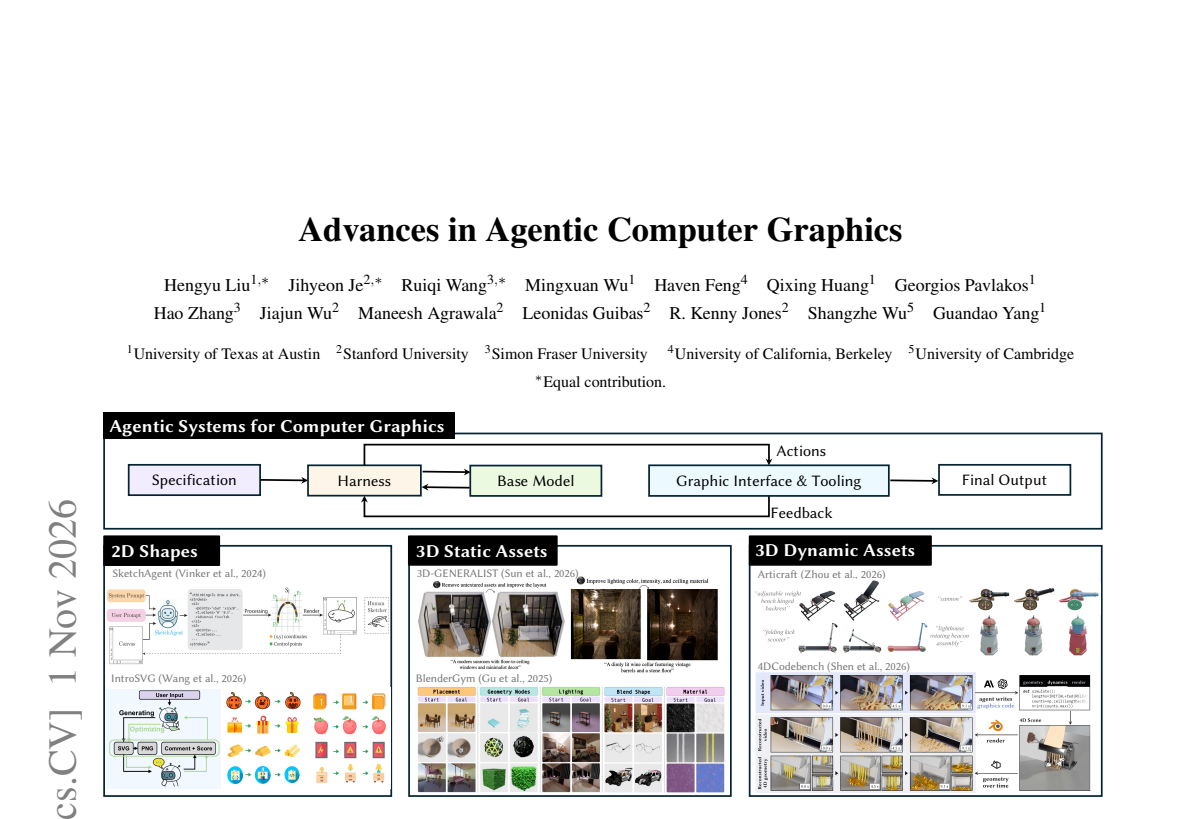
This capability opens the door to a potentially new paradigm of computer graphics, with graphics algorithms increasingly built around agentic systems to automate progressively complex tasks. Over the past years, research on agentic graphics has expanded rapidly across a diverse range of tasks. This rapid growth makes it increasingly difficult for manual literature reviews to keep pace with new developments. At the same time, similar ideas are often described using different terminology across these tasks, further complicating efforts to develop a systematic understanding of the field. In this report, we address these challenges through two contributions. First, we introduce a unified taxonomy for characterizing agentic systems across diverse computer graphics tasks. Second, we develop an agentic literature system that can assist human researchers in analyzing existing and newly published papers at scale. Building on these contributions, we analyze emerging research trends and discuss open challenges in coordinating agents and tools across graphics tasks, designing interfaces and representations for human-agent collaboration, sustaining long-horizon planning and refinement, and reliably evaluating interactive graphics systems.
from the abstract
Pith says
Machine review · deepseek-v4-flash · 4 Nov 2026 · what was read was not recorded · not checked by a person
It can be wrong. Challenge this review or reply to it.
The passes disagreed. Reader: holds up. Skeptic: holds up only with conditions. Referee: major revision.
A well-organized taxonomy for agentic graphics, but the trend analysis relies on unverified automatic labels and should be treated as suggestive, not conclusive. This line is wrong
3 major objections · 6 minor
How often objections from reviews like this one are right: not yet measured
Not checked: figures, code, what the 291 references say.
The paper says, at Sec. 4.2.2, Fig. 5
The review did not quote this passage.
A classifier read this sentence of the paper as acknowledging the concern (probability 0.77):
“We note that while these checks identify missing or inconsistent entries, they do not verify the correctness of the classifications.”
Pith says: Objection 1 of 3 · major
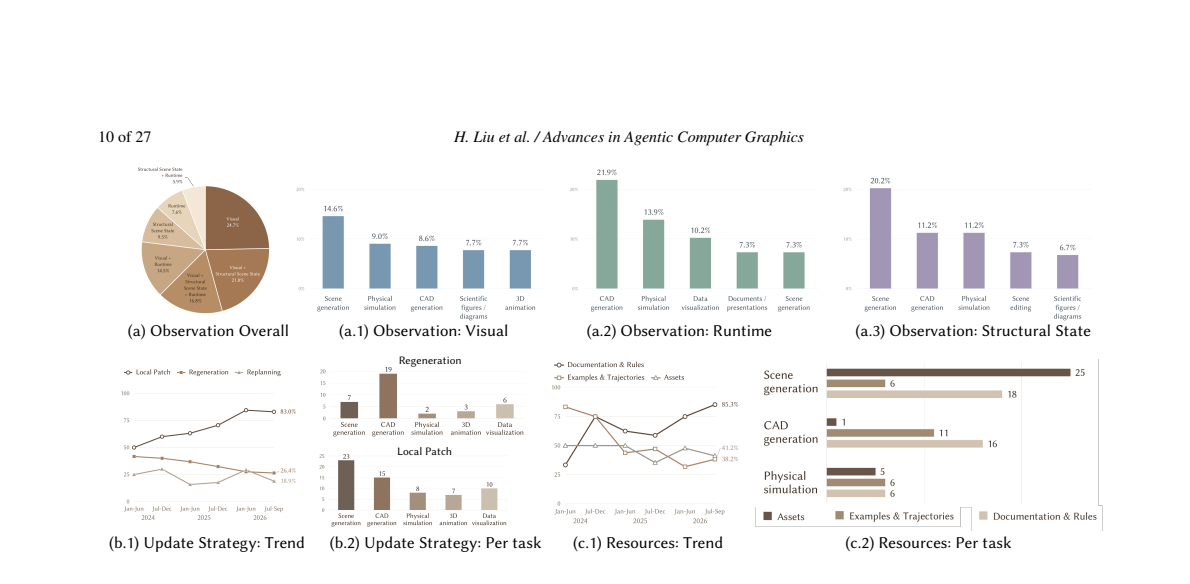
The quantitative trend analyses (e.g., 'local patching rising from 50.0% to 83.0%') are derived entirely from taxonomy labels assigned by the automated literature survey system. The paper explicitly states that curation checks 'do not verify the correctness of the classifications' (sentence b238).
more of objection 1
Manual verification was limited to paper relevance (Sec. 4.2.1), not to taxonomy labels. Without any validation of label accuracy (e.g., human inter-annotator agreement, per-category precision/recall), the reported percentages may reflect classification noise rather than genuine trends. This is a load-bearing issue because the trend analysis is a central empirical contribution of the paper. The authors should either (a) provide a validation study on a representative sample, or (b) clearly reframe these figures as exploratory and remove the quantitative precision (e.g., replace exact percentages with qualitative ranges).
The paper says, at Sec. 3, overall taxonomy
The review did not quote this passage.
Pith says: Objection 2 of 3 · major
The taxonomy is treated as a complete design space covering all agentic graphics systems. While the paper notes in Sec. 10 that categories can be expanded, the analysis in Sec. 4.2.2 relies on the current fixed set of dimensions and options.
more of objection 2
The paper would benefit from a more explicit discussion of potential blind spots—e.g., whether the four dimensions adequately capture systems that involve mixed-initiative human–agent collaboration or that use non-LLM decision-making components alongside LLMs. This could be addressed by adding a limitations paragraph to Sec. 3.
The paper says, at Sec. 4.1
The review did not quote this passage.
Pith says: Objection 3 of 3 · major
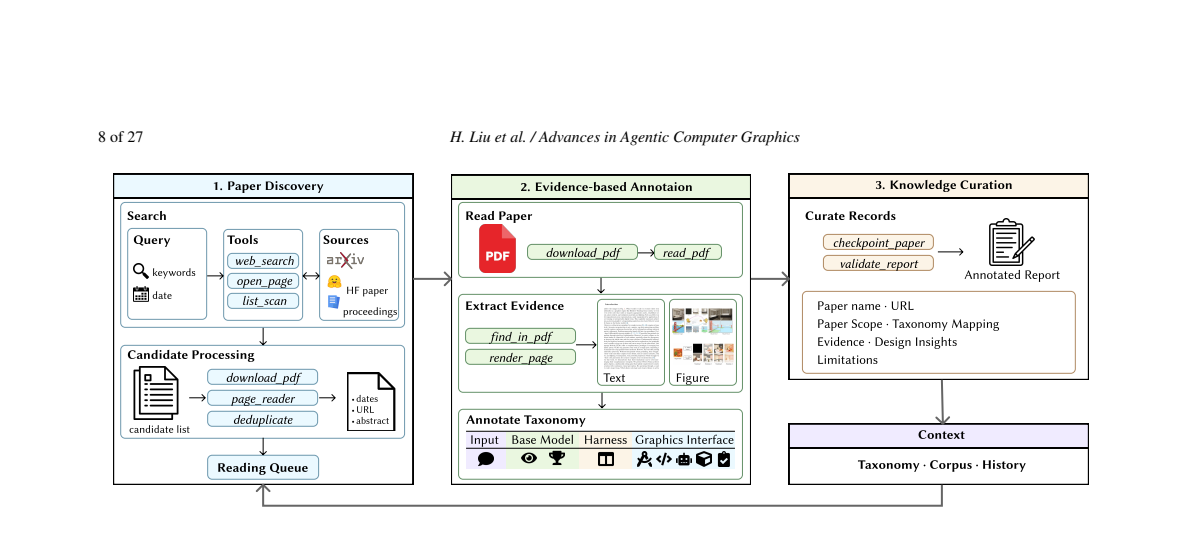
The agentic literature survey system is described at a high level, but key details needed for reproducibility are omitted: the exact prompt template for taxonomy annotation, the model configuration (e.g., temperature, number of reasoning steps), the tools used for paper reading and evidence extraction, and the criteria for the 'insufficient supporting evidence' flag.
more of objection 3
The paper states that the system will be released publicly, but until then the annotation process is not verifiable. The authors should provide a more detailed technical appendix or release the system as part of the supplementary material.
6 minor objections
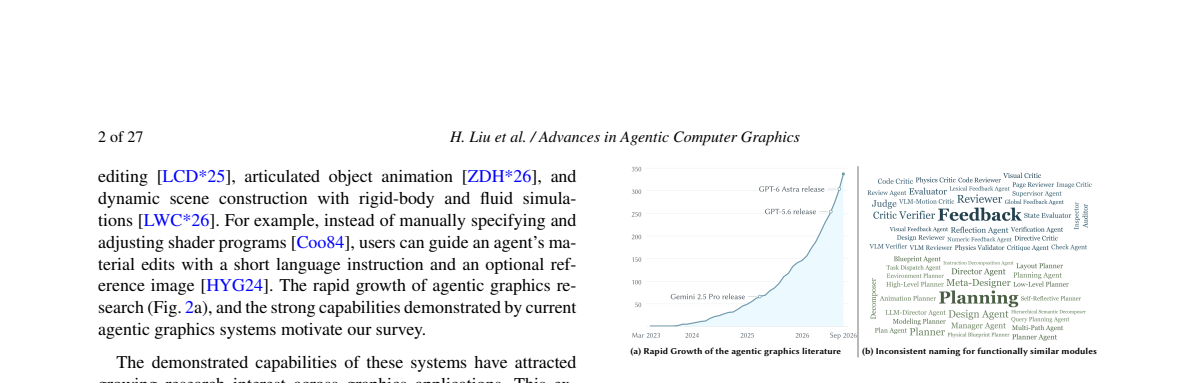
The paper says, at Sec. 2, Fig. 2b
Pith says: minor objection 1 of 6
The font in Fig. 2b is very small; consider enlarging it or using a legend that lists the terms in a table for readability.
The paper says, at Sec. 3.4.1
Pith says: minor objection 2 of 6
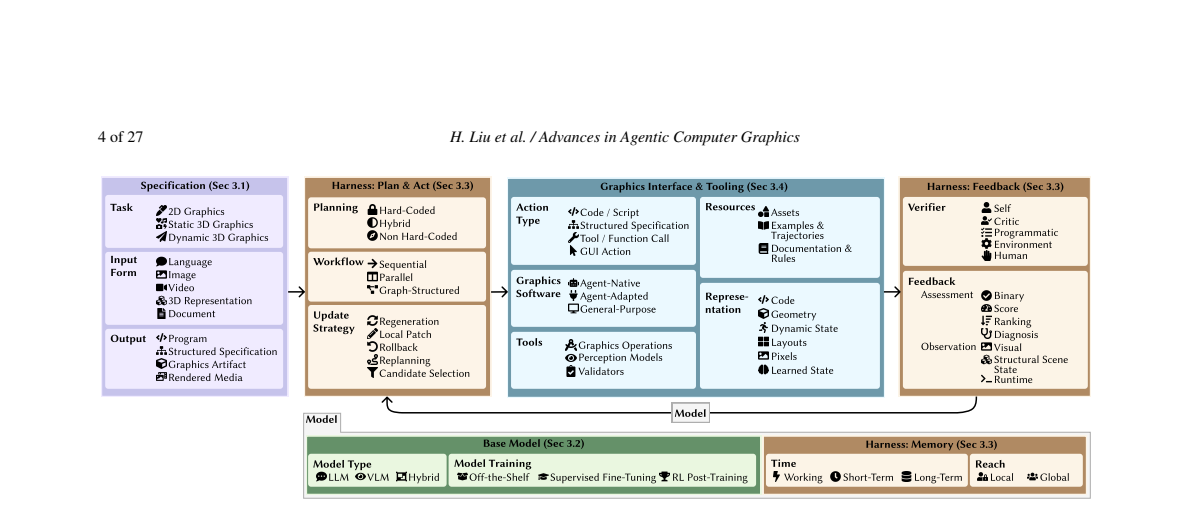
The sentence 'These types differ in how much of an operation the agent must specify and how much is handled by the execution environment' is a helpful summary, but it could be made more precise by adding a short example contrasting code/script vs. tool/function call.
show 4 more
The paper says, at Tables 2, 3, 4
Pith says: minor objection 3 of 6
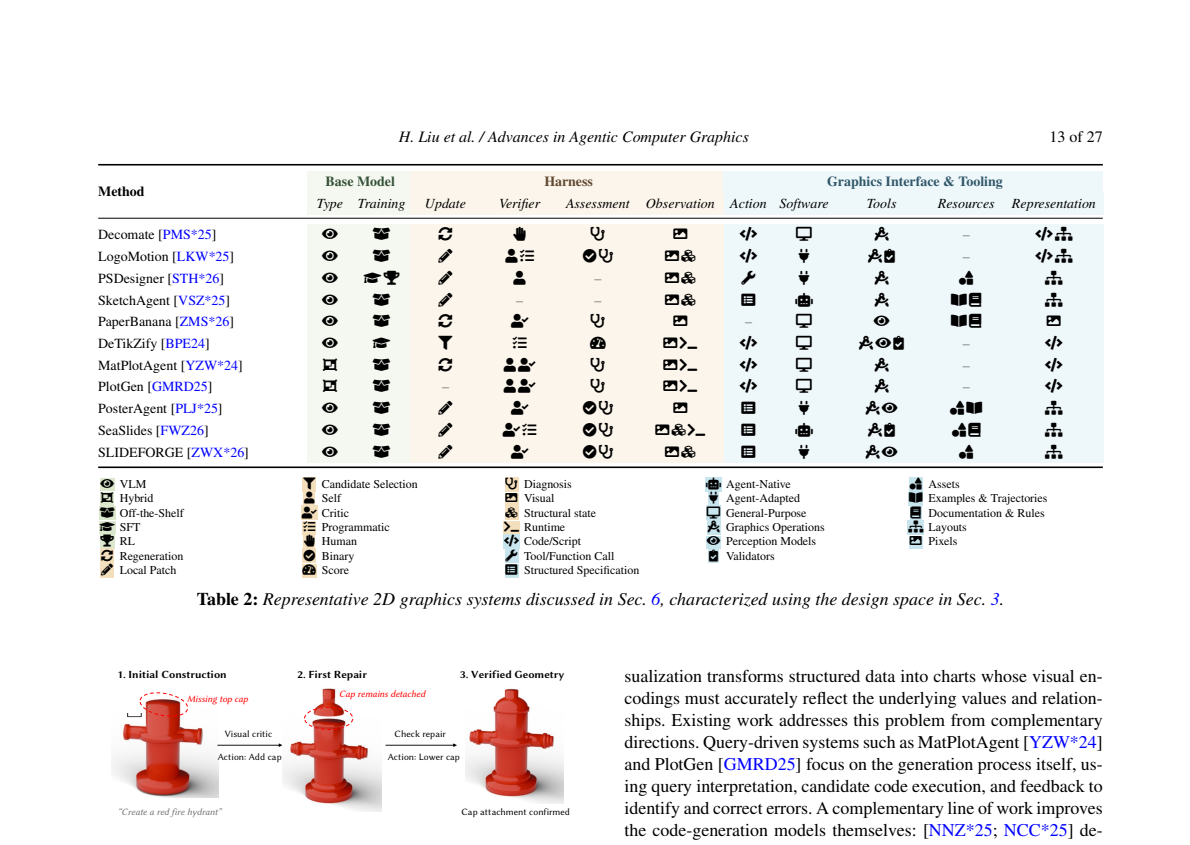
The tables are dense and use many icons. Consider adding a one-sentence caption that guides the reader to the most important pattern in each table (e.g., 'most methods use off-the-shelf VLMs with local patch updates').
The paper says, at Sec. 4.2.2, Fig. 5
Pith says: minor objection 4 of 6
The subfigures (a.1, a.2, a.3) are labeled only in the caption; label them on the figure itself for easier reference.
The paper says, at Sec. 9
Pith says: minor objection 5 of 6
The discussion of 'creativity and attribution' is welcome but brief. Consider adding a reference to recent work on human–AI co-creation to strengthen the context.
The paper says, at Sec. 2.1
Pith says: minor objection 6 of 6
The phrase 'these generators fall outside our scope' is clear, but it could be more explicit about why: they do not use an LLM to decide actions, as stated earlier. Repetition here is fine, but the justification should be consistent.
What would settle it
Randomly sample 50 papers from the corpus; have two domain experts independently assign all relevant taxonomy labels (dimensions in Sec 3). Compute per-category Cohen's kappa between experts and between each expert and the automated system. Report precision and recall for the automated labels using the majority expert vote as ground truth. If mean per-category agreement (expert vs automated) falls below 75% for any category appearing in more than 10% of the sample, the trend claims in Sec 4.2.2 should be caveated as preliminary and the paper should release the validation data.
from the skeptic's reading
How the review went
4 readings by deepseek-v4-flash · 4 Nov 2026
- Reader holds up
- Skeptic partly agrees: says it holds up only with conditions Trend analyses in Sec 4.2.2 rely on automated taxonomy labels whose correctness is not verified; the reported percentages may be artifacts of classification noise.
- Editor wrote the verdict above
- Referee major revision: 3 major objections, 6 minor
Not run on this paper: the simulated authors' defence.
Pith did not check this review's objections against the paper.
The review in full
The review in brief, machine-written
Hi colleague,
Here's my take on the agentic graphics survey (2611.01860).
The paper's main contribution is a clean four-dimensional taxonomy—specification, base model, harness, graphics interface and tooling—that makes it possible to compare systems that use different terminology. The survey covers a huge range of recent work (350 papers) and the application sections (2D, static 3D, dynamic 3D) are thorough. The open problems discussion is thoughtful. The paper is clearly written.
What's good: the taxonomy is the lasting contribution. The authors also built an automated literature survey system that classifies papers using their taxonomy. As a way to keep up with a fast-growing field, the idea is sound. The manual verification of paper relevance is a step toward quality control.
What's soft: the trend analysis in Section 4.2.2—the main empirical claim—rests entirely on taxonomy labels assigned by the automated system. The paper explicitly says (sentence b238) that the curation checks "do not verify the correctness of the classifications." Manual verification was limited to relevance, not the labels themselves. So numbers like local patching rising from 50% to 83% could reflect classification noise. The stress-test note on this is accurate. Without inter-annotator agreement or per-category precision/recall, these percentages are suggestive but not robust.
That said, the taxonomy and qualitative comparisons survive this issue. The paper acknowledges the limitation. If the authors want the trend analysis to carry weight, they need to validate the labels. For now, I'd treat those numbers as rough indicators.
Who this is for: anyone entering agentic graphics, or anyone who wants a structured map of the field. The taxonomy is worth citing. I'd accept peer review, but would ask for either label validation or a significant softening of the quantitative claims.
Best, [Your Name]
The strongest objection
The paper's strongest empirical contribution—trend analyses showing, e.g., local patching rising from 50.0% to 83.0% (Fig 5b.1)—is derived entirely from taxonomy labels assigned by the automated literature survey system. The paper explicitly states that the system's curation checks "do not verify the correctness of the classifications" (sentence b238). Manual verification was limited to paper relevance (Sec 4.2.1), not to the taxonomy labels themselves. Without ground-truth validation, classification errors of unknown magnitude propagate into every quantitative claim in Sec 4.2.2. For example, if the system systematically mislabels 'local patch' vs 'regeneration' for a subset of papers, the observed temporal trend could be spurious. The paper's central assertion—that the taxonomy enables systematic cross-task comparison and trend discovery—depends on the reliability of these automatically generated numbers. The absence of any validation protocol (e.g., human inter-annotator agreement, per-category precision/recall) is a significant gap that weakens the empirical support for this claim.
The reader identified the reliability of automated classifications as a weakest assumption. I agree that this is a critical vulnerability and sharpen it to a specific, testable deficiency: the quantitative trend analyses in Sec 4.2.2 are unvalidated. The taxonomy itself is a valuable conceptual contribution, and the automated system is presented as assistive, so the paper does not fail entirely. However, the paper makes explicit empirical claims (e.g., percentages and trends) that are not supported by evidence of classification accuracy. A conditional accept that requires validation of a random sample (or explicit softening of the claims) would strengthen the paper's empirical grounding without rejecting its main organizational contribution.
The referee's report
The taxonomy provides a well-structured vocabulary that can unify descriptions across the fragmented agentic graphics literature. The automated survey system is a novel methodological contribution that, if made reliable, could lower the barrier to keeping surveys current. The qualitative synthesis of design patterns (Secs. 6–8) is valuable for researchers entering the field. If the quantitative trend claims can be validated, the paper would also offer a data-driven view of the field's evolution.
Pith's reading of the paper (a machine's summary, not the authors')
This survey paper argues that research on LLM-based agentic graphics systems—where a language model writes code, runs it in a graphics environment, and revises based on feedback—has grown so fast and with such inconsistent terminology that manual understanding is no longer sufficient. The authors propose a unified taxonomy that classifies any such system along four dimensions: specification, base model, harness, and graphics interface and tooling. To demonstrate and deploy this taxonomy, they build an agentic literature system that automatically discovers relevant papers, reads them, assigns taxonomy labels, and curates structured reports. Using this system on 350 papers, they identify several design patterns, such as the dominance of visual feedback (77 % of systems) and a shift toward local patch updates (rising to 83 % over the analyzed period). The paper closes with open challenges around multi-agent coordination, long-horizon planning, human–agent alignment, and reliable evaluation.
What carries the argument. The four-dimensional taxonomy (specification, base model, harness, graphics interface and tooling) is the central organizing framework; it provides a common vocabulary for describing and comparing agentic graphics systems across inconsistent terminologies. The agentic literature survey system, built on top of a SWE-agent-style harness with PaperQA2-style evidence extraction, operationalizes the taxonomy by reading full papers, assigning labels, and curating structured records.
Core claim. The paper establishes that the design space of agentic graphics systems can be captured by four axes—specification (task, input, output), base model (type and training), harness (planning, feedback, memory), and graphics interface and tooling (action type, software, representation, tools, resources)—each with concrete sub-options. Using this taxonomy, the authors find that most systems rely on off-the-shelf base models, harness designs are highly diverse, code and structured specifications dominate action types, and feedback patterns vary strongly by task domain (e.g., CAD favors full regeneration while scene generation favors local patches). The automated survey system itself is a demonstration that large-scale, taxonomy-driven literature curation can be performed by an agent, though the authors note that classification correctness is not systematically verified.
The premise it rests on. The four dimensions and their subcategories capture the essential design choices of all agentic graphics systems sufficiently to enable meaningful cross-task comparison; the paper acknowledges this is a design choice that may need expansion as new approaches appear.
If the paper is right (Pith's inferences, not the authors')
Researchers can use the taxonomy to position their own system design explicitly, enabling apples-to-apples comparisons with prior work even when different application terms are used.
The observed shift toward local patch updates suggests that future system designs should prioritize targeted edits over full regeneration to improve efficiency and preserve earlier progress.
The dominance of visual feedback points to an increasing reliance on VLMs as critics; future work may need to address VLM blind spots in geometric and physical reasoning.
The automated survey system, if publicly released as planned, could become a living bibliography that keeps pace with the field's rapid growth, reducing the lag of manual reviews.
The taxonomy's four dimensions are a design choice, not a theorem; a different partitioning (e.g., separating feedback from planning more sharply) might prove equally useful, and the paper invites such refinements as new approaches emerge.
The automated system's classification accuracy is unverified; a human validation study comparing its labels against expert annotations would be a natural next step before relying on trend numbers.
If the taxonomy is adopted widely, it could enable meta-analyses that cross-task comparisons of architecture choices (e.g., which harness patterns correlate with success on dynamic vs. static tasks) become routine.
The open challenge of evaluating interactive graphics systems is particularly acute; the paper notes stochastic runs and proprietary models make disentangling system design from model capability difficult, implying that a shared evaluation protocol would greatly accelerate progress.
Check this review
Pith stored no record of this review's passes and took no fingerprint of it. Reviews made by code from 13 Nov 2026 on carry both.
How often reviews like this one are right
Reviews like this one: written by deepseek-v4-flash, where what was read was not recorded.
How often objections from reviews like this one are right: not yet measured
Reviews by people
This review was written by a machine. No person has reviewed this paper on Pith yet. A scientist listed on Pith can review it for a fee, and their review is published here whatever it concludes.
The paper
Abstract
Computer graphics is built on code. Large language model (LLM) agents can now generate graphics code and iteratively refine it through various feedback. This capability opens the door to a potentially new paradigm of computer graphics, with graphics algorithms increasingly built around agentic systems to automate progressively complex tasks. Over the past years, research on agentic graphics has expanded rapidly across a diverse range of tasks. This rapid growth makes it increasingly difficult for manual literature reviews to keep pace with new developments. At the same time, similar ideas are often described using different terminology across these tasks, further complicating efforts to develop a systematic understanding of the field. In this report, we address these challenges through two contributions. First, we introduce a unified taxonomy for characterizing agentic systems across diverse computer graphics tasks. Second, we develop an agentic literature system that can assist human researchers in analyzing existing and newly published papers at scale. Building on these contributions, we analyze emerging research trends and discuss open challenges in coordinating agents and tools across graphics tasks, designing interfaces and representations for human-agent collaboration, sustaining long-horizon planning and refinement, and reliably evaluating interactive graphics systems.
The paper's own sentences, arranged, kept beside the review and separate from it. Each label is drawn from a closed vocabulary; the number beside it is the probability the classifier gave that label. No sentence in this record was written by a model.
abstract compiled · 2026-11-03
The authors' main claim, as the classifier picked it out 0.63
“This capability opens the door to a potentially new paradigm of computer graphics, with graphics algorithms increasingly built around agentic systems to automate progressively complex tasks.”
How the main claim is stated: hedged possibility 0.96
What the abstract itself states, as probabilities: claims first 0.06 · states limitation 0.13 · human participants 0.13 · controlled comparison 0.02 · randomized assignment 0.01 · states quantitative result 0.03 · compares with prior results 0.06 · mentions code or data availability 0.03
The abstract, sentence by sentence
This table labels the abstract only (arXiv listing abstract v1). The number is the probability the classifier gave the label.
| Sentence | Role | The authors' own work | States the main conclusion | Strength |
|---|---|---|---|---|
| Computer graphics is built on code. | background 1.00 | 0.04 | 0.02 | asserted 1.00 |
| Large language model (LLM) agents can now generate graphics code and iteratively refine it through various feedback. | background 1.00 | 0.08 | 0.05 | asserted 0.92 |
| This capability opens the door to a potentially new paradigm of computer graphics, with graphics algorithms increasingly built around agentic systems to automate progressively complex tasks. | background 0.78 | 0.07 | 0.16 | hedged possibility 0.96 |
| Over the past years, research on agentic graphics has expanded rapidly across a diverse range of tasks. | background 0.99 | 0.07 | 0.03 | asserted 1.00 |
| This rapid growth makes it increasingly difficult for manual literature reviews to keep pace with new developments. | background 0.72 | 0.15 | 0.02 | asserted 0.97 |
| At the same time, similar ideas are often described using different terminology across these tasks, further complicating efforts to develop a systematic understanding of the field. | background 0.61 | 0.11 | 0.02 | asserted 1.00 |
| In this report, we address these challenges through two contributions. | contribution 0.98 | 0.58 | 0.05 | asserted 0.98 |
| First, we introduce a unified taxonomy for characterizing agentic systems across diverse computer graphics tasks. | contribution 1.00 | 0.96 | 0.08 | asserted 1.00 |
| Second, we develop an agentic literature system that can assist human researchers in analyzing existing and newly published papers at scale. | contribution 1.00 | 0.96 | 0.08 | asserted 1.00 |
| Building on these contributions, we analyze emerging research trends and discuss open challenges in coordinating agents and tools across graphics tasks, designing interfaces and representations for human-agent collaboration, sustaining long-horizon planning and refinement, and reliably evaluating interactive graphics systems. | contribution 0.78 | 0.78 | 0.36 | asserted 0.94 |
What kind of paper the classifier reports this is: method or tool 0.57 · evidence from literature 0.97
What was examined, and what was not
Sources read
- arXiv listing abstract v1
Not examined
- full text
- figures and tables
- references and citing sentences
- relations to other papers
Levels run
- P abstract
Not run
- S sections
- T body sentences
- C citations
- R cross-paper relations
How the labels were made
Compiled by classifier-1.13.0 via TypeSafe API, question bank abstract-p1-20260923, 2026-11-03: 1 request, 7,354 input tokens.
Every quoted sentence on this record is the authors'. Every label is from Pith's closed vocabulary, with the probability shown beside it. This record as JSON
Figures (19)

Showing 13 of the paper's 19 figures. Figures are the authors', reproduced from the paper.
References (291)
- [1] Huang, Zhening and Li, Yueyan and Chiu, Johnathan and Lyu, Xiaoyang and Zhou, Matt and Yao, Yuxin and Lasenby, Joan and Wu, Shangzhe , title =. 2026 , eprint = on Pith
- [2] Shi, Jin-Chuan and Ye, Binhong and Liu, Tao and He, Junzhe and Xu, Yangjinhui and Liu, Xiaoyang and Li, Zeju and Chen, Hao and Shen, Chunhua , title =. ACM SIGGRAPH 2026 Conference Papers , year =. doi:10.1145/3799902.3811134 , eprint = on Pithdoi:10.1145/3799902.3811134
- [3] Belouadi, Jonas and Boubekeur, Tamy and Kaiser, Adrien , title =. International Conference on Learning Representations , year =. 2509.22151 , eprinttype = on PithPith's reviewarXiv
- [4] Chen, Junhao and Li, Xiang and Ye, Xiaojun and Li, Chao and Fan, Zhaoxin and Zhao, Hao , title =. Proceedings of the 31st International Conference on Computational Linguistics , year =. 2404.04363 , eprinttype = on PithPith's reviewarXiv
- [5] Gao, Jin and Juluri, Saichandu , title =. 2026 , eprint = on Pith
- [6] Lam, Anson Y. and Li, Shuqing and Lyu, Michael R. , title =. 2026 , eprint = on Pith
- [7] Lin, Youtian and Yang, Yikang and Hu, Zhanpeng and Zhou, Mengqi and Zhang, Feihu and Cao, Xun and Liu, Jiaheng and Yao, Yao , title =. 2026 , eprint = on Pith
- [8] Pang, Bo and Pan, Jiaqi and Zhang, Xiaocheng and Xu, Jiacheng and Wang, Guoping and Wang, Peng-Shuai , title =. 2026 , eprint = on Pith
- [9] Zhang, Shuyuan and Jiang, Chenhan and Li, Zuoou and Deng, Jiankang , title =. Advances in Neural Information Processing Systems , year =. 2510.17603 , eprinttype = on PitharXiv
- [10] Ian Huang and Guandao Yang and Leonidas J. Guibas , title =. Computer Vision -- ECCV 2024 , pages =. 2024 , doi = on Pith
- [11] Yunqi Gu and Ian Huang and Jihyeon Je and Guandao Yang and Leonidas J. Guibas , title =. IEEE/CVF Conference on Computer Vision and Pattern Recognition (CVPR) , pages =. 2025 , doi = on Pith
- [12] Shaofeng Yin and Jiaxin Ge and Zora Zhiruo Wang and Chenyang Wang and Xiuyu Li and Michael J. Black and Trevor Darrell and Angjoo Kanazawa and Haiwen Feng , title =. arXiv preprint arXiv:2601.11109 , year = on PithPith's reviewarXiv
- [13] Xiaoxuan Ma and Jiashun Wang and Nicolas Ugrinovic and Yehonathan Litman and Kris Kitani , title =. arXiv preprint arXiv:2605.30338 , year = on PithPith's reviewarXiv
- [14] Zhengfei Kuang and Rui Lin and Long Zhao and Gordon Wetzstein and Saining Xie and Sanghyun Woo , title =. arXiv preprint arXiv:2512.22351 , year = on PitharXiv
- [15] Yipeng Gao and Lei Shu and Genzhi Ye and Xi Xiong and Ameesh Makadia and Meiqi Guo and Laurent Itti and Jindong Chen , title =. arXiv preprint arXiv:2606.01057 , year = on PithPith's reviewarXiv
- [16] Yuhao Du and Shunian Chen and Wenbo Zan and Peizhao Li and Mingxuan Wang and Dingjie Song and Bo Li and Yan Hu and Benyou Wang , title =. arXiv preprint arXiv:2412.14203 , year = on PithPith's reviewarXiv
- [17] Zhang, Yunzhi and Li, Zizhang and Zhou, Matt and Wu, Shangzhe and Wu, Jiajun , title =. Proceedings of the IEEE/CVF Conference on Computer Vision and Pattern Recognition (CVPR) , year = on Pith
- [18] Matt Zhou and Ruining Li and Xiaoyang Lyu and Zhaomou Song and Zhening Huang and Chuanxia Zheng and Christian Rupprecht and Andrea Vedaldi and Shangzhe Wu , title =. arXiv preprint arXiv:2605.15187 , year = on PithPith's reviewarXiv
- [19] Mohammadmehdi Ataei and Farzaneh Askari and Kamal Rahimi Malekshan and Pradeep Kumar Jayaraman , title =. arXiv preprint arXiv:2604.24479 , year = on PithPith's reviewarXiv
- [20] Tian Xia and Tianrun Gao and Wenhao Deng and Long Wei and Xiaowei Qian and Yixian Jiang and Chenglei Yu and Tailin Wu , title =. arXiv preprint arXiv:2510.16559 , year = on PithPith's reviewarXiv
show 80 more
- [21] Hongchi Xia and Xuan Li and Zhaoshuo Li and Qianli Ma and Jiashu Xu and Ming-Yu Liu and Yin Cui and Tsung-Yi Lin and Wei-Chiu Ma and Shenlong Wang and Shuran Song and Fangyin Wei , title =. arXiv preprint arXiv:2602.10116 , year = on PitharXiv
- [22] Yi Zhang and Yunshuang Wang and Zeyu Zhang and Hao Tang , title =. arXiv preprint arXiv:2602.11757 , year = on PitharXiv
- [23] Parker Liu and Chenxin Li and Zhengxin Li and Yipeng Wu and Wuyang Li and Zhiqin Yang and Zhenyuan Zhang and Yunlong Lin and Sirui Han and Brandon Y. Feng , title =. arXiv preprint arXiv:2506.23329 , year = on PithPith's reviewarXiv
- [24] Lu Ling and Chen-Hsuan Lin and Tsung-Yi Lin and Yifan Ding and Yu Zeng and Yichen Sheng and Yunhao Ge and Ming-Yu Liu and Aniket Bera and Zhaoshuo Li , title =. International Conference on Learning Representations (ICLR) , year = on Pith
- [25] Jiacheng Chen and Ramin Mehran and Xuhui Jia and Saining Xie and Sanghyun Woo , title =. arXiv preprint arXiv:2506.17450 , year = on PithPith's reviewarXiv
- [26] Yandan Yang and Baoxiong Jia and Shujie Zhang and Siyuan Huang , title =. Advances in Neural Information Processing Systems (NeurIPS) , year = on Pith
- [27] Ian Huang and Yanan Bao and Karen Truong and Howard Zhou and Cordelia Schmid and Leonidas J. Guibas and Alireza Fathi , title =. IEEE/CVF Conference on Computer Vision and Pattern Recognition (CVPR) , pages =. 2025 , doi = on Pith
- [28] Sining Lu and Guan Chen and Nam Anh Dinh and Itai Lang and Ari Holtzman and Rana Hanocka , title =. arXiv preprint arXiv:2508.08228 , year = on PithPith's reviewarXiv
- [29] Ziniu Hu and Ahmet Iscen and Aashi Jain and Thomas Kipf and Yisong Yue and David A. Ross and Cordelia Schmid and Alireza Fathi , title =. International Conference on Machine Learning (ICML) , pages = on Pith
- [30] Giorgio Giannone and Anna Clare Doris and Amin Heyrani Nobari and Kai Xu and Akash Srivastava and Faez Ahmed , title =. arXiv preprint arXiv:2603.27448 , year = on PitharXiv
- [31] Jason Wei and Xuezhi Wang and Dale Schuurmans and Maarten Bosma and Brian Ichter and Fei Xia and Ed H. Chi and Quoc V. Le and Denny Zhou , title =. Advances in Neural Information Processing Systems (NeurIPS) , year = on Pith
- [32] Shunyu Yao and Jeffrey Zhao and Dian Yu and Nan Du and Izhak Shafran and Karthik Narasimhan and Yuan Cao , title =. International Conference on Learning Representations (ICLR) , year = on Pith
- [33] Shunyu Yao and Dian Yu and Jeffrey Zhao and Izhak Shafran and Thomas L. Griffiths and Yuan Cao and Karthik Narasimhan , title =. Advances in Neural Information Processing Systems (NeurIPS) , year = on Pith
- [34] Noah Shinn and Federico Cassano and Edward Berman and Ashwin Gopinath and Karthik Narasimhan and Shunyu Yao , title =. Advances in Neural Information Processing Systems (NeurIPS) , year = on Pith
- [35] Timo Schick and Jane Dwivedi-Yu and Roberto Dess. Toolformer: Language Models Can Teach Themselves to Use Tools , journal =. 2023 , eprint = on Pith
- [36] Shishir G. Patil and Tianjun Zhang and Xin Wang and Joseph E. Gonzalez , title =. Advances in Neural Information Processing Systems (NeurIPS) , year = on Pith
- [37] Yongliang Shen and Kaitao Song and Xu Tan and Dongsheng Li and Weiming Lu and Yueting Zhuang , title =. Advances in Neural Information Processing Systems (NeurIPS) , year = on Pith
- [38] Guanzhi Wang and Yuqi Xie and Yunfan Jiang and Ajay Mandlekar and Chaowei Xiao and Yuke Zhu and Linxi Fan and Anima Anandkumar , title =. Transactions on Machine Learning Research (TMLR) , year = on Pith
- [39] Pascal M. Procedural Modeling of Buildings , journal = on Pith
- [40] Weixi Feng and Wanrong Zhu and Tsu-jui Fu and Varun Jampani and Arjun Akula and Xuehai He and Sugato Basu and Xin Eric Wang and William Yang Wang , title =. Advances in Neural Information Processing Systems , volume =. 2023 , eprint = on Pith
- [41] Zhengyi Wang and Jonathan Lorraine and Yikai Wang and Hang Su and Jun Zhu and Sanja Fidler and Xiaohui Zeng , title =. arXiv preprint arXiv:2411.09595 , year = on PithPith's reviewarXiv
- [42] Juan A. Rodriguez and Abhay Puri and Shubham Agarwal and Issam H. Laradji and Pau Rodriguez and Sai Rajeswar and David Vazquez and Christopher Pal and Marco Pedersoli , title =. Proceedings of the IEEE/CVF Conference on Computer Vision and Pattern Recognition (CVPR) , pages =.... on Pith
- [43] Jingyuan Chen and Sheng Jin and Haopeng Sun and Wentao Liu and Chen Qian , title =. arXiv preprint arXiv:2606.05058 , year = on PithPith's reviewarXiv
- [44] Yonglong Tian and Andrew Luo and Xingyuan Sun and Kevin Ellis and William T. Freeman and Joshua B. Tenenbaum and Jiajun Wu , title =. International Conference on Learning Representations (ICLR) , year = on Pith
- [45] R. Kenny Jones and Theresa Barton and Xianghao Xu and Kai Wang and Ellen Jiang and Paul Guerrero and Niloy J. Mitra and Daniel Ritchie , title =. ACM Transactions on Graphics (SIGGRAPH Asia) , volume =. 2020 , eprint = on Pith
- [46] Daniel Ritchie and Paul Guerrero and R. Kenny Jones and Niloy J. Mitra and Adriana Schulz and Karl D. D. Willis and Jiajun Wu , title =. Computer Graphics Forum (Eurographics STAR) , volume =. 2023 , eprint = on Pith
- [47] Carlos E. Jim. International Conference on Learning Representations (ICLR) , year = on Pith
- [48] John Yang and Carlos E. Jim. Advances in Neural Information Processing Systems (NeurIPS) , year = on Pith
- [49] Xingyao Wang and Boxuan Li and Yufan Song and Frank F. Xu and Xiangru Tang and Mingchen Zhuge and Jiayi Pan and Yueqi Song and Bowen Li and Jaskirat Singh and Hoang H. Tran and Fuqiang Li and Ren Ma and Mingzhang Zheng and Bill Qian and Yanjun Shao and Niklas Muennighoff and Y... on Pith
- [50] Wenting Zhao and Nan Jiang and Celine Lee and Justin T. Chiu and Claire Cardie and Matthias Gall. International Conference on Learning Representations (ICLR) , year =. 2412.01769 , eprinttype = on PithPith's reviewarXiv
- [51] Tianbao Xie and Danyang Zhang and Jixuan Chen and Xiaochuan Li and Siheng Zhao and Ruisheng Cao and Toh Jing Hua and Zhoujun Cheng and Dongchan Shin and Fangyu Lei and Yitao Liu and Yiheng Xu and Shuyan Zhou and Silvio Savarese and Caiming Xiong and Victor Zhong and Tao Yu , t... on Pith
- [52] Shuyan Zhou and Frank F. Xu and Hao Zhu and Xuhui Zhou and Robert Lo and Abishek Sridhar and Xianyi Cheng and Tianyue Ou and Yonatan Bisk and Daniel Fried and Uri Alon and Graham Neubig , title =. International Conference on Learning Representations (ICLR) , year = on Pith
- [53] Yiheng Xie and Towaki Takikawa and Shunsuke Saito and Or Litany and Shiqin Yan and Numair Khan and Federico Tombari and James Tompkin and Vincent Sitzmann and Srinath Sridhar , title =. Computer Graphics Forum , volume =. 2022 , pages = on Pith
- [54] Siddhartha Chaudhuri and Daniel Ritchie and Jiajun Wu and Kai Xu and Hao Zhang , title =. Computer Graphics Forum (Eurographics STAR) , volume =. 2020 , doi = on Pith
- [55] Xingyu Fu and Yushi Hu and Bangzheng Li and Yu Feng and Haoyu Wang and Xudong Lin and Dan Roth and Noah A. Smith and Wei-Chiu Ma and Ranjay Krishna , title =. European Conference on Computer Vision (ECCV) , year = on Pith
- [56] Shengbang Tong and Ellis Brown and Penghao Wu and Sanghyun Woo and Manoj Middepogu and Sai Charitha Akula and Jihan Yang and Shusheng Yang and Adithya Iyer and Xichen Pan and Ziteng Wang and Rob Fergus and Yann LeCun and Saining Xie , title =. Advances in Neural Information Pr... on Pith
- [57] Zhiheng Xi and Wenxiang Chen and Xin Guo and Wei He and Yiwen Ding and Boyang Hong and Ming Zhang and Junzhe Wang and Senjie Jin and Enyu Zhou and Rui Zheng and Xiaoran Fan and Xiao Wang and Limao Xiong and Yuhao Zhou and Weiran Wang and Changhao Jiang and Yicheng Zou and Xian... on PithPith's reviewarXiv
- [58] Junwei Liu and Kaixin Wang and Yixuan Chen and Xin Peng and Zhenpeng Chen and Lingming Zhang and Yiling Lou , title =. arXiv preprint arXiv:2409.02977 , year = on PithPith's reviewarXiv
- [59] Shuai Wang and Weiwen Liu and Jingxuan Chen and Yuqi Zhou and Weinan Gan and Xingshan Zeng and Yuhan Che and Shuai Yu and Xinlong Hao and Kun Shao and Bin Wang and Chuhan Wu and Yasheng Wang and Ruiming Tang and Jianye Hao , title =. arXiv preprint arXiv:2411.04890 , year = on PithPith's reviewarXiv
- [60] Chaoyun Zhang and Shilin He and Jiaxu Qian and Bowen Li and Liqun Li and Si Qin and Yu Kang and Minghua Ma and Guyue Liu and Qingwei Lin and Saravan Rajmohan and Dongmei Zhang and Qi Zhang , title =. arXiv preprint arXiv:2411.18279 , year = on PithPith's reviewarXiv
- [61] Dang Nguyen and Jian Chen and Yu Wang and Gang Wu and Namyong Park and Zhengmian Hu and Hanjia Lyu and Junda Wu and Ryan Aponte and Yu Xia and Xintong Li and Jing Shi and Hongjie Chen and Viet Dac Lai and Zhouhang Xie and Sungchul Kim and Ruiyi Zhang and Tong Yu and Mehrab Tan... on Pith
- [62] Robert L. Cook , title =. Proceedings of the 11th Annual Conference on Computer Graphics and Interactive Techniques (SIGGRAPH '84) , year = on Pith
- [63] Tzu-Mao Li and Miika Aittala and Fr. Differentiable. ACM Transactions on Graphics (SIGGRAPH Asia) , volume = on Pith
- [64] Samuli Laine and Janne Hellsten and Tero Karras and Yeongho Seol and Jaakko Lehtinen and Timo Aila , title =. ACM Transactions on Graphics (SIGGRAPH Asia) , volume =. 2020 , eprint = on Pith
- [65] David Baraff and Andrew Witkin , title =. Proceedings of the 25th Annual Conference on Computer Graphics and Interactive Techniques (SIGGRAPH '98) , year = on Pith
- [66] Jos Stam , title =. Proceedings of the 26th Annual Conference on Computer Graphics and Interactive Techniques (SIGGRAPH '99) , year = on Pith
- [67] Yuanming Hu and Tzu-Mao Li and Luke Anderson and Jonathan Ragan-Kelley and Fr. ACM Transactions on Graphics (SIGGRAPH Asia) , volume =. 2019 , doi = on Pith
- [68] arXiv preprint arXiv:2303.08774 , year = on PithPith's reviewarXiv
- [69] Haotian Liu and Chunyuan Li and Qingyang Wu and Yong Jae Lee , title =. Advances in Neural Information Processing Systems (NeurIPS) , year = on Pith
- [70] Mark Chen and Jerry Tworek and Heewoo Jun and Qiming Yuan and Henrique Ponde de Oliveira Pinto and Jared Kaplan and Harri Edwards and Yuri Burda and Nicholas Joseph and Greg Brockman and Alex Ray and Raul Puri and Gretchen Krueger and Michael Petrov and Heidy Khlaaf and Girish... on PithPith's reviewarXiv
- [71] arXiv preprint arXiv:2403.05530 , year = on PithPith's reviewarXiv
- [72] arXiv preprint arXiv:2412.15115 , year =. 2412.15115 , eprinttype = on PithPith's reviewarXiv
- [73] Peng Wang and Shuai Bai and Sinan Tan and Shijie Wang and Zhihao Fan and Jinze Bai and Keqin Chen and Xuejing Liu and Jialin Wang and Wenbin Ge and Yang Fan and Kai Dang and Mengfei Du and Xuancheng Ren and Rui Men and Dayiheng Liu and Chang Zhou and Jingren Zhou and Junyang L... on PithPith's reviewarXiv
- [74] arXiv preprint arXiv:2412.19437 , year = on PithPith's reviewarXiv
- [75] arXiv preprint arXiv:2501.12599 , year = on PithPith's reviewarXiv
- [76] arXiv preprint arXiv:2504.07491 , year = on PithPith's reviewarXiv
- [77] CADIR: A Cross-Backend Editable Intermediate Representation for Agentic CAD Generation , author=. arXiv preprint arXiv:2608.00891 , year= on PithPith's reviewarXiv
- [78] ParticleGen: A Multi-Agent System for Particle Effects Generation , author=. arXiv preprint arXiv:2608.00629 , year= on PithPith's reviewarXiv
- [79] GS-Agent: Creating 4D Physical Worlds With Generative Simulation , author=. arXiv preprint arXiv:2607.21522 , year= on PithPith's reviewarXiv
- [80] MUSE: Agentic 3D Scene Authoring via Memory-Grounded Incremental Requirement Satisfaction , author=. arXiv preprint arXiv:2606.14168 , year= on PitharXiv
- [81] SimWorlds: A Multi-Agent System for Dynamic 3D Scene Creation , author=. arXiv preprint arXiv:2607.01766 , year= on PithPith's reviewarXiv
- [82] SceneConductor: 3D Scene Generation from a Single Image with Multi-Agent Orchestration , author=. arXiv preprint arXiv:2606.08402 , year= on PithPith's reviewarXiv
- [83] SimFoundry: Modular and Automated Scene Generation for Policy Learning and Evaluation , author=. arXiv preprint arXiv:2606.28276 , year= on PithPith's reviewarXiv
- [84] Yuyang Yin and Zixiang Li and Longxuan Deng and Hongkai Li and Shifang Zhao and Junnan Liu and Weirong Huang and Mengyu Wang and Tianxiao Fu and Yikai Wang and Peng-Shuai Wang and Xiaojie Jin and Yao Zhao and Yunchao Wei , title =. arXiv preprint arXiv:2608.12314 , year = on PithPith's reviewarXiv
- [85] Tsz Hei Fan and Choi Wing Fung and Yuxuan Wan and Shuqing Li and Michael R. Lyu , title =. arXiv preprint arXiv:2607.11594 , year = on PithPith's reviewarXiv
- [86] Nicholas Pfaff and Thomas Cohn and Sergey Zakharov and Rick Cory and Russ Tedrake , title =. International Conference on Machine Learning (ICML) , year = on Pith
- [87] Yian Wang and Han Yang and Minghao Guo and Xiaowen Qiu and Tsun-Hsuan Wang and Wojciech Matusik and Joshua B. Tenenbaum and Chuang Gan , title =. International Conference on Learning Representations (ICLR) , year = on Pith
- [88] Lei Yin and Wentao Cheng and Zhida Qin and Tianyu Huang and Yidong Li and Gangyi Ding , title =. Findings of the Association for Computational Linguistics: ACL 2026 , pages =. 2026 , publisher = on Pith
- [89] Ziya Erko. arXiv preprint arXiv:2603.19708 , year = on PitharXiv
- [91] Global-local tree search in vlms for 3d indoor scene generation , author=. 2025 IEEE/CVF Conference on Computer Vision and Pattern Recognition (CVPR) , pages=. 2025 , organization= on Pith
- [92] Yankuan Chi and Xiang Li and Zixuan Huang and James Matthew Rehg , title =. IEEE/CVF Conference on Computer Vision and Pattern Recognition (CVPR) , pages = on Pith
- [93] Saugat Adhikari and Ashok Prasad Neupane and Pramish Paudel and Ajad Chhatkuli and Danda Pani Paudel , title =. arXiv preprint arXiv:2608.06161 , year = on PithPith's reviewarXiv
- [94] Rui-Huan Wang and Si-Tong Wei and Jia-Qi He and Heng-Yi Wei and Baoquan Chen and Peng-Shuai Wang , title =. arXiv preprint arXiv:2608.17975 , year = on PithPith's reviewarXiv
- [95] Yixuan Yang and Zhen Luo and Wanshui Gan and Jinkun Hao and Junru Lu and Jinghao Yan and Zhaoyang Lyu and Xudong Xu , title =. arXiv preprint arXiv:2605.18451 , year = on PithPith's reviewarXiv
- [96] Hao Wang and Wenhui Zhu and Shao Tang and Zhipeng Wang and Xuanzhao Dong and Xin Li and Xiwen Chen and Ashish Bastola and Xinhao Huang and Yalin Wang and Abolfazl Razi , title =. arXiv preprint arXiv:2601.07143 , year = on PitharXiv
- [97] Yutaro Yamada and Khyathi Chandu and Bill Yuchen Lin and Jack Hessel and Ilker Yildirim and Yejin Choi , title =. Proceedings of the 2025 Conference of the Nations of the Americas Chapter of the Association for Computational Linguistics: Human Language Technologies (System Dem... on PithPith's reviewarXiv
- [98] 3d-gpt: Procedural 3d modeling with large language models , author=. 2025 International Conference on 3D Vision (3DV) , pages=. 2025 , organization= on Pith
- [99] Scenegenagent: Precise industrial scene generation with coding agent , author=. Proceedings of the 63rd Annual Meeting of the Association for Computational Linguistics (Volume 1: Long Papers) , pages= on Pith
- [100] Dimitrios Mallis and Ahmet Serdar Karadeniz and Sebastian Cavada and Danila Rukhovich and Niki Foteinopoulou and Kseniya Cherenkova and Anis Kacem and Djamila Aouada , title =. Proceedings of the IEEE/CVF International Conference on Computer Vision (ICCV) , year =. 2412.13810 ... on PithPith's reviewarXiv
- [101] Elias Berger and Muhammad Usama and Jan Mehlst. Physics-in-the-Loop: A Hybrid Agentic Architecture for Validated. arXiv preprint arXiv:2605.19717 , year = on PithPith's reviewarXiv
The first 100 of 291 references are listed here. All of them are in this paper's citation record.
Challenges and discussion
Disagree with the review, or know something it missed? Leave a comment, or challenge this review formally: a challenge becomes a permanent entry in this paper's record, and its decision is published here.
Come back by email
A short list of the week's newly reviewed papers. Nothing is sent until you confirm from your inbox, and every email has a link that stops it. No account.
No comments yet.
Sign in to comment