A Framework to Model Stellar Irradiated Disks with Frequency-dependent Absorption and Scattering Opacities in Athena++
Pith reviewed 2026-06-27 17:39 UTC · model grok-4.3
The pith
A new multigroup radiation framework in Athena++ models stellar irradiated disks with frequency-dependent opacities and matches Monte Carlo benchmarks within 2-5% using 64 bands.
A machine-rendered reading of the paper's core claim, the machinery that carries it, and where it could break.
Core claim
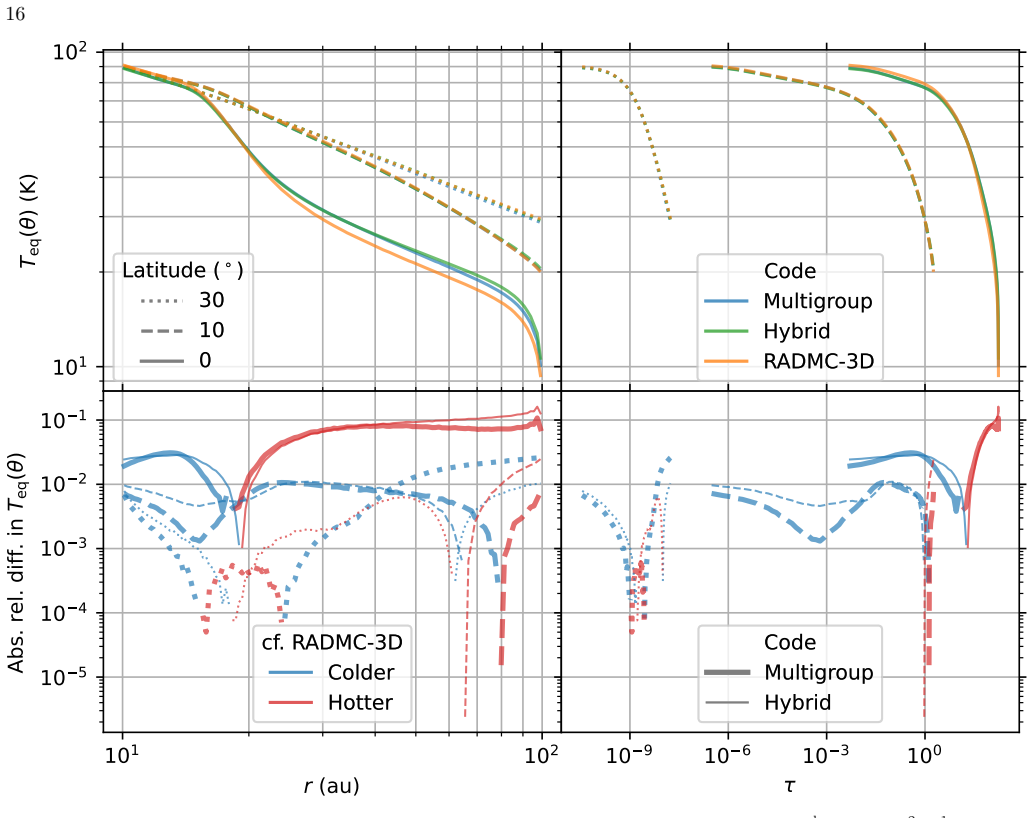
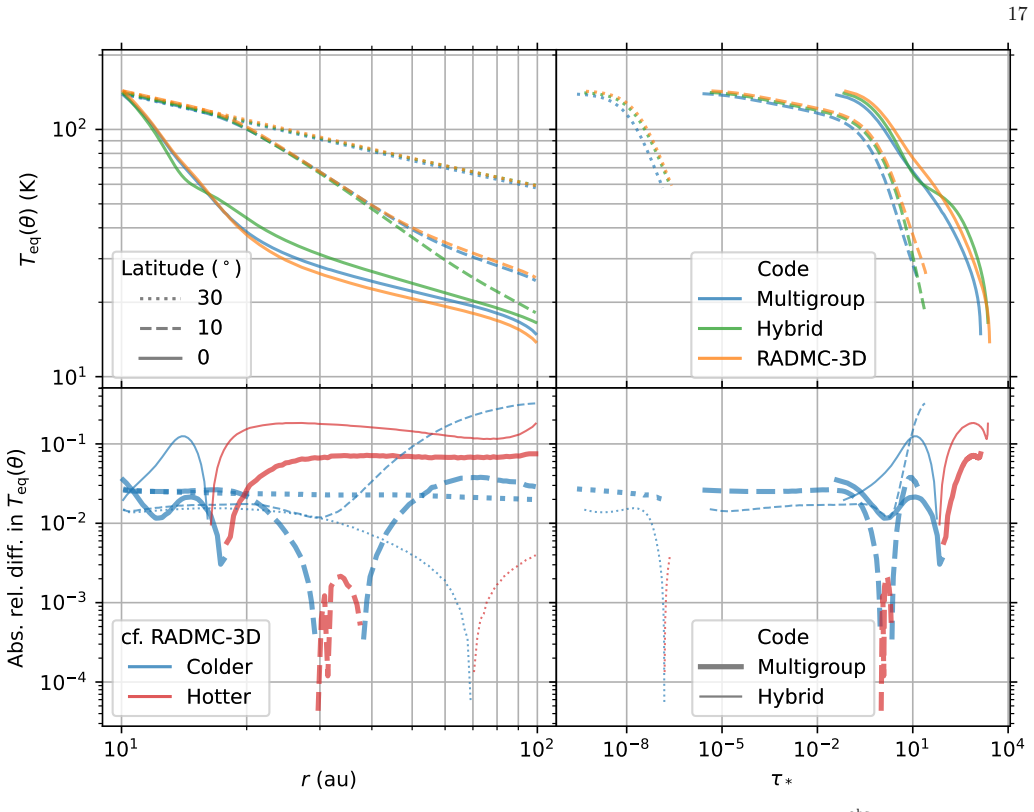
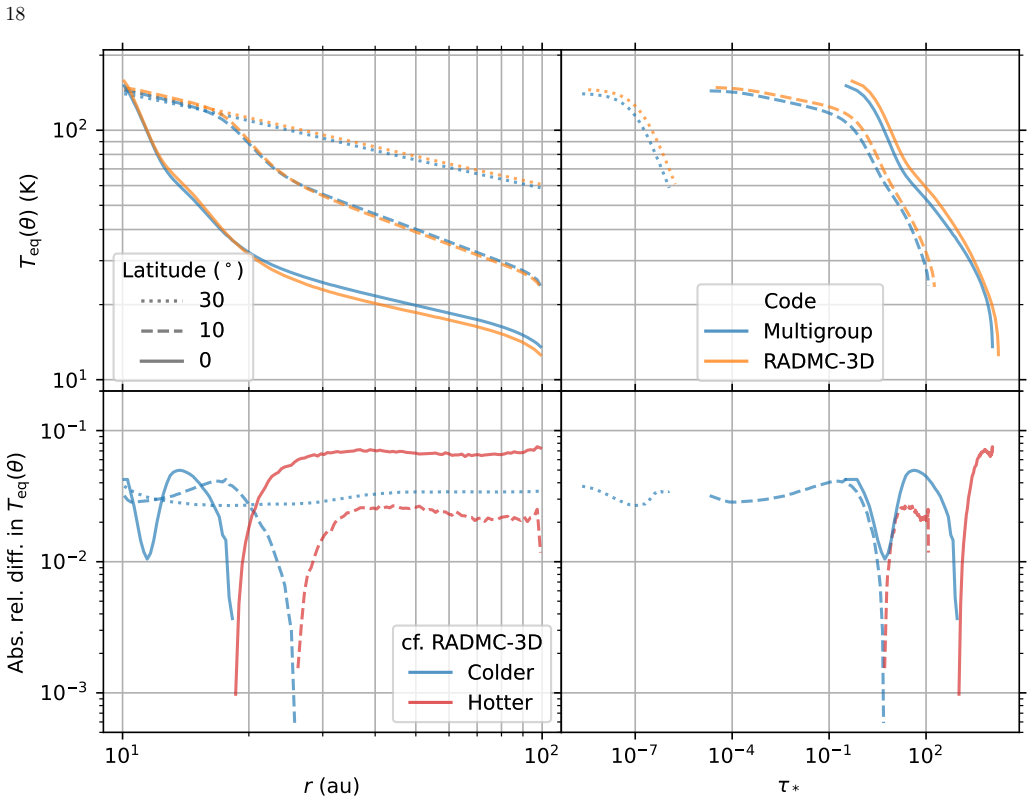
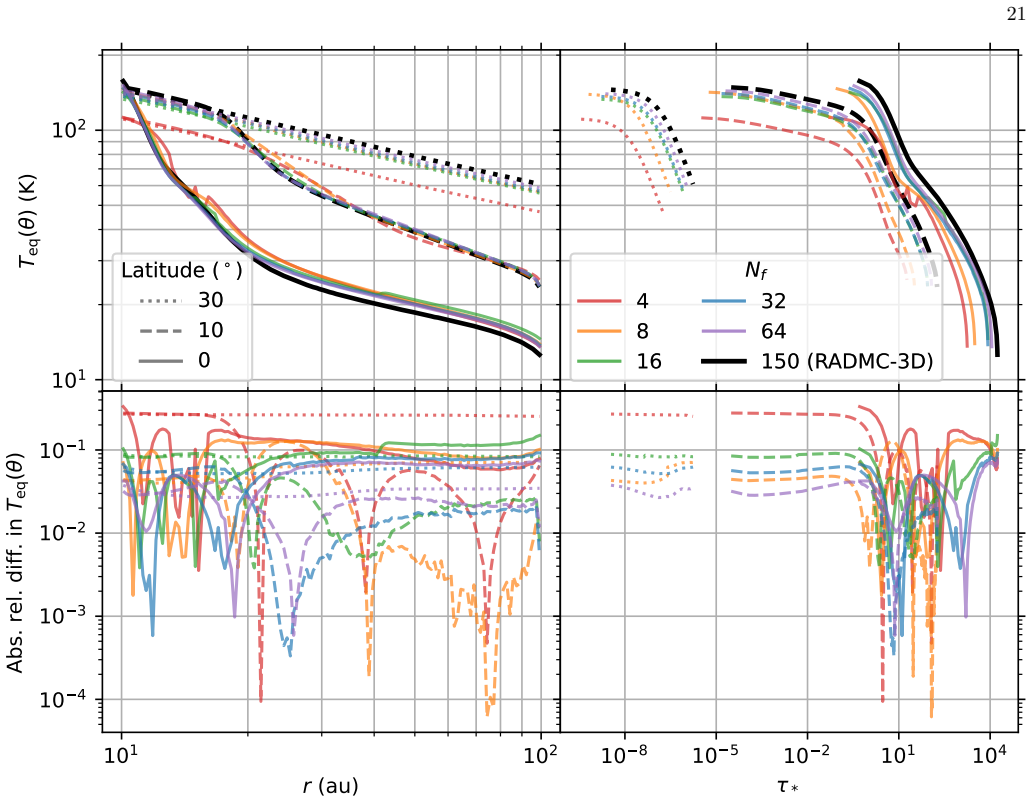
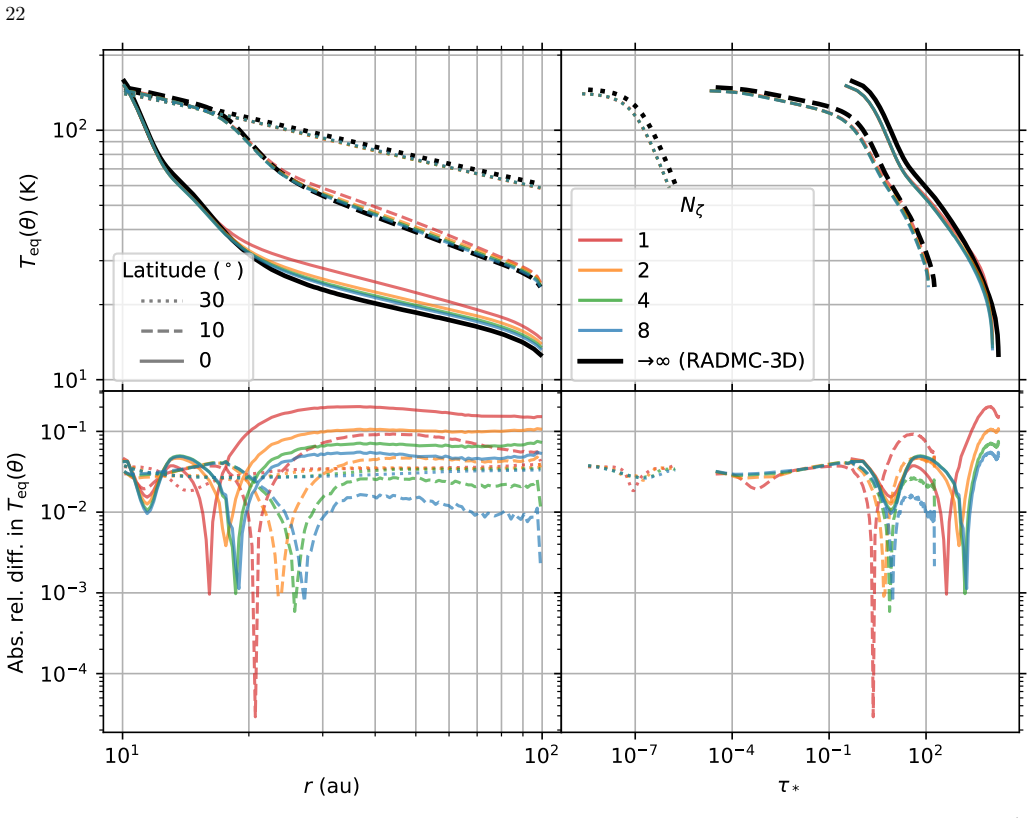
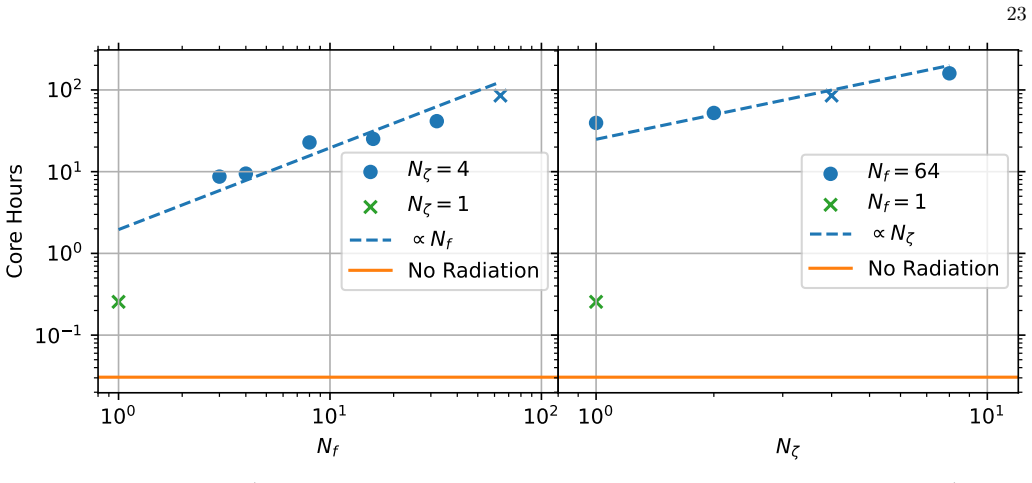
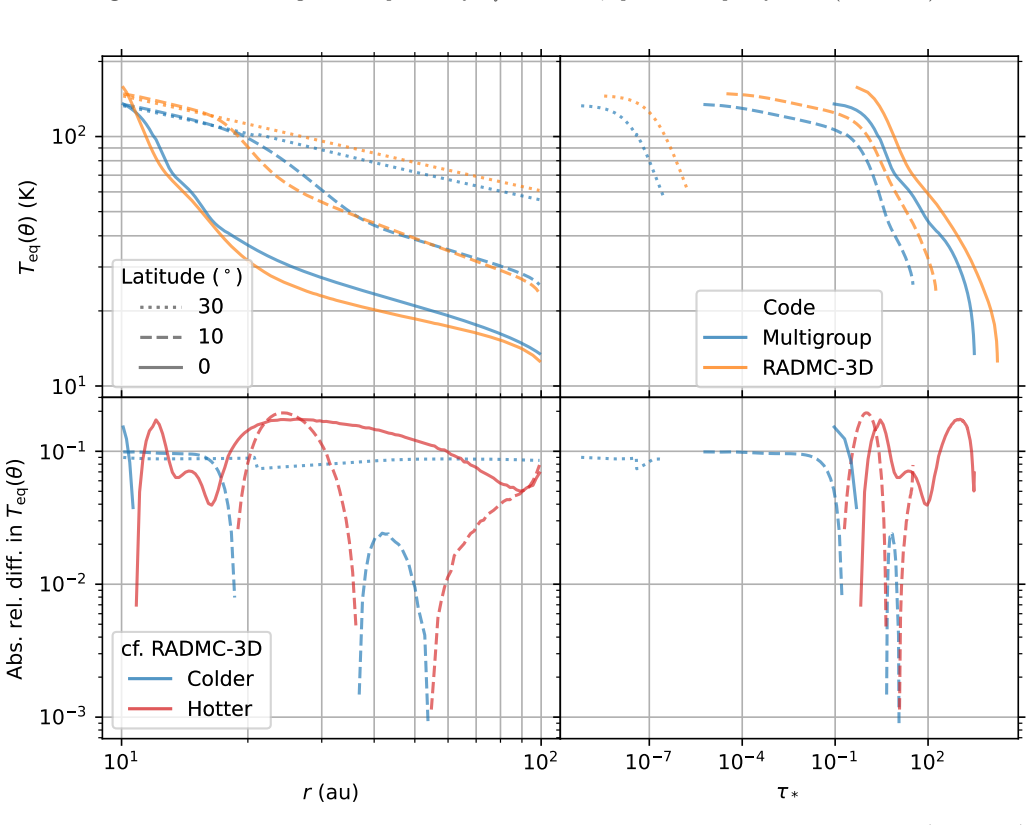
Our hydrostatic models achieve equilibrium temperatures that differ from Monte Carlo radiative-transfer benchmarks on average by 2--5% with 64 frequency bands and 7--11% with 3 bands. Reducing the number of bands lowers computational cost by at least an order of magnitude while increasing the maximum possible temperature deviation only from 8% to 19%.
What carries the argument
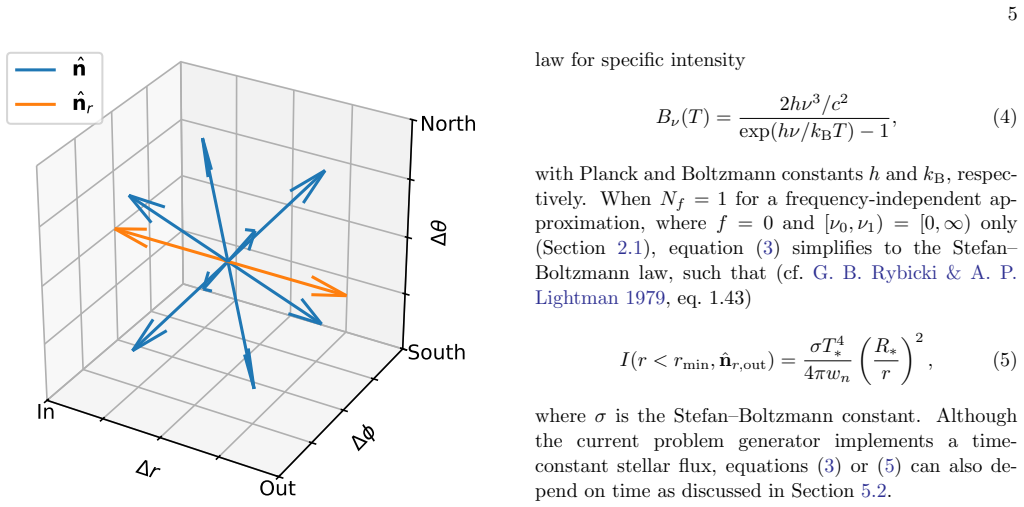
Multigroup radiation transport with frequency-dependent absorption and scattering opacities and newly implemented radial rays to represent the stellar flux in the Athena++ finite-volume code.
If this is right
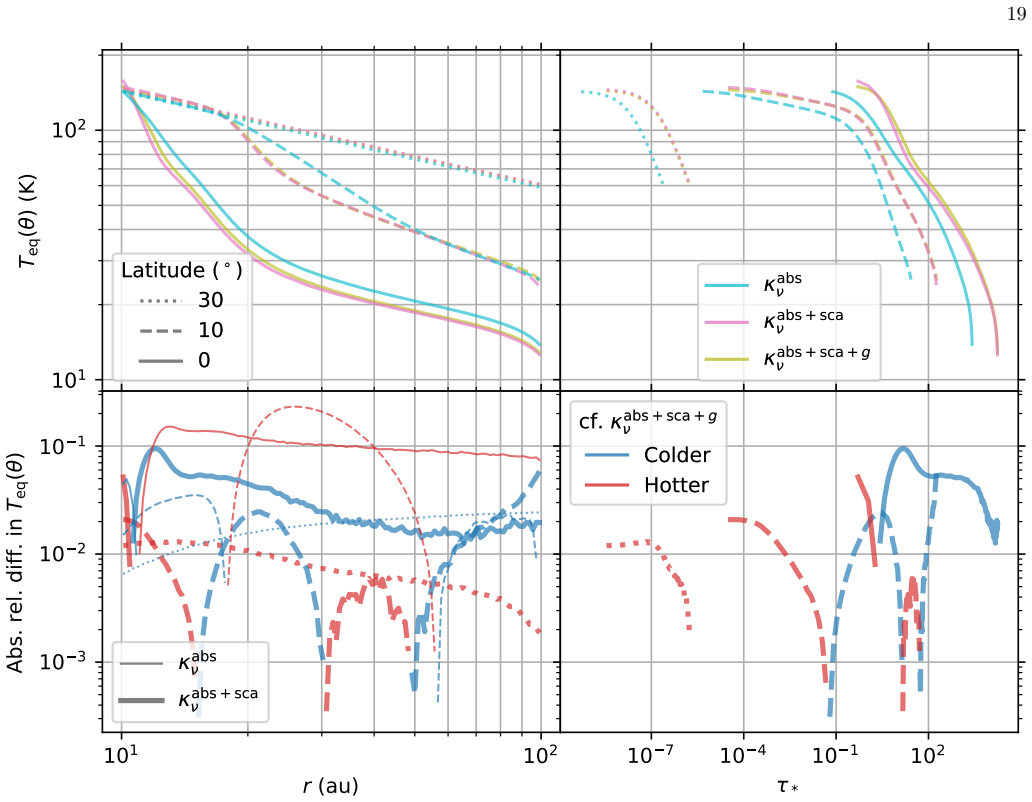
- The vertical temperature gradient is captured more accurately when more frequency bands are used or when scattering is included.
- Reducing the number of bands lowers computational cost by at least an order of magnitude while increasing the maximum possible temperature deviation only from 8% to 19%.
- This calibration provides a solid foundation for future self-consistent studies of irradiated protoplanetary disks, including fully dynamical simulations and applications involving chemical processes and time-dependent stellar luminosity.
Where Pith is reading between the lines
- This method could enable studies of how accurate thermal structures affect planet formation processes like migration and accretion in dynamical disks.
- Similar frequency-dependent approaches might improve models of other optically thick irradiated systems beyond protoplanetary disks.
- Extending the framework to include time-dependent effects could help simulate variable stellar activity on disk evolution.
Load-bearing premise
The premise that restricting the study to hydrostatic disk models isolates radiative effects without dynamical complexity, allowing the reported accuracy to generalize to future moving-disk simulations.
What would settle it
Running a full radiation-hydrodynamic simulation with moving gas and comparing the resulting temperature profiles directly to Monte Carlo benchmarks would test if the accuracy persists under dynamical conditions.
Figures
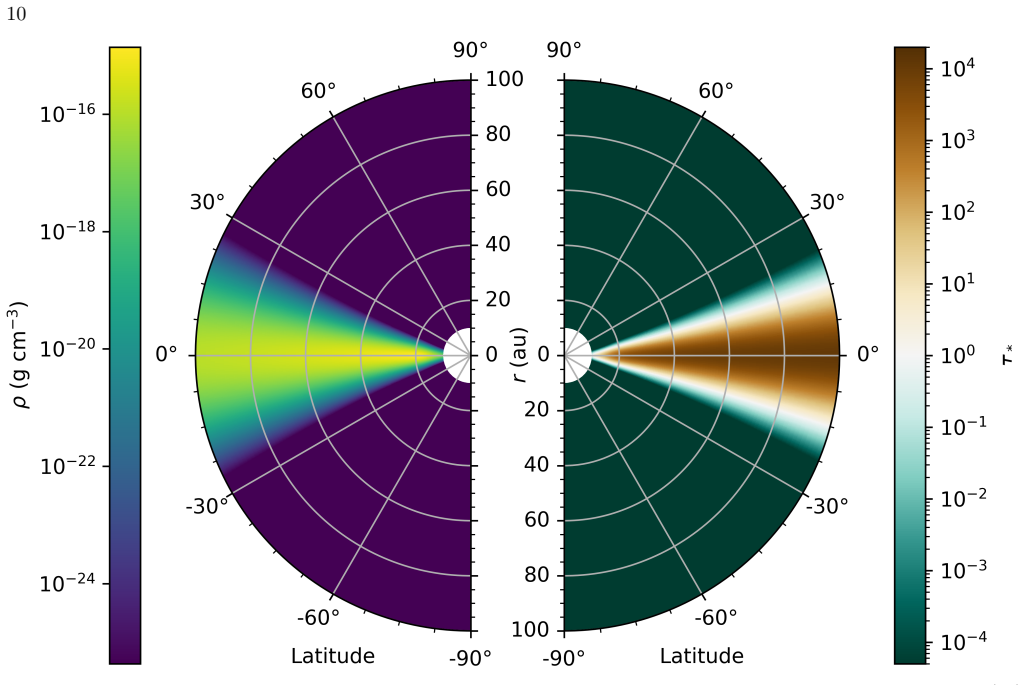
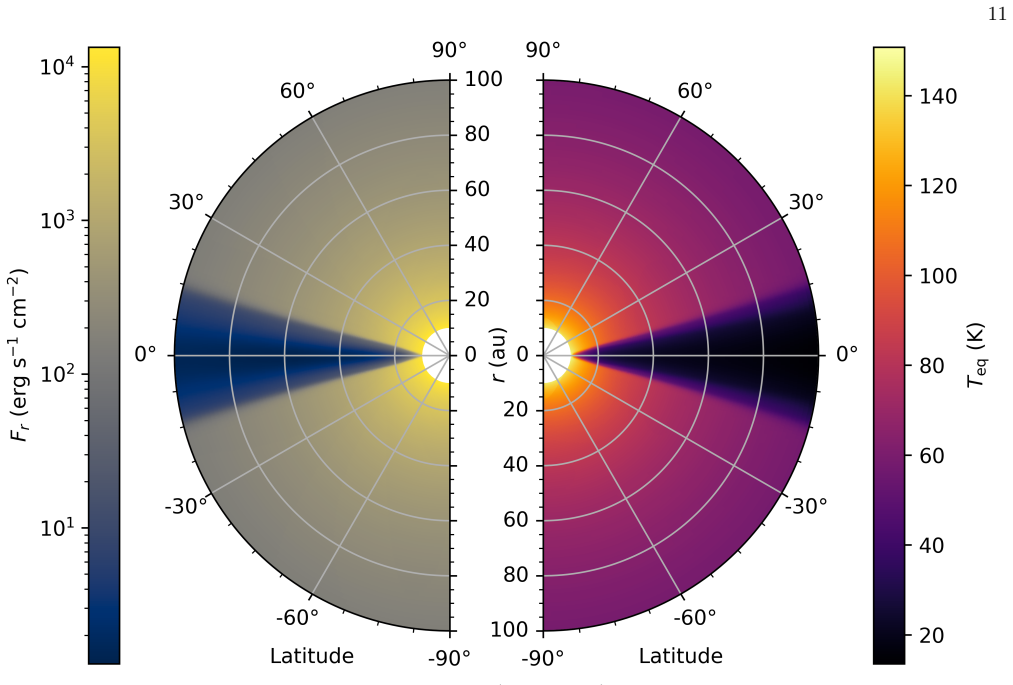
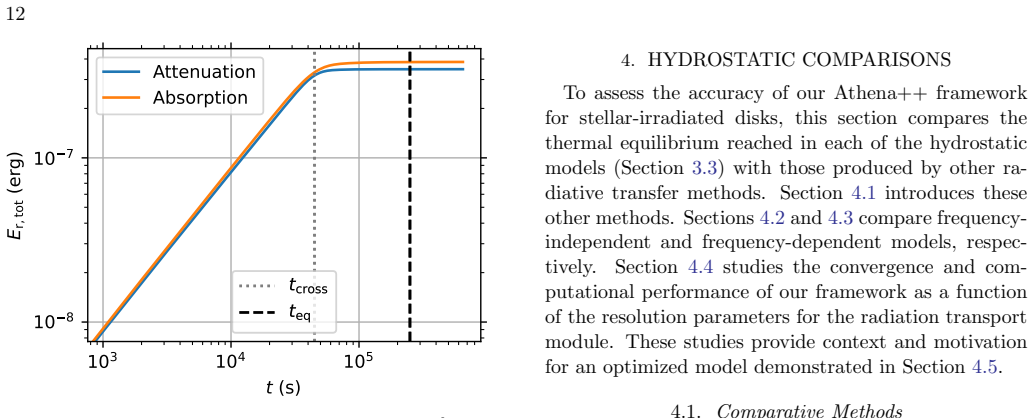
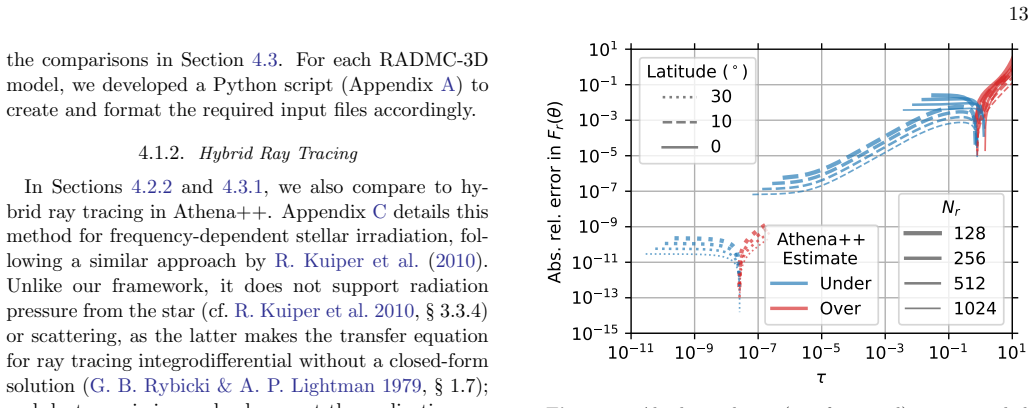
read the original abstract
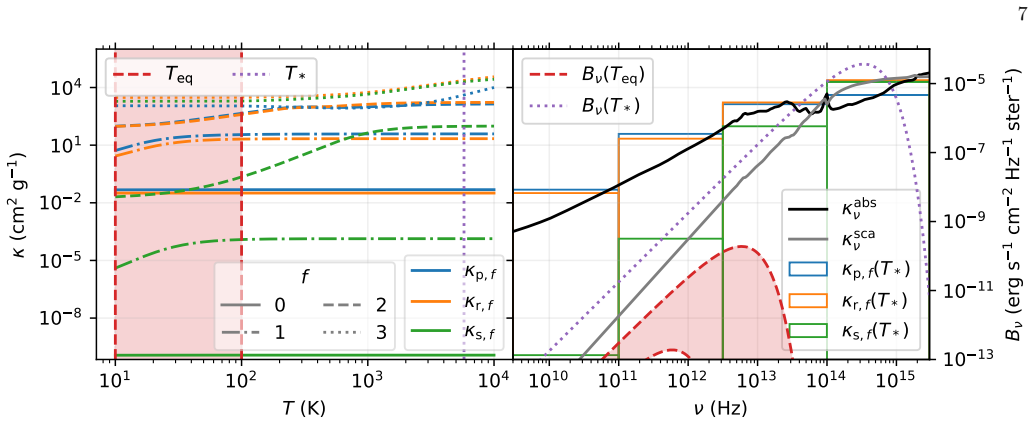
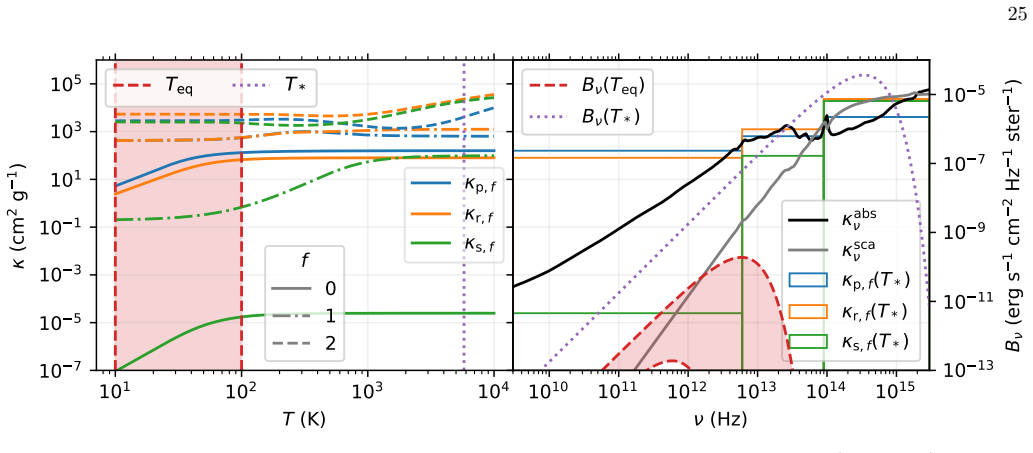
The frequency dependence of opacity is crucial for determining the thermal structure of protoplanetary disks, which in turn influences disk dynamics and planet formation. Yet many disk models adopt simplified thermodynamics, and common radiation-hydrodynamic approaches often use gray opacities, ignore scattering, and yield inaccurate results in regions with intermediate optical depth. We present a comprehensive framework that models stellar irradiation with frequency-dependent absorption and scattering across all optical depths using the Athena++ finite-volume code, extended with multigroup radiation transport and newly implemented radial rays to more accurately represent the stellar flux. To calibrate this framework, we focus exclusively on hydrostatic disk models, allowing us to isolate radiative effects and evaluate the method without additional dynamical complexity. Because dust opacity increases strongly with frequency, ultraviolet stellar irradiation heats the tenuous disk atmosphere while the optically thick midplane remains cooler. This vertical temperature gradient is captured more accurately when more frequency bands are used or when scattering is included. Our hydrostatic models achieve equilibrium temperatures that differ from Monte Carlo radiative-transfer benchmarks on average by 2--5% with 64 frequency bands and 7--11% with 3 bands. Reducing the number of bands lowers computational cost by at least an order of magnitude while increasing the maximum possible temperature deviation only from 8% to 19%. This calibration demonstrates the accuracy and efficiency of the framework and provides a solid foundation for future self-consistent studies of irradiated protoplanetary disks, including fully dynamical simulations and applications involving chemical processes and time-dependent stellar luminosity.
Editorial analysis
A structured set of objections, weighed in public.
Referee Report
Summary. The manuscript presents a framework implemented in Athena++ for modeling stellar-irradiated protoplanetary disks that incorporates frequency-dependent absorption and scattering opacities via multigroup radiation transport and newly added radial rays for the stellar flux. Calibration is restricted to hydrostatic disk models to isolate radiative effects, yielding average equilibrium temperature differences from Monte Carlo benchmarks of 2--5% (64 bands) and 7--11% (3 bands), with a reported order-of-magnitude cost reduction when using fewer bands.
Significance. If the benchmark agreements hold, the work supplies a practical, frequency-dependent radiative module for disk simulations that captures vertical temperature gradients arising from opacity variations. Credit is given for the explicit quantitative comparison to independent Monte Carlo results, the demonstration of accuracy-cost trade-offs with band number, and the deliberate choice to benchmark in a hydrostatic setting before dynamical extensions.
minor comments (2)
- [Abstract] Abstract: the statement that the framework 'provides a solid foundation for future self-consistent studies... including fully dynamical simulations' is forward-looking but unsupported by any dynamical test data; consider qualifying the language to reflect the hydrostatic calibration scope.
- [Methods (inferred from framework description)] The description of how the radial-ray method interfaces with the multigroup solver (including boundary conditions at the stellar source) lacks an explicit equation or pseudocode reference; adding this would improve reproducibility.
Simulated Author's Rebuttal
We thank the referee for their positive assessment of the manuscript, including recognition of the quantitative Monte Carlo benchmarks, the accuracy-cost trade-offs with band number, and the choice to calibrate in hydrostatic models. We appreciate the recommendation for minor revision.
Circularity Check
No significant circularity; validation against external benchmarks
full rationale
The paper's central result is a direct numerical comparison of equilibrium temperatures in hydrostatic models against independent Monte Carlo radiative-transfer benchmarks (2-5% average difference with 64 bands). This is an external calibration step, not an internal reduction. The hydrostatic restriction is explicitly framed as a deliberate isolation choice for calibration, without any claim that the error levels are derived from or forced by the paper's own equations. No self-definitional steps, fitted inputs renamed as predictions, or load-bearing self-citations appear in the derivation chain. The framework is presented as a code implementation whose accuracy is measured against outside references.
Axiom & Free-Parameter Ledger
axioms (1)
- standard math Standard assumptions of the Athena++ finite-volume radiation transport scheme
Reference graph
Works this paper leans on
-
[1]
2020, ApJ, 905, 68, doi: 10.3847/1538-4357/abc1d6
Barraza-Alfaro, M. 2020, ApJ, 905, 68, doi: 10.3847/1538-4357/abc1d6
-
[2]
Andrews, S. M., Huang, J., P´ erez, L. M., et al. 2018, ApJL, 869, L41, doi: 10.3847/2041-8213/aaf741
work page internal anchor Pith review doi:10.3847/2041-8213/aaf741 2018
-
[3]
Bailey, A., Stone, J. M., & Fung, J. 2024, MNRAS, 534, 1127, doi: 10.1093/mnras/stae2126
-
[4]
Baronett, S. A. 2025, sabaronett/irrad disk: ApJ submission, v1.0.0 Zenodo, doi: 10.5281/zenodo.16934710
-
[5]
2012, A&A, 539, A148, doi: 10.1051/0004-6361/201118136
Birnstiel, T., Klahr, H., & Ercolano, B. 2012, A&A, 539, A148, doi: 10.1051/0004-6361/201118136
-
[6]
Birnstiel, T., Dullemond, C. P., Zhu, Z., et al. 2018, ApJL, 869, L45, doi: 10.3847/2041-8213/aaf743
-
[7]
Bjorkman, J. E., & Wood, K. 2001, ApJ, 554, 615, doi: 10.1086/321336
-
[8]
W., Rozyczka, M., & Tohline, J
Bodenheimer, P., Yorke, H. W., Rozyczka, M., & Tohline, J. E. 1990, ApJ, 355, 651, doi: 10.1086/168798
-
[9]
Boley, A. C., Durisen, R. H., Nordlund, ˚A., & Lord, J. 2007, ApJ, 665, 1254, doi: 10.1086/519767
-
[10]
Bruls, J. H. M. J., Vollm¨ oller, P., & Sch¨ ussler, M. 1999, A&A, 348, 233
1999
-
[11]
Calahan, J. K., Bergin, E. A., Zhang, K., et al. 2021, ApJS, 257, 17, doi: 10.3847/1538-4365/ac143f
-
[12]
Carlson, B. G. 1963, in Methods in Computational Physics, ed. B. Alder, S. Fernbach, & M. Rotenberg, Vol. 1 (New York: Academic Press), 1–42. https://vdoc.pub/documents/methods-in-computational- physics-vol-01-statistical-physics-iklre00kl640
1963
-
[13]
Chiang, E. I., & Goldreich, P. 1997, ApJ, 490, 368, doi: 10.1086/304869
-
[14]
Curone, P., Facchini, S., Andrews, S. M., et al. 2025, ApJL, 984, L9, doi: 10.3847/2041-8213/adc438 D’Alessio, P., Cant¨ o, J., Calvet, N., & Lizano, S. 1998, ApJ, 500, 411, doi: 10.1086/305702
-
[15]
Davis, S. W., & Gammie, C. F. 2020, ApJ, 888, 94, doi: 10.3847/1538-4357/ab5950
-
[16]
Davis, S. W., Stone, J. M., & Jiang, Y.-F. 2012, ApJS, 199, 9, doi: 10.1088/0067-0049/199/1/9
-
[17]
Draine, B. T. 2003, ARA&A, 41, 241, doi: 10.1146/annurev.astro.41.011802.094840
work page internal anchor Pith review Pith/arXiv arXiv doi:10.1146/annurev.astro.41.011802.094840 2003
-
[18]
Protostars and Planets VII , year = 2023, editor =
Drazkowska, J., Bitsch, B., Lambrechts, M., et al. 2023, in Astronomical Society of the Pacific Conference Series, Vol. 534, Protostars and Planets VII, ed. S. Inutsuka, Y. Aikawa, T. Muto, K. Tomida, & M. Tamura, 717, doi: 10.48550/arXiv.2203.09759
-
[19]
Du, F., & Bergin, E. A. 2014, ApJ, 792, 2, doi: 10.1088/0004-637X/792/1/2
-
[20]
2002, Journal of Computational Physics, 180, 584, doi: 10.1006/jcph.2002.7106
Dubroca, B., & Klar, A. 2002, Journal of Computational Physics, 180, 584, doi: 10.1006/jcph.2002.7106
-
[21]
Dullemond, C. P., & Dominik, C. 2004, A&A, 421, 1075, doi: 10.1051/0004-6361:20040284
-
[22]
doi:10.1051/0004-6361:20042080 , eprint =
Dullemond, C. P., & Dominik, C. 2005, A&A, 434, 971, doi: 10.1051/0004-6361:20042080
-
[23]
P., Juhasz, A., Pohl, A., et al
Dullemond, C. P., Juhasz, A., Pohl, A., et al. 2012, RADMC-3D: A multi-purpose radiative transfer tool,, Astrophysics Source Code Library, record ascl:1202.015
2012
-
[24]
Dullemond, C. P., & Turolla, R. 2000, A&A, 360, 1187, doi: 10.48550/arXiv.astro-ph/0003456
work page internal anchor Pith review Pith/arXiv arXiv doi:10.48550/arxiv.astro-ph/0003456 2000
-
[25]
Dullemond, C. P., van Zadelhoff, G. J., & Natta, A. 2002, A&A, 389, 464, doi: 10.1051/0004-6361:20020608
-
[26]
M., Kokotanekova, R., & Samarasinha, N
Espaillat, C., Muzerolle, J., Najita, J., et al. 2014, in Protostars and Planets VI, ed. H. Beuther, R. S. Klessen, C. P. Dullemond, & T. Henning, 497–520, doi: 10.2458/azu uapress 9780816531240-ch022 31
work page doi:10.2458/azu 2014
-
[27]
2011, A&A, 534, A107, doi: 10.1051/0004-6361/201016068
Fromang, S., Lyra, W., & Masset, F. 2011, A&A, 534, A107, doi: 10.1051/0004-6361/201016068
-
[28]
Galloway-Sprietsma, M., Bae, J., Izquierdo, A. F., et al. 2025, ApJL, 984, L10, doi: 10.3847/2041-8213/adc437
-
[29]
Array programming with NumPy.Nature2020,585, 357–362
Harris, C. R., Millman, K. J., van der Walt, S. J., et al. 2020, Nature, 585, 357, doi: 10.1038/s41586-020-2649-2
-
[30]
Hayes, J. C., & Norman, M. L. 2003, ApJS, 147, 197, doi: 10.1086/374658
-
[31]
1996, A&A, 311, 291
Henning, T., & Stognienko, R. 1996, A&A, 311, 291
1996
-
[32]
Henyey, L. G., & Greenstein, J. L. 1941, ApJ, 93, 70, doi: 10.1086/144246
-
[33]
Hunter, J. D. 2007, Computing in Science & Engineering, 9, 90, doi: 10.1109/MCSE.2007.55
-
[34]
2021, ApJS, 253, 49, doi: 10.3847/1538-4365/abe303
Jiang, Y.-F. 2021, ApJS, 253, 49, doi: 10.3847/1538-4365/abe303
-
[35]
2022, ApJS, 263, 4, doi: 10.3847/1538-4365/ac9231
Jiang, Y.-F. 2022, ApJS, 263, 4, doi: 10.3847/1538-4365/ac9231
-
[36]
Jiang, Y.-F., Stone, J. M., & Davis, S. W. 2014, ApJS, 213, 7, doi: 10.1088/0067-0049/213/1/7
-
[37]
2006, A&A, 445, 747, doi: 10.1051/0004-6361:20053238
Klahr, H., & Kley, W. 2006, A&A, 445, 747, doi: 10.1051/0004-6361:20053238
-
[38]
Klahr, H. H., Henning, T., & Kley, W. 1999, ApJ, 514, 325, doi: 10.1086/306926
-
[39]
Krapp, L., Kratter, K. M., Youdin, A. N., et al. 2024, ApJ, 973, 153, doi: 10.3847/1538-4357/ad644a
-
[40]
Krieger, A., Klahr, H., Melon Fuksman, J. D., & Wolf, S. 2025, A&A, 694, A52, doi: 10.1051/0004-6361/202451780
-
[41]
Krumholz, M. R., Klein, R. I., McKee, C. F., & Bolstad, J. 2007, ApJ, 667, 626, doi: 10.1086/520791
-
[42]
Krumholz, M. R., & Thompson, T. A. 2013, MNRAS, 434, 2329, doi: 10.1093/mnras/stt1174
-
[43]
2010, A&A, 511, A81, doi: 10.1051/0004-6361/200912355
Henning, T. 2010, A&A, 511, A81, doi: 10.1051/0004-6361/200912355
-
[44]
Kuiper, R., & Klessen, R. S. 2013, A&A, 555, A7, doi: 10.1051/0004-6361/201321404
-
[45]
Kuiper, R., Yorke, H. W., & Mignone, A. 2020, ApJS, 250, 13, doi: 10.3847/1538-4365/ab9a36
-
[46]
Law, C. J., Teague, R., Loomis, R. A., et al. 2021a, ApJS, 257, 4, doi: 10.3847/1538-4365/ac1439
-
[47]
Law, C. J., Loomis, R. A., Teague, R., et al. 2021b, ApJS, 257, 3, doi: 10.3847/1538-4365/ac1434
-
[48]
2023, in Astronomical Society of the Pacific Conference Series, Vol
Lesur, G., Flock, M., Ercolano, B., et al. 2023, in Astronomical Society of the Pacific Conference Series, Vol. 534, Protostars and Planets VII, ed. S. Inutsuka, Y. Aikawa, T. Muto, K. Tomida, & M. Tamura, 465, doi: 10.48550/arXiv.2203.09821
-
[49]
Levermore, C. D. 1984, JQSRT, 31, 149, doi: 10.1016/0022-4073(84)90112-2
-
[50]
Levermore, C. D., & Pomraning, G. C. 1981, ApJ, 248, 321, doi: 10.1086/159157
-
[51]
Lucy, L. B. 1999, A&A, 344, 282
1999
-
[52]
Lyra, W., & Umurhan, O. M. 2019, PASP, 131, 072001, doi: 10.1088/1538-3873/aaf5ff
-
[53]
Ma, J.-Z., Pakmor, R., Justham, S., & de Mink, S. E. 2025, arXiv e-prints, arXiv:2503.16627, doi: 10.48550/arXiv.2503.16627
-
[54]
Mathis, J. S., Rumpl, W., & Nordsieck, K. H. 1977, ApJ, 217, 425, doi: 10.1086/155591 Melon Fuksman, D., Flock, M., Klahr, H., Mattia, G., &
-
[55]
2025, arXiv e-prints, arXiv:2504.13999
Muley, D. 2025, arXiv e-prints, arXiv:2504.13999. https://arxiv.org/abs/2504.13999 Melon Fuksman, J. D., & Klahr, H. 2022, ApJ, 936, 16, doi: 10.3847/1538-4357/ac7fee
-
[56]
2007, ApJS, 170, 228, doi: 10.1086/513316
Mignone, A., Bodo, G., Massaglia, S., et al. 2007, ApJS, 170, 228, doi: 10.1086/513316
-
[57]
Mihalas, D., & Mihalas, B. W. 1984, Foundations of radiation hydrodynamics (Oxford University Press)
1984
-
[58]
Muley, D., Melon Fuksman, J. D., & Klahr, H. 2024, A&A, 690, A355, doi: 10.1051/0004-6361/202451554
-
[59]
Nelson, R. P., Gressel, O., & Umurhan, O. M. 2013, MNRAS, 435, 2610, doi: 10.1093/mnras/stt1475
-
[60]
Noebauer, U. M., & Sim, S. A. 2019, Living Reviews in Computational Astrophysics, 5, 1, doi: 10.1007/s41115-019-0004-9
-
[61]
Ober, F., Wolf, S., Uribe, A. L., & Klahr, H. H. 2015, A&A, 579, A105, doi: 10.1051/0004-6361/201526117 ¨Oberg, K. I., & Bergin, E. A. 2021, PhR, 893, 1, doi: 10.1016/j.physrep.2020.09.004 ¨Oberg, K. I., Guzm´ an, V. V., Walsh, C., et al. 2021, ApJS, 257, 1, doi: 10.3847/1538-4365/ac1432
-
[62]
2023, in Astronomical Society of the Pacific Conference Series, Vol
Paardekooper, S., Dong, R., Duffell, P., et al. 2023, in Astronomical Society of the Pacific Conference Series, Vol. 534, Protostars and Planets VII, ed. S. Inutsuka, Y. Aikawa, T. Muto, K. Tomida, & M. Tamura, 685, doi: 10.48550/arXiv.2203.09595
-
[63]
Pakmor, R., Bauer, A., & Springel, V. 2011, MNRAS, 418, 1392, doi: 10.1111/j.1365-2966.2011.19591.x
-
[64]
2004, A&A, 417, 793, doi: 10.1051/0004-6361:20040017
Pascucci, I., Wolf, S., Steinacker, J., et al. 2004, A&A, 417, 793, doi: 10.1051/0004-6361:20040017
-
[65]
Pinte, C., Fouchet, L., M´ enard, F., Gonzalez, J. F., & Duchˆ ene, G. 2007, A&A, 469, 963, doi: 10.1051/0004-6361:20077137
-
[66]
B., Hollenbach, D., Beckwith, S., et al
Pollack, J. B., Hollenbach, D., Beckwith, S., et al. 1994, ApJ, 421, 615, doi: 10.1086/173677 Prˇ sa, A., Harmanec, P., Torres, G., et al. 2016, AJ, 152, 41, doi: 10.3847/0004-6256/152/2/41
-
[67]
B., & Lightman, A
Rybicki, G. B., & Lightman, A. P. 1979, Radiative processes in astrophysics (Wiley) 32
1979
-
[68]
Turner, N. J. 2019, ApJ, 874, 26, doi: 10.3847/1538-4357/aafc36
-
[69]
1978, Physical processes in the interstellar medium (New York: Wiley), doi: 10.1002/9783527617722
Spitzer, L. 1978, Physical processes in the interstellar medium (New York: Wiley), doi: 10.1002/9783527617722
-
[70]
Springel, V. 2010, MNRAS, 401, 791, doi: 10.1111/j.1365-2966.2009.15715.x
-
[71]
Simon, J. B. 2008, ApJS, 178, 137, doi: 10.1086/588755
-
[72]
arXiv , author =:2005.06651 , journal =
Stone, J. M., Tomida, K., White, C. J., & Felker, K. G. 2020, ApJS, 249, 4, doi: 10.3847/1538-4365/ab929b
-
[73]
Takeuchi, T., & Lin, D. N. C. 2002, ApJ, 581, 1344, doi: 10.1086/344437
-
[74]
2025, ApJL, 984, L6, doi: 10.3847/2041-8213/adc43b
Teague, R., Benisty, M., Facchini, S., et al. 2025, ApJL, 984, L6, doi: 10.3847/2041-8213/adc43b
-
[75]
Turner, N. J., & Stone, J. M. 2001, ApJS, 135, 95, doi: 10.1086/321779 van der Holst, B., T´ oth, G., Sokolov, I. V., et al. 2011, ApJS, 194, 23, doi: 10.1088/0067-0049/194/2/23
-
[76]
Vaytet, N. M. H., Audit, E., Dubroca, B., & Delahaye, F. 2011, JQSRT, 112, 1323, doi: 10.1016/j.jqsrt.2011.01.027
-
[77]
Vioque, M., Kurtovic, N. T., Trapman, L., et al. 2025, ApJ, 989, 9, doi: 10.3847/1538-4357/adc7b0
-
[78]
SciPy 1.0: Fundamental algorithms for scientific computing in Python.Nat
Virtanen, P., Gommers, R., Oliphant, T. E., et al. 2020, Nature Methods, 17, 261, doi: 10.1038/s41592-019-0686-2
-
[79]
Warren, S. G., & Brandt, R. E. 2008, Journal of Geophysical Research (Atmospheres), 113, D14220, doi: 10.1029/2007JD009744
-
[80]
R., Olivares, H., & Rezzolla, L
Weih, L. R., Olivares, H., & Rezzolla, L. 2020, MNRAS, 495, 2285, doi: 10.1093/mnras/staa1297
discussion (0)
Sign in with ORCID, Apple, or X to comment. Anyone can read and Pith papers without signing in.