Compactness Inference in Gravitational-Wave Mergers with PhenomDECO: Catalog Benchmarks and Robustness Diagnostics
Pith reviewed 2026-07-01 04:29 UTC · model grok-4.3
The pith
All high-significance GWTC-3 binary black hole candidates are consistent with standard mergers once low-frequency noise is accounted for.
A machine-rendered reading of the paper's core claim, the machinery that carries it, and where it could break.
Core claim
Applying the DECO extension to all high-significance BBH events from GWTC-3 reveals three types of posterior distributions for the compactness parameter: Gaussian peaks at C~0.5, additional high-compactness support, and low-compactness modes near C~0.15 in about 20% of cases. The low-compactness modes vanish upon raising the starting frequency, especially for Livingston data, indicating they arise from low-frequency noise. Time-frequency residual analysis confirms the data is better described by standard BBH waveforms, leading to the conclusion that all events are consistent with BBH sources except GW231123, which needs analysis above 50 Hz in both detectors to eliminate the low-compactness
What carries the argument
PhenomDECO, a phenomenological extension of a BBH waveform model that uses an effective compactness parameter C to characterize possible departures from the expected merger morphology.
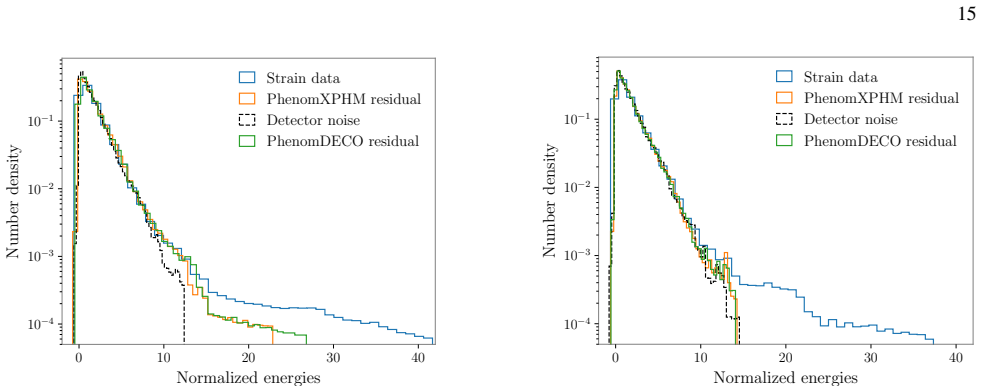
If this is right
- Low-compactness modes in compactness posteriors are artifacts of low-frequency noise rather than indications of exotic compact objects.
- Time-frequency residuals after subtracting BBH waveforms show no significant improvement from DECO deformations.
- Raising the analysis start frequency removes low-frequency noise without introducing bias in the compactness inference for most events.
- The high-mass event GW231123 requires data from both detectors above 50 Hz to confirm consistency with BBH.
- Careful treatment of low-frequency data is essential before claiming deviations from standard binary black hole expectations.
Where Pith is reading between the lines
- Future gravitational wave catalogs may require standardized frequency cuts to avoid false positives for exotic physics.
- Improved noise modeling at low frequencies could reduce the need for ad-hoc frequency cuts in analyses.
- Similar compactness tests could be applied to other waveform models to cross-validate the robustness of BBH interpretations.
Load-bearing premise
Raising the analysis start frequency removes only low-frequency noise artefacts without discarding genuine signal content or biasing the compactness posterior.
What would settle it
A low-compactness mode that persists in the posterior for GW231123 even when both detectors' data are analyzed above 50 Hz would indicate a genuine departure from BBH expectations rather than noise.
Figures
read the original abstract
Several gravitational wave (GW) observations have been identified as binary black hole (BBH) mergers, including systems with component masses that challenge typical formation scenarios. These observations motivate broader tests of whether the detected sources are consistent with this interpretation. We address this question using~\deco~, an existing phenomenological extension of a BBH model that uses an effective compactness parameter to characterize departures from the expected merger morphology. Applying this model to all high-significance BBH events from GWTC-3, we establish~\deco~as a robust test of the nature of compact binaries. In preliminary analyses we identify three recurring posterior morphologies: (i) near-Gaussian peaks consistent with the BBH expectation $C\sim0.5$, seen in 60\% of events; (ii) posteriors with additional high-compactness support $(C\ge0.8)$; and (iii) dominant low-compactness modes near $C\sim0.15$ in $\sim 20\%$ of cases. For the latter, the low-compactness modes disappear when the data, especially from Livingston, are analyzed from a higher starting frequency, indicating sensitivity to low-frequency noise artefacts. We further use time--frequency residuals, computed after subtracting maximum-likelihood BBH and~\deco~waveforms from the strain data, to assess if the data is better described by a compactness-based deformation. With this analysis, we conclude that all of the GWTC-3 observations that we have considered are indeed consistent with BBH sources. The exception is the high-mass GW231123 signal, for which data from \emph{both} detectors must be analyzed above 50Hz to remove a low-compactness mode. This study shows that low-frequency data treatment is crucial before attributing apparent deviations from BBH expectations to exotic physics, and provides a benchmark for compactness-based tests of merger morphology in current and future GW detections.
Editorial analysis
A structured set of objections, weighed in public.
Referee Report
Summary. The manuscript applies the PhenomDECO phenomenological extension of BBH waveform models, which introduces an effective compactness parameter C, to all high-significance BBH events from GWTC-3. It identifies three recurring posterior morphologies for C: near-Gaussian peaks at C~0.5 (60% of events), additional high-C support (C>=0.8), and dominant low-C modes near C~0.15 (~20% of cases). The low-C modes are shown to disappear when data (especially Livingston) are analyzed from higher starting frequencies, and time-frequency residuals after subtracting maximum-likelihood BBH and PhenomDECO waveforms are used to assess model preference. The authors conclude that all considered GWTC-3 events are consistent with BBH sources, except the high-mass GW231123 signal, for which both detectors require analysis above 50 Hz to remove the low-C mode. The work emphasizes that low-frequency data treatment is crucial before attributing deviations to exotic physics.
Significance. If the frequency-cut procedure is validated as signal-preserving, the paper supplies a useful catalog-wide benchmark for compactness-based tests of merger morphology and correctly flags the sensitivity of such inferences to low-frequency noise handling. Strengths include the systematic application to the full GWTC-3 set, identification of recurring posterior morphologies, and use of residual diagnostics. The result, if robust, would caution against premature claims of non-BBH physics in future detections.
major comments (2)
- [Abstract] Abstract: The central claim that all GWTC-3 observations are consistent with BBH sources (C~0.5) after higher-frequency cuts rests on the unverified premise that these cuts remove only noise artefacts without discarding genuine signal content or biasing the compactness posterior; for high-mass events such as GW231123 the merger/ringdown lies at lower frequencies, yet no injection-recovery tests or quantitative bias assessment are reported to confirm the cut is signal-preserving.
- [Abstract] Abstract: The reported posterior morphologies and mode disappearance are presented without quantitative error budgets, full likelihood details, or verification that the model recovers injected signals with known C; this absence is load-bearing because the morphologies and the disappearance diagnostic are the sole basis for the consistency conclusion.
minor comments (1)
- A table listing all analyzed events, their posterior types, and the exact frequency cuts applied would improve reproducibility and allow readers to assess coverage.
Simulated Author's Rebuttal
We thank the referee for their careful reading and constructive feedback on our manuscript. We address each major comment below and commit to revisions that clarify limitations while maintaining the empirical basis of our catalog analysis.
read point-by-point responses
-
Referee: [Abstract] Abstract: The central claim that all GWTC-3 observations are consistent with BBH sources (C~0.5) after higher-frequency cuts rests on the unverified premise that these cuts remove only noise artefacts without discarding genuine signal content or biasing the compactness posterior; for high-mass events such as GW231123 the merger/ringdown lies at lower frequencies, yet no injection-recovery tests or quantitative bias assessment are reported to confirm the cut is signal-preserving.
Authors: We acknowledge that the manuscript does not report new injection-recovery tests to quantify bias from the frequency cuts. The diagnostic is instead based on the repeated empirical behavior across events: low-C modes vanish when low-frequency content (especially Livingston) is excluded, while time-frequency residuals show no preference for PhenomDECO over standard BBH waveforms. For GW231123 we explicitly require cuts above 50 Hz in both detectors. We will add a limitations subsection discussing potential signal loss for high-mass events and note that future work will include targeted injections; this does not change the catalog-wide consistency conclusion but strengthens the presentation. revision: yes
-
Referee: [Abstract] Abstract: The reported posterior morphologies and mode disappearance are presented without quantitative error budgets, full likelihood details, or verification that the model recovers injected signals with known C; this absence is load-bearing because the morphologies and the disappearance diagnostic are the sole basis for the consistency conclusion.
Authors: The three posterior morphologies are obtained from standard nested sampling with the PhenomDECO likelihood; full likelihood details and sampling settings are given in the methods section and inherit from the original PhenomDECO framework. Quantitative error budgets on mode disappearance (e.g., integrated posterior mass below C=0.3) are not computed, and no new injection recoveries with known C are performed. We will revise the text to include quantitative measures of mode suppression and to cite prior PhenomDECO validation studies, while adding an explicit caveat on the absence of fresh injection tests. These additions address the load-bearing concern without altering the reported findings. revision: yes
Circularity Check
No significant circularity in derivation chain
full rationale
The paper applies the pre-existing PhenomDECO model (with its compactness parameter) to external GWTC-3 strain data, performs fits, and conducts separate frequency-cut diagnostics on the resulting posteriors. These are direct empirical tests on independent observations rather than any quantity being redefined in terms of itself, a fitted input relabeled as a prediction, or a central claim resting on a self-citation chain. No equations or steps in the provided text reduce the conclusions to the inputs by construction; the frequency-cut test is a data-handling procedure whose validity is an external assumption, not a logical circularity.
Axiom & Free-Parameter Ledger
free parameters (1)
- effective compactness C
axioms (2)
- domain assumption PhenomDECO provides a reliable phenomenological description of possible deviations from binary black hole mergers.
- domain assumption Low-frequency noise artefacts in the detectors can produce spurious low-compactness modes that are removed by raising the analysis start frequency.
Reference graph
Works this paper leans on
-
[1]
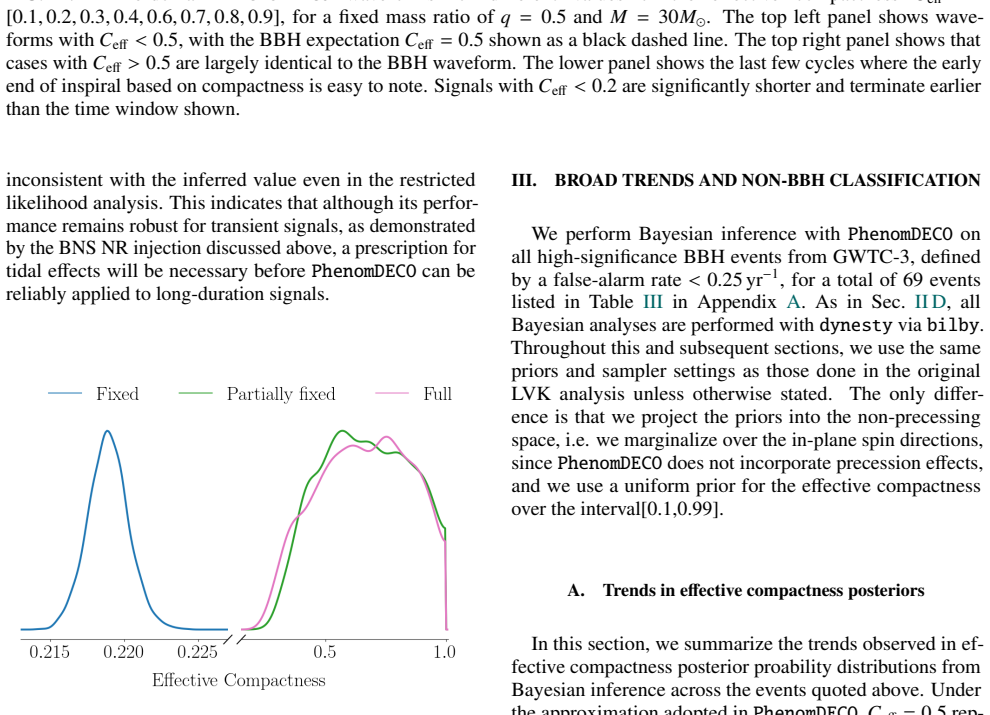
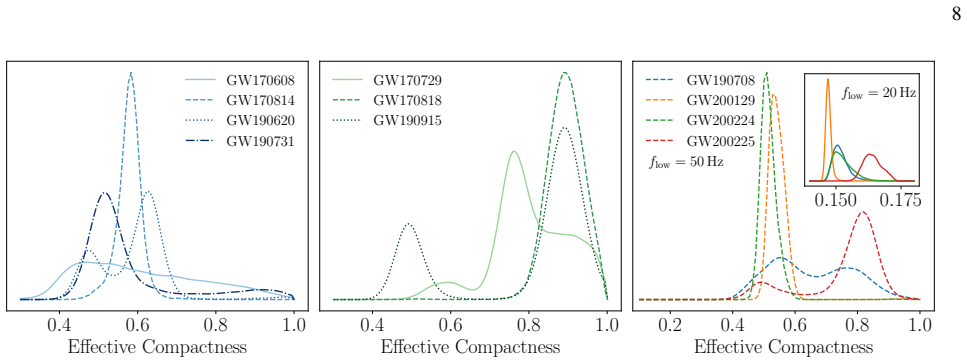
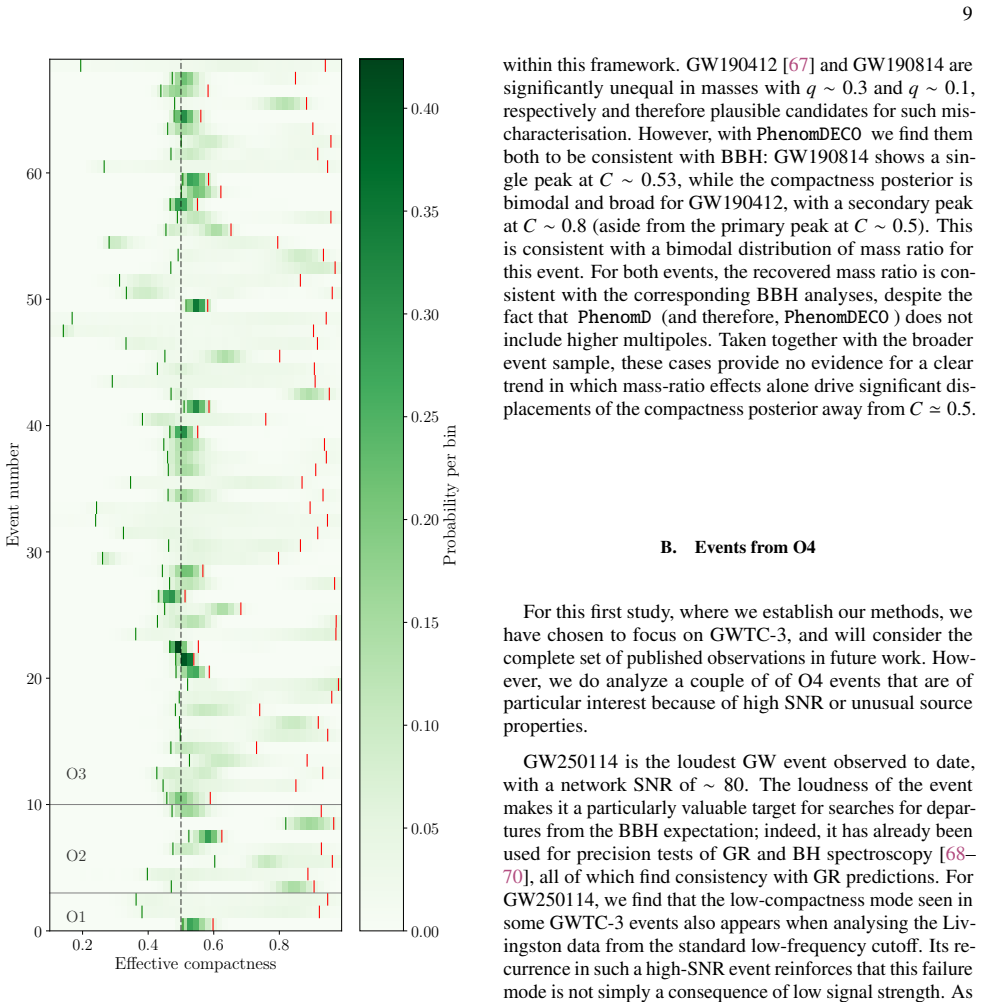
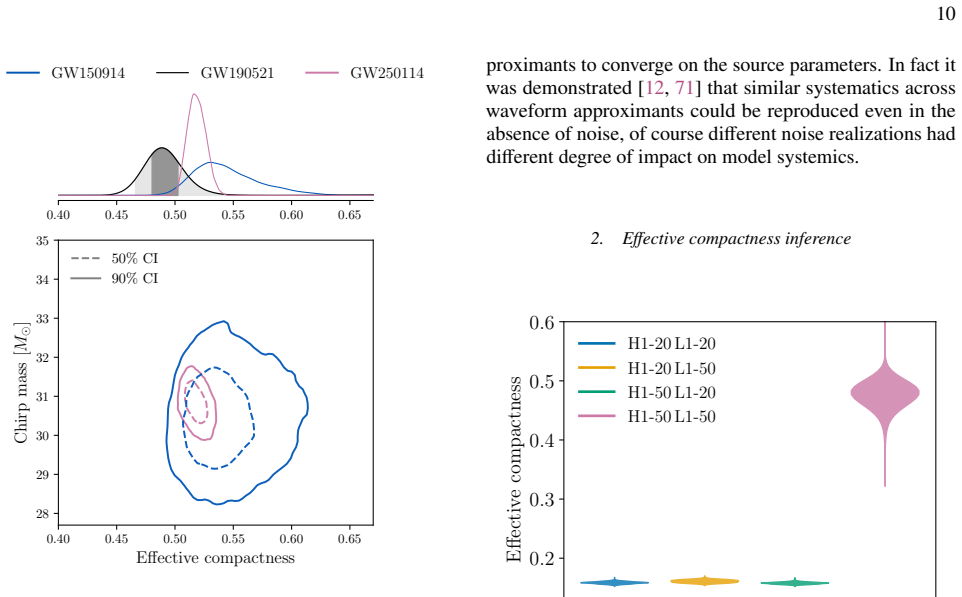
Dominant peak near C=0.5 About two thirds of the events show posteriors consistent with BBH, which we classify as typical behaviour. As shown in Figure 6, this category includes posteriors that: (i) exhibit a clear peak near C =0 .5 (GW190731); (ii) peak at 0.5, but with a very broad 90% credible interval (CI) (GW170608); (iii) are bimodal, with peaks dis...
-
[2]
Only one event shows a clear preference for C∼ 0.9 (GW170818), and in two other events C =0 .5 is excluded at 90% lower CI
Support for C>0.5 We found significant support for a compactness much higher than 0.5 for about ten events. Only one event shows a clear preference for C∼ 0.9 (GW170818), and in two other events C =0 .5 is excluded at 90% lower CI. In all the other cases, although the posterior probability favours a higher compactness, C =0 .5 was always included in the 9...
-
[3]
However, as discussed above, modest downward deviations from 0.5 can arise for a variety of non- exotic reasons
Spuriously low measure of compactness Nominally, a compactness posterior whose upper 90% CI lies below 0.5 would suggest that one or both components are of exotic origin. However, as discussed above, modest downward deviations from 0.5 can arise for a variety of non- exotic reasons. We therefore regard a compactness posterior as potentially suggestive of ...
-
[4]
This event is the most mas- sive BBH system observed to date by the LVK and was detected by the LIGO Livingston and Hanford observatories
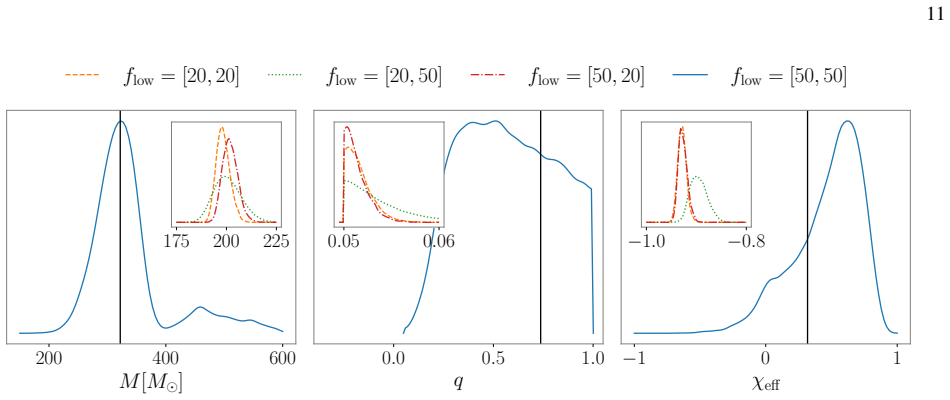
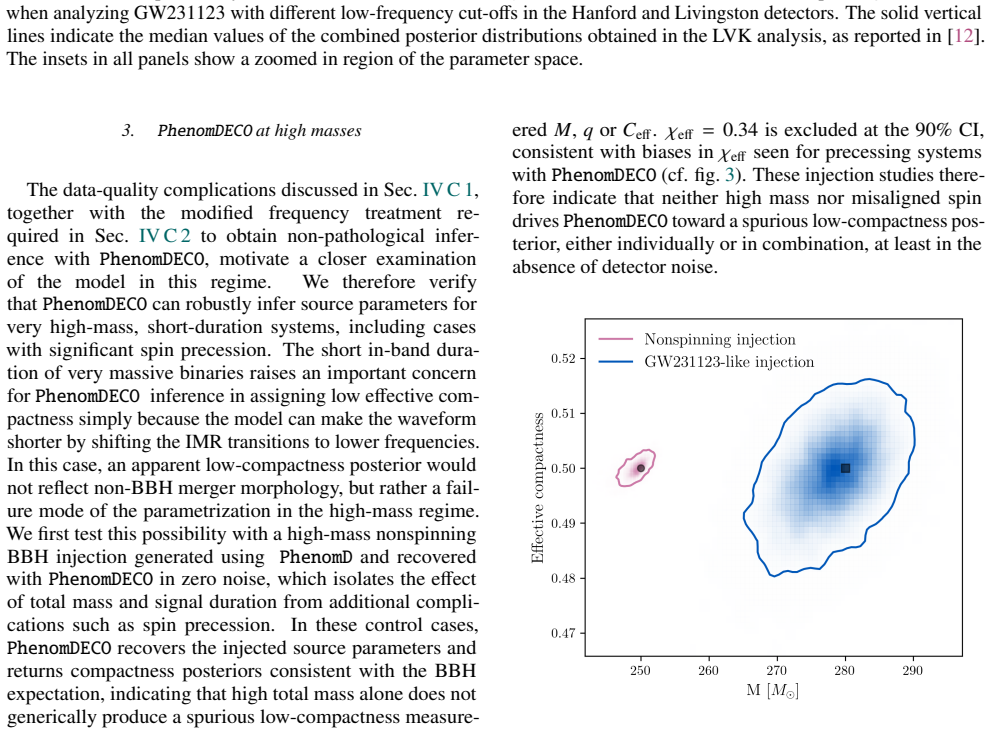
Event properties and analysis challenges We consider here the inference of source properties of GW231123 with PhenomDECO. This event is the most mas- sive BBH system observed to date by the LVK and was detected by the LIGO Livingston and Hanford observatories. Because of the binary’s short in-band duration, the detected signal is dominated by the merger-r...
-
[5]
10: Effective compactness inference for GW231123 using data above 20 Hz in both Livingston and Hanford is shown in blue
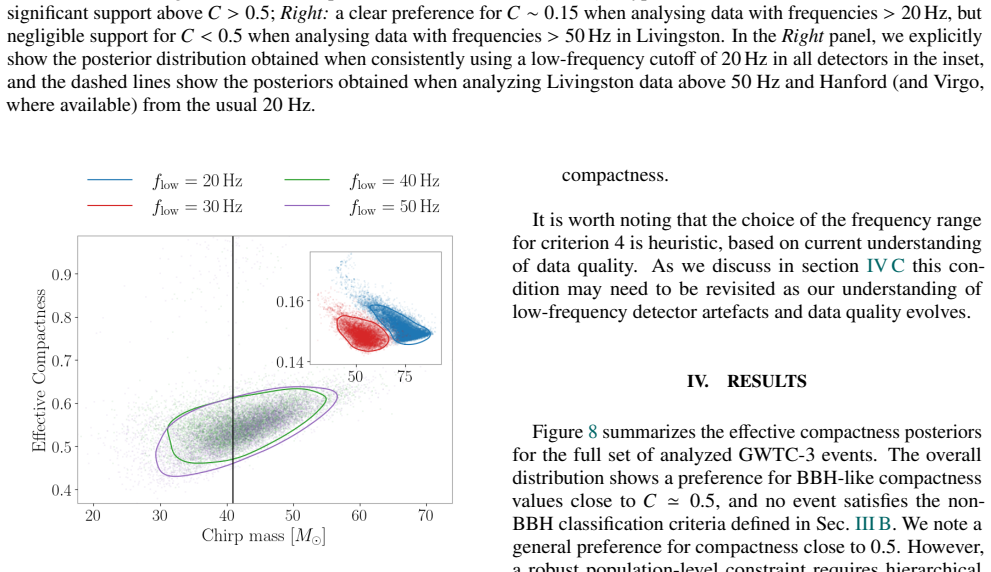
Effective compactness inference 0.1 0.2 0.3 0.4 0.5 0.6 Effective compactness H1-20 L1-20 H1-20 L1-50 H1-50 L1-20 H1-50 L1-50 FIG. 10: Effective compactness inference for GW231123 using data above 20 Hz in both Livingston and Hanford is shown in blue. Raising the low-frequency cutoffto 50 Hz in either detector, while keeping the other at 20 Hz, leaves the ...
-
[6]
Ordinarily, the persistence of a low-compactness mode under single- detector cutofftests would make the event more suggestive of genuine non-BBH structure
Interpretation Within our analysis, GW231123 stands out as a special case in that a BBH-like characterization with PhenomDECO is obtained only after raising the low- frequency cutoffconsistently in both detectors. Ordinarily, the persistence of a low-compactness mode under single- detector cutofftests would make the event more suggestive of genuine non-BB...
-
[7]
Using a low frequency cutoffof 50 Hz for Livingston data, while keeping 20 Hz for Hanford, shifts the recovered com- pactness posterior to a peak near 0.5
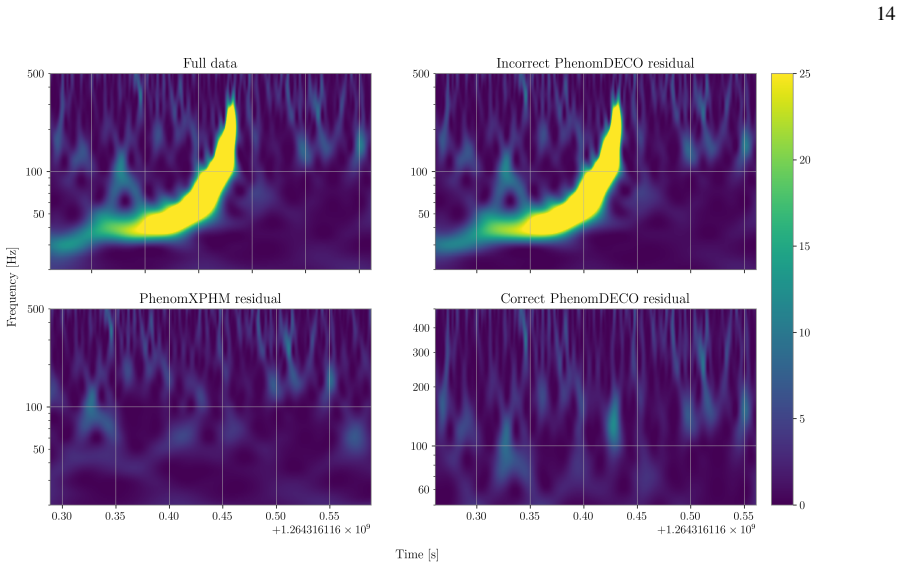
GW200129 First, we consider GW200129 which is one of the events where we found a spurious low-compactness peak at ∼ 0.15. Using a low frequency cutoffof 50 Hz for Livingston data, while keeping 20 Hz for Hanford, shifts the recovered com- pactness posterior to a peak near 0.5. The associated spec- trograms are consistent with this behaviour: the maximum- ...
-
[8]
This is comparable to what we find for events in which the likelihood peaks near C∼ 0.5 (see Table I)
GW191127 We then consider GW191127 and find the likeli- hood function to peak for a compactness C∼ 0.35 (logLC=0.5 =33 .69 and logLC=0.35 =48 .06 ) in Bayesian analysis, with a residual contrast of 0.037 be- tween PhenomDECO and PhenomXPHM . This is comparable to what we find for events in which the likelihood peaks near C∼ 0.5 (see Table I). Taken in iso...
-
[9]
13: Top left: spectrogram of the publicly available deglitched strain data for GW200129
GW200219 Finally, we consider GW200219, which was reported with the largest residual SNR and, more importantly, the 14 FIG. 13: Top left: spectrogram of the publicly available deglitched strain data for GW200129. Top right: residual spectrogram obtained after subtracting the maximum-likelihood PhenomDECO waveform from the analysis that favors C∼ 0.15. Bot...
-
[11]
A. H. Nitz, S. Kumar, Y .-F. Wang, S. Kastha, S. Wu, M. Schäfer, R. Dhurkunde, and C. D. Capano, 4-ogc: Catalog of gravitational waves from compact binary mergers, The Astrophysical Journal946, 59 (2023)
2023
-
[12]
Venumadhav, B
T. Venumadhav, B. Zackay, J. Roulet, L. Dai, and M. Zaldar- riaga, New binary black hole mergers in the second observing run of advanced ligo and advanced virgo, Phys. Rev. D101, 083030 (2020)
2020
- [13]
- [14]
-
[15]
A. G. Abacet al.(LIGO Scientific Collaboration and Virgo Collaboration and KAGRA Collaboration), GWTC-4.0: Up- dating the gravitational-wave transient catalog with ob- servations from the first part of the fourth LIGO-Virgo- KAGRA observing run 10.48550/arXiv.2508.18082 (2025), arXiv:2508.18082 [gr-qc]
work page internal anchor Pith review Pith/arXiv arXiv doi:10.48550/arxiv.2508.18082 2025
-
[16]
GWTC-5.0: An Introduction to Version 5.0 of the Gravitational-Wave Transient Catalog
N. Abacet al.(LIGO Scientific, VIRGO, KAGRA), GWTC- 5.0: An Introduction to Version 5.0 of the Gravitational-Wave Transient Catalog, (2026), arXiv:2605.27223 [gr-qc]
work page internal anchor Pith review Pith/arXiv arXiv 2026
-
[17]
GWTC-5.0: Population Properties of Merging Compact Bi- naries, (2026), arXiv:2605.27226 [astro-ph.HE]
work page internal anchor Pith review Pith/arXiv arXiv 2026
-
[18]
R. Abbottet al.(LIGO Scientific Collaboration and Virgo Collaboration), GW190814: Gravitational waves from the coalescence of a 23 solar mass black hole with a 2.6 solar mass compact object, The Astrophysical Journal Letters896, L44 (2020), arXiv:2006.12611 [astro-ph.HE]
work page internal anchor Pith review Pith/arXiv arXiv 2020
-
[19]
A. G. Abacet al.(LIGO Scientific Collaboration and Virgo Collaboration and KAGRA Collaboration), Observation of gravitational waves from the coalescence of a 2 .5–4.5 m⊙ compact object and a neutron star, The Astrophysical Journal Letters970, L34 (2024), arXiv:2404.04248 [astro-ph.HE]
- [20]
-
[21]
A. G. Abacet al.(LIGO Scientific, VIRGO, KAGRA), GW231123: A Binary Black Hole Merger with Total Mass 190–265 M ⊙, Astrophys. J. Lett.993, L25 (2025), arXiv:2507.08219 [astro-ph.HE]
work page internal anchor Pith review Pith/arXiv arXiv 2025
-
[22]
Phenomenological template family for black-hole coalescence waveforms
P. Ajithet al., Phenomenological template family for black- hole coalescence waveforms, Class. Quant. Grav.24, S689 (2007), arXiv:0704.3764 [gr-qc]
work page internal anchor Pith review Pith/arXiv arXiv 2007
-
[23]
Inspiral-merger-ringdown waveforms for black-hole binaries with non-precessing spins
P. Ajithet al., Inspiral-merger-ringdown waveforms for black- hole binaries with non-precessing spins, Phys. Rev. Lett.106, 241101 (2011), arXiv:0909.2867 [gr-qc]
work page internal anchor Pith review Pith/arXiv arXiv 2011
-
[24]
S. Khan, S. Husa, M. Hannam, F. Ohme, M. Pürrer, X. Jiménez Forteza, and A. Bohé, Frequency-domain gravi- tational waves from nonprecessing black-hole binaries. II. A phenomenological model for the advanced detector era, Phys. Rev. D93, 044007 (2016), arXiv:1508.07253 [gr-qc]
work page internal anchor Pith review Pith/arXiv arXiv 2016
-
[25]
S. Husa, S. Khan, M. Hannam, M. Pürrer, F. Ohme, X. Jiménez Forteza, and A. Bohé, Frequency-domain gravita- tional waves from nonprecessing black-hole binaries. I. New numerical waveforms and anatomy of the signal, Phys. Rev. D93, 044006 (2016), arXiv:1508.07250 [gr-qc]
work page internal anchor Pith review Pith/arXiv arXiv 2016
-
[26]
A simple model of complete precessing black-hole-binary gravitational waveforms
M. Hannam, P. Schmidt, A. Bohé, L. Haegel, S. Husa, F. Ohme, G. Pratten, and M. Pürrer, Simple Model of Complete Precessing Black-Hole-Binary Gravitational Wave- forms, Phys. Rev. Lett.113, 151101 (2014), arXiv:1308.3271 [gr-qc]
work page internal anchor Pith review Pith/arXiv arXiv 2014
-
[27]
J. E. Thompson, E. Hamilton, L. London, S. Ghosh, P. Kolit- sidou, C. Hoy, and M. Hannam, PhenomXO4a: a phenomeno- logical gravitational-wave model for precessing black-hole binaries with higher multipoles and asymmetries, Phys. Rev. D109, 063012 (2024), arXiv:2312.10025 [gr-qc]
-
[28]
M. Colleoni, F. A. R. Vidal, C. García-Quirós, S. Akçay, and S. Bera, Fast frequency-domain gravitational waveforms for precessing binaries with a new twist, Phys. Rev. D111, 104019 (2025), arXiv:2412.16721 [gr-qc]
-
[29]
E. Hamiltonet al., Improved gravitational wave model link- ing precessing inspirals and numerical-relativity-calibrated merger-ringdown, Phys. Rev. D113, 084055 (2026), arXiv:2507.02604 [gr-qc]
- [30]
-
[31]
Effective one-body approach to general relativistic two-body dynamics
A. Buonanno and T. Damour, Effective one-body approach to general relativistic two-body dynamics, Phys. Rev. D59, 084006 (1999), arXiv:gr-qc/9811091
work page internal anchor Pith review Pith/arXiv arXiv 1999
-
[32]
Transition from inspiral to plunge in binary black hole coalescences
A. Buonanno and T. Damour, Transition from inspiral to plunge in binary black hole coalescences, Phys. Rev. D62, 064015 (2000), arXiv:gr-qc/0001013
work page internal anchor Pith review Pith/arXiv arXiv 2000
-
[33]
Effective-one-body model for black-hole binaries with generic mass ratios and spins
A. Taracchiniet al., Effective-one-body model for black-hole binaries with generic mass ratios and spins, Phys. Rev. D89, 061502 (2014), arXiv:1311.2544 [gr-qc]
work page internal anchor Pith review Pith/arXiv arXiv 2014
-
[34]
Transition from inspiral to plunge in precessing binaries of spinning black holes
A. Buonanno, Y . Chen, and T. Damour, Transition from inspi- ral to plunge in precessing binaries of spinning black holes, Phys. Rev. D74, 104005 (2006), arXiv:gr-qc/0508067
work page internal anchor Pith review Pith/arXiv arXiv 2006
-
[35]
A. Ramos-Buades, A. Buonanno, H. Estellés, M. Khalil, D. P. Mihaylov, S. Ossokine, L. Pompili, and M. Shiferaw, Next generation of accurate and efficient multipolar precessing- spin effective-one-body waveforms for binary black holes, Phys. Rev. D108, 124037 (2023), arXiv:2303.18046 [gr-qc]
-
[36]
H. Estellés, A. Buonanno, R. Enficiaud, C. Foo, and L. Pom- pili, Adding equatorial-asymmetric effects for spin-precessing binaries into the seobnrv5phm waveform model, Phys. Rev. D113, 044049 (2026), arXiv:2506.19911 [gr-qc]
-
[37]
T. Evstafyeva, U. Sperhake, I. Romero-Shaw, and M. Agathos, Gravitational-wave data analysis with high-precision numer- ical relativity simulations of boson star mergers, (2024), arXiv:2406.02715 [gr-qc]
-
[38]
Lessons from binary dynamics of inspiralling equal-mass boson-star mergers
T. Evstafyeva, A. Seifert, U. Sperhake, C. J. Moore, and T. Jain, Lessons from binary dynamics of inspiralling equal- mass boson-star mergers, (2026), arXiv:2604.25582 [gr-qc]
work page internal anchor Pith review Pith/arXiv arXiv 2026
-
[39]
Tests of General Relativity with GWTC-3
R. Abbottet al.(LIGO Scientific, VIRGO, KAGRA), Tests of General Relativity with GWTC-3, Phys. Rev. D112, 084080 (2025), arXiv:2112.06861 [gr-qc]
work page internal anchor Pith review Pith/arXiv arXiv 2025
-
[40]
S. Ghosh and M. Hannam, Identification of exotic compact binaries with gravitational waves: A phenomenological ap- proach, Phys. Rev. D112, 104017 (2025), arXiv:2505.16380 [gr-qc]
-
[41]
Ghosh, C
S. Ghosh, C. Hoy, M. Hannam, and F. Ohme, Companion paper (2026), in preparation
2026
-
[42]
J. Aasiet al.(LIGO Scientific), Advanced LIGO, Class. Quant. Grav.32, 074001 (2015), arXiv:1411.4547 [gr-qc]
work page internal anchor Pith review Pith/arXiv arXiv 2015
-
[43]
A. Buikemaet al.(aLIGO), Sensitivity and performance of the Advanced LIGO detectors in the third observing run, Phys. Rev. D102, 062003 (2020), arXiv:2008.01301 [astro-ph.IM]
-
[44]
Tseet al., Quantum-Enhanced Advanced LIGO Detectors in the Era of Gravitational-Wave Astronomy, Phys
M. Tseet al., Quantum-Enhanced Advanced LIGO Detectors in the Era of Gravitational-Wave Astronomy, Phys. Rev. Lett. 123, 231107 (2019)
2019
-
[45]
Advanced Virgo: a 2nd generation interferometric gravitational wave detector
F. Acerneseet al.(VIRGO), Advanced Virgo: a second- generation interferometric gravitational wave detector, Class. Quant. Grav.32, 024001 (2015), arXiv:1408.3978 [gr-qc]
work page internal anchor Pith review Pith/arXiv arXiv 2015
-
[46]
Acerneseet al.(Virgo), Increasing the Astrophysical Reach of the Advanced Virgo Detector via the Application of Squeezed Vacuum States of Light, Phys
F. Acerneseet al.(Virgo), Increasing the Astrophysical Reach of the Advanced Virgo Detector via the Application of Squeezed Vacuum States of Light, Phys. Rev. Lett.123, 231108 (2019)
2019
-
[47]
F. Acerneseet al.(Virgo), Virgo detector characterization and data quality: results from the O3 run, Class. Quant. Grav.40, 185006 (2023), arXiv:2210.15633 [gr-qc]
-
[48]
K. Somiya (KAGRA), Detector configuration of KAGRA: The Japanese cryogenic gravitational-wave detector, Class. Quant. Grav.29, 124007 (2012), arXiv:1111.7185 [gr-qc]
-
[49]
Y . Aso, Y . Michimura, K. Somiya, M. Ando, O. Miyakawa, T. Sekiguchi, D. Tatsumi, and H. Yamamoto (The KAGRA Collaboration), Interferometer design of the kagra gravita- tional wave detector, Phys. Rev. D88, 043007 (2013)
2013
-
[50]
T. Akutsuet al.(KAGRA), Overview of KAGRA: Detector design and construction history, PTEP2021, 05A101 (2021), arXiv:2005.05574 [physics.ins-det]
-
[51]
N. V . Krishnendu, K. G. Arun, and C. K. Mishra, Testing the binary black hole nature of a compact binary coalescence, Phys. Rev. Lett.119, 091101 (2017), arXiv:1701.06318 [gr- qc]
work page internal anchor Pith review Pith/arXiv arXiv 2017
- [52]
- [53]
-
[54]
Black Hole Spectroscopy: Testing General Relativity through Gravitational Wave Observations
O. Dreyer, B. J. Kelly, B. Krishnan, L. S. Finn, D. Garrison, and R. Lopez-Aleman, Black hole spectroscopy: Testing general relativity through gravitational wave observations, Class. Quant. Grav.21, 787 (2004), arXiv:gr-qc/0309007
work page internal anchor Pith review Pith/arXiv arXiv 2004
- [55]
-
[56]
N. Uchikata, H. Nakano, T. Narikawa, N. Sago, H. Tagoshi, and T. Tanaka, Searching for black hole echoes from the LIGO-Virgo Catalog GWTC-1, Phys. Rev. D100, 062006 (2019), arXiv:1906.00838 [gr-qc]
-
[57]
N. Uchikata, T. Narikawa, H. Nakano, N. Sago, H. Tagoshi, 19 and T. Tanaka, Searching for gravitational wave echoes from black hole binary events in the third observing run of LIGO, Virgo, and KAGRA collaborations, Phys. Rev. D108, 104040 (2023), arXiv:2309.01894 [gr-qc]
-
[58]
S. A. Hughes and K. Menou, Golden binaries for LISA: Ro- bust probes of strong-field gravity, Astrophys. J.623, 689 (2005), arXiv:astro-ph/0410148
work page internal anchor Pith review Pith/arXiv arXiv 2005
-
[59]
Testing general relativity using golden black-hole binaries
A. Ghoshet al., Testing general relativity using golden black-hole binaries, Phys. Rev. D94, 021101 (2016), arXiv:1602.02453 [gr-qc]
work page internal anchor Pith review Pith/arXiv arXiv 2016
-
[60]
Head-on collisions of boson stars
C. Palenzuela, I. Olabarrieta, L. Lehner, and S. L. Liebling, Head-on collisions of boson stars, Phys. Rev. D75, 064005 (2007), arXiv:gr-qc/0612067
work page internal anchor Pith review Pith/arXiv arXiv 2007
-
[61]
Orbital Dynamics of Binary Boson Star Systems
C. Palenzuela, L. Lehner, and S. L. Liebling, Orbital Dynam- ics of Binary Boson Star Systems, Phys. Rev. D77, 044036 (2008), arXiv:0706.2435 [gr-qc]
work page internal anchor Pith review Pith/arXiv arXiv 2008
-
[62]
Full 3D Numerical Relativity Simulations of Neutron Star -- Boson Star Collisions with BAM
T. Dietrich, S. Ossokine, and K. Clough, Full 3D numer- ical relativity simulations of neutron star–boson star colli- sions with BAM, Class. Quant. Grav.36, 025002 (2019), arXiv:1807.06959 [gr-qc]
work page internal anchor Pith review Pith/arXiv arXiv 2019
-
[63]
Axion star collisions with black holes and neutron stars in full 3D numerical relativity
K. Clough, T. Dietrich, and J. C. Niemeyer, Axion star colli- sions with black holes and neutron stars in full 3D numerical relativity, Phys. Rev. D98, 083020 (2018), arXiv:1808.04668 [gr-qc]
work page internal anchor Pith review Pith/arXiv arXiv 2018
-
[64]
N. Siemonsen and W. E. East, Binary boson stars: Merger dynamics and formation of rotating remnant stars, Phys. Rev. D107, 124018 (2023), arXiv:2302.06627 [gr-qc]
-
[65]
G. Prattenet al., Computationally efficient models for the dominant and subdominant harmonic modes of precess- ing binary black holes, Phys. Rev. D103, 104056 (2021), arXiv:2004.06503 [gr-qc]
work page internal anchor Pith review Pith/arXiv arXiv 2021
-
[66]
Sensitivity Studies for Third-Generation Gravitational Wave Observatories
S. Hildet al., Sensitivity Studies for Third-Generation Gravi- tational Wave Observatories, Class. Quant. Grav.28, 094013 (2011), arXiv:1012.0908 [gr-qc]
work page internal anchor Pith review Pith/arXiv arXiv 2011
-
[67]
J. S. Speagle, dynesty: a dynamic nested sampling package for estimating Bayesian posteriors and evidences, Mon. Not. Roy. Astron. Soc.493, 3132 (2020), arXiv:1904.02180 [astro- ph.IM]
work page internal anchor Pith review Pith/arXiv arXiv 2020
-
[68]
Bilby: A user-friendly Bayesian inference library for gravitational-wave astronomy
G. Ashtonet al., BILBY: A user-friendly Bayesian inference library for gravitational-wave astronomy, Astrophys. J. Suppl. 241, 27 (2019), arXiv:1811.02042 [astro-ph.IM]
work page internal anchor Pith review Pith/arXiv arXiv 2019
-
[69]
I. M. Romero-Shawet al., Bayesian inference for com- pact binary coalescences with bilby: validation and appli- cation to the first LIGO–Virgo gravitational-wave transient catalogue, Mon. Not. Roy. Astron. Soc.499, 3295 (2020), arXiv:2006.00714 [astro-ph.IM]
work page internal anchor Pith review Pith/arXiv arXiv 2020
-
[70]
CoRe database of binary neutron star merger waveforms and its application in waveform development
T. Dietrich, D. Radice, S. Bernuzzi, F. Zappa, A. Perego, B. Brügmann, S. V . Chaurasia, R. Dudi, W. Tichy, and M. Uje- vic, CoRe database of binary neutron star merger waveforms, Class. Quant. Grav.35, 24LT01 (2018), arXiv:1806.01625 [gr-qc]
work page internal anchor Pith review Pith/arXiv arXiv 2018
-
[71]
R. Dudi, F. Pannarale, T. Dietrich, M. Hannam, S. Bernuzzi, F. Ohme, and B. Brügmann, Relevance of tidal effects and post-merger dynamics for binary neutron star parameter esti- mation, Phys. Rev. D98, 084061 (2018), arXiv:1808.09749 [gr-qc]
work page internal anchor Pith review Pith/arXiv arXiv 2018
-
[72]
M. Hannamet al., General-relativistic precession in a black- hole binary, Nature610, 652 (2022), arXiv:2112.11300 [gr- qc]
- [73]
-
[74]
Scattered light noise at LIGO Livingston Observatory during O4
D. Nandi, A. Effler, S. Soni, T. A. Ferreira, R. Schofield, H. Pham, T. O’Hanlon, V . V . Frolov, and G. González, Scat- tered light noise at ligo livingston observatory during o4 (2026), arXiv:2605.14143 [astro-ph.IM]
work page internal anchor Pith review Pith/arXiv arXiv 2026
-
[75]
A. G. Abacet al.(LIGO Scientific, Virgo, KAGRA), GW250114: Testing Hawking’s Area Law and the Kerr Na- ture of Black Holes, Phys. Rev. Lett.135, 111403 (2025), arXiv:2509.08054 [gr-qc]
work page internal anchor Pith review Pith/arXiv arXiv 2025
-
[76]
R. Abbottet al.(LIGO Scientific, Virgo), GW190412: Obser- vation of a Binary-Black-Hole Coalescence with Asymmetric Masses, Phys. Rev. D102, 043015 (2020), arXiv:2004.08342 [astro-ph.HE]
-
[77]
A. G. Abacet al.(LIGO Scientific, Virgo, KAGRA), Black Hole Spectroscopy and Tests of General Relativ- ity with GW250114, Phys. Rev. Lett.136, 041403 (2026), arXiv:2509.08099 [gr-qc]
work page internal anchor Pith review Pith/arXiv arXiv 2026
- [78]
-
[79]
Plunge-Merger-Ringdown Tests of General Relativity with GW250114
L. Grimaldi, E. Maggio, L. Pompili, and A. Buo- nanno, Plunge-merger-ringdown tests of general relativ- ity with GW250114, Phys. Rev. D113, L061506 (2026), arXiv:2601.13173 [gr-qc]
work page internal anchor Pith review Pith/arXiv arXiv 2026
-
[80]
S. Bini, K. Król, K. Chatziioannou, and M. Isi, The impact of waveform systematics and Gaussian noise on the interpreta- tion of GW231123, (2026), arXiv:2601.09678 [gr-qc]
work page internal anchor Pith review Pith/arXiv arXiv 2026
-
[81]
G. Dideron, S. Mukherjee, and L. Lehner, SCoRe: A New Framework to Study Unmodeled Physics from Grav- itational Wave Data, Phys. Rev. D107, 104023 (2023), arXiv:2209.14321 [gr-qc]
discussion (0)
Sign in with ORCID, Apple, or X to comment. Anyone can read and Pith papers without signing in.