Beyond the Fundamental Metallicity Relation: galaxy sizes encode the link between inflow and metallicity
Pith reviewed 2026-06-27 06:40 UTC · model grok-4.3
The pith
At fixed stellar mass, galaxy size encodes the link between long-term gas inflow history and present-day metallicity.
A machine-rendered reading of the paper's core claim, the machinery that carries it, and where it could break.
Core claim
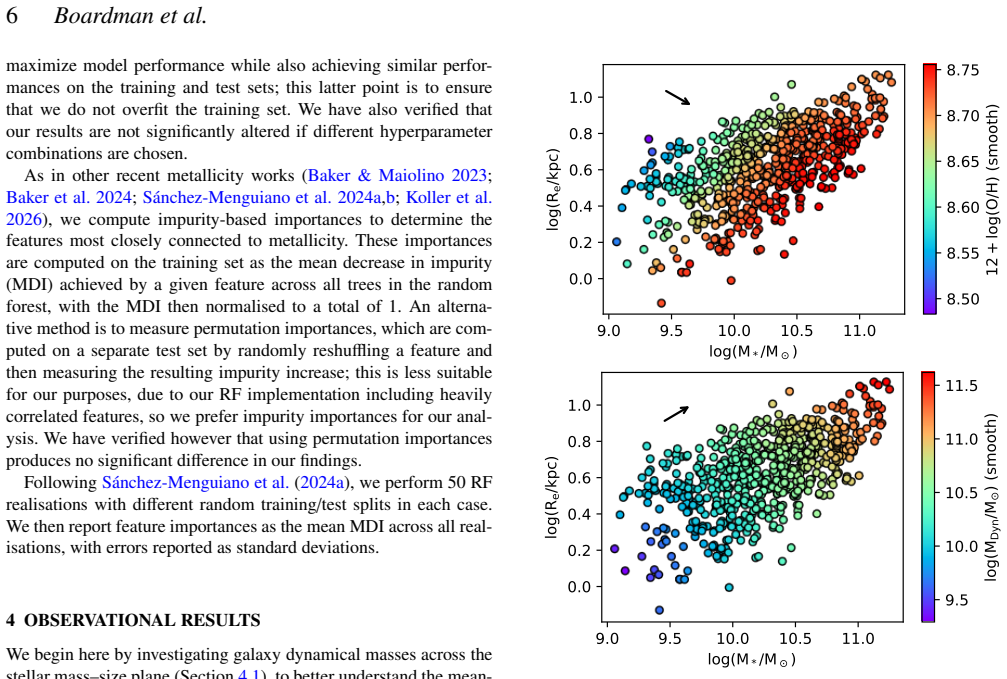
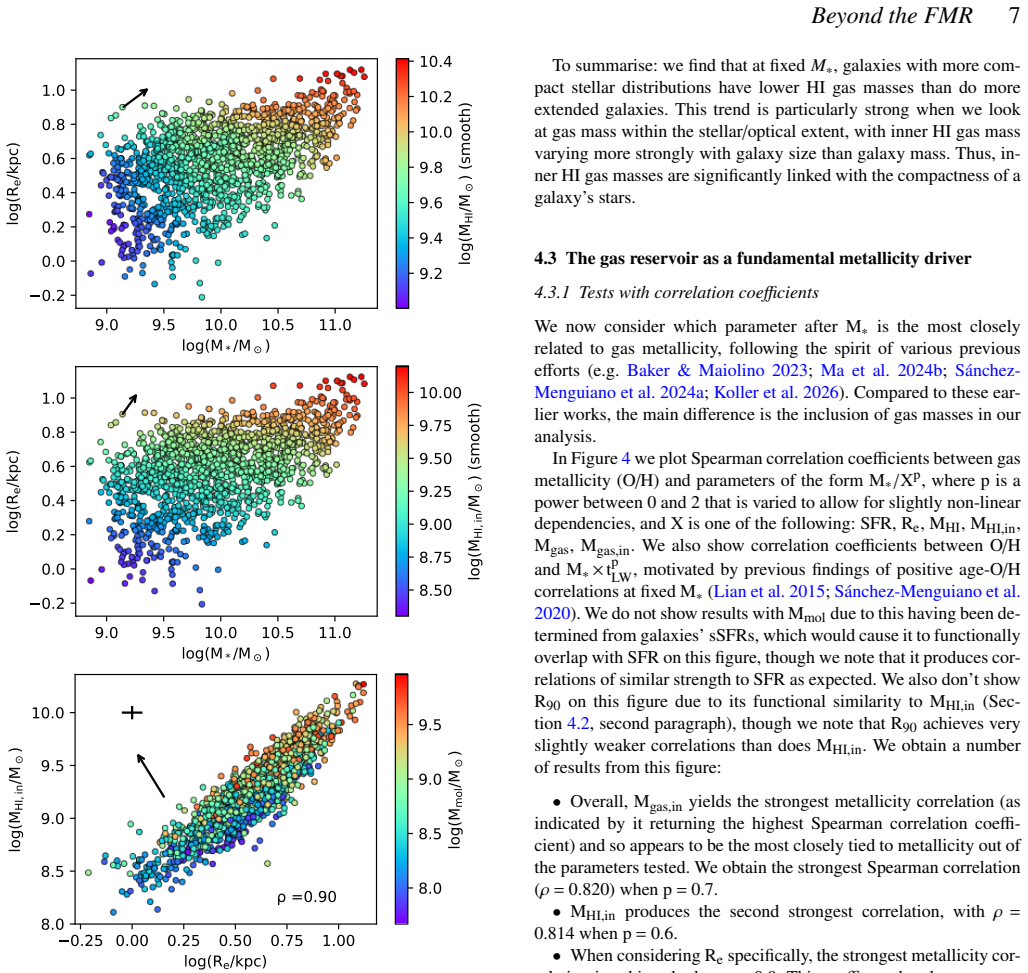
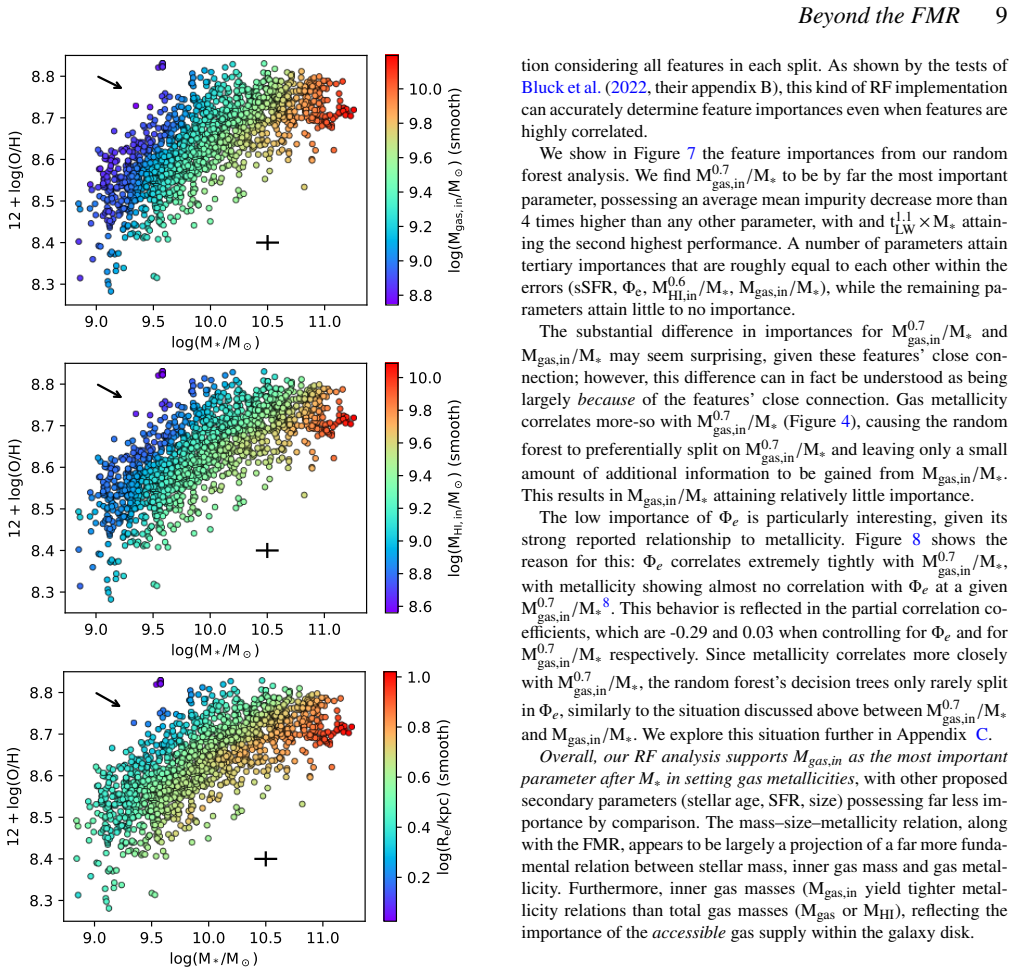
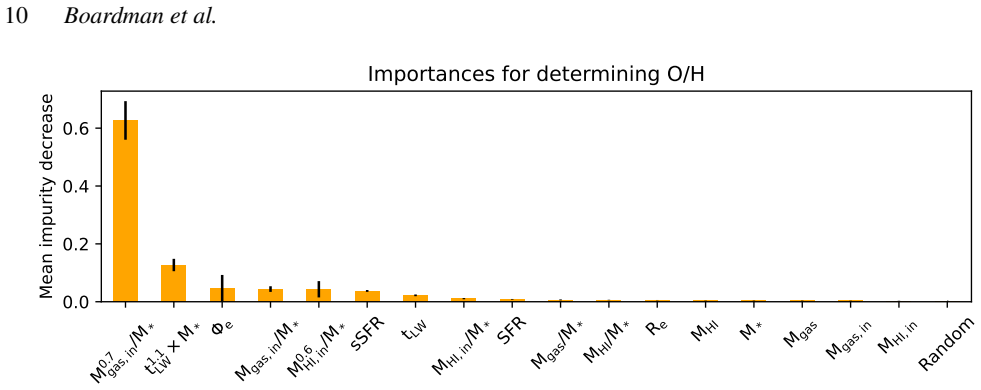
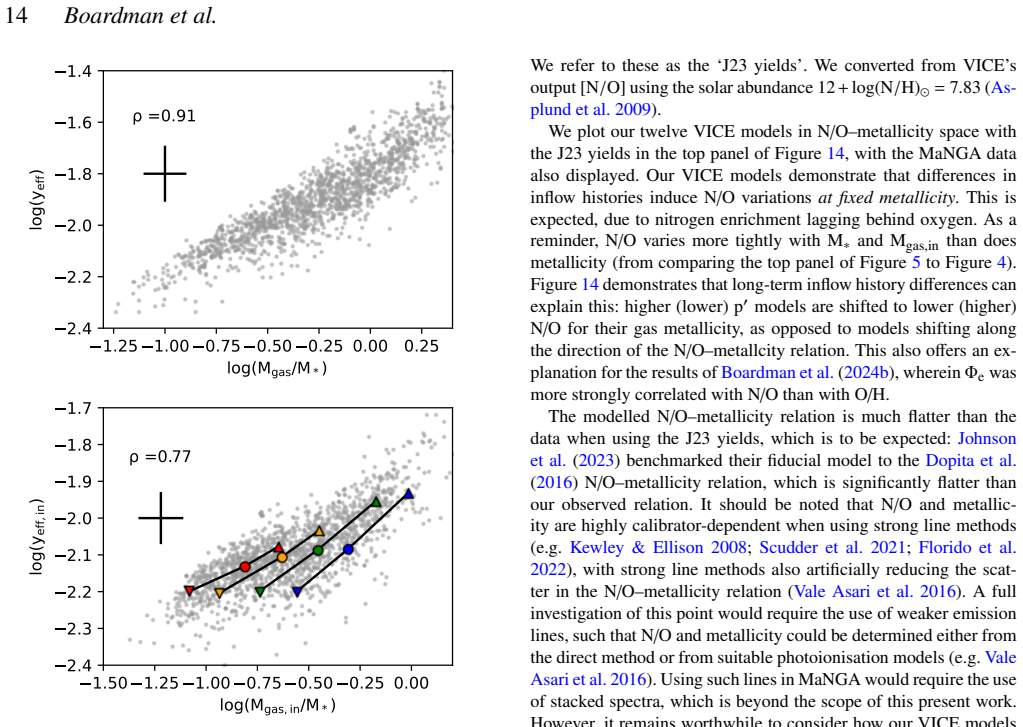
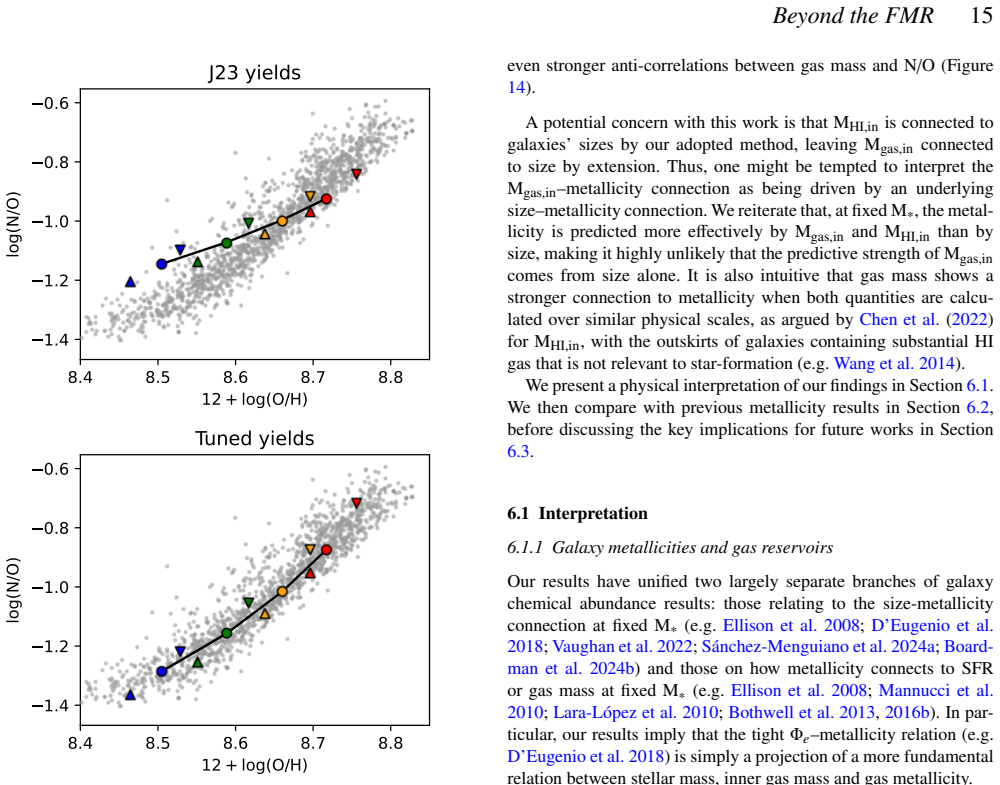
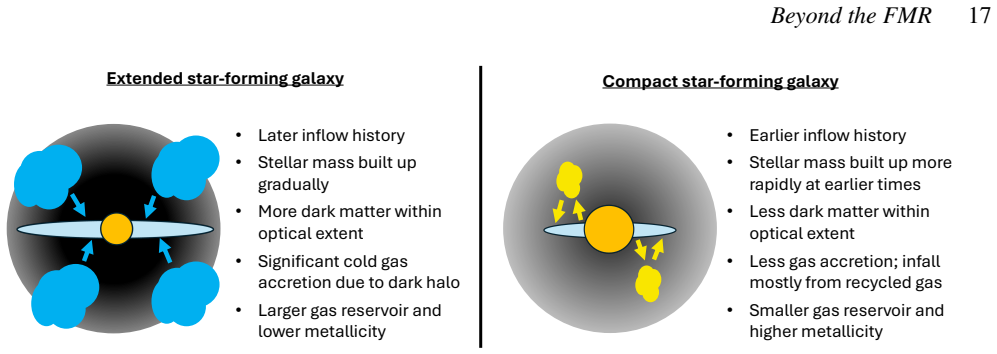
More compact galaxies at fixed stellar mass have lower dynamical masses, lower inner gas masses, and higher metallicities. The strong observed correlation between inner gas mass and size rules out short-term inflow fluctuations as the cause of the residuals. Instead, chemical evolution models show that earlier long-term inflow histories in compact systems produce more rapidly declining gas reservoirs at late times, yielding higher metallicities today. Stellar metallicities and N/O ratios follow the same trends, confirming the link to long-term histories.
What carries the argument
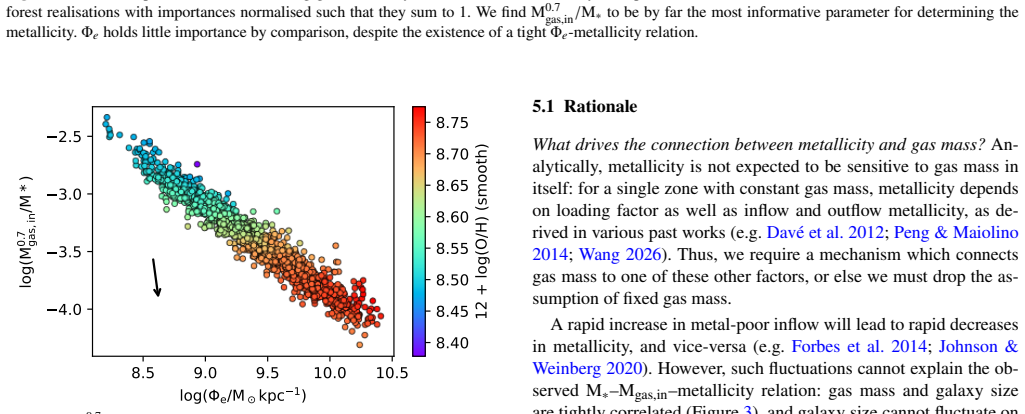
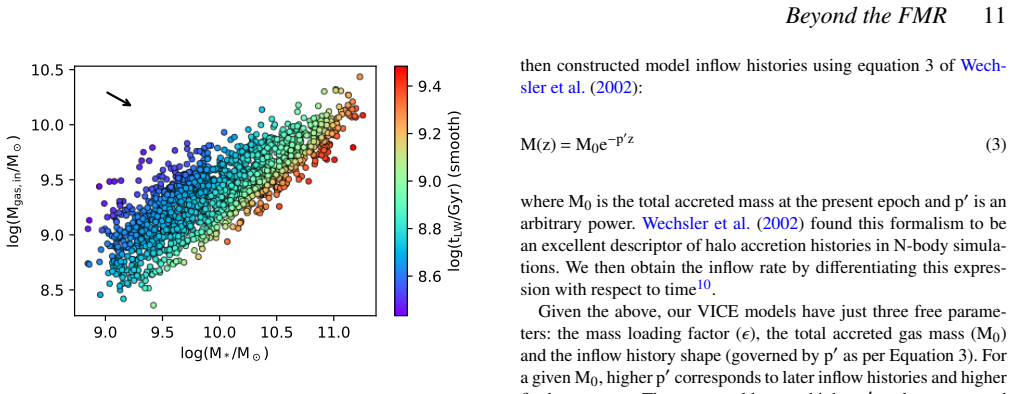
The correlation between inner gas mass (estimated from HI-MaNGA and MaNGA data) and optical size, interpreted through chemical evolution models as a signature of differing long-term inflow histories.
If this is right
- Compact galaxies have lower dynamical masses than extended galaxies at the same stellar mass.
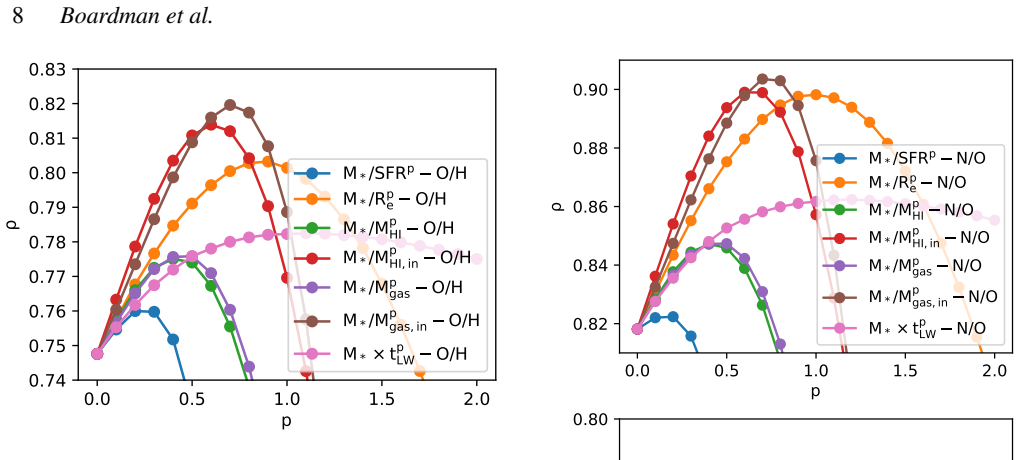
- Inner gas mass is the dominant secondary parameter after stellar mass in predicting gas, stellar, and N/O metallicities.
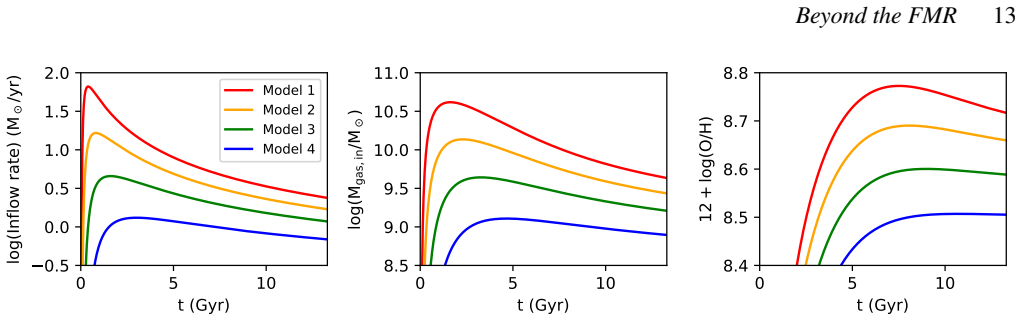
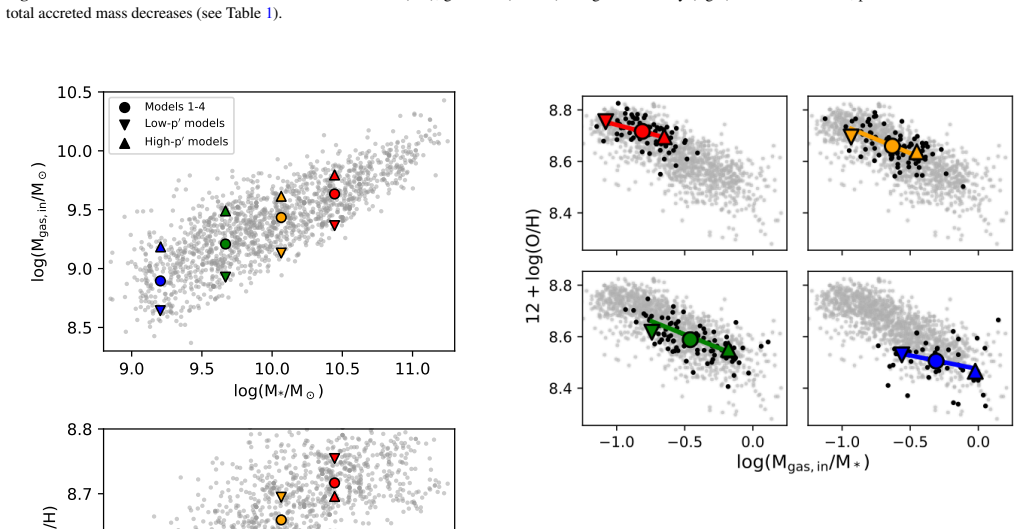
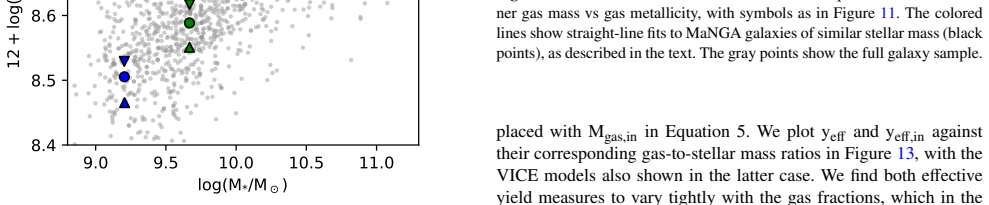
- Long-term differences in inflow timing produce the observed anti-correlation between size and metallicity at fixed mass.
- Halo assembly history differences are encoded in present-day galaxy size through their effect on gas reservoir evolution.
Where Pith is reading between the lines
- If size really traces inflow timing, then size-selected samples at fixed mass should show systematic differences in gas depletion timescales that can be checked with future HI and CO observations.
- The result suggests that semi-analytic models or simulations should reproduce the size-gas mass correlation as a direct consequence of earlier assembly for compact systems.
- Extending the analysis to higher redshifts could test whether the size-metallicity link strengthens or weakens as average inflow rates change.
Load-bearing premise
The correlation between inner gas mass and optical size is strong enough to exclude short-term inflow fluctuations as the driver of metallicity residuals, and chemical evolution models can be used to attribute the pattern exclusively to differences in long-term inflow timing.
What would settle it
A large sample of star-forming galaxies at fixed stellar mass showing no correlation between optical size and inner gas mass, or showing that short-term inflow variations reproduce the observed metallicity residuals without needing differences in long-term inflow timing.
Figures
read the original abstract
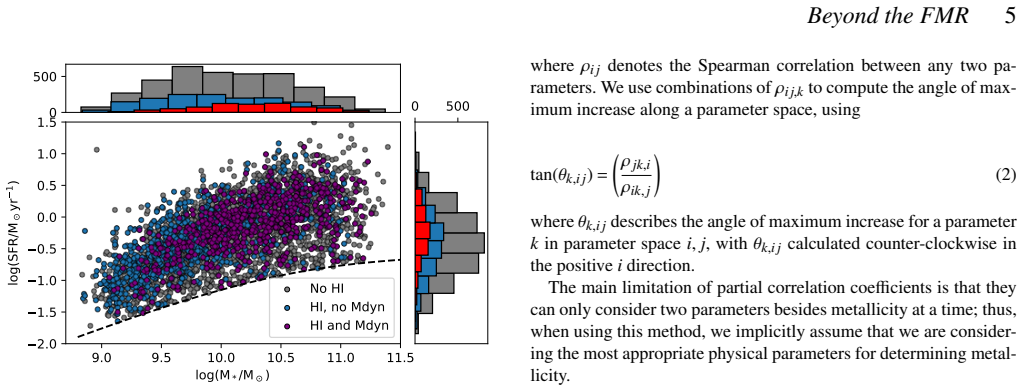
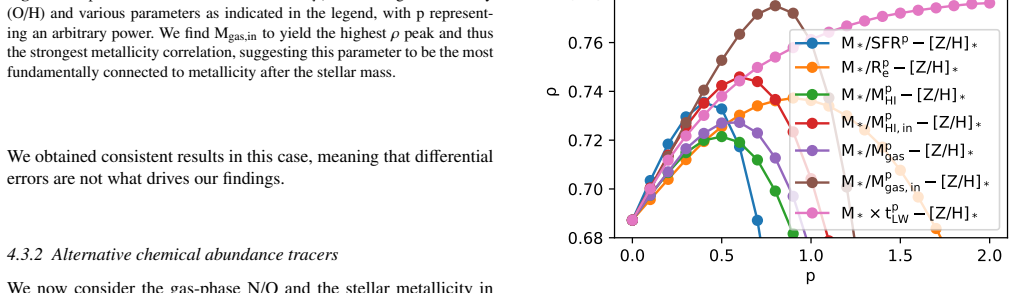
Gas-phase chemical abundances are key observable consequences of galaxy evolution, being intrinsically tied to galaxy formation histories. Gas metallicity rises with increasing stellar mass ($\mathrm{M_*}$), forming the well-known mass-metallicity relation (MZR). MZR residuals have separately been shown to anti-correlate with star-formation rate (the ``fundamental'' metallicity relation), with gas mass and with optical size, but no single analysis has considered all trends together. We thus perform a combined analysis of all three trends, utilizing optical MaNGA integral field spectroscopy, HI-MaNGA gas masses, and MaNGA DynPop dynamical masses. We estimate inner gas masses for $\sim$1500 star-forming galaxies, finding this to be the most important parameter after $\mathrm{M_*}$ in predicting gas metallicities. We obtain equivalent results for stellar metallicities and gaseous N/O, suggesting that current inner gas masses are intrinsically linked to long-term chemical evolution histories. We show that more compact galaxies have lower dynamical masses, challenging suggestions that deeper gravitational potentials confer higher metallicities. We find a strong correlation between inner gas mass and galaxy size, meaning that short term inflow fluctuations cannot be responsible for the MZR residuals. With chemical evolution models, we show that our results can instead be explained by differences in long-term inflow histories. The earlier inflow histories of compact galaxies lead to lower gas masses and more rapidly declining gas reservoirs at late times, leading to higher metallicities. At fixed stellar mass, galaxy size therefore encodes the link between halo assembly histories, long-term gas inflow histories, current gas reservoirs and metallicity.
Editorial analysis
A structured set of objections, weighed in public.
Referee Report
Summary. The manuscript analyzes ~1500 star-forming galaxies using MaNGA integral-field spectroscopy, HI-MaNGA gas masses, and DynPop dynamical masses. It reports that inner gas mass is the strongest predictor of gas-phase metallicity after stellar mass M_*, that inner gas mass correlates strongly with optical size at fixed M_*, and that more compact galaxies exhibit lower dynamical masses. Chemical-evolution models are invoked to interpret the size–metallicity residual correlation as arising from differences in long-term inflow timing rather than short-term fluctuations or deeper potentials, leading to the claim that galaxy size encodes the connection between halo assembly history, long-term gas inflow, current gas reservoirs, and metallicity.
Significance. If the central observational correlations are robust, the work offers a unified empirical picture of MZR residuals that ties an easily measured structural parameter (size) to assembly and accretion history. The combined treatment of SFR, gas mass, and size trends on the same sample is a clear strength, as is the use of public survey data. The result would be of broad interest to galaxy-evolution studies if the exclusion of short-term inflow scenarios can be placed on a quantitative footing.
major comments (2)
- [Abstract] Abstract: the assertion that the observed inner-gas-mass versus size correlation 'meaning that short term inflow fluctuations cannot be responsible for the MZR residuals' is presented as a direct logical consequence of the correlation strength. No quantitative test (e.g., forward-modelled mock catalogs with stochastic short-term accretion bursts, selection effects, and measurement uncertainties) is described that demonstrates incompatibility with the data; this step is load-bearing for the central claim that long-term inflow timing is the sole explanation.
- [Chemical evolution models] Chemical-evolution-model section: the models invoked to attribute the trends exclusively to long-term inflow history differences must have their parameters (inflow timescales, efficiencies, etc.) shown to be fixed by independent constraints or prior literature rather than tuned to the present MaNGA sample; otherwise the interpretation carries a circularity risk that affects the physical conclusion.
minor comments (1)
- [Methods] Methods: the manuscript should explicitly state the precise criteria used to select the ~1500 star-forming galaxies, the aperture definition for 'inner' gas mass, and the full error-propagation procedure for the dynamical-mass and metallicity measurements.
Simulated Author's Rebuttal
We thank the referee for their constructive feedback. We respond point by point to the major comments below.
read point-by-point responses
-
Referee: [Abstract] Abstract: the assertion that the observed inner-gas-mass versus size correlation 'meaning that short term inflow fluctuations cannot be responsible for the MZR residuals' is presented as a direct logical consequence of the correlation strength. No quantitative test (e.g., forward-modelled mock catalogs with stochastic short-term accretion bursts, selection effects, and measurement uncertainties) is described that demonstrates incompatibility with the data; this step is load-bearing for the central claim that long-term inflow timing is the sole explanation.
Authors: We agree a forward-modeling test with mocks would provide additional support. However, the observed tight correlation between inner gas mass and size at fixed M_* is difficult to produce via short-term stochastic inflows alone, since size is a long-term structural property while short-term fluctuations would primarily add uncorrelated scatter. We will revise the abstract wording to indicate that the correlation supports (rather than directly proves) the long-term interpretation and add a clarifying sentence on this reasoning. revision: partial
-
Referee: [Chemical evolution models] Chemical-evolution-model section: the models invoked to attribute the trends exclusively to long-term inflow history differences must have their parameters (inflow timescales, efficiencies, etc.) shown to be fixed by independent constraints or prior literature rather than tuned to the present MaNGA sample; otherwise the interpretation carries a circularity risk that affects the physical conclusion.
Authors: The model parameters (inflow timescales and efficiencies) are taken from standard values in the prior literature on galaxy chemical evolution and are not adjusted to the MaNGA sample. We will revise the section to explicitly cite the independent sources of these parameters and state that they were not tuned to the present data. revision: yes
Circularity Check
No significant circularity; observational correlations independent of interpretive models
full rationale
The paper reports direct observational correlations (inner gas mass vs. size at fixed M_*, metallicity trends) from MaNGA/HI-MaNGA data that do not reduce to prior fits or self-definitions. The assertion that the correlation excludes short-term fluctuations and the subsequent use of chemical evolution models for long-term inflow interpretation constitute model-based explanation rather than a derivation that collapses to the inputs by construction. No equations, self-citations, or ansatzes are shown that would make any 'prediction' tautological with the fitted quantities. The derivation chain is therefore self-contained against external benchmarks.
Axiom & Free-Parameter Ledger
Reference graph
Works this paper leans on
-
[1]
arXiv e-prints , keywords =
The Fifteenth Data Release of the Sloan Digital Sky Surveys: First Release of MaNGA Derived Quantities, Data Visualization Tools and Stellar Library. arXiv e-prints , keywords =
-
[2]
, keywords =
Nitrogen and oxygen abundances in galaxies. , keywords =
-
[3]
, archivePrefix = "arXiv", eprint =
Azimuthal Metallicity Structure in the Milky Way Disk. , archivePrefix = "arXiv", eprint =. doi:10.1088/0004-637X/806/2/199 , adsurl =
-
[4]
Quantifying the Bimodal Color-Magnitude Distribution of Galaxies. , eprint =. doi:10.1086/380092 , adsurl =
-
[5]
Nearly 5000 Distant Early-Type Galaxies in COMBO-17: A Red Sequence and Its Evolution since z\ 1. , eprint =. doi:10.1086/420778 , adsurl =
-
[6]
The Galaxy in Context: Structural, Kinematic and Integrated Properties
The Galaxy in Context: Structural, Kinematic, and Integrated Properties. , archivePrefix = "arXiv", eprint =. doi:10.1146/annurev-astro-081915-023441 , adsurl =
work page internal anchor Pith review doi:10.1146/annurev-astro-081915-023441
-
[7]
, archivePrefix = "arXiv", eprint =
Improved Background Subtraction for the Sloan Digital Sky Survey Images. , archivePrefix = "arXiv", eprint =. doi:10.1088/0004-6256/142/1/31 , adsurl =
-
[8]
, archivePrefix = "arXiv", eprint =
Sloan Digital Sky Survey IV: Mapping the Milky Way, Nearby Galaxies, and the Distant Universe. , archivePrefix = "arXiv", eprint =. doi:10.3847/1538-3881/aa7567 , adsurl =
-
[9]
, archivePrefix = "arXiv", eprint =
Integral-field kinematics and stellar populations of early-type galaxies out to three half-light radii. , archivePrefix = "arXiv", eprint =. doi:10.1093/mnras/stx1835 , adsurl =
-
[10]
Milky Way analogues in MaNGA: multiparameter homogeneity and comparison to the Milky Way. , keywords =. doi:10.1093/mnras/stz3126 , archivePrefix =. 1910.12896 , primaryClass =
-
[11]
Classification parameters for the emission-line spectra of extragalactic objects. , keywords =. doi:10.1086/130766 , adsurl =
-
[12]
P-MaNGA Galaxies: emission-lines properties - gas ionization and chemical abundances from prototype observations. , keywords =. doi:10.1093/mnras/stv296 , archivePrefix =. 1410.7781 , primaryClass =
work page internal anchor Pith review Pith/arXiv arXiv doi:10.1093/mnras/stv296
-
[13]
2017, MNRAS, 469, 151, doi: 10.1093/mnras/stx789
SDSS IV MaNGA - metallicity and nitrogen abundance gradients in local galaxies. , archivePrefix = "arXiv", eprint =. doi:10.1093/mnras/stx789 , adsurl =
-
[14]
SDSS IV MaNGA - The spatially resolved transition from star formation to quiescence
SDSS-IV MaNGA - the spatially resolved transition from star formation to quiescence. , keywords =. doi:10.1093/mnras/stw3211 , archivePrefix =. 1609.01737 , primaryClass =
work page internal anchor Pith review Pith/arXiv arXiv doi:10.1093/mnras/stw3211
-
[15]
, archivePrefix = "arXiv", eprint =
The SAMI Galaxy Survey: instrument specification and target selection. , archivePrefix = "arXiv", eprint =. doi:10.1093/mnras/stu2635 , adsurl =
-
[16]
arXiv e-prints , archivePrefix = "arXiv", eprint =
Notes on the Missing Satellites Problem. arXiv e-prints , archivePrefix = "arXiv", eprint =
-
[17]
, archivePrefix = "arXiv", eprint =
Overview of the SDSS-IV MaNGA Survey: Mapping nearby Galaxies at Apache Point Observatory. , archivePrefix = "arXiv", eprint =. doi:10.1088/0004-637X/798/1/7 , adsurl =
work page internal anchor Pith review doi:10.1088/0004-637x/798/1/7
-
[18]
The Dust Content and Opacity of Actively Star-forming Galaxies. , keywords =. doi:10.1086/308692 , archivePrefix =. astro-ph/9911459 , primaryClass =
work page internal anchor Pith review Pith/arXiv arXiv doi:10.1086/308692
-
[19]
Adaptive spatial binning of integral-field spectroscopic data using Voronoi tessellations. , eprint =. doi:10.1046/j.1365-8711.2003.06541.x , adsurl =
-
[20]
Parametric Recovery of Line-of-Sight Velocity Distributions from Absorption-Line Spectra of Galaxies via Penalized Likelihood. , eprint =. doi:10.1086/381875 , adsurl =
work page internal anchor Pith review doi:10.1086/381875
-
[21]
The ATLAS ^ 3D project - I. A volume-limited sample of 260 nearby early-type galaxies: science goals and selection criteria. , keywords =. doi:10.1111/j.1365-2966.2010.18174.x , adsurl =
-
[22]
Effect of Environment on Galaxies' Mass-Size Distribution: Unveiling the Transition from outside-in to inside-out Evolution. , keywords =. doi:10.1088/2041-8205/778/1/L2 , archivePrefix =. 1309.1136 , primaryClass =
work page internal anchor Pith review Pith/arXiv arXiv doi:10.1088/2041-8205/778/1/l2 2041
-
[23]
The ATLAS ^ 3D project - XX. Mass-size and mass- distributions of early-type galaxies: bulge fraction drives kinematics, mass-to-light ratio, molecular gas fraction and stellar initial mass function. , archivePrefix = "arXiv", eprint =. doi:10.1093/mnras/stt644 , adsurl =
-
[24]
Improving the full spectrum fitting method: accurate convolution with Gauss-Hermite functions
Improving the full spectrum fitting method: accurate convolution with Gauss-Hermite functions. , archivePrefix = "arXiv", eprint =. doi:10.1093/mnras/stw3020 , adsurl =
work page internal anchor Pith review doi:10.1093/mnras/stw3020
-
[25]
Reliable random error estimation in the measurement of line-strength indices
Reliable random error estimation in the measurement of line-strength indices. Astronomy and Astrophysics Supplement Series , keywords =. doi:10.1051/aas:1998123 , archivePrefix =. astro-ph/9706116 , primaryClass =
work page internal anchor Pith review Pith/arXiv arXiv doi:10.1051/aas:1998123
-
[26]
, archivePrefix = "arXiv", eprint =
Alternative diagnostic diagrams and the `forgotten' population of weak line galaxies in the SDSS. , archivePrefix = "arXiv", eprint =. doi:10.1111/j.1365-2966.2009.16185.x , adsurl =
-
[27]
A comprehensive classification of galaxies in the Sloan Digital Sky Survey: how to tell true from fake AGN?. , archivePrefix = "arXiv", eprint =. doi:10.1111/j.1365-2966.2011.18244.x , adsurl =
-
[28]
Galactic Stellar and Substellar Initial Mass Function
Galactic Stellar and Substellar Initial Mass Function. , eprint =. doi:10.1086/376392 , adsurl =
work page internal anchor Pith review doi:10.1086/376392
-
[29]
The Large Sky Area Multi-Object Fiber Spectroscopic Telescope (LAMOST). Research in Astronomy and Astrophysics , year = "2012", month = "Sep", volume =. doi:10.1088/1674-4527/12/9/003 , adsurl =
-
[30]
Chemical abundances in high-redshift galaxies: a powerful new emission line diagnostic. , archivePrefix = "arXiv", eprint =. doi:10.1007/s10509-016-2657-8 , adsurl =
-
[31]
Monthly Notices of the Royal Astronomical Society , author =
The SAURON project - IX. A kinematic classification for early-type galaxies. , eprint =. doi:10.1111/j.1365-2966.2007.11752.x , adsurl =
-
[32]
The ATLAS ^ 3D project - III. A census of the stellar angular momentum within the effective radius of early-type galaxies: unveiling the distribution of fast and slow rotators. , archivePrefix = "arXiv", eprint =. doi:10.1111/j.1365-2966.2011.18496.x , adsurl =
-
[33]
, archivePrefix = "arXiv", eprint =
NGC 2579 and the carbon and oxygen abundance gradients beyond the solar circle. , archivePrefix = "arXiv", eprint =. doi:10.1093/mnras/stt730 , adsurl =
-
[34]
Galaxy Luminosity Functions to z\ 1 from DEEP2 and COMBO-17: Implications for Red Galaxy Formation. , eprint =. doi:10.1086/519294 , adsurl =
-
[35]
, archivePrefix = "arXiv", eprint =
On the Abundance Discrepancy Problem in H II Regions. , archivePrefix = "arXiv", eprint =. doi:10.1086/521871 , adsurl =
-
[36]
arXiv e-prints , keywords =
The Milky Way like galaxy NGC 6384 and its nuclear star cluster at high NIR spatial resolution using LBT/ARGOS commissioning data. arXiv e-prints , keywords =
-
[37]
The Updated BaSTI Stellar Evolution Models and Isochrones. I. Solar-scaled Calculations. , keywords =. doi:10.3847/1538-4357/aab158 , archivePrefix =. 1802.07319 , primaryClass =
work page internal anchor Pith review Pith/arXiv arXiv doi:10.3847/1538-4357/aab158
-
[38]
, archivePrefix = "arXiv", eprint =
Observing Strategy for the SDSS-IV/MaNGA IFU Galaxy Survey. , archivePrefix = "arXiv", eprint =. doi:10.1088/0004-6256/150/1/19 , adsurl =
-
[39]
The Data Reduction Pipeline for the SDSS-IV MaNGA IFU Galaxy Survey
The Data Reduction Pipeline for the SDSS-IV MaNGA IFU Galaxy Survey. , keywords =. doi:10.3847/0004-6256/152/4/83 , archivePrefix =. 1607.08619 , primaryClass =
work page internal anchor Pith review Pith/arXiv arXiv doi:10.3847/0004-6256/152/4/83
-
[40]
The 2.5 m Telescope of the Sloan Digital Sky Survey. , eprint =. doi:10.1086/500975 , adsurl =
-
[41]
Age demographics of the Milky Way disc and bulge. , keywords =. doi:10.1093/mnras/stz3617 , archivePrefix =. 1912.02816 , primaryClass =
-
[42]
, archivePrefix = "arXiv", eprint =
Measuring Ages and Elemental Abundances from Unresolved Stellar Populations: Fe, Mg, C, N, and Ca. , archivePrefix = "arXiv", eprint =. doi:10.1086/588097 , adsurl =
-
[43]
The Milky Way, an Exceptionally Quiet Galaxy: Implications for the Formation of Spiral Galaxies. , eprint =. doi:10.1086/516727 , adsurl =
-
[44]
When the Milky Way turned off the lights: APOGEE provides evidence of star formation quenching in our Galaxy. , keywords =. doi:10.1051/0004-6361/201527567 , archivePrefix =. 1601.03042 , primaryClass =
work page internal anchor Pith review Pith/arXiv arXiv doi:10.1051/0004-6361/201527567
-
[45]
, archivePrefix = "arXiv", eprint =
Effect of Local Environment and Stellar Mass on Galaxy Quenching and Morphology at 0.5 z 2.0. , archivePrefix = "arXiv", eprint =. doi:10.3847/1538-4357/aa8b75 , adsurl =
-
[46]
M., Tremonti, C., et al.\ 2003, , 346, 1055
The host galaxies of active galactic nuclei. , eprint =. doi:10.1111/j.1365-2966.2003.07154.x , adsurl =
-
[47]
Past and future star formation in disk galaxies. , keywords =. doi:10.1086/174790 , adsurl =
-
[48]
Star Formation in Galaxies Along the Hubble Sequence. , eprint =. doi:10.1146/annurev.astro.36.1.189 , adsurl =
work page internal anchor Pith review doi:10.1146/annurev.astro.36.1.189
-
[49]
Optical Classification of Southern Warm Infrared Galaxies. , keywords =. doi:10.1086/318944 , adsurl =
-
[50]
The host galaxies and classification of active galactic nuclei. , eprint =. doi:10.1111/j.1365-2966.2006.10859.x , adsurl =
-
[51]
2006, MNRAS, 365, 1333, doi: 10.1111/j.1365-2966.2005.09824.x
Kinemetry: a generalization of photometry to the higher moments of the line-of-sight velocity distribution. , eprint =. doi:10.1111/j.1365-2966.2005.09902.x , adsurl =
-
[52]
, archivePrefix = "arXiv", eprint =
Five-Year Wilkinson Microwave Anisotropy Probe Observations: Cosmological Interpretation. , archivePrefix = "arXiv", eprint =. doi:10.1088/0067-0049/180/2/330 , adsurl =
-
[53]
, archivePrefix = "arXiv", eprint =
Unveiling the Milky Way: A New Technique for Determining the Optical Color and Luminosity of Our Galaxy. , archivePrefix = "arXiv", eprint =. doi:10.1088/0004-637X/809/1/96 , adsurl =
-
[54]
, archivePrefix = "arXiv", eprint =
Improved Estimates of the Milky Way's Stellar Mass and Star Formation Rate from Hierarchical Bayesian Meta-Analysis. , archivePrefix = "arXiv", eprint =. doi:10.1088/0004-637X/806/1/96 , adsurl =
-
[55]
, archivePrefix = "arXiv", eprint =
Sizing Up the Milky Way: A Bayesian Mixture Model Meta-analysis of Photometric Scale Length Measurements. , archivePrefix = "arXiv", eprint =. doi:10.3847/0004-637X/831/1/71 , adsurl =
-
[56]
, archivePrefix = "arXiv", eprint =
Does the Milky Way Obey Spiral Galaxy Scaling Relations?. , archivePrefix = "arXiv", eprint =. doi:10.3847/1538-4357/833/2/220 , adsurl =
-
[57]
, archivePrefix = "arXiv", eprint =
The age-metallicity structure of the Milky Way disc using APOGEE. , archivePrefix = "arXiv", eprint =. doi:10.1093/mnras/stx1774 , adsurl =
-
[58]
The O3N2 and N2 abundance indicators revisited: improved calibrations based on CALIFA and T _ e -based literature data. , keywords =. doi:10.1051/0004-6361/201321956 , archivePrefix =. 1307.5316 , primaryClass =
work page internal anchor Pith review Pith/arXiv arXiv doi:10.1051/0004-6361/201321956
-
[59]
The Galaxy Evolution Explorer: A Space Ultraviolet Survey Mission
The Galaxy Evolution Explorer: A Space Ultraviolet Survey Mission. , keywords =. doi:10.1086/426387 , archivePrefix =. astro-ph/0411302 , primaryClass =
work page internal anchor Pith review Pith/arXiv arXiv doi:10.1086/426387
-
[60]
, archivePrefix = "arXiv", eprint =
The Mid-life Crisis of the Milky Way and M31. , archivePrefix = "arXiv", eprint =. doi:10.1088/0004-637X/736/2/84 , adsurl =
-
[61]
2004, MNRAS, 354, 1020, doi: 10.1111/j.1365-2966.2004.08261.x
[OIII]/[NII] as an abundance indicator at high redshift. , eprint =. doi:10.1111/j.1365-2966.2004.07591.x , adsurl =
-
[62]
A database of high and medium-resolution stellar spectra. , eprint =. doi:10.1051/0004-6361:20010163 , adsurl =
-
[63]
A Distant Echo of Milky Way Central Activity closes the Galaxy's Baryon Census
A Distant Echo of Milky Way Central Activity Closes the Galaxy s Baryon Census. , keywords =. doi:10.3847/2041-8205/828/1/L12 , archivePrefix =. 1604.08210 , primaryClass =
work page internal anchor Pith review Pith/arXiv arXiv doi:10.3847/2041-8205/828/1/l12 2041
-
[64]
Swift bursts with optical supernovae
An empirical relation between sodium absorption and dust extinction. , keywords =. doi:10.1111/j.1365-2966.2012.21796.x , archivePrefix =. 1206.6107 , primaryClass =
-
[65]
UBVRI photometry of SN 1993J in M81: The first 120 days. , keywords =. doi:10.1086/116915 , adsurl =
-
[66]
, archivePrefix = "arXiv", eprint =
UV Star Formation Rates in the Local Universe. , archivePrefix = "arXiv", eprint =. doi:10.1086/519218 , adsurl =
-
[67]
The Luminosity Function and Stellar Evolution. , year = 1955, month = jan, volume = 121, pages =. doi:10.1086/145971 , adsurl =
-
[68]
CALIFA, the Calar Alto Legacy Integral Field Area survey. I. Survey presentation. , archivePrefix = "arXiv", eprint =. doi:10.1051/0004-6361/201117353 , adsurl =
-
[69]
A characteristic oxygen abundance gradient in galaxy disks unveiled with CALIFA
A characteristic oxygen abundance gradient in galaxy disks unveiled with CALIFA. , keywords =. 2014. doi:10.1051/0004-6361/201322343 , archivePrefix =. 1311.7052 , primaryClass =
work page internal anchor Pith review Pith/arXiv arXiv doi:10.1051/0004-6361/201322343 2014
-
[70]
2017", month =
The shape of oxygen abundance profiles explored with MUSE. Cosmic Feast of the Elements , year = "2017", month = "Nov", eid =
2017
-
[71]
, keywords =
SDSS IV MaNGA - Properties of AGN Host Galaxies. , keywords =. 2018
2018
-
[72]
, archivePrefix = "arXiv", eprint =
SDSS-IV MaNGA - an archaeological view of the cosmic star formation history. , archivePrefix = "arXiv", eprint =. doi:10.1093/mnras/sty2730 , adsurl =
-
[73]
Population Synthesis in the Blue. IV. Accurate Model Predictions for Lick Indices and UBV Colors in Single Stellar Populations. , eprint =. doi:10.1086/511753 , adsurl =
-
[74]
The green valley is a red herring: Galaxy Zoo reveals two evolutionary pathways towards quenching of star formation in early- and late-type galaxies. , keywords =. doi:10.1093/mnras/stu327 , archivePrefix =. 1402.4814 , primaryClass =
work page internal anchor Pith review Pith/arXiv arXiv doi:10.1093/mnras/stu327
-
[75]
Measuring Reddening with SDSS Stellar Spectra and Recalibrating SFD
Measuring Reddening with Sloan Digital Sky Survey Stellar Spectra and Recalibrating SFD. , archivePrefix = "arXiv", eprint =. doi:10.1088/0004-637X/737/2/103 , adsurl =
work page internal anchor Pith review doi:10.1088/0004-637x/737/2/103
-
[76]
The Astrophysical Journal , author =
Maps of Dust Infrared Emission for Use in Estimation of Reddening and Cosmic Microwave Background Radiation Foregrounds. , eprint =. doi:10.1086/305772 , adsurl =
work page internal anchor Pith review doi:10.1086/305772
-
[77]
, archivePrefix = "arXiv", eprint =
A Catalog of Bulge+disk Decompositions and Updated Photometry for 1.12 Million Galaxies in the Sloan Digital Sky Survey. , archivePrefix = "arXiv", eprint =. doi:10.1088/0067-0049/196/1/11 , adsurl =
-
[78]
The Astronomical Journal , author =
The Multi-object, Fiber-fed Spectrographs for the Sloan Digital Sky Survey and the Baryon Oscillation Spectroscopic Survey. , archivePrefix = "arXiv", eprint =. doi:10.1088/0004-6256/146/2/32 , adsurl =
-
[79]
Color Separation of Galaxy Types in the Sloan Digital Sky Survey Imaging Data. , eprint =. doi:10.1086/323301 , adsurl =
-
[80]
UV-extended E-MILES stellar population models: young components in massive early-type galaxies. , keywords =. doi:10.1093/mnras/stw2231 , archivePrefix =. 1612.01187 , primaryClass =
work page internal anchor Pith review Pith/arXiv arXiv doi:10.1093/mnras/stw2231
discussion (0)
Sign in with ORCID, Apple, or X to comment. Anyone can read and Pith papers without signing in.