(LRDs)²: The Low-ReDshift Little Red Dots Survey. II. DESI DR1 Sample
Pith reviewed 2026-05-22 09:42 UTC · model grok-4.3
The pith
Low-redshift Little Red Dots match the key spectral and morphological traits of their high-redshift counterparts.
A machine-rendered reading of the paper's core claim, the machinery that carries it, and where it could break.
Core claim
We identify 27 low-redshift LRDs with a number density lower limit of 7.5 times 10 to the minus 10 per cubic comoving megaparsec. Follow-up spectroscopy reveals that they exhibit compact morphology, V-shaped UV-optical continua, broad Balmer lines with median H-alpha over H-beta of about 16, Balmer absorption in 67 percent of cases, blackbody-like optical-to-NIR continua with temperatures 2000 to 4700 K, low metallicity, placement in the same BPT regions as high-z LRDs, softer ionizing spectra than typical AGNs, and ubiquitous [O III] outflows at 78 percent. One object shows long-term variability. These matches indicate the same physical processes operate at both low and high redshift.
What carries the argument
Photometric selection from DESI DR1 data followed by near-IR spectroscopic characterization to compare emission-line and continuum properties against high-redshift LRDs.
If this is right
- The deviation in broad-line Balmer luminosity versus 5100 angstrom luminosity limits direct use of local type-1 AGN black-hole mass calibrations.
- Ionized [O III] outflows appear in 78 percent of the low-z sample.
- Optical-to-NIR continuum temperatures span 2000 to 4700 K with some cooler and larger envelopes than seen at high redshift.
- Low-z LRDs can serve as accessible laboratories for studying the same phenomena observed at cosmic dawn.
Where Pith is reading between the lines
- If the population persists to low redshift, models of AGN or dust-obscured growth must accommodate these objects across a wide range of cosmic epochs rather than treating them as an early-universe-only phase.
- The presence of variability in at least one low-z LRD offers a direct test for accretion-driven activity that is harder to obtain at high redshift.
- Extending the same selection to larger low-z surveys could map the number density evolution and clarify whether LRDs represent a brief transitional stage in galaxy assembly.
Load-bearing premise
The photometric cuts applied to DESI DR1 successfully pick out genuine LRD analogs rather than other red compact sources and capture a representative fraction of the true population.
What would settle it
Deep imaging or additional spectroscopy that reveals a high fraction of the selected objects to be ordinary compact galaxies or that uncovers many more similar objects outside the color cuts would test whether the sample is pure and complete enough for the reported density and property comparisons.
Figures




read the original abstract
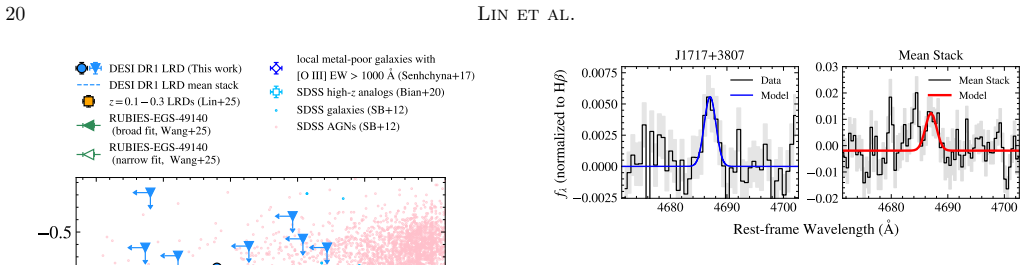
JWST has revealed a substantial population of "Little Red Dots" (LRDs) at $z>4$, challenging conventional AGN frameworks. However, the low-redshift regime remains largely unexplored. In the second paper of the (LRDs)$^2$ series, we present a systematic selection from DESI DR1 and identify 27 LRDs at $z=0.2-0.9$, yielding a number density lower limit of $7.5 \times 10^{-10}$ cMpc$^{-3}$. We conducted near-IR spectroscopic follow-up observations for 18 of them, revealing their full SED shapes and emission lines. These low-$z$ LRDs share the hallmark properties of their high-$z$ counterparts: compact morphology, V-shaped UV-optical continua, broad Balmer emission with extreme decrements (median H$\alpha$/H$\beta \sim 16$), frequent Balmer absorption (67%), and blackbody-like optical-to-near-IR continua. All have low metallicity, occupy the same regions in the BPT diagram as high-$z$ LRDs, and have softer ionizing spectra than typical AGNs. The consistency between low-$z$ and high-$z$ LRD properties indicates the same physical processes at work. The correlation between broad-line Balmer luminosity and $L_{5100}$ deviates from that of local type-1 AGNs, limiting the direct application of local BH mass calibrations. Ionized [O III] outflows are ubiquitous (78%). One LRD at $z=0.196$, J1717+3807, shows robust long-term variability in $i$ and WISE bands. The optical-to-NIR continua of LRDs reveal a wide range of temperatures $\sim 2000-4700$ K (peak $0.6-1.5$ $\mu$m), with a subset showing cooler and larger envelopes than those at high $z$. Low-$z$ LRDs serve not only as proximate laboratories for probing the nature of LRDs, but also trace the cosmic evolution of this population from the cosmic dawn to the present day.
Editorial analysis
A structured set of objections, weighed in public.
Referee Report
Summary. The paper reports a systematic photometric selection of 27 low-redshift (z = 0.2–0.9) Little Red Dot (LRD) candidates from DESI DR1, with near-IR spectroscopic follow-up for 18 objects. It claims these low-z LRDs exhibit the same hallmark properties as their high-z counterparts (compact morphology, V-shaped UV-optical continua, median Hα/Hβ ∼ 16, 67% Balmer absorption, blackbody-like optical-to-NIR continua, low metallicity, shared BPT regions, softer ionizing spectra) plus ubiquitous [O III] outflows (78%), a number-density lower limit of 7.5 × 10^{-10} cMpc^{-3}, and a deviation from local type-1 AGN broad-line luminosity relations, implying identical physical processes at work across cosmic time.
Significance. If the selection is robust, the work supplies the first sizable low-z LRD sample with NIR spectroscopy, enabling direct comparison to high-z JWST discoveries and serving as local laboratories for the same physics. The reported outflow ubiquity, extreme Balmer decrements, and breakdown of local BH-mass calibrations are observationally valuable; the density lower limit and evolutionary context add to the case that LRDs trace a distinct population or evolutionary phase from cosmic dawn to the present.
major comments (3)
- [Section 2] Section 2 (Sample Selection): the photometric color and compactness cuts applied to DESI DR1 are defined, but no completeness or purity estimates (from mocks, simulations, or recovery tests) are provided. This directly affects the validity of the number-density lower limit and the claim that the 27 objects are representative for cross-redshift property comparisons.
- [Section 4.3] Section 4.3 (Outflow Statistics): the 78% [O III] outflow fraction is stated for the sample, yet it is unclear whether this applies to the full 27 objects or only the 18 with NIR spectra, and whether the spectroscopic follow-up selection introduces bias; this statistic is used to argue for ubiquitous outflows matching high-z LRDs.
- [Section 5] Section 5 (Black-Hole Mass and Luminosity Relations): the claimed deviation of the broad Balmer luminosity vs. L_5100 correlation from local type-1 AGN relations is presented without a quantitative statistical test (e.g., Kolmogorov-Smirnov or regression significance) or explicit discussion of how the LRD selection function might truncate the luminosity range.
minor comments (3)
- [Figure 2] Figure 2 and Table 2: the V-shaped continuum and Balmer decrement panels would be clearer with explicit annotation of the median values and the high-z comparison sample overlaid.
- The introduction uses the acronym LRD before its first full definition; a brief parenthetical expansion on first use would improve readability.
- [Section 3.2] Section 3.2: the temperature range (∼2000–4700 K) for the optical-to-NIR blackbody fits is given, but the fitting procedure (e.g., wavelength range, extinction treatment) is only briefly described.
Simulated Author's Rebuttal
We thank the referee for their thorough review and constructive feedback on our manuscript. We have carefully considered each major comment and revised the paper accordingly to improve clarity, address potential biases, and strengthen the statistical analysis. Our point-by-point responses are provided below.
read point-by-point responses
-
Referee: [Section 2] Section 2 (Sample Selection): the photometric color and compactness cuts applied to DESI DR1 are defined, but no completeness or purity estimates (from mocks, simulations, or recovery tests) are provided. This directly affects the validity of the number-density lower limit and the claim that the 27 objects are representative for cross-redshift property comparisons.
Authors: We agree that quantitative completeness and purity estimates would be ideal for fully validating the number density. However, generating realistic mocks for LRDs is non-trivial given their distinctive V-shaped SEDs, which are not well-represented in standard galaxy or AGN simulations. Our selection cuts were intentionally conservative to prioritize purity over completeness, as described in Section 2. We have added explicit language emphasizing that the reported density of 7.5 × 10^{-10} cMpc^{-3} is a strict lower limit and that the sample is not claimed to be statistically representative of the full population, but rather a demonstration of shared properties with high-z LRDs. A more detailed discussion of selection limitations has been included. revision: partial
-
Referee: [Section 4.3] Section 4.3 (Outflow Statistics): the 78% [O III] outflow fraction is stated for the sample, yet it is unclear whether this applies to the full 27 objects or only the 18 with NIR spectra, and whether the spectroscopic follow-up selection introduces bias; this statistic is used to argue for ubiquitous outflows matching high-z LRDs.
Authors: The 78% [O III] outflow detection rate applies specifically to the 18 objects with NIR spectroscopy, as [O III] λ5007 falls in the observed wavelength range only for these sources at z = 0.2–0.9. We have clarified this distinction in the revised Section 4.3 and added a discussion of potential selection biases. The spectroscopic subsample was chosen based on observability and signal-to-noise considerations but matches the full photometric sample in color, magnitude, and redshift distributions. We note that the outflow ubiquity argument is supported by the high detection rate in the observed subset and is consistent with high-z LRDs, while acknowledging that the full sample would require additional observations. revision: yes
-
Referee: [Section 5] Section 5 (Black-Hole Mass and Luminosity Relations): the claimed deviation of the broad Balmer luminosity vs. L_5100 correlation from local type-1 AGN relations is presented without a quantitative statistical test (e.g., Kolmogorov-Smirnov or regression significance) or explicit discussion of how the LRD selection function might truncate the luminosity range.
Authors: We have added a Kolmogorov-Smirnov test comparing the LRD broad-line luminosity distribution to local type-1 AGN samples, reporting a p-value of <0.01 that supports the deviation. We have also included a new paragraph in Section 5 discussing the selection function: our primary cuts are on photometric colors and compactness rather than luminosity, but the requirement for a strong V-shaped continuum and broad Balmer lines may preferentially select objects with certain luminosities. This potential truncation is now explicitly noted as a caveat when interpreting the breakdown of local BH-mass calibrations. revision: yes
Circularity Check
No significant circularity; purely observational measurements
full rationale
This paper is an observational survey that applies photometric selection criteria to DESI DR1 to identify 27 low-z LRD candidates, followed by NIR spectroscopy on 18 objects to measure properties such as continua shapes, emission-line ratios, metallicities, and outflows. All quantities (e.g., median Hα/Hβ ~16, 67% Balmer absorption, number density lower limit of 7.5×10^{-10} cMpc^{-3}) are direct empirical measurements or counts from the data, with no derivations, first-principles predictions, fitted parameters renamed as predictions, or self-citation chains that reduce the central claims to inputs by construction. The consistency with high-z LRDs is presented as an empirical finding rather than a derived result. The paper is self-contained against external benchmarks with no load-bearing self-referential steps.
Axiom & Free-Parameter Ledger
free parameters (1)
- LRD selection color and compactness thresholds
axioms (1)
- domain assumption DESI DR1 provides a sufficiently complete and unbiased parent sample for low-redshift compact red sources.
Lean theorems connected to this paper
-
IndisputableMonolith/Cost/FunctionalEquation.leanwashburn_uniqueness_aczel unclear?
unclearRelation between the paper passage and the cited Recognition theorem.
We require the selected objects to satisfy the defining characteristics of LRDs ... V-shaped spectral energy distribution ... inflection point ... declining rest-frame near-infrared continuum ... weak [NII] ... negligible [NeV]
-
IndisputableMonolith/Foundation/AlphaCoordinateFixation.leancostAlphaLog_high_calibrated_iff unclear?
unclearRelation between the paper passage and the cited Recognition theorem.
We parameterize their UV-optical continua using a simple broken power-law model ... fλ = fλv (λ/λv)^kblue ...
What do these tags mean?
- matches
- The paper's claim is directly supported by a theorem in the formal canon.
- supports
- The theorem supports part of the paper's argument, but the paper may add assumptions or extra steps.
- extends
- The paper goes beyond the formal theorem; the theorem is a base layer rather than the whole result.
- uses
- The paper appears to rely on the theorem as machinery.
- contradicts
- The paper's claim conflicts with a theorem or certificate in the canon.
- unclear
- Pith found a possible connection, but the passage is too broad, indirect, or ambiguous to say the theorem truly supports the claim.
Reference graph
Works this paper leans on
-
[1]
Thei-band variability is based on only 23 exposures and thus lacks statistical significance
20 21i (AB mag) 18.2 18.4W1 (AB mag) 2010 2012 2014 2016 2018 2020 2022 2024 2026 Year 17.5 18.0 18.5W2 (AB mag) J164637.91+142648.62 Figure C.1.The ZTFi-band and WISE W1 and W2 light curves of J1646+1426. Thei-band variability is based on only 23 exposures and thus lacks statistical significance. The W2 light curve, although marginally passing our select...
work page 2010
-
[2]
Abazajian, K. N., Adelman-McCarthy, J. K., Ag¨ ueros, M. A., et al. 2009, ApJS, 182, 543, doi: 10.1088/0067-0049/182/2/543 Abdurro’uf, Accetta, K., Aerts, C., et al. 2022, ApJS, 259, 35, doi: 10.3847/1538-4365/ac4414
work page internal anchor Pith review doi:10.1088/0067-0049/182/2/543 2009
-
[3]
Akins, H. B., Casey, C. M., Lambrides, E., et al. 2024, arXiv e-prints, arXiv:2406.10341, doi: 10.48550/arXiv.2406.10341
-
[4]
Ananna, T. T., Bogd´ an,´A., Kov´ acs, O. E., Natarajan, P., & Hickox, R. C. 2024, ApJL, 969, L18, doi: 10.3847/2041-8213/ad5669
-
[5]
2025, MNRAS, 536, 3677, doi: 10.1093/mnras/stae2765
Arita, J., Kashikawa, N., Onoue, M., et al. 2025, MNRAS, 536, 3677, doi: 10.1093/mnras/stae2765
-
[6]
Asada, Y., Inayoshi, K., Fei, Q., Fujimoto, S., & Willott, C. 2026, arXiv e-prints, arXiv:2601.10573, doi: 10.48550/arXiv.2601.10573 40Lin et al
work page internal anchor Pith review Pith/arXiv arXiv doi:10.48550/arxiv.2601.10573 2026
-
[7]
Baggen, J. F. W., van Dokkum, P., Brammer, G., et al. 2024, ApJL, 977, L13, doi: 10.3847/2041-8213/ad90b8
-
[8]
J., Sollerman, J., Irani, I., et al
Baldwin, J. A., Phillips, M. M., & Terlevich, R. 1981, PASP, 93, 5, doi: 10.1086/130766
-
[9]
Compact, AGN-hosting Dwarf Galaxies with "Little Red Dots"-like SEDs in the Local Universe
Bao, L., Tsai, C.-W., Wu, J., & Wang, J. 2026, arXiv e-prints, arXiv:2605.04685, doi: 10.48550/arXiv.2605.04685
work page internal anchor Pith review Pith/arXiv arXiv doi:10.48550/arxiv.2605.04685 2026
-
[10]
Barro, G., Perez-Gonzalez, P. G., Kocevski, D., et al. 2025, arXiv e-prints, arXiv:2512.15853, doi: 10.48550/arXiv.2512.15853
-
[11]
2009, ApJ, 696, 1241, doi: 10.1088/0004-637X/696/2/1241
Bauer, A., Baltay, C., Coppi, P., et al. 2009, ApJ, 696, 1241, doi: 10.1088/0004-637X/696/2/1241
-
[12]
Begelman, M. C., & Dexter, J. 2026, ApJ, 996, 48, doi: 10.3847/1538-4357/ae274a
-
[13]
Bellm, E. C., Kulkarni, S. R., Graham, M. J., et al. 2019, PASP, 131, 018002, doi: 10.1088/1538-3873/aaecbe
-
[14]
Bevington, P. R., & Robinson, D. K. 2003, Data reduction and error analysis for the physical sciences
work page 2003
-
[15]
Bian, F., Kewley, L. J., Groves, B., & Dopita, M. A. 2020, MNRAS, 493, 580, doi: 10.1093/mnras/staa259
-
[16]
Bianchi, L. 2020, GALEX UV Unique Source Catalogs (”GUVcat”) and Cross-Matches With Gaia and SDSS (”GUVmatch”), STScI/MAST, doi: 10.17909/T9-PYXY-KG53
-
[17]
2017, ApJS, 230, 24, doi: 10.3847/1538-4365/aa7053
Bianchi, L., Shiao, B., & Thilker, D. 2017, ApJS, 230, 24, doi: 10.3847/1538-4365/aa7053
-
[18]
2025, arXiv e-prints, arXiv:2503.15323, doi: 10.48550/arXiv.2503.15323
Bisigello, L., Rodighiero, G., Fotopoulou, S., et al. 2025, arXiv e-prints, arXiv:2503.15323, doi: 10.48550/arXiv.2503.15323
-
[19]
Bock, J. J., Aboobaker, A. M., Adamo, J., et al. 2026, ApJ, 999, 139, doi: 10.3847/1538-4357/ae2be2
-
[20]
Bolton, A. S., & Schlegel, D. J. 2010, PASP, 122, 248, doi: 10.1086/651008
-
[21]
2025, arXiv e-prints, arXiv:2507.08929, doi: 10.48550/arXiv.2507.08929
Brazzini, M., D’Eugenio, F., Maiolino, R., et al. 2025, arXiv e-prints, arXiv:2507.08929, doi: 10.48550/arXiv.2507.08929
-
[22]
J., Stone, Z., Shen, Y., & Jiang, Y.-F
Burke, C. J., Stone, Z., Shen, Y., & Jiang, Y.-F. 2025, arXiv e-prints, arXiv:2511.16082, doi: 10.48550/arXiv.2511.16082
-
[23]
Cantiello, M., Hassan, J. B., Perna, R., et al. 2026, ApJL, 1000, L4, doi: 10.3847/2041-8213/ae4729
-
[24]
2024, A&A, 685, A99, doi: 10.1051/0004-6361/202347230
Carniani, S., Venturi, G., Parlanti, E., et al. 2024, A&A, 685, A99, doi: 10.1051/0004-6361/202347230
-
[25]
Carranza-Escudero, M., Conselice, C. J., Adams, N., et al. 2025, ApJL, 989, L50, doi: 10.3847/2041-8213/adf73d
-
[26]
Casey, C. M., Akins, H. B., Kokorev, V., et al. 2024, ApJL, 975, L4, doi: 10.3847/2041-8213/ad7ba7
-
[27]
Casey, C. M., Akins, H. B., Finkelstein, S. L., et al. 2025, arXiv e-prints, arXiv:2505.18873, doi: 10.48550/arXiv.2505.18873
-
[28]
2026, MNRAS, 545, staf2131, doi: 10.1093/mnras/staf2131
Chang, S.-J., Gronke, M., Matthee, J., & Mason, C. 2026, MNRAS, 545, staf2131, doi: 10.1093/mnras/staf2131
-
[29]
2022, Target Selection and Validation of DESI Quasars, doi: 10.3847/1538-4357/acb3c2
Chaussidon, E., Y` eche, C., Palanque-Delabrouille, N., et al. 2023, ApJ, 944, 107, doi: 10.3847/1538-4357/acb3c2
-
[30]
Chen, C.-H., Ho, L. C., Li, R., & Zhuang, M.-Y. 2025, ApJ, 983, 60, doi: 10.3847/1538-4357/ada93a
-
[31]
Chen, K., Li, Z., Inayoshi, K., & Ho, L. C. 2025, arXiv e-prints, arXiv:2505.22600, doi: 10.48550/arXiv.2505.22600
-
[32]
Chen, Y.-X., Liu, H., Li, R., et al. 2026, arXiv e-prints, arXiv:2602.06954, doi: 10.48550/arXiv.2602.06954
work page internal anchor Pith review Pith/arXiv arXiv doi:10.48550/arxiv.2602.06954 2026
-
[33]
Collier, S., & Peterson, B. M. 2001, ApJ, 555, 775, doi: 10.1086/321517
-
[34]
Cooper, R. A., Caputi, K. I., Iani, E., et al. 2025, ApJ, 994, 102, doi: 10.3847/1538-4357/ae0580
-
[35]
Cutri, R. M., Wright, E. L., Conrow, T., et al. 2021, VizieR Online Data Catalog: AllWISE Data Release (Cutri+ 2013),, VizieR On-line Data Catalog: II/328. Originally published in: IPAC/Caltech (2013) de Graaff, A., Rix, H.-W., Naidu, R. P., et al. 2025a, arXiv e-prints, arXiv:2503.16600, doi: 10.48550/arXiv.2503.16600 de Graaff, A., Hviding, R. E., Naidu...
-
[36]
Dey, A., Schlegel, D. J., Lang, D., et al. 2019, AJ, 157, 168, doi: 10.3847/1538-3881/ab089d
-
[37]
Ding, W., Kong, X., Guo, W.-J., et al. 2026, arXiv e-prints, arXiv:2604.14551, doi: 10.48550/arXiv.2604.14551
work page internal anchor Pith review Pith/arXiv arXiv doi:10.48550/arxiv.2604.14551 2026
-
[38]
J., Olsen, K., Economou, F., et al
Fitzpatrick, M. J., Olsen, K., Economou, F., et al. 2014, in Observatory Operations: Strategies, Processes, and Systems V, ed. A. B. Peck, C. R. Benn, & R. L. Seaman, Vol. 9149, International Society for Optics and Photonics (SPIE), 91491T, doi: 10.1117/12.2057445
-
[39]
Flewelling, H. A., Magnier, E. A., Chambers, K. C., et al. 2020, ApJS, 251, 7, doi: 10.3847/1538-4365/abb82d
-
[40]
2025, arXiv e-prints, arXiv:2512.02096, doi: 10.48550/arXiv.2512.02096
Fu, S., Zhang, Z., Jiang, D., et al. 2025, arXiv e-prints, arXiv:2512.02096, doi: 10.48550/arXiv.2512.02096
-
[41]
J., Labb´ e, I., Zitrin, A., et al
Furtak, L. J., Labb´ e, I., Zitrin, A., et al. 2024, Nature, 628, 57, doi: 10.1038/s41586-024-07184-8 DESI DR1 LRDs41
-
[42]
Furtak, L. J., Secunda, A. R., Greene, J. E., et al. 2025, A&A, 698, A227, doi: 10.1051/0004-6361/202554110 Gaia Collaboration, Vallenari, A., Brown, A. G. A., et al. 2023, A&A, 674, A1, doi: 10.1051/0004-6361/202243940
-
[43]
Greene, J. E., & Ho, L. C. 2005, ApJ, 630, 122, doi: 10.1086/431897
work page internal anchor Pith review doi:10.1086/431897 2005
-
[44]
Greene, J. E., Labbe, I., Goulding, A. D., et al. 2024, ApJ, 964, 39, doi: 10.3847/1538-4357/ad1e5f
-
[45]
Greene, J. E., Setton, D. J., Furtak, L. J., et al. 2025, arXiv e-prints, arXiv:2509.05434, doi: 10.48550/arXiv.2509.05434
-
[46]
2023, AJ, 165, 144, doi: 10.3847/1538-3881/acb212
Guy, J., Bailey, S., Kremin, A., et al. 2023, AJ, 165, 144, doi: 10.3847/1538-3881/acb212
-
[47]
A., Scarlata, C., Verhamme, A., & Erb, D
Henry, A., Berg, D. A., Scarlata, C., Verhamme, A., & Erb, D. 2018, ApJ, 855, 96, doi: 10.3847/1538-4357/aab099
-
[48]
Ho, I.-T., Kewley, L. J., Dopita, M. A., et al. 2014, MNRAS, 444, 3894, doi: 10.1093/mnras/stu1653
-
[49]
Hughes, P. A., Aller, H. D., & Aller, M. F. 1992, ApJ, 396, 469, doi: 10.1086/171734
-
[50]
Hviding, R. E., de Graaff, A., Miller, T. B., et al. 2025, arXiv e-prints, arXiv:2506.05459, doi: 10.48550/arXiv.2506.05459
-
[51]
E., de Graaff, A., Liu, H., et al
Hviding, R. E., de Graaff, A., Liu, H., et al. 2026, arXiv e-prints, arXiv:2601.09778, doi: 10.48550/arXiv.2601.09778
-
[52]
2024, arXiv e-prints, arXiv:2409.07805, doi: 10.48550/arXiv.2409.07805
Inayoshi, K., & Maiolino, R. 2024, arXiv e-prints, arXiv:2409.07805, doi: 10.48550/arXiv.2409.07805
-
[53]
Inayoshi, K., Murase, K., & Kashiyama, K. 2025a, arXiv e-prints, arXiv:2509.19422, doi: 10.48550/arXiv.2509.19422
work page internal anchor Pith review Pith/arXiv arXiv doi:10.48550/arxiv.2509.19422
-
[54]
The Emergence of Little Red Dots from Binary Massive Black Holes
Haiman, Z. 2025b, arXiv e-prints, arXiv:2505.05322, doi: 10.48550/arXiv.2505.05322
work page internal anchor Pith review Pith/arXiv arXiv doi:10.48550/arxiv.2505.05322
-
[55]
I., Chisholm, J., Worseck, G., et al
Izotov, Y. I., Chisholm, J., Worseck, G., et al. 2022, MNRAS, 515, 2864, doi: 10.1093/mnras/stac1899
-
[56]
Izotov, Y. I., Schaerer, D., Thuan, T. X., et al. 2016, MNRAS, 461, 3683, doi: 10.1093/mnras/stw1205
-
[57]
I., Schaerer, D., Worseck, G., et al
Izotov, Y. I., Schaerer, D., Worseck, G., et al. 2025, A&A, 704, A19, doi: 10.1051/0004-6361/202556004
-
[58]
I., Worseck, G., Schaerer, D., et al
Izotov, Y. I., Worseck, G., Schaerer, D., et al. 2018, MNRAS, 478, 4851, doi: 10.1093/mnras/sty1378
-
[59]
2025a, arXiv e-prints, arXiv:2501.13082, doi: 10.48550/arXiv.2501.13082
Ji, X., Maiolino, R., ¨Ubler, H., et al. 2025a, arXiv e-prints, arXiv:2501.13082, doi: 10.48550/arXiv.2501.13082
-
[60]
2025b, arXiv e-prints, arXiv:2507.23774, doi: 10.48550/arXiv.2507.23774
Ji, X., D’Eugenio, F., Juodˇ zbalis, I., et al. 2025b, arXiv e-prints, arXiv:2507.23774, doi: 10.48550/arXiv.2507.23774
-
[61]
Ji, X., Pezzulli, G., D’Eugenio, F., et al. 2026, arXiv e-prints, arXiv:2604.03370, doi: 10.48550/arXiv.2604.03370 Juodˇ zbalis, I., Ji, X., Maiolino, R., et al. 2024, MNRAS, 535, 853, doi: 10.1093/mnras/stae2367
work page internal anchor Pith review Pith/arXiv arXiv doi:10.48550/arxiv.2604.03370 2026
-
[62]
2016, ApJ, 819, 148, doi: 10.3847/0004-637X/819/2/148
Karouzos, M., Woo, J.-H., & Bae, H.-J. 2016, ApJ, 819, 148, doi: 10.3847/0004-637X/819/2/148
-
[63]
Kauffmann, G., Heckman, T. M., Tremonti, C., et al. 2003, MNRAS, 346, 1055, doi: 10.1111/j.1365-2966.2003.07154.x
-
[64]
Kewley, L. J., Groves, B., Kauffmann, G., & Heckman, T. 2006, MNRAS, 372, 961, doi: 10.1111/j.1365-2966.2006.10859.x
-
[65]
Kido, D., Ioka, K., Hotokezaka, K., Inayoshi, K., & Irwin, C. M. 2025, arXiv e-prints, arXiv:2505.06965, doi: 10.48550/arXiv.2505.06965
-
[66]
M., Aussel, H., Calzetti, D., et al
Kocevski, D. D., Finkelstein, S. L., Barro, G., et al. 2024, arXiv e-prints, arXiv:2404.03576, doi: 10.48550/arXiv.2404.03576
-
[67]
Kocevski, D. D., Finkelstein, S. L., Barro, G., et al. 2025, ApJ, 986, 126, doi: 10.3847/1538-4357/adbc7d
-
[68]
Kokorev, V., Caputi, K. I., Greene, J. E., et al. 2024, ApJ, 968, 38, doi: 10.3847/1538-4357/ad4265
-
[69]
2024.arXiv e-prints, arXiv:2407.04777 Kormendy, J., & Ho, L
Kokubo, M., & Harikane, Y. 2024, arXiv e-prints, arXiv:2407.04777, doi: 10.48550/arXiv.2407.04777 Koz lowski, S., Kochanek, C. S., Udalski, A., et al. 2010, ApJ, 708, 927, doi: 10.1088/0004-637X/708/2/927
-
[70]
Labbe, I., Greene, J. E., Matthee, J., et al. 2024, arXiv e-prints, arXiv:2412.04557, doi: 10.48550/arXiv.2412.04557
-
[71]
Labbe, I., Greene, J. E., Bezanson, R., et al. 2025, ApJ, 978, 92, doi: 10.3847/1538-4357/ad3551
-
[72]
Lawrence, A., Warren, S. J., Almaini, O., et al. 2007, MNRAS, 379, 1599, doi: 10.1111/j.1365-2966.2007.12040.x
-
[73]
Li, Z., Inayoshi, K., Chen, K., Ichikawa, K., & Ho, L. C. 2025, ApJ, 980, 36, doi: 10.3847/1538-4357/ada5fb
-
[74]
2025, ApJL, 980, L34, doi: 10.3847/2041-8213/adaaf1
Lin, R., Zheng, Z.-Y., Jiang, C., et al. 2025, ApJL, 980, L34, doi: 10.3847/2041-8213/adaaf1
-
[75]
2024, ApJ, 974, 147, doi: 10.3847/1538-4357/ad6565
Lin, X., Wang, F., Fan, X., et al. 2024, ApJ, 974, 147, doi: 10.3847/1538-4357/ad6565
-
[76]
2025, arXiv e-prints, arXiv:2504.08039, doi: 10.48550/arXiv.2504.08039
Lin, X., Fan, X., Wang, F., et al. 2025, arXiv e-prints, arXiv:2504.08039, doi: 10.48550/arXiv.2504.08039
-
[77]
2026a, ApJ, 997, 61, doi: 10.3847/1538-4357/ae1eef
Lin, X., Fan, X., Sun, F., et al. 2026a, ApJ, 997, 61, doi: 10.3847/1538-4357/ae1eef
-
[78]
2026b, ApJ, 997, 364, doi: 10.3847/1538-4357/ae2bdf
Lin, X., Fan, X., Cai, Z., et al. 2026b, ApJ, 997, 364, doi: 10.3847/1538-4357/ae2bdf
-
[79]
Liu, H., Jiang, Y.-F., Quataert, E., Greene, J. E., & Ma, Y. 2025, arXiv e-prints, arXiv:2507.07190. https://arxiv.org/abs/2507.07190
-
[80]
2026, arXiv e-prints, arXiv:2603.02317, doi: 10.48550/arXiv.2603.02317 42Lin et al
Liu, H., Jiang, Y.-F., Quataert, E., et al. 2026, arXiv e-prints, arXiv:2603.02317, doi: 10.48550/arXiv.2603.02317 42Lin et al
discussion (0)
Sign in with ORCID, Apple, or X to comment. Anyone can read and Pith papers without signing in.