MV-Forcing: Long Multi-View Video Generation via 4D-Grounded Spatio-Temporal Self-Forcing
Reviewed by Pith T0 review T1 audit T2 compute T3 formal T4 kernel 2026-07-07 13:44 UTCglm-5.2pith:KWI66S6Grecord.jsonopen to challenge →
The pith
4D reconstruction bridge unlocks long multi-view video
A machine-rendered reading of the paper's core claim, the machinery that carries it, and where it could break.
Core claim
An autoregressive 4D reconstruction model with a persistent latent state can replace dense bidirectional cross-view attention in multi-view video diffusion, serving as a geometric bridge that grounds each sequentially generated viewpoint in the accumulated 3D structure of all prior views. This enables both temporal and view-wise autoregression within a single few-step student model, producing geometrically consistent multi-view videos at arbitrary lengths and viewpoint counts.
What carries the argument
The central mechanism is the feedback loop between generation and reconstruction: each generated view is decoded to pixels and fed into CUT3R's recurrent state, which accumulates 4D scene structure; this state is then queried from the next target camera via raymaps to produce an RGB rendering plus a per-pixel confidence map, which a zero-initialized 3D convolution layer projects into the diffusion model's token space as conditioning. This is paired with spatio-temporal self-forcing, which unrolls autoregressive generation along both the temporal and view axes during training and applies a distribution-matching distillation loss against the bidirectional teacher's score function on the self-g
If this is right
- Multi-view video generation could become a streaming process rather than a fixed-window batch computation, enabling real-time applications like VR rendering or interactive simulation that require continuous multi-perspective output.
- The CUT3R-as-bridge pattern could generalize to other reconstruction models and generation backbones, suggesting that any feed-forward 3D reconstructor with a persistent, queryable state could serve as a geometric memory for autoregressive generation.
- The joint denoising regime that unifies first-view text-to-video with view-sequential conditioning suggests a path toward models that gracefully handle arbitrary generation orders over the time-view grid, not just row-major or column-major traversal.
- The stable cross-view metrics at 5 views and 648 frames suggest the geometric prior scales better than attention-based alternatives, which degrade quadratically, potentially making long multi-view generation practical on commodity hardware (23 GB VRAM across all configurations).
Load-bearing premise
The framework depends entirely on CUT3R producing accurate 3D reconstructions from sequentially generated, imperfect views. The paper acknowledges failure cases where extreme motion causes CUT3R to reconstruct incorrect limb geometry and extreme camera displacement causes depth ambiguity, but does not quantify how reconstruction errors accumulate over long view chains or temporal horizons.
What would settle it
If CUT3R's reconstruction error grows super-linearly with the number of accumulated views or timesteps, the geometric prior fed into the diffusion model would progressively degrade, causing cross-view consistency to collapse at large view counts or temporal lengths rather than remaining stable as reported.
Figures



read the original abstract
Recent advances in video diffusion models have enabled either long single-view generation through temporal autoregression, or short multi-view synthesis through bidirectional attention. However, generating long, multi-view consistent videos of dynamic scenes remains unsolved. In this work, we present MV-Forcing, a framework that composes temporal and view-wise autoregression within a single diffusion model by introducing a 4D geometric bridge between sequentially generated views. Our key insight is that an autoregressive 3D reconstruction model naturally interfaces between autoregressively generated views. Given a completed source view, we reconstruct its 3D structure and render a geometric prior of the next target viewpoint, which the diffusion model refines into a high-quality video. To extend generation beyond the teacher's fixed temporal window, we introduce a joint denoising regime where both view slots are initialized from noise during training, enabling temporally unbounded generation. We distill the model via Distribution Matching Distillation with Spatio-Temporal Self-Forcing, closing the train-inference exposure bias gap for both temporal and view-sequential autoregression. Extensive experiments on both synthetic and real-world data demonstrate that MV-Forcing produces geometrically consistent multi-view videos of dynamic scenes at arbitrary lengths and viewpoint counts using a single few-step student model.
Editorial analysis
A structured set of objections, weighed in public.
Referee Report
Summary. This paper presents MV-Forcing, a framework for long multi-view video generation that composes temporal and view-wise autoregression within a single diffusion model. The key innovation is using CUT3R, a recurrent 3D reconstruction model, as a geometric bridge between sequentially generated views: given a completed source view, the model reconstructs its 3D structure, renders a geometric prior for the next target viewpoint, and conditions the diffusion model on this prior via a Conv3d layer. The framework extends Self-Forcing to the spatio-temporal domain by unrolling view-sequential generation during training (Spatio-Temporal Self-Forcing) and introduces a joint denoising regime where both view slots are initialized from noise, enabling text-to-multi-view generation. The model is distilled from a bidirectional SynCamMaster teacher via Distribution Matching Distillation (DMD). Experiments are conducted on both synthetic and real-world data, comparing against constructed baselines (Self-Forcing + ReCamMaster) and the SynCamMaster teacher, with ablations isolating each component and scaling analyses along the view and temporal axes.
Significance. The paper addresses a genuinely unsolved problem: generating long, multi-view consistent videos of dynamic scenes. The approach of replacing dense bidirectional cross-view attention with an autoregressive 4D geometric bridge (CUT3R) is architecturally novel and enables streaming inference with constant memory regardless of output length or view count. The framework is well-motivated, and the composition of temporal and view-sequential autoregression within a unified self-forcing paradigm is a non-trivial technical contribution. The authors provide ablations isolating each design choice (Tab. 3), scaling analyses along both axes independently (Tabs. 4-5), and an honest failure case analysis (Fig. 5, Sec. C). The constant peak VRAM of 23 GB across all configurations (Tab. 6) is a notable practical strength. The code and models are stated to be publicly available, supporting reproducibility.
major comments (3)
- Sec. 3.2, final paragraph: The Spatio-Temporal Self-Forcing mechanism (contribution #3) is designed to close the view-sequential exposure bias by unrolling autoregressive generation during training. However, due to GPU memory constraints, training only unrolls from z_0^gt to generate ẑ_1 and ẑ_2 — a single view transition. At inference, the paper claims 'arbitrary viewpoint counts' (Sec. 1, contributions). The self-forcing thus only teaches the model to handle its own errors over one view transition, not the 3+ transitions required for 5-view generation (Tab. 4). While Tab. 4 shows stable metrics up to 5 views at 81 frames, this is the shortest temporal setting and uses synthetic data only. The concern is whether error compounding along the view axis is adequately mitigated by training on only a single transition. The authors should discuss this train-inference gap more explicitly and,if
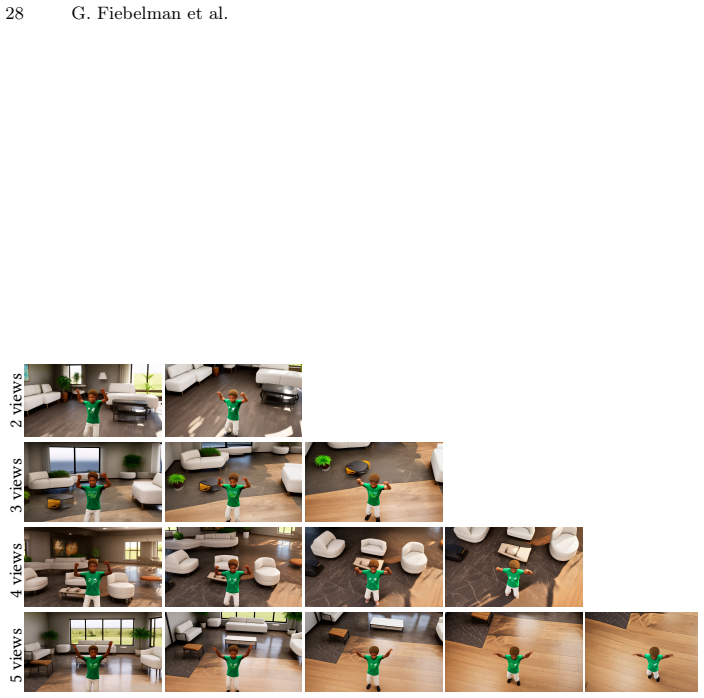
- Sec. 4.2, Tabs. 4-5: The headline claim is 'arbitrary lengths AND viewpoint counts' simultaneously (Sec. 1; Fig. 1 shows 3 views × 160 timesteps). However, the scaling analyses test each axis independently: Tab. 4 varies views (2→5) at fixed 81 frames, and Tab. 5 varies temporal length (81→648) at fixed 2 views. The combined stress regime — many views AND long temporal horizons — is never evaluated. Since CUT3R's persistent state accumulates along both axes, error compounding could be superlinear when both axes are extended simultaneously. The paper should either (a) provide at least one evaluation in the combined regime (e.g., 5 views × 324+ frames) or (b) explicitly scope the claim to note that the combined regime is not directly evaluated and discuss the risk.
- Sec. 4.1, Tab. 1: MV-Forcing is compared only against the SynCamMaster teacher at 2 views / 81 frames. The paper states that 'no existing method addresses long multi-view video generation' and constructs baselines by composing Self-Forcing and ReCamMaster (Sec. 4.1). While this composition is reasonable, the absence of comparison against any other multi-view video method (e.g., CVD [20], SV4D [38], CAT4D [37]) — even in settings where those methods could operate — weakens the competitive assessment. The authors should clarify whether these methods are truly inapplicable in the evaluated settings, or whether the comparison was omitted for scope reasons. If the latter, at least one additional comparison would strengthen the evaluation.
minor comments (8)
- Sec. 3.2, Eq. (3): The blockwise causal mask M_{i,j} is defined but the temporal block size K is not specified in the main text. It appears only in Sec. B.1 (K=3 latent frames). Consider stating K in Sec. 3.1 or 3.2 for self-containedness.
- Sec. 3.3, Eq. (10): The notation D' = C_latent + 1 is introduced but C_latent is not defined. Presumably this is the number of VAE latent channels, but this should be stated explicitly.
- Tab. 2: The 'Mat. Pix.' column header is abbreviated without prior definition in the main text. It is defined in Sec. B.5 as 'matching pixels with GIM confidence above 0.01,' but readers of the main text may find the abbreviation unclear. Consider adding a footnote or brief definition at first use in Sec. 4.1.
- Sec. 4.2, Tab. 3: The 'w/o View Unrolling' ablation shows a large degradation (FVD 1791 vs. 1560), which the paper attributes to train-inference distribution mismatch. It would strengthen the ablation to briefly describe what 'standard DMD along the view axis' means concretely — does the student condition on ground-truth preceding views during training, or is the DMD loss simply applied without unrolling?
- Fig. 2: The overview diagram is informative but dense. The red arrow illustrating view-sequential unrolling is mentioned in the caption but is somewhat hard to trace visually. Consider enlarging or annotating this path more prominently.
- Sec. B.2: The real-world finetuning uses only 500 iterations on the Mixkit subset. The paper should comment on whether this is sufficient for convergence, or whether metrics are sensitive to the number of finetuning iterations.
- Sec. 4.3, limitation 3: The paper notes that 'the DMD supervision never directly supervises consistency across more than two simultaneous views.' This is an important architectural limitation that could be elevated to the main text (Sec. 3.2) rather than only appearing in limitations, as it directly affects the scalability claim.
- References: Several arXiv preprints are cited without venue information (e.g., [4, 5, 6, 11, 23, 39]). Where published versions exist, they should be updated.
Simulated Author's Rebuttal
We thank the referee for the thorough and constructive report. The referee correctly identifies that the combined stress regime (many views AND long temporal horizons) is not directly evaluated, that the train-inference gap along the view axis is only partially addressed by single-transition unrolling, and that the competitive assessment could be strengthened by comparison against additional multi-view video methods. We address each point below and commit to revisions accordingly.
read point-by-point responses
-
Referee: Sec. 3.2, final paragraph: The Spatio-Temporal Self-Forcing mechanism is designed to close the view-sequential exposure bias by unrolling autoregressive generation during training. However, due to GPU memory constraints, training only unrolls from z_0^gt to generate ẑ_1 and ẑ_2 — a single view transition. At inference, the paper claims 'arbitrary viewpoint counts.' The self-forcing thus only teaches the model to handle its own errors over one view transition, not the 3+ transitions required for 5-view generation. The authors should discuss this train-inference gap more explicitly.
Authors: The referee raises a valid concern. We agree that the gap between single-transition unrolling during training and multi-transition chaining at inference is an important limitation that should be discussed more explicitly. We will add a dedicated paragraph in Sec. 3.2 acknowledging this gap and explaining why it is partially mitigated: (1) the DMD loss is applied to each consecutive view pair independently, so the distillation objective decomposes over view transitions, meaning the student learns to handle its own errors for each pairwise transition even though only one transition is unrolled; (2) the accumulated CUT3R geometric prior provides an external grounding signal that does not degrade with view chain length, as each new view is conditioned on the full 4D state rather than only the immediately preceding view; (3) Tab. 4 empirically shows stable metrics up to 5 views, though we agree this is at the shortest temporal setting and on synthetic data only. We will also note in Sec. 4.3 (Limitations) that extending the unrolling to longer view chains during training is a natural direction for future improvement, and that the current single-transition unrolling is a practical compromise given GPU memory constraints. We will temper the 'arbitrary viewpoint counts' claim in the abstract and contributions to clarify that this is demonstrated empirically up to 5 views and that training unrolling is limited to a single transition. revision: partial
-
Referee: Sec. 4.2, Tabs. 4-5: The headline claim is 'arbitrary lengths AND viewpoint counts' simultaneously. However, the scaling analyses test each axis independently: Tab. 4 varies views at fixed 81 frames, and Tab. 5 varies temporal length at fixed 2 views. The combined stress regime — many views AND long temporal horizons — is never evaluated. Since CUT3R's persistent state accumulates along both axes, error compounding could be superlinear when both axes are extended simultaneously. The paper should either (a) provide at least one evaluation in the combined regime or (b) explicitly scope the claim.
Authors: This is a fair and well-taken point. We acknowledge that the combined regime is not directly evaluated in the current manuscript. We will address this in two ways. First, we will run at least one evaluation in the combined stress regime (e.g., 5 views × 324 frames or 3 views × 648 frames) and report the results in a new table or extend Tab. 4/5. We note that Tab. 6 already reports wall-clock time and peak VRAM for a 5 views × 648 frames configuration, confirming the system runs at constant 23 GB VRAM, but we have not reported quality metrics for this configuration. We will add these. Second, regardless of the outcome, we will explicitly scope the claim in the abstract, introduction, and contributions to note that the combined regime is evaluated separately along each axis and that the joint stress test is added in the revision. We agree with the referee that error compounding could be superlinear when both axes are extended simultaneously, and we will discuss this risk transparently. revision: yes
-
Referee: Sec. 4.1, Tab. 1: MV-Forcing is compared only against the SynCamMaster teacher at 2 views / 81 frames. The absence of comparison against any other multi-view video method (e.g., CVD, SV4D, CAT4D) — even in settings where those methods could operate — weakens the competitive assessment. The authors should clarify whether these methods are truly inapplicable in the evaluated settings, or whether the comparison was omitted for scope reasons.
Authors: We appreciate this comment and agree that clarifying the applicability of other multi-view methods is important. The methods cited by the referee operate in settings that are fundamentally different from ours: SV4D, SV4D 2.0, and CAT4D are object-centric, generating dense orbital views of single objects with fixed camera configurations, and cannot handle open-world scenes with arbitrary camera trajectories as evaluated in our setting. CVD adds epipolar attention across views but operates on short, fixed-length clips and, to our knowledge, does not have publicly available weights or a standard evaluation protocol that would enable a fair comparison. We will add a clarifying paragraph in Sec. 4.1 explaining why these methods are not directly comparable in our evaluated settings. That said, we agree that at least one additional comparison would strengthen the evaluation. We will attempt to adapt CVD or another applicable method to our evaluation setting if feasible within the revision period, or, if this proves impractical due to code availability or domain mismatch, we will state this explicitly and provide a detailed discussion of the differences in capability and scope between our method and these approaches. revision: partial
Circularity Check
No significant circularity found. The derivation chain is self-contained against external benchmarks.
full rationale
The paper's core derivation chain is built on externally sourced, independently developed components: SynCamMaster [2] as the frozen bidirectional teacher, Self-Forcing [16] as the temporal autoregression paradigm, CUT3R [35] as a frozen external reconstruction model, and DMD [42,43] as the distillation objective. The DMD loss (Eq. 4) uses the teacher's score function as data score — standard distillation practice, not circular reasoning. The view-sequential unrolling (Eqs. 6-7) trains on the student's own generated outputs to close the train-inference exposure bias gap; this is a legitimate training strategy (following Self-Forcing's established methodology), not a self-definitional loop. The geometric prior (Eqs. 8-11) is produced by the external CUT3R model from decoded generated views — an autoregressive feedback process at inference, but not circular reasoning. The scaling 'predictions' in Tabs. 4-5 (view counts 2→5, temporal length 81→648) are genuine extrapolation tests beyond the training configuration, not fitted quantities renamed as predictions. The one self-citation [7] (Fiebelman, Averbuch-Elor, Benaim) appears in the related work as a reference for physics-guided score distillation and is not load-bearing for any central claim. The skeptic's concerns about train-inference gaps in view unrolling and untested combined stress regimes are correctness/robustness risks, not circularity. Score 1 reflects the minor, non-load-bearing self-citation.
Axiom & Free-Parameter Ledger
free parameters (8)
- temporal block size K =
3
- joint denoising probability p =
0.3
- ODE initialization iterations =
3000
- DMD training iterations =
1600
- real-world finetuning iterations =
500
- generator learning rate =
2e-6
- critic learning rate =
4e-7
- denoising steps Q =
4
axioms (5)
- domain assumption CUT3R provides sufficiently accurate 3D reconstructions from generated (imperfect) views to serve as a reliable geometric prior
- domain assumption Pairwise view consistency (supervised by 2-view teacher) generalizes to multi-view consistency (3+ views) at inference
- domain assumption Self-forcing unrolling over 2 views during training generalizes to longer view chains at inference
- standard math Distribution Matching Distillation (DMD) with asymmetric teacher-student distillation produces a faithful few-step approximation
- domain assumption The 3D VAE encoder/decoder (from Wan2.1) provides sufficient latent-to-pixel fidelity for CUT3R to reconstruct from decoded frames
invented entities (3)
-
Spatio-temporal self-forcing training regime
independent evidence
-
4D-grounded geometric prior via CUT3R state accumulation
independent evidence
-
Joint view denoising training regime
no independent evidence
Reference graph
Works this paper leans on
-
[1]
In: Proceedings of the IEEE/CVF International Conference on Computer Vision
Bai,J., Xia, M., Fu, X.,Wang, X.,Mu, L., Cao, J.,Liu, Z., Hu, H.,Bai, X., Wan, P., et al.: Recammaster: Camera-controlled generative rendering from a single video. In: Proceedings of the IEEE/CVF International Conference on Computer Vision. pp. 14834–14844 (2025)
work page 2025
-
[2]
SynCamMaster: Synchronizing Multi-Camera Video Generation from Diverse Viewpoints
Bai, J., Xia, M., Wang, X., Yuan, Z., Fu, X., Liu, Z., Hu, H., Wan, P., Zhang, D.: Syncammaster: Synchronizing multi-camera video generation from diverse view- points. arXiv preprint arXiv:2412.07760 (2024)
work page internal anchor Pith review Pith/arXiv arXiv 2024
-
[3]
Bian, W., Huang, Z., Shi, X., Li, Y., Wang, F.Y., Li, H.: Gs-dit: Advancing video generation with pseudo 4d gaussian fields through efficient dense 3d point tracking. arXiv preprint arXiv:2501.02690 (2025)
work page internal anchor Pith review Pith/arXiv arXiv 2025
-
[4]
Diffusion Forcing: Next-token Prediction Meets Full-Sequence Diffusion
Chen, B., Monso, D.M., Du, Y., Simchowitz, M., Tedrake, R., Sitzmann, V.: Dif- fusion forcing: Next-token prediction meets full-sequence diffusion. arXiv preprint arXiv:2407.01392 (2024)
work page internal anchor Pith review Pith/arXiv arXiv 2024
-
[5]
SkyReels-V2: Infinite-length Film Generative Model
Chen, G., Lin, D., Yang, J., Lin, C., Zhu, J., Fan, M., Zhang, H., Chen, S., Chen, Z., Ma, C., et al.: Skyreels-v2: Infinite-length film generative model. arXiv preprint arXiv:2504.13074 (2025)
work page internal anchor Pith review Pith/arXiv arXiv 2025
-
[6]
Self-Forcing++: Towards Minute-Scale High-Quality Video Generation
Cui, J., Wu, J., Li, M., Yang, T., Li, X., Wang, R., Bai, A., Ban, Y., Hsieh, C.J.: Self-forcing++: Towards minute-scale high-quality video generation. arXiv preprint arXiv:2510.02283 (2025)
work page internal anchor Pith review Pith/arXiv arXiv 2025
-
[7]
In: ProceedingsoftheIEEE/CVFConferenceonComputerVisionandPatternRecog- nition
Fiebelman, G., Averbuch-Elor, H., Benaim, S.: Let it snow! animating 3d gaus- sian scenes with dynamic weather effects via physics-guided score distillation. In: ProceedingsoftheIEEE/CVFConferenceonComputerVisionandPatternRecog- nition. pp. 37322–37331 (2026)
work page 2026
-
[8]
Advances in Neural Information Processing Systems36, 39897–39914 (2023)
Fridman, R., Abecasis, A., Kasten, Y., Dekel, T.: Scenescape: Text-driven con- sistent scene generation. Advances in Neural Information Processing Systems36, 39897–39914 (2023)
work page 2023
-
[9]
Ca2-VDM: Efficient Autoregressive Video Diffusion Model with Causal Generation and Cache Sharing
Gao, K., Shi, J., Zhang, H., Wang, C., Xiao, J., Chen, L.: Ca2-vdm: Efficient autoregressive video diffusion model with causal generation and cache sharing. arXiv preprint arXiv:2411.16375 (2024)
work page internal anchor Pith review Pith/arXiv arXiv 2024
-
[10]
CAT3D: Create Anything in 3D with Multi-View Diffusion Models
Gao, R., Holynski, A., Henzler, P., Brussee, A., Martin-Brualla, R., Srinivasan, P., Barron, J.T., Poole, B.: Cat3d: Create anything in 3d with multi-view diffusion models. arXiv preprint arXiv:2405.10314 (2024)
work page internal anchor Pith review Pith/arXiv arXiv 2024
-
[11]
Long-Context Autoregressive Video Modeling with Next-Frame Prediction
Gu, Y., Mao, W., Shou, M.Z.: Long-context autoregressive video modeling with next-frame prediction. arXiv preprint arXiv:2503.19325 (2025)
work page internal anchor Pith review Pith/arXiv arXiv 2025
-
[12]
Gu, Z., Yan, R., Lu, J., Li, P., Dou, Z., Si, C., Dong, Z., Liu, Q., Lin, C., Liu, Z., et al.: Diffusion as shader: 3d-aware video diffusion for versatile video generation control. In: Proceedings of the Special Interest Group on Computer Graphics and Interactive Techniques Conference Conference Papers. pp. 1–12 (2025)
work page 2025
-
[13]
He, H., Xu, Y., Guo, Y., Wetzstein, G., Dai, B., Li, H., Yang, C.: Cameractrl: En- ablingcameracontrolfortext-to-videogeneration.arXivpreprintarXiv:2404.02101 (2024)
work page internal anchor Pith review Pith/arXiv arXiv 2024
-
[14]
Advances in neural information processing systems30(2017)
Heusel,M.,Ramsauer,H.,Unterthiner,T.,Nessler,B.,Hochreiter,S.:Ganstrained by a two time-scale update rule converge to a local nash equilibrium. Advances in neural information processing systems30(2017)
work page 2017
-
[15]
arXiv preprint arXiv:2412.07720 (2024) MV-Forcing 17
Hu, J., Hu, S., Song, Y., Huang, Y., Wang, M., Zhou, H., Liu, Z., Ma, W.Y., Sun, M.: Acdit: Interpolating autoregressive conditional modeling and diffusion transformer. arXiv preprint arXiv:2412.07720 (2024) MV-Forcing 17
-
[16]
Self Forcing: Bridging the Train-Test Gap in Autoregressive Video Diffusion
Huang, X., Li, Z., He, G., Zhou, M., Shechtman, E.: Self forcing: Bridging the train-test gap in autoregressive video diffusion. arXiv preprint arXiv:2506.08009 (2025)
work page internal anchor Pith review Pith/arXiv arXiv 2025
-
[17]
In: Proceedings of the IEEE/CVF International Conference on Computer Vision
Jeong, H., Lee, S., Ye, J.C.: Reangle-a-video: 4d video generation as video-to- video translation. In: Proceedings of the IEEE/CVF International Conference on Computer Vision. pp. 11164–11175 (2025)
work page 2025
-
[18]
Jin, Y., Sun, Z., Li, N., Xu, K., Jiang, H., Zhuang, N., Huang, Q., Song, Y., Mu, Y., Lin, Z.: Pyramidal flow matching for efficient video generative modeling. In: ICLR (2025)
work page 2025
-
[19]
HunyuanVideo: A Systematic Framework For Large Video Generative Models
Kong, W., Tian, Q., Zhang, Z., Min, R., Dai, Z., Zhou, J., Xiong, J., Li, X., Wu, B., Zhang, J., et al.: Hunyuanvideo: A systematic framework for large video generative models. arXiv preprint arXiv:2412.03603 (2024)
work page internal anchor Pith review Pith/arXiv arXiv 2024
-
[20]
Advances in Neural Information Processing Systems37, 16240–16271 (2024)
Kuang,Z.,Cai,S.,He,H.,Xu,Y.,Li,H.,Guibas,L.J.,Wetzstein,G.:Collaborative video diffusion: Consistent multi-video generation with camera control. Advances in Neural Information Processing Systems37, 16240–16271 (2024)
work page 2024
-
[21]
In: European conference on computer vision
Leroy, V., Cabon, Y., Revaud, J.: Grounding image matching in 3d with mast3r. In: European conference on computer vision. pp. 71–91. Springer (2024)
work page 2024
-
[22]
In: Proceedings of the IEEE/CVF International Conference on Computer Vision
Li, R., Torr, P., Vedaldi, A., Jakab, T.: Vmem: Consistent interactive video scene generation with surfel-indexed view memory. In: Proceedings of the IEEE/CVF International Conference on Computer Vision. pp. 25690–25699 (2025)
work page 2025
-
[23]
Rolling Forcing: Autoregressive Long Video Diffusion in Real Time
Liu, K., Hu, W., Xu, J., Shan, Y., Lu, S.: Rolling forcing: Autoregressive long video diffusion in real time. arXiv preprint arXiv:2509.25161 (2025)
work page internal anchor Pith review Pith/arXiv arXiv 2025
-
[24]
com / PKU - YuanGroup / Open-Sora-Dataset(2024), accessed: 2026-03-06
PKU-YuanGroup: Open-sora-dataset.https : / / github . com / PKU - YuanGroup / Open-Sora-Dataset(2024), accessed: 2026-03-06
work page 2024
-
[25]
Movie Gen: A Cast of Media Foundation Models
Polyak, A., Zohar, A., Brown, A., Tjandra, A., Sinha, A., Lee, A., Vyas, A., Shi, B., Ma, C.Y., Chuang, C.Y., et al.: Movie gen: A cast of media foundation models. arXiv preprint arXiv:2410.13720 (2024)
work page internal anchor Pith review Pith/arXiv arXiv 2024
-
[26]
In: International conference on machine learning
Radford, A., Kim, J.W., Hallacy, C., Ramesh, A., Goh, G., Agarwal, S., Sastry, G., Askell, A., Mishkin, P., Clark, J., et al.: Learning transferable visual models from natural language supervision. In: International conference on machine learning. pp. 8748–8763. PmLR (2021)
work page 2021
-
[27]
In: Proceedings of the IEEE/CVF Conference on Computer Vision and Pattern Recognition
Ren,X.,Shen,T.,Huang,J.,Ling,H.,Lu,Y.,Nimier-David,M.,Müller,T.,Keller, A., Fidler, S., Gao, J.: Gen3c: 3d-informed world-consistent video generation with precise camera control. In: Proceedings of the IEEE/CVF Conference on Computer Vision and Pattern Recognition. pp. 6121–6132 (2025)
work page 2025
-
[28]
Sand-AI: Magi-1: Autoregressive video generation at scale (2025),https : / / static.magi.world/static/files/MAGI_1.pdf, accessed: 2026-02-24
work page 2025
-
[29]
GIM: Learning Generalizable Image Matcher From Internet Videos
Shen, X., Cai, Z., Yin, W., Müller, M., Li, Z., Wang, K., Chen, X., Wang, C.: Gim: Learning generalizable image matcher from internet videos. arXiv preprint arXiv:2402.11095 (2024)
work page internal anchor Pith review Pith/arXiv arXiv 2024
-
[30]
History-Guided Video Diffusion
Song, K., Chen, B., Simchowitz, M., Du, Y., Tedrake, R., Sitzmann, V.: History- guided video diffusion. arXiv preprint arXiv:2502.06764 (2025)
work page internal anchor Pith review Pith/arXiv arXiv 2025
-
[31]
Towards Accurate Generative Models of Video: A New Metric & Challenges
Unterthiner, T., Van Steenkiste, S., Kurach, K., Marinier, R., Michalski, M., Gelly, S.: Fvd: A new metric for video generation. arXiv preprint arXiv:1812.01717 (2019)
work page internal anchor Pith review Pith/arXiv arXiv 2019
-
[32]
In: European Conference on Computer Vision
Van Hoorick, B., Wu, R., Ozguroglu, E., Sargent, K., Liu, R., Tokmakov, P., Dave, A., Zheng, C., Vondrick, C.: Generative camera dolly: Extreme monocular dynamic novel view synthesis. In: European Conference on Computer Vision. pp. 313–331. Springer (2024)
work page 2024
-
[33]
Wan: Open and Advanced Large-Scale Video Generative Models
Wang, A., Ai, B., Wen, B., Mao, C., Xie, C.W., Chen, D., Yu, F., Zhao, H., Yang, J., Zeng, J., et al.: Wan: Open and advanced large-scale video generative models. arXiv preprint arXiv:2503.20314 (2025) 18 G. Fiebelman et al
work page internal anchor Pith review Pith/arXiv arXiv 2025
-
[34]
In: Proceedings of the Computer Vision and Pattern Recognition Conference
Wang, J., Chen, M., Karaev, N., Vedaldi, A., Rupprecht, C., Novotny, D.: Vggt: Visual geometry grounded transformer. In: Proceedings of the Computer Vision and Pattern Recognition Conference. pp. 5294–5306 (2025)
work page 2025
-
[35]
In: Proceedings of the Computer Vision and Pattern Recognition Conference
Wang, Q., Zhang, Y., Holynski, A., Efros, A.A., Kanazawa, A.: Continuous 3d perception model with persistent state. In: Proceedings of the Computer Vision and Pattern Recognition Conference. pp. 10510–10522 (2025)
work page 2025
-
[36]
In: Proceedings of the IEEE/CVF conference on computer vision and pattern recognition
Wang, S., Leroy, V., Cabon, Y., Chidlovskii, B., Revaud, J.: Dust3r: Geometric 3d vision made easy. In: Proceedings of the IEEE/CVF conference on computer vision and pattern recognition. pp. 20697–20709 (2024)
work page 2024
-
[37]
In: Proceed- ings of the IEEE/CVF Conference on Computer Vision and Pattern Recognition
Wu, R., Gao, R., Poole, B., Trevithick, A., Zheng, C., Barron, J.T., Holynski, A.: Cat4d: Create anything in 4d with multi-view video diffusion models. In: Proceed- ings of the IEEE/CVF Conference on Computer Vision and Pattern Recognition. pp. 26057–26068 (2025)
work page 2025
-
[38]
SV4D: Dynamic 3D Content Generation with Multi-Frame and Multi-View Consistency
Xie, Y., Yao, C.H., Voleti, V., Jiang, H., Jampani, V.: Sv4d: Dynamic 3d con- tent generation with multi-frame and multi-view consistency. arXiv preprint arXiv:2407.17470 (2024)
work page internal anchor Pith review Pith/arXiv arXiv 2024
-
[39]
LongLive: Real-time Interactive Long Video Generation
Yang, S., Huang, W., Chu, R., Xiao, Y., Zhao, Y., Wang, X., Li, M., Xie, E., Chen, Y., Lu, Y., et al.: Longlive: Real-time interactive long video generation. arXiv preprint arXiv:2509.22622 (2025)
work page internal anchor Pith review Pith/arXiv arXiv 2025
-
[40]
CogVideoX: Text-to-Video Diffusion Models with An Expert Transformer
Yang, Z., Teng, J., Zheng, W., Ding, M., Huang, S., Xu, J., Yang, Y., Hong, W., Zhang, X., Feng, G., et al.: Cogvideox: Text-to-video diffusion models with an expert transformer. arXiv preprint arXiv:2408.06072 (2024)
work page internal anchor Pith review Pith/arXiv arXiv 2024
-
[41]
In: Proceedings of the IEEE/CVF International Conference on Computer Vision
Yao, C.H., Xie, Y., Voleti, V., Jiang, H., Jampani, V.: Sv4d 2.0: Enhancing spatio- temporal consistency in multi-view video diffusion for high-quality 4d generation. In: Proceedings of the IEEE/CVF International Conference on Computer Vision. pp. 13248–13258 (2025)
work page 2025
-
[42]
Yin, T., Gharbi, M., Park, T., Zhang, R., Shechtman, E., Durand, F., Freeman, B.: Improved distribution matching distillation for fast image synthesis. NeurIPS (2024)
work page 2024
-
[43]
Yin, T., Gharbi, M., Zhang, R., Shechtman, E., Durand, F., Freeman, W.T., Park, T.: One-step diffusion with distribution matching distillation. In: CVPR (2024)
work page 2024
-
[44]
Yin, T., Zhang, Q., Zhang, R., Freeman, W.T., Durand, F., Shechtman, E., Huang, X.: From slow bidirectional to fast autoregressive video diffusion models. In: CVPR (2025)
work page 2025
-
[45]
In: Proceedings of the IEEE/CVF international conference on computer vision
Yu, M., Hu, W., Xing, J., Shan, Y.: Trajectorycrafter: Redirecting camera trajec- tory for monocular videos via diffusion models. In: Proceedings of the IEEE/CVF international conference on computer vision. pp. 100–111 (2025)
work page 2025
-
[46]
ViewCrafter: Taming Video Diffusion Models for High-fidelity Novel View Synthesis
Yu, W., Xing, J., Yuan, L., Hu, W., Li, X., Huang, Z., Gao, X., Wong, T.T., Shan, Y., Tian, Y.: Viewcrafter: Taming video diffusion models for high-fidelity novel view synthesis. arXiv preprint arXiv:2409.02048 (2024)
work page internal anchor Pith review Pith/arXiv arXiv 2024
-
[47]
Cameras as Rays: Pose Estimation via Ray Diffusion
Zhang, J.Y., Lin, A., Kumar, M., Yang, T.H., Ramanan, D., Tulsiani, S.: Cameras as rays: Pose estimation via ray diffusion. arXiv preprint arXiv:2402.14817 (2024)
work page internal anchor Pith review Pith/arXiv arXiv 2024
-
[48]
In: Proceedings of the IEEE/CVF international conference on computer vision
Zhang, L., Rao, A., Agrawala, M.: Adding conditional control to text-to-image diffusion models. In: Proceedings of the IEEE/CVF international conference on computer vision. pp. 3836–3847 (2023)
work page 2023
-
[49]
Zhang, T., Bi, S., Hong, Y., Zhang, K., Luan, F., Yang, S., Sunkavalli, K., Freeman, W.T., Tan, H.: Test-time training done right. arXiv preprint arXiv:2505.23884 (2025) MV-Forcing 19 Appendix A Interactive Visualizations Weprovideinteractivevideovisualizationsathttps://galfiebelman.github.io/mv- forcing/supp/index.html, including multi-view generation re...
work page internal anchor Pith review Pith/arXiv arXiv 2025
discussion (0)
Sign in with ORCID, Apple, or X to comment. Anyone can read and Pith papers without signing in.