Reference Frames and Gravitational-Wave Polarizations: Symmetry Classification and Preferred-Frame Phenomenology
Pith reviewed 2026-07-02 09:22 UTC · model grok-4.3
The pith
Gravitational wave modes with five degrees of freedom lock longitudinal and breathing amplitudes by the ratio A_l/A_b = -2(1 - k^2/ω^2) under boosts.
A machine-rendered reading of the paper's core claim, the machinery that carries it, and where it could break.
Core claim
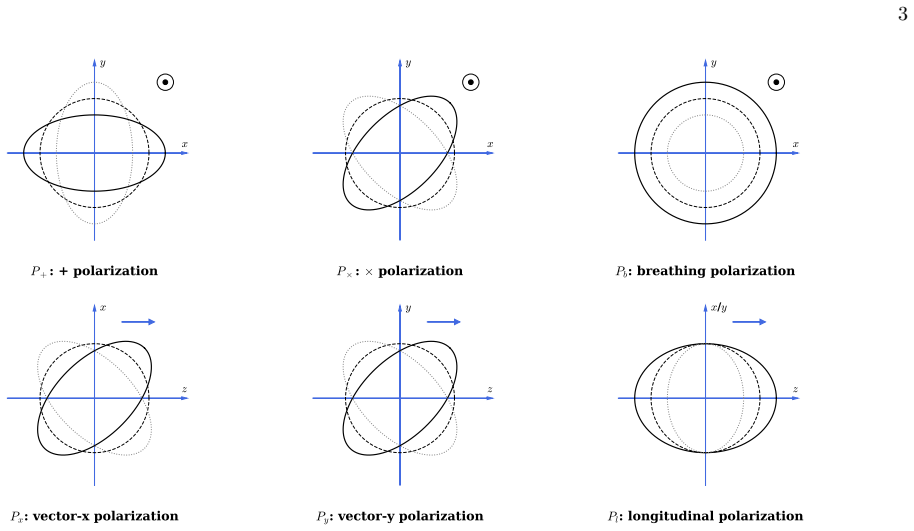
The paper derives explicit boost transformation laws for the six GW polarizations from the E(2) polarization decomposition. It finds that any propagating mode with five degrees of freedom enforces the universal amplitude relation A_l/A_b = -2(1-k^2/ω^2). In Bumblebee gravity, preferred-frame effects cause significant birefringence and polarization mixing, including a vector-to-tensor conversion that makes vector modes produce observable tensor signals for moving detectors.
What carries the argument
Explicit transformation laws for the six GW polarizations under longitudinal and transverse boosts, obtained from the standard E(2) polarization decomposition.
If this is right
- Polarization content measured by a detector depends on its velocity relative to the wave source.
- Five-degree-of-freedom modes cannot have independent longitudinal and breathing amplitudes.
- Preferred-frame theories predict observer-dependent polarization mixing and birefringence.
- Vector modes in the preferred frame generate tensor polarizations visible to boosted observers.
- Polarization conversion supplies a new observable signature for testing Lorentz violation.
Where Pith is reading between the lines
- Future detectors could test the amplitude relation directly by comparing scalar channels in events with known relative motion.
- The conversion mechanism might appear in other Lorentz-violating wave systems that admit vector modes.
- The symmetry classification could be applied to classify polarizations of other massless fields under boosts.
- If the relation holds, it constrains the possible dispersion relations for five-degree-of-freedom modes.
Load-bearing premise
The boost transformations follow from the standard E(2) decomposition and apply to the theories considered, including those without preferred frames and Bumblebee gravity.
What would settle it
Observation of a five-degree-of-freedom gravitational-wave mode in which the ratio of longitudinal to breathing amplitudes deviates from -2(1 - k^2/ω^2) at the expected wave speed would falsify the locking relation.
Figures
read the original abstract
Gravitational wave (GW) polarizations are traditionally classified in a fixed frame ($E(2)$ classification), which does not account for how polarization patterns change under Lorentz boosts. In this work, we derive the explicit transformation laws for all six GW polarizations under longitudinal and transverse boosts. For gravity theories devoid of preferred frames, we propose a symmetry-based classification of the GW polarizations they admit. Among our key findings, we demonstrate that a propagating mode with five degrees of freedom strictly locks its longitudinal and breathing scalar amplitudes via the universal relation $A_l/A_b = -2(1-k^2/\omega^2)$. For theories with a preferred frame, we analyze Bumblebee gravity and reveal that preferred-frame effects induce significant GW birefringence and observer-dependent polarization mixing. Crucially, we identify a novel vector-to-tensor polarization conversion mechanism, where vector modes in the preferred frame inevitably generate observable tensor polarizations for moving detectors, offering a new pathway to test Lorentz-violating gravity. Our framework provides a novel, observer-independent classification of GW polarizations and reveals previously unnoticed polarization mixing effects.
Editorial analysis
A structured set of objections, weighed in public.
Referee Report
Summary. The paper derives explicit transformation laws for all six GW polarizations under longitudinal and transverse boosts. For gravity theories without preferred frames it proposes a symmetry-based classification and reports that any propagating five-DOF mode obeys the universal amplitude lock A_l/A_b = -2(1-k²/ω²). For preferred-frame theories (exemplified by Bumblebee gravity) it identifies birefringence, observer-dependent polarization mixing, and a novel vector-to-tensor conversion mechanism that produces observable tensor modes for boosted detectors.
Significance. If the central derivations hold, the work supplies an observer-independent classification of GW polarizations and isolates concrete, potentially observable signatures of Lorentz violation. The reported amplitude lock and the vector-to-tensor conversion would constitute falsifiable predictions for multi-messenger or multi-detector analyses.
major comments (1)
- [Abstract / §3] Abstract and §3 (symmetry classification): the universal lock A_l/A_b = -2(1-k²/ω²) is stated to follow from the E(2) polarization decomposition. Five degrees of freedom imply a massive spin-2 representation whose little group is SO(3), not E(2); the factor (1-k²/ω²) itself signals non-lightlike dispersion. The derivation therefore appears to apply E(2) generators and helicity states outside their domain of validity, which directly undermines the claimed universality and symmetry-based classification.
minor comments (1)
- Clarify the precise counting of the six polarizations when five-DOF modes are admitted; the conventional massless count is two.
Simulated Author's Rebuttal
We are grateful to the referee for their careful reading of the manuscript and for raising this important point about the symmetry classification. We respond to the major comment below.
read point-by-point responses
-
Referee: [Abstract / §3] Abstract and §3 (symmetry classification): the universal lock A_l/A_b = -2(1-k²/ω²) is stated to follow from the E(2) polarization decomposition. Five degrees of freedom imply a massive spin-2 representation whose little group is SO(3), not E(2); the factor (1-k²/ω²) itself signals non-lightlike dispersion. The derivation therefore appears to apply E(2) generators and helicity states outside their domain of validity, which directly undermines the claimed universality and symmetry-based classification.
Authors: We thank the referee for highlighting this subtlety in the little-group structure. The relation is derived from the requirement of five independent degrees of freedom together with the explicit boost transformation laws for the polarization amplitudes, as presented in §2 and §3. The E(2) decomposition serves as a practical basis for the six possible metric polarizations in the observer frame, independent of the dispersion relation. However, we acknowledge that a massive spin-2 field is classified under SO(3) and that the factor (1-k²/ω²) indicates non-lightlike propagation. To resolve this, we will revise the abstract and §3 to clarify the scope of the symmetry classification, specifying that it applies to the polarization basis and boost properties rather than invoking the E(2) little group for non-massless modes. The universality claim will be qualified accordingly. revision: yes
Circularity Check
No significant circularity; derivation presented as independent symmetry consequence
full rationale
The abstract states that explicit boost transformation laws are derived from the standard E(2) polarization decomposition, after which the amplitude lock A_l/A_b = -2(1-k^2/ω^2) is demonstrated for five-DOF modes in preferred-frame-free theories. No quoted step shows the relation being presupposed by definition, fitted to a data subset and renamed as prediction, or justified solely via self-citation. The Bumblebee analysis and vector-to-tensor conversion are likewise presented as consequences of the framework rather than reductions to prior inputs. The derivation chain is therefore self-contained against external benchmarks.
Axiom & Free-Parameter Ledger
axioms (1)
- domain assumption Standard E(2) classification provides the starting polarization basis for deriving boost transformations
Reference graph
Works this paper leans on
-
[1]
These polarizations correspond to the massless spin-2 graviton with helicity±2, which are strictly transverse and traceless, satisfy- ing the standard propagation properties of GR
Two tensor polarizations (+ and×) propagating at the speed of light. These polarizations correspond to the massless spin-2 graviton with helicity±2, which are strictly transverse and traceless, satisfy- ing the standard propagation properties of GR
-
[2]
A scalar breathing polarization propagating at the speed of light. This polarization stems from a mass- less spin-0 scalar field with helicity 0, inducing an isotropic, transverse deformation on the test par- ticle array while leaving the longitudinal displace- ment entirely unaffected
-
[3]
A coupled combination of the breathing and lon- gitudinal polarizations, with their amplitude ra- tio tightly constrained byA l/Ab = 1−k 2/ω2. A quintessential representative of this class is the massive scalar propagating mode, where the phys- ical mass breaks the pure transversality and intro- duces a distinctive longitudinal polarization
-
[4]
The quintessential paradigm for this scenario is the massive tensor propagating mode (as realized in Fierz-Pauli or quadratic gravity)
A propagating mode possessing five physical de- grees of freedom, yet manifesting as a comprehen- sive mixture of tensor, vector, and scalar polar- izations, wherein the amplitudes of its scalar sec- tors strictly satisfy the interlinked relationAl/Ab = −2(1−k2/ω2). The quintessential paradigm for this scenario is the massive tensor propagating mode (as r...
-
[5]
The seemingly straightforward configuration fea- turing six distinct propagating DoFs paired with six independent polarizations. Intriguingly, no vi- able modified gravity framework discovered to date populates this sector, as the structural symmetry of the spacetime metric consistently intertwines the scalar components into the fine-tuned invariant re- l...
-
[6]
Whenk=ω, this mode propagates at the speed of light, under which the general scalar constraint reduces to Al/Ab = 0. Consequently, the longitudinal scalar polar- ization completely vanishes, leaving a configuration com- posed of two tensor modes, two vector modes, and a sin- gle pure breathing polarization. Nevertheless, despite its theoretical admissibil...
-
[7]
B. P. Abbottet al.(LIGO Scientific, Virgo), Observation of Gravitational Waves from a Binary Black Hole Merger, Phys. Rev. Lett.116, 061102 (2016), arXiv:1602.03837 [gr-qc]
work page internal anchor Pith review Pith/arXiv arXiv 2016
-
[8]
B. P. Abbottet al.(LIGO Scientific, Virgo), GWTC- 1: A Gravitational-Wave Transient Catalog of Compact Binary Mergers Observed by LIGO and Virgo during the First and Second Observing Runs, Phys. Rev. X9, 031040 (2019), arXiv:1811.12907 [astro-ph.HE]
work page internal anchor Pith review Pith/arXiv arXiv 2019
-
[9]
R. Abbottet al.(LIGO Scientific, Virgo), GWTC-2: Compact Binary Coalescences Observed by LIGO and Virgo During the First Half of the Third Observing Run, Phys. Rev. X11, 021053 (2021), arXiv:2010.14527 [gr- qc]
work page internal anchor Pith review Pith/arXiv arXiv 2021
-
[10]
R. Abbottet al.(LIGO Scientific, VIRGO), GWTC-2.1: Deep extended catalog of compact binary coalescences observed by LIGO and Virgo during the first half of the third observing run, Phys. Rev. D109, 022001 (2024), arXiv:2108.01045 [gr-qc]
work page internal anchor Pith review Pith/arXiv arXiv 2024
-
[11]
R. Abbottet al.(KAGRA, VIRGO, LIGO Scien- tific), GWTC-3: Compact Binary Coalescences Observed by LIGO and Virgo during the Second Part of the Third Observing Run, Phys. Rev. X13, 041039 (2023), arXiv:2111.03606 [gr-qc]
work page internal anchor Pith review Pith/arXiv arXiv 2023
-
[12]
A. G. Abacet al.(LIGO Scientific, KAGRA, VIRGO), GWTC-4.0: An Introduction to Version 4.0 of the Gravitational-Wave Transient Catalog, Astrophys. J. Lett.995, L18 (2025), arXiv:2508.18080 [gr-qc]
work page internal anchor Pith review Pith/arXiv arXiv 2025
-
[13]
GWTC-5.0: An Introduction to Version 5.0 of the Gravitational-Wave Transient Catalog
N. Abacet al.(LIGO Scientific, VIRGO, KA- GRA), GWTC-5.0: An Introduction to Version 5.0 of the Gravitational-Wave Transient Catalog, (2026), arXiv:2605.27223 [gr-qc]
work page internal anchor Pith review Pith/arXiv arXiv 2026
-
[14]
S. Hou, Y. Gong, and Y. Liu, Polarizations of Gravita- tional Waves in Horndeski Theory, Eur. Phys. J. C78, 378 (2018), arXiv:1704.01899 [gr-qc]
work page internal anchor Pith review Pith/arXiv arXiv 2018
-
[15]
T. Jacobson and D. Mattingly, Einstein-Aether waves, Phys. Rev. D70, 024003 (2004), arXiv:gr-qc/0402005
work page internal anchor Pith review Pith/arXiv arXiv 2004
-
[16]
Propagation of Gravitational Waves in Generalized TeVeS
E. Sagi, Propagation of gravitational waves in generalized TeVeS, Phys. Rev. D81, 064031 (2010), arXiv:1001.1555 [gr-qc]
work page internal anchor Pith review Pith/arXiv arXiv 2010
-
[17]
Y. Gong, S. Hou, E. Papantonopoulos, and D. Tzortzis, Gravitational waves and the polarizations in Hoˇ rava gravity after GW170817, Phys. Rev. D98, 104017 (2018), arXiv:1808.00632 [gr-qc]
work page internal anchor Pith review Pith/arXiv arXiv 2018
- [18]
-
[19]
F. Bombacigno, F. Moretti, and G. Montani, Scalar modes in extended hybrid metric-Palatini gravity: weak field phenomenology, Phys. Rev. D100, 124036 (2019), arXiv:1907.11949 [gr-qc]
- [20]
-
[21]
Y.-Q. Dong and Y.-X. Liu, Polarization modes of gravi- tational waves in Palatini-Horndeski theory, Phys. Rev. D105, 064035 (2022), arXiv:2111.07352 [gr-qc]
-
[22]
G. Farrugia, J. Levi Said, V. Gakis, and E. N. Saridakis, Gravitational Waves in Modified Teleparallel Theories, Phys. Rev. D97, 124064 (2018), arXiv:1804.07365 [gr- qc]
- [23]
-
[24]
S. Capozziello, M. Capriolo, and L. Caso, Weak field limit and gravitational waves inf(T, B) teleparallel gravity, Eur. Phys. J. C80, 156 (2020), arXiv:1912.12469 [gr-qc]
-
[25]
S. Capozziello, M. Capriolo, and L. Caso, Gravita- tional Waves in Higher Order Teleparallel Gravity, Class. Quant. Grav.37, 235013 (2020), arXiv:2010.00451 [gr- qc]
-
[26]
S. Bahamonde, M. Caruana, K. F. Dialektopoulos, V. Gakis, M. Hohmann, J. Levi Said, E. N. Saridakis, and J. Sultana, Gravitational-wave propagation and po- larizations in the teleparallel analog of Horndeski gravity, Phys. Rev. D104, 084082 (2021), arXiv:2105.13243 [gr- qc]
-
[27]
S. Capozziello and M. Capriolo, Gravitational waves in non-local gravity, Class. Quant. Grav.38, 175008 (2021), arXiv:2107.06972 [gr-qc]
-
[28]
T. Tachinami, S. Tonosaki, and Y. Sendouda, Gravitational-wave polarizations in generic linear massive gravity and generic higher-curvature gravity, Phys. Rev. D103, 104037 (2021), arXiv:2102.05540 [gr-qc]
-
[29]
Polarizations of gravitational waves in the bumble- bee gravity model,
D. Liang, R. Xu, X. Lu, and L. Shao, Polarizations of gravitational waves in the bumblebee gravity model, Phys. Rev. D106, 124019 (2022), arXiv:2207.14423 [gr- qc]
-
[30]
D. M. Eardley, D. L. Lee, A. P. Lightman, R. V. Wagoner, and C. M. Will, Gravitational-wave observations as a tool for testing relativistic gravity, Phys. Rev. Lett.30, 884 (1973)
1973
-
[31]
D. M. Eardley, D. L. Lee, and A. P. Lightman, Gravitational-wave observations as a tool for testing rel- ativistic gravity, Phys. Rev. D8, 3308 (1973)
1973
- [32]
-
[33]
Gravitational Wave Polarization Modes in $f(R)$ Theories
H. Rizwana Kausar, L. Philippoz, and P. Jetzer, Gravita- tional Wave Polarization Modes inf(R) Theories, Phys. Rev. D93, 124071 (2016), arXiv:1606.07000 [gr-qc]
work page internal anchor Pith review Pith/arXiv arXiv 2016
-
[34]
Polarizations of gravitational waves in $f(R)$ gravity
D. Liang, Y. Gong, S. Hou, and Y. Liu, Polarizations of gravitational waves inf(R) gravity, Phys. Rev. D95, 104034 (2017), arXiv:1701.05998 [gr-qc]
work page internal anchor Pith review Pith/arXiv arXiv 2017
-
[35]
Theoretical Aspects of Massive Gravity
K. Hinterbichler, Theoretical Aspects of Massive Gravity, Rev. Mod. Phys.84, 671 (2012), arXiv:1105.3735 [hep- 19 th]
work page internal anchor Pith review Pith/arXiv arXiv 2012
-
[36]
C. de Rham, Massive Gravity, Living Rev. Rel.17, 7 (2014), arXiv:1401.4173 [hep-th]
work page internal anchor Pith review Pith/arXiv arXiv 2014
-
[37]
Fierz and W
M. Fierz and W. Pauli, On relativistic wave equations for particles of arbitrary spin in an electromagnetic field, Proc. Roy. Soc. Lond. A173, 211 (1939)
1939
-
[38]
K. S. Stelle, Classical Gravity with Higher Derivatives, Gen. Rel. Grav.9, 353 (1978)
1978
-
[39]
K. S. Stelle, Renormalization of Higher Derivative Quan- tum Gravity, Phys. Rev. D16, 953 (1977)
1977
-
[40]
Parameterized Post-Newtonian Analysis of Quadratic Gravity and Solar System Constraints
J. Zhu and H. Li, Parameterized post-Newtonian analysis of quadratic gravity and solar system constraints, Eur. Phys. J. C86, 594 (2026), arXiv:2601.05750 [gr-qc]
work page internal anchor Pith review Pith/arXiv arXiv 2026
- [41]
-
[42]
Y.-Q. Dong, Y.-Q. Liu, and Y.-X. Liu, Polarization modes of gravitational waves in general modified grav- ity: General metric theory and general scalar-tensor the- ory, Phys. Rev. D109, 044013 (2024), arXiv:2310.11336 [gr-qc]
-
[43]
V. A. Kostelecky, Gravity, Lorentz violation, and the standard model, Phys. Rev. D69, 105009 (2004), arXiv:hep-th/0312310
work page internal anchor Pith review Pith/arXiv arXiv 2004
-
[44]
Spontaneous Lorentz Violation, Nambu-Goldstone Modes, and Gravity
R. Bluhm and V. A. Kostelecky, Spontaneous Lorentz violation, Nambu-Goldstone modes, and gravity, Phys. Rev. D71, 065008 (2005), arXiv:hep-th/0412320
work page internal anchor Pith review Pith/arXiv arXiv 2005
-
[45]
J. Zhu, H. Li, and Z. Xiao, Hamiltonian Constraints on Spontaneous Lorentz Symmetry Breaking in the Bum- blebee Model, (2026), arXiv:2604.06271 [hep-ph]
work page internal anchor Pith review Pith/arXiv arXiv 2026
-
[46]
Dynamic Aspects of Bumblebee Gravity: Post-Newtonian Approach
J. Zhu and H. Li, Dynamic Aspects of Bumble- bee Gravity: Post-Newtonian Approach, (2026), arXiv:2605.17516 [gr-qc]
work page internal anchor Pith review Pith/arXiv arXiv 2026
-
[47]
C. van de Bruck, M. A. Gorji, N. A. Nilsson, M. C. Pookkillath, and M. Yamaguchi, A no-go the- orem in bumblebee vector-tensor cosmology, (2025), arXiv:2509.11647 [hep-th]
-
[48]
Planck 2013 results. XXVII. Doppler boosting of the CMB: Eppur si muove
N. Aghanimet al.(Planck), Planck 2013 results. XXVII. Doppler boosting of the CMB: Eppur si muove, Astron. Astrophys.571, A27 (2014), arXiv:1303.5087 [astro- ph.CO]
work page internal anchor Pith review Pith/arXiv arXiv 2013
-
[49]
X.-B. Lai, Y.-Q. Dong, Y.-Z. Fan, and Y.-X. Liu, Stability analysis of cosmological perturbations in the bumblebee model: Parameter constraints and grav- itational waves, Phys. Rev. D113, 044003 (2026), arXiv:2509.13958 [gr-qc]
-
[50]
B. P. Abbottet al.(LIGO Scientific, Virgo, Fermi- GBM, INTEGRAL), Gravitational Waves and Gamma- rays from a Binary Neutron Star Merger: GW170817 and GRB 170817A, Astrophys. J. Lett.848, L13 (2017), arXiv:1710.05834 [astro-ph.HE]
work page internal anchor Pith review Pith/arXiv arXiv 2017
-
[51]
Gravity with a dynamical preferred frame
T. Jacobson and D. Mattingly, Gravity with a dynam- ical preferred frame, Phys. Rev. D64, 024028 (2001), arXiv:gr-qc/0007031
work page internal anchor Pith review Pith/arXiv arXiv 2001
-
[52]
C. Eling and T. Jacobson, Static postNewtonian equiv- alence of GR and gravity with a dynamical preferred frame, Phys. Rev. D69, 064005 (2004), arXiv:gr- qc/0310044
- [53]
-
[54]
B. Z. Foster and T. Jacobson, Post-Newtonian param- eters and constraints on Einstein-aether theory, Phys. Rev. D73, 064015 (2006), arXiv:gr-qc/0509083
work page internal anchor Pith review Pith/arXiv arXiv 2006
-
[55]
H. Ruegg and M. Ruiz-Altaba, The Stueckelberg field, Int. J. Mod. Phys. A19, 3265 (2004), arXiv:hep- th/0304245
discussion (0)
Sign in with ORCID, Apple, or X to comment. Anyone can read and Pith papers without signing in.