REVIEW 3 major objections 5 minor 45 cited by
Mish: A Self Regularized Non-Monotonic Activation Function
T0 review · 3 major / 5 minor · reviewed 2026-08-14 · deepseek-v4-flash
Pith's one-line read This paper proposes Mish, an activation function defined as f(x)=x tanh(softplus(x)), and reports that it consistently matches or exceeds ReLU, Swish, and Leaky ReLU across computer vision benchmarks.
desk verdict A genuinely new activation function with broad empirical coverage, but the paper's own statistics do not support the claimed consistent edge over Swish. read the letter →
The pith
A machine-rendered reading of the paper's core claim, the machinery that carries it, and where it could break.
The reading
What carries the argument
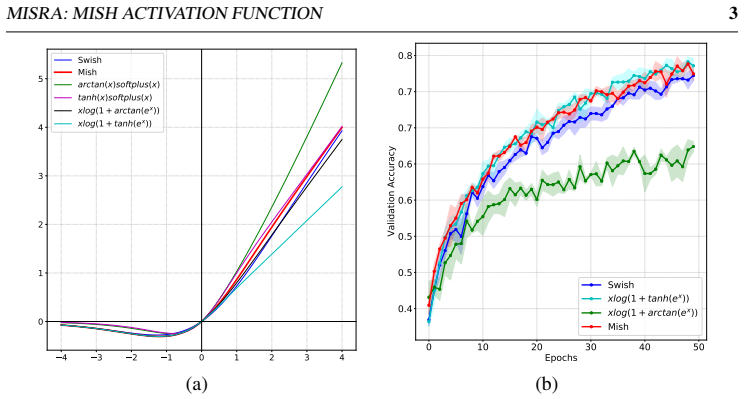
The central object is the activation function itself, $f(x)=x\tanh(\mathrm{softplus}(x))$, which combines identity, softplus, and tanh into a smooth non-monotonic function that is bounded below and unbounded above. Its load-bearing identity is the derivative decomposition $f'(x)=\Delta(x)\,\mathrm{swish}(x)+f(x)/x$, where $\Delta(x)=\mathrm{sech}^2(\mathrm{softplus}(x))$; the paper treats $\Delta(x)$ as a preconditioner that smooths the optimization landscape and thereby regularizes training. Mish also uses the self-gating property from Swish, multiplying the unmodulated input by the output of a nonlinear function of the input, and its smoothness and small negative-weight retention are credited with better gradient flow and avoidance of Dying ReLU. An optimized CUDA implementation, Mish-CUDA, is used to mitigate the extra computational cost of the formula.
What would settle it
Train the same architectures (e.g., ResNet-50 on ImageNet-1k and YOLOv4 on MS-COCO) with ReLU, Swish, Leaky ReLU, and Mish across many seeds, keeping all augmentation and hyperparameter settings fixed, and check whether the mean gaps persist above the seed variance. If the 1-2% differences shrink below one standard deviation, or change sign across architectures, the central empirical claim is not settled.
Extended reading notes
Core claim
The central claim is that Mish is a self-regularized non-monotonic activation function that matches or improves on ReLU, Swish, and Leaky ReLU in the vision settings tested. The paper defines Mish as $f(x)=x\tanh(\ln(1+e^x))$, notes its range is approximately $[-0.31,\infty)$, and derives $f'(x)=\Delta(x)\,\mathrm{swish}(x)+f(x)/x$ with $\Delta(x)=\mathrm{sech}^2(\mathrm{softplus}(x))$. This decomposition is used to argue that the $\Delta$ factor acts as a preconditioner that makes gradients and loss contours smoother, which the author identifies as the likely mechanism behind Mish's gains. Evidence includes a 23-run CIFAR-10 study, architecture sweeps on CIFAR-10, ImageNet-1k results on ResNet and CSP-family models, and MS-COCO object detection with YOLOv4, including combinations with CutMix, Mosaic, self-adversarial training, DropBlock, and label smoothing.
Load-bearing premise
The load-bearing premise is that the reported accuracy differences, roughly 0.4% to 2.1%, are caused by the activation function rather than by run-to-run randomness or unlisted training details, since most large-scale results are single runs without error bars.
Editorial extensions
If this is right
- Practitioners can treat Mish as a drop-in replacement in standard CNN backbones and expect small accuracy gains without retuning hyperparameters.
- Mish is more dependable than Swish in large or deep models: the paper reports Swish dropping ImageNet Top-1 by 13.4% on CSP-ResNext-50 while Mish improves it by 1%.
- Mish is compatible with modern augmentation and regularization schemes such as CutMix, Mosaic, self-adversarial training, DropBlock, and label smoothing, with consistent improvements.
- The optimized Mish-CUDA implementation brings forward and backward pass times close to native ReLU levels, making the accuracy gains available at modest computational cost.
- Because Mish consistently matched or exceeded baselines across ResNet, Wide ResNet, DenseNet, MobileNet, ShuffleNet, Inception, EfficientNet, and detection backbones, the reported benefit is not tied to one architecture family.
Reading between the lines
- Inference: if the $\Delta(x)$ preconditioner story is right, then activation design could focus on shaping the derivative's smoothing factor rather than hunting for function shapes; one test would be to vary the width or exponent of the sech-squared factor and measure loss-landscape curvature.
- The paper leaves non-vision tasks untested; a natural extension is to measure Mish in transformers or recurrent models, where smooth bounded-below activations may behave differently.
- Because the largest gains appear in hard, deep detection models, a testable extension is to check whether Mish's advantage grows with network depth or with smaller objects, using the per-size AP columns in Table 5.
- The results were obtained with fixed hyperparameters; a hyperparameter search with Mish as the target, which the author explicitly suggests, could either widen the gains or reveal that some of the baseline comparisons depend on tuning.
Signed reviews
Editorial analysis
A structured set of objections, weighed in public.
Referee Report
Summary. The paper proposes a new activation function, Mish, defined as f(x)=x tanh(softplus(x)), and argues that it is a smooth, non-monotonic, 'self-regularized' activation that can replace ReLU, Leaky ReLU, or Swish in deep networks. The manuscript derives the first derivative, offers a speculative interpretation of the derivative's Delta(x) term as a preconditioner, and reports benchmark comparisons on CIFAR-10, ImageNet-1k, and MS-COCO across many architectures, plus a runtime comparison with a CUDA implementation. The central empirical claim is that Mish consistently matches or exceeds ReLU, Leaky ReLU, and Swish while keeping all other network parameters and hyperparameters constant.
Significance. If the empirical claim is robust, Mish would be a useful drop-in activation function: it is simple to define, publicly implemented, and shows a broad pattern of small accuracy gains across many architectures. The paper's strengths are its breadth of architectures, the public code, the exact derivative identity in Eq. (1), and the presence of a 23-run statistical study for one small CIFAR-10 setup. However, the significance is conditional: the headline gains rest largely on single runs with no error bars, and the one repeated-run experiment does not separate Mish from Swish or GELU. With additional uncertainty quantification or with claims rescaled to what the evidence supports, this could be a useful empirical reference point; as it stands, the 'consistently outperforms' claim is stronger than the evidence.
major comments (3)
- [§4.4, Table 5] The abstract's headline 2.1% AP50 improvement is taken from YOLOv4pacsp-s, the smallest variant. On the main YOLOv4pacsp model, AP50 improves by only 0.9% while AP75 decreases from 51.0% to 50.2% and APL is essentially flat (59.5% to 59.4%); these are single runs with no error bars. The mixed directions across metrics are exactly what one would expect from seed or configuration noise, so this table does not by itself establish a reliable activation effect.
- [§4.3, Table 3] The statement that Mish 'consistently outperforms' ReLU, Leaky ReLU, and Swish is contradicted by the PeleeNet row, where Swish achieves 71.5% Top-1 and 90.7% Top-5 against Mish's 71.4% and 90.4%. The same table also reports a 13.4-point Top-1 drop for Swish on CSP-ResNext-50 without augmentation, which is far larger than any reported activation-function effect in the literature and suggests an uncontrolled difference in training or configuration; citing it as evidence that Swish 'cannot be used in every architecture' is not supported by the controlled-comparison protocol described in the paper.
- [§4.1, Table 1] The only repeated-run experiment (23 runs, SqueezeNet on CIFAR-10) does not resolve Mish from its closest competitors. Mish's mean accuracy is 0.16 points above Swish and 0.11 points above GELU, while the per-run standard deviations are 0.40-0.47; no significance test or multiple-comparison correction is reported, so the differences are within plausible noise. The comparison with ReLU (0.82 points) is more favorable but still should be accompanied by a significance statement.
minor comments (5)
- [§4.4, text] The sentence listing hyperparameters says epochs, initial learning rate, weight decay, and momentum were set at '500500, 0.01, 5e-4, and 0.9'; '500500' appears to be a typo and should be clarified.
- [Table 4] The ReLU and Mish results are identical for CSP-DarkNet-53 with and without the PANet+SPP module (64.5% and 64.9% in both rows); this makes the comparison uninformative and needs an explanation or correction.
- [§2, §4.5] The claim that the Delta(x) term 'acts like a preconditioner' is explicitly speculative and should be labeled as a hypothesis rather than presented as an explanation of the empirical results.
- [§4.2-§4.4] All benchmark tables lack information on the number of runs, seeds, and variance; adding this information would materially improve the reader's ability to judge the reported 1-3% improvements.
- [§3] The 'self-regularized' property is never defined formally; the paper would benefit from a precise statement of what quantity is regularized and how it is measured.
Circularity Check
No circularity found: the derivation is exact algebra and the empirical claims rest on external benchmarks.
full rationale
The paper's central mathematical content is the closed-form definition f(x) = x tanh(softplus(x)) and its exact first derivative, Eq. (1)-(4), which are algebraic identities rather than fitted or self-referential constructions. No parameter is fitted to a subset of the benchmarks and then renamed as a prediction; all reported comparisons are external evaluations in which the activation function is swapped while other network and training parameters are held constant. The preconditioning discussion in Section 2 is explicitly speculative ('we speculate', 'may be acting as a regularizer') and is not used to derive the empirical results, so it cannot make the conclusions circular. The paper contains no load-bearing self-citations: it cites standard references for architectures, datasets, and prior activation functions, and it does not invoke any uniqueness theorem or prior author result to rule out alternatives. Concerns about single-run large-scale benchmarks and the statistical resolution of small accuracy differences are methodological correctness risks, not circularity, and therefore do not affect this score.
Assumptions & free parameters
assumptions (3)
- domain assumption Smoother loss landscapes lead to easier optimization and better generalization, based on Li et al. (2018).
- ad hoc to paper The Delta(x) term in the derivative behaves like a preconditioner that makes gradients smoother.
- standard math Standard analytic properties of tanh and softplus (differentiability, monotonicity, limits) hold as assumed.
Cite this review
Pith. "Pith review of Mish: A Self Regularized Non-Monotonic Activation Function." pith.science (2026). https://pith.science/paper/QQZ22ZJ6
@misc{pith2026190808681,
  author       = {Pith},
  title        = {Pith review of: Mish: A Self Regularized Non-Monotonic Activation Function},
  year         = {2026},
  howpublished = {\url{https://pith.science/paper/QQZ22ZJ6}},
  note         = {Machine review of arXiv:1908.08681}
}
abstract
We propose $\textit{Mish}$, a novel self-regularized non-monotonic activation function which can be mathematically defined as: $f(x)=x\tanh(softplus(x))$. As activation functions play a crucial role in the performance and training dynamics in neural networks, we validated experimentally on several well-known benchmarks against the best combinations of architectures and activation functions. We also observe that data augmentation techniques have a favorable effect on benchmarks like ImageNet-1k and MS-COCO across multiple architectures. For example, Mish outperformed Leaky ReLU on YOLOv4 with a CSP-DarkNet-53 backbone on average precision ($AP_{50}^{val}$) by 2.1$\%$ in MS-COCO object detection and ReLU on ResNet-50 on ImageNet-1k in Top-1 accuracy by $\approx$1$\%$ while keeping all other network parameters and hyperparameters constant. Furthermore, we explore the mathematical formulation of Mish in relation with the Swish family of functions and propose an intuitive understanding on how the first derivative behavior may be acting as a regularizer helping the optimization of deep neural networks. Code is publicly available at https://github.com/digantamisra98/Mish.
Figures


Figures from the paper (2 more)


Forward citations
Cited by 45 Pith papers
-
Silent Impact: Tracking Tennis Shots from the Passive Arm
Tennis shots can be detected and classified from IMU data on the passive arm alone, with accuracy close to dominant-arm sensors and lower perceived burden.
-
Compress-Align-Detect: onboard change detection from unregistered images
A single neural network performs compression, co-registration, and change detection onboard a satellite, achieving F1 up to about 70% at low bitrates on simulated unregistered image pairs.
-
Why Does Action Chunking Improve Behavioral Cloning Performance in Robotic Control?
Action chunking in robotic behavioral cloning works mainly because it acts as a delayed-prediction policy and an implicit ensemble, not because of temporal consistency or horizon reduction.
-
UniRank: Benchmarking Ranking Models for Unified Sequential Modeling and Feature Interaction
UniRank is an open benchmark that standardizes chronological autoregressive supervision, multi-task evaluation, and capacity controls for 15 unified ranking models on five large datasets.
-
Rethinking Neural Nonlinearity as Gating
Common activations and softmax are instances of a single input-conditioned Threshold Gating primitive with few branches, enabling lossless conversion and a unified analog implementation path.
-
LVM-GP: Uncertainty-Aware PDE Solver via coupling latent variable model and Gaussian process
A hybrid model coupling a Gaussian process latent field with a neural operator provides uncertainty estimates for forward and inverse PDE problems with noisy data.
-
Joint Inference of Trajectory and Obstacle in Mean-Field Games via Bilevel Optimization
A bilevel optimization framework with normalizing flows recovers the latent obstacle and optimal trajectories in mean-field games from partial trajectory data, achieving about 0.1 relative L2 error even with fewer tha...
-
Latent-attention Based Transformer for Near ML Polar Decoding in Short-code Regime
A code-aware latent-attention transformer matches near-ML error rates for short polar codes only after per-configuration fine-tuning.
-
EAT: QoS-Aware Edge-Collaborative AIGC Task Scheduling via Attention-Guided Diffusion Reinforcement Learning
EAT, an attention-guided diffusion reinforcement learning scheduler for collaborative edge AIGC, reduces Stable Diffusion inference latency by 56-74% versus baselines while keeping CLIP quality nearly unchanged.
-
Transformers Learn Faster with Semantic Focus
Input-dependent top-k sparse attention makes small transformers converge faster and generalize as well as full attention, while input-agnostic sparsity does not, and the effect is tied to reduced dispersion of attenti...
-
A Composite Predictive-Generative Approach to Monaural Universal Speech Enhancement
PGUSE combines a predictive speech enhancer with a diffusion model, fusing their outputs and truncating the diffusion start to improve universal speech enhancement with low inference cost.
-
Revisiting Feature Interactions from the Perspective of Quadratic Neural Networks for Click-through Rate Prediction
Hadamard product feature interactions work because they make CTR models quadratic networks, and the proposed QNN-alpha with multi-head Khatri-Rao product and self-ensemble loss achieves state-of-the-art results on six...
-
FlowQ: Energy-Guided Flow Policies for Offline Reinforcement Learning
FlowQ uses energy-guided flow matching to learn an offline RL policy approximating π(a|s) ∝ πβ(a|s) exp(Q(s,a)) with guidance applied during training rather than at inference.
-
CoDynTrust: Robust Asynchronous Collaborative Perception via Dynamic Feature Trust Modulus
CoDynTrust gates shared vehicle features by a learned trust score derived from aleatoric and epistemic uncertainty, improving 3D detection under time delays, though its evaluation leaks test-set statistics.
-
A Hands-free Spatial Selection and Interaction Technique using Gaze and Blink Input with Blink Prediction for Extended Reality
A gaze-and-blink interaction technique for XR matches Gaze+Pinch in speed but has higher error rates, and a neural filter for involuntary blinks did not significantly reduce those errors.
-
Parseval Regularization for Continual Reinforcement Learning
Parseval regularization, a cheap orthogonality-preserving penalty, improves continual RL agents' success on new tasks across gridworld, CARL and MetaWorld benchmarks.
-
Ternary Stochastic Neuron -- Implemented with a Single Strained Magnetostrictive Nanomagnet
A strain-engineered magnetostrictive nanomagnet can produce the three-state activation function needed for a ternary stochastic neuron, according to Landau-Lifshitz-Gilbert simulations.
-
Meteosat Third Generation imagery improves CNN-based SSI retrieval
Higher-resolution MTG/FCI imagery cuts CNN SSI RMSE under overcast and cloudy skies versus MSG-only, with ~20% overall skill over SARAH-3, but not under clear skies.
-
Relative Value Learning
A critic that learns antisymmetric value differences ∆(s_i,s_j)=V(s_i)−V(s_j) has a provably contracting Bellman operator and an unbiased advantage estimator, and PPO with this critic matches standard PPO on Atari.
-
Measurement of the branching ratio of the $K^{+}\rightarrow\pi^{+}\nu\bar{\nu}$ decay
NA62 measures Br(K⁺→π⁺νν̄) = (9.6±1.9)×10⁻¹¹ from 2016–2024 data, a 20% relative-precision measurement consistent with the Standard Model.
-
Path optimization method for the sign problem: Insights from random matrix models
Path optimization improves the average phase factor in the Stephanov model at high chemical potential but not at low chemical potential or in the chiral random matrix model, pointing to the global sign problem as the ...
-
Learning-based Physics-Constrained Neural Kernel for Sound Field Estimation With Source-Position-Dependent Directional Weighting
A source-position-dependent implicit neural representation for the directional weighting in a physics-constrained kernel enables sound field estimation that generalizes to unseen source positions without per-snapshot ...
-
The Algorithm Is Not the Behavior: Learned Priors Override Look-Ahead in a Chess-Playing Neural Network
The paper demonstrates non-monotonic move-policy dynamics in a chess transformer, but its abstract claims a causal safety-prior override result that never appears in the body.
-
FLUX-Makeup: High-Fidelity, Identity-Consistent, and Robust Makeup Transfer via Diffusion Transformer
This document pairs a makeup-transfer abstract with a mismatched body about activation functions, leaving the claimed method unverifiable.
-
Masked Temporal Interpolation Diffusion for Procedure Planning in Instructional Videos
MTID improves action sequence planning in instructional videos by adding a learnable latent interpolation module, a masked projection, and a task-adaptive proximity loss to a DDIM-based diffusion model.
-
Distributional Soft Actor-Critic with Diffusion Policy
DSAC-D couples a diffusion-based value distribution network with a diffusion policy, but its headline state-of-the-art claim is contradicted by its own benchmark table.
-
Preserving Plasticity in Continual Learning with Adaptive Linearity Injection
AdaLin, a per-neuron learnable linearity injection gated by activation saturation, preserves plasticity in continual learning and off-policy RL without task boundaries or extra method hyperparameters.
-
Neural Stereo Video Compression with Hybrid Disparity Compensation
A hybrid disparity compensation module, combining shifted cost volumes with normalized cross-attention, improves neural stereo video compression by up to 55% bitrate over MV-HEVC on driving benchmarks.
-
Active RIS-Empowered Covert Satellite-Terrestrial Communications
An aerial active STAR-RIS with a generative diffusion-model DRL controller improves simulated covert satellite-to-ground capacity and fairness, but with limited reproducibility evidence.
-
PAGNet: Pluggable Adaptive Generative Networks for Information Completion in Multi-Agent Communication
PAGNet learns per-agent communication weights and generates global states with a U-Net and GAN discriminator, reporting improved cooperative MARL performance on LBF, Hallway, and SMAC.
-
Gompertz Linear Units: Leveraging Asymmetry for Enhanced Learning Dynamics
GoLU (x times e^{-e^{-x}}) matches or beats GELU and Swish on several benchmarks, but the gains often appear only after learning-rate tuning.
-
Dual-Branch Residual Network for Cross-Domain Few-Shot Hyperspectral Image Classification with Refined Prototype
A dual-branch residual network with query-prototype contrastive refinement and MMD domain alignment attains the highest mean accuracy on four cross-domain few-shot hyperspectral benchmarks.
-
Hadamard product in deep learning: Introduction, Advances and Challenges
A survey that taxonomizes deep learning applications of the Hadamard product into four domains and argues it is a core architectural primitive.
-
Estimating Probabilities of Causation with Machine Learning Models
On a synthetic causal model, a multilayer perceptron with the Mish activation function predicts the lower and upper bounds of the probability of necessity and sufficiency for subpopulations with limited data, reaching...
-
Softplus Attention with Re-weighting Boosts Length Extrapolation in Large Language Models
A two-stage softplus-based attention mechanism with re-weighting (LSSAR) is reported to keep validation loss nearly flat when a 124M-parameter GPT-2 is tested at up to 16x its 1024-token training length.
-
Reconstructing Time-of-Flight Detector Values of Angular Streaking Using Machine Learning
A convolutional autoencoder trained only on simulated data can denoise angular streaking images and reconstruct up to three missing time-of-flight detectors, with fast inference for online experiments.
-
Regression Guided Strategy to Automated Facial Beauty Optimization through Image Synthesis
A face can be automatically 'beautified' by mapping it into StyleGAN2's latent space and using CMA-ES to optimize a learned beauty score, with only qualitative evidence of improvement.
-
Reinforcement Learning: From Algorithms To Foundation Models
A dissertation uniting the author's published results: non-exploitable Nash-DQN policies and the FightLadder benchmark for games, plus diffusion/consistency-model world models for RL — a compilation rather than new results.
-
Hybrid activation functions for deep neural networks: S3 and S4 -- a novel approach to gradient flow optimization
A new parameterized activation function, S4, that blends sigmoid and softsign through a smooth sigmoid-weighted transition is claimed to improve accuracy and convergence on small neural network benchmarks.
-
Tangma: A Tanh-Guided Activation Function with Learnable Parameters
Tangma, defined as x times tanh(x plus a learned shift) plus a learned linear term, reaches 99.09% validation accuracy on MNIST and 78.15% on CIFAR-10 after 10 epochs, slightly beating ReLU, Swish, and GELU in these s...
-
SG-Blend: Learning an Interpolation Between Improved Swish and GELU for Robust Neural Representations
SG-Blend, a learnable convex combination of a shifted Swish and GELU, reports modest accuracy and BLEU gains on CIFAR-10, IMDB, and a WMT14 subset, with no variance reporting.
-
Neural Networks Learn Distance Metrics
A two-layer MNIST study argues that networks prefer distance-based representations, but the evidence is mostly architecture-specific and the OffsetL2 layer resembles known RBF units.
-
Local Control Networks (LCNs): Optimizing Flexibility in Neural Network Data Pattern Capture
Local Control Networks put a separate learnable B-spline activation on every neuron and report small accuracy gains over MLPs and KANs on benchmark tasks.
-
SoftReMish: A Novel Activation Function for Enhanced Convolutional Neural Networks for Visual Recognition Performance
SoftReMish is presented as new but reduces to Mish with rescaled input and output, and its MNIST evidence is not self-consistent.
-
YOLOv1 to YOLOv11: A Comprehensive Survey of Real-Time Object Detection Innovations and Challenges
A survey of YOLO object detectors from version 1 to version 11 that compiles architectures, benchmarks, and applications, with several factual inconsistencies.
Reference graph
Works this paper leans on
-
[1]
On the rate of convergence of the preconditioned conjugate gradient method
Owe Axelsson and Gunhild Lindskog. On the rate of convergence of the preconditioned conjugate gradient method. Numerische Mathematik, 48(5):499–523, 1986
work page 1986
-
[2]
Yolov4: Optimal speed and accuracy of object detection
Alexey Bochkovskiy, Chien-Yao Wang, and Hong-Yuan Mark Liao. Yolov4: Optimal speed and accuracy of object detection. arXiv preprint arXiv:2004.10934, 2020
arXiv 2004
-
[3]
Large-scale machine learning with stochastic gradient descent
Léon Bottou. Large-scale machine learning with stochastic gradient descent. In Pro- ceedings of COMPSTAT’2010, pages 177–186. Springer, 2010
work page 2010
-
[4]
Improving Deep Learning by Inverse Square Root Linear Units (ISRLUs)
Brad Carlile, Guy Delamarter, Paul Kinney, Akiko Marti, and Brian Whitney. Im- proving deep learning by inverse square root linear units (isrlus). arXiv preprint arXiv:1710.09967, 2017
work page Pith review arXiv 2017
-
[5]
Xception: Deep learning with depthwise separable convolutions
François Chollet. Xception: Deep learning with depthwise separable convolutions. In Proceedings of the IEEE conference on computer vision and pattern recognition, pages 1251–1258, 2017
2017
-
[6]
Fast and accurate deep network learning by exponential linear units (elus)
Djork-Arné Clevert, Thomas Unterthiner, and Sepp Hochreiter. Fast and accurate deep network learning by exponential linear units (elus). arXiv preprint arXiv:1511.07289, 2015
arXiv 2015
-
[7]
Imagenet: A large-scale hierarchical image database
Jia Deng, Wei Dong, Richard Socher, Li-Jia Li, Kai Li, and Li Fei-Fei. Imagenet: A large-scale hierarchical image database. In 2009 IEEE conference on computer vision and pattern recognition, pages 248–255. Ieee, 2009
2009
-
[8]
Spinenet: Learning scale-permuted backbone for recognition and localization
Xianzhi Du, Tsung-Yi Lin, Pengchong Jin, Golnaz Ghiasi, Mingxing Tan, Yin Cui, Quoc V Le, and Xiaodan Song. Spinenet: Learning scale-permuted backbone for recognition and localization. arXiv preprint arXiv:1912.05027, 2019
arXiv 1912
Show all 52 references
-
[9]
Dropblock: A regularization method for convolutional networks
Golnaz Ghiasi, Tsung-Yi Lin, and Quoc V Le. Dropblock: A regularization method for convolutional networks. In Advances in Neural Information Processing Systems, pages 10727–10737, 2018
2018
-
[10]
Rich feature hierar- chies for accurate object detection and semantic segmentation
Ross Girshick, Jeff Donahue, Trevor Darrell, and Jitendra Malik. Rich feature hierar- chies for accurate object detection and semantic segmentation. In Proceedings of the IEEE conference on computer vision and pattern recognition, pages 580–587, 2014. 12 MISRA: MISH ACTIV A TI...
2014
-
[11]
Understanding the difficulty of training deep feed- forward neural networks
Xavier Glorot and Yoshua Bengio. Understanding the difficulty of training deep feed- forward neural networks. In Proceedings of the thirteenth international conference on artificial intelligence and statistics, pages 249–256, 2010
2010
-
[12]
Lets keep it simple, using simple architectures to outperform deeper and more complex architectures
Seyyed Hossein HasanPour, Mohammad Rouhani, Mohsen Fayyaz, and Mohammad Sabokrou. Lets keep it simple, using simple architectures to outperform deeper and more complex architectures. arXiv preprint arXiv:1608.06037, 2016
2016 arXiv
-
[13]
Delving deep into rectifiers: Surpassing human-level performance on imagenet classification
Kaiming He, Xiangyu Zhang, Shaoqing Ren, and Jian Sun. Delving deep into rectifiers: Surpassing human-level performance on imagenet classification. In Proceedings of the IEEE international conference on computer vision, pages 1026–1034, 2015
2015
-
[14]
Spatial pyramid pooling in deep convolutional networks for visual recognition
Kaiming He, Xiangyu Zhang, Shaoqing Ren, and Jian Sun. Spatial pyramid pooling in deep convolutional networks for visual recognition. IEEE transactions on pattern analysis and machine intelligence, 37(9):1904–1916, 2015
1904
-
[15]
Deep residual learning for image recognition
Kaiming He, Xiangyu Zhang, Shaoqing Ren, and Jian Sun. Deep residual learning for image recognition. In Proceedings of the IEEE conference on computer vision and pattern recognition, pages 770–778, 2016
2016
-
[16]
Gaussian error linear units (gelus)
Dan Hendrycks and Kevin Gimpel. Gaussian error linear units (gelus). arXiv preprint arXiv:1606.08415, 2016
2016 arXiv
-
[17]
Mobilenets: Effi- cient convolutional neural networks for mobile vision applications
Andrew G Howard, Menglong Zhu, Bo Chen, Dmitry Kalenichenko, Weijun Wang, Tobias Weyand, Marco Andreetto, and Hartwig Adam. Mobilenets: Effi- cient convolutional neural networks for mobile vision applications. arXiv preprint arXiv:1704.04861, 2017
2017 arXiv
-
[18]
Squeeze-and-excitation networks
Jie Hu, Li Shen, and Gang Sun. Squeeze-and-excitation networks. In Proceedings of the IEEE conference on computer vision and pattern recognition , pages 7132–7141, 2018
2018
-
[19]
Densely connected convolutional networks
Gao Huang, Zhuang Liu, Laurens Van Der Maaten, and Kilian Q Weinberger. Densely connected convolutional networks. InProceedings of the IEEE conference on computer vision and pattern recognition, pages 4700–4708, 2017
2017
-
[20]
Batch normalization: Accelerating deep network training by reducing internal covariate shift
Sergey Ioffe and Christian Szegedy. Batch normalization: Accelerating deep network training by reducing internal covariate shift. arXiv preprint arXiv:1502.03167, 2015
2015 arXiv
-
[21]
Deep learning with s-shaped rectified linear activation units
Xiaojie Jin, Chunyan Xu, Jiashi Feng, Yunchao Wei, Junjun Xiong, and Shuicheng Yan. Deep learning with s-shaped rectified linear activation units. In Thirtieth AAAI Conference on Artificial Intelligence, 2016
2016
-
[22]
Adam: A method for stochastic optimization
Diederik P Kingma and Jimmy Ba. Adam: A method for stochastic optimization. arXiv preprint arXiv:1412.6980, 2014
2014 arXiv
-
[23]
Self- normalizing neural networks
Günter Klambauer, Thomas Unterthiner, Andreas Mayr, and Sepp Hochreiter. Self- normalizing neural networks. In Advances in neural information processing systems , pages 971–980, 2017
2017
-
[24]
Learning multiple layers of features from tiny images
Alex Krizhevsky, Geoffrey Hinton, et al. Learning multiple layers of features from tiny images. 2009. MISRA: MISH ACTIV A TION FUNCTION 13
2009
-
[25]
Imagenet classification with deep convolutional neural networks
Alex Krizhevsky, Ilya Sutskever, and Geoffrey E Hinton. Imagenet classification with deep convolutional neural networks. In Advances in neural information processing systems, pages 1097–1105, 2012
2012
-
[26]
Mnist handwritten digit database
Yann LeCun, Corinna Cortes, and CJ Burges. Mnist handwritten digit database. ATT Labs [Online]. Available: http://yann. lecun. com/exdb/mnist, 2, 2010
2010
-
[27]
Efficient backprop
Yann A LeCun, Léon Bottou, Genevieve B Orr, and Klaus-Robert Müller. Efficient backprop. In Neural networks: Tricks of the trade, pages 9–48. Springer, 2012
2012
-
[28]
Visualizing the loss landscape of neural nets
Hao Li, Zheng Xu, Gavin Taylor, Christoph Studer, and Tom Goldstein. Visualizing the loss landscape of neural nets. In Advances in Neural Information Processing Systems, pages 6389–6399, 2018
2018
-
[29]
Preconditioned stochastic gradient descent
Xi-Lin Li. Preconditioned stochastic gradient descent. IEEE transactions on neural networks and learning systems, 29(5):1454–1466, 2017
2017
-
[30]
Microsoft coco: Common objects in context
Tsung-Yi Lin, Michael Maire, Serge Belongie, James Hays, Pietro Perona, Deva Ra- manan, Piotr Dollár, and C Lawrence Zitnick. Microsoft coco: Common objects in context. In European conference on computer vision, pages 740–755. Springer, 2014
2014
-
[31]
Sgdr: Stochastic gradient descent with warm restarts
Ilya Loshchilov and Frank Hutter. Sgdr: Stochastic gradient descent with warm restarts. arXiv preprint arXiv:1608.03983, 2016
2016 arXiv
-
[32]
Rectifier nonlinearities improve neural network acoustic models
Andrew L Maas, Awni Y Hannun, and Andrew Y Ng. Rectifier nonlinearities improve neural network acoustic models. In Proc. icml, volume 30, page 3, 2013
2013
-
[33]
When does label smoothing help? In Advances in Neural Information Processing Systems, pages 4696–4705, 2019
Rafael Müller, Simon Kornblith, and Geoffrey E Hinton. When does label smoothing help? In Advances in Neural Information Processing Systems, pages 4696–4705, 2019
2019
-
[34]
Rectified linear units improve restricted boltzmann machines
Vinod Nair and Geoffrey E Hinton. Rectified linear units improve restricted boltzmann machines. In Proceedings of the 27th international conference on machine learning (ICML-10), pages 807–814, 2010
2010
-
[35]
Pytorch: An imperative style, high-performance deep learning library
Adam Paszke, Sam Gross, Francisco Massa, Adam Lerer, James Bradbury, Gregory Chanan, Trevor Killeen, Zeming Lin, Natalia Gimelshein, Luca Antiga, et al. Pytorch: An imperative style, high-performance deep learning library. In Advances in Neural Information Processing Systems, ...
2019
-
[36]
Language models are unsupervised multitask learners
Alec Radford, Jeffrey Wu, Rewon Child, David Luan, Dario Amodei, and Ilya Sutskever. Language models are unsupervised multitask learners. OpenAI Blog, 1 (8):9, 2019
2019
-
[37]
Searching for activation functions
Prajit Ramachandran, Barret Zoph, and Quoc V Le. Searching for activation functions. arXiv preprint arXiv:1710.05941, 2017
2017 arXiv
-
[38]
Darknet: Open source neural networks in c
Joseph Redmon. Darknet: Open source neural networks in c. http://pjreddie. com/darknet/, 2013–2016
2013
-
[39]
Yolov3: An incremental improvement
Joseph Redmon and Ali Farhadi. Yolov3: An incremental improvement. arXiv preprint arXiv:1804.02767, 2018. 14 MISRA: MISH ACTIV A TION FUNCTION
2018 arXiv
-
[40]
Dynamic routing between cap- sules
Sara Sabour, Nicholas Frosst, and Geoffrey E Hinton. Dynamic routing between cap- sules. In Advances in neural information processing systems, pages 3856–3866, 2017
2017
-
[41]
Dropout: a simple way to prevent neural networks from overfitting
Nitish Srivastava, Geoffrey Hinton, Alex Krizhevsky, Ilya Sutskever, and Ruslan Salakhutdinov. Dropout: a simple way to prevent neural networks from overfitting. The journal of machine learning research, 15(1):1929–1958, 2014
1929
-
[42]
Going deeper with convolutions
Christian Szegedy, Wei Liu, Yangqing Jia, Pierre Sermanet, Scott Reed, Dragomir Anguelov, Dumitru Erhan, Vincent Vanhoucke, and Andrew Rabinovich. Going deeper with convolutions. In Proceedings of the IEEE conference on computer vision and pat- tern recognition, pages 1–9, 2015
2015
-
[43]
Efficientnet: Rethinking model scaling for convolu- tional neural networks
Mingxing Tan and Quoc V Le. Efficientnet: Rethinking model scaling for convolu- tional neural networks. arXiv preprint arXiv:1905.11946, 2019
1905 arXiv
-
[44]
Efficientdet: Scalable and efficient object detection
Mingxing Tan, Ruoming Pang, and Quoc V Le. Efficientdet: Scalable and efficient object detection. arXiv preprint arXiv:1911.09070, 2019
1911 arXiv
-
[45]
Cspnet: A new backbone that can enhance learning capability of cnn
Chien-Yao Wang, Hong-Yuan Mark Liao, I-Hau Yeh, Yueh-Hua Wu, Ping-Yang Chen, and Jun-Wei Hsieh. Cspnet: A new backbone that can enhance learning capability of cnn. arXiv preprint arXiv:1911.11929, 2019
1911 arXiv
-
[46]
Pelee: A real-time object detection system on mobile devices
Robert J Wang, Xiang Li, and Charles X Ling. Pelee: A real-time object detection system on mobile devices. In Advances in Neural Information Processing Systems , pages 1963–1972, 2018
1963
-
[47]
Aggregated residual transformations for deep neural networks
Saining Xie, Ross Girshick, Piotr Dollár, Zhuowen Tu, and Kaiming He. Aggregated residual transformations for deep neural networks. In Proceedings of the IEEE confer- ence on computer vision and pattern recognition, pages 1492–1500, 2017
2017
-
[48]
Empirical evaluation of rectified activations in convolutional network
Bing Xu, Naiyan Wang, Tianqi Chen, and Mu Li. Empirical evaluation of rectified activations in convolutional network. arXiv preprint arXiv:1505.00853, 2015
2015 arXiv
-
[49]
Cutmix: Regularization strategy to train strong classifiers with lo- calizable features
Sangdoo Yun, Dongyoon Han, Seong Joon Oh, Sanghyuk Chun, Junsuk Choe, and Youngjoon Yoo. Cutmix: Regularization strategy to train strong classifiers with lo- calizable features. In Proceedings of the IEEE International Conference on Computer Vision, pages 6023–6032, 2019
2019
-
[50]
Wide residual networks
Sergey Zagoruyko and Nikos Komodakis. Wide residual networks. arXiv preprint arXiv:1605.07146, 2016
2016 arXiv
-
[51]
Shufflenet: An extremely efficient convolutional neural network for mobile devices
Xiangyu Zhang, Xinyu Zhou, Mengxiao Lin, and Jian Sun. Shufflenet: An extremely efficient convolutional neural network for mobile devices. In Proceedings of the IEEE conference on computer vision and pattern recognition, pages 6848–6856, 2018
2018
-
[52]
Neural architecture search with reinforcement learning
Barret Zoph and Quoc V Le. Neural architecture search with reinforcement learning. arXiv preprint arXiv:1611.01578, 2016
2016 arXiv
Reviewed August 14, 2026 · model on record in the stance chip above.
Discussion (0). Continue with ORCID to comment.