REVIEW 3 major objections 83 references
A fast thick-disk model turns continuum SEDs of forming giant planets into quantitative constraints on luminosity, accretion timescale, and envelope extinction.
Reviewed by Pith at T0; open to challenge. T0 means a machine referee read the full paper against a public rubric. the ladder, T0–T4 →
T0 review · grok-4.5
2026-07-10 13:28 UTC pith:RSH3NINQ
load-bearing objection Usable thick-disk CPD retrieval that cleanly maps wavelength bands onto L_tot, τ_acc, and τ_env, with the sparse RBF calibration as a real but not fatal soft spot. the 3 major comments →
A Retrieval Framework for Observationally Constraining the Parameters of Circumplanetary Disks
The pith
A machine-rendered reading of the paper's core claim, the machinery that carries it, and where it could break.
Core claim
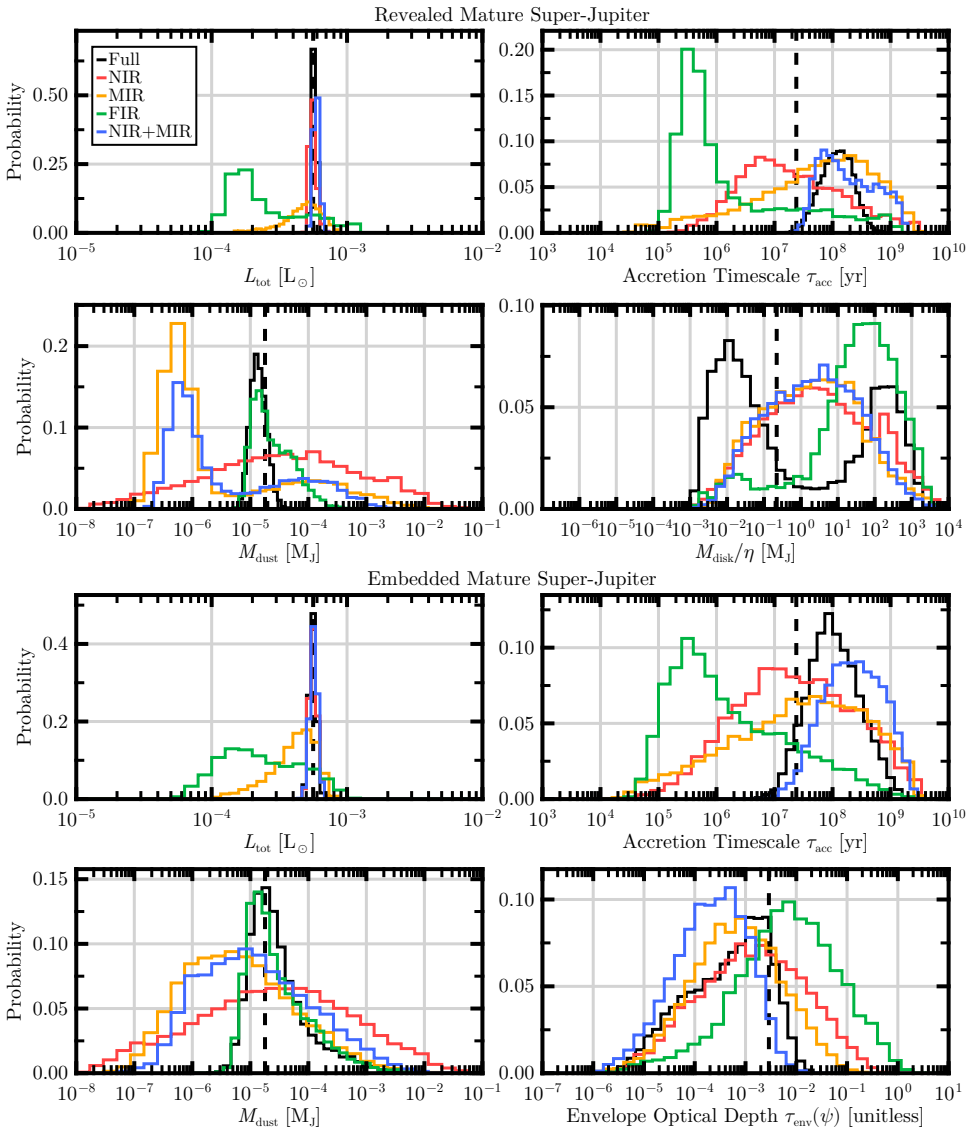
A calibrated semianalytic model of geometrically thick circumplanetary disks, when fit by MCMC to continuum SEDs, recovers the total system luminosity to ≲0.1 dex and, for optically thick disks, the accretion timescale (hence Mp and Ṁ separately) to roughly 0.35–0.8 dex, while joint near- and mid-infrared data constrain the line-of-sight envelope optical depth of embedded systems.
What carries the argument
The thick-disk semianalytic model (SAM): three structure parameters (α_d, q, f_L) interpolated from a RAD+ training grid fully determine the disk photosphere, self-shadowing, and emergent SEDs, enabling 10^8-fold speed-up over full radiative-transfer calculations so that MCMC retrieval becomes practical.
Load-bearing premise
The three structure parameters that set the entire disk temperature and self-shadowing are assumed to remain accurate when interpolated from a sparse grid of only forty numerical training models.
What would settle it
Obtain simultaneous high-resolution NIR+MIR+FIR photometry of a known CPD system (or a high-fidelity RAD+ synthetic SED outside the training set) and check whether the SAM posterior recovers the true Mp and Ṁ within the claimed 0.35–0.8 dex; systematic failure outside those bounds would falsify the calibration.
Editorial analysis
A structured set of objections, weighed in public.
Referee Report
Summary. The paper constructs a calibrated semianalytic model (SAM) for the continuum SEDs of geometrically thick circumplanetary disks (CPDs) and their host protoplanets, then uses MCMC retrievals on synthetic RAD+ SEDs and on real photometry of PDS 70 b/c and GQ Lup b to quantify which system parameters can be constrained. Structure parameters α_d, q and f_L are interpolated from a 40-model RAD+ training grid so that the SAM matches RAD+ SEDs to ~20 % RMS (Fig. 4). For optically thick disks the full SED (especially FIR) is claimed to constrain total luminosity to ≲0.1 dex and the accretion timescale to ~0.35–0.8 dex; for embedded systems NIR+MIR constrain envelope optical depth. Applications to PDS 70 and GQ Lup b recover luminosities tightly and masses/accretion rates consistent with independent estimates once modest extinction is allowed.
Significance. If the claimed posterior widths hold under the stated assumptions, the work supplies a practical, computationally cheap retrieval framework for the next generation of unresolved CPD detections (JWST, ELT/METIS, and any future FIR capability). The explicit mapping of wavelength bands onto derived quantities (L_tot, τ_acc, M_dust, τ_env) and the demonstration that FIR continuum can break the M_p–Ṁ degeneracy for optically thick CPDs are useful, falsifiable predictions. The real-system applications already give concrete numbers for PDS 70 and GQ Lup b and motivate MIR follow-up. Strengths include the direct RAD+ validation set, energy-conserving construction of T_X and T_C, and transparent discussion of model limitations (opacity, fixed R_p/λ_d, continuum-only).
major comments (3)
- Sec. 2.2 and Appendix A: the three structure parameters (α_d, q, f_L) that fully set the constant-aspect-ratio photosphere, T(R) and self-shadowing are obtained by multiquadric RBF interpolation on only 40 RAD+ training models. The paper reports only a global ~20 % RMS SED error on 40 random test models (Fig. 4) and that injected parameters lie inside 1σ. That is necessary but not sufficient for the dex-level posterior widths claimed in Secs. 3.1–3.3 (Figs. 7–9). The FIR τ_acc and NIR+MIR τ_env constraints are controlled by the high-M_p/low-Ṁ and high-Ṁ/large-a corners where optical-depth transitions and outer-disk emission change. Without leave-one-out or denser-grid tests that quantify local interpolation error in those corners, the reported posterior widths may be systematically optimistic. A short appendix quantifying RBF residuals versus M_p, Ṁ and a (or a denser training set) is ne
- Sec. 2.2 and Eqs. (7)–(8), (15)–(16): the constant-aspect-ratio conical photosphere and the step-function cutoff ψ_c used for energy conservation are strong geometric assumptions. The paper never shows that RAD+ τ=1 surfaces are well approximated by a single α_d, nor how much flaring/warping residual remains after the median α_d is taken. Because the FIR outer-disk emission and the self-shadowing factor f_L both depend on this geometry, residual mismatch can bias the very quantities (q, R_C temperature, τ_acc) that the paper uses to claim that FIR breaks the M_p–Ṁ degeneracy. A direct comparison of SAM versus RAD+ surface shapes (or of the resulting FIR SEDs when α_d is forced to the RAD+ median) would make this load-bearing step transparent.
- Sec. 3 (opening paragraphs) and Table 2: R_p and λ_d are fixed a priori while the text acknowledges that plausible ranges (ΔR_p ~0.5 dex, λ_d down to 0.3) shift L_tot and the outer radius. The synthetic-retrieval experiments that produce the headline 0.05–0.15 dex L_tot and 0.35–0.8 dex τ_acc widths never re-run with these parameters free or marginalized. Because the real-system applications (Sec. 4) also fix R_p=2 R_J, the quoted uncertainties on M_p and Ṁ for PDS 70 and GQ Lup b are conditional on that choice. At minimum the paper should show one set of synthetic posteriors with R_p (and preferably λ_d) free so that readers can judge how much the claimed precisions degrade.
Circularity Check
No significant circularity: SAM is calibrated on an independent RAD+ training grid then validated on hold-out test SEDs; MCMC retrievals recover injected parameters without forcing outputs to equal inputs by construction.
full rationale
The paper builds a thick-disk SAM whose three structure parameters (α_d, q, f_L) are obtained once by multiquadric RBF interpolation on a 40-model RAD+ training grid (Sec. 2.2, Appendix A) and then held fixed (or re-interpolated) during subsequent MCMC fits. Synthetic SEDs are generated from an independent set of 40 RAD+ test models; the SAM is fitted to those SEDs and recovers the injected parameters inside 1σ (Fig. 4 and Sec. 3). Energy-conservation closures for T_X and T_C (Eqs. 7–8, 15–16, A.1) are ordinary bookkeeping once the structure parameters are supplied; they do not redefine the target quantities (L_tot, τ_acc, τ_env) in terms of themselves. Self-citations point to earlier thin-disk models that the present work explicitly supersedes, not to a uniqueness theorem or ansatz that forces the new results. Real-object fits (PDS 70, GQ Lup b) are ordinary Bayesian retrievals whose posteriors are compared to external literature values. The claimed posterior widths are therefore empirical outcomes of the retrieval experiments, not tautologies. Minor residual model error (~20 % RMS) is reported and folded into the likelihood; it does not constitute circularity.
Axiom & Free-Parameter Ledger
free parameters (6)
- α_d (disk aspect ratio)
- q (temperature power-law index)
- f_L (pole-to-total luminosity ratio)
- κ0, γ (opacity normalization and slope)
- α (viscosity), η (dust-to-gas), f_Si (silicate fraction)
- Bp,0 (surface magnetic field)
axioms (5)
- domain assumption Infall is ballistic and isotropic; density follows the Ulrich (1976) streamlines.
- ad hoc to paper Disk photosphere is a constant-aspect-ratio cone that emits as a plane-parallel slab; outer wall emission is negligible for q>0.5.
- domain assumption Internal planetary luminosity is negligible compared with accretion luminosity; planet is a single-temperature blackbody (or SONORA Bobcat).
- domain assumption Dust opacity is a pure power law with fixed size distribution (0.005–100 µm, n∝a^−3.5); no gas lines or settling.
- ad hoc to paper Structure parameters (α_d,q,f_L) can be accurately interpolated from a 40-point RAD+ grid via multiquadric RBF.
read the original abstract
As they form, giant planets are surrounded by disks of gas and dust sourced from the background circumstellar disk. Although there have been few detections to date, upcoming instruments are likely to discover many more of these systems in the coming decades. Accurate spectral modeling will enable these observations to constrain the properties of these forming systems. Towards this end, we have constructed a semianalytic model for the structure and radiative signatures of geometrically thick circumplanetary disks and their planet hosts. Fitting these radiative signatures to synthetic observations of a two-dimensional disk model then quantifies the parameter constraints that can be derived (subject to model assumptions). This machinery provides estimates of the values and uncertainties in system parameters, and some combinations of parameters have significantly smaller uncertainties than others. This model is then used to fit observations of real protoplanets, with good results. The derived parameters provide useful context about the local extinction, formation history, and initial entropy of these objects.
Figures




Reference graph
Works this paper leans on
-
[1]
Adams, F. C., & Batygin, K. 2022, The Astrophysical Journal, 934, 111, doi:10.3847/1538-4357/ac7a3e —. 2025, Publications of the Astronomical Society of the Pacific, 137, 054401, doi:10.1088/1538-3873/adcf57
-
[2]
Adams, F. C., & Shu, F. H. 1985, The Astrophysical Journal, 296, 655, doi:10.1086/163483 Alcalá, J. M., Majidi, F. Z., Desidera, S., et al. 2020, Astronomy and Astrophysics, 635, L1, doi:10.1051/0004-6361/201937309
-
[3]
M., Elder, W., Zhang, S., et al
Andrews, S. M., Elder, W., Zhang, S., et al. 2021, The Astrophysical Journal, 916, 51, doi:10.3847/1538-4357/ac00b9
-
[4]
2019, The Astrophysical Journal, 885, L29, doi:10.3847/2041-8213/ab5062
Aoyama, Y., & Ikoma, M. 2019, The Astrophysical Journal, 885, L29, doi:10.3847/2041-8213/ab5062
-
[5]
2021, The Astrophysical Journal Letters, 917, L30, doi:10.3847/2041-8213/ac19bd
Aoyama, Y., Marleau, G.-D., Ikoma, M., & Mordasini, C. 2021, The Astrophysical Journal Letters, 917, L30, doi:10.3847/2041-8213/ac19bd
-
[6]
2009, title Clustering of luminous red galaxies - III
Ayliffe, B. A., & Bate, M. R. 2009, Monthly Notices of the Royal Astro- nomical Society, 397, 657, doi:10.1111/j.1365-2966.2009.15002.x Bae,J.,Teague,R.,Andrews,S.M.,etal.2022,TheAstrophysicalJournal Letters, 934, L20, doi:10.3847/2041-8213/ac7fa3 Batygin,K.,&Adams,F.C.2025,NatureAstronomy,9,835,doi:10.1038/ s41550-025-02512-y
-
[7]
2021, The Astrophysical Journal, 916, L2, doi:10.3847/2041-8213/ac0f83
Benisty, M., Bae, J., Facchini, S., et al. 2021, The Astrophysical Journal, 916, L2, doi:10.3847/2041-8213/ac0f83
-
[8]
Bezanson, J., Edelman, A., Karpinski, S., & Shah, V. B. 2017, SIAM Review, 59, 65, doi:10.1137/141000671
-
[9]
doi: https://doi.org/10.1146/ annurev-astro-081817-051948
Blandford, R. D., & Payne, D. G. 1982, Monthly Notices of the Royal Astronomical Society, 199, 883, doi:10.1093/mnras/199.4.883
-
[10]
MIRAC-5: A ground-based mid-IR instrumentwith the potential to detect ammonia in gas giants
Bowens, R., Leisenring, J., Meyer, M., et al. 2022, in Proceedings of the SPIE,Vol.12184,Astronomicaltelescopesandinstrumentation,eprint: arXiv:2206.12682, 121841U, doi:10.1117/12.2628953
work page internal anchor Pith review Pith/arXiv arXiv doi:10.1117/12.2628953 2022
-
[11]
2021, The Messenger, 182, 22, doi:10.18727/0722-6691/5218
Brandl, B., Bettonvil, F., van Boekel, R., et al. 2021, The Messenger, 182, 22, doi:10.18727/0722-6691/5218
-
[12]
Canup, R. M., & Ward, W. R. 2002, The Astronomical Journal, 124, 3404, doi:10.1086/344684
-
[13]
Cardelli, J. A., Clayton, G. C., & Mathis, J. S. 1989, The Astrophysical Journal, 345, 245, doi:10.1086/167900
-
[14]
Cassen, P., & Moosman, A. 1981, Icarus, 48, 353, doi:10.1016/ 0019-1035(81)90051-8 Chen,X.,&Szulágyi,J.2022,MonthlyNoticesoftheRoyalAstronomical Society, 516, 506, doi:10.1093/mnras/stac1976
-
[15]
Chevalier, R. A. 1983, The Astrophysical Journal, 268, 753, doi:10.1086/ 160997 Choksi,N.,&Chiang,E.2025,MonthlyNoticesoftheRoyalAstronomical Society, 537, 2945, doi:10.1093/mnras/stae2530
-
[16]
2023, Monthly Notices of the Royal Astronomical Society, 525, 2806, doi:10.1093/mnras/stad2269
Choksi, N., Chiang, E., Fung, J., & Zhu, Z. 2023, Monthly Notices of the Royal Astronomical Society, 525, 2806, doi:10.1093/mnras/stad2269
-
[17]
Christiaens, V., Samland, M., Henning, T., et al. 2024, Astronomy and Astrophysics, 685, L1, doi:10.1051/0004-6361/202349089 Cimerman,N.P.,Kuiper,R.,&Ormel,C.W.2017,MonthlyNoticesofthe Royal Astronomical Society, 471, 4662, doi:10.1093/mnras/stx1924
-
[18]
Close, L. M., van Capelleveen, R. F., Weible, G., et al. 2025a, The Astro- physical Journal, 990, L9, doi:10.3847/2041-8213/adf7a5
-
[19]
Close, L. M., Males, J. R., Li, J., et al. 2025b, The Astronomical Journal, 169, 35, doi:10.3847/1538-3881/ad8648 Cugno,G.,Patapis,P.,Banzatti,A.,etal.2024,TheAstrophysicalJournal, 966, L21, doi:10.3847/2041-8213/ad3cbc Cugno,G.,Facchini,S.,Alarcon,F.,etal.2025,TheAstronomicalJournal, Volume 170, Issue 6, id.317, 16 pp., 170, 317, doi:10.3847/1538-3881/ a...
-
[20]
2021, Journal of Open Source Software, 6, 3349, doi:10.21105/joss.03349
Danisch, S., & Krumbiegel, J. 2021, Journal of Open Source Software, 6, 3349, doi:10.21105/joss.03349
-
[21]
2023, Astronomy and Astrophysics, 676, A123, doi:10.1051/0004-6361/202346221
Demars, D., Bonnefoy, M., Dougados, C., et al. 2023, Astronomy and Astrophysics, 676, A123, doi:10.1051/0004-6361/202346221
-
[22]
Dominguez-Jamett, O., Casassus, S., Liu, H. B., et al. 2025, Multi- frequency observations of PDS 70c: Radio emission mechanisms in the circum-planetary environment, arXiv, doi:10.48550/arXiv.2507.21970
-
[23]
P., Juhasz, A., Pohl, A., et al
Dullemond, C. P., Juhasz, A., Pohl, A., et al. 2012, Astrophysics Source Code Library, ascl:1202.015.https://ui.adsabs.harvard.edu/abs/ 2012ascl.soft02015D Fasano,D.,Benisty,M.,Curone,P.,etal.2025,Innerdiscandcircumplan- etary material in the PDS 70 system, arXiv, doi:10.48550/arXiv.2506. 11709
-
[24]
Finley, C. O., Bowler, B. P., Wu, Y.-L., et al. 2026, Ultraviolet Imaging of SR12cwithHST/WFC3:AccretionandVariabilityofaGiantPlanetat the End Stages of Growth, arXiv, doi:10.48550/arXiv.2606.12862 Fung,J.,Zhu,Z.,&Chiang,E.2019,TheAstrophysicalJournal,887,152, doi:10.3847/1538-4357/ab53da
work page internal anchor Pith review Pith/arXiv arXiv doi:10.48550/arxiv.2606.12862 2026
-
[25]
Ghosh, P., & Lamb, F. K. 1978, The Astrophysical Journal, 223, L83, doi:10.1086/182734
-
[26]
Glenn, J., Meixner, M., Bradford, C. M., et al. 2025, Journal of Astronom- ical Telescopes, Instruments, and Systems, 11, 031628, doi:10.1117/1. JATIS.11.3.031628 González Picos, D., Snellen, I. A. G., de Regt, S., et al. 2025, Astronomy and Astrophysics, 693, A298, doi:10.1051/0004-6361/202451936
work page doi:10.1117/1 2025
-
[27]
Haffert, S. Y., Bohn, A. J., de Boer, J., et al. 2019, Nature Astronomy, 3, 749, doi:10.1038/s41550-019-0780-5
-
[28]
2020, The Astronomical Journal, 159, 222, doi:10.3847/1538-3881/ab811e
Hashimoto, J., Aoyama, Y., Konishi, M., et al. 2020, The Astronomical Journal, 159, 222, doi:10.3847/1538-3881/ab811e
-
[29]
1981, Progress of Theoretical Physics Supplement, 70, 35, doi:10.1143/PTPS.70.35
Hayashi, C. 1981, Progress of Theoretical Physics Supplement, 70, 35, doi:10.1143/PTPS.70.35
-
[30]
Giant Planet Formation, Evolution, and Internal Structure
Helled, R., Bodenheimer, P., Podolak, M., et al. 2014, in Protostars and Planets VI, eprint: arXiv:1311.1142, 643–665, doi:10.2458/azu_ uapress_9780816531240-ch028
work page internal anchor Pith review Pith/arXiv arXiv doi:10.2458/azu_ 2014
-
[31]
2019, The Astrophysical Journal, 879, L25, doi:10.3847/2041-8213/ab2a12
Isella, A., Benisty, M., Teague, R., et al. 2019, The Astrophysical Journal, 879, L25, doi:10.3847/2041-8213/ab2a12
-
[32]
F., Bae, J., Galloway-Sprietsma, M., et al
Izquierdo, A. F., Bae, J., Galloway-Sprietsma, M., et al. 2026, The Astro- physical Journal, 997, L2, doi:10.3847/2041-8213/ae2f59
-
[33]
2024b, A&A, 691, A148, doi: 10.1051/0004-6361/202451589
Jang, H., Waters, R., Kaeufer, T., et al. 2024, Astronomy & Astrophysics, 691, A148, doi:10.1051/0004-6361/202451589
-
[34]
2018, Astronomy and Astro- physics, 617, A44, doi:10.1051/0004-6361/201832957
Keppler, M., Benisty, M., Müller, A., et al. 2018, Astronomy and Astro- physics, 617, A44, doi:10.1051/0004-6361/201832957
-
[35]
2019, Astronomy & Astrophysics, 625, A118, doi:10.1051/0004-6361/201935034
Keppler, M., Teague, R., Bae, J., et al. 2019, Astronomy & Astrophysics, 625, A118, doi:10.1051/0004-6361/201935034
-
[36]
Knierim, H., Batygin, K., Helled, R., Morf, L., & Adams, F. C. 2026, As- tronomy and Astrophysics, 706, A51, doi:10.1051/0004-6361/202556984 Krapp,L.,Kratter,K.M.,&Youdin,A.N.2022,TheAstrophysicalJournal, 928, 156, doi:10.3847/1538-4357/ac5899
-
[37]
Krapp, L., Kratter, K. M., Youdin, A. N., et al. 2024, The Astrophysical Journal, 973, 153, doi:10.3847/1538-4357/ad644a
-
[38]
2022, Astronomy & Astrophysics, 662, A99, doi:10.1051/0004-6361/202142652
Krieger, A., & Wolf, S. 2022, Astronomy & Astrophysics, 662, A99, doi:10.1051/0004-6361/202142652
-
[39]
2024, Astronomy and Astrophysics, 682, A14, doi:10.1051/0004-6361/202347530
Kuwahara, A., & Kurokawa, H. 2024, Astronomy and Astrophysics, 682, A14, doi:10.1051/0004-6361/202347530
-
[40]
2017, Astronomy & Astrophysics, 606, A146, doi:10.1051/0004-6361/201731014
Lambrechts, M., & Lega, E. 2017, Astronomy & Astrophysics, 606, A146, doi:10.1051/0004-6361/201731014
-
[41]
P., Crida, A., & Morbidelli, A
Lambrechts, M., Lega, E., Nelson, R. P., Crida, A., & Morbidelli, A. 2019, Astronomy&Astrophysics,630,A82,doi:10.1051/0004-6361/201834413
-
[42]
Lega, E., Benisty, M., Cridland, A., et al. 2024, Astronomy and Astro- physics, 690, A183, doi:10.1051/0004-6361/202450899 Li,Y.-P.,Chen,Y.-X.,&Lin,D.N.C.2023,MonthlyNoticesoftheRoyal Astronomical Society, 526, 5346, doi:10.1093/mnras/stad3049
-
[43]
H., Seibert, M., & Artymowicz, P
Lubow, S. H., Seibert, M., & Artymowicz, P. 1999, The Astrophysical Journal, 526, 1001, doi:10.1086/308045
-
[44]
Lunine, J. I., & Stevenson, D. J. 1982, Icarus, 52, 14, doi:10.1016/ 0019-1035(82)90166-X MacGregor,M.A.,Wilner,D.J.,Czekala,I.,etal.2017,TheAstrophysical Journal, 835, 17, doi:10.3847/1538-4357/835/1/17 Taylor & Adams:Preprint submitted to ElsevierPage 25 of 26 Constraining CPD Parameters
-
[45]
N., Kokubo, E., Inutsuka, S.-i., & Matsumoto, T
Machida, M. N., Kokubo, E., Inutsuka, S.-i., & Matsumoto, T. 2008, The Astrophysical Journal, 685, 1220, doi:10.1086/590421
-
[46]
Maeda, N., Ohtsuki, K., Tanigawa, T., Machida, M. N., & Suetsugu, R. 2022,TheAstrophysicalJournal,935,56,doi:10.3847/1538-4357/ac7ddf
-
[47]
Marleau, G.-D. 2025, Semianalytical Accretion-Tracer Emission: Forming Planets Are Intrinsically Faint, arXiv, doi:10.48550/arXiv.2510.00138
-
[48]
2014, Monthly Notices of the Royal Astronomical Society, 437, 1378, doi:10.1093/mnras/stt1967
Marleau, G.-D., & Cumming, A. 2014, Monthly Notices of the Royal Astronomical Society, 437, 1378, doi:10.1093/mnras/stt1967
-
[49]
2023, The Astrophysical Journal, 952, 89, doi:10.3847/1538-4357/accf12
Marleau, G.-D., Kuiper, R., Béthune, W., & Mordasini, C. 2023, The Astrophysical Journal, 952, 89, doi:10.3847/1538-4357/accf12
-
[50]
D., Aoyama, Y., Kuiper, R., et al
Marleau, G. D., Aoyama, Y., Kuiper, R., et al. 2022, Astronomy & Astro- physics, 657, A38, doi:10.1051/0004-6361/202037494
-
[51]
S., Saumon, D., Visscher, C., et al
Marley, M. S., Saumon, D., Visscher, C., et al. 2021, The Astrophysical Journal, 920, 85, doi:10.3847/1538-4357/ac141d Marois,C.,Macintosh,B.,&Barman,T.2006,TheAstrophysicalJournal, 654, L151, doi:10.1086/511071
-
[52]
Martin, R. G., & Lubow, S. H. 2011, Monthly Notices of the Royal Astro- nomical Society, 413, 1447, doi:10.1111/j.1365-2966.2011.18228.x
-
[53]
Mathis, J. S., Rumpl, W., & Nordsieck, K. H. 1977, The Astrophysical Journal, 217, 425, doi:10.1086/155591
-
[54]
K., van’t Hoff, M., Francis, L., et al
McClure, M. K., van’t Hoff, M., Francis, L., et al. 2025, Nature, 643, 649, doi:10.1038/s41586-025-09163-z
-
[55]
2019, Astronomy and Astro- physics, 632, A25, doi:10.1051/0004-6361/201936764
Mesa, D., Keppler, M., Cantalloube, F., et al. 2019, Astronomy and Astro- physics, 632, A25, doi:10.1051/0004-6361/201936764
-
[56]
1953, The Journal of Chemical Physics, 21, 1087, doi:10
Teller, E. 1953, The Journal of Chemical Physics, 21, 1087, doi:10. 1063/1.1699114
work page 1953
-
[57]
Gas Giant and Brown Dwarf Companions: Mass Ratio and Orbital Distributions From A stars to M dwarfs
Meyer, M. R., Li, Y., Calissendorf, P., & Amara, A. 2025, Gas Giant and Brown Dwarf Companions: Mass Ratio and Orbital Distributions From A stars to M dwarfs, arXiv, doi:10.48550/arXiv.2508.05122
work page internal anchor Pith review Pith/arXiv arXiv doi:10.48550/arxiv.2508.05122 2025
-
[58]
2024, The Astrophysical Journal, 976, 251, doi:10.3847/1538-4357/ad8884
Micolta, M., Calvet, N., Thanathibodee, T., et al. 2024, The Astrophysical Journal, 976, 251, doi:10.3847/1538-4357/ad8884
-
[59]
Mosqueira, I., & Estrada, P. R. 2003a, Icarus, 163, 198, doi:10.1016/ S0019-1035(03)00076-9 —. 2003b, Icarus, 163, 232, doi:10.1016/S0019-1035(03)00077-0 Müller, A., Keppler, M., Henning, T., et al. 2018, Astronomy and Astro- physics, 617, L2, doi:10.1051/0004-6361/201833584 Neuhaeuser,R.2005,Homogeneouscomparisonofdirectlydetectedplanet candidates: GQ Lu...
work page internal anchor Pith review Pith/arXiv arXiv doi:10.1016/s0019-1035(03)00077-0 2018
-
[60]
Perotti, G., Christiaens, V., Henning, T., et al. 2023, Nature, 620, 516, doi:10.1038/s41586-023-06317-9 Pittman,C.V.,Espaillat,C.C.,Robinson,C.E.,etal.2025,TheAstrophys- ical Journal, 992, 134, doi:10.3847/1538-4357/adef35
-
[61]
, year = 1996, month = nov, volume =
Pollack, J. B., Hubickyj, O., Bodenheimer, P., et al. 1996, Icarus, 124, 62, doi:10.1006/icar.1996.0190 Quillen,A.C.,&Trilling,D.E.1998,TheAstrophysicalJournal,508,707, doi:10.1086/306421
-
[62]
2025, The Astrophysical Journal, 987, 216, doi:10.3847/1538-4357/add934
Sagynbayeva, S., Li, R., Kuznetsova, A., et al. 2025, The Astrophysical Journal, 987, 216, doi:10.3847/1538-4357/add934
-
[63]
Shakura, N. I., & Sunyaev, R. A. 1973, Astronomy and Astrophysics, 24, 337.https://ui.adsabs.harvard.edu/abs/1973A&A....24..337S
work page 1973
-
[64]
2024, Astronomy and Astrophysics, 687, A166, doi:10.1051/0004-6361/202449522
Shibaike, Y., & Mordasini, C. 2024, Astronomy and Astrophysics, 687, A166, doi:10.1051/0004-6361/202449522
-
[65]
Spiegel, D. S., & Burrows, A. 2012, The Astrophysical Journal, 745, 174, doi:10.1088/0004-637X/745/2/174
-
[66]
2020, Astronomy and Astro- physics, 644, A13, doi:10.1051/0004-6361/202038878
Stolker, T., Marleau, G.-D., Cugno, G., et al. 2020, Astronomy and Astro- physics, 644, A13, doi:10.1051/0004-6361/202038878
-
[67]
Stolker, T., Haffert, S. Y., Kesseli, A. Y., et al. 2021, The Astronomical Journal, 162, 286, doi:10.3847/1538-3881/ac2c7f Sun,X.,Huang,P.,Dong,R.,&Liu,S.-F.2024,TheAstrophysicalJournal, 972, 25, doi:10.3847/1538-4357/ad57c2
-
[68]
Parameter Effects in Circumplanetary Disk Spectra and Prospects for Spectral Fitting
Sun, X., Marleau, G.-D., & Liu, S.-F. 2026, Parameter Effects in Cir- cumplanetary Disk Spectra and Prospects for Spectral Fitting, arXiv, doi:10.48550/arXiv.2606.08996 Szulágyi, J., Dullemond, C. P., Pohl, A., & Quanz, S. P. 2019, Monthly Notices of the Royal Astronomical Society, 487, 1248, doi:10.1093/ mnras/stz1326 Szulágyi,J.,Masset,F.,Lega,E.,etal.2...
work page internal anchor Pith review Pith/arXiv arXiv doi:10.48550/arxiv.2606.08996 2026
-
[69]
Takata, T., & Stevenson, D. J. 1996, Icarus, 123, 404, doi:10.1006/icar. 1996.0167
-
[70]
Tanigawa, T., Ohtsuki, K., & Machida, M. N. 2012, The Astrophysical Journal, 747, 47, doi:10.1088/0004-637X/747/1/47
-
[71]
Taylor, A. G., & Adams, F. C. 2024, Icarus, 415, 116044, doi:10.1016/j. icarus.2024.116044 —. 2025, Icarus, 425, 116327, doi:10.1016/j.icarus.2024.116327
work page doi:10.1016/j 2024
-
[72]
Taylor, A. G., Adams, F. C., & Calvet, N. 2026, Icarus, 447, 116913, doi:10.1016/j.icarus.2025.116913
-
[73]
Thanathibodee, T., Calvet, N., Bae, J., Muzerolle, J., & Hernández, R. F. 2019,TheAstrophysicalJournal,885,94,doi:10.3847/1538-4357/ab44c1
-
[74]
2023, The Astrophysical Journal, 944, 90, doi:10.3847/1538-4357/acac84
Thanathibodee, T., Molina, B., Serna, J., et al. 2023, The Astrophysical Journal, 944, 90, doi:10.3847/1538-4357/acac84
-
[75]
Trevascus, D., Blunt, S., Christiaens, V., et al. 2025, Astronomy & Astro- physics, 698, A19, doi:10.1051/0004-6361/202553936 Turner,N.J.,Lee,M.H.,&Sano,T.2014,TheAstrophysicalJournal,783, 14, doi:10.1088/0004-637X/783/1/14
-
[76]
Ulrich, R. K. 1976, The Astrophysical Journal, 210, 377, doi:10.1086/ 154840 van Capelleveen, R. F., Ginski, C., Kenworthy, M. A., et al. 2025, The Astrophysical Journal Letters, 990, L8, doi:10.3847/2041-8213/adf721 Venkatesan,V.,Blunt,S.,Wang,J.J.,etal.2025,TheAstrophysicalJournal, 993, 69, doi:10.3847/1538-4357/ae0c15
-
[77]
Wagner, K., Follete, K. B., Close, L. M., et al. 2018, The Astrophysical Journal, 863, L8, doi:10.3847/2041-8213/aad695
-
[78]
J., Ginzburg, S., Ren, B., et al
Wang, J. J., Ginzburg, S., Ren, B., et al. 2020, The Astronomical Journal, 159, 263, doi:10.3847/1538-3881/ab8aef
-
[79]
J., Vigan, A., Lacour, S., et al
Wang, J. J., Vigan, A., Lacour, S., et al. 2021, The Astronomical Journal, 161, 148, doi:10.3847/1538-3881/abdb2d
-
[80]
Wu, Y.-L., Sheehan, P. D., Males, J. R., et al. 2017, The Astrophysical Journal, 836, 223, doi:10.3847/1538-4357/aa5b96 Xuan,J.W.,Hsu,C.-C.,Finnerty,L.,etal.2024,TheAstrophysicalJournal, 970, 71, doi:10.3847/1538-4357/ad4796 Zhou,Y.,Herczeg,G.J.,Kraus,A.L.,Metchev,S.,&Cruz,K.L.2014,The Astrophysical Journal Letters, 783, L17, doi:10.1088/2041-8205/783/1/ L17
discussion (0)
Sign in with ORCID, Apple, or X to comment. Anyone can read and Pith papers without signing in.