REVIEW 2 major objections 2 minor 2 cited by
Reviewed by Pith at T0; open to challenge.
T0 means a machine referee read the full paper against a public rubric. The mark states how deep the mechanical check went, never who wrote it. the ladder, T0–T4 →
T0 review · grok-4.3
The finite-temperature heat kernel produces consistent dimension-six operators for hot scalar QED and shows they match in the static limit when the Polyakov loop is included.
2026-06-27 15:45 UTC pith:DLTKS4OW
load-bearing objection Gives explicit dim-6 operators for hot scalar QED plus Polyakov-loop shifts via two heat-kernel routes that match in the static limit, but the static approximation itself is the main thing to check. the 2 major comments →
Higher-dimensional operators and Polyakov loop in hot Scalar QED from the heat kernel
The pith
A machine-rendered reading of the paper's core claim, the machinery that carries it, and where it could break.
Core claim
The finite-temperature heat kernel method yields the gauge-invariant effective Lagrangian up to dimension-six operators for massive hot scalar QED; the two proposed methods—direct integration of heavy modes at finite temperature and derivation of finite-temperature coefficients from their zero-temperature counterparts—produce identical three-dimensional effective operators in the static limit; the Polyakov loop modifies the matching coefficients; and the combined effect of these operators and the Polyakov loop changes the thermodynamics of cosmological first-order phase transitions and the associated gravitational-wave spectrum.
What carries the argument
The finite-temperature heat kernel coefficients that generate the effective operators when heavy modes are integrated out at finite temperature.
Load-bearing premise
The static limit is enough to match the four-dimensional finite-temperature theory onto three-dimensional effective operators without leftover corrections from non-static modes.
What would settle it
An independent calculation of the same dimension-six operators by lattice simulation or by a different perturbative technique that produces numerically different coefficients once the static limit is imposed.
If this is right
- Explicit dimension-six operators are obtained for the three-dimensional effective theory of hot scalar QED.
- The Polyakov loop shifts the numerical values of the matching coefficients.
- The higher-dimensional operators and the Polyakov loop together change the free energy and the strength of the first-order phase transition.
- The gravitational-wave spectrum emitted by that transition is therefore altered.
Where Pith is reading between the lines
- The same heat-kernel procedure could be repeated for other Abelian or non-Abelian gauge theories at finite temperature.
- Including the derived operators in effective-potential calculations would give more accurate predictions for the bubble nucleation rate.
- A next step would be to quantify how large the non-static-mode corrections become when the static limit is relaxed.
Editorial analysis
A structured set of objections, weighed in public.
Referee Report
Summary. The manuscript computes the gauge-invariant effective Lagrangian up to dimension six for massive hot scalar QED via the finite-temperature heat kernel. Two complementary methods (integrating out heavy modes at finite T and deriving finite-T coefficients from zero-T ones) are shown to agree on the resulting three-dimensional effective operators once the static limit is imposed. The Coleman-Weinberg potential for a constant background is also obtained, and the Polyakov loop is incorporated into the matching coefficients to assess its effect, together with the higher-dimensional operators, on the thermodynamics of cosmological first-order phase transitions and the associated gravitational-wave spectrum.
Significance. If the central matching holds, the work supplies a systematic heat-kernel derivation of dimension-six operators in hot scalar QED together with an explicit treatment of the Polyakov loop; this can improve the reliability of effective-theory inputs to phase-transition and gravitational-wave calculations. The agreement between the two independent heat-kernel routes is a positive feature when the static-limit assumption is controlled.
major comments (2)
- [complementary methods / static limit] The static-limit matching (section describing the two complementary methods): the claim that non-static Matsubara modes can be integrated out without residual contributions to the dimension-six coefficients is load-bearing for the central result. An explicit estimate or bound on the size of the omitted n≠0 terms (e.g., via the next term in the Matsubara sum for the relevant heat-kernel coefficient) is required, because those corrections enter the same operators that are later used for the phase-transition and GW analysis.
- [effective Lagrangian / results] Results for the dimension-six operators (section presenting the effective Lagrangian): the manuscript states that the two methods agree but does not display the explicit coefficient values, their dependence on the scalar mass and temperature, or any cross-check against an independent calculation; without these the quantitative agreement cannot be verified and the subsequent cosmological application rests on an unquantified claim.
minor comments (2)
- [notation / methods] The notation for the heat-kernel coefficients and the precise definition of the static limit should be collected in one place with explicit formulas to aid readability.
- [results] A short table comparing the dimension-six coefficients obtained from each method (including any numerical values or functional dependence) would make the agreement concrete.
Simulated Author's Rebuttal
We thank the referee for the careful reading and constructive comments on our manuscript. We address the two major points below and will incorporate revisions to improve clarity and rigor.
read point-by-point responses
-
Referee: The static-limit matching (section describing the two complementary methods): the claim that non-static Matsubara modes can be integrated out without residual contributions to the dimension-six coefficients is load-bearing for the central result. An explicit estimate or bound on the size of the omitted n≠0 terms (e.g., via the next term in the Matsubara sum for the relevant heat-kernel coefficient) is required, because those corrections enter the same operators that are later used for the phase-transition and GW analysis.
Authors: We agree that an explicit bound strengthens the central claim. In the revised manuscript we will add a dedicated paragraph estimating the leading n=±1 Matsubara correction to the relevant heat-kernel coefficients. This term is suppressed by (T/m)^2 relative to the static contribution in the regime m ≫ T where the static limit is applied, allowing us to quantify the truncation error for the parameter values used in the phase-transition analysis. revision: yes
-
Referee: Results for the dimension-six operators (section presenting the effective Lagrangian): the manuscript states that the two methods agree but does not display the explicit coefficient values, their dependence on the scalar mass and temperature, or any cross-check against an independent calculation; without these the quantitative agreement cannot be verified and the subsequent cosmological application rests on an unquantified claim.
Authors: We acknowledge the omission. The explicit coefficient expressions were left out of the main text to maintain focus on the methodological agreement. In the revision we will insert the full analytic forms of the dimension-six operators, explicitly showing their m and T dependence, together with a cross-check that recovers the known zero-temperature results in the appropriate limit. revision: yes
Circularity Check
No circularity; independent heat-kernel computations
full rationale
The derivation computes the dim-6 effective Lagrangian via two distinct heat-kernel routes (integrating heavy modes at finite T; rescaling zero-T coefficients) and verifies agreement only after imposing the static limit. No equation reduces a claimed prediction to a fitted input by construction, no load-bearing self-citation is invoked, and the static-limit matching is presented as an explicit assumption rather than a tautology. The result is therefore self-contained against external benchmarks.
Axiom & Free-Parameter Ledger
read the original abstract
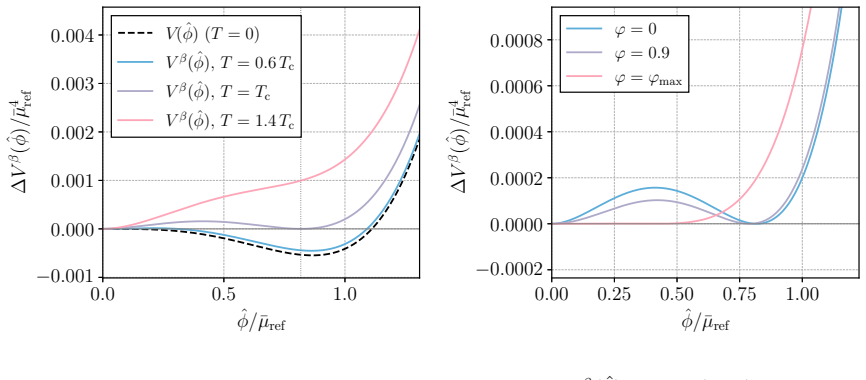
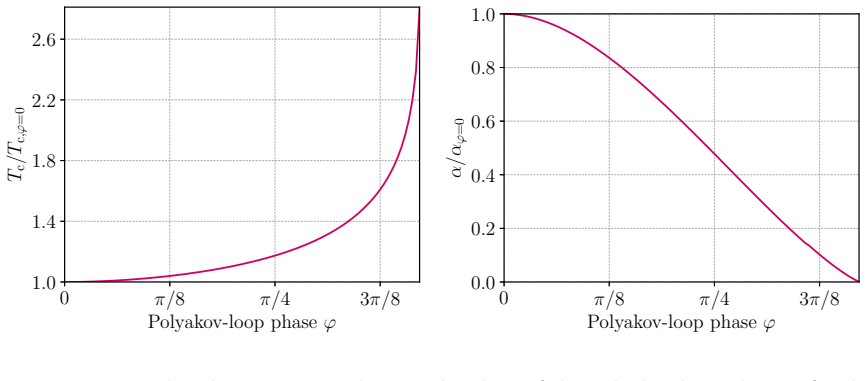
Using the finite-temperature heat kernel method, we compute the gauge-invariant effective Lagrangian up to dimension-six for massive hot scalar QED. We propose two complementary methods: integrating out heavy modes at finite temperature, and deriving the finite-temperature heat kernel coefficients from the zero-temperature ones. We show that in the static limit, both lead to the same three-dimensional effective operators. We also compute the gauge-invariant Coleman-Weinberg effective potential for a constant background at finite temperature. We further examine how the Polyakov loop modifies the matching coefficients and assess its impact together with the higher-dimensional operators on the thermodynamics of cosmological first-order phase transitions, which in turn can affect an associated gravitational-wave spectrum.
Figures
Forward citations
Cited by 2 Pith papers
-
Polyakov Loops Tame Phase Transitions
Polyakov loop contributions to the thermal effective potential soften electroweak phase transitions, disfavoring first-order transitions and suppressing gravitational-wave signals.
-
A critical look at low-scale cosmological phase transitions in the PTA era
Precision study of dark sector phase transitions finds PTA-favored parameters near EFT breakdown with disfavored GW signals after higher-order corrections.
Reference graph
Works this paper leans on
-
[1]
LISA Cosmology Working Group Collaboration, C. Caprini, R. Jinno, M. Lewicki, et al. , Gravitational waves from first-order phase transitions in L ISA: reconstruction pipeline and physics interpretation, JCAP 10 (2024) 020 [ 2403.03723]
-
[2]
Cosmology with the Laser Interferometer Space Antenna
LISA Cosmology Working Group Collaboration, P. Auclair et al. , Cosmology with the Laser Interferometer Space Antenna, Living Rev. Rel. 26 (2023) 5 [ 2204.05434]
work page Pith review arXiv 2023
-
[3]
Laser Interferometer Space Antenna
LISA Collaboration, P. Amaro-Seoane et al., Laser Interferometer Space Antenna, [1702.00786]. 28
work page internal anchor Pith review Pith/arXiv arXiv
-
[4]
C. Caprini et al., Science with the space-based interferometer eLISA. II: Gra vitational waves from cosmological phase transitions, JCAP 04 (2016) 001 [ 1512.06239]
work page internal anchor Pith review Pith/arXiv arXiv 2016
-
[5]
Detecting gravitational waves from cosmological phase transitions with LISA: an update
C. Caprini et al. , Detecting gravitational waves from cosmological phase tra nsitions with LISA: an update, JCAP 03 (2020) 024 [ 1910.13125]
work page internal anchor Pith review Pith/arXiv arXiv 2020
-
[6]
Theoretical uncertainties for cosmological first-order phase transitions,
D. Croon, O. Gould, P. Schicho, T. V. I. Tenkanen, and G. White, Theoretical uncertainties for cosmological first-order phase transitions, JHEP 04 (2021) 055 [ 2009.10080]
-
[7]
P. H. Ginsparg, First Order and Second Order Phase Transitions in Gauge Theo ries at Finite Temperature, Nucl. Phys. B 170 (1980) 388
1980
-
[8]
Appelquist and R
T. Appelquist and R. D. Pisarski, High-Temperature Yang-Mills Theories and Three-Dimensional Quantum Chromodynamics, Phys. Rev. D 23 (1981) 2305
1981
-
[9]
Nadkarni, Dimensional Reduction in Finite Temperature Quantum Chrom odynamics
S. Nadkarni, Dimensional Reduction in Finite Temperature Quantum Chrom odynamics. 2., Phys. Rev. D 38 (1988) 3287
1988
-
[10]
N. P. Landsman, Limitations to Dimensional Reduction at High Temperature, Nucl. Phys. B 322 (1989) 498
1989
-
[11]
Generic Rules for High Temperature Dimensional Reduction and Their Application to the Standard Model
K. Kajantie, M. Laine, K. Rummukainen, and M. E. Shaposhnikov , Generic rules for high tem- perature dimensional reduction and their application to th e standard model, Nucl. Phys. B 458 (1996) 90 [ hep-ph/9508379]
work page internal anchor Pith review Pith/arXiv arXiv 1996
-
[12]
Free Energy of QCD at High Temperature
E. Braaten and A. Nieto, Free energy of QCD at high temperature, Phys. Rev. D 53 (1996) 3421 [hep-ph/9510408]
work page internal anchor Pith review Pith/arXiv arXiv 1996
-
[13]
Effective Field Theory Approach to High-Temperature Thermodynamics
E. Braaten and A. Nieto, Effective field theory approach to high temperature thermody namics, Phys. Rev. D 51 (1995) 6990 [ hep-ph/9501375]
work page internal anchor Pith review Pith/arXiv arXiv 1995
-
[14]
Higher-order corrections to phase-transition parameters in dimensional reduction
M. Chala, J. C. Criado, L. Gil, and J. L. Miras, Higher-order-operator corrections to phase- transition parameters in dimensional reduction, JHEP 10 (2024) 025 [ 2406.02667]
work page Pith review arXiv 2024
-
[15]
Higher-dimensional operators at finite-temperature affect gravitational-wave predictions
F. Bernardo, P. Klose, P. Schicho, and T. V. I. Tenkanen, Higher-dimensional operators at finite temperature affect gravitational-wave predictions, JHEP 08 (2025) 109 [ 2503.18904]
work page internal anchor Pith review Pith/arXiv arXiv 2025
-
[16]
Hot news on the phase-structure of the SMEFT,
M. Chala, M. C. Fiore, and L. Gil, Hot news on the phase-structure of the SMEFT, [2507.16905]
work page internal anchor Pith review arXiv
-
[17]
Phase Transitions in Dimensional Reduction up to Three Loops
M. Chala, L. Gil, and Z. Ren, Phase transitions in dimensional reduction up to three loop s, Chin. Phys. C 49 (2025) 123105 [ 2505.14335]
work page Pith review arXiv 2025
-
[18]
Hard thermal contributions to phase transition observables at NNLO
F. Bernardo, M. Chala, L. Gil, and P. Schicho, Hard thermal contributions to phase transition observables at NNLO, [2602.06962]
work page internal anchor Pith review arXiv
-
[19]
O. Gould and T. V. I. Tenkanen, On the perturbative expansion at high temperature and impli - cations for cosmological phase transitions, JHEP 06 (2021) 069 [ 2104.04399]
-
[20]
Perturbative effective field theory expansions for cosmological phase transitions
O. Gould and T. V. I. Tenkanen, Perturbative effective field theory expansions for cosmolog ical phase transitions, JHEP 01 (2024) 048 [ 2309.01672]
work page Pith review arXiv 2024
-
[21]
Cosmological phase transitions at three loops: the final verdict on perturbation theory
A. Ekstedt, P. Schicho, and T. V. I. Tenkanen, Cosmological phase transitions at three loops: The final verdict on perturbation theory, Phys. Rev. D 110 (2024) 096006 [ 2405.18349]. 29
work page Pith review arXiv 2024
-
[22]
J. S. Schwinger, On gauge invariance and vacuum polarization, Phys. Rev. 82 (1951) 664
1951
-
[23]
B. S. DeWitt, Quantum Field Theory in Curved Space-Time, Phys. Rept. 19 (1975) 295
1975
-
[24]
D. I. D’yakonov, V. Y. Petrov, and A. V. Yung, Quasiclassical expansion in an external Yang- Mills field and the approximate calculation of functional de terminants, Sov. J. Nucl. Phys. 39:1 (1984)
1984
-
[25]
A New Dimensionally Reduced Effective Action for QCD at High Temperature
S. Chapman, A New dimensionally reduced effective action for QCD at high t emperature, Phys. Rev. D 50 (1994) 5308 [ hep-ph/9407313]
work page internal anchor Pith review Pith/arXiv arXiv 1994
-
[26]
The thermal heat kernel expansion and the one-loop effective action of QCD at finite temperature
E. Megias, E. Ruiz Arriola, and L. L. Salcedo, The Thermal heat kernel expansion and the one loop effective action of QCD at finite temperature, Phys. Rev. D 69 (2004) 116003 [ hep-ph/0312133]
work page internal anchor Pith review Pith/arXiv arXiv 2004
-
[27]
One Loop Thermal Effective Action
J. Chakrabortty and S. Mohanty, One Loop Thermal Effective Action, Nucl. Phys. B 1020 (2025) 117165 [ 2411.14146]
work page Pith review arXiv 2025
-
[28]
Gauge Choices, Infrared Pitfalls, and Thermal Effects in Effective Potentials
D. Balui, T. Biswas, J. Chakrabortty, D. Dey, C. Englert, and S . Mohanty, Gauge choices, infrared pitfalls, and thermal effects in effective potentials, Phys. Rev. D 112 (2025) 056022 [ 2507.22706]
work page Pith review arXiv 2025
-
[29]
Finite-temperature operator basis on $\mathbb{R}^3 \times S^1$ for SMEFT
J. Chakrabortty, B. S. Eduardo, S. Karmakar, and P. Schich o, Finite-temperature operator basis on R3 × S1 for SMEFT, [2605.02878]
work page internal anchor Pith review Pith/arXiv arXiv
-
[30]
DRalgo: a package for effective field theory approach for thermal phase transitions
A. Ekstedt, P. Schicho, and T. V. I. Tenkanen, DRalgo: A package for effective field theory ap- proach for thermal phase transitions, Comput. Phys. Commun. 288 (2023) 108725 [ 2205.08815]
work page Pith review arXiv 2023
-
[31]
Matching higher-dimensional operators at finite temperature for general models
F. Bernardo, R. G. Reinle, and P. Schicho, Matching higher-dimensional operators at finite tem- perature for general models, [2605.15176]
work page internal anchor Pith review Pith/arXiv arXiv
-
[32]
Matsubara, A New approach to quantum statistical mechanics, Prog
T. Matsubara, A New approach to quantum statistical mechanics, Prog. Theor. Phys. 14 (1955) 351
1955
-
[33]
R. T. Seeley, Complex powers of an elliptic operator, Proc. Symp. Pure Math. 10 (1967) 288
1967
-
[34]
A. A. Bel’kov, A. V. Lanyov, and A. Schaale, Calculation of heat kernel coefficients and usage of computer algebra, Comput. Phys. Commun. 95 (1996) 123 [ hep-ph/9506237]
work page internal anchor Pith review Pith/arXiv arXiv 1996
-
[35]
D. V. Vassilevich, Heat kernel expansion: User’s manual, Phys. Rept. 388 (2003) 279 [hep-th/0306138]
work page internal anchor Pith review Pith/arXiv arXiv 2003
-
[36]
I. G. Avramidi, Heat kernel approach in quantum field theory, Nucl. Phys. B Proc. Suppl. 104 (2002) 3 [ math-ph/0107018]
work page internal anchor Pith review Pith/arXiv arXiv 2002
-
[37]
Geometry of determinants of elliptic operators
M. Kontsevich and S. Vishik, Geometry of determinants of elliptic operators, [hep-th/9406140]
work page internal anchor Pith review Pith/arXiv arXiv
-
[38]
U. Banerjee, J. Chakrabortty, S. U. Rahaman, and K. Ramku mar, One-loop effective action up to dimension eight: integrating out heavy scalar(s), Eur. Phys. J. Plus 139 (2024) 159 [ 2306.09103]
-
[39]
U. Banerjee, J. Chakrabortty, S. U. Rahaman, and K. Ramku mar, One-loop effective action up to any mass-dimension for non-degenerate scalars and fermion s including light–heavy mixing, Eur. Phys. J. Plus 139 (2024) 169 [ 2311.12757]
-
[40]
J. Chakrabortty, S. U. Rahaman, and K. Ramkumar, One-loop effective action up to dimension eight: Integrating out heavy fermion(s), Nucl. Phys. B 1000 (2024) 116488 [ 2308.03849]. 30
-
[41]
Fock, Proper time in classical and quantum mechanics, Phys
V. Fock, Proper time in classical and quantum mechanics, Phys. Z. Sowjetunion 12 (1937) 404
1937
-
[42]
Gauge Invariant Effective Potential
D. Balui, J. Chakrabortty, D. Dey, and S. Mohanty, Gauge invariant effective potential, Phys. Rev. D 111 (2025) 085032 [ 2502.17156]
work page Pith review arXiv 2025
-
[43]
Background Fields Meet the Heat Kernel: Gauge Invariance and RGEs without diagrams
D. Balui, J. Chakrabortty, C. Englert, S. Mohanty, and Tusha r, Background Fields Meet the Heat Kernel: Gauge Invariance and RGEs without diagrams, [2604.05972]
work page internal anchor Pith review Pith/arXiv arXiv
-
[44]
F. J. Moral-Gamez and L. L. Salcedo, Derivative expansion of the heat kernel at finite temperatur e, Phys. Rev. D 85 (2012) 045019 [ 1110.6300]
work page internal anchor Pith review Pith/arXiv arXiv 2012
-
[45]
Weiss, The Effective Potential for the Order Parameter of Gauge Theo ries at Finite Temper- ature, Phys
N. Weiss, The Effective Potential for the Order Parameter of Gauge Theo ries at Finite Temper- ature, Phys. Rev. D 24 (1981) 475
1981
-
[46]
A. M. Polyakov, Compact Gauge Fields and the Infrared Catastrophe, Phys. Lett. B 59 (1975) 82
1975
-
[47]
S. R. Coleman and E. J. Weinberg, Radiative Corrections as the Origin of Spontaneous Symmetr y Breaking, Phys. Rev. D 7 (1973) 1888
1973
-
[48]
Computing the gauge-invariant bubble nucleation rate in finite temperature effective field theory
J. Hirvonen, J. L¨ ofgren, M. J. Ramsey-Musolf, P. Schicho, a nd T. V. I. Tenkanen, Computing the gauge-invariant bubble nucleation rate in finite temper ature effective field theory, JHEP 07 (2022) 135 [ 2112.08912]
work page Pith review arXiv 2022
-
[49]
Model-independent energy budget of cosmological first-order phase transitions
F. Giese, T. Konstandin, and J. van de Vis, Model-independent energy budget of cosmological first-order phase transitions — A sound argument to go beyond the bag model, JCAP 07 (2020) 057 [ 2004.06995]
work page Pith review arXiv 2020
-
[50]
Model-independent energy budget for LISA
F. Giese, T. Konstandin, K. Schmitz, and J. van de Vis, Model-independent energy budget for LISA, JCAP 01 (2021) 072 [ 2010.09744]
work page Pith review arXiv 2021
-
[51]
Matchotter: An Automated Tool for Dimensional Reduction at Finite Temperature
J. Fuentes-Mart ´ ın, J. L´ opez Miras, and A. Moreno-S´ anchez, Matchotter: An Automated Tool for Dimensional Reduction at Finite Temperature, [2604.21972]
work page internal anchor Pith review Pith/arXiv arXiv
-
[52]
L. F. Abbott, The Background Field Method Beyond One Loop, Nucl. Phys. B 185 (1981) 189
1981
-
[53]
R. G. Reinle, The Heat-Kernel and functional matching methods for finite- temperature effective field theory, Master’s thesis, ETH Z¨ urich, University of Geneva, 2026
2026
-
[54]
CoDEx: Wilson coefficient calculator connecting SMEFT to UV theory
S. Das Bakshi, J. Chakrabortty, and S. K. Patra, CoDEx: Wilson coefficient calculator connecting SMEFT to UV theory, Eur. Phys. J. C 79 (2019) 21 [ 1808.04403]
work page internal anchor Pith review Pith/arXiv arXiv 2019
-
[55]
J. Fuentes-Mart ´ ın, M. K¨ onig, J. Pag` es, A. E. Thomsen, and F. Wilsch, A proof of concept for matchete: an automated tool for matching effective theories , Eur. Phys. J. C 83 (2023) 662 [2212.04510]
-
[56]
P. N. Meisinger and M. C. Ogilvie, Complete high temperature expansions for one loop finite temperature effects, Phys. Rev. D 65 (2002) 056013 [ hep-ph/0108026]. 31
work page internal anchor Pith review Pith/arXiv arXiv 2002
discussion (0)
Sign in with ORCID, Apple, or X to comment. Anyone can read and Pith papers without signing in.