REVIEW 2 major objections 2 minor 1 cited by
Black holes in anisotropic matter keep quasinormal modes largely set by redshift while tidal Love numbers show large deviations including sign flips.
Reviewed by Pith at T0; open to challenge. T0 means a machine referee read the full paper against a public rubric. the ladder, T0–T4 →
T0 review · grok-4.3
2026-06-27 12:08 UTC pith:CO2VZHCH
load-bearing objection Extends perturbative BH framework to generic anisotropy with polytropic pressure and reports sensitive tidal Love numbers, but control of the expansion at large anisotropy needs checking. the 2 major comments →
Quasinormal modes and tidal responses of black holes in generic anisotropic matter environments
The pith
A machine-rendered reading of the paper's core claim, the machinery that carries it, and where it could break.
Core claim
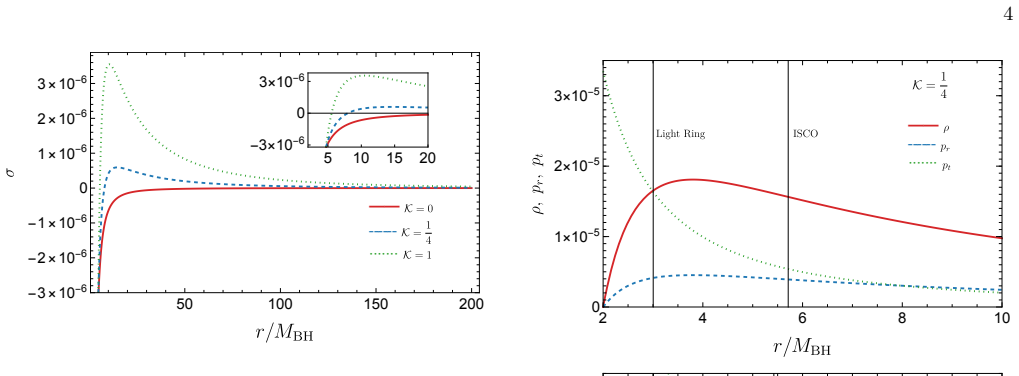
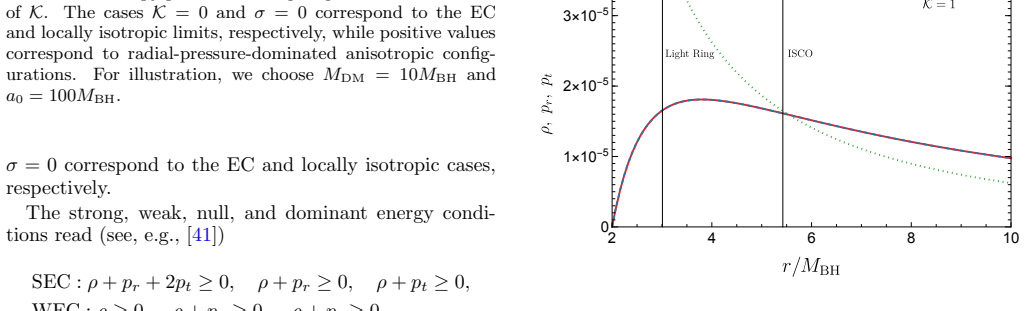
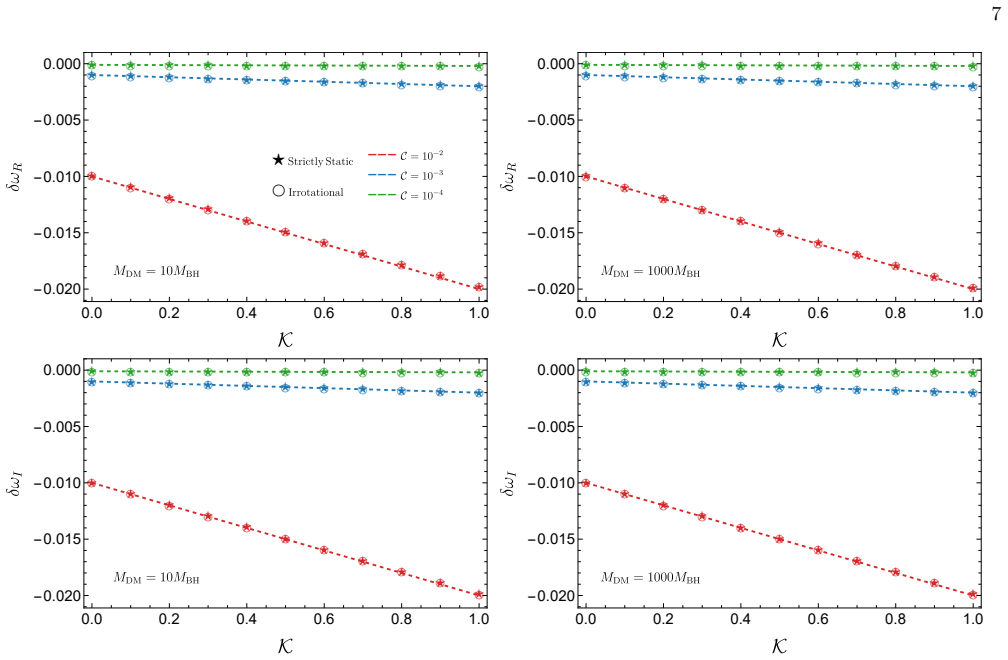
In a black hole embedded in a generic, possibly anisotropic, matter environment under spherical symmetry, both the geodesic structure and the axial quasinormal-mode spectrum remain predominantly governed by an overall gravitational redshift effect, while the radial pressure systematically enhances the environmental corrections. In contrast, the tidal Love numbers are substantially more sensitive, and can exhibit order-unity deviations, including vanishing and negative strictly static magnetic Love numbers for sufficiently large anisotropy.
What carries the argument
Perturbative framework that generalizes the Einstein cluster solution by adding polytropic radial pressure and yields the full set of linearized equations for geodesics, axial quasinormal modes, and tidal responses.
Load-bearing premise
The perturbative framework remains valid and accurate for generic anisotropic matter configurations beyond the restricted cases of vanishing radial pressure or small perturbations.
What would settle it
Explicit computation of the strictly static magnetic Love number for an anisotropic configuration with large enough anisotropy parameter; if the number stays positive the claim of order-unity deviations and sign changes is falsified.
If this is right
- Geodesic motion and axial quasinormal frequencies are dominated by the overall redshift factor set by total mass.
- Radial pressure adds a systematic but secondary enhancement to environmental corrections in orbits and modes.
- Tidal Love numbers exhibit order-unity shifts and can vanish or become negative for strong anisotropy.
- The derived linearized equations directly support extensions to ringdown waveforms and extreme-mass-ratio inspirals.
Where Pith is reading between the lines
- Tidal measurements could distinguish anisotropic environments more readily than ringdown observations.
- Negative static Love numbers might alter the expected inspiral phasing for binaries immersed in such matter.
- The framework could be cross-checked by comparing its predictions against fully numerical evolutions of anisotropic fluid configurations around black holes.
Editorial analysis
A structured set of objections, weighed in public.
Referee Report
Summary. The paper develops a perturbative framework for a black hole embedded in a generic, possibly anisotropic, matter environment under spherical symmetry, extending prior work limited to vanishing radial pressure or small perturbations. It derives an analytical generalization of the Einstein cluster with polytropic radial pressure, then analyzes geodesic structure, axial quasinormal-mode spectrum, and tidal Love numbers. The central claims are that geodesics and axial QNMs remain predominantly governed by an overall gravitational redshift effect (with radial pressure enhancing corrections), while tidal Love numbers are substantially more sensitive and can exhibit order-unity deviations, including vanishing and negative strictly static magnetic Love numbers, for sufficiently large anisotropy. The full linearized equations are presented for future extensions such as ringdown and EMRIs.
Significance. If the results hold within the stated perturbative regime, the work supplies a systematic extension for modeling black-hole responses in anisotropic environments, with the differential sensitivity of Love numbers versus QNMs offering a potentially useful diagnostic for environmental effects in gravitational-wave observations. The provision of the full linearized equations is a concrete strength that facilitates reproducibility and further applications.
major comments (2)
- [§3 and §6] §3 (Perturbative framework) and §6 (Tidal responses): the headline result that tidal Love numbers exhibit order-unity deviations, vanishing, and negative strictly static magnetic values for sufficiently large anisotropy is load-bearing, yet no explicit bound on the anisotropy parameter or estimate of higher-order remainder terms is supplied to confirm that the linearization remains controlled precisely in the regime where these large corrections appear.
- [§4 and §5] §4 (Geodesic structure) and §5 (Axial QNMs): while the redshift-dominance claim is less sensitive to the validity issue, the statement that radial pressure 'systematically enhances the environmental corrections' should be accompanied by a quantitative comparison (e.g., relative size of the pressure term versus the redshift term) to substantiate that the enhancement is not an artifact of the truncation.
minor comments (2)
- [Abstract] The abstract states that the full linearized equations 'can be applied to various extensions' but does not indicate whether they appear in the main text, an appendix, or a supplemental file.
- [Notation] Notation for the anisotropy parameter and the polytropic index should be introduced once with a clear reference to the Einstein-cluster generalization and used consistently thereafter.
Simulated Author's Rebuttal
We thank the referee for the detailed and constructive report. The comments highlight important aspects of the perturbative regime and the need for quantitative support. We address each major comment below and indicate the revisions we will make.
read point-by-point responses
-
Referee: [§3 and §6] §3 (Perturbative framework) and §6 (Tidal responses): the headline result that tidal Love numbers exhibit order-unity deviations, vanishing, and negative strictly static magnetic values for sufficiently large anisotropy is load-bearing, yet no explicit bound on the anisotropy parameter or estimate of higher-order remainder terms is supplied to confirm that the linearization remains controlled precisely in the regime where these large corrections appear.
Authors: We acknowledge that an explicit bound on the anisotropy parameter and an estimate of higher-order remainder terms would strengthen the presentation of the tidal Love number results. In the revised manuscript we will add a dedicated paragraph in §3 and §6 that derives a rough validity criterion by comparing the magnitude of the first-order correction to an estimate of the second-order term obtained from the structure of the linearized equations. This will be illustrated with a plot showing the ratio of successive orders as a function of the anisotropy parameter, thereby identifying the range where the reported order-unity deviations remain within the controlled perturbative regime. revision: yes
-
Referee: [§4 and §5] §4 (Geodesic structure) and §5 (Axial QNMs): while the redshift-dominance claim is less sensitive to the validity issue, the statement that radial pressure 'systematically enhances the environmental corrections' should be accompanied by a quantitative comparison (e.g., relative size of the pressure term versus the redshift term) to substantiate that the enhancement is not an artifact of the truncation.
Authors: We agree that a quantitative comparison is desirable. In the revised version we will insert, in both §4 and §5, a short subsection that tabulates the relative contributions of the redshift term and the radial-pressure correction for several representative values of the polytropic index and anisotropy parameter. The table will show that the pressure term consistently increases the magnitude of the correction by a factor of order 1.5–3 across the explored range, thereby confirming that the enhancement is a genuine feature of the first-order solution rather than a truncation artifact. revision: yes
Circularity Check
No circularity; derivation is self-contained
full rationale
The paper develops a perturbative framework for anisotropic matter around black holes, extends prior restricted cases, derives an analytical generalization of the Einstein cluster with polytropic pressure, and computes geodesic, QNM, and tidal Love number properties from the linearized equations. No quoted step reduces a claimed result to a fitted input, self-definition, or self-citation chain by construction; the redshift dominance and Love-number sensitivity statements are presented as outputs of the framework rather than tautologies. The analysis remains within standard GR perturbation theory without load-bearing self-referential definitions.
Axiom & Free-Parameter Ledger
axioms (2)
- domain assumption The matter environment obeys spherical symmetry
- domain assumption A perturbative treatment suffices for generic anisotropic configurations
read the original abstract
We develop a perturbative framework for a black hole embedded in a generic, possibly anisotropic, matter environment under spherical symmetry. Our approach extends previous analyses restricted to vanishing radial pressure or to perturbative matter configurations. Within this framework, we derive an analytical generalization of the Einstein cluster that incorporates a polytropic radial pressure, and we investigate the properties of this solution. We show that both the geodesic structure and the axial quasinormal-mode spectrum remain predominantly governed by an overall gravitational redshift effect, while the radial pressure systematically enhances the environmental corrections. In contrast, the tidal Love numbers are substantially more sensitive, and can exhibit order-unity deviations, including vanishing and negative strictly static magnetic Love numbers for sufficiently large anisotropy. We present the full linearized equations, which can be applied to various extensions, including ringdown analysis and extreme-mass-ratio inspirals.
Figures
Forward citations
Cited by 1 Pith paper
-
Tidal deformation of an accreting compact object
For perfectly reflecting Schwarzschild-like ECOs, the log-compactness scaling of static scalar and spin-1 Love numbers survives a thin accretion disk, which mainly amplifies the response magnitude.
Reference graph
Works this paper leans on
-
[1]
Decomposition of perturbations With the adoption of the RW gauge [39, 57], the per- turbed metric of Eq. (4) can be split into axial (odd- parity) and polar (even-parity) sectors as gaxial(1) µν = ∞X ℓ=2 ℓX m=−ℓ 0 0h ℓm 0 Sℓm θ hℓm 0 Sℓm ϕ ∗0h ℓm 1 Sℓm θ hℓm 1 Sℓm ϕ ∗ ∗0 0 ∗ ∗ ∗0 ,(A1) and gpolar(1) µν = ∞X ℓ=2 ℓX m=−ℓ Y ℓm× eνH ℓm 0 H ℓ...
-
[2]
up” and “down
Axial sector In this section, we derive the axial perturbation equa- tions from Eqs. (6) and (7); in the following expres- sions we omit the subscript “ℓm”. The components (Eθθ,E θϕ,E ϕϕ), (E rθ,E rϕ), and (E tθ,E tϕ) of the axial sec- tor lead to the following equations, respectively: e−ν ˙h0 −e −λh′ 1 − 1 r2 2M−4π(ρ−p r)r3 h1 = 0,(A26) e−ν ˙h′ 0 − ¨h1 −...
-
[3]
The polar-sector componentE θϕ implies H ℓm 2 =H ℓm 0 ,(A45) which was used to simplify the equations
Polar sector The polar-sector equations are complicated by the cou- pling between metric and fluid perturbations, and we summarize them in theMathematicanotebook [55]. The polar-sector componentE θϕ implies H ℓm 2 =H ℓm 0 ,(A45) which was used to simplify the equations. Moreover, the TOV equations, Eqs. (9)–(11), were also used to simplify the equations. ...
-
[4]
B. P. Abbottet al.(LIGO Scientific, Virgo), Observation of Gravitational Waves from a Binary Black Hole Merger, Phys. Rev. Lett.116, 061102 (2016), arXiv:1602.03837 12 [gr-qc]
work page internal anchor Pith review Pith/arXiv arXiv 2016
-
[5]
Characterization of the LIGO detectors during their sixth science run
J. Aasiet al.(LIGO Scientific, VIRGO), Characteriza- tion of the LIGO detectors during their sixth science run, Class. Quant. Grav.32, 115012 (2015), arXiv:1410.7764 [gr-qc]
work page internal anchor Pith review Pith/arXiv arXiv 2015
-
[6]
Advanced Virgo: a 2nd generation interferometric gravitational wave detector
F. Acerneseet al.(VIRGO), Advanced Virgo: a second- generation interferometric gravitational wave detector, Class. Quant. Grav.32, 024001 (2015), arXiv:1408.3978 [gr-qc]
work page internal anchor Pith review Pith/arXiv arXiv 2015
-
[7]
T. Akutsuet al.(KAGRA), Overview of KAGRA: Detec- tor design and construction history, PTEP2021, 05A101 (2021), arXiv:2005.05574 [physics.ins-det]
-
[8]
B. P. Abbottet al.(LIGO Scientific, Virgo), GWTC- 1: A Gravitational-Wave Transient Catalog of Compact Binary Mergers Observed by LIGO and Virgo during the First and Second Observing Runs, Phys. Rev. X9, 031040 (2019), arXiv:1811.12907 [astro-ph.HE]
work page internal anchor Pith review Pith/arXiv arXiv 2019
-
[9]
R. Abbottet al.(LIGO Scientific, Virgo), GWTC-2: Compact Binary Coalescences Observed by LIGO and Virgo During the First Half of the Third Observing Run, Phys. Rev. X11, 021053 (2021), arXiv:2010.14527 [gr- qc]
work page internal anchor Pith review Pith/arXiv arXiv 2021
-
[10]
R. Abbottet al.(KAGRA, VIRGO, LIGO Scien- tific), GWTC-3: Compact Binary Coalescences Observed by LIGO and Virgo during the Second Part of the Third Observing Run, Phys. Rev. X13, 041039 (2023), arXiv:2111.03606 [gr-qc]
work page internal anchor Pith review Pith/arXiv arXiv 2023
-
[11]
A. G. Abacet al.(LIGO Scientific, VIRGO, KAGRA), GWTC-4.0: Updating the Gravitational-Wave Tran- sient Catalog with Observations from the First Part of the Fourth LIGO-Virgo-KAGRA Observing Run (2025), arXiv:2508.18082 [gr-qc]
work page internal anchor Pith review Pith/arXiv arXiv 2025
-
[12]
GWTC-5.0: Observations from the Second Part of the Fourth LIGO-Virgo-KAGRA Observing Run and Updates to the Gravitational-Wave Transient Catalog (2026), arXiv:2605.27225 [gr-qc]
work page internal anchor Pith review Pith/arXiv arXiv 2026
-
[13]
Laser Interferometer Space Antenna
P. Amaro-Seoaneet al.(LISA), Laser Interferometer Space Antenna (2017), arXiv:1702.00786 [astro-ph.IM]
work page internal anchor Pith review Pith/arXiv arXiv 2017
-
[14]
The Science of the Einstein Telescope
A. Abacet al.(ET), The science of the einstein telescope, Journal of Cosmology and Astroparticle Physics2026 (03), 081, arXiv:2503.12263 [gr-qc]
work page internal anchor Pith review Pith/arXiv arXiv
-
[15]
A Horizon Study for Cosmic Explorer: Science, Observatories, and Community
M. Evanset al., A Horizon Study for Cosmic Ex- plorer: Science, Observatories, and Community (2021), arXiv:2109.09882 [astro-ph.IM]
work page internal anchor Pith review Pith/arXiv arXiv 2021
-
[16]
Environmental Effects for Gravitational-wave Astrophysics
E. Barausse, V. Cardoso, and P. Pani, Environmental Ef- fects for Gravitational-wave Astrophysics, J. Phys. Conf. Ser.610, 012044 (2015), arXiv:1404.7140 [astro-ph.CO]
work page internal anchor Pith review Pith/arXiv arXiv 2015
-
[17]
Can environmental effects spoil precision gravitational-wave astrophysics?
E. Barausse, V. Cardoso, and P. Pani, Can environmental effects spoil precision gravitational-wave astrophysics?, Phys. Rev. D89, 104059 (2014), arXiv:1404.7149 [gr-qc]
work page internal anchor Pith review Pith/arXiv arXiv 2014
-
[18]
V. Cardoso, K. Destounis, F. Duque, R. P. Macedo, and A. Maselli, Black holes in galaxies: Environmental im- pact on gravitational-wave generation and propagation, Phys. Rev. D105, L061501 (2022), arXiv:2109.00005 [gr- qc]
-
[19]
Gravitational waves from extreme-mass-ratio systems in astrophysical environments
V. Cardoso, K. Destounis, F. Duque, R. Panosso Macedo, and A. Maselli, Gravitational Waves from Extreme-Mass- Ratio Systems in Astrophysical Environments, Phys. Rev. Lett.129, 241103 (2022), arXiv:2210.01133 [gr-qc]
work page Pith review arXiv 2022
-
[20]
T. F. M. Spieksma, V. Cardoso, G. Carullo, M. Della Rocca, and F. Duque, Black Hole Spectroscopy in Environments: Detectability Prospects, Phys. Rev. Lett.134, 081402 (2025), arXiv:2409.05950 [gr-qc]
work page Pith review arXiv 2025
-
[21]
S. Chakraborty, G. Comp` ere, and L. Machet, Tidal Love numbers and quasinormal modes of the Schwarzschild- Hernquist black hole, Phys. Rev. D112, 024015 (2025), arXiv:2412.14831 [gr-qc]
- [22]
-
[23]
"Kludge" gravitational waveforms for a test-body orbiting a Kerr black hole
S. Babak, H. Fang, J. R. Gair, K. Glampedakis, and S. A. Hughes, ’Kludge’ gravitational waveforms for a test-body orbiting a Kerr black hole, Phys. Rev. D75, 024005 (2007), [Erratum: Phys.Rev.D 77, 04990 (2008)], arXiv:gr-qc/0607007
work page internal anchor Pith review Pith/arXiv arXiv 2007
-
[24]
K. Destounis, A. G. Suvorov, and K. D. Kokkotas, Testing spacetime symmetry through gravitational waves from extreme-mass-ratio inspirals, Phys. Rev. D102, 064041 (2020), arXiv:2009.00028 [gr-qc]
-
[25]
K. Destounis and K. D. Kokkotas, Gravitational-wave glitches: Resonant islands and frequency jumps in nonin- tegrable extreme-mass-ratio inspirals, Phys. Rev. D104, 064023 (2021), arXiv:2108.02782 [gr-qc]
-
[26]
Y. Zhao and Y. Gong, Dark matter distributions around extreme mass ratio inspirals: effects of radial pressure and relativistic treatment (2026), arXiv:2602.12022 [gr- qc]
-
[27]
P. G. S. Fernandes and V. Cardoso, Dark matter and modified gravity: Einstein clusters from a non-minimally coupled vector field (2025), arXiv:2505.00563 [gr-qc]
work page internal anchor Pith review Pith/arXiv arXiv 2025
-
[28]
Binney and S
J. Binney and S. Tremaine,Galactic dynamics(Prince- ton university press, 2011)
2011
-
[29]
D. N. Spergel and P. J. Steinhardt, Observational ev- idence for selfinteracting cold dark matter, Phys. Rev. Lett.84, 3760 (2000), arXiv:astro-ph/9909386
work page internal anchor Pith review Pith/arXiv arXiv 2000
-
[30]
L. Berezhiani, G. Cintia, V. De Luca, and J. Khoury, Superfluid dark matter, Phys. Rept.1172, 1 (2026), arXiv:2505.23900 [astro-ph.CO]
-
[31]
Subhaloes in Self-Interacting Galactic Dark Matter Haloes
M. Vogelsberger, J. Zavala, and A. Loeb, Subhaloes in Self-Interacting Galactic Dark Matter Haloes, Mon. Not. Roy. Astron. Soc.423, 3740 (2012), arXiv:1201.5892 [astro-ph.CO]
work page internal anchor Pith review Pith/arXiv arXiv 2012
-
[32]
Dark matter annihilation at the galactic center
P. Gondolo and J. Silk, Dark matter annihilation at the galactic center, Phys. Rev. Lett.83, 1719 (1999), arXiv:astro-ph/9906391
work page internal anchor Pith review Pith/arXiv arXiv 1999
-
[33]
Dark matter distributions around massive black holes: A general relativistic analysis
L. Sadeghian, F. Ferrer, and C. M. Will, Dark mat- ter distributions around massive black holes: A general relativistic analysis, Phys. Rev. D88, 063522 (2013), arXiv:1305.2619 [astro-ph.GA]
work page internal anchor Pith review Pith/arXiv arXiv 2013
-
[34]
N. Speeney, A. Antonelli, V. Baibhav, and E. Berti, Impact of relativistic corrections on the detectability of dark-matter spikes with gravitational waves, Phys. Rev. D106, 044027 (2022), arXiv:2204.12508 [gr-qc]
-
[35]
Extreme mass ratio inspirals in rotating dark matter spikes
S. Mitra, N. Speeney, S. Chakraborty, and E. Berti, Ex- treme mass ratio inspirals in rotating dark matter spikes, Phys. Rev. D112, 044030 (2025), arXiv:2505.04697 [gr- qc]
work page Pith review arXiv 2025
- [36]
-
[37]
A multi-parameter expansion for the evolution of asymmetric binaries in astrophysical environments
S. Datta and A. Maselli, A multi-parameter expan- sion for the evolution of asymmetric binaries in astro- physical environments, SciPost Phys.20, 080 (2026), arXiv:2507.04471 [gr-qc]
work page internal anchor Pith review Pith/arXiv arXiv 2026
-
[38]
Environmental effects in extreme mass ratio inspirals: perturbations to the environment in Kerr
C. Dyson, T. F. M. Spieksma, R. Brito, M. van de Meent, and S. Dolan, Environmental Effects in Extreme-Mass- Ratio Inspirals: Perturbations to the Environment in 13 Kerr Spacetimes, Phys. Rev. Lett.134, 211403 (2025), arXiv:2501.09806 [gr-qc]
work page Pith review arXiv 2025
-
[39]
Axial tidal Love numbers of black holes in matter environments
S. D’Onofrio, S. Datta, and A. Maselli, Axial tidal Love numbers of black holes in matter environments (2026), arXiv:2605.02633 [gr-qc]
work page internal anchor Pith review Pith/arXiv arXiv 2026
-
[40]
J. F. Rodriguez-Ruiz, L. M. Becerra, and F. D. Lora-Clavijo, On the non-radial oscillations of real- istic anisotropic neutron stars: Axial modes (2026), arXiv:2605.06418 [gr-qc]
work page internal anchor Pith review Pith/arXiv arXiv 2026
-
[41]
Chandrasekhar and K
S. Chandrasekhar and K. S. Thorne,The mathematical theory of black holes, Vol. 69 (Oxford university press, 1998)
1998
-
[42]
A. Nagar and L. Rezzolla, Gauge-invariant non-spherical metric perturbations of Schwarzschild black-hole space- times, Class. Quant. Grav.22, R167 (2005), [Erra- tum: Class.Quant.Grav. 23, 4297 (2006)], arXiv:gr- qc/0502064
-
[43]
Kojima, Equations governing the nonradial oscilla- tions of a slowly rotating relativistic star, Phys
Y. Kojima, Equations governing the nonradial oscilla- tions of a slowly rotating relativistic star, Phys. Rev. D 46, 4289 (1992)
1992
- [44]
-
[45]
Datta, Black holes immersed in dark matter: Energy condition and sound speed, Phys
S. Datta, Black holes immersed in dark matter: Energy condition and sound speed, Phys. Rev. D109, 104042 (2024), arXiv:2312.01277 [gr-qc]
-
[46]
Tidal Response of Compact Objects
S. Chakraborty and P. Pani, Tidal Response of Compact Objects (2026), arXiv:2604.08679 [gr-qc]
work page internal anchor Pith review Pith/arXiv arXiv 2026
-
[47]
M. J. Rodr´ ıguez, L. Santoni, and A. R. Solomon, Love numbers of black holes and compact objects, preprint (2026), arXiv:2604.08653 [gr-qc]
work page internal anchor Pith review Pith/arXiv arXiv 2026
-
[48]
Ferrari, L
V. Ferrari, L. Gualtieri, and P. Pani,General Relativity and its Applications(CRC Press, 2020)
2020
-
[49]
Muller, Speeds of propagation in classical and rela- tivistic extended thermodynamics, Living Rev
I. Muller, Speeds of propagation in classical and rela- tivistic extended thermodynamics, Living Rev. Rel.2, 1 (1999)
1999
-
[50]
Nollert, TOPICAL REVIEW: Quasinormal modes: the characteristic ‘sound’ of black holes and neutron stars, Class
H.-P. Nollert, TOPICAL REVIEW: Quasinormal modes: the characteristic ‘sound’ of black holes and neutron stars, Class. Quant. Grav.16, R159 (1999)
1999
-
[51]
Quasinormal modes of black holes and black branes
E. Berti, V. Cardoso, and A. O. Starinets, Quasinormal modes of black holes and black branes, Class. Quant. Grav.26, 163001 (2009), arXiv:0905.2975 [gr-qc]
work page internal anchor Pith review Pith/arXiv arXiv 2009
-
[52]
R. A. Konoplya and A. Zhidenko, Quasinormal modes of black holes: From astrophysics to string theory, Rev. Mod. Phys.83, 793 (2011), arXiv:1102.4014 [gr-qc]
work page internal anchor Pith review Pith/arXiv arXiv 2011
-
[53]
Black hole spectroscopy: from theory to experiment
E. Bertiet al., Black hole spectroscopy: from theory to experiment, preprint (2025), arXiv:2505.23895 [gr-qc]
work page internal anchor Pith review Pith/arXiv arXiv 2025
-
[54]
On gravitational-wave spectroscopy of massive black holes with the space interferometer LISA
E. Berti, V. Cardoso, and C. M. Will, On gravitational- wave spectroscopy of massive black holes with the space interferometer LISA, Phys. Rev. D73, 064030 (2006), arXiv:gr-qc/0512160
work page internal anchor Pith review Pith/arXiv arXiv 2006
-
[55]
P. Pani, L. Gualtieri, T. Abdelsalhin, and X. Jim´ enez- Forteza, Magnetic tidal Love numbers clarified, Phys. Rev. D98, 124023 (2018), arXiv:1810.01094 [gr-qc]
work page internal anchor Pith review Pith/arXiv arXiv 2018
-
[56]
R. M. Wald,General relativity(University of Chicago press, 2010)
2010
-
[57]
xAct developers, https://xact.es/
-
[58]
Zhao, https://github.com/yqzhao1998/anisotropic- fluid
Y.-Q. Zhao, https://github.com/yqzhao1998/anisotropic- fluid
-
[59]
Anisotropic stars as ultracompact objects in General Relativity
G. Raposo, P. Pani, M. Bezares, C. Palenzuela, and V. Cardoso, Anisotropic stars as ultracompact objects in General Relativity, Phys. Rev. D99, 104072 (2019), arXiv:1811.07917 [gr-qc]
work page internal anchor Pith review Pith/arXiv arXiv 2019
-
[60]
Regge and J
T. Regge and J. A. Wheeler, Stability of a Schwarzschild singularity, Phys. Rev.108, 1063 (1957)
1957
-
[61]
F. J. Zerilli, Effective potential for even parity Regge- Wheeler gravitational perturbation equations, Phys. Rev. Lett.24, 737 (1970)
1970
-
[62]
D. D. Doneva and S. S. Yazadjiev, Gravitational wave spectrum of anisotropic neutron stars in Cowl- ing approximation, Phys. Rev. D85, 124023 (2012), arXiv:1203.3963 [gr-qc]
work page internal anchor Pith review Pith/arXiv arXiv 2012
-
[63]
Gravitomagnetic response of an irrotational body to an applied tidal field
P. Landry and E. Poisson, Gravitomagnetic response of an irrotational body to an applied tidal field, Phys. Rev. D91, 104026 (2015), arXiv:1504.06606 [gr-qc]
work page internal anchor Pith review Pith/arXiv arXiv 2015
- [64]
-
[65]
Geodesic stability, Lyapunov exponents and quasinormal modes
V. Cardoso, A. S. Miranda, E. Berti, H. Witek, and V. T. Zanchin, Geodesic stability, Lyapunov exponents and quasinormal modes, Phys. Rev. D79, 064016 (2009), arXiv:0812.1806 [hep-th]
work page internal anchor Pith review Pith/arXiv arXiv 2009
-
[66]
First M87 Event Horizon Telescope Results. I. The Shadow of the Supermassive Black Hole
K. Akiyamaet al.(Event Horizon Telescope), First M87 Event Horizon Telescope Results. I. The Shadow of the Supermassive Black Hole, Astrophys. J. Lett.875, L1 (2019), arXiv:1906.11238 [astro-ph.GA]
work page internal anchor Pith review Pith/arXiv arXiv 2019
-
[67]
Detection of orbital motions near the last stable circular orbit of the massive black hole SgrA*
R. Abuteret al., Detection of orbital motions near the last stable circular orbit of the massive black hole SgrA*, Astron. Astrophys.618, 10.1051/0004-6361/201834294 (2018), arXiv:1810.12641 [astro-ph.GA]
work page internal anchor Pith review Pith/arXiv arXiv doi:10.1051/0004-6361/201834294 2018
-
[68]
Iyer and C
S. Iyer and C. M. Will, Black Hole Normal Modes: A WKB Approach. 1. Foundations and Application of a Higher Order WKB Analysis of Potential Barrier Scat- tering, Phys. Rev. D35, 3621 (1987)
1987
-
[69]
R. A. Konoplya, Quasinormal behavior of the d- dimensional Schwarzschild black hole and higher or- der WKB approach, Phys. Rev. D68, 024018 (2003), arXiv:gr-qc/0303052
work page internal anchor Pith review Pith/arXiv arXiv 2003
-
[70]
Quasinormal modes of black holes. The improved semianalytic approach
J. Matyjasek and M. Opala, Quasinormal modes of black holes. The improved semianalytic approach, Phys. Rev. D96, 024011 (2017), arXiv:1704.00361 [gr-qc]
work page internal anchor Pith review Pith/arXiv arXiv 2017
-
[71]
Testing strong-field gravity with tidal Love numbers
V. Cardoso, E. Franzin, A. Maselli, P. Pani, and G. Ra- poso, Testing strong-field gravity with tidal Love num- bers, Phys. Rev. D95, 084014 (2017), [Addendum: Phys.Rev.D 95, 089901 (2017)], arXiv:1701.01116 [gr-qc]
work page internal anchor Pith review Pith/arXiv arXiv 2017
-
[72]
V. Cardoso and F. Duque, Environmental effects in gravitational-wave physics: Tidal deformability of black holes immersed in matter, Phys. Rev. D101, 064028 (2020), arXiv:1912.07616 [gr-qc]
-
[73]
V. De Luca and P. Pani, Tidal deformability of dressed black holes and tests of ultralight bosons in extended mass ranges, JCAP08, 032, arXiv:2106.14428 [gr-qc]
-
[74]
V. De Luca, A. Maselli, and P. Pani, Modeling frequency-dependent tidal deformability for environmen- tal black hole mergers, Phys. Rev. D107, 044058 (2023), arXiv:2212.03343 [gr-qc]
-
[75]
E. Cannizzaro, V. De Luca, and P. Pani, Tidal deforma- bility of black holes surrounded by thin accretion disks, Phys. Rev. D110, 123004 (2024), arXiv:2408.14208 [astro-ph.HE]
-
[76]
N. Speeney, E. Berti, V. Cardoso, and A. Maselli, Black holes surrounded by generic matter distributions: Polar perturbations and energy flux, Phys. Rev. D109, 084068 (2024), arXiv:2401.00932 [gr-qc]
-
[77]
A metric solution for rotating black holes embedded in dark matter halos with central spikes
R.-H. Yue, Y.-Q. Zhao, and W.-L. Qian, A metric solu- tion for rotating black holes embedded in dark matter 14 halos with central spikes (2026), arXiv:2605.15330 [gr- qc]
work page internal anchor Pith review Pith/arXiv arXiv 2026
discussion (0)
Sign in with ORCID, Apple, or X to comment. Anyone can read and Pith papers without signing in.