Exploring Leptogenesis in the Era of First Order Electroweak Phase Transition
Pith reviewed 2026-05-22 20:49 UTC · model grok-4.3
The pith
Right-handed neutrinos lighter than the Higgs mass can produce the observed baryon asymmetry in a first-order electroweak phase transition.
A machine-rendered reading of the paper's core claim, the machinery that carries it, and where it could break.
Core claim
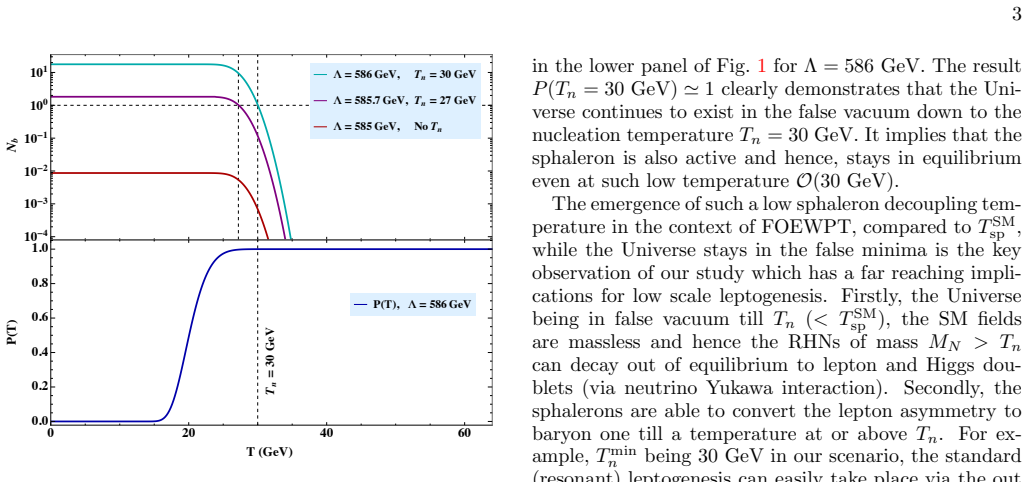
In the neutrino seesaw framework, a sufficient lepton asymmetry is generated via out-of-equilibrium CP-violating decays of right-handed neutrinos even when their mass falls below the Standard Model Higgs mass. This becomes possible by keeping the sphaleron in equilibrium below its conventional decoupling temperature of approximately 131.7 GeV, thanks to the flexibility of the bubble nucleation temperature when the electroweak phase transition is first order.
What carries the argument
The first-order electroweak phase transition, whose bubble nucleation temperature can be adjusted to keep sphalerons active at temperatures below 131.7 GeV for converting lepton to baryon asymmetry.
If this is right
- A lepton asymmetry generated at low scales converts efficiently to the observed baryon asymmetry.
- Stochastic gravitational waves characteristic of the first-order transition may be detected in near-future experiments.
- Right-handed neutrinos with masses as low as 35 GeV can participate in this leptogenesis and open detection possibilities at accelerator experiments.
- The mechanism remains effective even when the Universe's reheating temperature is lower than 131.7 GeV.
Where Pith is reading between the lines
- New physics responsible for making the electroweak phase transition first order could simultaneously enable this low-scale leptogenesis.
- Joint observations of gravitational wave signals and light right-handed neutrinos at colliders would provide strong evidence for the scenario.
- This framework suggests leptogenesis can occur in cosmologies with late-time reheating below the standard sphaleron decoupling temperature.
Load-bearing premise
The electroweak phase transition must be strongly first order with a bubble nucleation temperature low enough that sphaleron processes remain in thermal equilibrium below the Standard Model decoupling temperature of approximately 131.7 GeV.
What would settle it
A measurement or calculation showing that the bubble nucleation temperature in the first-order transition is above 131.7 GeV, or the absence of the predicted gravitational wave signal, would prevent the low-scale conversion and falsify the claim for right-handed neutrinos below the Higgs mass.
Figures


read the original abstract
We present a novel approach for implementing baryogenesis via leptogenesis at low scale within neutrino seesaw framework where a sufficient lepton asymmetry can be generated via out of equilibrium CP-violating decays of right handed neutrinos (RHNs) even when their mass falls below the Standard Model (SM) Higgs mass. It becomes possible by keeping the sphaleron in equilibrium below its conventional decoupling temperature $T_{\rm sp}^{\rm SM} \sim131.7$ GeV in SM so as to facilitate the conversion of lepton asymmetry to baryon asymmetry at such a low scale, thanks to the flexibility of the bubble nucleation temperature in case the electroweak phase transition (EWPT) is of first order. The scenario emerges as an exciting (and perhaps unique) possibility for low scale leptogenesis, particularly if the Universe attains a reheating temperature lower than 131.7 GeV. We show that a stochastic gravitational wave, characteristic of such first order EWPT, may be detected in near future detectors while the presence of RHNs of mass as low as 35 GeV opens up an intriguing detection possibility at current and future accelerator experiments.
Editorial analysis
A structured set of objections, weighed in public.
Referee Report
Summary. The manuscript proposes a low-scale leptogenesis scenario in the neutrino seesaw framework. It claims that right-handed neutrinos with masses below the SM Higgs mass (down to ~35 GeV) can generate a sufficient lepton asymmetry via out-of-equilibrium CP-violating decays, with the asymmetry converted to baryon asymmetry because a first-order electroweak phase transition allows the sphaleron processes to remain in equilibrium at temperatures below the standard SM decoupling value of ~131.7 GeV. This is enabled by supercooling and a lower bubble nucleation temperature. The paper further notes that such a transition produces a stochastic gravitational wave background potentially detectable in future experiments and that the light RHNs could be accessible at accelerators.
Significance. If the mechanism can be shown to work without additional washout or inconsistencies, it would offer a distinctive route to low-scale baryogenesis that relaxes the usual temperature hierarchy between RHN mass and sphaleron decoupling. The scenario ties together leptogenesis, first-order EWPT, gravitational waves, and collider searches, which could make it observationally testable. The absence of explicit joint scans of nucleation temperature and Boltzmann equations in the presented material limits the current assessment of viability.
major comments (2)
- [Abstract and phase-transition discussion] The central claim requires that a strongly first-order EWPT produces a bubble nucleation temperature T_n sufficiently below ~131.7 GeV to keep sphalerons active during the out-of-equilibrium decays of m_N ≈ 35 GeV RHNs, while still satisfying the out-of-equilibrium condition and yielding enough CP asymmetry. No explicit calculation or parameter scan combining the bounce action (to determine T_n) with the leptogenesis Boltzmann equations is described; without this, it is unclear whether the required conversion efficiency of order 10^{-2} is achieved or whether rapid completion of the transition suppresses the sphaleron rate.
- [Model setup and assumptions] The scenario assumes an extended scalar sector that realizes a sufficiently strong first-order transition (large barrier, v/T > 1 at nucleation) without introducing new washout channels or modifying the RHN decay width and CP asymmetry ε_CP. This assumption is load-bearing for the low-scale viability but is not verified through explicit model construction or rate calculations in the provided text.
minor comments (2)
- [Introduction] Notation for the SM sphaleron decoupling temperature is given as T_sp^SM ~131.7 GeV; a precise reference or derivation of this value should be added for clarity.
- [Abstract] The abstract mentions potential detection of RHNs at accelerators but does not specify production channels or branching ratios; a brief discussion or reference would improve accessibility.
Simulated Author's Rebuttal
We thank the referee for the careful reading and constructive comments on our manuscript. We address each major comment below and outline the revisions we will make to strengthen the presentation.
read point-by-point responses
-
Referee: [Abstract and phase-transition discussion] The central claim requires that a strongly first-order EWPT produces a bubble nucleation temperature T_n sufficiently below ~131.7 GeV to keep sphalerons active during the out-of-equilibrium decays of m_N ≈ 35 GeV RHNs, while still satisfying the out-of-equilibrium condition and yielding enough CP asymmetry. No explicit calculation or parameter scan combining the bounce action (to determine T_n) with the leptogenesis Boltzmann equations is described; without this, it is unclear whether the required conversion efficiency of order 10^{-2} is achieved or whether rapid completion of the transition suppresses the sphaleron rate.
Authors: We acknowledge that the manuscript presents the scenario through analytical estimates of the required T_n range and sphaleron conversion efficiency rather than a full numerical joint scan. These estimates indicate that nucleation temperatures of 40-80 GeV allow sufficient time for asymmetry conversion before transition completion. To directly address the concern, the revised manuscript will include an explicit combined analysis of the bounce action and Boltzmann equations over a representative parameter grid, confirming that viable regions exist where the conversion efficiency meets or exceeds 10^{-2} without suppression from rapid bubble expansion. revision: yes
-
Referee: [Model setup and assumptions] The scenario assumes an extended scalar sector that realizes a sufficiently strong first-order transition (large barrier, v/T > 1 at nucleation) without introducing new washout channels or modifying the RHN decay width and CP asymmetry ε_CP. This assumption is load-bearing for the low-scale viability but is not verified through explicit model construction or rate calculations in the provided text.
Authors: The work is framed phenomenologically, assuming an extended scalar sector capable of a strong FOEWPT while preserving the RHN decay and CP properties. Such sectors (e.g., singlet extensions) can be arranged to avoid new washout if additional scalars are decoupled from the RHNs. In revision we will add a dedicated subsection with example model realizations and order-of-magnitude estimates showing that washout rates can remain subdominant; full rate calculations for a benchmark model will be noted as future work rather than performed here. revision: partial
Circularity Check
No significant circularity; scenario is conditional on explicit first-order EWPT assumption
full rationale
The paper's derivation chain begins from the stated premise that the EWPT is first order, which permits a lower bubble nucleation temperature T_n than the SM sphaleron decoupling temperature. This external assumption (requiring an extended scalar sector) then enables sphaleron conversion of lepton asymmetry from RHN decays at m_N ~ 35 GeV. No load-bearing step reduces the generated asymmetry or conversion efficiency to a fitted parameter, self-citation, or ansatz by construction; the abstract and described mechanism treat the PT order and T_n flexibility as inputs rather than outputs. The central claim is therefore a conditional possibility, not a self-referential derivation.
Axiom & Free-Parameter Ledger
free parameters (1)
- bubble nucleation temperature
axioms (1)
- domain assumption Sphaleron processes remain in equilibrium at temperatures below 131.7 GeV when the electroweak phase transition is first order.
Lean theorems connected to this paper
-
IndisputableMonolith/Foundation/AlexanderDuality.leanalexander_duality_circle_linking unclear?
unclearRelation between the paper passage and the cited Recognition theorem.
Tn can be kept below T_sp^SM ... via strongly first order EWPT ... Nb(Tn) = ∫ Γ(T)/H(T)^4 dT/T =1
-
IndisputableMonolith/Cost/FunctionalEquation.leanwashburn_uniqueness_aczel unclear?
unclearRelation between the paper passage and the cited Recognition theorem.
ε_i^ℓ from resonant CP asymmetry ... Boltzmann eqs for Y_N and Y_{B-L}
What do these tags mean?
- matches
- The paper's claim is directly supported by a theorem in the formal canon.
- supports
- The theorem supports part of the paper's argument, but the paper may add assumptions or extra steps.
- extends
- The paper goes beyond the formal theorem; the theorem is a base layer rather than the whole result.
- uses
- The paper appears to rely on the theorem as machinery.
- contradicts
- The paper's claim conflicts with a theorem or certificate in the canon.
- unclear
- Pith found a possible connection, but the passage is too broad, indirect, or ambiguous to say the theorem truly supports the claim.
Forward citations
Cited by 1 Pith paper
-
Solving Cosmological Puzzles using Finite Temperature $\nu$SMEFT
A minimal extension of the Standard Model with three heavy Majorana neutrinos simultaneously realizes fermionic dark matter, a strong first-order electroweak phase transition, and low-scale resonant leptogenesis consi...
Reference graph
Works this paper leans on
-
[1]
Effective potential construction In order to study the details of FOEWPT, we have to employ the one-loop corrections (zero-temperature as well as thermal) to the tree-level potential along with the corrections due to ring diagrams at higher loop, called daisy resummation [69, 70] . We can then write the full effective potential as Veff(ϕ, T) = V tree (ϕ) ...
-
[2]
(A7), for different Λ values, corresponding to different critical tem- peratures Tc
Barrier height dependence on Λ Figure 5 shows the effective potential, Eq. (A7), for different Λ values, corresponding to different critical tem- peratures Tc. As Λ increases, the barrier height decreases and vice-versa. For Λ = 590 GeV, the barrier height is Λ=590,T c =65.4 Λ=600,T c =68 Λ=650,T c =79.2 Λ=700,T c =88.3 Λ=750,T c =96.2 0 50 100 150 200 0 ...
-
[3]
Planck 2018 results. VI. Cosmological parameters
N. Aghanim et al. (Planck), Planck 2018 results. VI. Cosmological parameters, Astron. Astrophys. 641, A6 (2020), [Erratum: Astron.Astrophys. 652, C4 (2021)], arXiv:1807.06209 [astro-ph.CO]
work page internal anchor Pith review Pith/arXiv arXiv 2018
-
[4]
M. A. Luty, Baryogenesis via leptogenesis, Phys. Rev. D 45, 455 (1992)
work page 1992
-
[5]
M. Fukugita and T. Yanagida, Baryogenesis Without Grand Unification, Phys. Lett. B 174, 45 (1986)
work page 1986
-
[6]
Baryogenesis and lepton number violation
M. Plumacher, Baryogenesis and lepton number viola- tion, Z. Phys. C 74, 549 (1997), arXiv:hep-ph/9604229
work page internal anchor Pith review Pith/arXiv arXiv 1997
-
[7]
L. Covi, E. Roulet, and F. Vissani, CP violating decays in leptogenesis scenarios, Phys. Lett. B 384, 169 (1996), arXiv:hep-ph/9605319
work page internal anchor Pith review Pith/arXiv arXiv 1996
-
[8]
V. A. Kuzmin, V. A. Rubakov, and M. E. Shaposhnikov, On the Anomalous Electroweak Baryon Number Non- conservation in the Early Universe, Phys. Lett. B 155, 36 (1985)
work page 1985
-
[9]
P. B. Arnold and L. D. McLerran, Sphalerons, Small Fluctuations and Baryon Number Violation in Elec- troweak Theory, Phys. Rev. D 36, 581 (1987)
work page 1987
-
[10]
P. B. Arnold and L. D. McLerran, The Sphaleron Strikes Back, Phys. Rev. D 37, 1020 (1988)
work page 1988
-
[11]
A. I. Bochkarev and M. E. Shaposhnikov, Electroweak Production of Baryon Asymmetry and Upper Bounds on the Higgs and Top Masses, Mod. Phys. Lett. A 2, 417 (1987)
work page 1987
-
[12]
S. Y. Khlebnikov and M. E. Shaposhnikov, The Statis- tical Theory of Anomalous Fermion Number Nonconser- vation, Nucl. Phys. B 308, 885 (1988)
work page 1988
-
[13]
Minkowski, µ → eγ at a Rate of One Out of 109 Muon Decays?, Phys
P. Minkowski, µ → eγ at a Rate of One Out of 109 Muon Decays?, Phys. Lett. B 67, 421 (1977)
work page 1977
-
[14]
Complex Spinors and Unified Theories
M. Gell-Mann, P. Ramond, and R. Slansky, Complex Spinors and Unified Theories, Conf. Proc. C 790927, 315 (1979), arXiv:1306.4669 [hep-th]
work page internal anchor Pith review Pith/arXiv arXiv 1979
-
[15]
R. N. Mohapatra and G. Senjanovic, Neutrino Mass and Spontaneous Parity Nonconservation, Phys. Rev. Lett. 44, 912 (1980)
work page 1980
-
[16]
Yanagida, Horizontal gauge symmetry and masses of neutrinos, Conf
T. Yanagida, Horizontal gauge symmetry and masses of neutrinos, Conf. Proc. C 7902131, 95 (1979)
work page 1979
-
[17]
J. Schechter and J. W. F. Valle, Neutrino Masses in SU(2) x U(1) Theories, Phys. Rev. D 22, 2227 (1980)
work page 1980
-
[18]
J. Schechter and J. W. F. Valle, Neutrino Decay and Spontaneous Violation of Lepton Number, Phys. Rev. D 25, 774 (1982)
work page 1982
- [19]
-
[20]
W. H. Julian, On the Effect of Interstellar Material on Stellar Non-Circular Velocities in Disk Galaxies, Astro- phys. J. 148, 175 (1967)
work page 1967
-
[21]
Cosmological parameters from SDSS and WMAP
M. Tegmark et al. (SDSS), Cosmological parameters from SDSS and WMAP, Phys. Rev. D 69, 103501 (2004), arXiv:astro-ph/0310723
work page internal anchor Pith review Pith/arXiv arXiv 2004
-
[22]
A lower bound on the right-handed neutrino mass from leptogenesis
S. Davidson and A. Ibarra, A Lower bound on the right- handed neutrino mass from leptogenesis, Phys. Lett. B 535, 25 (2002), arXiv:hep-ph/0202239
work page internal anchor Pith review Pith/arXiv arXiv 2002
- [23]
-
[24]
Baryogenesis Through Mixing of Heavy Majorana Neutrinos
M. Flanz, E. A. Paschos, U. Sarkar, and J. Weiss, Baryo- genesis through mixing of heavy Majorana neutrinos, Phys. Lett. B 389, 693 (1996), arXiv:hep-ph/9607310
work page internal anchor Pith review Pith/arXiv arXiv 1996
-
[25]
CP Violation and Baryogenesis due to Heavy Majorana Neutrinos
A. Pilaftsis, CP violation and baryogenesis due to heavy Majorana neutrinos, Phys. Rev. D 56, 5431 (1997), arXiv:hep-ph/9707235
work page internal anchor Pith review Pith/arXiv arXiv 1997
-
[26]
A. Pilaftsis and T. E. J. Underwood, Resonant lep- togenesis, Nucl. Phys. B 692, 303 (2004), arXiv:hep- ph/0309342
-
[27]
The Sphaleron Rate in the Minimal Standard Model
M. D’Onofrio, K. Rummukainen, and A. Tranberg, Sphaleron Rate in the Minimal Standard Model, Phys. Rev. Lett. 113, 141602 (2014), arXiv:1404.3565 [hep-ph]
work page internal anchor Pith review Pith/arXiv arXiv 2014
-
[28]
The Standard Model cross-over on the lattice
M. D’Onofrio and K. Rummukainen, Standard model cross-over on the lattice, Phys. Rev. D93, 025003 (2016), arXiv:1508.07161 [hep-ph]
work page internal anchor Pith review Pith/arXiv arXiv 2016
-
[29]
Higgs doublet decay as the origin of the baryon asymmetry
T. Hambye and D. Teresi, Higgs doublet decay as the origin of the baryon asymmetry, Phys. Rev. Lett. 117, 091801 (2016), arXiv:1606.00017 [hep-ph]
work page internal anchor Pith review Pith/arXiv arXiv 2016
-
[30]
E. K. Akhmedov, V. A. Rubakov, and A. Y. Smirnov, Baryogenesis via neutrino oscillations, Phys. Rev. Lett. 81, 1359 (1998), arXiv:hep-ph/9803255
work page internal anchor Pith review Pith/arXiv arXiv 1998
-
[31]
D. Bhandari, A. Datta, and A. Sil, Leptogenesis from a phase transition in a dynamical vacuum, Phys. Rev. D 110, 115008 (2024), arXiv:2312.13157 [hep-ph]
-
[32]
J. M. Cline, Baryogenesis, in Les Houches Summer School - Session 86: Particle Physics and Cosmology: The Fabric of Spacetime (2006) arXiv:hep-ph/0609145
work page internal anchor Pith review Pith/arXiv arXiv 2006
-
[33]
Signals of the electroweak phase transition at colliders and gravitational wave observatories
M. Chala, C. Krause, and G. Nardini, Signals of the elec- troweak phase transition at colliders and gravitational wave observatories, JHEP 07, 062, arXiv:1802.02168 [hep-ph]
work page internal anchor Pith review Pith/arXiv arXiv
-
[34]
The Baryon asymmetry in the Standard Model with a low cut-off
D. Bodeker, L. Fromme, S. J. Huber, and M. Seniuch, The Baryon asymmetry in the standard model with a low cut-off, JHEP 02, 026, arXiv:hep-ph/0412366
work page internal anchor Pith review Pith/arXiv arXiv
-
[35]
Dynamics of Non-renormalizable Electroweak Symmetry Breaking
C. Delaunay, C. Grojean, and J. D. Wells, Dynamics of Non-renormalizable Electroweak Symmetry Breaking, JHEP 04, 029, arXiv:0711.2511 [hep-ph]
work page internal anchor Pith review Pith/arXiv arXiv
-
[36]
C. Grojean, G. Servant, and J. D. Wells, First-order elec- troweak phase transition in the standard model with a low cutoff, Phys. Rev. D 71, 036001 (2005), arXiv:hep- ph/0407019
-
[37]
F. P. Huang, P.-H. Gu, P.-F. Yin, Z.-H. Yu, and X. Zhang, Testing the electroweak phase transition and electroweak baryogenesis at the LHC and a circu- lar electron-positron collider, Phys. Rev. D 93, 103515 (2016), arXiv:1511.03969 [hep-ph]
work page internal anchor Pith review Pith/arXiv arXiv 2016
-
[38]
F. P. Huang, Y. Wan, D.-G. Wang, Y.-F. Cai, and X. Zhang, Hearing the echoes of electroweak baryogene- sis with gravitational wave detectors, Phys. Rev. D 94, 041702 (2016), arXiv:1601.01640 [hep-ph]
work page internal anchor Pith review Pith/arXiv arXiv 2016
-
[39]
A. H. Guth and E. J. Weinberg, Cosmological Conse- quences of a First Order Phase Transition in the SU(5) Grand Unified Model, Phys. Rev. D 23, 876 (1981)
work page 1981
-
[40]
A. H. Guth and S. H. H. Tye, Phase Transitions and Magnetic Monopole Production in the Very Early Universe, Phys. Rev. Lett. 44, 631 (1980), [Erratum: Phys.Rev.Lett. 44, 963 (1980)]
work page 1980
-
[41]
S. R. Coleman, The Fate of the False Vacuum. 1. Semi- classical Theory, Phys. Rev. D15, 2929 (1977), [Erratum: Phys.Rev.D 16, 1248 (1977)]
work page 1977
-
[42]
A. D. Linde, Fate of the False Vacuum at Finite Temper- ature: Theory and Applications, Phys. Lett. B 100, 37 (1981)
work page 1981
-
[43]
A. D. Linde, Decay of the False Vacuum at Finite Tem- perature, Nucl. Phys. B 216, 421 (1983), [Erratum: Nucl.Phys.B 223, 544 (1983)]
work page 1983
- [44]
-
[45]
Cosmological Constraints on Late-time Entropy Production
M. Kawasaki, K. Kohri, and N. Sugiyama, Cosmological constraints on late time entropy production, Phys. Rev. Lett. 82, 4168 (1999), arXiv:astro-ph/9811437
work page internal anchor Pith review Pith/arXiv arXiv 1999
-
[46]
MeV-scale Reheating Temperature and Thermalization of Neutrino Background
M. Kawasaki, K. Kohri, and N. Sugiyama, MeV scale reheating temperature and thermalization of neu- trino background, Phys. Rev. D 62, 023506 (2000), arXiv:astro-ph/0002127
work page internal anchor Pith review Pith/arXiv arXiv 2000
- [47]
- [48]
- [49]
-
[50]
P. A. Zyla et al. (Particle Data Group), Review of Par- ticle Physics, PTEP 2020, 083C01 (2020)
work page 2020
-
[51]
Probing Leptogenesis at Future Colliders
S. Antusch, E. Cazzato, M. Drewes, O. Fischer, B. Gar- brecht, D. Gueter, and J. Klaric, Probing Leptogenesis at Future Colliders, JHEP 09, 124, arXiv:1710.03744 [hep- ph]
work page internal anchor Pith review Pith/arXiv arXiv
-
[52]
Testing the low scale seesaw and leptogenesis
M. Drewes, B. Garbrecht, D. Gueter, and J. Klaric, Test- ing the low scale seesaw and leptogenesis, JHEP 08, 018, arXiv:1609.09069 [hep-ph]
work page internal anchor Pith review Pith/arXiv arXiv
-
[53]
Higgs Boson self-coupling measurements using ratios of cross sections
F. Goertz, A. Papaefstathiou, L. L. Yang, and J. Zurita, Higgs Boson self-coupling measurements using ratios of cross sections, JHEP 06, 016, arXiv:1301.3492 [hep-ph]
work page internal anchor Pith review Pith/arXiv arXiv
-
[54]
Higgs-Pair Production and Measurement of the Triscalar Coupling at LHC(8,14)
V. Barger, L. L. Everett, C. B. Jackson, and G. Shaugh- nessy, Higgs-Pair Production and Measurement of the Triscalar Coupling at LHC(8,14), Phys. Lett. B 728, 433 (2014), arXiv:1311.2931 [hep-ph]
work page internal anchor Pith review Pith/arXiv arXiv 2014
-
[55]
A. J. Barr, M. J. Dolan, C. Englert, D. E. Ferreira de Lima, and M. Spannowsky, Higgs Self-Coupling Measure- ments at a 100 TeV Hadron Collider, JHEP 02, 016, arXiv:1412.7154 [hep-ph]
work page internal anchor Pith review Pith/arXiv arXiv
-
[56]
C. Caprini et al., Science with the space-based interfer- ometer eLISA. II: Gravitational waves from cosmologi- cal phase transitions, JCAP 04, 001, arXiv:1512.06239 [astro-ph.CO]
work page internal anchor Pith review Pith/arXiv arXiv
-
[57]
Laser Interferometer Space Antenna
P. Amaro-Seoane et al. (LISA), Laser Interferometer Space Antenna, (2017), arXiv:1702.00786 [astro-ph.IM]
work page internal anchor Pith review Pith/arXiv arXiv 2017
-
[58]
Detector configuration of DECIGO/BBO and identification of cosmological neutron-star binaries
K. Yagi and N. Seto, Detector configuration of DE- CIGO/BBO and identification of cosmological neutron- star binaries, Phys. Rev. D 83, 044011 (2011), [Erratum: Phys.Rev.D 95, 109901 (2017)], arXiv:1101.3940 [astro- ph.CO]
work page internal anchor Pith review Pith/arXiv arXiv 2011
-
[59]
Beyond LISA: Exploring Future Gravitational Wave Missions
J. Crowder and N. J. Cornish, Beyond LISA: Explor- ing future gravitational wave missions, Phys. Rev. D 72, 083005 (2005), arXiv:gr-qc/0506015
work page internal anchor Pith review Pith/arXiv arXiv 2005
-
[60]
V. Corbin and N. J. Cornish, Detecting the cosmic gravitational wave background with the big bang ob- server, Class. Quant. Grav. 23, 2435 (2006), arXiv:gr- qc/0512039. 10
-
[61]
G. M. Harry, P. Fritschel, D. A. Shaddock, W. Folkner, and E. S. Phinney, Laser interferometry for the big bang observer, Class. Quant. Grav. 23, 4887 (2006), [Erratum: Class.Quant.Grav. 23, 7361 (2006)]
work page 2006
-
[62]
Kawamura et al., The Japanese space gravitational wave antenna DECIGO, Class
S. Kawamura et al., The Japanese space gravitational wave antenna DECIGO, Class. Quant. Grav. 23, S125 (2006)
work page 2006
-
[63]
Unveiling the Gravitational Universe at \mu-Hz Frequencies
A. Sesana et al., Unveiling the gravitational universe at µ-Hz frequencies, Exper. Astron. 51, 1333 (2021), arXiv:1908.11391 [astro-ph.IM]
work page internal anchor Pith review Pith/arXiv arXiv 2021
-
[64]
B. P. Abbott et al. (LIGO Scientific), Exploring the Sensitivity of Next Generation Gravitational Wave Detectors, Class. Quant. Grav. 34, 044001 (2017), arXiv:1607.08697 [astro-ph.IM]
work page internal anchor Pith review Pith/arXiv arXiv 2017
-
[65]
Cosmic Explorer: The U.S. Contribution to Gravitational-Wave Astronomy beyond LIGO
D. Reitze et al., Cosmic Explorer: The U.S. Contribu- tion to Gravitational-Wave Astronomy beyond LIGO, Bull. Am. Astron. Soc. 51, 035 (2019), arXiv:1907.04833 [astro-ph.IM]
work page internal anchor Pith review Pith/arXiv arXiv 2019
-
[66]
Punturo et al., The Einstein Telescope: A third- generation gravitational wave observatory, Class
M. Punturo et al., The Einstein Telescope: A third- generation gravitational wave observatory, Class. Quant. Grav. 27, 194002 (2010)
work page 2010
-
[67]
Sensitivity Studies for Third-Generation Gravitational Wave Observatories
S. Hild et al., Sensitivity Studies for Third-Generation Gravitational Wave Observatories, Class. Quant. Grav. 28, 094013 (2011), arXiv:1012.0908 [gr-qc]
work page internal anchor Pith review Pith/arXiv arXiv 2011
-
[68]
Scientific Objectives of Einstein Telescope
B. Sathyaprakash et al., Scientific Objectives of Ein- stein Telescope, Class. Quant. Grav. 29, 124013 (2012), [Erratum: Class.Quant.Grav. 30, 079501 (2013)], arXiv:1206.0331 [gr-qc]
work page internal anchor Pith review Pith/arXiv arXiv 2012
-
[69]
Science Case for the Einstein Telescope
M. Maggiore et al. (ET), Science Case for the Ein- stein Telescope, JCAP 03, 050, arXiv:1912.02622 [astro- ph.CO]
work page internal anchor Pith review Pith/arXiv arXiv 1912
-
[70]
J. Garcia-Bellido, H. Murayama, and G. White, Explor- ing the early Universe with Gaia and Theia, JCAP 12 (12), 023, arXiv:2104.04778 [hep-ph]
-
[71]
P. B. Arnold and O. Espinosa, The Effective potential and first order phase transitions: Beyond leading-order, Phys. Rev. D 47, 3546 (1993), [Erratum: Phys.Rev.D 50, 6662 (1994)], arXiv:hep-ph/9212235
work page internal anchor Pith review Pith/arXiv arXiv 1993
-
[72]
M. E. Carrington, The Effective potential at finite tem- perature in the Standard Model, Phys. Rev. D 45, 2933 (1992)
work page 1992
-
[73]
S. R. Coleman and E. J. Weinberg, Radiative Corrections as the Origin of Spontaneous Symmetry Breaking, Phys. Rev. D 7, 1888 (1973)
work page 1973
-
[74]
Finite temperature field theory and phase transitions
M. Quiros, Finite temperature field theory and phase transitions, in ICTP Summer School in High-Energy Physics and Cosmology (1999) pp. 187–259, arXiv:hep-ph/9901312
work page internal anchor Pith review Pith/arXiv arXiv 1999
-
[75]
Cosmological phase transitions: From perturbative particle physics to gravitational waves,
P. Athron, C. Bal´ azs, A. Fowlie, L. Morris, and L. Wu, Cosmological phase transitions: From perturbative parti- cle physics to gravitational waves, Prog. Part. Nucl. Phys. 135, 104094 (2024), arXiv:2305.02357 [hep-ph]
- [76]
-
[77]
Detecting gravitational waves from cosmological phase transitions with LISA: an update
C. Caprini et al., Detecting gravitational waves from cos- mological phase transitions with LISA: an update, JCAP 03, 024, arXiv:1910.13125 [astro-ph.CO]
work page internal anchor Pith review arXiv 1910
- [78]
-
[79]
Gravitational Waves from Phase Transitions at the Electroweak Scale and Beyond
C. Grojean and G. Servant, Gravitational Waves from Phase Transitions at the Electroweak Scale and Beyond, Phys. Rev. D 75, 043507 (2007), arXiv:hep-ph/0607107
work page internal anchor Pith review Pith/arXiv arXiv 2007
-
[80]
Vaskonen, Electroweak baryogenesis and gravitational waves from a real scalar singlet, Phys
V. Vaskonen, Electroweak baryogenesis and gravitational waves from a real scalar singlet, Phys. Rev. D95, 123515 (2017), arXiv:1611.02073 [hep-ph]
discussion (0)
Sign in with ORCID, Apple, or X to comment. Anyone can read and Pith papers without signing in.