Joint population and strong-lensing inference for resolved gravitational-wave events probes the black-hole merger rate beyond the peak of star formation
Pith reviewed 2026-06-30 05:21 UTC · model grok-4.3
The pith
Joint inference of lensing and black-hole merger populations finds no strongly lensed events and modestly tighter rate constraints.
A machine-rendered reading of the paper's core claim, the machinery that carries it, and where it could break.
Core claim
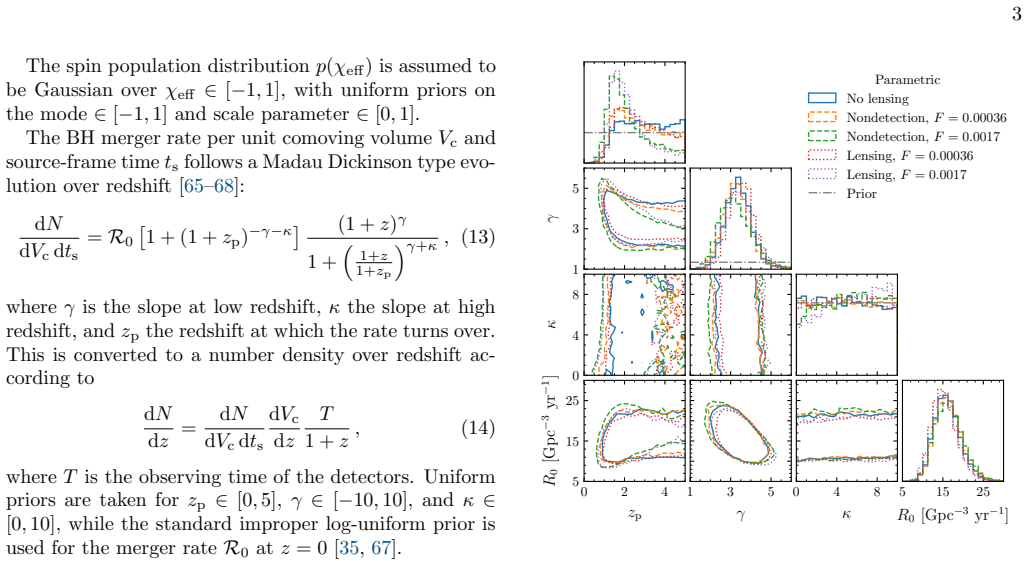
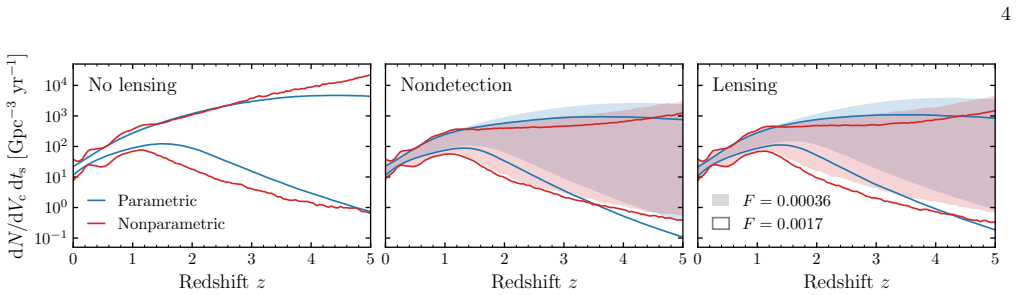
By performing a joint Bayesian analysis over per-event lensing status, magnification, and global population parameters, the method shows that strong lensing does not affect any catalog event at more than the 1 percent level. Population inferences therefore remain unchanged from standard nondetection analyses, yet the same framework yields a 10 percent reduction in uncertainty on the redshift at which the merger rate peaks and an order-of-magnitude improvement in high-redshift rate upper limits, all derived solely from resolved events.
What carries the argument
Joint Bayesian inference that couples per-event lensing probability and magnification with global population parameters, using both parametric and nonparametric merger-rate models together with two lensing optical depth prescriptions.
If this is right
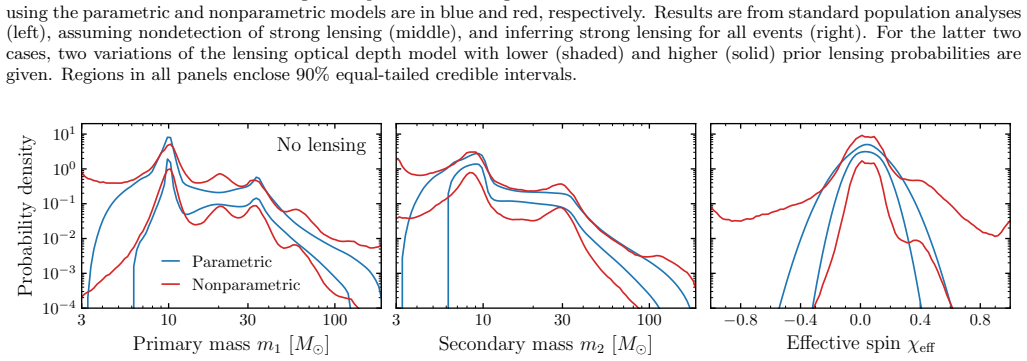
- Population constraints, including multiple mass subpopulations and a high-spin component, stay consistent with analyses that assume no lensing occurs.
- Uncertainty on the redshift at which the black-hole merger rate peaks shrinks by approximately 10 percent.
- Upper limits on the merger rate at high redshifts tighten by roughly an order of magnitude.
- These constraints reach redshifts at and beyond the peak of star formation using only currently resolved events.
Where Pith is reading between the lines
- The framework could be applied to future detector catalogs to extend rate measurements to still higher redshifts where lensing becomes more probable.
- If different optical depth models were adopted, the same joint method might assign higher lensing probabilities to some events and alter the high-redshift limits.
- The approach illustrates that resolved events alone can inform merger-rate behavior in regimes normally inaccessible without strong lensing.
Load-bearing premise
The chosen parametric and nonparametric population models plus the two lensing optical depth models are sufficient to capture all relevant physics.
What would settle it
An event whose posterior lensing probability exceeds a few percent under the same models, or a re-analysis in which the reported 10 percent and order-of-magnitude improvements disappear.
Figures
read the original abstract
Gravitational waves can be lensed by intervening potentials of various scales. Strong lensing leads to underestimated distances and overestimated masses, biasing astrophysical results if not accounted for. I present a novel analysis of the LIGO-Virgo-KAGRA catalog of binary black-hole mergers, simultaneously inferring (1) whether or not each event is strongly lensed, (2) their magnifications if so, and (3) the underlying merger population, using both parametric and nonparametric population models as well as two models for the lensing optical depth. Posterior lensing probabilities do not exceed 1% for any event, so population constraints are consistent with those assuming nondetection of strong lensing or that lensing never occurs. This includes multiple subpopulations over black-hole mass and a component with high aligned spins. Compared to standard analyses, however, there are reductions of order 10% in uncertainty on the redshift at which the merger rate peaks and an order of magnitude in high-redshift rate upper limits. Though modest, these are the first constraints using only resolved events at redshifts where current ground-based gravitational-wave detectors are usually insensitive, at and beyond the peak of star formation.
Editorial analysis
A structured set of objections, weighed in public.
Referee Report
Summary. The manuscript presents a joint Bayesian framework for analyzing the LVK binary black-hole catalog that simultaneously infers per-event strong-lensing probabilities and magnifications together with the underlying merger population, using both parametric and nonparametric population models and two lensing optical-depth prescriptions. The central results are that no event has a posterior lensing probability exceeding 1%, population posteriors remain consistent with standard no-lensing analyses (including multiple subpopulations and high-spin components), and modest gains appear in the uncertainty on the redshift of the merger-rate peak (~10% reduction) and in high-redshift rate upper limits (order-of-magnitude tightening).
Significance. If the results hold, the work supplies the first population-level constraints on black-hole merger rates at redshifts at and beyond the peak of star formation that are derived solely from resolved gravitational-wave events. The joint-inference approach is novel and the low lensing probabilities provide direct support for the robustness of existing LVK population analyses. The use of both parametric and nonparametric models plus two optical-depth prescriptions is a positive step toward robustness.
major comments (1)
- [§3 and §4] §4 (Results) and §3 (Methods): The headline claims that all posterior lensing probabilities remain below 1% and that the reported tightening of the peak-redshift uncertainty and high-z rate limits are obtained only after marginalizing over one specific pair of population models and exactly two optical-depth prescriptions. No sensitivity test to alternative population models (e.g., additional subpopulations or different mass-function parametrizations) or to a different strong-lensing cross-section scaling is presented; such a test is required because the central claim that population constraints are consistent with a no-lensing analysis rests on the sufficiency of these model families.
minor comments (2)
- [§2] The notation for the lensing optical depth and magnification priors should be made fully explicit in §2 so that readers can reproduce the exact functional forms used.
- [Figure captions] Figure captions for the posterior corner plots should state the exact prior ranges and the number of live points used in the nested sampling runs.
Simulated Author's Rebuttal
We thank the referee for their positive assessment and recommendation for minor revision. We respond to the single major comment below.
read point-by-point responses
-
Referee: [§3 and §4] §4 (Results) and §3 (Methods): The headline claims that all posterior lensing probabilities remain below 1% and that the reported tightening of the peak-redshift uncertainty and high-z rate limits are obtained only after marginalizing over one specific pair of population models and exactly two optical-depth prescriptions. No sensitivity test to alternative population models (e.g., additional subpopulations or different mass-function parametrizations) or to a different strong-lensing cross-section scaling is presented; such a test is required because the central claim that population constraints are consistent with a no-lensing analysis rests on the sufficiency of these model families.
Authors: The nonparametric population model is constructed to be highly flexible, allowing it to capture additional subpopulations, varied mass-function shapes, and rate evolution without being restricted to a fixed parametric form; results are shown to be consistent between the parametric and nonparametric cases. The two optical-depth prescriptions are the dominant choices in the literature. We will add explicit discussion in §§3–4 on the representativeness of these choices and why they suffice to support the consistency claim with no-lensing analyses. revision: yes
Circularity Check
No significant circularity detected
full rationale
The paper performs a joint Bayesian inference using external LVK catalog events, parametric/nonparametric population models, and two standard lensing optical-depth prescriptions. No derivation step reduces by construction to its inputs, no fitted parameter is relabeled as a prediction, and no load-bearing premise rests on self-citation chains. The central results (posterior lensing probabilities <1% and modest tightening of rate constraints) follow directly from marginalization over the chosen models applied to independent data, satisfying the criteria for a self-contained analysis against external benchmarks.
Axiom & Free-Parameter Ledger
Reference graph
Works this paper leans on
-
[1]
are the source (apparent detector-frame) primary and secondary masses. Lensing nondetection—Given that targeted strong lensing searches find no significant detections [9], a rea- sonable assumption is instead thatL i = 0 and thus µi = 1 for each eventi= 1, ..., N obs. The likelihood in this case isL l({µi = 1, Li = 0}Nobs i=1 ,Λ). No lensing—Results are a...
-
[2]
Schneider, J
P. Schneider, J. Ehlers, and E. E. Falco,Gravitational Lenses, Astronomy and Astrophysics Library (Springer, New York, 1992)
1992
-
[3]
T. Treu, Ann. Rev. Astron. Astrophys.48, 87 (2010), arXiv:1003.5567 [astro-ph.CO]
work page internal anchor Pith review Pith/arXiv arXiv 2010
-
[4]
A. G. Abacet al.(LIGO Scientific Collaboration, Virgo Collaboration, and KAGRA Collaboration), Astrophys. J. Lett.995, L18 (2025), arXiv:2508.18080 [gr-qc]
work page internal anchor Pith review Pith/arXiv arXiv 2025
-
[5]
J. Aasiet al.(LIGO Scientific Collaboration), Class. Quantum Grav.32, 074001 (2015), arXiv:1411.4547 [gr- qc]
work page internal anchor Pith review Pith/arXiv arXiv 2015
-
[6]
Advanced Virgo: a 2nd generation interferometric gravitational wave detector
F. Acerneseet al., Class. Quantum Grav.32, 024001 (2015), arXiv:1408.3978 [gr-qc]
work page internal anchor Pith review Pith/arXiv arXiv 2015
-
[7]
Akutsuet al.(KAGRA Collaboration), Prog
T. Akutsuet al.(KAGRA Collaboration), Prog. Theor. Exp. Phys.2021, 05A101 (2021), arXiv:2005.05574 [physics.ins-det]
-
[8]
LIGO Scientific Collaboration, Virgo Collaboration, and KAGRA Collaboration, arXiv:2605.27225 [gr-qc] (2026)
work page internal anchor Pith review Pith/arXiv arXiv 2026
-
[9]
A. G. Abacet al.(LIGO Scientific Collaboration, Virgo Collaboration, and KAGRA Collaboration), arXiv:2508.18082 [gr-qc] (2025)
work page internal anchor Pith review Pith/arXiv arXiv 2025
- [10]
-
[11]
K. K. Y. Ng, K. W. K. Wong, T. Broadhurst, and T. G. F. Li, Phys. Rev. D97, 023012 (2018), arXiv:1703.06319 [astro-ph.CO]
work page internal anchor Pith review Pith/arXiv arXiv 2018
-
[12]
G. P. Smith, M. Jauzac, J. Veitch, W. M. Farr, R. Massey, and J. Richard, Mon. Not. Roy. Astron. Soc. 475, 3823 (2018), arXiv:1707.03412 [astro-ph.HE]
work page internal anchor Pith review Pith/arXiv arXiv 2018
-
[13]
R. Buscicchio, C. J. Moore, G. Pratten, P. Schmidt, and A. Vecchio, Phys. Rev. D102, 081501 (2020), arXiv:2008.12621 [astro-ph.HE]
-
[14]
A. G. Abacet al.(LIGO Scientific Collaboration, Virgo Collaboration, and KAGRA Collaboration), As- trophys. J. Lett.993, L25 (2025), arXiv:2507.08219 [astro-ph.HE]
work page internal anchor Pith review Pith/arXiv arXiv 2025
- [15]
-
[16]
A. Jan, S. Nicolella, D. Shoemaker, and R. O’Shaughnessy, Phys. Rev. D113, 084052 (2026), arXiv:2512.20060 [gr-qc]
work page internal anchor Pith review Pith/arXiv arXiv 2026
-
[17]
Q. Hu, H. Narola, J. Heynen, M. Wright, J. Veitch, J. Janquart, and C. Van Den Broeck, Astrophys. J. 1003, 187 (2026), arXiv:2512.17550 [gr-qc]
work page internal anchor Pith review Pith/arXiv arXiv 2026
-
[18]
Assessing the imprint of eccentricity in GW signatures using two independent waveform models
N. Malagon and R. O’Shaughnessy, arXiv:2605.12818 [astro-ph.HE] (2026)
work page internal anchor Pith review Pith/arXiv arXiv 2026
-
[19]
GW231123: False Massive Graviton Signatures from Unmodeled Point-Mass Lensing
B. Wang and T. Yang, arXiv:2604.08179 [gr-qc] (2026)
work page internal anchor Pith review Pith/arXiv arXiv 2026
-
[20]
K. Chandra, J. Fernandes, A. Mittal, and G. Carullo, arXiv:2606.15150 [gr-qc] (2026)
- [21]
-
[22]
X. Shan, H. Yang, S. Mao, and O. A. Hannuksela, As- trophys. J.1004, 35 (2026), arXiv:2508.21262 [astro- ph.CO]
work page internal anchor Pith review Pith/arXiv arXiv 2026
- [23]
- [24]
-
[25]
A. Chakraborty and S. Mukherjee, Astrophys. J.1003, 20 (2026), arXiv:2512.19077 [gr-qc]
work page internal anchor Pith review Pith/arXiv arXiv 2026
- [26]
-
[27]
BB plot: A Tool for Accurate Model Selection Using Bayes factors
A. Barsode, arXiv:2605.10333 [gr-qc] (2026)
work page internal anchor Pith review Pith/arXiv arXiv 2026
-
[28]
A. Liu, M. Wright, J. Heynen, E. Seo, I. C. F. Wong, D. Hegde, L. E. Uronen, H. Narola, M. Hendry, T. G. F. Li, O. A. Hannuksela, and J. Janquart (2026)
2026
-
[29]
S. Bini, K. Kr´ ol, K. Chatziioannou, and M. Isi, Phys. Rev. D113, 083036 (2026), arXiv:2601.09678 [gr-qc]
work page internal anchor Pith review Pith/arXiv arXiv 2026
- [30]
- [31]
- [32]
-
[33]
R. Buscicchio, C. J. Moore, G. Pratten, P. Schmidt, M. Bianconi, and A. Vecchio, Phys. Rev. Lett.125, 141102 (2020), arXiv:2006.04516 [astro-ph.CO]
-
[34]
S. Mukherjee, T. Broadhurst, J. M. Diego, J. Silk, and G. F. Smoot, Mon. Not. Roy. Astron. Soc.501, 2451 (2021), arXiv:2006.03064 [astro-ph.CO]
-
[35]
S.-S. Li, S. Mao, Y. Zhao, and Y. Lu, Mon. Not. Roy. Astron. Soc.476, 2220 (2018), arXiv:1802.05089 [astro- ph.CO]
work page internal anchor Pith review Pith/arXiv arXiv 2018
-
[36]
A. G. Abacet al.(LIGO Scientific Collaboration, Virgo Collaboration, and KAGRA Collaboration), arXiv:2508.18083 [astro-ph.HE] (2025)
work page internal anchor Pith review Pith/arXiv arXiv 2025
-
[37]
LIGO Scientific Collaboration, Virgo Collaboration, and KAGRA Collaboration, arXiv:2605.27226 [astro- ph.HE] (2026)
work page internal anchor Pith review Pith/arXiv arXiv 2026
-
[38]
Abbottet al.(LIGO Scientific Collaboration and Virgo Collaboration), Astrophys
R. Abbottet al.(LIGO Scientific Collaboration and Virgo Collaboration), Astrophys. J. Lett.900, L13 (2020), arXiv:2009.01190 [astro-ph.HE]
- [39]
- [40]
- [41]
-
[42]
Considering lensing effect on gravitational wave signals from black holes in mass gap
Q. Yang, Z.-Q. You, and X. Fan, arXiv:2512.20890 [astro-ph.HE] (2025)
work page internal anchor Pith review Pith/arXiv arXiv 2025
-
[43]
Identifying strongly lensed gravitational wave signals from binary black hole mergers
K. Haris, A. K. Mehta, S. Kumar, T. Venumadhav, and P. Ajith, arXiv:1807.07062 [gr-qc] (2018)
work page internal anchor Pith review Pith/arXiv arXiv 2018
-
[44]
O. A. Hannuksela, K. Haris, K. K. Y. Ng, S. Kumar, A. K. Mehta, D. Keitel, T. G. F. Li, and P. Ajith, Astro- phys. J. Lett.874, L2 (2019), arXiv:1901.02674 [gr-qc]
work page internal anchor Pith review Pith/arXiv arXiv 2019
-
[45]
E. L. Turner, J. P. Ostriker, and J. R. Gott, III, Astro- phys. J.284, 1 (1984)
1984
-
[46]
E. Thrane and C. Talbot, Publ. Astron. Soc. Aust.36, e010 (2019), arXiv:1809.02293 [astro-ph.IM]
-
[47]
Inference with finite time series II: the window strikes back
C. Talbotet al., Class. Quantum Grav.42, 235023 (2025), arXiv:2508.11091 [gr-qc]
work page internal anchor Pith review Pith/arXiv arXiv 2025
-
[48]
T. J. Loredo, AIP Conf. Proc.735, 195 (2004), arXiv:astro-ph/0409387
work page internal anchor Pith review Pith/arXiv arXiv 2004
-
[49]
S. R. Taylor and D. Gerosa, Phys. Rev. D98, 083017 (2018), arXiv:1806.08365 [astro-ph.HE]
work page internal anchor Pith review Pith/arXiv arXiv 2018
-
[50]
Extracting distribution parameters from multiple uncertain observations with selection biases
I. Mandel, W. M. Farr, and J. R. Gair, Mon. Not. R. Astron. Soc.486, 1086 (2019), arXiv:1809.02063 [physics.data-an]
work page internal anchor Pith review Pith/arXiv arXiv 2019
-
[51]
Inferring the properties of a population of compact binaries in presence of selection effects
S. Vitale, D. Gerosa, W. M. Farr, and S. R. Taylor, in Handbook of Gravitational Wave Astronomy(Springer, Singapore, 2022) pp. 1709–1768, arXiv:2007.05579 [astro-ph.IM]
work page internal anchor Pith review Pith/arXiv arXiv 2022
-
[52]
G. Ashton, RAS Tech. Instrum.5, rzag012 (2026), arXiv:2510.11197 [gr-qc]
-
[53]
V. Tiwari, Class. Quantum Grav.35, 145009 (2018), arXiv:1712.00482 [astro-ph.HE]
work page internal anchor Pith review Pith/arXiv arXiv 2018
-
[54]
A. G. Abacet al.(LIGO Scientific Collaboration, Virgo Collaboration, and KAGRA Collaboration), arXiv:2508.18079 [gr-qc] (2025)
work page internal anchor Pith review Pith/arXiv arXiv 2025
-
[55]
Gravitational-wave astronomy requires population-informed parameter estimation
M. Mould, R. Tenorio, and D. Gerosa, arXiv:2604.15885 [gr-qc] (2026)
work page internal anchor Pith review Pith/arXiv arXiv 2026
-
[56]
R. Essicket al., Phys. Rev. D112, 102001 (2025), arXiv:2508.10638 [gr-qc]
-
[57]
W. M. Farr, Res. Notes Am. Astron. Soc.3, 66 (2019), arXiv:1904.10879 [astro-ph.IM]
work page internal anchor Pith review Pith/arXiv arXiv 2019
- [58]
-
[59]
C. Talbot and J. Golomb, Mon. Not. R. Astron. Soc. 526, 3495 (2023), arXiv:2304.06138 [astro-ph.IM]
- [60]
- [61]
-
[62]
Abbottet al.(LIGO Scientific Collaboration and Virgo Collaboration), Astrophys
R. Abbottet al.(LIGO Scientific Collaboration and Virgo Collaboration), Astrophys. J. Lett.913, L7 (2021), arXiv:2010.14533 [astro-ph.HE]
-
[63]
The population of merging compact binaries inferred using gravitational waves through GWTC-3
R. Abbottet al.(LIGO Scientific Collaboration, Virgo Collaboration, and KAGRA Collaboration), Phys. Rev. X13, 011048 (2023), arXiv:2111.03634 [astro-ph.HE]
work page internal anchor Pith review Pith/arXiv arXiv 2023
-
[64]
Analysis of spin precession in binary black hole systems including quadrupole-monopole interaction
E. Racine, Phys. Rev. D78, 044021 (2008), arXiv:0803.1820 [gr-qc]
work page internal anchor Pith review Pith/arXiv arXiv 2008
-
[65]
Measurement prospects for the pair-instability mass cutoff with gravitational waves
M. Mould, J. Heinzel, S. Alvarez-Lopez, C. Plunkett, N. E. Wolfe, and S. Vitale, Phys. Rev. D113, 103021 (2026), arXiv:2602.11282 [astro-ph.HE]
work page internal anchor Pith review Pith/arXiv arXiv 2026
-
[66]
2014, ARA&A, 52, 415, doi: 10.1146/annurev-astro-081811-125615
P. Madau and M. Dickinson, Ann. Rev. Astron. Astro- phys.52, 415 (2014), arXiv:1403.0007 [astro-ph.CO]
work page internal anchor Pith review Pith/arXiv arXiv 2014
-
[67]
Radiation Backgrounds at Cosmic Dawn: X-Rays from Compact Binaries
P. Madau and T. Fragos, Astrophys. J.840, 39 (2017), arXiv:1606.07887 [astro-ph.GA]
work page internal anchor Pith review Pith/arXiv arXiv 2017
-
[68]
Does the Black Hole Merger Rate Evolve with Redshift?
M. Fishbach, D. E. Holz, and W. M. Farr, Astrophys. J. Lett.863, L41 (2018), arXiv:1805.10270 [astro-ph.HE]
work page internal anchor Pith review Pith/arXiv arXiv 2018
-
[69]
T. Callister, M. Fishbach, D. Holz, and W. Farr, Astro- phys. J. Lett.896, L32 (2020), arXiv:2003.12152 [astro- ph.HE]
-
[70]
Besag, Journal of the Royal Statistical Society
J. Besag, Journal of the Royal Statistical Society. Series B (Methodological)36, 192 (1974)
1974
-
[71]
Besag and C
J. Besag and C. Kooperberg, Biometrika82, 733 (1995)
1995
-
[72]
J. Heinzel, M. Mould, S. ´Alvarez-L´ opez, and S. Vitale, Phys. Rev. D111, 063043 (2025), arXiv:2406.16813 [astro-ph.HE]. 7
-
[73]
J. Heinzel, M. Mould, and S. Vitale, Phys. Rev. D111, L061305 (2025), arXiv:2406.16844 [astro-ph.HE]
-
[74]
S. Alvarez-Lopez, J. Heinzel, M. Mould, and S. Vitale, arXiv:2506.20731 [astro-ph.HE] (2025)
-
[75]
Jeffreys,The Theory of Probability(Oxford Univer- sity Press, Oxford, 1939)
H. Jeffreys,The Theory of Probability(Oxford Univer- sity Press, Oxford, 1939)
1939
-
[76]
Jeffreys, Proceedings of the Royal Society of London
H. Jeffreys, Proceedings of the Royal Society of London. A. Mathematical and Physical Sciences186, 453 (1946)
1946
-
[77]
Gelman, J
A. Gelman, J. B. Carlin, H. S. Stern, and D. B. Rubin, Bayesian data analysis(Chapman and Hall/CRC, New York, 1995)
1995
-
[78]
https://github.com/mdmould/gwax
-
[79]
https://github.com/pyro-ppl/numpyro
-
[80]
https://github.com/jax-ml/jax
discussion (0)
Sign in with ORCID, Apple, or X to comment. Anyone can read and Pith papers without signing in.