Recognition: 2 theorem links
· Lean TheoremCOOL-LAMPS IX: A Rare Duo of Quasars Each Lensed by a Single Massive Galaxy Cluster
Pith reviewed 2026-05-14 18:08 UTC · model grok-4.3
The pith
One galaxy cluster lenses two background quasars, each into four images.
A machine-rendered reading of the paper's core claim, the machinery that carries it, and where it could break.
Core claim
COOLJ1153+0755 features two multiply-imaged quasars, a broad-line Type I at z=1.524 and a dust-obscured Type II at z=1.939, each split into four images by the same z=0.4301 cluster, with a simple lens model recovering a projected mass M(<500 kpc) ~ 3.3 x 10^14 solar masses and relative time delays of hundreds to over one thousand days.
What carries the argument
A simple lens model that recovers the cluster's projected mass and the relative time delays between images of each quasar from the observed image positions and redshifts.
If this is right
- The known wide-separation lensed quasar sample grows from seven to eight systems containing nine quasars.
- The system supplies two new laboratories for probing black hole-galaxy co-evolution at Cosmic Noon.
- Relative time delays of hundreds to over a thousand days enable time-delay cosmography constraints on the Hubble constant.
- The system was found without a morphological cut, showing that point-source selections miss such configurations.
Where Pith is reading between the lines
- Future wide-field surveys may uncover additional dual-quasar systems by relaxing point-source morphology requirements.
- The dense galaxy environment around the Type I quasar, including two other strongly lensed galaxies, offers a test bed for environmental influences on quasar activity.
- Repeated imaging of the predicted time delays could independently verify the lens model and the cluster mass estimate.
Load-bearing premise
The images identified in imaging and confirmed by spectroscopy all belong to single background quasars at the quoted redshifts, and the lens model accurately recovers the cluster mass and time delays without major contamination or misidentification.
What would settle it
New spectroscopy or monitoring that shows the candidate images of either quasar have inconsistent redshifts or measured time delays that differ substantially from the model's predictions of 800 to 1200 days.
Figures







read the original abstract
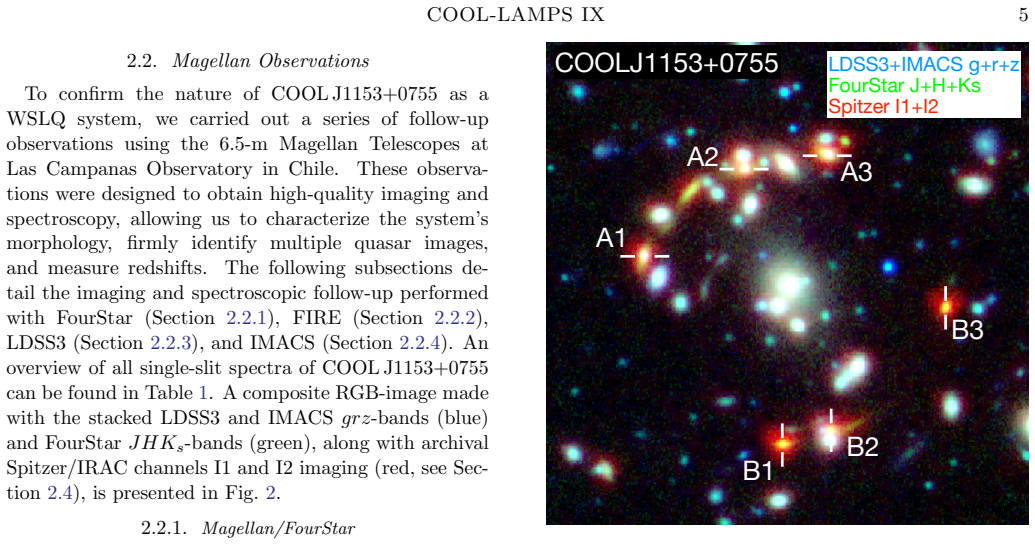
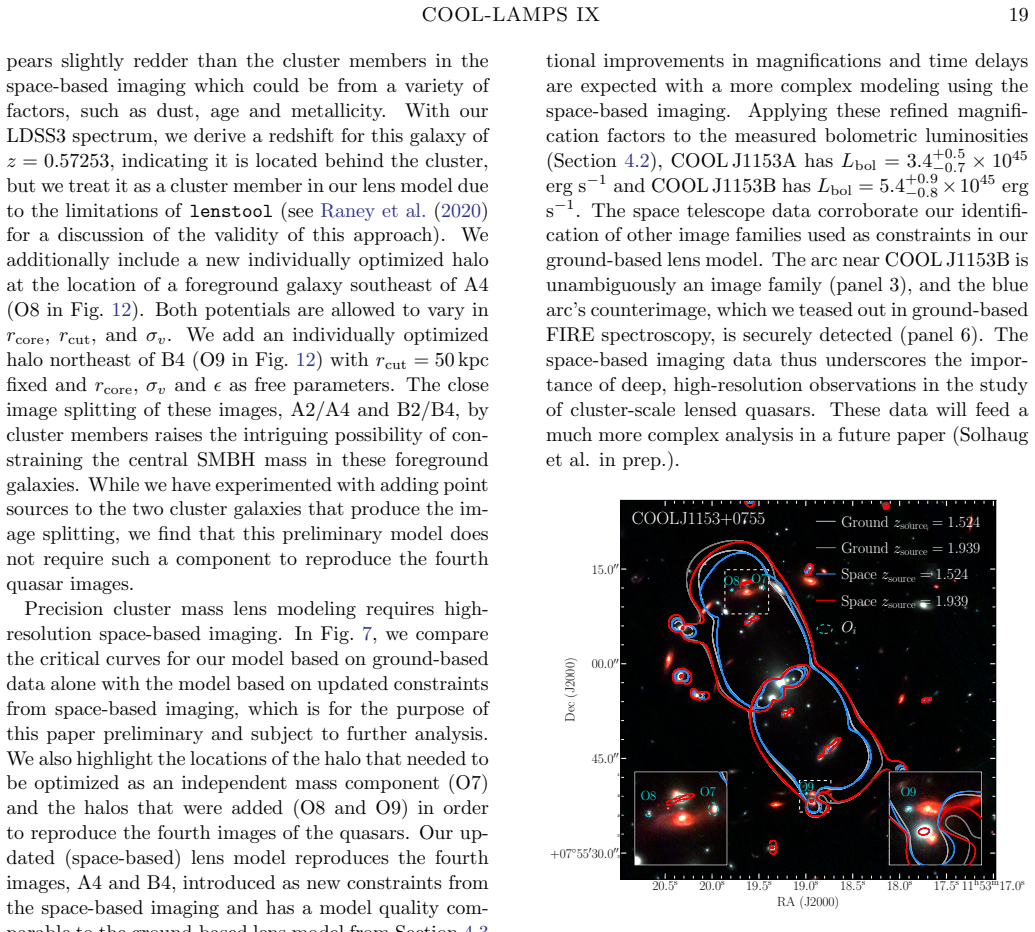
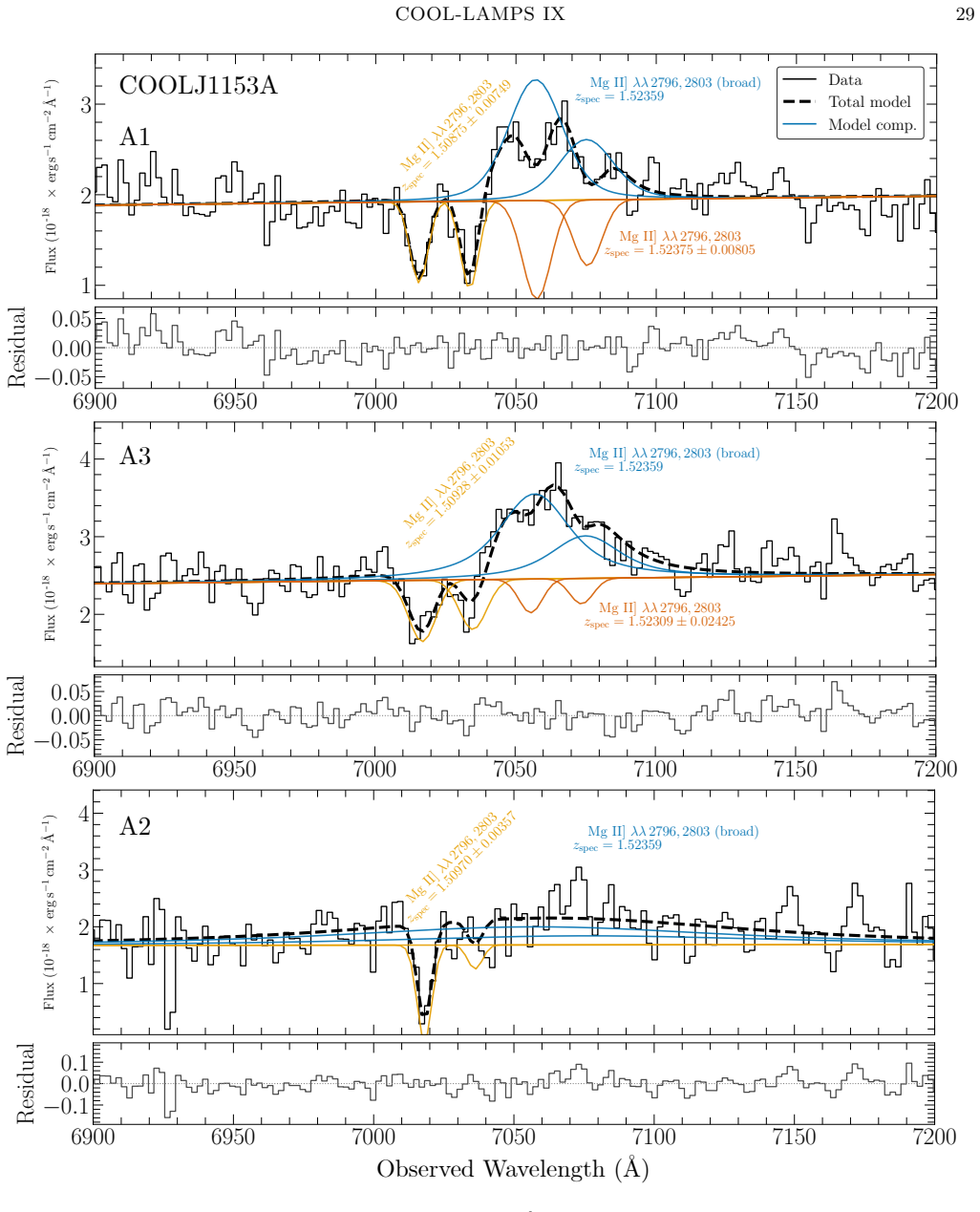
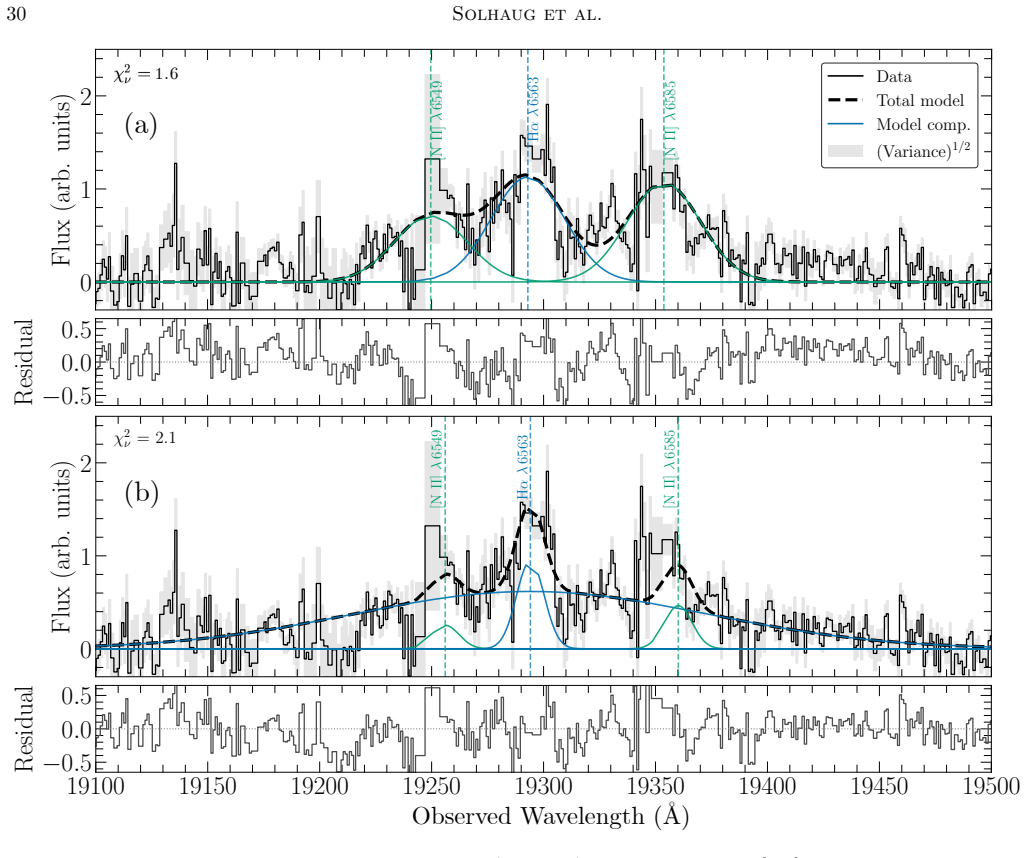
Wide-separation lensed quasars (WSLQs) are rare systems that arise from the chance alignment of two objects: a galaxy cluster and a background quasar. After two decades, only seven WSLQs have been found. Here, we report the discovery of COOLJ1153+0755 by the COOL-LAMPS collaboration in DECaLS imaging and its confirmation with follow-up observations with the Magellan Telescopes and the Nordic Optical Telescope. This system features two multiply-imaged quasars each lensed into four images by the same $z=0.4301$ cluster: a classic broad-line Type I quasar at $z=1.524$ (COOLJ1153A) and a dust-obscured Type II quasar at $z=1.939$ (COOLJ1153B), with maximum image separations of $25.''6$ and $26.''0$, respectively. We construct a lens model to estimate a projected cluster mass of $M(<500\,{\rm kpc})\sim3.3\times10^{14}{\rm M}_{\odot}$ and relative time delays between the three brightest images of each quasar of $\Delta t_{\rm \,A3,A1}\sim800$, $\Delta t_{\rm \,A2,A1}\sim1200$, $\Delta t_{\rm \,B1,B3}\sim800$, and $\Delta t_{\rm \,B2,B3}\sim1000$ days. COOLJ1153A resides in a dense environment with three nearby galaxies, two of which are also strongly lensed. We identify COOLJ1153+0755 without making a morphological cut in the DECaLS catalog; none of its multiple images are classified as point sources in those data, implying that morphology-based selection would miss such systems. COOLJ1153+0755 expands the WSLQ sample from 7 to 8 systems (9 individual quasars), adding two powerful laboratories for probing black hole-galaxy co-evolution at Cosmic Noon and for time-delay cosmography constraints on the Hubble constant, $H_0$.
Editorial analysis
A structured set of objections, weighed in public.
Referee Report
Summary. The manuscript reports the discovery of COOLJ1153+0755, a wide-separation lensed quasar system in which a single z=0.4301 galaxy cluster lenses two background quasars into four images each: a broad-line Type I quasar (COOLJ1153A) at z=1.524 with maximum image separation 25.6 arcsec and a dust-obscured Type II quasar (COOLJ1153B) at z=1.939 with 26.0 arcsec separation. DECaLS imaging plus Magellan and NOT spectroscopy confirm the redshifts and image identifications; a simple lens model then yields a projected cluster mass M(<500 kpc) ~ 3.3e14 Msun and relative time delays of order 800-1200 days among the brightest images of each quasar. The system is presented as the eighth known WSLQ, notable for containing both Type I and Type II quasars and for residing in a dense environment with additional strongly lensed galaxies.
Significance. If the image identifications and lens model hold, the discovery expands the rare sample of wide-separation lensed quasars from seven to eight systems and supplies two new laboratories for black-hole/galaxy co-evolution studies at Cosmic Noon plus time-delay cosmography. The spectroscopic confirmation of both redshifts and the morphological independence of the selection (no point-source cut required) are clear strengths that strengthen the observational foundation.
major comments (1)
- [Lens modeling section] Lens modeling section (description of mass and time-delay estimates): the simple lens model used to derive M(<500 kpc) ~ 3.3e14 Msun and the quoted time delays (Δt_A3,A1 ~800 d, Δt_A2,A1 ~1200 d, Δt_B1,B3 ~800 d, Δt_B2,B3 ~1000 d) does not include the three nearby galaxies around COOLJ1153A (two of which are themselves strongly lensed) as perturbers. For 25-arcsec image splittings, these local mass components can change the potential and predicted delays by tens of percent; an explicit test of their inclusion or a quantified uncertainty budget on the time delays is required before the cosmography utility can be claimed.
minor comments (2)
- [Abstract] Abstract: the phrase 'none of its multiple images are classified as point sources' is slightly ambiguous; clarify whether this refers to the DECaLS catalog classification of the individual images or to the system as a whole.
- [System description] The text states that COOLJ1153A 'resides in a dense environment with three nearby galaxies, two of which are also strongly lensed,' but does not specify whether these galaxies were used in the lens model or only noted for context; a short sentence linking the two would improve clarity.
Simulated Author's Rebuttal
We thank the referee for their positive summary and constructive comment. We address the major comment below and will revise the manuscript to strengthen the lens modeling discussion.
read point-by-point responses
-
Referee: [Lens modeling section] Lens modeling section (description of mass and time-delay estimates): the simple lens model used to derive M(<500 kpc) ~ 3.3e14 Msun and the quoted time delays (Δt_A3,A1 ~800 d, Δt_A2,A1 ~1200 d, Δt_B1,B3 ~800 d, Δt_B2,B3 ~1000 d) does not include the three nearby galaxies around COOLJ1153A (two of which are themselves strongly lensed) as perturbers. For 25-arcsec image splittings, these local mass components can change the potential and predicted delays by tens of percent; an explicit test of their inclusion or a quantified uncertainty budget on the time delays is required before the cosmography utility can be claimed.
Authors: We agree that the three nearby galaxies represent local perturbers whose inclusion could affect the predicted time delays at the tens-of-percent level, particularly given the large image separations. Our current model is a deliberately simple cluster-scale representation intended to provide initial mass and delay estimates, as stated in the manuscript. In the revised version we will add an explicit test that incorporates these galaxies (using their observed positions and photometric mass estimates) as additional components in the lens model. We will report the resulting shifts in the time delays and include a quantified uncertainty budget on the delays to better support the potential cosmography applications. revision: yes
Circularity Check
No significant circularity: purely observational discovery with standard lens modeling
full rationale
The paper reports an observational discovery of two lensed quasars via DECaLS imaging and spectroscopic confirmation, followed by a standard lens model that fits observed image positions to estimate cluster mass and time delays. No derivation step reduces to self-definition, fitted inputs renamed as predictions, or load-bearing self-citations. The lens model is a conventional parametric fit to data and does not claim to derive new results from prior self-citations in a circular manner. The central claims rest on direct observations and standard modeling techniques that remain independent of the fitted outputs.
Axiom & Free-Parameter Ledger
free parameters (1)
- projected cluster mass within 500 kpc
axioms (1)
- domain assumption Standard thin-lens gravitational lensing formalism applies to the observed image configurations.
Lean theorems connected to this paper
-
IndisputableMonolith/Cost/FunctionalEquation.leanwashburn_uniqueness_aczel unclear?
unclearRelation between the paper passage and the cited Recognition theorem.
We construct a lens model to estimate a projected cluster mass of M(<500 kpc)∼3.3×10^14 M⊙ and relative time delays ... Δt A3,A1 ∼800, Δt A2,A1 ∼1200 ...
-
IndisputableMonolith/Foundation/RealityFromDistinction.leanreality_from_one_distinction unclear?
unclearRelation between the paper passage and the cited Recognition theorem.
Throughout this paper, we assume a flat cosmology with H0=70 km s−1 Mpc−1, ΩM=0.3, and ΩΛ=0.7.
What do these tags mean?
- matches
- The paper's claim is directly supported by a theorem in the formal canon.
- supports
- The theorem supports part of the paper's argument, but the paper may add assumptions or extra steps.
- extends
- The paper goes beyond the formal theorem; the theorem is a base layer rather than the whole result.
- uses
- The paper appears to rely on the theorem as machinery.
- contradicts
- The paper's claim conflicts with a theorem or certificate in the canon.
- unclear
- Pith found a possible connection, but the passage is too broad, indirect, or ambiguous to say the theorem truly supports the claim.
Reference graph
Works this paper leans on
-
[1]
The Astropy Project: Building an inclusive, open-science project and status of the v2.0 core package
The Astropy Project: Building an Open-science Project and Status of the v2.0 Core Package. , keywords =. doi:10.3847/1538-3881/aabc4f , archivePrefix =. 1801.02634 , primaryClass =
work page internal anchor Pith review Pith/arXiv arXiv doi:10.3847/1538-3881/aabc4f
-
[4]
Quantifying the Observational Effort Required for the Radial Velocity Characterization of TESS Planets. , keywords =. 2018. doi:10.3847/1538-3881/aacea9 , archivePrefix =. 1807.01263 , primaryClass =
work page internal anchor Pith review Pith/arXiv arXiv doi:10.3847/1538-3881/aacea9 2018
-
[5]
X-Ray Scattering Echoes and Ghost Halos from the Intergalactic Medium: Relation to the Nature of AGN Variability. , keywords =. 2015. doi:10.1088/0004-637X/805/1/23 , archivePrefix =. 1503.01475 , primaryClass =
work page internal anchor Pith review Pith/arXiv arXiv doi:10.1088/0004-637x/805/1/23 2015
-
[6]
, keywords =
The 2013 Release of Cloudy. , keywords =. 2013
2013
-
[7]
1989", month =
T _ E X and LAT _ E X Macro Definition Files for Astronomical Publications. , year = "1989", month = "Mar", pages =
1989
-
[8]
LaTeX: A Document Preparation System. 1994
1994
-
[9]
Quasi-periodic Fast Propagating Magnetoacoustic Waves during the Magnetic Reconnection Between Solar Coronal Loops. , keywords =. 2018. doi:10.3847/2041-8213/aaf167 , archivePrefix =. 1811.08553 , primaryClass =
work page internal anchor Pith review Pith/arXiv arXiv doi:10.3847/2041-8213/aaf167 2018
-
[10]
Nominal values for selected solar and planetary quantities: IAU 2015 Resolution B3
Nominal Values for Selected Solar and Planetary Quantities: IAU 2015 Resolution B3. , keywords =. 2016. doi:10.3847/0004-6256/152/2/41 , archivePrefix =. 1605.09788 , primaryClass =
work page internal anchor Pith review Pith/arXiv arXiv doi:10.3847/0004-6256/152/2/41 2015
-
[11]
Swift X-Ray Observations of Classical Novae. II. The Super Soft Source Sample. , keywords =. 2011. doi:10.1088/0067-0049/197/2/31 , archivePrefix =. 1110.6224 , primaryClass =
work page internal anchor Pith review Pith/arXiv arXiv doi:10.1088/0067-0049/197/2/31 2011
-
[12]
Galaxy emission line classification using 3D line ratio diagrams
Galaxy Emission Line Classification Using Three-dimensional Line Ratio Diagrams. , keywords =. 2014. doi:10.1088/0004-637X/793/2/127 , archivePrefix =. 1406.5186 , primaryClass =
work page internal anchor Pith review Pith/arXiv arXiv doi:10.1088/0004-637x/793/2/127 2014
-
[13]
A Bayesian approach to strong lensing modelling of galaxy clusters
A Bayesian approach to strong lensing modelling of galaxy clusters. New Journal of Physics , keywords =. doi:10.1088/1367-2630/9/12/447 , archivePrefix =. 0706.0048 , primaryClass =
work page internal anchor Pith review Pith/arXiv arXiv doi:10.1088/1367-2630/9/12/447
-
[14]
Absorption by Highly Ionized Interstellar Gas Along Extragalactic and Galactic Sight Lines. , keywords =. doi:10.1086/118427 , adsurl =
-
[15]
A New Method For Galaxy Cluster Detection. I. The Algorithm. , keywords =. doi:10.1086/301557 , archivePrefix =. astro-ph/0004092 , primaryClass =
work page internal anchor Pith review Pith/arXiv arXiv doi:10.1086/301557
-
[16]
CIGALE: a python Code Investigating GALaxy Emission
CIGALE: a python Code Investigating GALaxy Emission. , keywords =. doi:10.1051/0004-6361/201834156 , archivePrefix =. 1811.03094 , primaryClass =
work page internal anchor Pith review Pith/arXiv arXiv doi:10.1051/0004-6361/201834156
-
[17]
Instrumentation in astronomy VI , year = 1986, editor =
The IRAF Data Reduction and Analysis System. Instrumentation in astronomy VI , year = 1986, editor =. doi:10.1117/12.968154 , adsurl =
-
[18]
Astronomical Data Analysis Software and Systems II , year = 1993, editor =
IRAF in the Nineties. Astronomical Data Analysis Software and Systems II , year = 1993, editor =
1993
-
[19]
The Dust Content and Opacity of Actively Star-forming Galaxies. , keywords =. doi:10.1086/308692 , archivePrefix =. astro-ph/9911459 , primaryClass =
work page internal anchor Pith review Pith/arXiv arXiv doi:10.1086/308692
-
[20]
A Two-parameter Model for the Infrared/Submillimeter/Radio Spectral Energy Distributions of Galaxies and Active Galactic Nuclei. , keywords =. doi:10.1088/0004-637X/784/1/83 , archivePrefix =. 1402.1495 , primaryClass =
work page internal anchor Pith review Pith/arXiv arXiv doi:10.1088/0004-637x/784/1/83
-
[21]
, archivePrefix = "arXiv", eprint =
3D radiative transfer modelling of the dusty tori around active galactic nuclei as a clumpy two-phase medium. , keywords =. doi:10.1111/j.1365-2966.2011.19775.x , archivePrefix =. 1109.1286 , primaryClass =
-
[22]
The dust covering factor in active galactic nuclei
The dust covering factor in active galactic nuclei. , keywords =. doi:10.1093/mnras/stw444 , archivePrefix =. 1602.06954 , primaryClass =
work page internal anchor Pith review Pith/arXiv arXiv doi:10.1093/mnras/stw444
-
[23]
Physics of the Interstellar and Intergalactic Medium
-
[24]
The host galaxies of active galactic nuclei. , keywords =. doi:10.1111/j.1365-2966.2003.07154.x , archivePrefix =. astro-ph/0304239 , primaryClass =
-
[25]
Classification parameters for the emission-line spectra of extragalactic objects. , keywords =. doi:10.1086/130766 , adsurl =
-
[26]
COOL-LAMPS. Discovery of COOL J0335-1927, a Gravitationally Lensed Quasar at z = 3.27 with an Image Separation of 23.″3. , keywords =. 2023a , month = sep, volume =. doi:10.3847/2041-8213/acf132 , archivePrefix =. 2305.14317 , primaryClass =
-
[27]
SDSS J1029+2623: A Gravitationally Lensed Quasar with an Image Separation of 22.5 Arcseconds
SDSS J1029+2623: A Gravitationally Lensed Quasar with an Image Separation of 22.5''. , keywords =. doi:10.1086/510671 , archivePrefix =. astro-ph/0611275 , primaryClass =
work page internal anchor Pith review Pith/arXiv arXiv doi:10.1086/510671
-
[28]
SDSS J2222+2745: A Gravitationally Lensed Sextuple Quasar with a Maximum Image Separation of 15.''1 Discovered in the Sloan Giant Arcs Survey. , keywords =. doi:10.1088/0004-637X/773/2/146 , archivePrefix =. 1211.1091 , primaryClass =
work page internal anchor Pith review Pith/arXiv arXiv doi:10.1088/0004-637x/773/2/146
-
[29]
A Gravitationally Lensed Quasar with Quadruple Images Separated by 14.62 Arcseconds
A gravitationally lensed quasar with quadruple images separated by 14.62arcseconds. , keywords =. doi:10.1038/nature02153 , archivePrefix =. astro-ph/0312427 , primaryClass =
work page internal anchor Pith review Pith/arXiv arXiv doi:10.1038/nature02153
-
[30]
SDSS J0909$+$4449: A Large-separation Strongly Lensed Quasar at $z \sim 2.8$ with Three Images
SDSS J0909+4449: A large-separation strongly lensed quasar at z 2.8 with three images. , keywords =. doi:10.1093/mnrasl/sly174 , archivePrefix =. 1809.07337 , primaryClass =
work page internal anchor Pith review Pith/arXiv arXiv doi:10.1093/mnrasl/sly174
-
[31]
Catalogues of active galactic nuclei from Gaia and unWISE data. , keywords =. doi:10.1093/mnras/stz2487 , archivePrefix =. 1909.02010 , primaryClass =
-
[32]
COOL-LAMPS. III. Discovery of a 25.″9 Separation Quasar Lensed by a Merging Galaxy Cluster. , keywords =. doi:10.3847/1538-4357/acbe39 , archivePrefix =. 2209.03972 , primaryClass =
-
[33]
Overview of the DESI Legacy Imaging Surveys
Overview of the DESI Legacy Imaging Surveys. , keywords =. doi:10.3847/1538-3881/ab089d , archivePrefix =. 1804.08657 , primaryClass =
work page internal anchor Pith review Pith/arXiv arXiv doi:10.3847/1538-3881/ab089d
-
[34]
The Sloan Digital Sky Survey Quasar Lens Search. I. Candidate Selection Algorithm. , keywords =. doi:10.1086/506019 , archivePrefix =. astro-ph/0605571 , primaryClass =
work page internal anchor Pith review Pith/arXiv arXiv doi:10.1086/506019
-
[35]
The Open Journal of Astrophysics , keywords =
The Million Quasars (Milliquas) Catalogue, v8. The Open Journal of Astrophysics , keywords =. doi:10.21105/astro.2308.01505 , archivePrefix =. 2308.01505 , primaryClass =
-
[36]
Nine lensed quasars and quasar pairs discovered through spatially extended variability in Pan-STARRS. , keywords =. doi:10.1051/0004-6361/202347598 , archivePrefix =. 2307.13729 , primaryClass =
-
[37]
The STRong lensing Insights into the Dark Energy Survey (STRIDES) 2016 follow-up campaign - II. New quasar lenses from double component fitting. , keywords =. doi:10.1093/mnras/sty2172 , archivePrefix =. 1805.12151 , primaryClass =
work page internal anchor Pith review Pith/arXiv arXiv doi:10.1093/mnras/sty2172 2016
-
[38]
150 new lenses, quasar pairs, and projected quasars
Gravitationally lensed quasars in Gaia - IV. 150 new lenses, quasar pairs, and projected quasars. , keywords =. doi:10.1093/mnras/stac3721 , archivePrefix =. 2206.07714 , primaryClass =
-
[39]
Gravitationally lensed quasars in Gaia: III. 22 new lensed quasars from Gaia Data Release 2
Gravitationally lensed quasars in Gaia - III. 22 new lensed quasars from Gaia data release 2. , keywords =. doi:10.1093/mnras/sty3366 , archivePrefix =. 1810.04480 , primaryClass =
work page internal anchor Pith review Pith/arXiv arXiv doi:10.1093/mnras/sty3366
-
[40]
Euclid preparation. I. The Euclid Wide Survey. , keywords =. doi:10.1051/0004-6361/202141938 , archivePrefix =. 2108.01201 , primaryClass =
-
[41]
What does strong gravitational lensing? The mass and redshift distribution of high-magnification lenses. , keywords =. doi:10.1093/mnras/staa1429 , archivePrefix =. 2002.01479 , primaryClass =
-
[42]
The Open Journal of Astrophysics , keywords =
A halo model approach for mock catalogs of time-variable strong gravitational lenses. The Open Journal of Astrophysics , keywords =. doi:10.33232/001c.128482 , archivePrefix =. 2411.07509 , primaryClass =
-
[43]
Probing coherence in metal absorption towards multiple images of strong gravitationally lensed quasars. , keywords =. doi:10.1093/mnras/stae048 , archivePrefix =. 2401.03024 , primaryClass =
-
[44]
Absorption-based circumgalactic medium line emission estimates. , keywords =. doi:10.1093/mnras/stac2390 , archivePrefix =. 2202.11121 , primaryClass =
-
[45]
, year = 1964, month = jan, volume =
On the possibility of determining Hubble's parameter and the masses of galaxies from the gravitational lens effect. , year = 1964, month = jan, volume =. doi:10.1093/mnras/128.4.307 , adsurl =
-
[46]
Hubble Constant Measurement from Three Large-separation Quasars Strongly Lensed by Galaxy Clusters. , keywords =. 2023b , month = dec, volume =. doi:10.3847/1538-4357/ad045a , archivePrefix =. 2301.11240 , primaryClass =
-
[47]
H0LiCOW - XIII. A 2.4 per cent measurement of H _ 0 from lensed quasars: 5.3 tension between early- and late-Universe probes. , keywords =. doi:10.1093/mnras/stz3094 , archivePrefix =. 1907.04869 , primaryClass =
-
[48]
COOL-LAMPS. VIII. Known Wide-separation Lensed Quasars and Their Host Galaxies Reveal a Lack of Evolution in M _ BH /M _ Since z 3. , keywords =. doi:10.3847/1538-4357/addabf , archivePrefix =. 2408.03379 , primaryClass =
-
[49]
The UV--mid-IR Spectral Energy Distribution of a z=1.7 Quasar Host Galaxy
The UV-Mid-IR Spectral Energy Distribution of a z = 1.7 Quasar Host Galaxy. , keywords =. doi:10.1088/0004-637X/702/1/472 , archivePrefix =. 0904.1708 , primaryClass =
work page internal anchor Pith review Pith/arXiv arXiv doi:10.1088/0004-637x/702/1/472
-
[50]
The Black Hole Mass of the z = 2.805 Multiply Imaged Quasar SDSS J2222+2745 from Velocity-resolved Time Lags of the C IV Emission Line. , keywords =. doi:10.3847/1538-4357/abe943 , archivePrefix =. 2011.02007 , primaryClass =
-
[51]
Dynamical Modeling of the C IV Broad Line Region of the z = 2.805 Multiply Imaged Quasar SDSS J2222+2745. , keywords =. doi:10.3847/2041-8213/ac081b , archivePrefix =. 2103.10961 , primaryClass =
-
[52]
Spatially Resolved Patchy Ly Emission within the Central Kiloparsec of a Strongly Lensed Quasar Host Galaxy at z = 2.8. , keywords =. doi:10.3847/2041-8213/aa831a , archivePrefix =. 1708.00453 , primaryClass =
work page internal anchor Pith review Pith/arXiv arXiv doi:10.3847/2041-8213/aa831a 2041
-
[53]
SExtractor: Software for source extraction. , keywords =. doi:10.1051/aas:1996164 , adsurl =
-
[54]
Harris, Charles R. and Millman, K. Jarrod and van der Walt, St. Array programming with NumPy , url =. Nature , number =. 2020 , bdsk-url-1 =. doi:10.1038/s41586-020-2649-2 , id =
-
[55]
Matplotlib: A 2D graphics environment
Matplotlib: A 2D Graphics Environment. Computing in Science and Engineering , keywords =. doi:10.1109/MCSE.2007.55 , adsurl =
-
[56]
SciPy 1.0: fundamental algorithms for scientific computing in Python. Nature Methods , keywords =. doi:10.1038/s41592-019-0686-2 , archivePrefix =. 1907.10121 , primaryClass =
-
[57]
Astropy: A Community Python Package for Astronomy
Astropy: A community Python package for astronomy. , keywords =. doi:10.1051/0004-6361/201322068 , archivePrefix =. 1307.6212 , primaryClass =
work page internal anchor Pith review Pith/arXiv arXiv doi:10.1051/0004-6361/201322068
-
[58]
SAOImage DS9: A utility for displaying astronomical images in the X11 window environment
-
[59]
The Sloan Digital Sky Survey: Technical Summary
The Sloan Digital Sky Survey: Technical Summary. , keywords =. doi:10.1086/301513 , archivePrefix =. astro-ph/0006396 , primaryClass =
work page internal anchor Pith review Pith/arXiv arXiv doi:10.1086/301513
-
[60]
Sloan Digital Sky Survey IV: Mapping the Milky Way, Nearby Galaxies, and the Distant Universe
Sloan Digital Sky Survey IV: Mapping the Milky Way, Nearby Galaxies, and the Distant Universe. , keywords =. doi:10.3847/1538-3881/aa7567 , archivePrefix =. 1703.00052 , primaryClass =
work page internal anchor Pith review Pith/arXiv arXiv doi:10.3847/1538-3881/aa7567
-
[61]
The MOSDEF Survey: Electron Density and Ionization Parameter at $z\sim2.3$
The MOSDEF Survey: Electron Density and Ionization Parameter at z -0.5ex 2.3. , keywords =. doi:10.3847/0004-637X/816/1/23 , archivePrefix =. 1509.03636 , primaryClass =
work page internal anchor Pith review Pith/arXiv arXiv doi:10.3847/0004-637x/816/1/23
-
[62]
Lectures on Gravitational Lensing
Lectures on Gravitational Lensing. arXiv e-prints , keywords =. doi:10.48550/arXiv.astro-ph/9606001 , archivePrefix =. astro-ph/9606001 , primaryClass =
work page internal anchor Pith review Pith/arXiv arXiv doi:10.48550/arxiv.astro-ph/9606001
-
[63]
, keywords =
A new formulation of gravitational lens theory, time-delay, and Fermat's principle. , keywords =
-
[64]
LSST: From Science Drivers to Reference Design and Anticipated Data Products. , keywords =. doi:10.3847/1538-4357/ab042c , archivePrefix =. 0805.2366 , primaryClass =
-
[65]
arXiv e-prints , keywords =
PypeIt: The Python Spectroscopic Data Reduction Pipeline. arXiv e-prints , keywords =. 2020a , month = may, eid =
-
[66]
2020, The Journal of Open Source Software, 5, 2308, doi: 10.21105/joss.02308
J. Xavier Prochaska and Joseph F. Hennawi and Kyle B. Westfall and Ryan J. Cooke and Feige Wang and Tiffany Hsyu and Frederick B. Davies and Emanuele Paolo Farina and Debora Pelliccia , title =. 2020b , publisher =. doi:10.21105/joss.02308 , url =
-
[67]
pypeit/PypeIt: Release 1.0.0. 2020c , month = apr, eid =. doi:10.5281/zenodo.3743493 , version =
-
[68]
Spectral Classification of Emission-Line Galaxies. , keywords =. doi:10.1086/191166 , adsurl =
-
[69]
Pseudo Elliptical Lensing Mass Model: Application to the NFW Mass Distribution
Pseudo elliptical lensing mass model: Application to the NFW mass distribution. , keywords =. doi:10.1051/0004-6361:20020639 , archivePrefix =. astro-ph/0112138 , primaryClass =
work page internal anchor Pith review Pith/arXiv arXiv doi:10.1051/0004-6361:20020639
-
[70]
PySpecKit: Python Spectroscopic Toolkit
-
[71]
Pyspeckit: A Spectroscopic Analysis and Plotting Package. , keywords =. doi:10.3847/1538-3881/ac695a , archivePrefix =. 2205.04987 , primaryClass =
-
[72]
ALMA 1.3 mm Survey of Lensed Submillimeter Galaxies Selected by Herschel: Discovery of Spatially Extended SMGs and Implications. , keywords =. doi:10.3847/1538-4357/abd6e4 , archivePrefix =. 2101.03677 , primaryClass =
-
[73]
, year = 2011, month = mar, volume =
IMACS: The Inamori-Magellan Areal Camera and Spectrograph on Magellan-Baade. , year = 2011, month = mar, volume =. doi:10.1086/658908 , adsurl =
-
[74]
Computing in Science and Engineering , keywords =
Jupyter-Enabled Astrophysical Analysis Using Data-Proximate Computing Platforms. Computing in Science and Engineering , keywords =. doi:10.1109/MCSE.2021.3057097 , archivePrefix =. 2104.06527 , primaryClass =
-
[75]
Ram Pressure Stripping of Disc Galaxies: The Role of the Inclination Angle , shorttitle =
The host galaxies and classification of active galactic nuclei. , keywords =. doi:10.1111/j.1365-2966.2006.10859.x , archivePrefix =. astro-ph/0605681 , primaryClass =
-
[76]
Understanding Galaxy Evolution Through Emission Lines. , keywords =. doi:10.1146/annurev-astro-081817-051832 , archivePrefix =. 1910.09730 , primaryClass =
-
[77]
Observational evidence for AGN feedback in early-type galaxies. , keywords =. doi:10.1111/j.1365-2966.2007.12487.x , archivePrefix =. 0709.3015 , primaryClass =
-
[78]
Theoretical Modeling of Starburst Galaxies. , keywords =. doi:10.1086/321545 , archivePrefix =. astro-ph/0106324 , primaryClass =
work page internal anchor Pith review Pith/arXiv arXiv doi:10.1086/321545
-
[79]
The Gaia mission. , keywords =. doi:10.1051/0004-6361/201629272 , archivePrefix =. 1609.04153 , primaryClass =
work page internal anchor Pith review Pith/arXiv arXiv doi:10.1051/0004-6361/201629272
-
[80]
Gaia Data Release 3. Summary of the content and survey properties. , keywords =. doi:10.1051/0004-6361/202243940 , archivePrefix =. 2208.00211 , primaryClass =
-
[81]
The Two Micron All Sky Survey (2MASS). , keywords =. doi:10.1086/498708 , adsurl =
-
[82]
, year = 2013, month = jun, volume =
FourStar: The Near-Infrared Imager for the 6.5 m Baade Telescope at Las Campanas Observatory. , year = 2013, month = jun, volume =. doi:10.1086/671164 , adsurl =
discussion (0)
Sign in with ORCID, Apple, or X to comment. Anyone can read and Pith papers without signing in.