A Minimal Dark SU(2) Origin of a Massless Dirac Neutrino
Pith reviewed 2026-06-29 11:12 UTC · model grok-4.3
The pith
A minimal dark SU(2) gauge symmetry enforces a rank-two Dirac neutrino mass matrix with one exactly massless neutrino.
A machine-rendered reading of the paper's core claim, the machinery that carries it, and where it could break.
Core claim
The mechanism relies on a minimal dark SU(2)_D gauge symmetry under which one right-handed-neutrino-like Weyl fermion is charged, thereby forbidding its Standard Model Yukawa coupling. Cancellation of the Witten anomaly requires a second fermionic SU(2)_D doublet, while a discrete Z4 symmetry that forbids Majorana masses allows the two dark doublets to form a vectorlike pair. This anomaly-free completion gives rise to a secluded, confining dark sector with a viable dark matter candidate, linking the protected neutrino texture to dark infrared dynamics.
What carries the argument
The dark SU(2)_D gauge symmetry acting on one right-handed neutrino-like fermion, completed by a vectorlike pair of SU(2)_D doublets required for anomaly cancellation and protected by a Z4 symmetry.
If this is right
- The neutrino mass matrix is forced to have rank two, so exactly one Dirac neutrino remains massless.
- The remaining two neutrino masses can be chosen to reproduce all current oscillation data.
- The dark sector confines at low energies and supplies a stable dark matter particle.
- No tree-level Majorana masses are generated for the neutrinos or the dark fermions.
Where Pith is reading between the lines
- Precision measurements of the neutrino mass ordering could distinguish this exact zero from small corrections induced by higher-dimensional operators.
- The shared dark fermions open a possible link between the neutrino sector and the dynamics that set the dark matter relic density.
- Collider searches for new gauge bosons or long-lived particles from the dark sector could provide an independent test of the same symmetry that protects the massless neutrino.
Load-bearing premise
A discrete Z4 symmetry must be present to forbid Majorana mass terms for the dark fermions.
What would settle it
Detection of three neutrinos each carrying a non-zero mass that cannot be accommodated by a rank-two Dirac texture, or the absence of any dark matter candidate matching the predicted secluded confining sector, would rule out the construction.
Figures
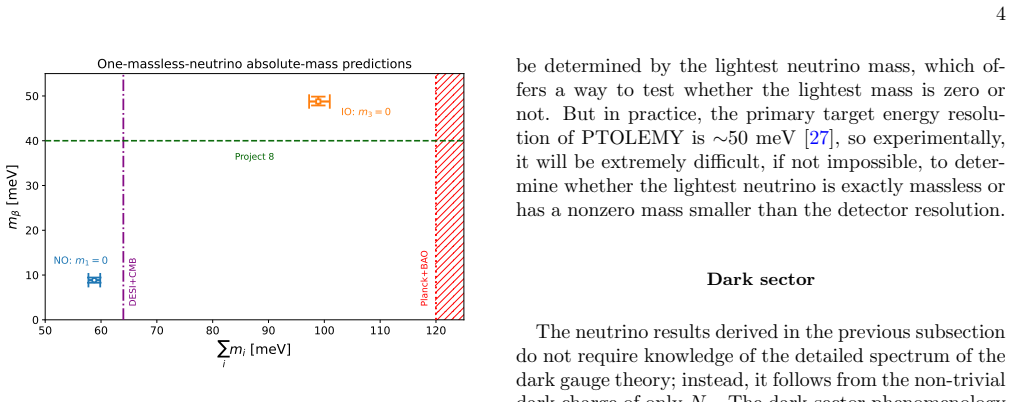
read the original abstract
We propose a gauge-symmetry origin of a rank-two Dirac neutrino mass matrix that enforces one exactly massless neutrino, while being consistent with the oscillation data, as well as cosmological constraints. The mechanism relies on a minimal dark $SU(2)_D$ gauge symmetry under which one right-handed-neutrino-like Weyl fermion is charged, thereby forbidding its Standard Model Yukawa coupling. Quantum consistency then fixes the minimal dark-sector completion: Cancellation of the Witten anomaly requires a second fermionic $SU(2)_D$ doublet, while a discrete $Z_4$ symmetry that forbids Majorana masses allows the two dark doublets to form a vectorlike pair. This anomaly-free completion gives rise to a secluded, confining dark sector with a viable dark matter candidate, linking the protected neutrino texture to dark infrared dynamics.
Editorial analysis
A structured set of objections, weighed in public.
Referee Report
Summary. The paper proposes a gauge-symmetry origin for a rank-two Dirac neutrino mass matrix that enforces one exactly massless neutrino. A minimal dark SU(2)_D symmetry charges one right-handed neutrino under a doublet, forbidding its Standard Model Yukawa coupling. Witten anomaly cancellation requires a second fermionic doublet; a discrete Z4 symmetry then permits a vector-like mass term for the pair while forbidding Majorana operators. The resulting anomaly-free, secluded confining dark sector supplies a viable dark matter candidate, with the construction asserted to be consistent with neutrino oscillation data and cosmological constraints.
Significance. If the symmetry construction and its implications hold, the work supplies a minimal, gauge-theoretic explanation for the protected massless neutrino state without ad-hoc parameter tuning in the neutrino sector, while simultaneously generating a dark matter candidate through infrared dynamics of the dark gauge group. This links two a priori separate puzzles (neutrino texture and dark matter) through anomaly cancellation and discrete symmetry, offering a concrete realization that could be probed via dark-sector searches or precision neutrino measurements.
minor comments (2)
- The abstract asserts consistency with oscillation data and cosmological constraints, but the manuscript should include an explicit numerical example or fit of the resulting Dirac mass matrix to current oscillation parameters (e.g., in a dedicated subsection after the mass-matrix derivation) to make the claim quantitative rather than qualitative.
- Notation for the dark-sector fields and charges (e.g., the two SU(2)_D doublets and their Z4 assignments) should be introduced with a clear table or list early in the model-building section to improve readability for readers unfamiliar with the construction.
Simulated Author's Rebuttal
We thank the referee for their positive assessment of our manuscript, including the recognition of its significance in linking a protected neutrino texture to dark-sector dynamics via anomaly cancellation and discrete symmetry. We note the recommendation for minor revision and will incorporate any editorial improvements accordingly.
Circularity Check
No significant circularity identified
full rationale
The paper constructs a neutrino mass texture via explicit gauge symmetry assignments (one RH neutrino charged under SU(2)_D to forbid its Yukawa) plus standard anomaly cancellation (Witten anomaly requiring a second doublet) and a discrete Z4 to enforce vector-like pairing while forbidding Majorana terms. These steps are self-contained symmetry arguments that do not reduce to fitted inputs, self-citations, or redefinitions of the target massless state. No equations or claims in the provided text exhibit the enumerated circular patterns; the resulting dark sector is a derived consequence rather than an input.
Axiom & Free-Parameter Ledger
axioms (3)
- standard math The Standard Model particle content and gauge symmetries form the base.
- domain assumption Witten anomaly must be canceled by adding a second SU(2)_D doublet.
- ad hoc to paper A discrete Z4 symmetry is imposed to forbid Majorana masses.
invented entities (2)
-
SU(2)_D dark gauge symmetry
no independent evidence
-
Z4 discrete symmetry
no independent evidence
Reference graph
Works this paper leans on
-
[1]
Evidence for oscillation of atmospheric neutrinos
Y. Fukudaet al.(Super-Kamiokande), Evidence for os- cillation of atmospheric neutrinos, Phys. Rev. Lett.81, 1562 (1998), arXiv:hep-ex/9807003
work page internal anchor Pith review Pith/arXiv arXiv 1998
-
[2]
Q. R. Ahmadet al.(SNO), Direct evidence for neutrino flavor transformation from neutral current interactions in the Sudbury Neutrino Observatory, Phys. Rev. Lett. 89, 011301 (2002), arXiv:nucl-ex/0204008
work page internal anchor Pith review Pith/arXiv arXiv 2002
- [3]
-
[4]
A. Abuslemeet al.(JUNO), Sub-percent precision mea- surement of neutrino oscillation parameters with JUNO, Chin. Phys. C46, 123001 (2022), arXiv:2204.13249 [hep-ex]
-
[5]
R. Abbasiet al.(IceCube), Measurement of atmospheric neutrino mixing with improved IceCube DeepCore cali- bration and data processing, Phys. Rev. D108, 012014 (2023), arXiv:2304.12236 [hep-ex]
-
[6]
Hyper-Kamiokande Design Report
K. Abeet al.(Hyper-Kamiokande), Hyper-Kamiokande Design Report, (2018), arXiv:1805.04163 [physics.ins- det]
work page internal anchor Pith review Pith/arXiv arXiv 2018
-
[7]
B. Abiet al.(DUNE), Deep Underground Neutrino Experiment (DUNE), Far Detector Technical Design Report, Volume II: DUNE Physics 10.2172/1599307 (2020), arXiv:2002.03005 [hep-ex]
-
[8]
H. Nunokawa, S. J. Parke, and R. Zukanovich Funchal, Another possible way to determine the neutrino mass hierarchy, Phys. Rev. D72, 013009 (2005), arXiv:hep- ph/0503283
-
[9]
Complementarity Between Hyperkamiokande and DUNE in Determining Neutrino Oscillation Parameters
S. Fukasawa, M. Ghosh, and O. Yasuda, Complemen- tarity Between Hyperkamiokande and DUNE in Deter- mining Neutrino Oscillation Parameters, Nucl. Phys. B 918, 337 (2017), arXiv:1607.03758 [hep-ph]
work page internal anchor Pith review Pith/arXiv arXiv 2017
- [10]
- [11]
- [12]
-
[13]
E. Di Valentino, S. Gariazzo, and O. Mena, Neutrinos in Cosmology, (2024), arXiv:2404.19322 [astro-ph.CO]
- [14]
-
[15]
Akeret al.(KATRIN), Science388, adq9592 (2025), arXiv:2406.13516 [nucl-ex]
M. Akeret al.(KATRIN), Direct neutrino-mass mea- surement based on 259 days of KATRIN data, Science 388, adq9592 (2025), arXiv:2406.13516 [nucl-ex]
-
[16]
G. T. Zatsepin, On the possibility of determining the upper limit of the neutrino mass by means of the flight time, Pisma Zh. Eksp. Teor. Fiz.8, 333 (1968)
1968
-
[17]
T. J. Loredo and D. Q. Lamb, Bayesian analysis of neu- trinos observed from supernova SN-1987A, Phys. Rev. D65, 063002 (2002), arXiv:astro-ph/0107260
work page internal anchor Pith review Pith/arXiv arXiv 2002
-
[18]
Exploring the sub-eV neutrino mass range with supernova neutrinos
E. Nardi and J. I. Zuluaga, Exploring the sub-eV neu- trino mass range with supernova neutrinos, Phys. Rev. D69, 103002 (2004), arXiv:astro-ph/0306384
work page internal anchor Pith review Pith/arXiv arXiv 2004
-
[19]
Neutrino mass bound in the standard scenario for supernova electronic antineutrino emission
G. Pagliaroli, F. Rossi-Torres, and F. Vissani, Neutrino mass bound in the standard scenario for supernova elec- tronic antineutrino emission, Astropart. Phys.33, 287 (2010), arXiv:1002.3349 [hep-ph]
work page internal anchor Pith review Pith/arXiv arXiv 2010
-
[20]
J.-S. Lu, J. Cao, Y.-F. Li, and S. Zhou, Constrain- ing Absolute Neutrino Masses via Detection of Galac- tic Supernova Neutrinos at JUNO, JCAP05, 044, arXiv:1412.7418 [hep-ph]
work page internal anchor Pith review Pith/arXiv arXiv
- [21]
- [22]
-
[23]
V. Brdar and X.-J. Xu, Timing and multi-channel: novel method for determining the neutrino mass order- ing from supernovae, JCAP08, 067, arXiv:2204.13135 [hep-ph]
- [24]
- [25]
- [26]
- [27]
- [28]
-
[29]
DESI DR2 Results II: Measurements of Baryon Acoustic Oscillations and Cosmological Constraints
M. Abdul Karimet al.(DESI), DESI DR2 results. II. Measurements of baryon acoustic oscillations and cos- mological constraints, Phys. Rev. D112, 083515 (2025), arXiv:2503.14738 [astro-ph.CO]
work page internal anchor Pith review Pith/arXiv arXiv 2025
-
[30]
Planck 2018 results. VI. Cosmological parameters
Planck Collaboration, N. Aghanim,et al., Planck 2018 results. VI. Cosmological parameters, Astron. Astro- phys.641, A6 (2020), [Erratum: Astron. Astrophys. 652, C4 (2021)], arXiv:1807.06209 [astro-ph.CO]
work page internal anchor Pith review Pith/arXiv arXiv 2018
-
[31]
S. Alamet al.(eBOSS), Completed SDSS-IV extended Baryon Oscillation Spectroscopic Survey: Cosmological implications from two decades of spectroscopic surveys at the Apache Point Observatory, Phys. Rev. D103, 083533 (2021), arXiv:2007.08991 [astro-ph.CO]
work page internal anchor Pith review Pith/arXiv arXiv 2021
-
[32]
The Atacama Cosmology Telescope: DR6 Constraints on Extended Cosmological Models
E. Calabreseet al.(Atacama Cosmology Telescope), The Atacama Cosmology Telescope: DR6 constraints on extended cosmological models, JCAP11, 063, arXiv:2503.14454 [astro-ph.CO]
work page internal anchor Pith review Pith/arXiv arXiv
-
[33]
E. Camphuiset al.(SPT-3G), SPT-3G D1: CMB temperature and polarization power spectra and cos- mology from 2019 and 2020 observations of the SPT- 3G main field, Phys. Rev. D113, 083504 (2026), arXiv:2506.20707 [astro-ph.CO]
work page internal anchor Pith review Pith/arXiv arXiv 2019
- [34]
-
[35]
Cosmological constraints on the neutrino mass including systematic uncertainties
F. Couchot, S. Henrot-Versill´ e, O. Perdereau, S. Plaszczynski, B. Rouill´ e d’Orfeuil, M. Spinelli, and M. Tristram, Cosmological constraints on the neutrino mass including systematic uncertainties, As- tron. Astrophys.606, A104 (2017), arXiv:1703.10829 [astro-ph.CO]
work page internal anchor Pith review Pith/arXiv arXiv 2017
-
[36]
E. Abdallaet al., Cosmology intertwined: A review of the particle physics, astrophysics, and cosmology asso- ciated with the cosmological tensions and anomalies, JHEAp34, 49 (2022), arXiv:2203.06142 [astro-ph.CO]
work page internal anchor Pith review Pith/arXiv arXiv 2022
- [37]
- [38]
- [39]
- [40]
-
[41]
D. Green and J. Meyers, Cosmological preference for a negative neutrino mass, Phys. Rev. D111, 083507 (2025), arXiv:2407.07878 [astro-ph.CO]
- [42]
-
[43]
D. Naredo-Tuero, M. Escudero, E. Fern´ andez-Mart´ ınez, X. Marcano, and V. Poulin, Critical look at the cosmo- logical neutrino mass bound, Phys. Rev. D110, 123537 (2024), arXiv:2407.13831 [astro-ph.CO]
-
[44]
J.-Q. Jiang, W. Giar` e, S. Gariazzo, M. G. Dainotti, E. Di Valentino, O. Mena, D. Pedrotti, S. S. da Costa, and S. Vagnozzi, Neutrino cosmology after DESI: tight- est mass upper limits, preference for the normal order- ing, and tension with terrestrial observations, JCAP01, 153, arXiv:2407.18047 [astro-ph.CO]. 10
-
[45]
T. Bert´ olez-Mart´ ınez, I. Esteban, R. Hajjar, O. Mena, and J. Salvado, Origin of cosmological neutrino mass bounds: background versus perturbations, JCAP06, 058, arXiv:2411.14524 [astro-ph.CO]
- [46]
-
[47]
E. Di Valentinoet al.(CosmoVerse Network), The CosmoVerse White Paper: Addressing observational tensions in cosmology with systematics and funda- mental physics, Phys. Dark Univ.49, 101965 (2025), arXiv:2504.01669 [astro-ph.CO]
work page internal anchor Pith review Pith/arXiv arXiv 2025
- [48]
-
[49]
W. Giar` e, O. Mena, E. Specogna, and E. Di Valentino, Neutrino mass tension or suppressed growth rate of mat- ter perturbations?, Phys. Rev. D112, 103520 (2025), arXiv:2507.01848 [astro-ph.CO]
- [50]
-
[51]
A. Cozzumbo, M. Atzori Corona, R. Murgia, M. Archidiacono, and M. Cadeddu, A short blan- ket for cosmology: the CMB lensing anomaly behind the preference for a negative neutrino mass, (2025), arXiv:2511.01967 [astro-ph.CO]
-
[52]
J. F. Beacom, N. F. Bell, and S. Dodelson, Neutri- noless universe, Phys. Rev. Lett.93, 121302 (2004), arXiv:astro-ph/0404585
work page internal anchor Pith review Pith/arXiv arXiv 2004
-
[53]
Neutrinos secretly converting to lighter particles to please both KATRIN and the cosmos
Y. Farzan and S. Hannestad, Neutrinos secretly con- verting to lighter particles to please both KATRIN and the cosmos, JCAP02, 058, arXiv:1510.02201 [hep-ph]
work page internal anchor Pith review Pith/arXiv arXiv
-
[54]
M. Escudero, T. Schwetz, and J. Terol-Calvo, A seesaw model for large neutrino masses in concordance with cosmology, JHEP02, 142, [Addendum: JHEP 06, 119 (2024)], arXiv:2211.01729 [hep-ph]
- [55]
- [56]
-
[57]
R. K. Sharma, M. Archidiacono, and J. Lesgourgues, Recoupled Dark Radiation reconciling CMB and DESI BAO measurements, (2026), arXiv:2605.18716 [astro- ph.CO]
work page internal anchor Pith review Pith/arXiv arXiv 2026
-
[58]
L. Boyle, K. Finn, and N. Turok, CPT-Symmetric Universe, Phys. Rev. Lett.121, 251301 (2018), arXiv:1803.08928 [hep-ph]
work page internal anchor Pith review Pith/arXiv arXiv 2018
- [59]
-
[60]
Radiative Seesaw Mechanism at Weak Scale
Z.-j. Tao, Radiative seesaw mechanism at weak scale, Phys. Rev. D54, 5693 (1996), arXiv:hep-ph/9603309
work page internal anchor Pith review Pith/arXiv arXiv 1996
-
[61]
Verifiable Radiative Seesaw Mechanism of Neutrino Mass and Dark Matter
E. Ma, Verifiable radiative seesaw mechanism of neu- trino mass and dark matter, Phys. Rev. D73, 077301 (2006), arXiv:hep-ph/0601225
work page internal anchor Pith review Pith/arXiv arXiv 2006
-
[62]
Dirac neutrino mass generation from dark matter
Y. Farzan and E. Ma, Dirac neutrino mass generation from dark matter, Phys. Rev. D86, 033007 (2012), arXiv:1204.4890 [hep-ph]
work page internal anchor Pith review Pith/arXiv arXiv 2012
-
[63]
P. Escribano, M. Reig, and A. Vicente, Generalizing the Scotogenic model, JHEP07, 097, arXiv:2004.05172 [hep-ph]
-
[64]
Minkowski,µ→eγat a Rate of One Out of 10 9 Muon Decays?, Phys
P. Minkowski,µ→eγat a Rate of One Out of 10 9 Muon Decays?, Phys. Lett. B67, 421 (1977)
1977
-
[65]
R. N. Mohapatra and G. Senjanovic, Neutrino Mass and Spontaneous Parity Nonconservation, Phys. Rev. Lett. 44, 912 (1980)
1980
-
[66]
Complex Spinors and Unified Theories
M. Gell-Mann, P. Ramond, and R. Slansky, Complex Spinors and Unified Theories, Conf. Proc. C790927, 315 (1979), arXiv:1306.4669 [hep-th]
work page internal anchor Pith review Pith/arXiv arXiv 1979
-
[67]
Yanagida, Horizontal gauge symmetry and masses of neutrinos, Conf
T. Yanagida, Horizontal gauge symmetry and masses of neutrinos, Conf. Proc. C7902131, 95 (1979)
1979
-
[68]
A. Y. Smirnov, Seesaw enhancement of lepton mixing, Phys. Rev. D48, 3264 (1993), arXiv:hep-ph/9304205
work page internal anchor Pith review Pith/arXiv arXiv 1993
-
[69]
E. Ma, D. P. Roy, and U. Sarkar, A Seesaw model for atmospheric and solar neutrino oscillations, Phys. Lett. B444, 391 (1998), arXiv:hep-ph/9810309
work page internal anchor Pith review Pith/arXiv arXiv 1998
-
[70]
S. F. King, Large mixing angle MSW and atmospheric neutrinos from single right-handed neutrino dominance and U(1) family symmetry, Nucl. Phys. B576, 85 (2000), arXiv:hep-ph/9912492
work page internal anchor Pith review Pith/arXiv arXiv 2000
-
[71]
Seesaw model with softly broken L_e - L_\mu - L_\tau
L. Lavoura and W. Grimus, Seesaw model with softly broken L(e) - L(muon) - L(tau), JHEP09, 007, arXiv:hep-ph/0008020
work page internal anchor Pith review Pith/arXiv arXiv
-
[72]
S. F. King, Constructing the large mixing angle MNS matrix in seesaw models with right-handed neutrino dominance, JHEP09, 011, arXiv:hep-ph/0204360
work page internal anchor Pith review Pith/arXiv arXiv
-
[73]
P. H. Frampton, S. L. Glashow, and T. Yanagida, Cos- mological sign of neutrino CP violation, Phys. Lett. B 548, 119 (2002), arXiv:hep-ph/0208157
work page internal anchor Pith review Pith/arXiv arXiv 2002
-
[74]
Predictions of the most minimal see-saw model
M. Raidal and A. Strumia, Predictions of the most minimal seesaw model, Phys. Lett. B553, 72 (2003), arXiv:hep-ph/0210021
work page internal anchor Pith review Pith/arXiv arXiv 2003
-
[75]
Neutrino Phenomenology -- the case of two right handed neutrinos
A. Ibarra and G. G. Ross, Neutrino phenomenology: The Case of two right-handed neutrinos, Phys. Lett. B 591, 285 (2004), arXiv:hep-ph/0312138
work page internal anchor Pith review Pith/arXiv arXiv 2004
-
[76]
S. F. King, Littlest Seesaw, JHEP02, 085, arXiv:1512.07531 [hep-ph]
work page internal anchor Pith review Pith/arXiv arXiv
-
[77]
R. N. Mohapatra and J. W. F. Valle, Neutrino Mass and Baryon Number Nonconservation in Superstring Mod- els, Phys. Rev. D34, 1642 (1986)
1986
-
[78]
Non-unitary neutrino mixing and CP violation in the minimal inverse seesaw model
M. Malinsky, T. Ohlsson, Z.-z. Xing, and H. Zhang, Non-unitary neutrino mixing and CP violation in the minimal inverse seesaw model, Phys. Lett. B679, 242 (2009), arXiv:0905.2889 [hep-ph]
work page internal anchor Pith review Pith/arXiv arXiv 2009
-
[79]
P. S. B. Dev and A. Pilaftsis, Minimal Radiative Neu- trino Mass Mechanism for Inverse Seesaw Models, Phys. Rev. D86, 113001 (2012), arXiv:1209.4051 [hep-ph]
work page internal anchor Pith review Pith/arXiv arXiv 2012
-
[80]
Looking for the minimal inverse seesaw realisation
A. Abada and M. Lucente, Looking for the minimal in- verse seesaw realisation, Nucl. Phys. B885, 651 (2014), arXiv:1401.1507 [hep-ph]
work page internal anchor Pith review Pith/arXiv arXiv 2014
discussion (0)
Sign in with ORCID, Apple, or X to comment. Anyone can read and Pith papers without signing in.