REVIEW 3 major objections 55 references
Decoupling high-level language understanding from low-latency flight control doubles success and halves runtime in long-horizon aerial vision-language navigation.
Reviewed by Pith at T0; open to challenge. T0 means a machine referee read the full paper against a public rubric. the ladder, T0–T4 →
T0 review · grok-4.5
2026-07-10 08:44 UTC pith:NTTLRT4I
load-bearing objection Useful dual-system engineering for aerial VLN: real joint gains on success and latency in sim, but the 2× SR headline is thin without error bars and everything stays Unreal-only. the 3 major comments →
FSD-VLN: Fast-Slow Dual-System Modeling for Aerial Long-Horizon Vision-Language Navigation
The pith
A machine-rendered reading of the paper's core claim, the machinery that carries it, and where it could break.
Core claim
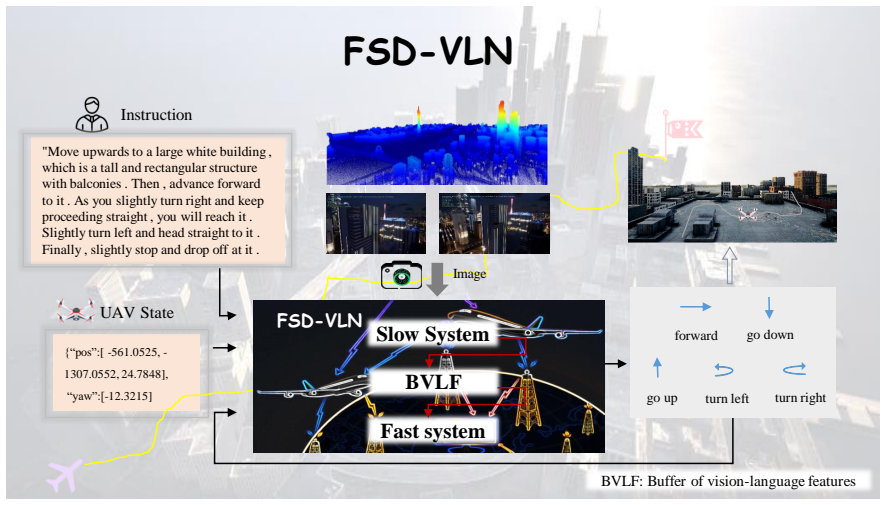
The structural conflict between global multimodal reasoning and high-frequency flight control can be resolved by explicitly decoupling them into asynchronous slow and fast pathways. When the slow pathway supplies stable semantic priors and the fast pathway models temporally coherent action distributions with a Diffusion Transformer, long-horizon aerial vision-language navigation becomes both more successful and substantially lower-latency than prior reactive or fully autoregressive designs.
What carries the argument
FSD-VLN fast–slow dual system: a slow VLM stream that writes vision–language semantic features into a buffer, plus a DiT-based fast stream that conditions action denoising on those features, UAV state, and prior actions, trained with a time-weighted MSE loss that up-weights later timesteps.
Load-bearing premise
Gains measured only inside high-fidelity city simulators with a discrete eight-action set will transfer to real UAV dynamics, continuous control, and real-world visual shift.
What would settle it
Fly the same instruction set on a physical multirotor in an unseen outdoor urban corridor: if success rate does not rise relative to a strong single-stream baseline and end-to-end latency does not fall by roughly half under identical sensors and compute, the central claim fails.
If this is right
- Long-horizon aerial VLN systems can keep a heavy vision–language model offline or low-rate while still issuing smooth, low-latency flight commands.
- Explicit cross-temporal action modeling reduces oscillatory trajectories and compounding error without requiring denser online reasoning.
- Time-weighted supervision becomes a practical lever for stabilizing multi-step action learning on long UAV trajectories.
- The same slow-semantic / fast-control split can be reused as a design template for other latency-sensitive embodied agents that must fuse language with continuous motion.
Where Pith is reading between the lines
- If the slow buffer is refreshed only at keyframes or landmarks rather than every frame, compute budgets on small onboard GPUs could drop further while preserving most of the reported gains.
- The same DiT action head conditioned on a frozen multimodal prior may transfer to ground or underwater platforms that face analogous reasoning-versus-control frequency conflicts.
- A natural next stress test is continuous rather than discrete action spaces; if the hybrid mapping still holds, the architecture would support finer-grained agile flight.
Editorial analysis
A structured set of objections, weighed in public.
Referee Report
Summary. The paper proposes FSD-VLN, a fast-slow dual-system architecture for long-horizon aerial vision-language navigation. A slow pathway uses a frozen pretrained VLM to maintain a vision-language semantic feature buffer, while a fast pathway based on a Diffusion Transformer (DiT) with alternating self- and cross-attention generates temporally coherent discrete flight actions conditioned on UAV state, prior actions, and the semantic buffer. A time-weighted MSE loss is introduced to stabilize long-horizon training. Evaluated in large-scale Unreal Engine urban simulations (AirVLN-S + OpenFly trajectories), the method reports higher success rates and SPL than several baselines (including a self-reproduced OpenFly) on both seen and unseen splits, together with substantially lower single-action latency and end-to-end task time.
Significance. If the reported gains hold under stronger statistical controls, the work offers a practical and timely paradigm for aerial VLN: explicitly decoupling heavy multimodal reasoning from high-frequency control, while using generative temporal modeling (DiT) rather than purely reactive or fully autoregressive policies. The latency reductions (Tables 2–3) and the closed-loop asynchronous design are especially relevant for real-time UAV deployment. Strengths include a clear architectural separation, concrete ablations on the time-weighted loss and action horizon, and end-to-end timing measurements beyond single-step latency. The absolute success rates remain modest and all evidence is simulation-only, so the primary contribution is a well-motivated systems design with promising empirical support rather than a definitive solution to aerial VLN.
major comments (3)
- Abstract and Table 1: the central claim of “up to 2× higher” unseen SR (13.6 % vs OpenFly 5.1 %) rests on a single self-reproduced OpenFly baseline with no error bars, multi-seed averages, or statistical significance tests for any method. Absolute SR is low, so modest seed/hyperparameter/split variation could erase or reverse the multiplier. At minimum, report means ± std over multiple seeds (or bootstrap CIs) for FSD-VLN and the main baselines on the same test set, and temper the 2× language if the gap is not robust.
- §4.2–4.3 and Table 1: OpenFly is marked “self-reproduced … on our test set,” yet the reproduction protocol (checkpoints, action discretization, success threshold, trajectory filtering, number of evaluation episodes) is not specified in enough detail to judge fairness. CityNavAgent (11.7 % unseen SR) is already close to FSD-VLN (13.6 %); without a transparent, multi-run comparison the ranking among recent methods is not secure. Please document the reproduction settings and, if possible, evaluate against the original OpenFly numbers on a shared split.
- §3.2–3.3 and Algorithm 1: the dual-system claim is that asynchronous slow/fast operation yields both semantic consistency and low latency. The paper does not quantify how often the VLSF buffer is refreshed relative to action steps, nor the effect of stale semantic features on trajectory quality. An ablation that freezes or delays the slow stream (or measures buffer age vs. NE/SR) would make the “asynchronous coordination” contribution load-bearing rather than architectural description alone.
Circularity Check
No circularity: empirical dual-system architecture evaluated on held-out simulation splits; success/latency claims do not reduce to fitted inputs or self-definitional equations.
full rationale
FSD-VLN is an engineering/architecture paper whose load-bearing claims are experimental (Table 1 SR/SPL/NE on seen/unseen AirVLN-S+OpenFly trajectories; Tables 2–3 latency). The dual-system decomposition (slow VLM priors + DiT fast action generator, Eqs. 2–4), discrete 8-action set, global adaptive normalization (Eq. 5), and time-weighted MSE (Eq. 6) are design choices trained on trajectories and measured against external metrics (NE, SR, OSR, SPL) on separate test sets. No equation equates a reported success rate or latency figure to a free parameter fitted on the same quantity. Use of the frozen GR00T N1 backbone and self-reproduction of the OpenFly baseline are ordinary engineering practice, not a self-citation chain that forces the 2× SR claim by construction. Ablations (horizon H, TW-MSE vs MSE) are likewise empirical. The derivation chain is therefore self-contained against the paper’s own simulation benchmarks; score 0 is the correct non-finding.
Axiom & Free-Parameter Ledger
free parameters (4)
- action horizon H
- time-weight coefficients w_t
- DiT architecture sizes
- success threshold (20 m)
axioms (4)
- domain assumption High-fidelity Unreal Engine city simulations (AirVLN-S + OpenFly) are a valid proxy for real low-altitude UAV navigation performance.
- domain assumption A frozen pre-trained vision-language model supplies sufficiently stable semantic priors for long-horizon aerial tasks.
- domain assumption Discrete 8-action flight primitives (forward 3/6/9 m, ±30°, ascend/descend 3 m, stop) adequately represent continuous UAV control.
- ad hoc to paper Cross-temporal action dependencies can be captured by alternating self- and cross-attention inside a Diffusion Transformer.
invented entities (2)
-
FSD-VLN dual-system architecture (slow VLM + fast DiT + VLSF buffer)
no independent evidence
-
Time-Weighted MSE (TW-MSE) loss
no independent evidence
read the original abstract
Vision-Language Navigation (VLN) enables UAV autonomous navigation in unknown environments by mapping language instructions to real-time visual inputs. Compared with GPS-dependent or pre-programmed navigation, VLN supports intuitive human-machine interaction and stronger environmental adaptability, requiring tight integration of high-level semantic reasoning and low-latency flight control.Existing methods suffer from structural misalignment between global multimodal understanding and sequential action generation, causing jittery trajectories and severe decision latency for long-horizon aerial navigation. To solve this issue, we propose FSD-VLN, a fast-slow dual-system architecture disentangling semantic reasoning and low-latency flight command generation.The framework has two asynchronous branches: a slow stream extracting stable semantic priors from pre-trained vision-language models, and a Diffusion Transformer (DiT) fast stream modeling cross-temporal action distributions to produce consistent flight outputs. We further introduce a time-aware adaptive optimizer to stabilize long-sequence training and reduce gradient oscillation.Large-scale low-altitude simulation experiments show FSD-VLN achieves up to 2X higher navigation success rates on unseen scenes than SOTA methods, while cutting single-action inference delay and total task runtime by over 50%. Our work validates the benefit of decoupled semantic-control modeling and provides a practical paradigm for long-horizon aerial VLN.
Figures


Reference graph
Works this paper leans on
-
[1]
Achiam, J., Adler, S., Agarwal, S., Ahmad, L., Akkaya, I., Aleman, F.L., Almeida, D., Altenschmidt, J., Altman, S., Anadkat, S., et al.: Gpt-4 technical report. arXiv preprint arXiv:2303.08774 (2023)
work page internal anchor Pith review Pith/arXiv arXiv 2023
-
[2]
In: Proceedings of the IEEE conference on computer vision and pattern recognition
Anderson, P., Wu, Q., Teney, D., Bruce, J., Johnson, M., Sünderhauf, N., Reid, I., Gould, S., Van Den Hengel, A.: Vision-and-language navigation: Interpreting visually-grounded navigation instructions in real environments. In: Proceedings of the IEEE conference on computer vision and pattern recognition. pp. 3674–3683 (2018)
work page 2018
-
[3]
Bai, J., Bai, S., Chu, Y., Cui, Z., Dang, K., Deng, X., Fan, Y., Ge, W., Han, Y., Huang, F., et al.: Qwen technical report. arXiv preprint arXiv:2309.16609 (2023)
work page internal anchor Pith review Pith/arXiv arXiv 2023
-
[4]
GR00T N1: An Open Foundation Model for Generalist Humanoid Robots
Bjorck, J., Castañeda, F., Cherniadev, N., Da, X., Ding, R., Fan, L., Fang, Y., Fox, D., Hu, F., Huang, S., et al.: Gr00t n1: An open foundation model for generalist humanoid robots. arXiv preprint arXiv:2503.14734 (2025)
work page internal anchor Pith review Pith/arXiv arXiv 2025
-
[5]
$\pi_0$: A Vision-Language-Action Flow Model for General Robot Control
Black, K., Brown, N., Driess, D., Esmail, A., Equi, M., Finn, C., Fusai, N., Groom, L., Hausman, K., Ichter, B., et al.:\pi_0: A vision-language-action flow model for general robot control. arXiv preprint arXiv:2410.24164 (2024)
work page internal anchor Pith review Pith/arXiv arXiv 2024
-
[6]
In: 2018 IEEE InternationalConferenceonRoboticsandAutomation(ICRA).pp.3818–3825.IEEE (2018)
Blochliger, F., Fehr, M., Dymczyk, M., Schneider, T., Siegwart, R.: Topomap: Topological mapping and navigation based on visual slam maps. In: 2018 IEEE InternationalConferenceonRoboticsandAutomation(ICRA).pp.3818–3825.IEEE (2018)
work page 2018
-
[7]
Advances in neural information processing systems33, 1877–1901 (2020)
Brown, T., Mann, B., Ryder, N., Subbiah, M., Kaplan, J.D., Dhariwal, P., Nee- lakantan, A., Shyam, P., Sastry, G., Askell, A., et al.: Language models are few-shot learners. Advances in neural information processing systems33, 1877–1901 (2020)
work page 1901
-
[8]
Bu, Q., Cai, J., Chen, L., Cui, X., Ding, Y., Feng, S., Gao, S., He, X., Hu, X., Huang, X., et al.: Agibot world colosseo: A large-scale manipulation platform for scalable and intelligent embodied systems. arXiv preprint arXiv:2503.06669 (2025) 14
work page internal anchor Pith review Pith/arXiv arXiv 2025
-
[9]
IEEE Transactions on Mobile Computing (2025)
Chen, G., Yu, X., Ling, N., Zhong, L.: Chatfly: Low-latency drone planning with large language models. IEEE Transactions on Mobile Computing (2025)
work page 2025
-
[10]
In: Proceedings of the IEEE/CVF conference on computer vision and pattern recognition
Chen, H., Suhr, A., Misra, D., Snavely, N., Artzi, Y.: Touchdown: Natural language navigation and spatial reasoning in visual street environments. In: Proceedings of the IEEE/CVF conference on computer vision and pattern recognition. pp. 12538–12547 (2019)
work page 2019
-
[11]
Advances in neural information processing sys- tems 34, 5834–5847 (2021)
Chen, S., Guhur, P.L., Schmid, C., Laptev, I.: Historyawaremultimodaltransformer for vision-and-language navigation. Advances in neural information processing sys- tems 34, 5834–5847 (2021)
work page 2021
-
[12]
Chu, Y., Xu, J., Yang, Q., Wei, H., Wei, X., Guo, Z., Leng, Y., Lv, Y., He, J., Lin, J., et al.: Qwen2-audio technical report. arXiv preprint arXiv:2407.10759 (2024)
work page internal anchor Pith review Pith/arXiv arXiv 2024
-
[13]
In: Findings of the Association for Computational Linguistics: ACL 2023
Fan, Y., Chen, W., Jiang, T., Zhou, C., Zhang, Y., Wang, X.: Aerial vision-and- dialog navigation. In: Findings of the Association for Computational Linguistics: ACL 2023. pp. 3043–3061 (2023)
work page 2023
-
[14]
Advances in neural information processing systems 31 (2018)
Fried, D., Hu, R., Cirik, V., Rohrbach, A., Andreas, J., Morency, L.P., Berg- Kirkpatrick, T., Saenko, K., Klein, D., Darrell, T.: Speaker-follower models for vision-and-language navigation. Advances in neural information processing systems 31 (2018)
work page 2018
-
[15]
Gao, Y., Li, C., You, Z., Liu, J., Li, Z., Chen, P., Chen, Q., Tang, Z., Wang, L., Yang, P., et al.: Openfly: A versatile toolchain and large-scale benchmark for aerial vision-language navigation. arXiv e-prints pp. arXiv–2502 (2025)
work page 2025
-
[16]
In: Proceedings of the IEEE/CVF International Conference on Computer Vision
Hamdan, S., Sima, C., Yang, Z., Li, H., Guney, F.: Eta: Efficiency through thinking ahead, a dual approach to self-driving with large models. In: Proceedings of the IEEE/CVF International Conference on Computer Vision. pp. 26529–26538 (2025)
work page 2025
-
[17]
In: Proceedings of the IEEE/CVF confer- ence on Computer Vision and Pattern Recognition
Hong, Y., Wu, Q., Qi, Y., Rodriguez-Opazo, C., Gould, S.: Vln bert: A recurrent vision-and-language bert for navigation. In: Proceedings of the IEEE/CVF confer- ence on Computer Vision and Pattern Recognition. pp. 1643–1653 (2021)
work page 2021
-
[18]
Autonomous robots 34(3), 189–206 (2013)
Hornung, A., Wurm, K.M., Bennewitz, M., Stachniss, C., Burgard, W.: Octomap: An efficient probabilistic 3d mapping framework based on octrees. Autonomous robots 34(3), 189–206 (2013)
work page 2013
-
[19]
Video Prediction Policy: A Generalist Robot Policy with Predictive Visual Representations
Hu, Y., Guo, Y., Wang, P., Chen, X., Wang, Y.J., Zhang, J., Sreenath, K., Lu, C., Chen, J.: Video prediction policy: A generalist robot policy with predictive visual representations. arXiv preprint arXiv:2412.14803 (2024)
work page internal anchor Pith review Pith/arXiv arXiv 2024
-
[20]
VoxPoser: Composable 3D Value Maps for Robotic Manipulation with Language Models
Huang, W., Wang, C., Zhang, R., Li, Y., Wu, J., Fei-Fei, L.: Voxposer: Compos- able 3d value maps for robotic manipulation with language models. arXiv preprint arXiv:2307.05973 (2023)
work page internal anchor Pith review Pith/arXiv arXiv 2023
-
[21]
In: 2021 IEEE international conference on robotics and automation (ICRA)
Irshad, M.Z., Ma, C.Y., Kira, Z.: Hierarchical cross-modal agent for robotics vision- and-language navigation. In: 2021 IEEE international conference on robotics and automation (ICRA). pp. 13238–13246. IEEE (2021) 15
work page 2021
-
[22]
Transactions on Science and Technology3(1), 31–40 (2016)
Janis, A., Bade, A.: Path planning algorithm in complex environment: a survey. Transactions on Science and Technology3(1), 31–40 (2016)
work page 2016
-
[23]
Kawaharazuka, K., Oh, J., Yamada, J., Posner, I., Zhu, Y.: Vision-language-action models for robotics: A review towards real-world applications. IEEE Access (2025)
work page 2025
-
[24]
OpenVLA: An Open-Source Vision-Language-Action Model
Kim, M.J., Pertsch, K., Karamcheti, S., Xiao, T., Balakrishna, A., Nair, S., Rafailov, R., Foster, E., Lam, G., Sanketi, P., etal.: Openvla: Anopen-sourcevision-language- action model. arXiv preprint arXiv:2406.09246 (2024)
work page internal anchor Pith review Pith/arXiv arXiv 2024
-
[25]
In: Proceedings of the IEEE/CVF confer- ence on computer vision and pattern recognition
Krantz, J., Banerjee, S., Zhu, W., Corso, J., Anderson, P., Lee, S., Thomason, J.: Iterative vision-and-language navigation. In: Proceedings of the IEEE/CVF confer- ence on computer vision and pattern recognition. pp. 14921–14930 (2023)
work page 2023
-
[26]
In: European Confer- ence on Computer Vision
Krantz, J., Wijmans, E., Majumdar, A., Batra, D., Lee, S.: Beyond the nav-graph: Vision-and-language navigation in continuous environments. In: European Confer- ence on Computer Vision. pp. 104–120. Springer (2020)
work page 2020
-
[27]
Lee, J., Miyanishi, T., Kurita, S., Sakamoto, K., Azuma, D., Matsuo, Y., Inoue, N.: Citynav: Language-goal aerial navigation dataset using geographic information (2024)
work page 2024
-
[28]
In: Proceedings of the IEEE/CVF Conference on Computer Vision and Pattern Recognition
Lin, B., Zhu, Y., Chen, Z., Liang, X., Liu, J., Liang, X.: Adapt: Vision-language navigation with modality-aligned action prompts. In: Proceedings of the IEEE/CVF Conference on Computer Vision and Pattern Recognition. pp. 15396–15406 (2022)
work page 2022
-
[29]
arXiv preprint arXiv:2511.06182 (2025)
Lin, P., Sun, G., Liu, C., Li, F., Ren, W., Cong, Y.: Openvln: Open-world aerial vision-language navigation. arXiv preprint arXiv:2511.06182 (2025)
-
[30]
In: Proceedings of the IEEE/CVF International Con- ference on Computer Vision
Liu, S., Zhang, H., Qi, Y., Wang, P., Zhang, Y., Wu, Q.: Aerialvln: Vision-and- language navigation for uavs. In: Proceedings of the IEEE/CVF International Con- ference on Computer Vision. pp. 15384–15394 (2023)
work page 2023
-
[31]
Continuously Learning, Adapting, and Improving: A Dual-Process Approach to Autonomous Driving
Mei, J., Ma, Y., Yang, X., Wen, L., Cai, X., Li, X., Fu, D., Zhang, B., Cai, P., Dou, M., et al.: Continuously learning, adapting, and improving: A dual-process approach to autonomous driving. arXiv preprint arXiv:2405.15324 (2024)
work page internal anchor Pith review Pith/arXiv arXiv 2024
-
[32]
IEEE transactions on robotics33(5), 1255–1262 (2017)
Mur-Artal, R., Tardós, J.D.: Orb-slam2: Anopen-sourceslamsystemformonocular, stereo, and rgb-d cameras. IEEE transactions on robotics33(5), 1255–1262 (2017)
work page 2017
-
[33]
In: 2021 Aerial robotic systems physically interacting with the environment (AIRPHARO)
Oršulić, J., Milijas, R., Batinovic, A., Markovic, L., Ivanovic, A., Bogdan, S.: Flying with cartographer: Adapting the cartographer 3d graph slam stack for uav naviga- tion. In: 2021 Aerial robotic systems physically interacting with the environment (AIRPHARO). pp. 1–7. IEEE (2021)
work page 2021
-
[34]
In: European conference on computer vision
Qi, Y., Pan, Z., Zhang, S., van den Hengel, A., Wu, Q.: Object-and-action aware model for visual language navigation. In: European conference on computer vision. pp. 303–317. Springer (2020)
work page 2020
-
[35]
Qian, K., Ma, Z., He, Y., Luo, Z., Shi, T., Zhu, T., Li, J., Wang, J., Chen, Z., He, X., et al.: Fasionad: Fast and slow fusion thinking systems for human-like autonomous driving with adaptive feedback. arXiv preprint arXiv:2411.18013 (2024) 16
work page internal anchor Pith review Pith/arXiv arXiv 2024
-
[36]
Radford, A., Narasimhan, K., Salimans, T., Sutskever, I., et al.: Improving language understanding by generative pre-training (2018)
work page 2018
-
[37]
Radford, A., Wu, J., Child, R., Luan, D., Amodei, D., Sutskever, I., et al.: Language models are unsupervised multitask learners. OpenAI blog1(8), 9 (2019)
work page 2019
-
[38]
Tan, H., Yu, L., Bansal, M.: Learning to navigate unseen environments: Back translation with environmental dropout. In: Proceedings of the 2019 Conference of the North American Chapter of the Association for Computational Linguistics: Human Language Technologies, Volume 1 (Long and Short Papers). pp. 2610–2621 (2019)
work page 2019
-
[39]
LLaMA: Open and Efficient Foundation Language Models
Touvron, H., Lavril, T., Izacard, G., Martinet, X., Lachaux, M.A., Lacroix, T., Rozière, B., Goyal, N., Hambro, E., Azhar, F., et al.: Llama: Open and efficient foundation language models. arXiv preprint arXiv:2302.13971 (2023)
work page internal anchor Pith review Pith/arXiv arXiv 2023
-
[40]
Journal of Smart Internet of Things2023(2), 133–141 (2023)
Ubaid, M.M., Sana, M.S., Salim, K., Khalid, S., Batool, I., Gilani, S.H., Gilani, S.S.: Uavs path planning using visual-slam technique based hybrid particle swarm optimization. Journal of Smart Internet of Things2023(2), 133–141 (2023)
work page 2023
-
[41]
Towards Realistic UAV Vision-Language Navigation: Platform, Benchmark, and Methodology
Wang, X., Yang, D., Wang, Z., Kwan, H., Chen, J., Wu, W., Li, H., Liao, Y., Liu, S.: Towards realistic uav vision-language navigation: Platform, benchmark, and methodology. arXiv preprint arXiv:2410.07087 (2024)
work page internal anchor Pith review Pith/arXiv arXiv 2024
-
[42]
arXiv preprint arXiv:2512.15258 (2025)
Wu, Y., Zhu, M., Li, X., Du, Y., Fan, Y., Li, W., Han, Z., Zhou, X., Gao, F.: Vla-an: An efficient and onboard vision-language-action framework for aerial navigation in complex environments. arXiv preprint arXiv:2512.15258 (2025)
-
[43]
In: Proceed- ings of the 33rd ACM International Conference on Multimedia
Xiao, J., Sun, Y., Shao, Y., Gan, B., Liu, R., Wu, Y., Guan, W., Deng, X.: Uav-on: A benchmark for open-world object goal navigation with aerial agents. In: Proceed- ings of the 33rd ACM International Conference on Multimedia. pp. 13023–13029 (2025)
work page 2025
-
[44]
Acta Electronica Sinica45(7), 1764–1769 (2017)
Yin, G., Zhou, S., Wu, Q.: An improved rrt algorithm for uav path planning. Acta Electronica Sinica45(7), 1764–1769 (2017)
work page 2017
-
[45]
arXiv preprint arXiv:2602.00551 (2026)
Zhang, D., Chen, P., Xia, X., Su, X., Zhen, R., Xiao, J., Yang, S.: Apex: A decou- pled memory-based explorer for asynchronous aerial object goal navigation. arXiv preprint arXiv:2602.00551 (2026)
-
[46]
Zhang, J., Guo, Y., Chen, X., Wang, Y.J., Hu, Y., Shi, C., Chen, J.: Hirt: Enhancing roboticcontrolwithhierarchicalrobottransformers.arXivpreprintarXiv:2410.05273 (2024)
work page internal anchor Pith review Pith/arXiv arXiv 2024
-
[47]
NaVid: Video-based VLM Plans the Next Step for Vision-and-Language Navigation
Zhang, J., Wang, K., Xu, R., Zhou, G., Hong, Y., Fang, X., Wu, Q., Zhang, Z., Wang, H.: Navid: Video-based vlm plans the next step for vision-and-language navigation. arXiv preprint arXiv:2402.15852 (2024)
work page internal anchor Pith review Pith/arXiv arXiv 2024
-
[48]
LLaMA-Adapter: Efficient Fine-tuning of Language Models with Zero-init Attention
Zhang, R., Han, J., Liu, C., Gao, P., Zhou, A., Hu, X., Yan, S., Lu, P., Li, H., Qiao, Y.: Llama-adapter: Efficient fine-tuning of language models with zero-init attention. arXiv preprint arXiv:2303.16199 (2023) 17
work page internal anchor Pith review Pith/arXiv arXiv 2023
-
[49]
In: Proceed- ings of the IEEE/CVF International Conference on Computer Vision
Zhang, R., Xie, J., Zhang, W., Chen, W., Tan, X., Wan, X., Li, G.: Adadrive: Self- adaptive slow-fast system for language-grounded autonomous driving. In: Proceed- ings of the IEEE/CVF International Conference on Computer Vision. pp. 5112–5121 (2025)
work page 2025
-
[50]
Zhang, W., Gao, C., Yu, S., Peng, R., Zhao, B., Zhang, Q., Cui, J., Chen, X., Li, Y.: Citynavagent: Aerial vision-and-language navigation with hierarchical semantic planning and global memory. In: Proceedings of the 63rd Annual Meeting of the Association for Computational Linguistics (Volume 1: Long Papers). pp. 31292– 31309 (2025)
work page 2025
-
[51]
Grounded Vision-Language Navigation for UAVs with Open-Vocabulary Goal Understanding
Zhang, Y., Yu, H., Xiao, J., Feroskhan, M.: Grounded vision-language navigation for uavs with open-vocabulary goal understanding. arXiv preprint arXiv:2506.10756 (2025)
work page internal anchor Pith review Pith/arXiv arXiv 2025
-
[52]
Aerial Vision-and-Language Navigation with Grid-based View Selection and Map Construction
Zhao, G., Li, G., Pan, J., Yu, Y.: Aerial vision-and-language navigation with grid- based view selection and map construction. arXiv preprint arXiv:2503.11091 (2025)
work page internal anchor Pith review Pith/arXiv arXiv 2025
-
[53]
In: European Confer- ence on Computer Vision
Zhou, G., Hong, Y., Wang, Z., Wang, X.E., Wu, Q.: Navgpt-2: Unleashing naviga- tional reasoning capability for large vision-language models. In: European Confer- ence on Computer Vision. pp. 260–278. Springer (2024)
work page 2024
-
[54]
In: Proceedings of the AAAI Conference on Artificial Intelligence
Zhou, G., Hong, Y., Wu, Q.: Navgpt: Explicit reasoning in vision-and-language navigation with large language models. In: Proceedings of the AAAI Conference on Artificial Intelligence. vol. 38, pp. 7641–7649 (2024)
work page 2024
-
[55]
In: Conference on Robot Learning
Zitkovich, B., Yu, T., Xu, S., Xu, P., Xiao, T., Xia, F., Wu, J., Wohlhart, P., Welker, S., Wahid, A., et al.: Rt-2: Vision-language-action models transfer web knowledge to robotic control. In: Conference on Robot Learning. pp. 2165–2183. PMLR (2023) 18
work page 2023
discussion (0)
Sign in with ORCID, Apple, or X to comment. Anyone can read and Pith papers without signing in.