Artificial Intelligence · arXiv:2610.01787 v1 · submitted 1 Oct 2026 · 68 references
Not All Experience Belongs in the Weights: Component Routing for Self-Improving GUI Agents
The paper says
“Self-improving GUI agents keep the trajectories they produce and return them to the agent, by fine-tuning or by retrieval into the prompt, and studies that compare the two destinations disagree.”
more of the abstract
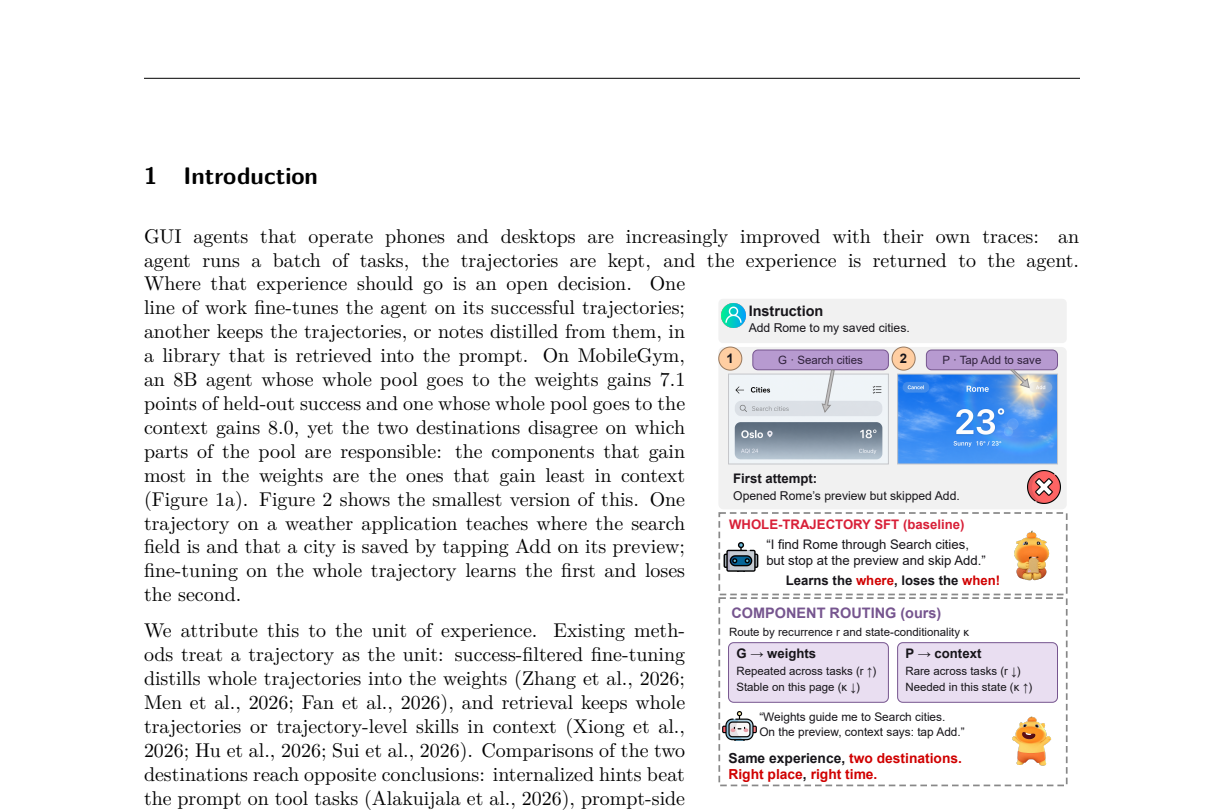
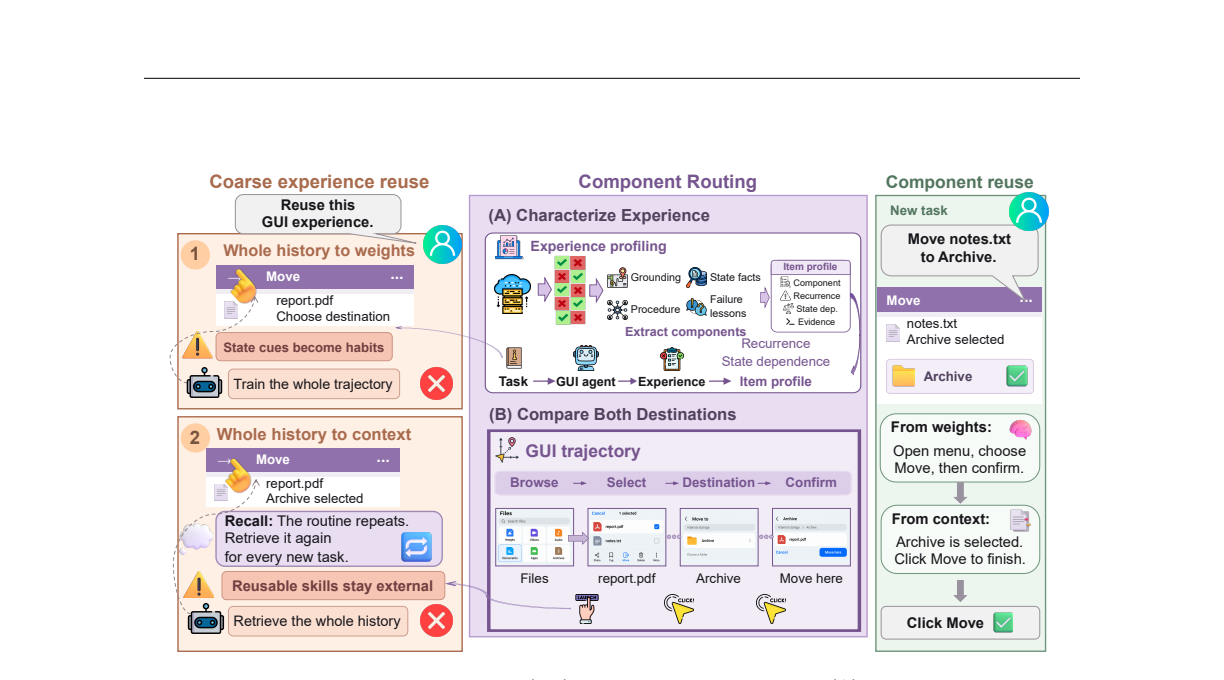
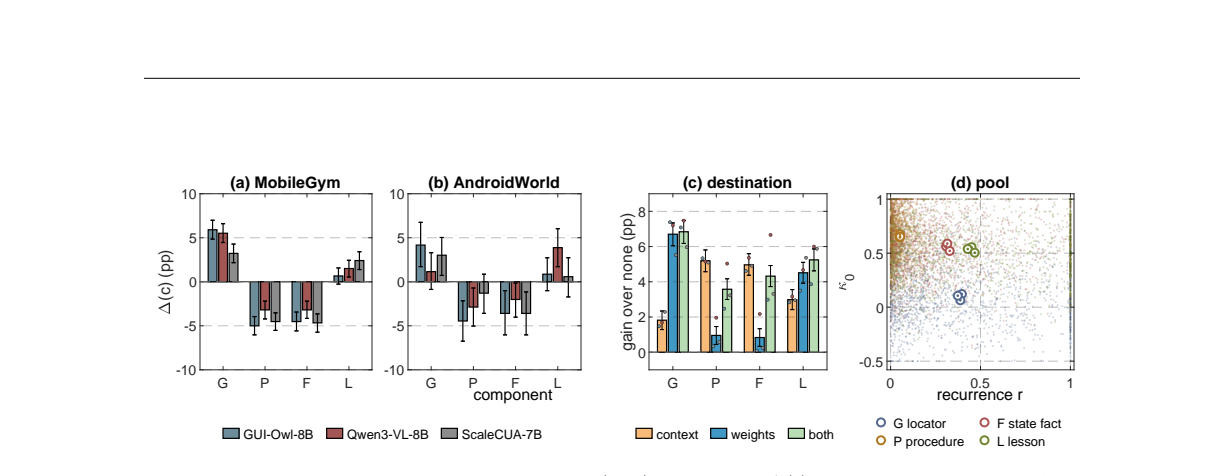
We attribute this to the unit of experience: a trajectory bundles items with different properties, so a conclusion about the bundle depends on its mix. To address this, (i) we introduce component routing, which splits the experience into locators, procedures, state facts and lessons and sends each component to the context or to the weights, compared on the same items across three backbone families, two environments and three seeds. One pool has two destinations: locators and lessons win in the weights, procedures and state facts in the context. (ii) We fit a rule in two properties measured before any training, recurrence and state-conditionality; it recovers the destination of a held-out backbone family in 24 of 24 cells, two interventions move a component toward the boundary, and routing by the rule beats every whole-trajectory baseline and, by +3.5 points on average, the better single destination of each backbone. (iii) We identify how training and producer-consumer differences change the value of the two destinations: note readout decreases after the same component is written into the weights, most for the items that recur most, context gains increase with the information gap, and weights gains decrease with the policy gap. Code and data will be released.
from the abstract
Pith says
Machine review · deepseek-v4-flash · 2 Oct 2026 · what was read was not recorded · not checked by a person
It can be wrong. Challenge this review or reply to it.
Holds up, with conditions. Solid measurement, overstated law: the +3.5-point routing advantage is real, but the 24/24 held-out rule is effectively a one-dimensional recurrence threshold dressed up as a two-property account. This line is wrong
3 major objections · 5 minor
How often objections from reviews like this one are right: not yet measured
Not checked: figures, code, what the 68 references say.
The paper says, at §5.1, Eq. (5), Table D.2
The review did not quote this passage.
Pith says: Objection 1 of 3 · major
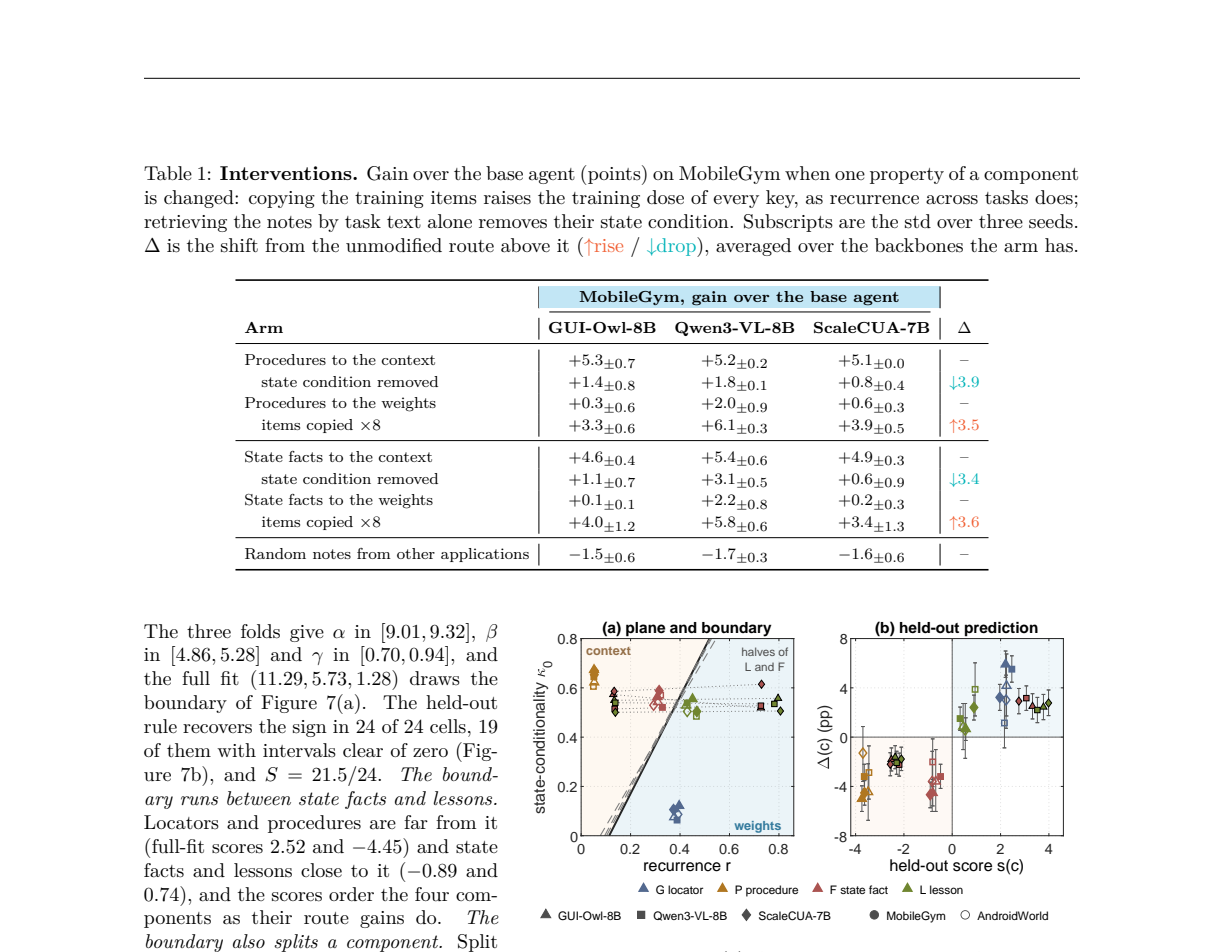
The held-out 24/24 sign recovery is not uniformly discriminating: locators (full-fit score ≈ +2.5) and procedures (≈ −4.4) sit several score units from the boundary and carry identical signs across all three families, so twelve of the twenty-four cells are recovered by any rule that places G on the weights side and P on the context side.
more of objection 1
The only genuinely informative pair is state facts (score ≈ −0.89) versus lessons (≈ +0.74), and there the weights-side evidence is the softest in the paper: three of the six lesson intervals include zero, which is exactly why the authors' own weighted held-out score is S = 21.5/24 rather than 24. The headline 'recovers the destination in 24 of 24 cells' should therefore be accompanied by a decomposition of how many cells the boundary actually decides, e.g., a per-pair held-out score or a statement that the decisive pair carries a margin of only ~1.6 units with the weakest observation.
The paper says, at §4.1 (Eqs. 2–3), Table A.1
The review did not quote this passage.
Pith says: Objection 2 of 3 · major
Recurrence alone orders the four components as P (0.05) < F (0.31) < G (0.39) < L (0.44), so a horizontal threshold on r between 0.31 and 0.39 yields the same assignment (F, P → context; G, L → weights) for every family, and the decisive F-versus-L pair differs chiefly in recurrence (r ≈ 0.31 vs 0.45) while its κ0 values nearly coincide (≈ 0.53–0.56).
more of objection 2
The paper never reports a recurrence-only held-out fit, so the claimed 'rule in two properties' is not established: κ0's incremental contribution to any routing assignment is unquantified, and its online confirmation carries only Spearman 0.56, which itself compares near-identical F and L values. Please add a recurrence-only baseline to the leave-one-family-out comparison, and report how many of the 24 held-out assignments change when κ0 is dropped or perturbed within its measurement error.
The paper says, at Table D.4
The review did not quote this passage.
Pith says: Objection 3 of 3 · major
The prospective half-split test is a genuine strength and is properly pre-registered, but it splits lessons and state facts on recurrence only (thresholds r = 0.377 and r = 0.394), so it supplies no evidence for κ0's role in routing.
more of objection 3
Taken together with the near-coincident κ0 of F and L, the two-property explanation currently rests on a single soft boundary whose discrimination is essentially one-dimensional. Either demonstrate κ0's routing value explicitly (for instance by a perturbed-κ0 sensitivity of the assignment) or soften the abstract's 'rule in two properties' formulation to 'a rule in recurrence, with state-conditionality as a secondary descriptor.'
5 minor objections
The paper says, at §5.4, Table 2, Table E.2
Pith says: minor objection 1 of 5
The main text says routing 'exceeds the better single destination on every MobileGym backbone' and 'matches it with GUI-Owl-8B' on AndroidWorld; the AndroidWorld GUI-Owl cell is in fact −0.3 points below all-to-context with interval [−2.6, +2.0]. Please report the paired-bootstrap interval for the +3.5-point average gain over the better single destination so that the one non-positive cell is visible in the headline number.
The paper says, at §3, Eq. (4)
Pith says: minor objection 2 of 5
The online state-conditionality κ(c) is defined as a ratio whose denominator is U(C_E^c) − U0; please state how the quantity is treated when the denominator is near zero or negative (e.g., when the exact-only route does not beat the base agent), since the rank correlation of 0.56 with κ0 depends on those cells.
show 3 more
The paper says, at §4.3, Figure 6b
Pith says: minor objection 3 of 5
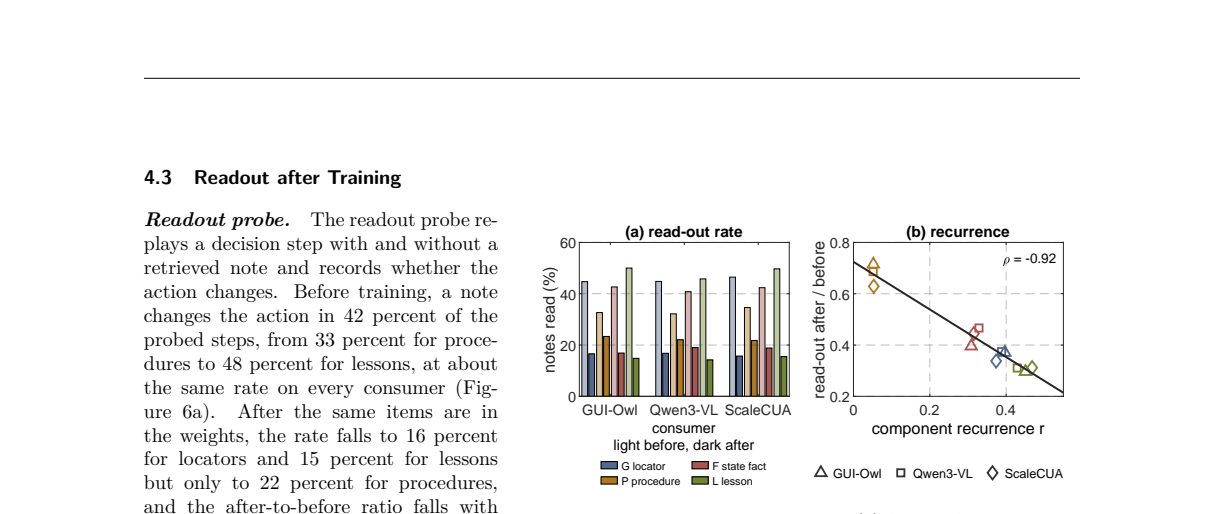
The figure reports Spearman −0.92 for the after-to-before readout ratio against recurrence; please state explicitly over how many points this is computed (twelve cells of three backbones and four components, or item-level pools) and add the per-component r-coordinates to the figure caption.
The paper says, at Related Work and References
Pith says: minor objection 4 of 5
The reference list is dominated by 2026 arXiv preprints, several of which are the authors' own works; please verify that the characterizations of the contrasted studies (Alakuijala et al., Li et al., Agrawal et al.) are accurate and complete, and consider trimming self-citations that do not bear on the comparison.
The paper says, at Abstract / Reproducibility
Pith says: minor objection 5 of 5
The abstract promises 'Code and data will be released'; since several claims depend on the rule-based extractors and the exact retrieval templates, please provide a release link or supplement with the extractor code, pool statistics, and routing assignments so that the held-out protocol can be audited.
What would settle it
Refit the three-fold held-out procedure of Eq. 5 with kappa0 removed, i.e., score s(c) = alpha·r(c) − gamma only, using the same logistic objective, ridge penalty, and fold structure (Appendix D.1–D.2), and compare: (i) the 24-cell sign recovery and weighted score S; (ii) the routed-arm held-out success versus the better single destination on the same 1106/232 instances with the same paired bootstrap. If recurrence-only attains the same 24/24 (S) and the same routed advantage within interval noise, then kappa0 is not load-bearing: the near-boundary concern is resolved, but the paper's two-property explanation should be restated as a one-property rule and the Spearman-0.56 proxy weakness is moot.
from the skeptic's reading
How the review went
4 readings by deepseek-v4-flash · 2 Oct 2026
- Reader holds up, with conditions
- Skeptic partly agrees
- Editor wrote the verdict above
- Referee major revision: 3 major objections, 5 minor
Not run on this paper: the simulated authors' defence.
Pith did not check this review's objections against the paper.
The review in full
The review in brief, machine-written
The routing result is real and the reframing is worth having. Splitting experience into four components and asking where each belongs settles the fine-tune-versus-retrieve disagreement more cleanly than the whole-trajectory literature has managed, and the measurement is careful: paired instances, three seeds, analysis fixed before the runs, assignments written to disk before training, bootstrap intervals, interventions. The +3.5-point average edge over the better single destination is a genuinely trained-and-evaluated arm, not an extrapolation.
The soft spot is exactly what the stress-test note hits. The 24-of-24 held-out recovery is carried almost entirely by the lessons-versus-state-facts boundary. Locators and procedures sit two to four score units from the line and carry identical signs in every family, so the fit adds nothing for them. The one pair that decides is the pair whose signs are softest — three of six lesson intervals cross zero. The authors disclose S=21.5/24 rather than 24, which helps, but the headline number still overstates what the rule demonstrably discriminates.
The second dimension is the bigger problem. Recurrence alone orders all four components correctly; a threshold near r≈0.35 reproduces the identical assignment. kappa0 is confirmed only at Spearman 0.56, and its near-boundary contribution is never isolated. So 'two properties' is not established; the paper effectively reports one, recurrence — though the state-condition interventions do real work (removing the condition costs 3.4–3.9 points of context gain), so kappa0 is not dead. It is simply not shown to move the boundary.
Other proportionate nits: code and data are promised, not shipped; on AndroidWorld the routed arm matches rather than beats the better single destination for GUI-Owl-8B; the budget inequality between routes is disclosed but makes the comparison less than fully symmetric. The self-citation cluster is heavy but the papers are mostly external and recent; not a real problem.
This deserves a serious referee. The measured advantage stands; what needs revision is the causal language around the two-property rule and an honest statement about how little the fit discriminates. A recurrence-only ablation would settle it cleanly, and asking for it would materially improve the paper.
The strongest objection
The routing gain of the measured routed arm is real (the arm was actually trained and evaluated with its assignment fixed to disk before training, and all differences are paired over instances and seeds), so my concern is not with the +3.5-point average advantage but with the strength of the explanation that accompanies it: that a rule in two pre-training properties, recurrence r and state-conditionality kappa0, recovers the destination of a held-out backbone family in 24 of 24 cells (Eq. 5, Table D.2). Decompose where that recovery actually decides. Locators (full-fit score ≈ +2.5) and procedures (≈ −4.4) sit two to four score units from the boundary and carry the identical sign in all three families; the fit adds no information for them. The rule's only decision content is placing lessons (score +0.74) on the weights side and state facts (−0.89) on the context side, a margin of ≈1.6 units versus 2.5+ elsewhere. On exactly that decisive pair the weights-side observation is softest: three of the six lesson cells have 95% intervals that include zero — GUI-Owl MobileGym +0.7 [−0.3,+1.6], GUI-Owl AndroidWorld +0.9 [−1.0,+2.7], ScaleCUA AndroidWorld +0.6 [−1.7,+2.7] — each counted at half weight, which is why the held-out score is S=21.5/24 rather than 24. Second, the two-property account is unverified in its second dimension. Recurrence alone orders all four components correctly (procedures 0.05, state facts 0.31, locators 0.39, lessons 0.44), so a recurrence-only threshold near r≈0.35 would reproduce the identical 24-of-24 assignment; kappa0's only online confirmation is Spearman 0.56 (Eq. 3 vs Eq. 4), and its near-boundary contribution is never isolated. Two readings follow. If kappa0 is non-load-bearing, the weak-proxy worry is moot but the claimed 'two properties' mechanism is not established and the paper effectively reports one property.
Three candidate concerns were weighed and rejected before settling on this one. (1) The routing advantage being a measured artifact: the routed arm is actually trained and evaluated with its assignment fixed before any adapter is trained, evaluations are paired over (template, instance, seed), and the paper reports per-cell intervals; the +3.5-point average over the better single destination is a measured fact, softened only by the one tie cell (AndroidWorld/GUI-Owl routing 33.3 vs all-to-context 33.6, [−2.6,+2.0]), which the paper honestly reports as an 'on average' claim. (2) Budget inequality between the notes tokens and adapter training: the paper explicitly reports both accounts in Appendix H without equalizing them (sentence b374), so this is an acknowledged scope condition, not a hidden flaw. (3) The near-boundary weak point: this is the genuine soft spot, and it is where the reader's CONDITIONAL already gestures; my contribution is to decompose it. The decisive pair is state facts vs lessons, the weights-side lesson signs are within noise of zero in half the cells, and kappa0 may be redundant with recurrence, which alone reproduces the full 24-of-24 assignment. That decomposition changes the character of the risk. If recurrence alone suffices, the weak proxy is irrelevant and the rule is more robust than the paper argues (one property, directly measured), but then the two-property explanation and the boundary figure overstate mechanism. If kappa0 is required and load-bearing, then the boundary placement at the only genuinely decided cells rests on a proxy with 0.56 rank agreement and on near-zero lesson gains, making the 24-of-24 recovery a semi-tautological re-assertion of cross-family sign consistency with real predictive content concentrated on a near-degenerate pair. Both resolutions are informative and both are reachable by one cheap refit rather than by new training runs, which is why the recurrence-only decomposition (and, on artifact release, a fourth family or third environment) should be a condition before the verdict is lifted. Weighing all this, the reader's CONDITIONAL is appropriate and my concern does not move it, so the verdict remains UNCHANGED in substance while being expressed as CONDITIONAL.
The referee's report
The empirical protocol is a strength: route gains are paired per instance, the analysis was fixed before the runs, the routed arm's assignment was written to disk before training, and the authors transparently report that five of twenty-four cells have intervals crossing zero (S = 21.5/24). If the routing comparison holds, the paper makes a concrete contribution by showing that the destination of experience depends on component type rather than only on pipeline choice, and the +3.5-point average advantage over the better single destination is a reproducible, falsifiable result. The main caveat is the strength of the explanatory rule: the leave-one-family-out recovery is dominated by components far from the boundary, and the only borderline pair (state facts vs lessons) is decided almost entirely by recurrence, with κ0 contributing little discriminative information. The core routing measurement is therefore credible, but the headline 'rule in two properties' claim needs reframing or additional evidence before it can be taken at face value.
Pith's reading of the paper (a machine's summary, not the authors')
Self-improving GUI agents collect their own trajectories and return them to the agent either by fine-tuning into the weights or by retrieval into the context, and studies comparing these two destinations disagree. The paper attributes the disagreement to bundling: a trajectory mixes items with different properties, so a conclusion about the whole bundle depends on its mix. Component routing splits the experience into locators, procedures, state facts and lessons, and compares the two destinations per component on the same held-out items across three backbone families and two environments. The finding is that one pool has two destinations: locators and lessons win in the weights, procedures and state facts in the context. A linear rule in recurrence and state-conditionality, both measurable before any training, recovers the winning destination of a held-out backbone family in 24 of 24 cells, and routing by the rule beats every whole-trajectory baseline and, on average by +3.5 points, the better single destination.
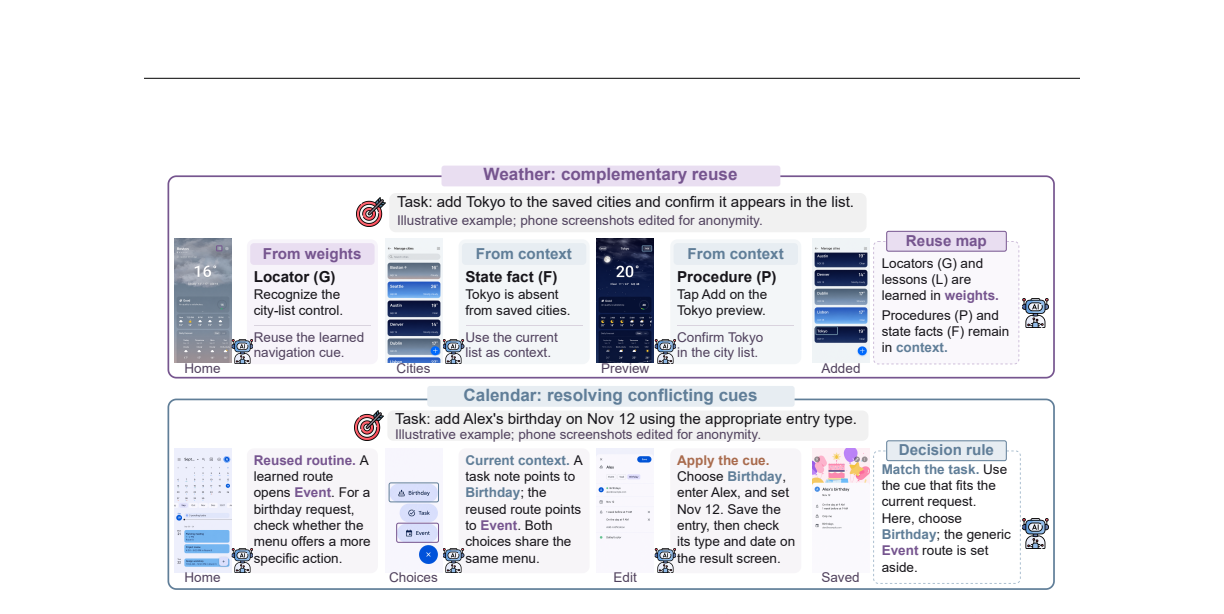
What carries the argument. The central object is component routing: an extractor carves a trajectory pool into four item sets—locators (where a named element sits), procedures (a recurring run of action targets), state facts (preconditions that must hold before an action) and lessons (failed-action / succeeded-action pairs)—each item carrying a key, a note for the context route, and a sample for the weights route. Two properties, both measured on the pool before any training, characterise each component: recurrence r, the share of unrelated tasks where the item's key reappears, and state-conditionality κ0, how much the item's usefulness depends on the current state matching its source state. The comparison is the route gain Δ(c)=U(Wc)−U(Cc), held-out success with the component in the weights minus the same items in the context. A linear rule sθ(c)=αr(c)−βκ0(c)−γ, fitted by weighted logistic loss with a ridge penalty while holding out one backbone family, predicts the sign of Δ(c), and the online quantity κ, read from exact-only versus relaxed-only retrieval, confirms the pre-training proxy. This rule is what carries the argument: it recovers the winning destination in 24 of 24 held-out cells and splits lessons and state facts at the boundary by item recurrence, with the ten-times learning rate leaving the route gains essentially unchanged.
Core claim. On the same items and the same held-out tasks, the route gain Δ(c)=U(Wc)−U(Cc) is positive for locators (+4.9 points pooled) and lessons (+1.5) and negative for procedures (−4.2) and state facts (−4.1), and this sign pattern repeats across three backbone families and two environments. The paper's central claim is that experience type, not pipeline choice, determines where experience should be stored, and that two properties measurable on the pool before any training—recurrence, how often a key reappears in unrelated tasks, and state-conditionality, how much usefulness depends on the state matching its source—predict the destination. A rule fitted with one backbone family held out recovers the sign in 24 of 24 cells, splits lessons and state facts at the boundary by item recurrence so that both halves land on the predicted side, and routing each component by the rule exceeds the better single destination of each backbone by +3.5 points on average. Two interventions support the mechanism: copying procedure items eightfold moves their route gain toward the weights by +3.5 points, and stripping the state condition from state facts costs 3.4 points. Training on a component makes its notes redundant, most for the items that recur most (after-training readout falls to 11 percent for the highest-recurrence locators and lessons), context gains increase with the information gap, and weights gains decrease with the policy gap.
The premise it rests on. The load-bearing premise is that the two pre-training properties, recurrence and state-conditionality, really measure why a component belongs in the weights or the context, so the boundary fitted on two backbone families can be trusted on a new family; the near-degenerate state-fact / lesson pair and the only moderate agreement between the pre-training proxy and the online measure mark where that premise is thinnest.
If the paper is right (Pith's inferences, not the authors')
No single destination is right for all experience: locators and lessons win in the weights, procedures and state facts in the context, on the same items.
A rule in recurrence and state-conditionality, both measurable before any training, predicts the winning destination on a held-out backbone family and splits components internally by item recurrence.
Routing each component by the rule exceeds the better single destination by +3.5 points on average, while the reverse assignment loses 7.8 to 8.9 points against routing.
Fine-tuning a component makes its notes redundant, most for the items that recur most, so coexistence adds little where the weights already win.
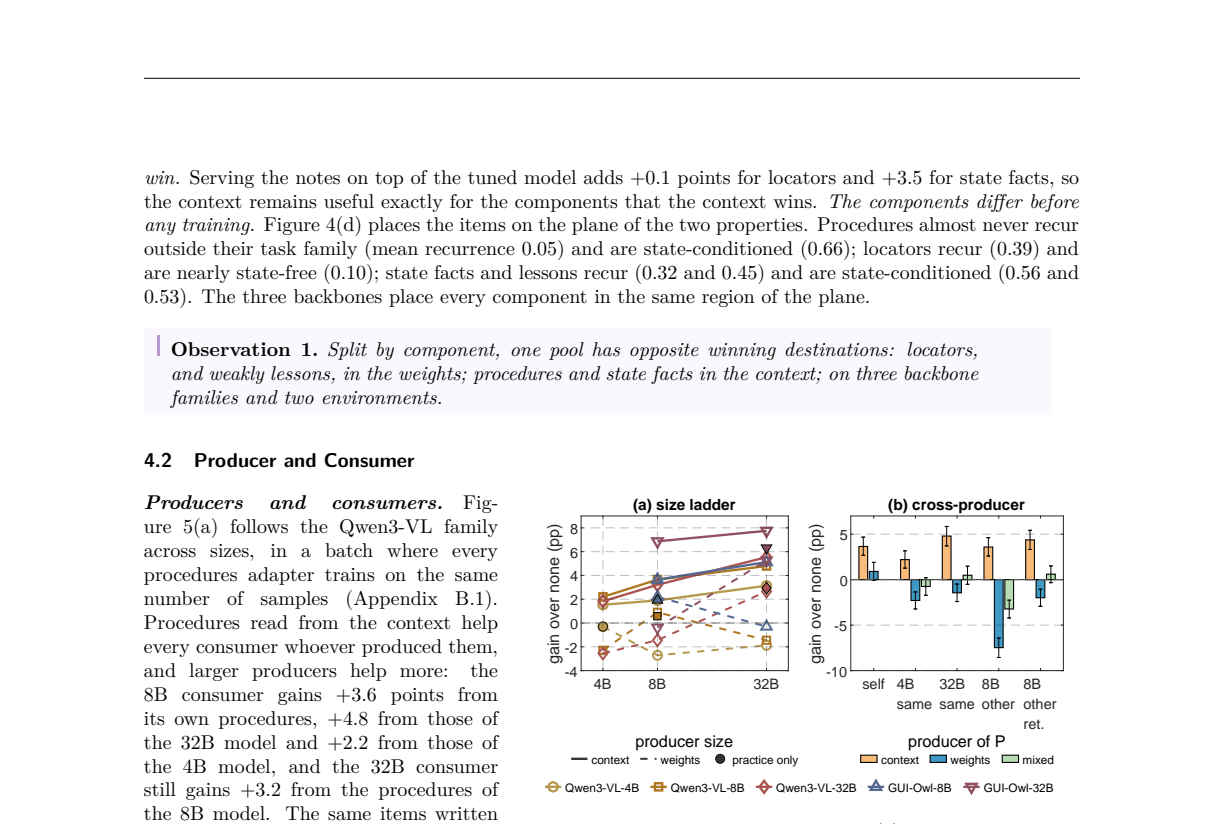
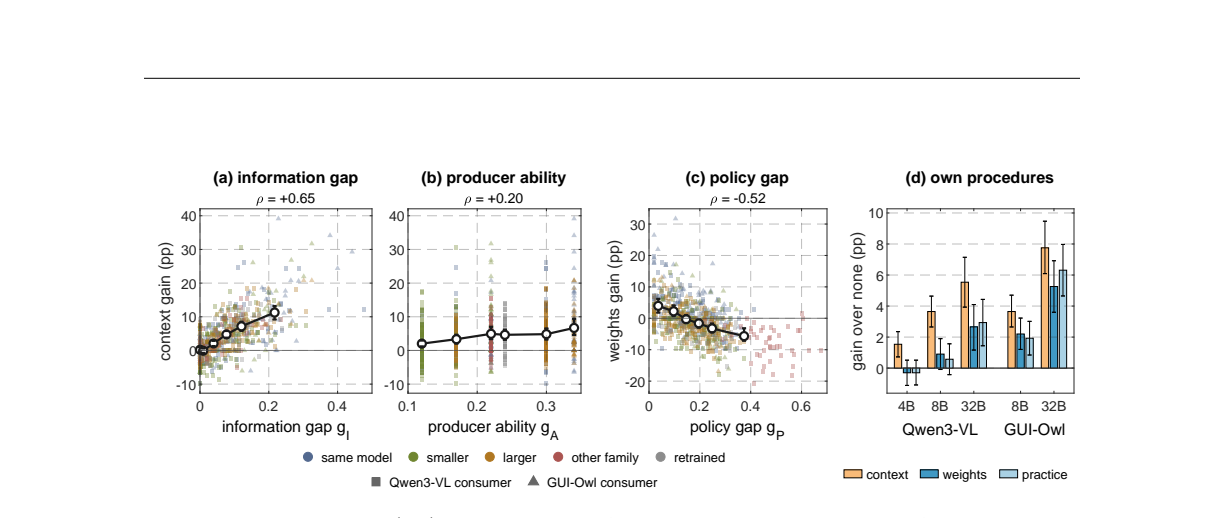
Context gains grow with the information gap and weights gains shrink with the policy gap, so notes carry across producers and consumers while fine-tuning largely buys practice on the consumer's own trajectories.
If the experience-type principle holds, it generalises beyond GUI agents: self-improving systems of any kind could subdivide their trajectory data by functional role and measure per-item properties before committing to a storage medium, rather than treating whole trajectories as an atomic unit.
The near-degenerate state-fact / lesson pair, with the pre-training proxy κ0 confirming online state-conditionality at only Spearman 0.56, suggests that a finer-grained property or a non-linear boundary may be needed to separate components that sit close to the line.
The readout drop after internalisation points to a concrete token-saving strategy: items that recur most should be internalised once and then dropped from the context, without loss of accuracy.
A testable extension is a blind routing experiment on a fresh environment: measure recurrence and state-conditionality before training, predict each component's destination, and compare the predicted routing to the empirically optimal one on the same held-out items.
Check this review
Pith stored no record of this review's passes and took no fingerprint of it. Reviews made by code from 13 Nov 2026 on carry both.
How often reviews like this one are right
Reviews like this one: written by deepseek-v4-flash, where what was read was not recorded.
How often objections from reviews like this one are right: not yet measured
Reviews by people
This review was written by a machine. No person has reviewed this paper on Pith yet. A scientist listed on Pith can review it for a fee, and their review is published here whatever it concludes.
The paper
Abstract
Self-improving GUI agents keep the trajectories they produce and return them to the agent, by fine-tuning or by retrieval into the prompt, and studies that compare the two destinations disagree. We attribute this to the unit of experience: a trajectory bundles items with different properties, so a conclusion about the bundle depends on its mix. To address this, (i) we introduce component routing, which splits the experience into locators, procedures, state facts and lessons and sends each component to the context or to the weights, compared on the same items across three backbone families, two environments and three seeds. One pool has two destinations: locators and lessons win in the weights, procedures and state facts in the context. (ii) We fit a rule in two properties measured before any training, recurrence and state-conditionality; it recovers the destination of a held-out backbone family in 24 of 24 cells, two interventions move a component toward the boundary, and routing by the rule beats every whole-trajectory baseline and, by +3.5 points on average, the better single destination of each backbone. (iii) We identify how training and producer-consumer differences change the value of the two destinations: note readout decreases after the same component is written into the weights, most for the items that recur most, context gains increase with the information gap, and weights gains decrease with the policy gap. Code and data will be released.
The paper's own sentences, arranged, kept beside the review and separate from it. Each label is drawn from a closed vocabulary; the number beside it is the probability the classifier gave that label. No sentence in this record was written by a model.
abstract compiled · 2026-10-02
The authors' main claim, as the classifier picked it out 0.55
“One pool has two destinations: locators and lessons win in the weights, procedures and state facts in the context.”
How the main claim is stated: asserted 1.00
What the abstract itself states, as probabilities: claims first 0.07 · states limitation 0.25 · human participants 0.06 · controlled comparison 0.95 · randomized assignment 0.06 · states quantitative result 0.98 · compares with prior results 0.96 · mentions code or data availability 0.98
The abstract, sentence by sentence
This table labels the abstract only (arXiv listing abstract v1). The number is the probability the classifier gave the label.
| Sentence | Role | The authors' own work | States the main conclusion | Strength |
|---|---|---|---|---|
| Self-improving GUI agents keep the trajectories they produce and return them to the agent, by fine-tuning or by retrieval into the prompt, and studies that compare the two destinations disagree. | background 0.96 | 0.06 | 0.03 | asserted 1.00 |
| We attribute this to the unit of experience: a trajectory bundles items with different properties, so a conclusion about the bundle depends on its mix. | interpretation 0.45 | 0.28 | 0.10 | asserted 0.78 |
| To address this, (i) we introduce component routing, which splits the experience into locators, procedures, state facts and lessons and sends each component to the context or to the weights, compared on the same items across three backbone families, two environments and three seeds. | method 0.74 | 0.96 | 0.08 | asserted 0.98 |
| One pool has two destinations: locators and lessons win in the weights, procedures and state facts in the context. | result 0.95 | 0.93 | 0.48 | asserted 1.00 |
| (ii) We fit a rule in two properties measured before any training, recurrence and state-conditionality; it recovers the destination of a held-out backbone family in 24 of 24 cells, two interventions move a component toward the boundary, and routing by the rule beats every whole-trajectory baseline and, by +3.5 points on average, the better single destination of each backbone. | result 0.89 | 0.97 | 0.52 | asserted 1.00 |
| (iii) We identify how training and producer-consumer differences change the value of the two destinations: note readout decreases after the same component is written into the weights, most for the items that recur most, context gains increase with the information gap, and weights gains decrease with the policy gap. | result 0.66 | 0.94 | 0.07 | asserted 1.00 |
| Code and data will be released. | future work 0.67 | 0.41 | 0.01 | asserted 0.95 |
What kind of paper the classifier reports this is: method or tool 0.94 · evidence from observation or experiment 0.99
What was examined, and what was not
Sources read
- arXiv listing abstract v1
Not examined
- full text
- figures and tables
- references and citing sentences
- relations to other papers
Levels run
- P abstract
Not run
- S sections
- T body sentences
- C citations
- R cross-paper relations
How the labels were made
Compiled by classifier-1.13.0 via TypeSafe API, question bank abstract-p1-20260923, 2026-10-02: 1 request, 5,789 input tokens.
Every quoted sentence on this record is the authors'. Every label is from Pith's closed vocabulary, with the probability shown beside it. This record as JSON
Figures (9)

Figures are the authors', reproduced from the paper.
References (68)
- [1] Laksh Advani. From Confident Closing to Silent Failure: Characterizing False Success in LLM Agents . arXiv preprint arXiv:2606.09863, 2026 on PithPith's reviewarXiv
- [2] Lakshya A Agrawal, Shangyin Tan, Dilara Soylu, Noah Ziems, Rishi Khare, Krista Opsahl-Ong, Arnav Singhvi, Herumb Shandilya, Michael J Ryan, Meng Jiang, Christopher Potts, Koushik Sen, Alexandros G. Dimakis, Ion Stoica, Dan Klein, Matei Zaharia, and Omar Khattab. GEPA: Reflecti... on Pith
- [3] Minttu Alakuijala, Ya Gao, Georgy Ananov, Samuel Kaski, Pekka Marttinen, Alexander Ilin, and Harri Valpola. Memento No More: Coaching AI Agents to Master Multiple Tasks via Hints Internalization . Transactions on Machine Learning Research, 2026 on Pith
- [4] Shuai Bai, Yuxuan Cai, Ruizhe Chen, Keqin Chen, Xionghui Chen, Zesen Cheng, Lianghao Deng, Wei Ding, Chang Gao, Chunjiang Ge, Wenbin Ge, Zhifang Guo, Qidong Huang, Jie Huang, Fei Huang, Binyuan Hui, Shutong Jiang, Zhaohai Li, Mingsheng Li, Mei Li, Kaixin Li, Zicheng Lin, Junya... on PithPith's reviewarXiv
- [5] Bryan Chan, Xinyi Chen, András György, and Dale Schuurmans. Toward Understanding In-context vs. In-weight Learning . In International Conference on Learning Representations, 2025 on Pith
- [6] Jingwen Chen, Wenkai Yang, Shengda Fan, Wenbo Nie, Chenxing Sun, Shaodong Zheng, Yangen Hu, Lu Pan, Ke Zeng, and Yankai Lin. Rethinking Continual Experience Internalization for Self-Evolving LLM Agents . arXiv preprint arXiv:2606.04703, 2026 on PithPith's reviewarXiv
- [7] Zihao Ding and Jun Huang. Toward Trustworthy Federated Unlearning for Mobile Autonomous Systems . IEEE Network, 2026. doi:10.1109/MNET.2026.3704364 on Pithdoi:10.1109/mnet.2026.3704364
- [8] Zihao Ding, Jun Huang, Qiang Duan, Cheng Zhang, Yanxiao Zhao, and Shuyang Gu. A Dual-Level Game-Theoretic Approach for Collaborative Learning in UAV-Assisted Heterogeneous Vehicle Networks . In Proceedings of the IEEE International Performance, Computing, and Communications Co... on Pithdoi:10.1109/ipccc66453.2025.11304656
- [9] Zihao Ding, Jun Huang, and Junjian Qi. Learning to Defend: A Multi-Agent Reinforcement Learning Framework for Stackelberg Security Game in Mobile Edge Computing . In Proceedings of the International Conference on Computing, Networking and Communications, pp.\ 769--774, 2026 a ... on Pithdoi:10.1109/icnc68183.2026.11416846
- [10] Zihao Ding, Beining Wu, and Jun Huang. EASE: Federated Multimodal Unlearning via Entanglement-Aware Anchor Closure . arXiv preprint arXiv:2605.00733, 2026 b on PithPith's reviewarXiv
- [11] Zihao Ding, Beining Wu, and Jun Huang. SCALE: Sensitivity-Aware Federated Unlearning with Information Freshness Optimization for Mobile Edge Computing . In Proceedings of the IEEE International Conference on Distributed Computing Systems, pp.\ 1476--1486, 2026 c . doi:10.1109/... on Pithdoi:10.1109/2575-8411.2026.00143
- [12] Zihao Ding, Beining Wu, Jun Huang, and Shiwen Mao. Application-Aware Twin-in-the-Loop Planning for Federated Split Learning over Wireless Edge Networks . IEEE Journal on Selected Areas in Communications, 2026 d . in press on Pith
- [13] Qiang Duan, Jun Huang, Shijing Hu, Ruijun Deng, Zhihui Lu, and Shui Yu. Combining Federated Learning and Edge Computing Toward Ubiquitous Intelligence in 6G Network: Challenges, Recent Advances, and Future Directions . IEEE Communications Surveys & Tutorials, 25 0 (4): 0 2892-... on Pithdoi:10.1109/comst.2023.3316615
- [14] Zhimin Fan, Hongwei Yu, Yeqing Shen, Haolong Yan, Guozhen Peng, Tianhao Peng, Yudong Zhang, Xiaowen Zhang, Kaijun Tan, Zheng Ge, Xiangyu Zhang, and Daxin Jiang. Skill-Guided Continuation Distillation for GUI Agents . arXiv preprint arXiv:2606.18890, 2026 on PithPith's reviewarXiv
- [15] Zhengru Fang, Yu Guo, Yuang Zhang, Haonan An, Wenbo Ding, and Yuguang Fang. Shared Spatial Memory Through Predictive Coding . arXiv preprint arXiv:2511.04235, 2025 a on PitharXiv
- [16] Zhengru Fang, Senkang Hu, Jingjing Wang, Yiqin Deng, Xianhao Chen, and Yuguang Fang. Prioritized Information Bottleneck Theoretic Framework With Distributed Online Learning for Edge Video Analytics . IEEE/ACM Transactions on Networking, 33 0 (3): 0 1203--1219, 2025 b . doi:10.... on Pithdoi:10.1109/ton.2025.3526148
- [17] Zhengru Fang, Jingjing Wang, Yanan Ma, Yihang Tao, Yiqin Deng, Xianhao Chen, and Yuguang Fang. R-ACP: Real-Time Adaptive Collaborative Perception Leveraging Robust Task-Oriented Communications . IEEE Journal on Selected Areas in Communications, 43 0 (12): 0 4215--4230, 2025 c ... on Pithdoi:10.1109/jsac.2025.3623179
- [18] Chenhui Gou, Haoqin Tu, Yunhao Fang, Jianfei Cai, and Hamid Rezatofighi. Sample-Efficient Learning from Agent Experience . arXiv preprint arXiv:2607.21051, 2026 on PithPith's reviewarXiv
- [19] Weizheng Gu, Chengze Li, Zhuohao Yu, Mengyuan Sun, Zhibang Yang, Wei Wang, Hongrui Jia, Shikun Zhang, and Wei Ye. What Do Agents Learn from Trajectory-SFT: Semantics or Interfaces? In Proceedings of the International Conference on Machine Learning, 2026 on Pith
- [20] Sina Hajimiri, Masih Aminbeidokhti, Jose Dolz, Ismail Ben Ayed, Issam H. Laradji, Spandana Gella, and Nicolas Gontier. Are Online Skill and Memory Modules Always Worth Their Tokens? A Budget-Constrained Study of Web Agents . arXiv preprint arXiv:2606.15017, 2026 on PithPith's reviewarXiv
show 48 more
- [21] Bowei He, Xiaokun Zhang, Meng Ding, and Xue Liu. SCAFFOLD: Self-Improving Web Agents via Recursive Parametric Skill Abstraction . arXiv preprint arXiv:2609.05511, 2026 on PithPith's reviewarXiv
- [22] Edward J. Hu, Yelong Shen, Phillip Wallis, Zeyuan Allen-Zhu, Yuanzhi Li, Shean Wang, Lu Wang, and Weizhu Chen. LoRA: Low-Rank Adaptation of Large Language Models . In International Conference on Learning Representations, 2022 on Pith
- [23] Longtao Hu, Xiao Liang, and Linchao Zhu. From Interaction Traces to Persistent Skills: Online Evolution for Computer-Use Agents . arXiv preprint arXiv:2609.04869, 2026 on PithPith's reviewarXiv
- [24] Jun Huang, Beining Wu, Zihao Ding, and Leo Ostigaard. Reinforcement Learning-Based Energy-Aware Coverage Path Planning for Precision Agriculture . In Proceedings of the International Conference on Research in Adaptive and Convergent Systems, pp.\ 1--8, 2025 a . doi:10.1145/376... on Pithdoi:10.1145/3769002.3769971
- [25] Jun Huang, Beining Wu, Qiang Duan, Liang Dong, and Shui Yu. A Fast UAV Trajectory Planning Framework in RIS-Assisted Communication Systems With Accelerated Learning via Multithreading and Federating . IEEE Transactions on Mobile Computing, 24 0 (8): 0 6870--6885, 2025 b . doi:... on Pithdoi:10.1109/tmc.2025.3544903
- [26] Tianyun Ji, Zhenya Huang, Jiayu Liu, Zirui Liu, Yu Su, and Hongbin Pei. Learning What to Remember and What to Internalize in LLM Self-Evolution via Adaptive Memory-Parameter Coordination . arXiv preprint arXiv:2608.01234, 2026 on PithPith's reviewarXiv
- [27] Haechan Kim, Yoonho Lee, Gisang Lee, Chelsea Finn, and Kangwook Lee. WHALE: A Simple Recipe for Joint Harness-Weight Optimization . arXiv preprint arXiv:2609.00196, 2026 a on PithPith's reviewarXiv
- [28] Suji Kim, Kangsan Kim, and Sung Ju Hwang. Learn from Weaknesses: Automated Domain Specialization for Small Computer-Use Agents . arXiv preprint arXiv:2605.28775, 2026 b on PithPith's reviewarXiv
- [29] To Eun Kim, Xuhong He, Dishank Jain, Ambuj Agrawal, Negar Arabzadeh, and Fernando Diaz. Multi-Agent Transactive Memory . arXiv preprint arXiv:2606.19911, 2026 c on PithPith's reviewarXiv
- [30] Andrew K. Lampinen, Arslan Chaudhry, Stephanie C. Y. Chan, Cody Wild, Diane Wan, Alex Ku, Jörg Bornschein, Razvan Pascanu, Murray Shanahan, and James L. McClelland. On the generalization of language models from in-context learning and finetuning: a controlled study . arXiv pre... on PitharXiv
- [31] Yibo Li, Zijie Lin, Ailin Deng, Xuan Zhang, Yufei He, Shuo Ji, Tri Cao, and Bryan Hooi. Just-In-Time Reinforcement Learning: Continual Learning in LLM Agents Without Gradient Updates . In Proceedings of the International Conference on Machine Learning, 2026 on Pith
- [32] Minhua Lin, Juncheng Wu, Zijun Wang, Zhan Shi, Yisi Sang, Bing He, Zewen Liu, Tianxin Wei, Zongyu Wu, Zhiwei Zhang, Dakuo Wang, Xiang Zhang, Benoit Dumoulin, Cihang Xie, Yuyin Zhou, Suhang Wang, and Hanqing Lu. Harness Updating Is Not Harness Benefit: Disentangling Evolution C... on PithPith's reviewarXiv
- [33] Zhaoyang Liu, Jingjing Xie, Zichen Ding, Zehao Li, Bowen Yang, Zhenyu Wu, Xuehui Wang, Qiushi Sun, Shi Liu, Weiyun Wang, Shenglong Ye, Qingyun Li, Xuan Dong, Yue Yu, Chenyu Lu, YunXiang Mo, Yao Yan, Zeyue Tian, Xiao Zhang, Yuan Huang, Yiqian Liu, Weijie Su, Gen Luo, Xiangyu Yu... on Pith
- [34] Zhou Liu, Ligang Huang, Zeli Su, Zewei Pan, Zhaoyang Han, Xing Chen, Yuanfeng Song, and Wentao Zhang. SkillLens: Visual Skill Cards for Retrieval-Augmented GUI Action Prediction and On-Policy Distillation . arXiv preprint arXiv:2608.10775, 2026 b on PithPith's reviewarXiv
- [35] Renze Lou, Baolin Peng, Wenlin Yao, Qianhui Wu, Hao Cheng, Suman Nath, Wenpeng Yin, and Jianfeng Gao. The Tool Illusion: Rethinking Tool Use in Web Agents . In Conference on Language Modeling, 2026 on Pith
- [36] Tianyi Men, Zhuoran Jin, Pengfei Cao, Yubo Chen, Kang Liu, and Jun Zhao. Empowering GUI Agents via Autonomous Experience Exploration and Hindsight Experience Utilization for Task Planning . In Proceedings of the Annual Meeting of the Association for Computational Linguistics, 2026 on Pith
- [37] Dong Pan, Bei-Ning Wu, Yi-Liu Sun, and Yi-Peng Xu. A Fault-Tolerant and Energy-Efficient Design of a Network Switch Based on a Quantum-Based Nano-Communication Technique . Sustainable Computing: Informatics and Systems, 37: 0 100827, 2023. doi:10.1016/j.suscom.2022.100827 on Pithdoi:10.1016/j.suscom.2022.100827
- [38] Rafael Rafailov, Archit Sharma, Eric Mitchell, Stefano Ermon, Christopher D. Manning, and Chelsea Finn. Direct Preference Optimization: Your Language Model is Secretly a Reward Model . In Advances in Neural Information Processing Systems, 2023 on Pith
- [39] Christopher Rawles, Sarah Clinckemaillie, Yifan Chang, Jonathan Waltz, Gabrielle Lau, Marybeth Fair, Alice Li, William Bishop, Wei Li, Folawiyo Campbell-Ajala, Daniel Toyama, Robert Berry, Divya Tyamagundlu, Timothy Lillicrap, and Oriana Riva. AndroidWorld: A Dynamic Benchmark... on Pith
- [40] Xingyu Sui, Weixiang Zhao, Yongxin Tang, Yanyan Zhao, Yang Wu, Dandan Tu, and Bing Qin. Learning to Learn from Multimodal Experience . arXiv preprint arXiv:2605.16857, 2026 on PithPith's reviewarXiv
- [41] Libo Sun, Jiwen Zhang, Siyuan Wang, and Zhongyu Wei. MAGNET: Towards Adaptive GUI Agents with Memory-Driven Knowledge Evolution . In Proceedings of the Annual Meeting of the Association for Computational Linguistics, 2026 on Pith
- [42] Dhe Yeong Tchalla, Beining Wu, Jun Huang, Shuyang Gu, and Qiang Duan. FedSceneX: Time-to-Target Orchestration for Same-Scene Multimodal Federated Edge Learning . arXiv preprint arXiv:2608.07730, 2026 on PithPith's reviewarXiv
- [43] Karen Ullrich, Jingtong Su, Claudia Shi, Arjun Subramonian, Amir Bar, Ivan Evtimov, Nikolaos Tsilivis, Randall Balestriero, Julia Kempe, and Mark Ibrahim. OpenApps: Simulating Environment Variations to Measure UI-Agent Reliability . In International Conference on Learning Repr... on Pith
- [44] Bowen Wang, Dunjie Lu, Junli Wang, Tianyi Bai, Shixuan Liu, Zhipeng Zhang, Haiquan Wang, Hao Hu, Tianbao Xie, Shuai Bai, Dayiheng Liu, Que Shen, Junyang Lin, and Tao Yu. CUA-Gym: Scaling Verifiable Training Environments and Tasks for Computer-Use Agents . arXiv preprint arXiv:... on PithPith's reviewarXiv
- [45] Xinyuan Wang, Bowen Wang, Dunjie Lu, Junlin Yang, Tianbao Xie, Junli Wang, Jiaqi Deng, Xiaole Guo, Yiheng Xu, Chen Henry Wu, Zhennan Shen, Zhuokai Li, Ryan Li, Xiaochuan Li, Junda Chen, Boyuan Zheng, Peihang Li, Fangyu Lei, Ruisheng Cao, Yeqiao Fu, Dongchan Shin, Martin Shin, ... on Pith
- [46] Zekun Wang, Anant Gupta, Zihan Dong, and Christopher J. MacLellan. Self-Consolidating Language Models: Continual Knowledge Incorporation from Context . arXiv preprint arXiv:2605.07076, 2026 b on PithPith's reviewarXiv
- [47] Tianxin Wei, Zhan Shi, Minhua Lin, Bing He, Zewen Liu, Yisi Sang, Yuanchen Bei, Xuying Ning, Jiaru Zou, Ting-Wei Li, Xiao Lin, Yanjun Zhao, Chi Wang, Benoit Dumoulin, Dakuo Wang, Jingrui He, and Hanqing Lu. Evo-Harness: Context-to-Harness Skill Compilation for Self-Evolving Ag... on PithPith's reviewarXiv
- [48] Beining Wu and Jun Huang. CrystalMem: Elastic Memory for Self-Evolving LLM Agents via Knowledge Crystallization . arXiv preprint arXiv:2608.00303, 2026 a on PithPith's reviewarXiv
- [49] Beining Wu and Jun Huang. Lifecycle-Aware Federated Continual Learning in Mobile Autonomous Systems . arXiv preprint arXiv:2604.20745, 2026 b on PithPith's reviewarXiv
- [50] Beining Wu and Wei Wu. Model-Free Cooperative Optimal Output Regulation for Linear Discrete-Time Multi-Agent Systems Using Reinforcement Learning . Mathematical Problems in Engineering, 2023 0 (1): 0 6350647, 2023. doi:10.1155/2023/6350647 on Pithdoi:10.1155/2023/6350647
- [51] Beining Wu, Zhengkun Cai, Wei Wu, and Xiaobin Yin. AoI-Aware Resource Management for Smart Health via Deep Reinforcement Learning . IEEE Access, 11: 0 81180--81195, 2023. doi:10.1109/ACCESS.2023.3299340 on Pithdoi:10.1109/access.2023.3299340
- [52] Beining Wu, Jun Huang, and Qiang Duan. FedTD3: An Accelerated Learning Approach for UAV Trajectory Planning . In Proceedings of the International Conference on Wireless Artificial Intelligent Computing Systems and Applications, pp.\ 13--24, 2025. doi:10.1007/978-981-96-8725-1_2 on Pithdoi:10.1007/978-981-96-8725-1_2
- [53] Beining Wu, Zihao Ding, and Jun Huang. ERRAND: Budgeted Maintenance of Agent Memory . arXiv preprint arXiv:2609.29545, 2026 a on PithPith's reviewarXiv
- [54] Beining Wu, Zihao Ding, and Jun Huang. RELIEF: Turning Missing Modalities into Training Acceleration for Federated Learning on Heterogeneous IoT Edge . IEEE Internet of Things Journal, 2026 b . doi:10.1109/JIOT.2026.3725593 on Pithdoi:10.1109/jiot.2026.3725593
- [55] Beining Wu, Zihao Ding, and Jun Huang. Exposing and Resolving Spurious Isolation in Federated Multimodal Continual Learning . IEEE Transactions on Multimedia, 2026 c . doi:10.1109/TMM.2026.3736516 on Pithdoi:10.1109/tmm.2026.3736516
- [56] Beining Wu, Zihao Ding, and Jun Huang. A Review of Continual Learning in Edge AI . IEEE Transactions on Network Science and Engineering, 13: 0 6571--6588, 2026 d . doi:10.1109/TNSE.2026.3657652 on Pithdoi:10.1109/tnse.2026.3657652
- [57] Beining Wu, Zihao Ding, Jun Huang, and Yanxiao Zhao. Forget to Improve: On-Device LLM-Agent Continual Learning via Budget-Curated Memory . arXiv preprint arXiv:2606.25115, 2026 e on PithPith's reviewarXiv
- [58] Beining Wu, Jun Huang, and Qiang Duan. Real-Time Intelligent Healthcare Enabled by Federated Digital Twins With AoI Optimization . IEEE Network, 40 0 (2): 0 184--191, 2026 f . doi:10.1109/MNET.2025.3565977 on Pithdoi:10.1109/mnet.2025.3565977
- [59] Beining Wu, Jun Huang, Qiang Duan, Liang Dong, and Zhipeng Cai. Enhancing Vehicular Platooning With Wireless Federated Learning: A Resource-Aware Control Framework . IEEE/ACM Transactions on Networking, 34: 0 1479--1494, 2026 g . doi:10.1109/TON.2025.3625084 on Pithdoi:10.1109/ton.2025.3625084
- [60] Beining Wu, Jun Huang, and Shui Yu. ``X of Information'' Continuum: A Survey on AI-Driven Multi-Dimensional Metrics for Next-Generation Networked Systems . IEEE Communications Surveys & Tutorials, 28: 0 5307--5344, 2026 h . doi:10.1109/COMST.2026.3670279 on Pithdoi:10.1109/comst.2026.3670279
- [61] Beining Wu, Jun Huang, and Yanxiao Zhao. From Alpha to Omega: Lifecycle-Aware Forgetting Defense in Federated Continual Learning for Planetary Exploration . In Proceedings of the IEEE International Conference on Distributed Computing Systems, pp.\ 1--11, 2026 i . doi:10.1109/2... on Pithdoi:10.1109/2575-8411.2026.00061
- [62] Dingbang Wu, Rui Hao, Haiyang Wang, Shuzhe Wu, Han Xiao, Zhenghong Li, Bojiang Zhou, Zheng Ju, Zichen Liu, Lue Fan, and Zhaoxiang Zhang. MobileGym: A Verifiable and Highly Parallel Simulation Platform for Mobile GUI Agent Research . arXiv preprint arXiv:2605.26114, 2026 j on PithPith's reviewarXiv
- [63] Jinyang Wu, Shuo Yang, Zhengxi Lu, Fan Zhang, Yuhao Shen, Lang Feng, Haoran Luo, Zheng Lian, Shuai Zhang, Zhengqi Wen, and Jianhua Tao. SEED: Self-Evolving On-Policy Distillation for Agentic Reinforcement Learning . arXiv preprint arXiv:2607.14777, 2026 k on PithPith's reviewarXiv
- [64] Cong-Cong Xing, Zihao Ding, and Jun Huang. A Stochastic Geometry-Based Analysis of SWIPT-Assisted Underlaid Device-to-Device Energy Harvesting . ACM SIGAPP Applied Computing Review, 25 0 (4): 0 18--34, 2025. doi:10.1145/3787594.3787596 on Pithdoi:10.1145/3787594.3787596
- [65] Zidi Xiong, Yuping Lin, Wenya Xie, Pengfei He, Zirui Liu, Jiliang Tang, Himabindu Lakkaraju, and Zhen Xiang. How Memory Management Impacts LLM Agents: An Empirical Study of Experience-Following Behavior . In Proceedings of the Annual Meeting of the Association for Computationa... on Pith
- [66] Haiyang Xu, Xi Zhang, Haowei Liu, Junyang Wang, Zhaozai Zhu, Shengjie Zhou, Xuhao Hu, Feiyu Gao, Junjie Cao, Zihua Wang, Zhiyuan Chen, Jitong Liao, Qi Zheng, Jiahui Zeng, Ze Xu, Shuai Bai, Junyang Lin, Jingren Zhou, and Ming Yan. Mobile-Agent-v3.5: Multi-platform Fundamental G... on PitharXiv
- [67] Qinyuan Ye, Yu Li, Yada Pruksachatkun, Jiaxin Zhang, and Chien-Sheng Wu. On the Fragility of Self-Improving Agents: Variance, Task Order, and Underspecification . arXiv preprint arXiv:2608.18066, 2026 on PithPith's reviewarXiv
- [68] Kai Zhang, Xiangchao Chen, Bo Liu, Tianci Xue, Zeyi Liao, Zhihan Liu, Xiyao Wang, Yuting Ning, Zhaorun Chen, Xiaohan Fu, Jian Xie, Yuxuan Sun, Boyu Gou, Qi Qi, Zihang Meng, Jianwei Yang, Ning Zhang, Xian Li, Ashish Shah, Dat Huynh, Hengduo Li, Zi Yang, Sara Cao, Lawrence Jang,... on Pith
Cited by 5 Pith papers
Reviewed papers on Pith that cite this one. The full citation record
- Externalise the Memory: A Pre-Registered Study of Where an Embodied Agent's Experience Should Live cs.RO · Oct 2026
- Federated Unlearning of Quantum Data via Classical Shadows quant-ph · Oct 2026
- Tracing Knowledge Lineage for Federated Unlearning under Mutual Distillation cs.NI · Oct 2026
- Work Agents: Systems, Capabilities, and Optimization cs.LG · Oct 2026
- Pod-wise Multimodal Federated Learning for Heterogeneous IoT cs.NI · Nov 2026
Challenges and discussion
Disagree with the review, or know something it missed? Leave a comment, or challenge this review formally: a challenge becomes a permanent entry in this paper's record, and its decision is published here.
Come back by email
A short list of the week's newly reviewed papers. Nothing is sent until you confirm from your inbox, and every email has a link that stops it. No account.
No comments yet.
Sign in to comment