Equation of state during (p)reheating with trilinear interactions
Pith reviewed 2026-05-19 03:55 UTC · model grok-4.3
The pith
Accounting for the late return to w=0 after preheating reduces the stochastic gravitational wave background amplitude by many orders of magnitude.
A machine-rendered reading of the paper's core claim, the machinery that carries it, and where it could break.
Core claim
The trilinear interaction excites daughter-field modes through tachyonic resonance immediately after inflation, producing a temporary rise in the average equation of state to a maximum value below 1/3; at later times the inflaton homogeneous mode once again dominates the energy density, returning the equation of state toward zero until the onset of perturbative reheating.
What carries the argument
2+1-dimensional lattice simulations that follow the long-term evolution of the equation of state for roughly ten e-folds, combined with a Boltzmann approach to assemble the full post-inflationary expansion history.
If this is right
- The full expansion history yields precise predictions for inflationary CMB observables.
- The redshift of the stochastic gravitational wave background produced during preheating can be computed accurately.
- The amplitude of that background is reduced by many orders of magnitude relative to earlier calculations that omitted the return to w=0.
Where Pith is reading between the lines
- The same late-time inflaton dominance could appear in other trilinear or higher-order coupling models and would similarly suppress gravitational-wave signals.
- Full three-dimensional lattice runs could test whether the return to w=0 survives without back-reaction from additional spatial modes.
- Future gravitational-wave observatories could place direct limits on the duration of this late w=0 phase.
Load-bearing premise
The 2+1-dimensional lattice simulations faithfully capture the long-term three-dimensional dynamics and the homogeneous inflaton mode regains dominance without significant back-reaction or higher-dimensional effects altering the equation of state at late times.
What would settle it
Detection of a stochastic gravitational wave background whose amplitude and redshift match previous estimates that assumed a sustained equation of state above zero would falsify the claim that the late-time return to w=0 materially suppresses the signal.
Figures




read the original abstract
We characterize the post-inflationary evolution of the equation of state of the universe from the end of inflation until the onset of radiation domination, when the inflaton is coupled to a daughter field through a trilinear interaction. We consider an inflaton potential that is quadratic near the minimum and flattens in the inflationary regime. By simulating the dynamics in 2+1-dimensional lattices, we have tracked the long-term evolution of the equation of state for about ten e-folds of expansion, for various coupling strengths. The trilinear interaction initially excites daughter field modes through a process of tachyonic resonance immediately after inflation and triggers a temporary deviation of the equation of state from $\bar{w} = 0$ to a maximum value $\bar{w} = \bar{w}_{\rm max} < 1/3$. However, at much later times, the inflaton homogeneous mode once again dominates the energy density, pushing the equation of state towards $\bar{w} = 0$ until the onset of perturbative reheating. By combining the lattice results with a Boltzmann approach, we characterize the entire post-inflationary expansion history, which allows to calculate precise predictions for the inflationary CMB observables. We also accurately compute the redshift of the stochastic gravitational wave background produced during preheating, and show that taking the temporary return of the equation of state towards $\bar{w} = 0$ into account can reduce the amplitude by many orders of magnitude relative to previous estimates.
Editorial analysis
A structured set of objections, weighed in public.
Referee Report
Summary. The paper studies the post-inflationary equation-of-state evolution for a quadratic-near-minimum inflaton potential with trilinear coupling to a daughter field. 2+1D lattice simulations over ~10 e-folds show initial tachyonic resonance driving a temporary rise in average w above 0, followed by return of homogeneous inflaton dominance that pushes w back toward 0 until perturbative reheating begins. Lattice results are stitched to a Boltzmann treatment to obtain the full expansion history, CMB observables, and a revised stochastic gravitational-wave background amplitude that is reduced by many orders of magnitude relative to constant-w assumptions.
Significance. If the reported late-time return to w=0 survives scrutiny, the work supplies a concrete, simulation-backed correction to preheating-era expansion history that directly affects SGWB redshift and amplitude predictions. The hybrid lattice-plus-Boltzmann approach is a methodological strength, as is the parameter-free extraction of w(t) from the simulations rather than from an assumed functional form.
major comments (2)
- [§4] §4 (Lattice results) and the subsequent Boltzmann stitching: the headline claim that accounting for the return to w=0 reduces the SGWB amplitude by many orders of magnitude rests on the homogeneous inflaton mode regaining >90 % of the energy density after the initial resonance. This behavior is extracted exclusively from 2+1D runs; the paper does not demonstrate that the same late-time dominance occurs in 3D, where the larger phase space for daughter-field modes and rescattering could sustain fragmentation and keep the homogeneous fraction low. Because the GW redshift factor is built directly on this w(t), a qualitative change in 3D would alter the central prediction.
- [§4.3] §4.3 and Figure 7: no convergence tests with respect to lattice spacing, volume, or number of modes are reported for the late-time regime (t > 10 e-folds). Without these, it is unclear whether the observed return of the zero mode is a physical effect or a numerical artifact of the reduced dimensionality.
minor comments (2)
- [Abstract] The abstract uses the symbol w_max without defining whether it is a time average or a peak value; a brief clarification would improve readability.
- [§3] Notation for the time-averaged equation of state (bar w) is introduced only in the abstract and should be restated once in the main text near the first lattice results.
Simulated Author's Rebuttal
We thank the referee for their careful reading of the manuscript and for the constructive comments, which have prompted us to clarify several aspects of our analysis. We respond to each major comment below and indicate the revisions we intend to make.
read point-by-point responses
-
Referee: [§4] §4 (Lattice results) and the subsequent Boltzmann stitching: the headline claim that accounting for the return to w=0 reduces the SGWB amplitude by many orders of magnitude rests on the homogeneous inflaton mode regaining >90 % of the energy density after the initial resonance. This behavior is extracted exclusively from 2+1D runs; the paper does not demonstrate that the same late-time dominance occurs in 3D, where the larger phase space for daughter-field modes and rescattering could sustain fragmentation and keep the homogeneous fraction low. Because the GW redshift factor is built directly on this w(t), a qualitative change in 3D would alter the central prediction.
Authors: We agree that the restriction to 2+1D constitutes a limitation for the quantitative robustness of the late-time homogeneous dominance. The 2+1D setup was chosen to reach the required ~10 e-folds while maintaining adequate resolution; full 3D runs at comparable duration and resolution remain computationally prohibitive. The return to homogeneous dominance arises from the coherent oscillations of the inflaton and the specific inefficiency of sustained fragmentation under a trilinear coupling once the tachyonic resonance subsides. While additional modes in 3D could alter the precise energy fractions and timescales, the qualitative mechanism is expected to persist. We will add a dedicated paragraph in §4 and the conclusions that explicitly discusses this dimensionality caveat, references related 3D preheating studies, and qualifies the SGWB amplitude reduction as subject to possible quantitative modification in 3D. This is a partial revision. revision: partial
-
Referee: [§4.3] §4.3 and Figure 7: no convergence tests with respect to lattice spacing, volume, or number of modes are reported for the late-time regime (t > 10 e-folds). Without these, it is unclear whether the observed return of the zero mode is a physical effect or a numerical artifact of the reduced dimensionality.
Authors: We thank the referee for highlighting the absence of late-time convergence tests. In the revised manuscript we will include an appendix presenting explicit convergence checks for t > 10 e-folds, varying lattice spacing (by factors of 2), comoving volume, and the number of Fourier modes. These tests confirm that the homogeneous inflaton energy fraction remains above 90 % and that the return of w toward zero is stable across the tested resolutions, indicating a physical rather than numerical origin. The revised text will reference these tests when discussing Figure 7. revision: yes
- Full 3D lattice simulations with sufficient resolution and duration to reach the late-time regime (~10 e-folds) and to extract reliable statistics for the equation of state are currently beyond available computational resources.
Circularity Check
No circularity: EoS from independent lattice simulation
full rationale
The paper computes the post-inflationary equation-of-state evolution directly from 2+1D lattice simulations of the field equations with trilinear coupling. These numerical outputs are then combined with a standard Boltzmann treatment of perturbative reheating to obtain the full expansion history. The SGWB amplitude is obtained by applying the resulting redshift factor to the preheating-era spectrum. No step equates a prediction to a fitted parameter by construction, invokes a self-citation as a uniqueness theorem, or renames an input as a derived result. The central claim follows from the simulation data without tautological reduction.
Axiom & Free-Parameter Ledger
axioms (1)
- domain assumption The inflaton potential is quadratic near the minimum and flattens in the inflationary regime.
Lean theorems connected to this paper
-
IndisputableMonolith/Cost/FunctionalEquation.leanwashburn_uniqueness_aczel unclear?
unclearRelation between the paper passage and the cited Recognition theorem.
the inflaton homogeneous mode once again dominates the energy density, pushing the equation of state towards w̄=0 until the onset of perturbative reheating
-
IndisputableMonolith/Foundation/AlexanderDuality.leanalexander_duality_circle_linking unclear?
unclearRelation between the paper passage and the cited Recognition theorem.
By simulating the dynamics in 2+1-dimensional lattices... for about ten e-folds
What do these tags mean?
- matches
- The paper's claim is directly supported by a theorem in the formal canon.
- supports
- The theorem supports part of the paper's argument, but the paper may add assumptions or extra steps.
- extends
- The paper goes beyond the formal theorem; the theorem is a base layer rather than the whole result.
- uses
- The paper appears to rely on the theorem as machinery.
- contradicts
- The paper's claim conflicts with a theorem or certificate in the canon.
- unclear
- Pith found a possible connection, but the passage is too broad, indirect, or ambiguous to say the theorem truly supports the claim.
Forward citations
Cited by 3 Pith papers
-
Self-resonance preheating in deformed attractor models: oscillon formation and evolution
Deformed alpha-attractor T-models with a Gaussian feature near the minimum yield more smaller shorter-lived oscillons during self-resonance preheating, suppressing energy in oscillons and altering the high-frequency g...
-
Thermal effects on Dark Matter production during cosmic reheating
Thermal corrections to reheating and freeze-in DM production rates are generally small in the computable regime but can be large in constructed counter-examples.
-
ACT DR6+Planck impact on inflation with non-zero vacuum expectation value and the post-inflationary behavior
Updated constraints on non-zero VEV parameter M from ACT+Planck data, plus lattice simulations showing oscillon formation and reheating implications.
Reference graph
Works this paper leans on
-
[1]
2. 3. 4. 5. 6. 7. 8. 9. 100 101 102 103 104 105 106 -1. -0.5 0. 0.5 1. 0.3 1. 2. 3. 4. 5. 6. 7. 8. 100 101 102 103 104 105 106 10-6 10-5 10-4 10-3 10-2 10-1 1
-
[2]
2. 3. 4. 5. 6. 7. 8. 100 101 102 103 104 105 106 -1. -0.5 0. 0.5 1. 0.3 1. 2. 3. 4. 5. 6. 7. 8. Figure 4. Left panels: Evolution of the energy ratios εα for Case A (top-left) and Case B (top-right) as a function of time u and number of e-folds, obtained from 2+1-dimensional lattice simulations. Note that for the interaction energy ratio we plot the absolu...
-
[3]
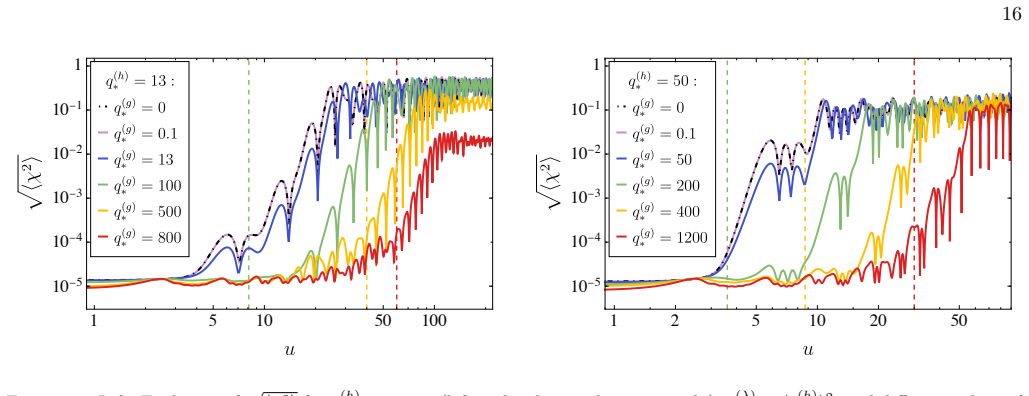
For q(g) ∗ < q (g) min ≈ 103, the system enters the nar- row resonance regime before the daughter field fluctuations fragment the inflaton
-
[4]
For q(g) ∗ < q (λ) ∗ , the quartic self-coupling leads to an early termination of the resonance, and the variance saturates at ⟨χ2⟩ ≈ q(g) ∗ ¯φ2/(3q(λ) ∗ )
-
[5]
For q(g) ∗ > q (λ) ∗ the fluctuations of the daugh- ter field grow exponentially until backreaction processes become relevant, fragmenting the in- flaton. In the latter case, this happens approx- imately when the condition ρ¯ϕ ≃ ρX holds, at time ubr ∼ 102, and the saturated variance of the daughter field scales as ⟨χ2⟩ ∼ (q(g) ∗ )−3/2 [69]. In the latter...
work page 2000
-
[6]
[68], where Λ and M have dimensions of en- 17 100 101 102 103 104 105 106 -1
Inflaton potential The lattice simulations presented in this work have been performed for the symmetric α-attractor T-model (3), see Ref. [68], where Λ and M have dimensions of en- 17 100 101 102 103 104 105 106 -1. -0.5 0. 0.5 1. 0.3 1. 2. 3. 4. 5. 6. 7. 8. 9. 100 101 102 103 104 105 -1. -0.5 0. 0.5 1. 0.3 1. 2. 3. 4. 5. 6. 7. Figure 11. Evolution of equ...
work page 2000
-
[7]
≃ 0.66M. For inflaton amplitudes ϕ ≲ ϕi the inflaton potential can be well approximated by the quadratic function (2). The slow-roll parameters take the following form, εV ≡ m2 pl 2 V ′ T VT 2 = 8m2 pl M2 sinh2 2|ϕ| M , (B1) ηV ≡ m2 pl V ′′ T VT = 8 2 − cosh 2|ϕ| M m2 pl M2 sinh2 2|ϕ| M . (B2) Let us define ϕe as the field amplitude when the condition εV ...
-
[8]
Energy ratios The energy and pressure densities of the two-field sys- tem considered in this work are ρ = 1 2 ϕ,XX f ˙f2 + 1 2a2 ϕ,XX f |∇f |2 + V (ϕ, X) , (B12) p = 1 2 ϕ,XX f ˙f2 − 1 6a2 ϕ,XX f |∇f |2 − V (ϕ, X) , (B13) where the potential V (ϕ, X) is given in Eq. (1). It is convenient to write these in terms of the natural variables (5)-(6) as follows,...
-
[9]
Comparison of simulations in 2+1 and 3+1 dimensions In the left panel of Fig. 12 we compare the evolu- tion of the daughter field spectrum obtained from lat- tice simulations in 3+1 (solid lines) and 2+1 dimensions (dashed lines), for the choice of parameters q(h) ∗ = 50 and q(λ) ∗ = 2500, obtained with a lattice of N = 256 points per dimension and infrar...
-
[10]
Coupling constants values The relations between the coupling parameters q(h) ∗ and q(λ) ∗ and the coupling constants h and λ are given by Eqs. (9) and (10). For the α-attractor T-model (3), which we have investigated withM = 5mpl and Nk = 55, they are related as follows, h ≡ ω2 ∗ ϕ∗ q(h) ∗ = 3.0 · 10−11 q(h) ∗ mpl, (B21) λ ≡ ω2 ∗ ϕ2∗ q(λ) ∗ = 2.2 · 10−11 ...
-
[11]
Let us consider some physical frequency today, fgw = k 2πa0
GW suppression factor Here we explain how to redshift the GW spectrum from preheating from the time the gravitational wave produc- tion ends uf until the present time u0. Let us consider some physical frequency today, fgw = k 2πa0 . (B23) We can express a0 in the following way 1 a0 = 1 af Hf af ae ae ard ard a0 Hf , (B24) where ae ≡ a(ue) denotes the scal...
-
[12]
Planck 2018 results. X. Constraints on inflation
Planck Collaboration, Y. Akrami et al., “Planck 2018 results. X. Constraints on inflation,” Astron. Astrophys. 641 (2020) A10, arXiv:1807.06211 [astro-ph.CO]
work page internal anchor Pith review Pith/arXiv arXiv 2018
-
[13]
A New Type of Isotropic Cosmological Models Without Singularity,
A. A. Starobinsky, “A New Type of Isotropic Cosmological Models Without Singularity,” Phys. Lett. B 91 (1980) 99–102
work page 1980
-
[14]
The Inflationary Universe: A Possible Solution to the Horizon and Flatness Problems,
A. H. Guth, “The Inflationary Universe: A Possible Solution to the Horizon and Flatness Problems,” Phys. Rev. D 23 (1981) 347–356. 20
work page 1981
-
[15]
A. D. Linde, “A New Inflationary Universe Scenario: A Possible Solution of the Horizon, Flatness, Homogeneity, Isotropy and Primordial Monopole Problems,” Phys. Lett. B 108 (1982) 389–393
work page 1982
-
[16]
Cosmology for Grand Unified Theories with Radiatively Induced Symmetry Breaking,
A. Albrecht and P. J. Steinhardt, “Cosmology for Grand Unified Theories with Radiatively Induced Symmetry Breaking,” Phys. Rev. Lett. 48 (1982) 1220–1223
work page 1982
-
[17]
BICEP, Keck Collaboration, P. A. R. Ade et al., “Improved Constraints on Primordial Gravitational Waves using Planck, WMAP, and BICEP/Keck Observations through the 2018 Observing Season,” Phys. Rev. Lett. 127 no. 15, (2021) 151301, arXiv:2110.00483 [astro-ph.CO]
-
[18]
The Atacama Cosmology Telescope: DR6 Power Spectra, Likelihoods and $\Lambda$CDM Parameters
ACT Collaboration, T. Louis et al., “The Atacama Cosmology Telescope: DR6 Power Spectra, Likelihoods and ΛCDM Parameters,” arXiv:2503.14452 [astro-ph.CO]
work page internal anchor Pith review Pith/arXiv arXiv
-
[19]
Reheating constraints to inflationary models
L. Dai, M. Kamionkowski, and J. Wang, “Reheating constraints to inflationary models,” Phys. Rev. Lett. 113 (2014) 041302, arXiv:1404.6704 [astro-ph.CO]
work page internal anchor Pith review Pith/arXiv arXiv 2014
-
[20]
Observing the Inflationary Reheating
J. Martin, C. Ringeval, and V. Vennin, “Observing Inflationary Reheating,” Phys. Rev. Lett. 114 no. 8, (2015) 081303, arXiv:1410.7958 [astro-ph.CO]
work page internal anchor Pith review Pith/arXiv arXiv 2015
-
[21]
Equation-of-State Parameter for Reheating
J. B. Munoz and M. Kamionkowski, “Equation-of-State Parameter for Reheating,” Phys. Rev. D 91 no. 4, (2015) 043521, arXiv:1412.0656 [astro-ph.CO]
work page internal anchor Pith review Pith/arXiv arXiv 2015
-
[22]
Probing reheating with primordial spectrum
J.-O. Gong, S. Pi, and G. Leung, “Probing reheating with primordial spectrum,” JCAP 05 (2015) 027, arXiv:1501.03604 [hep-ph]
work page internal anchor Pith review Pith/arXiv arXiv 2015
-
[23]
Reheating predictions in single field inflation
J. L. Cook, E. Dimastrogiovanni, D. A. Easson, and L. M. Krauss, “Reheating predictions in single field inflation,” JCAP 04 (2015) 047, arXiv:1502.04673 [astro-ph.CO]
work page internal anchor Pith review Pith/arXiv arXiv 2015
-
[24]
Cosmological Constraints on Late-time Entropy Production
M. Kawasaki, K. Kohri, and N. Sugiyama, “Cosmological constraints on late time entropy production,” Phys. Rev. Lett. 82 (1999) 4168, arXiv:astro-ph/9811437
work page internal anchor Pith review Pith/arXiv arXiv 1999
-
[25]
MeV-scale Reheating Temperature and Thermalization of Neutrino Background
M. Kawasaki, K. Kohri, and N. Sugiyama, “MeV scale reheating temperature and thermalization of neutrino background,” Phys. Rev. D 62 (2000) 023506, arXiv:astro-ph/0002127
work page internal anchor Pith review Pith/arXiv arXiv 2000
-
[26]
What is the lowest possible reheating temperature?
S. Hannestad, “What is the lowest possible reheating temperature?,” Phys. Rev. D 70 (2004) 043506, arXiv:astro-ph/0403291
work page internal anchor Pith review Pith/arXiv arXiv 2004
-
[27]
T. Hasegawa, N. Hiroshima, K. Kohri, R. S. L. Hansen, T. Tram, and S. Hannestad, “MeV-scale reheating temperature and thermalization of oscillating neutrinos by radiative and hadronic decays of massive particles,” JCAP 12 (2019) 012, arXiv:1908.10189 [hep-ph]
-
[28]
Particle Production During Out-of-equilibrium Phase Transitions,
J. H. Traschen and R. H. Brandenberger, “Particle Production During Out-of-equilibrium Phase Transitions,” Phys. Rev. D 42 (1990) 2491–2504
work page 1990
-
[29]
L. Kofman, A. D. Linde, and A. A. Starobinsky, “Reheating after inflation,” Phys. Rev. Lett. 73 (1994) 3195–3198, arXiv:hep-th/9405187
work page internal anchor Pith review Pith/arXiv arXiv 1994
-
[30]
Universe Reheating after Inflation
Y. Shtanov, J. H. Traschen, and R. H. Brandenberger, “Universe reheating after inflation,” Phys. Rev. D 51 (1995) 5438–5455, arXiv:hep-ph/9407247
work page internal anchor Pith review Pith/arXiv arXiv 1995
-
[31]
Post-Inflation Reheating in an Expanding Universe
D. I. Kaiser, “Post inflation reheating in an expanding universe,” Phys. Rev. D 53 (1996) 1776–1783, arXiv:astro-ph/9507108
work page internal anchor Pith review Pith/arXiv arXiv 1996
-
[32]
Towards the Theory of Reheating After Inflation
L. Kofman, A. D. Linde, and A. A. Starobinsky, “Towards the theory of reheating after inflation,” Phys. Rev. D 56 (1997) 3258–3295, arXiv:hep-ph/9704452
work page internal anchor Pith review Pith/arXiv arXiv 1997
-
[33]
Structure of Resonance in Preheating after Inflation
P. B. Greene, L. Kofman, A. D. Linde, and A. A. Starobinsky, “Structure of resonance in preheating after inflation,” Phys. Rev. D 56 (1997) 6175–6192, arXiv:hep-ph/9705347
work page internal anchor Pith review Pith/arXiv arXiv 1997
-
[34]
Preheating in an Expanding Universe: Analytic Results for the Massless Case
D. I. Kaiser, “Preheating in an expanding universe: Analytic results for the massless case,” Phys. Rev. D 56 (1997) 706–716, arXiv:hep-ph/9702244
work page internal anchor Pith review Pith/arXiv arXiv 1997
-
[35]
Resonance Structure for Preheating with Massless Fields
D. I. Kaiser, “Resonance structure for preheating with massless fields,” Phys. Rev. D 57 (1998) 702–711, arXiv:hep-ph/9707516
work page internal anchor Pith review Pith/arXiv arXiv 1998
-
[36]
Reheating in Inflationary Cosmology: Theory and Applications
R. Allahverdi, R. Brandenberger, F.-Y. Cyr-Racine, and A. Mazumdar, “Reheating in Inflationary Cosmology: Theory and Applications,” Ann. Rev. Nucl. Part. Sci. 60 (2010) 27–51, arXiv:1001.2600 [hep-th]
work page internal anchor Pith review Pith/arXiv arXiv 2010
-
[37]
Nonperturbative Dynamics Of Reheating After Inflation: A Review
M. A. Amin, M. P. Hertzberg, D. I. Kaiser, and J. Karouby, “Nonperturbative Dynamics Of Reheating After Inflation: A Review,” Int. J. Mod. Phys. D 24 (2014) 1530003, arXiv:1410.3808 [hep-ph]
work page internal anchor Pith review Pith/arXiv arXiv 2014
-
[38]
Lectures on Reheating after Inflation
K. D. Lozanov, “Lectures on Reheating after Inflation,” arXiv:1907.04402 [astro-ph.CO]
work page internal anchor Pith review Pith/arXiv arXiv 1907
-
[39]
R. Allahverdi et al., “The First Three Seconds: a Review of Possible Expansion Histories of the Early Universe,” Open J. Astrophys. 4 (2021) astro.2006.16182, arXiv:2006.16182 [astro-ph.CO]
-
[40]
Relativistic Turbulence: A Long Way from Preheating to Equilibrium
R. Micha and I. I. Tkachev, “Relativistic turbulence: A Long way from preheating to equilibrium,” Phys. Rev. Lett. 90 (2003) 121301, arXiv:hep-ph/0210202
work page internal anchor Pith review Pith/arXiv arXiv 2003
-
[41]
R. Micha and I. I. Tkachev, “Turbulent thermalization,” Phys. Rev. D 70 (2004) 043538, arXiv:hep-ph/0403101
work page internal anchor Pith review Pith/arXiv arXiv 2004
-
[42]
The art of simulating the early Universe – Part I,
D. G. Figueroa, A. Florio, F. Torrenti, and W. Valkenburg, “The art of simulating the early Universe – Part I,” JCAP 04 (2021) 035, arXiv:2006.15122 [astro-ph.CO]
- [43]
-
[44]
Equation of state and Beginning of Thermalization After Preheating
D. I. Podolsky, G. N. Felder, L. Kofman, and M. Peloso, “Equation of state and beginning of thermalization after preheating,” Phys. Rev. D 73 (2006) 023501, arXiv:hep-ph/0507096
work page internal anchor Pith review Pith/arXiv arXiv 2006
-
[45]
Preheating with Trilinear Interactions: Tachyonic Resonance
J. F. Dufaux, G. N. Felder, L. Kofman, M. Peloso, and D. Podolsky, “Preheating with trilinear interactions: Tachyonic resonance,” JCAP 07 (2006) 006, arXiv:hep-ph/0602144. 21
work page internal anchor Pith review Pith/arXiv arXiv 2006
-
[46]
Parametric Resonance in the Early Universe - A Fitting Analysis
D. G. Figueroa and F. Torrenti, “Parametric resonance in the early Universe—a fitting analysis,” JCAP 02 (2017) 001, arXiv:1609.05197 [astro-ph.CO]
work page internal anchor Pith review Pith/arXiv arXiv 2017
-
[47]
(P)reheating after minimal Plateau Inflation and constraints from CMB
D. Maity and P. Saha, “(P)reheating after minimal Plateau Inflation and constraints from CMB,” JCAP 07 (2019) 018, arXiv:1811.11173 [astro-ph.CO]
work page internal anchor Pith review Pith/arXiv arXiv 2019
-
[48]
Accounting for the time evolution of the equation of state parameter during reheating,
P. Saha, S. Anand, and L. Sriramkumar, “Accounting for the time evolution of the equation of state parameter during reheating,” Phys. Rev. D 102 no. 10, (2020) 103511, arXiv:2005.01874 [astro-ph.CO]
-
[49]
Reheating after inflaton fragmentation,
M. A. G. Garcia and M. Pierre, “Reheating after inflaton fragmentation,” JCAP 11 (2023) 004, arXiv:2306.08038 [hep-ph]
-
[50]
Effects of fragmentation on post-inflationary reheating,
M. A. G. Garcia, M. Gross, Y. Mambrini, K. A. Olive, M. Pierre, and J.-H. Yoon, “Effects of fragmentation on post-inflationary reheating,” JCAP 12 (2023) 028, arXiv:2308.16231 [hep-ph]
-
[51]
Potential surge preheating: enhanced resonance from potential features,
P. Saha and Y. Urakawa, “Potential surge preheating: enhanced resonance from potential features,” JCAP 04 (2025) 061, arXiv:2412.17359 [astro-ph.CO]
-
[52]
Preheating with Non-Minimal Kinetic Terms
H. L. Child, J. T. Giblin, Jr, R. H. Ribeiro, and D. Seery, “Preheating with Non-Minimal Kinetic Terms,” Phys. Rev. Lett. 111 (2013) 051301, arXiv:1305.0561 [astro-ph.CO]
work page internal anchor Pith review Pith/arXiv arXiv 2013
-
[53]
On preheating in α-attractor models of inflation,
T. Krajewski, K. Turzy´ nski, and M. Wieczorek, “On preheating in α-attractor models of inflation,” Eur. Phys. J. C 79 no. 8, (2019) 654, arXiv:1801.01786 [astro-ph.CO]
-
[54]
Nonlinear Dynamics of Preheating after Multifield Inflation with Nonminimal Couplings,
R. Nguyen, J. van de Vis, E. I. Sfakianakis, J. T. Giblin, and D. I. Kaiser, “Nonlinear Dynamics of Preheating after Multifield Inflation with Nonminimal Couplings,” Phys. Rev. Lett. 123 no. 17, (2019) 171301, arXiv:1905.12562 [hep-ph]
-
[55]
J. van de Vis, R. Nguyen, E. I. Sfakianakis, J. T. Giblin, and D. I. Kaiser, “Time scales for nonlinear processes in preheating after multifield inflation with nonminimal couplings,” Phys. Rev. D 102 no. 4, (2020) 043528, arXiv:2005.00433 [astro-ph.CO]
-
[56]
M. P. DeCross, D. I. Kaiser, A. Prabhu, C. Prescod-Weinstein, and E. I. Sfakianakis, “Preheating after Multifield Inflation with Nonminimal Couplings, I: Covariant Formalism and Attractor Behavior,” Phys. Rev. D 97 no. 2, (2018) 023526, arXiv:1510.08553 [astro-ph.CO]
work page internal anchor Pith review Pith/arXiv arXiv 2018
-
[57]
Preheating after multifield inflation with nonminimal couplings, II: Resonance Structure
M. P. DeCross, D. I. Kaiser, A. Prabhu, C. Prescod-Weinstein, and E. I. Sfakianakis, “Preheating after multifield inflation with nonminimal couplings, II: Resonance Structure,” Phys. Rev. D 97 no. 2, (2018) 023527, arXiv:1610.08868 [astro-ph.CO]
work page internal anchor Pith review Pith/arXiv arXiv 2018
-
[58]
Preheating after multifield inflation with nonminimal couplings, III: Dynamical spacetime results
M. P. DeCross, D. I. Kaiser, A. Prabhu, C. Prescod-Weinstein, and E. I. Sfakianakis, “Preheating after multifield inflation with nonminimal couplings, III: Dynamical spacetime results,” Phys. Rev. D 97 no. 2, (2018) 023528, arXiv:1610.08916 [astro-ph.CO]
work page internal anchor Pith review Pith/arXiv arXiv 2018
-
[59]
Stochastic Gravitational Wave Production After Inflation
R. Easther and E. A. Lim, “Stochastic gravitational wave production after inflation,” JCAP 04 (2006) 010, arXiv:astro-ph/0601617
work page internal anchor Pith review Pith/arXiv arXiv 2006
-
[60]
A stochastic background of gravitational waves from hybrid preheating
J. Garcia-Bellido and D. G. Figueroa, “A stochastic background of gravitational waves from hybrid preheating,” Phys. Rev. Lett. 98 (2007) 061302, arXiv:astro-ph/0701014
work page internal anchor Pith review Pith/arXiv arXiv 2007
-
[61]
A Gravitational Wave Background from Reheating after Hybrid Inflation
J. Garcia-Bellido, D. G. Figueroa, and A. Sastre, “A Gravitational Wave Background from Reheating after Hybrid Inflation,” Phys. Rev. D 77 (2008) 043517, arXiv:0707.0839 [hep-ph]
work page internal anchor Pith review Pith/arXiv arXiv 2008
-
[62]
Theory and Numerics of Gravitational Waves from Preheating after Inflation
J. F. Dufaux, A. Bergman, G. N. Felder, L. Kofman, and J.-P. Uzan, “Theory and Numerics of Gravitational Waves from Preheating after Inflation,” Phys. Rev. D 76 (2007) 123517, arXiv:0707.0875 [astro-ph]
work page internal anchor Pith review Pith/arXiv arXiv 2007
-
[63]
Gravity Waves from Tachyonic Preheating after Hybrid Inflation
J.-F. Dufaux, G. Felder, L. Kofman, and O. Navros, “Gravity Waves from Tachyonic Preheating after Hybrid Inflation,” JCAP 03 (2009) 001, arXiv:0812.2917 [astro-ph]
work page internal anchor Pith review Pith/arXiv arXiv 2009
-
[64]
Gravitational Waves from Abelian Gauge Fields and Cosmic Strings at Preheating
J.-F. Dufaux, D. G. Figueroa, and J. Garcia-Bellido, “Gravitational Waves from Abelian Gauge Fields and Cosmic Strings at Preheating,” Phys. Rev. D 82 (2010) 083518, arXiv:1006.0217 [astro-ph.CO]
work page internal anchor Pith review Pith/arXiv arXiv 2010
-
[65]
Anisotropies in the Gravitational Wave Background from Preheating
L. Bethke, D. G. Figueroa, and A. Rajantie, “Anisotropies in the Gravitational Wave Background from Preheating,” Phys. Rev. Lett. 111 no. 1, (2013) 011301, arXiv:1304.2657 [astro-ph.CO]
work page internal anchor Pith review Pith/arXiv arXiv 2013
-
[66]
On the Anisotropy of the Gravitational Wave Background from Massless Preheating
L. Bethke, D. G. Figueroa, and A. Rajantie, “On the Anisotropy of the Gravitational Wave Background from Massless Preheating,” JCAP 06 (2014) 047, arXiv:1309.1148 [astro-ph.CO]
work page internal anchor Pith review Pith/arXiv arXiv 2014
-
[67]
Gravitational wave production from preheating: parameter dependence
D. G. Figueroa and F. Torrenti, “Gravitational wave production from preheating: parameter dependence,” JCAP 10 (2017) 057, arXiv:1707.04533 [astro-ph.CO]
work page internal anchor Pith review Pith/arXiv arXiv 2017
-
[68]
Gravitational Waves from Gauge Preheating,
P. Adshead, J. T. Giblin, and Z. J. Weiner, “Gravitational waves from gauge preheating,” Phys. Rev. D 98 no. 4, (2018) 043525, arXiv:1805.04550 [astro-ph.CO]
-
[69]
P. Adshead, J. T. Giblin, M. Pieroni, and Z. J. Weiner, “Constraining axion inflation with gravitational waves from preheating,” Phys. Rev. D 101 no. 8, (2020) 083534, arXiv:1909.12842 [astro-ph.CO]
-
[70]
P. Adshead, J. T. Giblin, M. Pieroni, and Z. J. Weiner, “Constraining Axion Inflation with Gravitational Waves across 29 Decades in Frequency,” Phys. Rev. Lett. 124 no. 17, (2020) 171301, arXiv:1909.12843 [astro-ph.CO]
-
[71]
Coherent Scalar Field Oscillations in an Expanding Universe,
M. S. Turner, “Coherent Scalar Field Oscillations in an Expanding Universe,” Phys. Rev. D 28 (1983) 1243
work page 1983
-
[72]
The Equation of State and Duration to Radiation Domination After Inflation
K. D. Lozanov and M. A. Amin, “Equation of State and Duration to Radiation Domination after Inflation,” Phys. Rev. Lett. 119 no. 6, (2017) 061301, arXiv:1608.01213 [astro-ph.CO] . 22
work page internal anchor Pith review Pith/arXiv arXiv 2017
-
[73]
Self-resonance after inflation: oscillons, transients and radiation domination
K. D. Lozanov and M. A. Amin, “Self-resonance after inflation: oscillons, transients and radiation domination,” Phys. Rev. D 97 no. 2, (2018) 023533, arXiv:1710.06851 [astro-ph.CO]
work page internal anchor Pith review Pith/arXiv arXiv 2018
-
[74]
S. Antusch, D. G. Figueroa, K. Marschall, and F. Torrenti, “Energy distribution and equation of state of the early Universe: matching the end of inflation and the onset of radiation domination,” Phys. Lett. B 811 (2020) 135888, arXiv:2005.07563 [astro-ph.CO]
-
[75]
S. Antusch, D. G. Figueroa, K. Marschall, and F. Torrenti, “Characterizing the postinflationary reheating history: Single daughter field with quadratic-quadratic interaction,” Phys. Rev. D 105 no. 4, (2022) 043532, arXiv:2112.11280 [astro-ph.CO]
- [76]
-
[77]
S. Antusch, K. Marschall, and F. Torrenti, “Characterizing the post-inflationary reheating history. Part II. Multiple interacting daughter fields,” JCAP 02 (2023) 019, arXiv:2206.06319 [astro-ph.CO]
-
[78]
Gravitational wave production from preheating with trilinear interactions,
C. Cosme, D. G. Figueroa, and N. Loayza, “Gravitational wave production from preheating with trilinear interactions,” JCAP 05 (2023) 023, arXiv:2206.14721 [astro-ph.CO]
-
[79]
Universality Class in Conformal Inflation
R. Kallosh and A. Linde, “Universality Class in Conformal Inflation,” JCAP 07 (2013) 002, arXiv:1306.5220 [hep-th]
work page internal anchor Pith review Pith/arXiv arXiv 2013
-
[80]
Resonant decay of Bose condensates
S. Y. Khlebnikov and I. I. Tkachev, “Resonant decay of Bose condensates,” Phys. Rev. Lett. 79 (1997) 1607–1610, arXiv:hep-ph/9610477
work page internal anchor Pith review Pith/arXiv arXiv 1997
discussion (0)
Sign in with ORCID, Apple, or X to comment. Anyone can read and Pith papers without signing in.