REVIEW 4 major objections 7 minor 1 cited by
Reviewed by Pith at T0; open to challenge.
T0 means a machine referee read the full paper against a public rubric. The mark states how deep the mechanical check went, never who wrote it. the ladder, T0–T4 →
T0 review · glm-5.2
Interactive world model sustains hour-long real-time video generation
2026-07-09 07:39 UTC pith:CQZV3HO7
load-bearing objection Open-source interactive world model with hour-long rollout claims, but stability evidence is qualitative only and self-contradicted by the paper's own limitations section. the 4 major comments →
Infinite Worlds with Versatile Interactions
The pith
A machine-rendered reading of the paper's core claim, the machinery that carries it, and where it could break.
Core claim
The paper's central claim is that long-horizon drift in autoregressive video world models can be suppressed to the point of practical irrelevance by combining (1) a hybrid attention mask (MoBA) that regularizes pure teacher forcing during pretraining, preventing the model from passively copying context rather than predicting future frames, with (2) distribution matching distillation applied over the model's own long self-rollout trajectories, so the student is optimized on the distribution of states it will actually encounter at deployment time rather than only on teacher-forced states. The authors present a single 60-minute uninterrupted rollout across 20 scenarios as evidence that this is,
What carries the argument
Mixture of Bidirectional and Autoregressive (MoBA) attention mask, Distribution Matching Distillation (DMD) on self-rollout trajectories, Director-Pilot agentic harness
Load-bearing premise
The hour-long stability claim rests on a single qualitative rollout with no quantitative drift metric, no multiple seeds, and no automated quality assessment across the 60-minute timeline, so the assertion that stability is structural rather than clip-specific is not rigorously established.
What would settle it
Run multiple independent hour-long rollouts across different initial scenes and action sequences, measuring per-frame quality metrics (FID, LPIPS, temporal consistency) across the full timeline. If quality degrades measurably in any run, the structural-stability claim is weakened.
If this is right
- If the anti-drift mechanism generalizes beyond the demonstrated rollout, interactive video world models could become practical backends for open-ended game environments and embodied simulation, replacing hand-authored content pipelines with generative ones.
- The Director-Pilot architecture suggests a separation of concerns — semantic reasoning in language models, physical rendering in diffusion models — that could become a standard design pattern for interactive AI systems where causal reasoning and pixel-level generation require different computational substrates.
- The release of both a 14B base model and a 1.3B distilled variant on a single GPU lowers the deployment barrier enough that independent developers could build on real-time interactive world generation without proprietary infrastructure.
Where Pith is reading between the lines
- The paper attributes stability jointly to MoBA and to DMD-on-self-rollout, but does not isolate their contributions through ablation. If the self-rollout DMD is the dominant factor, the MoBA mask may be replaceable by simpler regularization, which would simplify future training pipelines.
- The hour-long stability claim rests on a single qualitative rollout with no quantitative drift metric (FID, LPIPS, temporal consistency) measured across the timeline. A natural testable extension would be to run multiple seeds and scenarios with automated quality scoring to determine whether stability holds uniformly or is scenario-dependent.
- The paper acknowledges that the model lacks genuine long-term memory — revisited regions are regenerated rather than recalled. This implies the world is persistent in appearance but not in identity, which would become visible in any task requiring the agent to reference a previously visited location by its specific features rather than its general category.
Editorial analysis
A structured set of objections, weighed in public.
Referee Report
Summary. The paper presents LingBot-World 2.0 (LingBot-World-Infinity), an interactive causal video world model with four claimed advances: (1) hour-long stable generation via causal pretraining with a Mixture of Bidirectional and Autoregressive (MoBA) attention mask, (2) real-time 720p/60fps distilled model via consistency + distribution matching distillation, (3) a rich action space (combat, archery, spell-casting, shooting, environmental events), and (4) a Director-Pilot agentic harness where a VLM proposes events and a video generator renders them. The system is released with checkpoints and code. The central empirical claim is that the distilled model sustains drift-free interactive generation for over an hour, demonstrated via a single 60-minute rollout (Fig. 10) across 20 scenarios.
Significance. The paper tackles a genuine and important problem in interactive world modeling: long-horizon stability under autoregressive error accumulation. The combination of MoBA attention, DMD-on-self-rollout training, and the Director-Pilot harness is a reasonable engineering response. The release of checkpoints, code, and a real-time system at 720p/60fps is a concrete community contribution. However, the load-bearing claim of hour-long drift-free generation is supported only by qualitative evidence, and the paper's own Limitations section partially contradicts the headline. The MoBA and DMD contributions are not individually ablated, making causal attribution of the stability claim difficult.
major comments (4)
- Sec. 5.1, contributions bullet 2, and Fig. 10: The claim that the model is 'verified by over an hour of continuous generation without quality loss' and that 'visual quality shows no perceptible decay' is supported solely by a single qualitative rollout with selected frames at ~20 timestamps. There are no quantitative drift metrics (FID, LPIPS, temporal consistency, action-response accuracy), no multiple seeds, and no baseline comparison on the same long-horizon protocol. For a claim described as 'verified' and 'structural,' this evidence is insufficient. At minimum, the authors should compute frame-level or chunk-level quality metrics across the 60-minute timeline and report them, ideally across multiple sessions.
- Sec. 6 (Limitations) vs. Sec. 5.1 and contributions bullet 2: The Limitations section states 'specific characters can subtly change in appearance and the overall art style may gradually drift' over very long rollouts. This directly contradicts the headline claim of 'drift-free' generation and 'no perceptible decay.' The authors should either soften the headline claim to match the acknowledged limitations (e.g., 'low drift' with quantified boundaries) or remove the 'drift-free' language from the abstract, contributions, and Sec. 5.1.
- Sec. 3.2 (MoBA) and Sec. 3.3 (DMD-on-self-rollout): Both the MoBA attention mask and the DMD self-rollout training are motivated as anti-drift mechanisms, but no ablation isolates the contribution of either. The claim that stability is 'structural' and attributable to the causal pretraining paradigm cannot be verified without knowing whether MoBA, DMD-on-self-rollout, or their combination is responsible. An ablation table reporting drift metrics (even qualitative degradation timestamps) for: (a) teacher forcing only, (b) MoBA only, (c) DMD-on-teacher-forced states only, (d) both combined, would substantially strengthen the contribution.
- Table 1: The comparison table uses categorical labels ('Minutes' vs 'Hours (Infinite)') for generation duration without quantitative measurements. Claiming 'Hours (Infinite)' for the proposed model while labeling all baselines as 'Minutes' is not a fair comparison unless the baselines were tested under the same long-horizon protocol and failed. The table should either report measured maximum stable durations for all models or clearly state that baseline entries are based on published reports.
minor comments (7)
- Sec. 3.1: The Hume epigraph is decorative and does not contribute to the technical exposition. Consider removing.
- Sec. 3.2, Fig. 4: The MoBA mask is described verbally but the exact mask structure (which frames attend bidirectionally vs. autoregressively) is not fully specified. A formal matrix definition or clearer diagram annotation would aid reproducibility.
- Sec. 4.3.2: The dynamic KV-cache management mechanism is described qualitatively ('adapt the cache on the fly according to the current control signal and input state') but the scheduling policy, retention criteria, and cache size budget are not specified.
- Fig. 11 and Fig. 12: The qualitative comparisons show frames at 5s, 15s, 25s, 35s, 45s, 60s for baselines and the proposed model, but no metric is provided to quantify the visual differences. Even a simple FID or CLIP-score per timestamp would strengthen the comparison.
- Sec. 2: The data pipeline is described in detail but the total dataset size (number of videos, hours of footage) is not reported. This makes it difficult to assess the training data's adequacy.
- The paper uses both 'LingBot-World 2.0' and 'LingBot-World-Infinity' interchangeably. Consider standardizing on one name.
- Sec. 4.2: The Director-Pilot framework is described as a 'novel' contribution, but the relationship to prior LLM-directed video generation work (e.g., Free-Bloom [25], LLM-Grounded Video Diffusion [29]) should be discussed to position the contribution.
Simulated Author's Rebuttal
We thank the referee for a careful and constructive review. The referee identifies four substantive issues: (1) insufficient quantitative evidence for the hour-long stability claim, (2) a contradiction between the headline 'drift-free' language and the Limitations section, (3) missing ablations for MoBA and DMD-on-self-rollout, and (4) unfair categorical labels in Table 1. We agree with the substance of all four points and will revise accordingly. Below we address each in turn.
read point-by-point responses
-
Referee: Sec. 5.1, contributions bullet 2, and Fig. 10: The claim that the model is 'verified by over an hour of continuous generation without quality loss' and that 'visual quality shows no perceptible decay' is supported solely by a single qualitative rollout with selected frames at ~20 timestamps. There are no quantitative drift metrics, no multiple seeds, and no baseline comparison on the same long-horizon protocol.
Authors: The referee is correct that the current evidence for the hour-long stability claim is purely qualitative. We will address this by computing frame-level and chunk-level quality metrics (FID, LPIPS, temporal consistency via optical-flow warping error, and action-response accuracy) across the full 60-minute timeline, sampled at regular intervals. We will additionally run at least three independent 60-minute sessions with different seeds and report the metrics across all sessions. We will present these as a quantitative drift curve alongside the existing qualitative figure. We acknowledge that the single-rollout evidence in the current manuscript is insufficient to support the word 'verified,' and we will adjust our language accordingly. revision: yes
-
Referee: Sec. 6 (Limitations) vs. Sec. 5.1 and contributions bullet 2: The Limitations section states 'specific characters can subtly change in appearance and the overall art style may gradually drift' over very long rollouts. This directly contradicts the headline claim of 'drift-free' generation and 'no perceptible decay.'
Authors: The referee has identified a genuine internal contradiction in the manuscript. The Limitations section acknowledges that subtle character appearance changes and gradual art-style drift can occur over very long rollouts, while the abstract, contributions, and Sec. 5.1 use the language 'drift-free' and 'no perceptible decay.' These two statements cannot both be true. We will resolve this by removing the absolute term 'drift-free' from the abstract, contributions list, and Sec. 5.1, replacing it with a more precise characterization such as 'low drift' or 'substantially reduced drift,' accompanied by the quantitative boundaries from the new drift metrics described in our response to Comment 1. The Limitations text will be retained and, where appropriate, sharpened to reference the measured drift rates so that the headline claim and the acknowledged limitations are consistent. revision: yes
-
Referee: Sec. 3.2 (MoBA) and Sec. 3.3 (DMD-on-self-rollout): Both the MoBA attention mask and the DMD self-rollout training are motivated as anti-drift mechanisms, but no ablation isolates the contribution of either. The claim that stability is 'structural' and attributable to the causal pretraining paradigm cannot be verified without knowing whether MoBA, DMD-on-self-rollout, or their combination is responsible.
Authors: We agree that the current manuscript does not provide the ablations needed to attribute the stability improvement to specific components. We will conduct and report a 2x2 ablation along the lines the referee suggests: (a) teacher forcing only (no MoBA, no DMD-on-self-rollout), (b) MoBA only, (c) DMD-on-self-rollout applied to a teacher-forced backbone (no MoBA), and (d) both combined. For each configuration, we will report the same drift metrics (FID, LPIPS, temporal consistency) measured over a fixed long-horizon protocol (e.g., 30 minutes), as well as qualitative degradation timestamps. This will allow causal attribution of the stability properties to MoBA, DMD-on-self-rollout, or their interaction. We will also soften the claim that stability is 'structural' until the ablation results justify the specific attribution. revision: yes
-
Referee: Table 1: The comparison table uses categorical labels ('Minutes' vs 'Hours (Infinite)') for generation duration without quantitative measurements. Claiming 'Hours (Infinite)' for the proposed model while labeling all baselines as 'Minutes' is not a fair comparison unless the baselines were tested under the same long-horizon protocol and failed.
Authors: The referee is right that the categorical labels in Table 1 are not backed by a controlled comparison. We will revise Table 1 in one of two ways, depending on feasibility: (Option A) If we can obtain and run the open-source baselines (M-G 3.0, D-W, LingBot-World 1.0, SANA-WM) under the same long-horizon protocol, we will report measured maximum stable durations for all models. (Option B) If running all baselines for extended periods is not feasible due to compute or access constraints, we will clearly annotate each baseline entry with its source (e.g., 'per published report' or 'our measurement') and replace the categorical labels with the specific durations cited. In either case, we will remove the label 'Hours (Infinite)' for our own model and replace it with the measured stable duration from our quantitative evaluation, and we will add a footnote clarifying the protocol under which each duration was determined. revision: yes
Circularity Check
No significant circularity: the paper's claims are empirical, not derived from self-cited premises by construction.
full rationale
The paper describes an interactive world model system (LingBot-World-Infinity) with four claimed upgrades: long-horizon stability, real-time distillation, diverse interactions, and an agentic harness. The central claim—hour-long stability—is an empirical assertion verified (or under-verified, per the skeptic) by a single 60-minute rollout (Fig. 10), not a quantity derived from equations or prior cited results. The technical derivations (Eqs. 1–4) are standard formulations: Eq. 1 is the causal factorization of a video sequence, Eqs. 2–4 are flow-matching, consistency distillation, and DMD objectives drawn from external methods (rectified flow, consistency models [39], DMD [58]). None of these equations reduce to their own inputs by construction. The paper does cite its predecessor LingBot-World 1.0 [44] and related work by overlapping authors (CausalCine [32], WorldDirector [46]), but these citations provide context or architectural choices, not load-bearing premises from which the paper's results are derived. The MoBA attention mask (Sec. 3.2) is a proposed architectural component, not a result claimed to follow from a self-cited theorem. The distillation pipeline (Sec. 3.3) combines externally established techniques (consistency distillation, DMD, self-forcing [26]) without circular dependency. The under-verification of the stability claim (single qualitative rollout, no quantitative drift metrics, Limitations section acknowledging drift) is a correctness and evidence concern, not a circularity issue—the claim is not constructed to be true by definition. No step in the paper's chain reduces to its inputs by construction.
Axiom & Free-Parameter Ledger
free parameters (5)
- Model architecture hyperparameters (N DiT blocks, hidden dim, attention heads) =
Not stated
- Training data volume and composition =
Not stated
- DMD self-rollout trajectory length =
Not stated
- KV-cache scheduling policy parameters =
Not stated
- Consistency distillation step size (Δt) =
Not stated
axioms (5)
- domain assumption Causal factorization of video generation (Eq. 1): each state depends solely on historical context and current input.
- domain assumption Teacher forcing causes overfitting and quality degradation as context grows, motivating MoBA mask.
- domain assumption DMD over self-rollout trajectories reduces accumulated drift.
- domain assumption VLM-based Director can perform causal reasoning sufficient for world simulation.
- standard math Rectified-flow interpolation is the correct training target for flow matching.
invented entities (2)
-
MoBA (Mixture of Bidirectional and Autoregressive) Attention Mask
no independent evidence
-
Director-Pilot Co-Simulation Framework
no independent evidence
read the original abstract
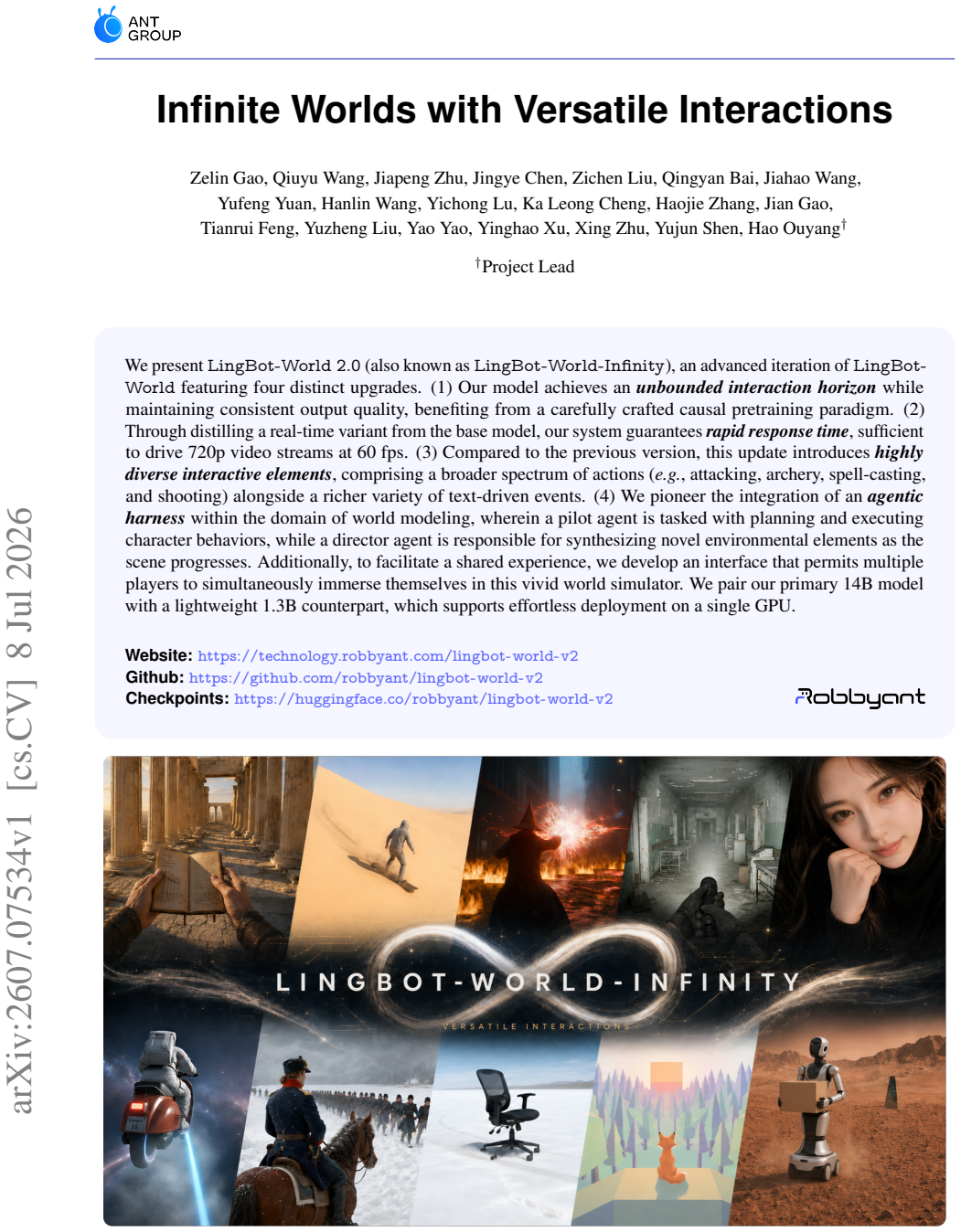
We present LingBot-World 2.0 (also known as LingBot-World-Infinity), an advanced iteration of LingBot-World featuring four distinct upgrades. (1) Our model achieves an unbounded interaction horizon while maintaining consistent output quality, benefiting from a carefully crafted causal pretraining paradigm. (2) Through distilling a real-time variant from the base model, our system guarantees rapid response time, sufficient to drive 720p video streams at 60 fps. (3) Compared to the previous version, this update introduces highly diverse interactive elements, comprising a broader spectrum of actions (e.g., attacking, archery, spell-casting, and shooting) alongside a richer variety of text-driven events. (4) We pioneer the integration of an agentic harness within the domain of world modeling, wherein a pilot agent is tasked with planning and executing character behaviors, while a director agent is responsible for synthesizing novel environmental elements as the scene progresses. Additionally, to facilitate a shared experience, we develop an interface that permits multiple players to simultaneously immerse themselves in this vivid world simulator. We pair our primary 14B model with a lightweight 1.3B counterpart, which supports effortless deployment on a single GPU.
Figures


Forward citations
Cited by 1 Pith paper
-
Native Video-Action Pretraining for Generalizable Robot Control
A video-action foundation model pretrained natively for embodiment achieves few-shot generalization and 225 Hz real-time closed-loop robot control.
Reference graph
Works this paper leans on
-
[1]
Cosmos 3: Omnimodal World Models for Physical AI
Niket Agarwal, Arslan Ali, Jon Allen, Martin Antolini, Adeline Aubame, Alisson Azzolini, Junjie Bai, Maciej Bala, Yogesh Balaji, Josh Bapst, et al. Cosmos 3: Omnimodal world models for physical ai.arXiv preprint arXiv:2606.02800, 2026
work page internal anchor Pith review Pith/arXiv arXiv 2026
- [2]
-
[3]
Philip J. Ball, Jakob Bauer, Frank Belletti, Bethanie Brownfield, Ariel Ephrat, Shlomi Fruchter, Agrim Gupta, Kristian Holsheimer, Aleksander Holynski, Jiri Hron, Christos Kaplanis, Marjorie Limont, Matt McGill, Yanko Oliveira, Jack Parker- Holder, Frank Perbet, Guy Scully, Jeremy Shar, Stephen Spencer, Omer Tov, Ruben Villegas, Emma Wang, Jessica Yung, C...
work page 2025
-
[4]
My view is the best view: Procedure learning from egocentric videos
Siddhant Bansal, Chetan Arora, and CV Jawahar. My view is the best view: Procedure learning from egocentric videos. In European Conference on Computer Vision. Springer, 2022
work page 2022
-
[5]
Gamegen-x: Interactive open-world game video generation
Haoxuan Che, Xuanhua He, Quande Liu, Cheng Jin, and Hao Chen. Gamegen-x: Interactive open-world game video generation. InInt. Conf. Learn. Represent., 2025
work page 2025
-
[6]
Cong Chen, Guo Gan, Kaixiang Ji, ZhaoYang Zhang, Zhen Yang, Guangming Yao, Hao Chen, Jingdong Chen, Yi Yuan, and Chunhua Shen. Memdreamer: Decoupling perception and reasoning for long video understanding via hierarchical graph memory and agentic retrieval mechanism, 2026. 16
work page 2026
-
[7]
SkyReels-V2: Infinite-length Film Generative Model
Guibin Chen, Dixuan Lin, Jiangping Yang, Chunze Lin, Junchen Zhu, Mingyuan Fan, Hao Zhang, Sheng Chen, Zheng Chen, Chengcheng Ma, et al. Skyreels-v2: Infinite-length film generative model.arXiv preprint arXiv:2504.13074, 2025
work page internal anchor Pith review Pith/arXiv arXiv 2025
-
[8]
Panda-70m: Captioning 70m videos with multiple cross-modality teachers
Tsai-Shien Chen, Aliaksandr Siarohin, Willi Menapace, Ekaterina Deyneka, Hsiang-wei Chao, Byung Eun Jeon, Yuwei Fang, Hsin-Ying Lee, Jian Ren, Ming-Hsuan Yang, et al. Panda-70m: Captioning 70m videos with multiple cross-modality teachers. InInt. Conf. Comput. Vis., 2024
work page 2024
-
[9]
LongLive-2.0: An NVFP4 Parallel Infrastructure for Long Video Generation
Yukang Chen, Luozhou Wang, Wei Huang, Shuai Yang, Bohan Zhang, Yicheng Xiao, Ruihang Chu, Weian Mao, Qixin Hu, Shaoteng Liu, Yuyang Zhao, Huizi Mao, Ying-Cong Chen, Enze Xie, Xiaojuan Qi, and Song Han. Longlive2.0: An nvfp4 parallel infrastructure for long video generation.arXiv preprint arXiv: 2605.18739, 2026
work page internal anchor Pith review Pith/arXiv arXiv 2026
-
[10]
Abot-physworld: Interactive world foundation model for robotic manipulation with physics alignment
Yuzhi Chen, Ronghan Chen, Dongjie Huo, Yandan Yang, Dekang Qi, Haoyun Liu, Tong Lin, Shuang Zeng, Junjin Xiao, Xinyuan Chang, et al. Abot-physworld: Interactive world foundation model for robotic manipulation with physics alignment. arXiv preprint arXiv:2603.23376, 2026
-
[11]
PaddleOCR 3.0 Technical Report
Cheng Cui, Ting Sun, Manhui Lin, Tingquan Gao, Yubo Zhang, Jiaxuan Liu, Xueqing Wang, Zelun Zhang, Changda Zhou, Hongen Liu, et al. Paddleocr 3.0 technical report.arXiv preprint arXiv:2507.05595, 2025
work page internal anchor Pith review Pith/arXiv arXiv 2025
-
[12]
Dima Damen, Hazel Doughty, Giovanni Maria Farinella, Sanja Fidler, Antonino Furnari, Evangelos Kazakos, Davide Moltisanti, Jonathan Munro, Toby Perrett, Will Price, et al. The epic-kitchens dataset: Collection, challenges and baselines.IEEE Transactions on Pattern Analysis and Machine Intelligence, 2020
work page 2020
-
[13]
xDiT: an Inference Engine for Diffusion Transformers (DiTs) with Massive Parallelism
Jiarui Fang, Jinzhe Pan, Xibo Sun, Aoyu Li, and Jiannan Wang. xdit: an inference engine for diffusion transformers (dits) with massive parallelism.ArXiv, abs/2411.01738, 2024
work page internal anchor Pith review Pith/arXiv arXiv 2024
-
[14]
Streamdiffusionv2: A streaming system for dynamic and interactive video generation
Tianrui Feng, Zhi Li, Shuo Yang, Haocheng Xi, Muyang Li, Xiuyu Li, Lvmin Zhang, Keting Yang, Kelly Peng, Song Han, et al. Streamdiffusionv2: A streaming system for dynamic and interactive video generation. InMLSYS, 2026
work page 2026
-
[15]
FlashDreams Contributors. Flashdreams: High-performance inference and serving for interactive autoregressive video and world models.https://github.com/NVIDIA/flashdreams, 2026
work page 2026
-
[16]
Gigaworld-0: World models as data engine to empower embodied ai, 2025
GigaAI. Gigaworld-0: World models as data engine to empower embodied ai, 2025
work page 2025
-
[17]
Kristen Grauman, Andrew Westbury, Eugene Byrne, Zachary Chavis, Antonino Furnari, Rohit Girdhar, Jackson Hamburger, Hao Jiang, Miao Liu, Xingyu Liu, Miguel Martin, Tushar Nagarajan, Ilija Radosavovic, Santhosh Kumar Ramakrishnan, Fiona Ryan, Jayant Sharma, Michael Wray, Mengmeng Xu, Eric Zhongcong Xu, Chen Zhao, Siddhant Bansal, Dhruv Batra, Vincent Carti...
work page 2022
-
[18]
LTX-Video: Realtime Video Latent Diffusion
Yoav HaCohen, Nisan Chiprut, Benny Brazowski, Daniel Shalem, Dudu Moshe, Eitan Richardson, Eran Levin, Guy Shiran, Nir Zabari, Ori Gordon, Poriya Panet, Sapir Weissbuch, Victor Kulikov, Yaki Bitterman, Zeev Melumian, and Ofir Bibi. Ltx-video: Realtime video latent diffusion.arXiv preprint arXiv:2501.00103, 2024
work page internal anchor Pith review Pith/arXiv arXiv 2024
-
[19]
Happy oyster: Real-time world model for interactive creation, 2026
Happy Oyster. Happy oyster: Real-time world model for interactive creation, 2026
work page 2026
-
[20]
CameraCtrl: Enabling Camera Control for Text-to-Video Generation
Hao He, Yinghao Xu, Yuwei Guo, Gordon Wetzstein, Bo Dai, Hongsheng Li, and Ceyuan Yang. Cameractrl: Enabling camera control for text-to-video generation.arXiv preprint arXiv:2404.02101, 2024
work page internal anchor Pith review Pith/arXiv arXiv 2024
-
[21]
Cameractrl ii: Dynamic scene exploration via camera-controlled video diffusion models
Hao He, Ceyuan Yang, Shanchuan Lin, Yinghao Xu, Meng Wei, Liangke Gui, Qi Zhao, Gordon Wetzstein, Lu Jiang, and Hongsheng Li. Cameractrl ii: Dynamic scene exploration via camera-controlled video diffusion models. InIEEE Conf. Comput. Vis. Pattern Recog., 2025
work page 2025
-
[22]
Matrix-game 2.0: An open-source real-time and streaming interactive world model
Xianglong He, Chunli Peng, Zexiang Liu, Boyang Wang, Yifan Zhang, Qi Cui, Fei Kang, Biao Jiang, Mengyin An, Yangyang Ren, et al. Matrix-game 2.0: An open-source real-time and streaming interactive world model.arXiv preprint arXiv:2508.13009, 2025
work page internal anchor Pith review Pith/arXiv arXiv 2025
-
[23]
Yoon, Mouli Sivapurapu, and Jian Zhang
Ryan Hoque, Peide Huang, David J. Yoon, Mouli Sivapurapu, and Jian Zhang. Egodex: Learning dexterous manipulation from large-scale egocentric video, 2025. 17
work page 2025
-
[24]
StoryAgent: Customized Storytelling Video Generation via Multi-Agent Collaboration
Panwen Hu, Jin Jiang, Jianqi Chen, Mingfei Han, Shengcai Liao, Xiaojun Chang, and Xiaodan Liang. Storyagent: Customized storytelling video generation via multi-agent collaboration.ArXiv, abs/2411.04925, 2024
work page internal anchor Pith review Pith/arXiv arXiv 2024
-
[25]
Free-Bloom: Zero-Shot Text-to-Video Generator with LLM Director and LDM Animator
Hanzhuo Huang, Yufan Feng, Cheng Shi, Lan Xu, Jingyi Yu, and Sibei Yang. Free-bloom: Zero-shot text-to-video generator with llm director and ldm animator.ArXiv, abs/2309.14494, 2023
work page internal anchor Pith review Pith/arXiv arXiv 2023
-
[26]
Self Forcing: Bridging the Train-Test Gap in Autoregressive Video Diffusion
Xun Huang, Zhengqi Li, Guande He, Mingyuan Zhou, and Eli Shechtman. Self forcing: Bridging the train-test gap in autoregressive video diffusion.arXiv preprint arXiv:2506.08009, 2025
work page internal anchor Pith review Pith/arXiv arXiv 2025
-
[27]
David Hume.A treatise of human nature. Oxford University Press, 2000
work page 2000
-
[28]
Epic-tent: An egocentric video dataset for camping tent assembly
Youngkyoon Jang, Brian Sullivan, Casimir Ludwig, Iain Gilchrist, Dima Damen, and Walterio Mayol-Cuevas. Epic-tent: An egocentric video dataset for camping tent assembly. InProceedings of the IEEE/CVF International Conference on Computer Vision Workshops, 2019
work page 2019
-
[29]
Llm-grounded video diffusion models
Long Lian, Baifeng Shi, Adam Yala, Boyi Li, et al. Llm-grounded video diffusion models. InInt. Conf. Learn. Represent., volume 2024, 2024
work page 2024
-
[30]
Autoregressive adversarial post-training for real-time interactive video generation
Shanchuan Lin, Ceyuan Yang, Hao He, Jianwen Jiang, Yuxi Ren, Xin Xia, Yang Zhao, Xuefeng Xiao, and Lu Jiang. Autoregressive adversarial post-training for real-time interactive video generation. InAdv. Neural Inform. Process. Syst., 2025
work page 2025
-
[31]
Xiaofeng Mao, Zhen Li, Chuanhao Li, Xiaojie Xu, Kaining Ying, and Kaipeng Zhang. Yume1. 5: A text-controlled interactive world generation model. InIEEE Conf. Comput. Vis. Pattern Recog., 2026
work page 2026
-
[32]
CausalCine: Real-Time Autoregressive Generation for Multi-Shot Video Narratives
Yihao Meng, Zichen Liu, Hao Ouyang, Qiuyu Wang, Ka Leong Cheng, Yue Yu, Hanlin Wang, Haobo Li, Jiapeng Zhu, Yanhong Zeng, et al. Causalcine: Real-time autoregressive generation for multi-shot video narratives.arXiv preprint arXiv:2605.12496, 2026
work page internal anchor Pith review Pith/arXiv arXiv 2026
-
[33]
Openvid-1m: A large-scale high-quality dataset for text-to-video generation
Kepan Nan, Rui Xie, Penghao Zhou, Tiehan Fan, Zhenheng Yang, Zhijie Chen, Xiang Li, Jian Yang, and Ying Tai. Openvid-1m: A large-scale high-quality dataset for text-to-video generation. InInt. Conf. Learn. Represent., volume 2025, 2025
work page 2025
-
[34]
Qwen3.5: Towards native multimodal agents, February 2026
Qwen Team. Qwen3.5: Towards native multimodal agents, February 2026
work page 2026
-
[35]
Qwen3.6-27B: Flagship-level coding in a 27B dense model, April 2026
Qwen Team. Qwen3.6-27B: Flagship-level coding in a 27B dense model, April 2026
work page 2026
-
[36]
Qwen3.6-35B-A3B: Agentic coding power, now open to all, April 2026
Qwen Team. Qwen3.6-35B-A3B: Agentic coding power, now open to all, April 2026
work page 2026
-
[37]
Solaris: Building a multiplayer video world model in minecraft.arXiv preprint arXiv:2602.22208, 2026
Georgy Savva, Oscar Michel, Daohan Lu, Suppakit Waiwitlikhit, Timothy Meehan, Dhairya Mishra, Srivats Poddar, Jack Lu, and Saining Xie. Solaris: Building a multiplayer video world model in minecraft.arXiv preprint arXiv:2602.22208, 2026
-
[38]
Improved aesthetic predictor, 2022
Christoph Schuhmann. Improved aesthetic predictor, 2022. GitHub repository
work page 2022
-
[39]
Yang Song, Prafulla Dhariwal, Mark Chen, and Ilya Sutskever. Consistency models.arXiv preprint arXiv:2303.01469, 2023
work page internal anchor Pith review Pith/arXiv arXiv 2023
-
[40]
Transnet v2: An effective deep network architecture for fast shot transition detection
Tomás Soucek and Jakub Lokoc. Transnet v2: An effective deep network architecture for fast shot transition detection. In Proceedings of the 32nd ACM International Conference on Multimedia, 2024
work page 2024
-
[41]
WorldPlay: Towards Long-Term Geometric Consistency for Real-Time Interactive World Modeling
Wenqiang Sun, Haiyu Zhang, Haoyuan Wang, Junta Wu, Zehan Wang, Zhenwei Wang, Yunhong Wang, Jun Zhang, Tengfei Wang, and Chunchao Guo. Worldplay: Towards long-term geometric consistency for real-time interactive world modeling. arXiv preprint arXiv:2512.14614, 2025
work page internal anchor Pith review Pith/arXiv arXiv 2025
-
[42]
VidGen-1M: A Large-Scale Dataset for Text-to-video Generation
Zhiyu Tan, Xiaomeng Yang, Luozheng Qin, and Hao Li. Vidgen-1m: A large-scale dataset for text-to-video generation.arXiv preprint arXiv:2408.02629, 2024
work page internal anchor Pith review Pith/arXiv arXiv 2024
-
[43]
Dreamx-world 1.0: A general-purpose interactive world model.arXiv preprint arXiv:2606.16993, 2026
DreamX Team, Yancheng Bai, Rui Chen, Xiangxiang Chu, Rujing Dang, Hao Dou, Bingjie Gao, Qiwen Gu, Siyu Hong, Jiachen Lei, et al. Dreamx-world 1.0: A general-purpose interactive world model.arXiv preprint arXiv:2606.16993, 2026
-
[44]
Advancing Open-source World Models
Robbyant Team, Zelin Gao, Qiuyu Wang, Yanhong Zeng, Jiapeng Zhu, Ka Leong Cheng, Yixuan Li, Hanlin Wang, Yinghao Xu, Shuailei Ma, Yihang Chen, Jie Liu, Yansong Cheng, Yao Yao, Jiayi Zhu, Yihao Meng, Kecheng Zheng, Qingyan Bai, Jingye Chen, Zehong Shen, Yue Yu, Xing Zhu, Yujun Shen, and Hao Ouyang. Advancing open-source world models.arXiv preprint arXiv:26...
work page internal anchor Pith review Pith/arXiv arXiv 2026
-
[45]
MAGI-1: Autoregressive Video Generation at Scale
Hansi Teng, Hongyu Jia, Lei Sun, Lingzhi Li, Maolin Li, Mingqiu Tang, Shuai Han, Tianning Zhang, WQ Zhang, Weifeng Luo, et al. Magi-1: Autoregressive video generation at scale.arXiv preprint arXiv:2505.13211, 2025
work page internal anchor Pith review Pith/arXiv arXiv 2025
-
[46]
WorldDirector: Building Controllable World Simulators with Persistent Dynamic Memory
Hanlin Wang, Hao Ouyang, Qiuyu Wang, Wen Wang, Qingyan Bai, Ka Leong Cheng, Yue Yu, Yixuan Li, Yihao Meng, Zichen Liu, Yanhong Zeng, Yujun Shen, and Qifeng Chen. Worlddirector: Building controllable world simulators with persistent dynamic memory.arXiv preprint arXiv:2607.02517, 2026. 18
work page internal anchor Pith review Pith/arXiv arXiv 2026
-
[47]
Jiahao Wang, Yufeng Yuan, Rujie Zheng, Youtian Lin, Jian Gao, Lin-Zhuo Chen, Yajie Bao, Yi Zhang, Chang Zeng, Yanxi Zhou, et al. Spatialvid: A large-scale video dataset with spatial annotations.arXiv preprint arXiv:2509.09676, 2025
-
[48]
Qiuheng Wang, Yukai Shi, Jiarong Ou, Rui Chen, Ke Lin, Jiahao Wang, Boyuan Jiang, Haotian Yang, Mingwu Zheng, Xin Tao, et al. Koala-36m: A large-scale video dataset improving consistency between fine-grained conditions and video content. In IEEE Conf. Comput. Vis. Pattern Recog., 2025
work page 2025
-
[49]
Matrix-Game 3.0: Real-Time and Streaming Interactive World Model with Long-Horizon Memory
Zile Wang, Zexiang Liu, Jiaxing Li, Kaichen Huang, Baixin Xu, Fei Kang, Mengyin An, Peiyu Wang, Biao Jiang, Yichen Wei, et al. Matrix-game 3.0: Real-time and streaming interactive world model with long-horizon memory.arXiv preprint arXiv:2604.08995, 2026
work page internal anchor Pith review Pith/arXiv arXiv 2026
-
[50]
Ronald J Williams and David Zipser. A learning algorithm for continually running fully recurrent neural networks.Neural computation, 1989
work page 1989
-
[51]
Haoning Wu, Erli Zhang, Liang Liao, Chaofeng Chen, Jingwen Hou, Annan Wang, Wenxiu Sun, Qiong Yan, and Weisi Lin. Exploring video quality assessment on user generated contents from aesthetic and technical perspectives. InProceedings of the IEEE/CVF international conference on computer vision, 2023
work page 2023
-
[52]
ActWorld: From Explorable to Interactive World Model via Action-Aware Memory
Zhexiao Xiong, Yizhi Song, Hao Kang, Qing Yan, Liming Jiang, Jenson Yang, Zhoujie Fu, Stathi Fotiadis, Angtian Wang, Zichuan Liu, et al. Actworld: From explorable to interactive world model via action-aware memory.arXiv preprint arXiv:2606.17730, 2026
work page internal anchor Pith review Pith/arXiv arXiv 2026
-
[53]
Understanding and improving layer normalization
Jingjing Xu, Xu Sun, Zhiyuan Zhang, Guangxiang Zhao, and Junyang Lin. Understanding and improving layer normalization. InAdv. Neural Inform. Process. Syst., 2019
work page 2019
-
[54]
Aoe: Always-on egocentric human video collection for embodied ai
Bowen Yang, Zishuo Li, Yang Sun, Changtao Miao, Yifan Yang, Man Luo, Xiaotong Yan, Feng Jiang, Jinchuan Shi, Yankai Fu, et al. Aoe: Always-on egocentric human video collection for embodied ai. InProceedings of the IEEE/CVF Conference on Computer Vision and Pattern Recognition, 2026
work page 2026
-
[55]
LongLive: Real-time Interactive Long Video Generation
Shuai Yang, Wei Huang, Ruihang Chu, Yicheng Xiao, Yuyang Zhao, Xianbang Wang, Muyang Li, Enze Xie, Yingcong Chen, Yao Lu, Song Han, and Yukang Chen. Longlive: Real-time interactive long video generation.arXiv preprint arXiv:2509.22622, 2025
work page internal anchor Pith review Pith/arXiv arXiv 2025
-
[56]
Timing Yang, Sucheng Ren, Alan L. Yuille, and Feng Wang. Vimix-14m: A curated multi-source video-text dataset with long-form, high-quality captions and crawl-free access.ArXiv, abs/2511.18382, 2025
-
[57]
Hidir Yesiltepe, Tuna Meral, Adil Kaan Akan, Kaan Oktay, and Pinar Yanardag. Infinity-rope: Action-controllable infinite video generation emerges from autoregressive self-rollout. InIEEE Conf. Comput. Vis. Pattern Recog., 2026
work page 2026
-
[58]
One-step diffusion with distribution matching distillation
Tianwei Yin, Michaël Gharbi, Richard Zhang, Eli Shechtman, Fredo Durand, William T Freeman, and Taesung Park. One-step diffusion with distribution matching distillation. InIEEE Conf. Comput. Vis. Pattern Recog., 2024
work page 2024
-
[59]
From slow bidirectional to fast autoregressive video diffusion models
Tianwei Yin, Qiang Zhang, Richard Zhang, William T Freeman, Fredo Durand, Eli Shechtman, and Xun Huang. From slow bidirectional to fast autoregressive video diffusion models. InIEEE Conf. Comput. Vis. Pattern Recog., 2025
work page 2025
-
[60]
Haojie Zhang, Di Wu, Bingyan Liu, Linjie Zhong, Yuancheng Wei, Xingsong Ye, Nanqing Liu, and Yaling Liang. Muss: A large- scale dataset and cinematic narrative benchmark for multi-shot subject-to-video generation.arXiv preprint arXiv:2604.23789, 2026
work page internal anchor Pith review Pith/arXiv arXiv 2026
-
[61]
minWM: A Full-Stack Open-Source Framework for Real-Time Interactive Video World Models
Min Zhao, Hongzhou Zhu, Bokai Yan, Zihan Zhou, Yimin Chen, Wenqiang Sun, Kaiwen Zheng, Guande He, Xiao Yang, Chongxuan Li, et al. minwm: A full-stack open-source framework for real-time interactive video world models.arXiv preprint arXiv:2605.30263, 2026
work page internal anchor Pith review Pith/arXiv arXiv 2026
-
[62]
Large scale diffusion distillation via score-regularized continuous-time consistency
Kaiwen Zheng, Yuji Wang, Qianli Ma, Huayu Chen, Jintao Zhang, Yogesh Balaji, Jianfei Chen, Ming-Yu Liu, Jun Zhu, and Qinsheng Zhang. Large scale diffusion distillation via score-regularized continuous-time consistency. InInt. Conf. Learn. Represent., 2026
work page 2026
-
[63]
SANA-WM: Efficient Minute-Scale World Modeling with Hybrid Linear Diffusion Transformer
Haoyi Zhu, Haozhe Liu, Yuyang Zhao, Tian Ye, Junsong Chen, Jincheng Yu, Tong He, Song Han, and Enze Xie. Sana-wm: Efficient minute-scale world modeling with hybrid linear diffusion transformer.arXiv preprint arXiv:2605.15178, 2026
work page internal anchor Pith review Pith/arXiv arXiv 2026
-
[64]
Hongzhou Zhu, Min Zhao, Guande He, Hang Su, Chongxuan Li, and Jun Zhu. Causal forcing: Autoregressive diffusion distillation done right for high-quality real-time interactive video generation.arXiv preprint arXiv:2602.02214, 2026. 19
work page internal anchor Pith review Pith/arXiv arXiv 2026
discussion (0)
Sign in with ORCID, Apple, or X to comment. Anyone can read and Pith papers without signing in.