A Suppressed Volumetric Rate of High-Luminosity Mid-Infrared Selected Tidal Disruption Events
Pith reviewed 2026-07-01 03:42 UTC · model grok-4.3
The pith
High-luminosity mid-infrared TDEs occur at a suppressed volumetric rate.
A machine-rendered reading of the paper's core claim, the machinery that carries it, and where it could break.
Core claim
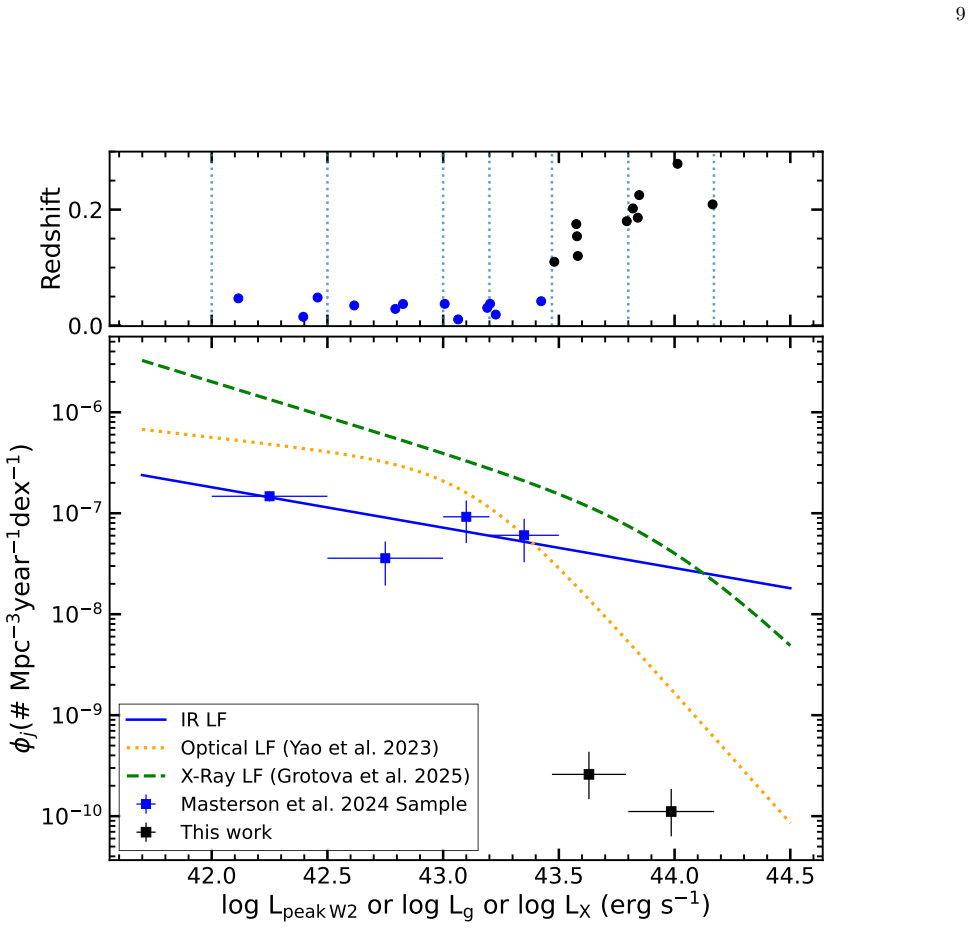
A search of the NEOWISE archive using W1-W2 color evolution identifies 10 high-luminosity IR TDEs with a volumetric rate of 1.2^{+0.5}_{-0.4} times 10^{-10} Mpc^{-3} yr^{-1}; this rate is suppressed relative to the local luminosity function of lower-luminosity events, consistent with reduced TDE production around larger black holes.
What carries the argument
W1-W2 color evolution selection applied to NEOWISE photometry to isolate luminous IR TDE candidates, followed by direct comparison of their derived volumetric rate against the local lower-luminosity TDE luminosity function.
If this is right
- The TDE luminosity function turns over at high luminosities rather than continuing to rise.
- Tidal disruptions become less common once black hole masses exceed a threshold set by the tidal radius falling inside the event horizon.
- The ten candidates receive independent confirmation of TDE identity from the match between their rate and the expected suppression.
- Infrared time-domain searches can recover TDEs at luminosities and distances missed by optical surveys.
Where Pith is reading between the lines
- The same color-evolution technique can be applied to future infrared surveys to extend the TDE luminosity function to still higher luminosities.
- Combining optical and infrared samples allows a single luminosity function to be constructed across the full accessible black-hole mass range.
- The measured suppression provides an indirect constraint on the high-mass end of the supermassive black hole occupation fraction in galaxies.
Load-bearing premise
The ten candidates selected solely by W1-W2 color evolution are all genuine TDEs with negligible contamination.
What would settle it
A multi-wavelength or spectroscopic campaign showing that more than one or two of the ten candidates are instead active galactic nuclei or supernovae would remove the observed rate suppression.
Figures
read the original abstract
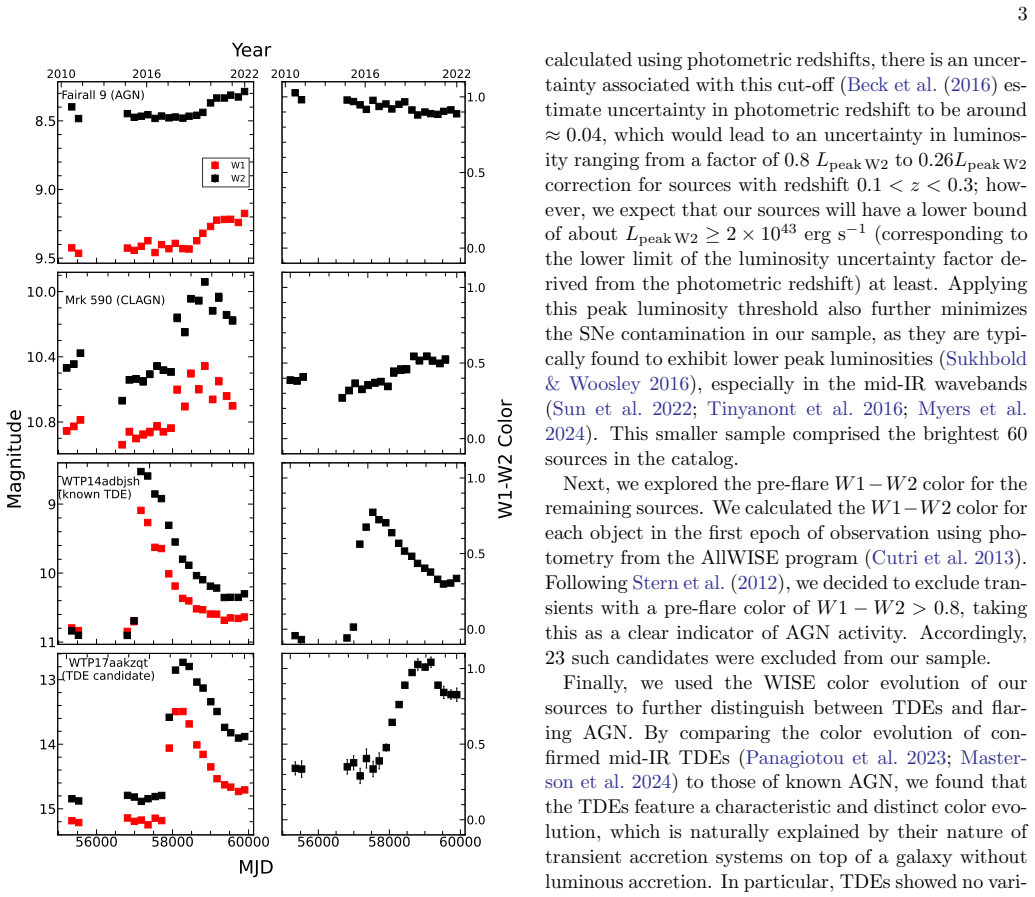
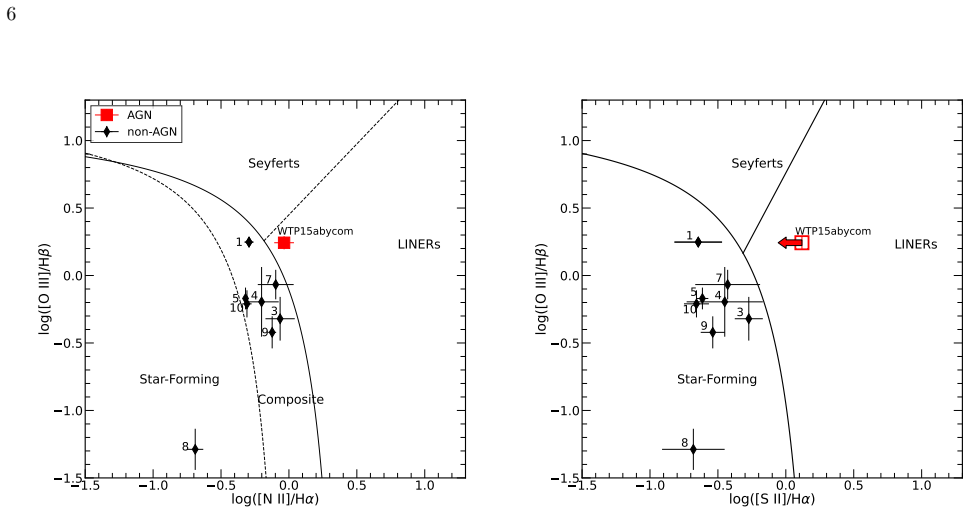
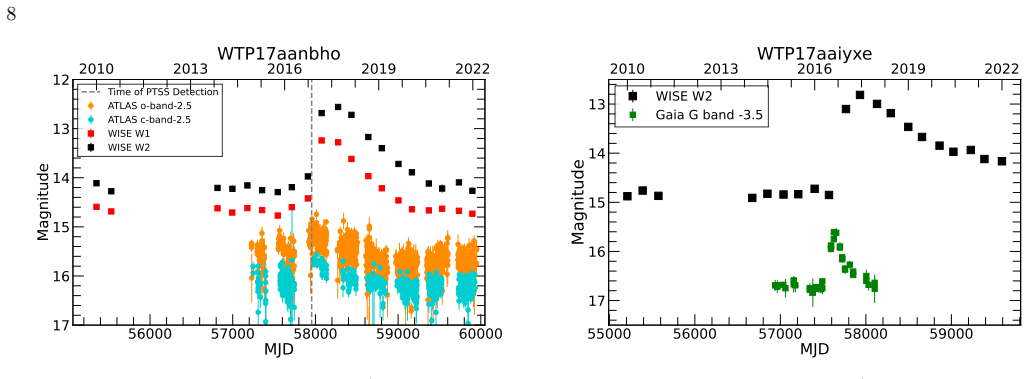
Tidal Disruption Events (TDEs) serve as direct probes of the population of supermassive black holes in the center of galaxies and are nowadays regularly detected in optical wide-field time-domain sky surveys. Recent studies have demonstrated that a large fraction of TDEs can be uniquely identified in the infrared (IR) waveband, but these studies have to date been limited to relatively nearby events. In this work, we searched for highly luminous IR-bright TDEs that are rare and thus missed by searches in the local universe. We performed a systematic search of the NEOWISE archive and developed a new selection criterion based on the evolution of the W1-W2 color to select TDE candidates. We identified 10 IR bright TDEs with peak luminosities above $L_{\rm peak\, W2} \simeq 3 \times 10^{43}$ erg s$^{-1}$ and estimated an event rate of $1.2^{+0.5}_{-0.4}\times10^{-10}$ Mpc$^{-3}$year$^{-1}$ for the luminosity range of our sample. Compared to the existing local luminosity function of lower luminosity events, we detect a suppressed rate for these highly luminous events. This turn-over in the luminosity function can be naturally explained by the suppressed amount of TDEs taking place in systems with larger black hole masses, thereby confirming the TDE nature of our sources.
Editorial analysis
A structured set of objections, weighed in public.
Referee Report
Summary. The manuscript reports a systematic search of the NEOWISE archive for high-luminosity mid-infrared TDEs using a new W1-W2 color-evolution selection criterion. It identifies 10 candidates with peak W2 luminosities ≳ 3 × 10^{43} erg s^{-1}, derives a volumetric rate of 1.2^{+0.5}_{-0.4} × 10^{-10} Mpc^{-3} yr^{-1}, and claims this rate is suppressed relative to the local lower-luminosity TDE luminosity function, with the turnover naturally explained by reduced TDE occurrence in systems hosting larger black holes.
Significance. If the sample is shown to be clean and the volumetric rate robustly computed, the result would constrain the high-luminosity tail of the TDE luminosity function and provide empirical support for a black-hole-mass dependence in TDE rates, consistent with theoretical expectations near the Hills mass.
major comments (3)
- [Abstract and search description] Abstract and search description: the 10 candidates are selected solely via W1-W2 color evolution, yet no quantitative false-positive rate, contamination estimate from variable AGN, or multi-wavelength/spectroscopic validation is supplied. This purity assumption is load-bearing for both the quoted rate and the suppression claim; even modest contamination would bring the high-L rate into consistency with a simple extrapolation of the local luminosity function.
- [Rate calculation section] Rate calculation section: the volumetric rate requires an explicit survey volume, redshift-dependent completeness corrections, and effective survey area, none of which are described or validated in the provided text. Without these, the numerical value 1.2^{+0.5}_{-0.4} × 10^{-10} Mpc^{-3} yr^{-1} cannot be assessed for systematic bias.
- [Rate comparison paragraph] Rate comparison paragraph: the claimed turnover is contrasted with an existing local luminosity function, but no quantitative assessment is given of differing selection functions (mid-IR color evolution versus optical surveys) or of whether the local LF baseline is directly comparable without selection-effect corrections.
minor comments (1)
- [Abstract] The abstract LaTeX notation L_{\rm peak\, W2} contains an extraneous backslash before the comma; standard formatting is L_{\rm peak, W2}.
Simulated Author's Rebuttal
We thank the referee for their constructive comments on our manuscript. We address each major comment below and will revise the paper to incorporate the requested clarifications and additions.
read point-by-point responses
-
Referee: [Abstract and search description] Abstract and search description: the 10 candidates are selected solely via W1-W2 color evolution, yet no quantitative false-positive rate, contamination estimate from variable AGN, or multi-wavelength/spectroscopic validation is supplied. This purity assumption is load-bearing for both the quoted rate and the suppression claim; even modest contamination would bring the high-L rate into consistency with a simple extrapolation of the local luminosity function.
Authors: We agree that a quantitative purity assessment is necessary to support the rate and suppression claims. The color-evolution criterion was developed to exploit the distinct mid-IR behavior of TDEs relative to AGN, but the original submission lacked a formal contamination estimate. In the revised manuscript we will add a dedicated subsection providing an estimate of the false-positive rate (using control samples of variable AGN from NEOWISE and any available multi-wavelength constraints on the candidates). revision: yes
-
Referee: [Rate calculation section] Rate calculation section: the volumetric rate requires an explicit survey volume, redshift-dependent completeness corrections, and effective survey area, none of which are described or validated in the provided text. Without these, the numerical value 1.2^{+0.5}_{-0.4} × 10^{-10} Mpc^{-3} yr^{-1} cannot be assessed for systematic bias.
Authors: The quoted rate was derived from the NEOWISE time baseline, sky coverage, and our selection efficiency, but these ingredients were not presented in sufficient detail. We will expand the rate-calculation section to explicitly state the survey volume, redshift-dependent completeness (including any injection-recovery validation), and effective area, allowing readers to evaluate possible systematic biases. revision: yes
-
Referee: [Rate comparison paragraph] Rate comparison paragraph: the claimed turnover is contrasted with an existing local luminosity function, but no quantitative assessment is given of differing selection functions (mid-IR color evolution versus optical surveys) or of whether the local LF baseline is directly comparable without selection-effect corrections.
Authors: We will revise the comparison paragraph to include a quantitative discussion of the differing selection functions. This will address how the mid-IR color-evolution criterion samples the luminosity function relative to optical surveys and will evaluate whether selection-effect corrections are required before claiming a turnover; any such corrections will be applied or estimated in the revised text. revision: yes
Circularity Check
No circularity: rate derived from direct counts and external comparison
full rationale
The paper estimates the volumetric rate directly from the 10 identified candidates in the NEOWISE archive using an assumed survey volume, then compares the result to an existing local luminosity function from prior independent work. No equations or steps reduce a claimed prediction to a fitted input by construction, no self-citations are load-bearing for the central result, and the selection criterion (W1-W2 color evolution) is presented as an independent development rather than a renaming or self-referential definition. The interpretive statement that the turnover 'confirms' the TDE nature is a consistency argument, not a tautological reduction of the rate itself. The derivation chain is therefore self-contained against external benchmarks.
Axiom & Free-Parameter Ledger
free parameters (1)
- volumetric rate
axioms (2)
- domain assumption W1-W2 color evolution selects TDEs with low contamination from other variables or transients
- domain assumption The local luminosity function of lower-luminosity TDEs is directly comparable without major selection biases
Reference graph
Works this paper leans on
-
[1]
Reverberation in Tidal Disruption Events: Dust Echoes, Coronal Emission Lines, Multi-wavelength Cross-correlations, and QPOs. , keywords =. doi:10.1007/s11214-021-00835-6 , archivePrefix =. 2107.12268 , primaryClass =
-
[2]
Fundamental scaling relationships revealed in the optical light curves of tidal disruption events. , keywords =. doi:10.1093/mnras/stad3001 , archivePrefix =. 2308.08255 , primaryClass =
-
[3]
The spectral evolution of disc dominated tidal disruption events. , keywords =. doi:10.1093/mnras/staa192 , archivePrefix =. 1912.06577 , primaryClass =
-
[4]
Late-time UV observations of tidal disruption flares reveal unobscured, compact accretion disks
Late-time UV Observations of Tidal Disruption Flares Reveal Unobscured, Compact Accretion Disks. , keywords =. doi:10.3847/1538-4357/ab1844 , archivePrefix =. 1809.00003 , primaryClass =
work page internal anchor Pith review Pith/arXiv arXiv doi:10.3847/1538-4357/ab1844
-
[5]
unWISE: unblurred coadds of the WISE imaging
unWISE: Unblurred Coadds of the WISE Imaging. , keywords =. doi:10.1088/0004-6256/147/5/108 , archivePrefix =. 1405.0308 , primaryClass =
work page internal anchor Pith review Pith/arXiv arXiv doi:10.1088/0004-6256/147/5/108
-
[6]
Time-resolved WISE/NEOWISE Coadds
Time-resolved WISE/NEOWISE Coadds. , keywords =. doi:10.3847/1538-3881/aacbcd , archivePrefix =. 1710.02526 , primaryClass =
work page internal anchor Pith review Pith/arXiv arXiv doi:10.3847/1538-3881/aacbcd
-
[7]
The Astrophysical Journal , author =. 2012 , pages =. doi:10.1088/0004-637X/753/1/30 , abstract =
work page internal anchor Pith review doi:10.1088/0004-637x/753/1/30 2012
-
[8]
and Merloni, Andrea and Newsome, Megan and Rau, Arne and Simcoe, Robert A
Masterson, Megan and De, Kishalay and Panagiotou, Christos and Kara, Erin and Arcavi, Iair and Eilers, Anna-Christina and Frostig, Danielle and Gezari, Suvi and Grotova, Iuliia and Liu, Zhu and Malyali, Adam and Meisner, Aaron M. and Merloni, Andrea and Newsome, Megan and Rau, Arne and Simcoe, Robert A. and Velzen, Sjoert van , month = jan, year =. A
-
[9]
Publications of the Astronomical Society of the Pacific , author =
Palomar. Publications of the Astronomical Society of the Pacific , author =. 2020 , pages =. doi:10.1088/1538-3873/ab6069 , abstract =
-
[10]
The Astrophysical Journal Letters , author =
Tidal. The Astrophysical Journal Letters , author =. 2023 , pages =. doi:10.3847/2041-8213/acf216 , abstract =
-
[12]
The Astrophysical Journal Letters , author =
A. The Astrophysical Journal Letters , author =. 2023 , pages =. doi:10.3847/2041-8213/acc02f , abstract =
-
[13]
The Wide-field Infrared Survey Explorer (WISE): Mission Description and Initial On-orbit Performance
The Astronomical Journal , author =. 2010 , pages =. doi:10.1088/0004-6256/140/6/1868 , abstract =
work page internal anchor Pith review doi:10.1088/0004-6256/140/6/1868 2010
-
[14]
The host galaxies of active galactic nuclei , volume =. Monthly Notices of the Royal Astronomical Society , author =. 2003 , pages =. doi:10.1111/j.1365-2966.2003.07154.x , abstract =
-
[15]
Publications of the Astronomical Society of the Pacific , author =. 1981 , pages =. doi:10.1086/130766 , abstract =
-
[16]
Theoretical Modeling of Starburst Galaxies
Theoretical. The Astrophysical Journal , author =. 2001 , pages =. doi:10.1086/321545 , abstract =
work page internal anchor Pith review doi:10.1086/321545 2001
-
[17]
The host galaxies and classification of active galactic nuclei , volume =. Monthly Notices of the Royal Astronomical Society , author =. 2006 , pages =. doi:10.1111/j.1365-2966.2006.10859.x , abstract =
-
[18]
Observational evidence for
-
[19]
The Astrophysical Journal , author =
The. The Astrophysical Journal , author =. 2020 , pages =. doi:10.3847/1538-4357/ab6458 , abstract =
-
[20]
Clark, Peter and Graur, Or and Callow, Joseph and Aguilar, Jessica and Ahlen, Steven and Anderson, Joseph P. and Berger, Edo and Brink, Thomas and Brooks, David and Chen, Ting-Wan and Claybaugh, Todd and Macorra, Axel de la and Doel, Peter and Filippenko, Alexei and Forero-Romero, Jamie and Gomez, Sebastian and Gromadzki, Mariusz and Honscheid, Klaus and ...
-
[21]
Cutri, R. M. and Wright, E. L. and Conrow, T. and Fowler, J. W. and Eisenhardt, P. R. M. and Grillmair, C. and Kirkpatrick, J. D. and Masci, F. and McCallon, H. L. and Wheelock, S. L. and Fajardo-Acosta, S. and Yan, L. and Benford, D. and Harbut, M. and Jarrett, T. and Lake, S. and Leisawitz, D. and Ressler, M. E. and Stanford, S. A. and Tsai, C. W. and L...
-
[23]
The Astrophysical Journal Letters , author =. 2016 , pages =. doi:10.3847/2041-8205/820/2/L38 , abstract =
-
[24]
Tidal disruption of stars by black holes of 106–108 solar masses in nearby galaxies , volume =. Nature , author =. 1988 , keywords =. doi:10.1038/333523a0 , abstract =
-
[25]
Annual Review of Astronomy and Astrophysics , author =
Tidal. Annual Review of Astronomy and Astrophysics , author =. 2021 , pages =. doi:10.1146/annurev-astro-111720-030029 , abstract =
-
[26]
Komossa, Stefanie and Greiner, Jochen , month = aug, year =. Discovery of a giant and luminous. doi:10.48550/arXiv.astro-ph/9908216 , keywords =
work page internal anchor Pith review Pith/arXiv arXiv doi:10.48550/arxiv.astro-ph/9908216
-
[27]
The giant X-ray outbursts in NGC 5905 and IC 3599: Follow-up observations and outburst scenarios
Komossa, Stefanie and Bade, Norbert , month = jan, year =. The giant. doi:10.48550/arXiv.astro-ph/9901141 , keywords =
work page internal anchor Pith review Pith/arXiv arXiv doi:10.48550/arxiv.astro-ph/9901141
-
[28]
The Astronomical Journal , author =
Large-. The Astronomical Journal , author =. 2002 , pages =. doi:10.1086/342280 , abstract =
-
[30]
An ultraviolet–optical flare from the tidal disruption of a helium-rich stellar core , volume =. Nature , author =. 2012 , keywords =. doi:10.1038/nature10990 , abstract =
-
[31]
The Astrophysical Journal Letters , author =
Tidal. The Astrophysical Journal Letters , author =. 2021 , pages =. doi:10.3847/2041-8213/abdcb4 , abstract =
-
[32]
The Astrophysical Journal , author =
Forward. The Astrophysical Journal , author =. 2021 , pages =. doi:10.3847/1538-4357/abdf50 , abstract =
-
[33]
Tidal disruption rate suppression by the event horizon of spinning black holes , url =
Huang, Hao-Tse and Lu, Wenbin , month = dec, year =. Tidal disruption rate suppression by the event horizon of spinning black holes , url =. doi:10.48550/arXiv.2301.00259 , keywords =
-
[35]
The Astrophysical Journal , author =. 2013 , pages =. doi:10.1088/0004-637X/780/1/44 , abstract =
-
[36]
2013, ApJ, 767, 25, doi: 10.1088/0004-637X/767/1/25
The Astrophysical Journal , author =. 2013 , pages =. doi:10.1088/0004-637X/767/1/25 , abstract =
-
[37]
The Astrophysical Journal , author =
The. The Astrophysical Journal , author =. 2022 , pages =. doi:10.3847/1538-4357/aca283 , abstract =
-
[38]
The Astrophysical Journal , author =. 2016 , pages =. doi:10.3847/0004-637X/829/1/19 , abstract =
-
[40]
The Astrophysical Journal , author =
Revised. The Astrophysical Journal , author =. 2004 , pages =. doi:10.1086/379767 , abstract =
-
[41]
Rates of stellar tidal disruption as probes of the supermassive black hole mass function
-
[42]
Possible power source of. Nature , author =. 1975 , keywords =. doi:10.1038/254295a0 , abstract =
-
[43]
The Astrophysical Journal , author =. 2016 , pages =. doi:10.3847/0004-637X/827/1/3 , abstract =
-
[44]
Monthly Notices of the Royal Astronomical Society , author =
Infrared emission from tidal disruption events – probing the pc-scale dust content around galactic nuclei , volume =. Monthly Notices of the Royal Astronomical Society , author =. 2016 , pages =. doi:10.1093/mnras/stw307 , abstract =
-
[45]
The Astrophysical Journal Supplement Series , author =
Mid-. The Astrophysical Journal Supplement Series , author =. 2021 , keywords =. doi:10.3847/1538-4365/abd1dc , abstract =
-
[46]
Research Notes of the AAS , author =
A. Research Notes of the AAS , author =. 2020 , pages =. doi:10.3847/2515-5172/abbe23 , abstract =
-
[47]
Publications of the Astronomical Society of the Pacific , author =. 2018 , keywords =. doi:10.1088/1538-3873/aabadf , abstract =
work page internal anchor Pith review doi:10.1088/1538-3873/aabadf 2018
-
[48]
The. The Astrophysical Journal , author =. 2014 , keywords =. doi:10.1088/0004-637X/788/1/48 , abstract =
work page internal anchor Pith review doi:10.1088/0004-637x/788/1/48 2014
-
[49]
The. Publications of the Astronomical Society of the Pacific , author =. 2019 , keywords =. doi:10.1088/1538-3873/aaecbe , abstract =
-
[50]
The Astrophysical Journal Supplement Series , author =
The. The Astrophysical Journal Supplement Series , author =. 2007 , pages =. doi:10.1086/516576 , abstract =
-
[51]
Voges, Wolfgang and Aschenbach, Bernd and Boller, Thomas and Braeuninger, Heinrich and Briel, Ulrich and Burkert, Wolfgang and Dennerl, Konrad and Englhauser, Jakob and Gruber, Rainer and Haberl, Frank and Hartner, Gisela and Hasinger, Guenther and Pfeffermann, Elmar and Pietsch, Wolfgang and Predehl, Peter and Rosso, Cristina and Schmitt, Juergen H. M. M...
work page internal anchor Pith review Pith/arXiv arXiv doi:10.48550/arxiv.astro-ph/9909315
-
[52]
Astronomy and Astrophysics , author =. 2001 , keywords =. doi:10.1051/0004-6361:20000036 , abstract =
-
[53]
2021, A&A, 647, A1, doi: 10.1051/0004-6361/202039313
The. Astronomy & Astrophysics , author =. 2021 , pages =. doi:10.1051/0004-6361/202039313 , abstract =
-
[54]
Publications of the Astronomical Society of the Pacific , author =
The. Publications of the Astronomical Society of the Pacific , author =. 2017 , pages =. doi:10.1088/1538-3873/aa80d9 , abstract =
-
[55]
Jansky Very Large Array Sky Survey (VLASS)
The. Publications of the Astronomical Society of the Pacific , author =. 2020 , keywords =. doi:10.1088/1538-3873/ab63eb , abstract =
-
[56]
The Astrophysical Journal , author =
Tidal. The Astrophysical Journal , author =. 2016 , keywords =. doi:10.3847/2041-8205/818/1/L21 , abstract =
-
[57]
The Astrophysical Journal , author =
The. The Astrophysical Journal , author =. 1996 , keywords =. doi:10.1086/177495 , abstract =
-
[58]
Monthly Notices of the Royal Astronomical Society , author =
A mid-infrared study of superluminous supernovae , volume =. Monthly Notices of the Royal Astronomical Society , author =. 2022 , pages =. doi:10.1093/mnras/stac1121 , abstract =
-
[59]
Astronomy & Astrophysics , author =
Intermediate-luminosity red transients:. Astronomy & Astrophysics , author =. 2021 , pages =. doi:10.1051/0004-6361/202141078 , abstract =
-
[61]
Mo, Geoffrey and De, Kishalay and Wiston, Eli and J, Nayana A. and Margutti, Raffaella and Frostig, Danielle and Sollerman, Jesper and Sharma, Yashvi and Moriya, Takashi J. and Burdge, Kevin B. and Jencson, Jacob and Karambelkar, Viraj R. and Lourie, Nathan P. , month = jan, year =. A diverse, overlooked population of. doi:10.48550/arXiv.2410.14644 , keywords =
-
[62]
The Astrophysical Journal , author =
A. The Astrophysical Journal , author =. 2014 , pages =. doi:10.1088/0004-637X/793/1/38 , abstract =
-
[63]
The Astrophysical Journal , author =
‧. The Astrophysical Journal , author =. 2015 , keywords =. doi:10.1088/0004-637X/806/2/164 , abstract =
-
[64]
2017 , keywords =
Transient Name Server Discovery Report , author =. 2017 , keywords =
2017
-
[65]
Weisskopf, Martin C. , month = sep, year =. The. doi:10.1117/12.929670 , abstract =
-
[66]
Space Science Reviews , author =
The. Space Science Reviews , author =. 2005 , keywords =. doi:10.1007/s11214-005-5097-2 , abstract =
work page internal anchor Pith review doi:10.1007/s11214-005-5097-2 2005
-
[67]
The Astrophysical Journal , author =. 2013 , pages =. doi:10.1088/0004-637X/770/2/103 , abstract =
-
[68]
Monthly Notices of the Royal Astronomical Society , author =
Gaia transients in galactic nuclei , volume =. Monthly Notices of the Royal Astronomical Society , author =. 2018 , keywords =. doi:10.1093/mnras/sty2221 , abstract =
-
[69]
Monthly Notices of the Royal Astronomical Society , author =. 2022 , keywords =. doi:10.1093/mnras/stac1443 , abstract =
-
[70]
The Astrophysical Journal , author =
The. The Astrophysical Journal , author =. 2001 , keywords =. doi:10.1086/322488 , abstract =
-
[71]
Monthly Notices of the Royal Astronomical Society , author =
First tidal disruption events discovered by. Monthly Notices of the Royal Astronomical Society , author =. 2021 , keywords =. doi:10.1093/mnras/stab2843 , abstract =
-
[72]
Helou, G. and Madore, B. F. and Schmitz, M. and Bicay, M. D. and Wu, X. and Bennett, J. , month = jan, year =. The. doi:10.1007/978-94-011-3250-3_10 , abstract =
-
[73]
Publications of the Astronomical Society of the Pacific , author =
A. Publications of the Astronomical Society of the Pacific , author =. 2006 , keywords =. doi:10.1086/510102 , abstract =
work page internal anchor Pith review doi:10.1086/510102 2006
-
[74]
1986, ApJ, 303, 336, doi: 10.1086/164079
Confidence. The Astrophysical Journal , author =. 1986 , keywords =. doi:10.1086/164079 , abstract =
-
[75]
Astronomy and Astrophysics , author =
The. Astronomy and Astrophysics , author =. 2016 , keywords =. doi:10.1051/0004-6361/201629272 , abstract =
-
[76]
Yao, Yujun and Ye, Jingjing and Sun, Luming and Jiang, Ning and Masterson, Megan and Shu, Xinwen , month = mar, year =. Distinguishing. doi:10.48550/arXiv.2503.10053 , keywords =
-
[77]
The Astrophysical Journal , author =
Discovery of an. The Astrophysical Journal , author =. 2016 , keywords =. doi:10.3847/2041-8205/819/2/L25 , abstract =
-
[78]
Space Science Reviews , author =
Radio. Space Science Reviews , author =. 2020 , keywords =. doi:10.1007/s11214-020-00702-w , abstract =
-
[79]
, year = 1968, month = feb, volume = 151, pages =
Space. The Astrophysical Journal , author =. 1968 , note =. doi:10.1086/149446 , abstract =
-
[80]
The Astrophysical Journal , author =
Optical. The Astrophysical Journal , author =. 2011 , note =. doi:10.1088/0004-637X/741/2/73 , abstract =
-
[81]
Monthly Notices of the Royal Astronomical Society , author =
The tidal disruption event. Monthly Notices of the Royal Astronomical Society , author =. 2019 , note =. doi:10.1093/mnras/stz1837 , abstract =
-
[82]
Planck 2018 results. Astronomy and Astrophysics , author =. 2020 , note =. doi:10.1051/0004-6361/201833910 , abstract =
-
[84]
Astronomy & Astrophysics , author =
The population of tidal disruption events discovered with. Astronomy & Astrophysics , author =. 2025 , note =. doi:10.1051/0004-6361/202553669 , abstract =
-
[85]
, archivePrefix = "arXiv", eprint =
Proper Image Subtraction - Optimal Transient Detection, Photometry, and Hypothesis Testing. , archivePrefix = "arXiv", eprint =. doi:10.3847/0004-637X/830/1/27 , adsurl =
-
[86]
, year = 2023, month = may, volume =
An infrared transient from a star engulfing a planet. , year = 2023, month = may, volume =. doi:10.1038/s41586-023-05842-x , adsurl =
-
[87]
Mid-Infrared Galaxy Luminosity Functions from the AGN and Galaxy Evolution Survey
Mid-Infrared Galaxy Luminosity Functions from the AGN and Galaxy Evolution Survey. , keywords =. doi:10.1088/0004-637X/697/1/506 , archivePrefix =. 0902.2812 , primaryClass =
work page internal anchor Pith review Pith/arXiv arXiv doi:10.1088/0004-637x/697/1/506
discussion (0)
Sign in with ORCID, Apple, or X to comment. Anyone can read and Pith papers without signing in.