REVIEW 3 major objections 10 minor 57 references
Reviewed by Pith at T0; open to challenge.
T0 means a machine referee read the full paper against a public rubric. The mark states how deep the mechanical check went, never who wrote it. the ladder, T0–T4 →
T0 review · glm-5.2
Plasma traps light near black holes with topological defects
2026-07-09 09:18 UTC pith:ITDWGXJM
load-bearing objection Solid analytic results on EM quasi-bound states in topological-defect BH + plasma; WKB reliability at l=0 is the main concern the 3 major comments →
Scalar and Electromagnetic Perturbations around a Black Hole with a Topological Defect: Quasinormal Modes and Quasi-bound States in a Plasma Medium
The pith
A machine-rendered reading of the paper's core claim, the machinery that carries it, and where it could break.
Core claim
The paper's central discovery is that electromagnetic quasi-bound states around a black hole with a topological defect exist only in a homogeneous plasma and only below a critical plasma frequency threshold given by M*omega_pl <= (1-k)*sqrt(l(l+1)/12), where k is the topological defect parameter and l is the multipole index. In the axial electromagnetic sector, the plasma frequency enters the effective potential as a mass term, creating a barrier-well structure when the plasma is uniform. For radially inhomogeneous plasma profiles where the density falls off as 1/r-squared (SIS and NSIS), the plasma contribution merely renormalizes the centrifugal barrier and no potential well forms, so notr
What carries the argument
topological defect parameter k in the metric function f(r) = 1 - k - 2M/r; effective potential for axial electromagnetic perturbations V_ax = (1-k-2M/r)(l(l+1)/r^2 + omega_pl^2); critical threshold M*omega_pl <= (1-k)*sqrt(l(l+1)/12); WKB approximation at third and sixth order for QNM frequencies; eikonal correspondence linking QNM real part to shadow radius via plasma refractive index
Load-bearing premise
The WKB approximation at third and sixth order is assumed reliable for computing quasinormal mode frequencies at low multipole numbers, including l=0 and l=1, where the method is known to have poor convergence because there is no centrifugal barrier for the semiclassical expansion to build upon.
What would settle it
If a full numerical computation of the quasinormal mode spectrum (e.g., via direct integration or Leaver's method) fails to reproduce the (0,0) mode or the quasi-bound state frequencies reported in the tables, the central quantitative results would be undermined.
If this is right
- If the critical threshold for quasi-bound states is correct, observing long-lived electromagnetic oscillations near a black hole could simultaneously constrain both the plasma density and the topological defect parameter k, providing a combined probe of environment and spacetime structure.
- The absence of quasi-bound states for 1/r-squared plasma profiles means that realistic accretion environments with such density distributions cannot trap electromagnetic waves in this manner, narrowing the astrophysical conditions under which these states are observable.
- The monotonic decrease of the Lyapunov exponent with increasing k implies that stronger topological defects make photon-sphere orbits less unstable, which could produce measurable differences in black hole shadow characteristics.
- The shadow-QNM correspondence in the eikonal limit, modified by the plasma refractive index, offers a cross-check between electromagnetic imaging and gravitational-wave ringdown observations for the same black hole system.
Where Pith is reading between the lines
- The critical threshold depends on (1-k), meaning that as k approaches 1, the allowed plasma frequency for quasi-bound states shrinks to zero. This suggests a degeneracy: a strong topological defect and a dense plasma are mutually exclusive for supporting trapped electromagnetic states, which could serve as a diagnostic if both parameters could be independently estimated.
- The paper notes that the polar sector effective potential is too complicated to solve with WKB. If the polar sector were solved numerically, it might reveal additional quasi-bound states or instabilities not present in the axial sector, potentially changing the observational predictions.
- The claimed (0,0) scalar mode for the topological-defect black hole, absent in Schwarzschild, arises because the defect modifies the effective potential at low multipoles. If confirmed by non-WKB methods, this mode would be a distinctive signature of the topological defect observable in the lowest-frequency ringdown signal.
- The weak dependence of the Lyapunov exponent on plasma frequency but strong dependence on k suggests that shadow-based measurements of photon-sphere instability are primarily sensitive to the spacetime geometry rather than the plasma environment, which could simplify the interpretation of shadow observations.
Editorial analysis
A structured set of objections, weighed in public.
Referee Report
Summary. This paper studies scalar and electromagnetic perturbations around a Schwarzschild black hole with a topological defect (global monopole, parameter k) immersed in a plasma medium. The authors derive effective potentials for massive scalar perturbations in homogeneous, SIS, and NSIS plasma profiles, compute QNM frequencies using 3rd- and 6th-order WKB approximations, and analyze the eikonal shadow-QNM correspondence. For electromagnetic perturbations, they derive the coupled plasma-photon equations following Breuer-Ehlers, decouple the axial and polar sectors, and derive an analytical threshold condition for quasi-bound states in the axial sector with homogeneous plasma. The main quantitative results include QNM frequency tables for scalar perturbations and quasi-bound state frequencies for the axial electromagnetic sector.
Significance. The paper provides a systematic treatment combining topological defects and plasma effects on black hole observables, which is a reasonable contribution to the literature. The analytical threshold condition (Eq. C2) for quasi-bound state existence is a clean, parameter-free result derived from the extrema of the axial potential. The decoupling of axial and polar sectors (Eqs. 42-45) and the derivation of the polar effective potential (Appendix B) are technically sound. The comparison across three plasma profiles (homogeneous, SIS, NSIS) adds useful breadth. However, the central quantitative results rely entirely on the WKB approximation at low multipole numbers where its reliability is questionable, which limits the significance of the numerical findings.
major comments (3)
- §IV, Table I: The (0,0) scalar QNM mode is reported as a distinctive feature of the topological-defect black hole (absent in Schwarzschild), making it the most novel scalar-sector claim. However, this mode is computed at l=0, where the effective potential (Eq. 25) lacks the centrifugal barrier l(l+1)/r^2 that the WKB method is designed to handle. The 3rd- and 6th-order WKB values for this mode differ by approximately 20% in both Re(omega) and Im(omega) (0.0368-0.1668i vs. 0.0298-0.2032i for m=0.3, k=0.1, chi=0.1), which is itself evidence of non-convergence. The authors acknowledge in §VI that 'complementary numerical techniques that go beyond the WKB approximation, particularly in the low-multipole regime' are needed, yet all reported low-l results rely entirely on WKB. This is load-bearing because the (0,0) mode is presented as a key qualitative distinction introduced by the topology.
- §IV, Tables I-III: The WKB convergence is also poor for several (1,1) modes. For example, in Table I (m=0.3, k=0.1, chi=0.1), the (1,1) mode gives 0.2188-0.3044i (3rd order) vs. 0.1913-0.2951i (6th order), a ~12% discrepancy in Re(omega). In Table III (m=0.1, k=0.2, chi=0.3), the (0,0) mode gives 0.0488-0.0982i vs. 0.0080-0.1552i, a ~84% discrepancy in Re(omega). These large discrepancies suggest the WKB series is not converging for these modes, and the reported values should be treated with caution. The paper should either restrict claims to modes where 3rd- and 6th-order results agree to reasonable precision, or provide independent verification (e.g., via direct numerical integration or a time-domain analysis) for at least a subset of the low-l modes.
- §V.B, Table IV and Fig. 8: The quasi-bound state frequencies in the axial sector are computed using WKB for l=1 and l=2. While these are higher than l=0, the WKB method is still a semiclassical approximation and the quasi-bound state problem involves a potential well (not just a barrier peak), which is a different regime from the standard QNM WKB application. The paper does not discuss whether the WKB method is validated for quasi-bound state problems of this type, nor does it provide any comparison with exact or independently computed values. Since the quasi-bound state existence is the central electromagnetic-sector result, some validation of the numerical method would strengthen the claim.
minor comments (10)
- §III, Eq. (6): The notation uses both c (speed of light) and the subscript conventions inconsistently. The text says 'here we shall introduce temporary the speed of light c' but c appears only in Eq. (6) and not in subsequent equations. This should be clarified.
- §IV, Eq. (18): The action introduces both c and hbar temporarily, but these do not appear consistently in the subsequent Klein-Gordon equation (Eq. 19). The transition should be made explicit.
- §IV, Eq. (19): The notation chi(r) = kappa*N(r) is introduced, but in the homogeneous plasma case chi is treated as a constant. It would help to state explicitly that chi = const for the homogeneous case.
- §V.A, Eq. (45): The term r^3*omega^3 appears in Eq. (45), which seems dimensionally inconsistent with the other terms (which involve omega^2). This may be a typo and should be checked.
- Tables I-III: The Schwarzschild tables in Table I for m=0.7, chi=0.3 appear identical to those for m=0.3, chi=0.1. This is likely a copy-paste error and should be corrected.
- §V.B, Fig. 6: The inset plots show very small numerical ranges (e.g., 0.035060 to 0.035080) which are difficult to read. Consider enlarging or providing a table of the extremum positions.
- §V.C: The statement that Eq. (48) 'could not be solved due to the complicated dependence of the effective potential on omega' is unclear. The polar effective potential depends on r (through omega_pl(r)), not on omega itself. This should be clarified.
- Appendix C: The numerical example states 'M*omega_pl <= 9/(10*sqrt(6))' for l=1, k=0.1, but 9/(10*sqrt(6)) ≈ 0.367, while (1-0.1)*sqrt(2/12) ≈ 0.367. The expression '9/10*sqrt(6)' as written is ambiguous and should be parenthesized.
- The paper uses 'QNMs represented' and 'it was necessary' (past tense) in some places and present tense in others. The tense should be made consistent throughout.
- §II: The EHT constraint k <= 0.005 (1 sigma) is mentioned, but most numerical calculations use k up to 0.4. A brief comment on the astrophysical relevance of the chosen k range would be helpful.
Simulated Author's Rebuttal
We thank the referee for a careful and constructive report. The central concern—that the WKB approximation is unreliable at low multipole numbers, precisely where our most novel results lie—is well taken. We address each major comment below and outline concrete revisions.
read point-by-point responses
-
Referee: §IV, Table I: The (0,0) scalar QNM mode is reported as a distinctive feature of the topological-defect black hole (absent in Schwarzschild), making it the most novel scalar-sector claim. However, this mode is computed at l=0, where the effective potential lacks the centrifugal barrier l(l+1)/r^2 that the WKB method is designed to handle. The 3rd- and 6th-order WKB values differ by ~20%, evidence of non-convergence. The authors acknowledge in §VI that complementary numerical techniques are needed, yet all reported low-l results rely entirely on WKB.
Authors: The referee is correct on all counts. The l=0 effective potential (Eq. 25) lacks the centrifugal barrier, and the WKB method is fundamentally a semiclassical approximation designed for potentials with a single well-defined barrier peak. The ~20% discrepancy between 3rd- and 6th-order WKB results for the (0,0) mode is indeed evidence of non-convergence, and we should not have presented this mode's frequency as a reliable quantitative result without independent verification. We will address this in the revised manuscript in two ways. First, we will add a clear caveat to §IV and Table I stating that the (0,0) mode values are indicative rather than precise, and that the WKB method is not reliable at l=0. Second, we will perform time-domain integration (using the Gundlach–Price–Pullin method) for at least the (0,0) and (1,0) modes in the homogeneous plasma case to provide an independent cross-check. We note that the qualitative claim—that the (0,0) mode exists for the topological-defect black hole but is absent in Schwarzschild—follows from the structure of the effective potential itself (the potential at l=0 is non-vanishing when k≠0 due to the f·f'/r term and the mass/plasma contributions, whereas for k=0 the potential still has a barrier but the mode structure differs), and does not depend on the WKB numerics. However, the specific frequency values we reported for this mode should be treated as order-of-magnitude estimates until verified. We will revise the text accordingly. revision: yes
-
Referee: §IV, Tables I-III: WKB convergence is also poor for several (1,1) modes. Large discrepancies (e.g., ~12% for (1,1) in Table I, ~84% for (0,0) in Table III) suggest the WKB series is not converging. The paper should either restrict claims to modes where 3rd- and 6th-order results agree, or provide independent verification for at least a subset of low-l modes.
Authors: We agree. The discrepancies the referee identifies are large and indicate that the WKB series has not converged for these modes. In the revised manuscript, we will take the following steps: (1) We will flag all modes where the 3rd- and 6th-order WKB results differ by more than ~5% in either Re(ω) or Im(ω) as unreliable, with an explicit note in the table captions. (2) For the modes where the two WKB orders agree to within ~1–2% (which includes most of the (l,0) and (l,1) modes with l≥2), we will retain the values as reliable. (3) We will provide time-domain verification for a representative subset of low-l modes (specifically (1,0), (1,1), (2,0), and (2,1) for the homogeneous plasma case with m=0.3, k=0.1, χ=0.1) and include a comparison table. (4) We will add a paragraph in §IV discussing the convergence properties of the WKB series across the parameter space, explicitly identifying the regimes where it is and is not trustworthy. The ~84% discrepancy for the (0,0) mode in Table III (m=0.1, k=0.2, χ=0.3) is particularly concerning and we will either remove that entry or clearly mark it as unreliable pending independent verification. revision: yes
-
Referee: §V.B, Table IV and Fig. 8: The quasi-bound state frequencies in the axial sector are computed using WKB for l=1 and l=2. The quasi-bound state problem involves a potential well (not just a barrier peak), which is a different regime from the standard QNM WKB application. The paper does not discuss whether WKB is validated for quasi-bound state problems of this type, nor does it provide any comparison with exact or independently computed values.
Authors: The referee raises a valid point. The WKB method as developed by Schutz–Will and extended by Iyer–Will and Konoplya is designed for QNM problems involving a single potential barrier peak, not for a barrier–well structure as in the quasi-bound state problem. The application of WKB to quasi-bound states in a potential well is not standard and its accuracy in this regime has not been systematically validated in the literature, to our knowledge. We will address this in the revision as follows. First, we will add an explicit discussion in §V.B acknowledging that the WKB method is being applied outside its standard domain of validity for the quasi-bound state problem, and that the numerical values in Table IV should be treated as approximate. Second, we note that the central electromagnetic-sector result—the analytical threshold condition (Eq. C2) for the existence of quasi-bound states—is derived directly from the extrema of the axial potential and is independent of the WKB approximation. This result stands regardless of the accuracy of the WKB frequencies. Third, we will attempt to verify at least the l=1, n=0 quasi-bound state frequency using direct numerical integration of the axial equation (Eq. 46) with appropriate boundary conditions (outgoing at the horizon, decaying at infinity), and include the comparison if the computation is feasible within the revision timeframe. If we cannot complete the independent verification in time, we will explicitly state that the WKB quasi-bound state frequencies are unverified and downgrade the corresponding claims from quantitative to qualitative. revision: partial
- We note one limitation: if the time-domain and direct numerical integration computations cannot be completed to sufficient accuracy within the revision period, we will not be able to provide fully verified numerical values for all low-l modes. In that case, we will restrict the manuscript's quantitative claims to the modes where WKB convergence is good (l≥2, low overtones) and present the low-l results as qualitative/indicative only. The analytical results (shadow–QNM correspondence, threshold condition Eq. C2, decoupling of axial/polar sectors) are independent of the WKB approximation and are not affected by this limitation.
Circularity Check
No significant circularity found. The derivation chain is self-contained; the one self-citation ([44]) is non-load-bearing and independently verifiable.
full rationale
The paper's central results are derived from first principles or established external frameworks without circular reduction. The quasi-bound state threshold (Eq. C2) is obtained by a purely algebraic derivation: differentiating the axial effective potential (Eq. 47), obtaining the quadratic (Eq. C1), and requiring a non-negative discriminant. No parameter is fitted and then repackaged as a prediction. The scalar QNM frequencies (Tables I–III) are computed via the WKB method (Konoplya [48], an external citation) applied to the derived effective potential (Eq. 25) — these are numerical computations, not fitted inputs renamed as predictions. The shadow–QNM correspondence (Eqs. 5–9) combines Cardoso et al. [23] (external) with standard geometric relations. The EM perturbation equations (Eqs. 42–45) follow from the Breuer–Ehlers [52] framework (external). The SIS/NSIS no-quasi-bound-state conclusion follows from the structural observation that ω²_pl ∝ 1/r² renormalizes the centrifugal term, preserving the single-maximum potential shape. The only self-citation is [44] (Umarov, Atamurotov, Abdujabbarov et al.), cited for the Schwarzschild Lyapunov exponent formula (Eq. 11), which is a standard independently-verifiable result and not load-bearing for the paper's novel claims. The reader's concern about WKB reliability at l=0 is a correctness/approximation risk, not a circularity issue. Score 1 reflects the minor self-citation that is non-load-bearing.
Axiom & Free-Parameter Ledger
free parameters (6)
- k =
varied in [0, 0.4]
- m (scalar field mass) =
0.1–0.7
- χ (plasma coupling) =
0.1–0.3
- κξ (SIS/NSIS plasma parameter) =
0.1–0.2
- rc (NSIS core radius) =
3
- ω_pl (plasma frequency) =
0.1–0.2
axioms (4)
- domain assumption The metric f(r) = 1−k−2M/r describes a Schwarzschild black hole with a global monopole topological defect.
- ad hoc to paper The WKB approximation (3rd and 6th order) is valid for computing QNM frequencies at the multipole numbers used (l=0,1,2).
- domain assumption The plasma is cold, unmagnetized, and static, with perturbations of ions neglected (me/mion ≪ 1).
- domain assumption The eikonal QNM-shadow correspondence (Eq. 9) holds in the presence of a dispersive plasma medium.
read the original abstract
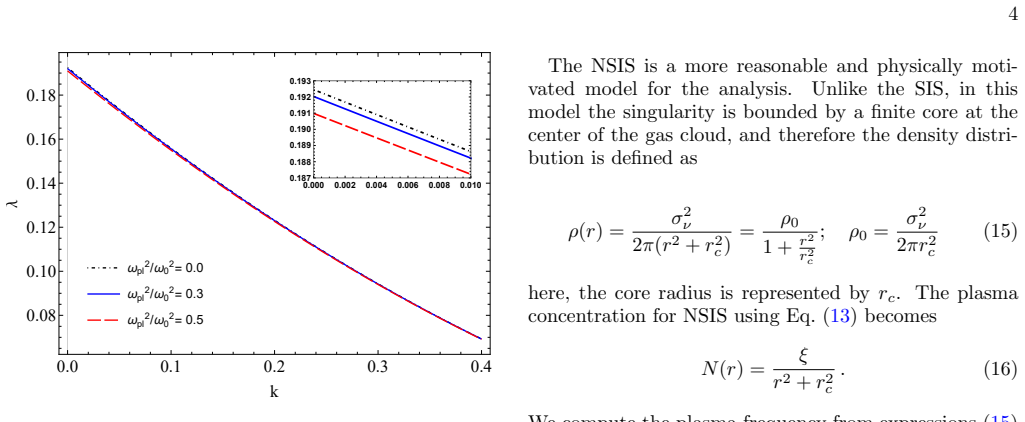
We investigated the influence of a plasma environment on the optical and perturbative properties of a black hole with a topological defect, characterized by the parameter \(k\). We first established a straightforward correspondence between the real part of the quasinormal-mode (QNM) frequencies in the eikonal limit and the black-hole shadow radius. We then demonstrated that the Lyapunov exponent associated with the photon sphere exhibits only a weak dependence on the plasma frequency, while it monotonically decreases as the topological-defect parameter \(k\) increases. Subsequently, we analyzed massive scalar-field perturbations by deriving the associated effective potential and computing the QNM spectrum using the third- and sixth-order WKB approximations for both homogeneous and radially inhomogeneous plasma configurations, including the singular isothermal sphere (SIS) and non-singular isothermal sphere (NSIS) density profiles. Our results show that the presence of plasma induces shifts in both the oscillation frequencies and the damping rates of the modes, and that larger values of \(k\) systematically suppress the real part of the QNM frequencies. Among the plasma models considered, the NSIS profile generally yields slightly higher oscillation frequencies than both the SIS and homogeneous cases. Finally, we derived the dynamical equations governing electromagnetic perturbations in a cold, unmagnetized plasma and demonstrated that the axial and polar sectors decouple. In the axial sector, the plasma frequency enters as an effective mass term, thereby permitting the existence of quasi-bound states only in the case of a homogeneous plasma and only when the plasma frequency lies below a critical threshold that depends on the topological-defect parameter \(k\) and the multipole index \(l\).
Figures


Reference graph
Works this paper leans on
-
[1]
Effective potential for the polar sector in the homogeneous plasma case Vpl =−A −1 4r12ω10 + 4l(1 +l)(2M+ (−1 +k)r) 6ω4 pl l+l 2 + 4r2ω2 pl −4r 9(−2M+r−kr)ω 8 3l(1 +l) + 5r 2ω2 pl + 4r(2M+ (−1 +k)r) 5ω4 pl l2(1 +l) 2(1 +l+l 2) +l(1 +l)(1 + 3l(1 +l))r 2ω2 pl + 3l(1 +l)r 4ω4 pl +r 6ω6 pl +r 4(2M+ (−1 +k)r)ω 6 2l(1 +l)r 3 + 30l(1 +l)r(2M+ (−1 +k)r) 2 + (2M+ ...
-
[2]
Effective potential for the polar sector in the inhomogeneous plasma case In the general case of an inhomogeneous plasma, the effective potential for the polar sector was discussed in Ref. [55]. Appendix C: Relative location of maxima and minima for the axial effective potential The effective axial potentialV ax ℓm(r) is given by Eq. (47), which admits bo...
-
[3]
B. P. Abbottet al.(LIGO Scientific, Virgo), Phys. Rev. Lett.116, 061102 (2016), arXiv:1602.03837 [gr-qc]
work page internal anchor Pith review Pith/arXiv arXiv 2016
-
[4]
B. P. Abbottet al.(LIGO Scientific, Virgo), Phys. Rev. Lett.119, 161101 (2017), arXiv:1710.05832 [gr-qc]
work page internal anchor Pith review Pith/arXiv arXiv 2017
-
[5]
First M87 Event Horizon Telescope Results. I. The Shadow of the Supermassive Black Hole
K. Akiyamaet al.(Event Horizon Telescope), Astrophys. J. Lett.875, L1 (2019), arXiv:1906.11238 [astro-ph.GA]
work page internal anchor Pith review Pith/arXiv arXiv 2019
-
[6]
K. Akiyamaet al.(Event Horizon Telescope), Astrophys. J. Lett.930, L12 (2022), arXiv:2311.08680 [astro-ph.HE]
work page internal anchor Pith review Pith/arXiv arXiv 2022
-
[7]
Gravitational Test Beyond the First Post-Newtonian Order with the Shadow of the M87 Black Hole
D. Psaltiset al.(Event Horizon Telescope), Phys. Rev. Lett.125, 141104 (2020), arXiv:2010.01055 [gr-qc]
work page internal anchor Pith review Pith/arXiv arXiv 2020
-
[8]
FairFace Challenge at ECCV 2020: Analyzing Bias in Face Recognition
A. Cardenas-Avendano, D. Luque, and N. Yunes, Class. Quant. Grav.38, 145010 (2021), arXiv:2009.07838 [gr- qc]
work page internal anchor Pith review Pith/arXiv arXiv 2021
-
[9]
S. Vagnozziet al., Class. Quant. Grav.40, 165007 (2023), arXiv:2205.07787 [gr-qc]
work page internal anchor Pith review Pith/arXiv arXiv 2023
-
[10]
T. W. B. Kibble, J. Phys. A9, 1387 (1976)
work page 1976
- [11]
-
[12]
Schwarzschild black hole with global monopole charge
N. Dadhich, K. Narayan, and U. A. Yajnik, Pramana 50, 307 (1998), arXiv:gr-qc/9703034
work page internal anchor Pith review Pith/arXiv arXiv 1998
- [13]
-
[14]
G. S. Bisnovatyi-Kogan and O. Y. Tsupko, Mon. Not. R. Astron. Soc.404, 1790 (2010)
work page 2010
-
[15]
Influence of a plasma on the shadow of a spherically symmetric black hole
V. Perlick, O. Y. Tsupko, and G. S. Bisnovatyi-Kogan, Phys. Rev. D92, 104031 (2015), arXiv:1507.04217 [gr- qc]
work page internal anchor Pith review Pith/arXiv arXiv 2015
-
[16]
V. Perlick and O. Y. Tsupko, Phys. Rev. D95, 104003 (2017), arXiv:1702.08768 [gr-qc]
work page internal anchor Pith review Pith/arXiv arXiv 2017
-
[17]
Optical properties of black hole in the presence of plasma: shadow
F. Atamurotov and B. Ahmedov, Phys. Rev. D92, 084005 (2015), arXiv:1507.08131 [gr-qc]
work page internal anchor Pith review Pith/arXiv arXiv 2015
-
[18]
G. Z. Babar, A. Z. Babar, and F. Atamurotov, Eur. Phys. J. C80, 761 (2020), [Erratum: Eur.Phys.J.C 82, 403 (2022)], arXiv:2008.05845 [gr-qc]
work page internal anchor Pith review Pith/arXiv arXiv 2020
-
[19]
F. Atamurotov, K. Jusufi, M. Jamil, A. Abdujabbarov, and M. Azreg-A¨ ınou, Phys. Rev. D104, 064053 (2021), arXiv:2109.08150 [gr-qc]
work page internal anchor Pith review Pith/arXiv arXiv 2021
-
[20]
Quantum effects on the black hole shadow and deflection angle in presence of plasma
F. Atamurotov, M. Jamil, and K. Jusufi, Chin. Phys. C 47, 035106 (2023), arXiv:2212.12949 [gr-qc]
work page internal anchor Pith review Pith/arXiv arXiv 2023
-
[21]
Shadow and quasinormal modes of the Kerr-Newman-Kiselev-Letelier black hole
F. Atamurotov, I. Hussain, G. Mustafa, and K. Jusufi, Eur. Phys. J. C82, 831 (2022), arXiv:2209.01652 [gr-qc]
work page internal anchor Pith review Pith/arXiv arXiv 2022
-
[22]
R. A. Konoplya and A. Zhidenko, Rev. Mod. Phys.83, 793 (2011), arXiv:1102.4014 [gr-qc]
work page internal anchor Pith review Pith/arXiv arXiv 2011
-
[23]
R. A. Konoplya, A. Stashko, and A. Zhidenko, Universe 5, 171 (2019), arXiv:1906.00375 [gr-qc]
work page internal anchor Pith review Pith/arXiv arXiv 2019
- [24]
-
[25]
Geodesic stability, Lyapunov exponents and quasinormal modes
V. Cardoso, A. S. Miranda, E. Berti, H. Witek, and V. T. Zanchin, Phys. Rev. D79, 064016 (2009), arXiv:0812.1806 [hep-th]
work page internal anchor Pith review Pith/arXiv arXiv 2009
-
[26]
K. Jusufi, Phys. Rev. D101, 084055 (2020), arXiv:1912.13320 [gr-qc]
work page internal anchor Pith review Pith/arXiv arXiv 2020
-
[27]
Connection Between the Shadow Radius and Quasinormal Modes in Rotating Spacetimes
K. Jusufi, Phys. Rev. D101, 124063 (2020), arXiv:2004.04664 [gr-qc]
work page internal anchor Pith review Pith/arXiv arXiv 2020
-
[28]
I. Z. Stefanov, S. S. Yazadjiev, and G. G. Gyulchev, Phys. Rev. Lett.104, 251103 (2010), arXiv:1003.1609 [gr-qc]
work page internal anchor Pith review Pith/arXiv arXiv 2010
-
[29]
B. Cuadros-Melgar, R. D. B. Fontana, and J. de Oliveira, Phys. Lett. B811, 135966 (2020). 16
work page 2020
- [30]
-
[31]
P. C. Li, T. C. Lee, M. Guo, and B. Chen, Phys. Rev. D104, 084044 (2021), arXiv:2105.14268 [gr-qc]
work page internal anchor Pith review Pith/arXiv arXiv 2021
- [32]
-
[33]
M. S. Churilova, Eur. Phys. J. C79, 629 (2019)
work page 2019
-
[34]
R. A. Konoplya and Z. Stuchl´ ık, Phys. Lett. B771, 597 (2017), arXiv:1705.05928 [gr-qc]
work page internal anchor Pith review Pith/arXiv arXiv 2017
-
[35]
J. G. Rosa and S. R. Dolan, Phys. Rev. D85, 044043 (2012), arXiv:1110.4494 [gr-qc]
work page internal anchor Pith review Pith/arXiv arXiv 2012
-
[36]
A. M. Oliveira, V. Cardoso, and C. F. B. Macedo, Phys. Rev. D107, 084030 (2023), arXiv:2301.07081 [gr-qc]
work page internal anchor Pith review Pith/arXiv arXiv 2023
-
[37]
Formation of Topological Defects at First Order Phase Transitions
M. Hindmarsh, A.-C. Davis, and R. H. Brandenberger, Phys. Rev. D49, 1944 (1994), arXiv:hep-ph/9307203
work page internal anchor Pith review Pith/arXiv arXiv 1944
- [38]
- [39]
- [40]
-
[41]
A. S. Goldhaber, Phys. Rev. Lett.63, 2158 (1989)
work page 1989
-
[42]
S. H. Rhie and D. P. Bennett, Phys. Rev. Lett.67, 1173 (1991)
work page 1991
- [43]
-
[44]
Calculating black hole shadows: Review of analytical studies
V. Perlick and O. Y. Tsupko, Phys. Rept.947, 1 (2022), arXiv:2105.07101 [gr-qc]
work page internal anchor Pith review Pith/arXiv arXiv 2022
-
[45]
S.-W. Wei and Y.-X. Liu, Chin. Phys. C44, 115103 (2020), arXiv:1909.11911 [gr-qc]
work page internal anchor Pith review Pith/arXiv arXiv 2020
- [46]
-
[47]
Frequency-dependent effects of gravitational lensing within plasma
A. Rogers, Mon. Not. Roy. Astron. Soc.451, 17 (2015), arXiv:1505.06790 [gr-qc]
work page internal anchor Pith review Pith/arXiv arXiv 2015
-
[48]
G. B. Gelmini, V. Takhistov, and E. Vitagliano, Phys. Lett. B809, 135779 (2020), arXiv:2006.13909 [hep-ph]
work page internal anchor Pith review Pith/arXiv arXiv 2020
-
[49]
D. J. Gogoi and U. D. Goswami, JCAP06, 029 (2022), arXiv:2203.07594 [gr-qc]
work page internal anchor Pith review Pith/arXiv arXiv 2022
-
[50]
R. A. Konoplya, Phys. Rev. D68, 024018 (2003), arXiv:gr-qc/0303052
work page internal anchor Pith review Pith/arXiv arXiv 2003
-
[51]
B. F. Schutz and C. M. Will, APJL291, L33 (1985)
work page 1985
- [52]
- [53]
-
[54]
R. A. Breuer and J. Ehlers, Astronomy and Astrophysics 96, 293 (1981)
work page 1981
-
[55]
G. F. R. Ellis, Proc. Int. Sch. Phys. Fermi47, 104 (1971)
work page 1971
-
[56]
E. Cannizzaro, A. Caputo, L. Sberna, and P. Pani, Phys. Rev. D103, 124018 (2021), arXiv:2012.05114 [gr-qc]
work page internal anchor Pith review Pith/arXiv arXiv 2021
-
[57]
Accreting Schwarzschild-like compact object: Plasma-photon interaction and stability
A. Chowdhury, S. Biswas, and S. Chakraborty, Phys. Rev. D110, 064072 (2024), arXiv:2405.04006 [gr-qc]
work page internal anchor Pith review Pith/arXiv arXiv 2024
discussion (0)
Sign in with ORCID, Apple, or X to comment. Anyone can read and Pith papers without signing in.