Investigating the Spectral Properties of Dual Nuclei in Galaxy Mergers from the GOTHIC survey: Supermassive Black Hole Growth, metal enrichment and Dual AGN
Pith reviewed 2026-06-26 16:14 UTC · model grok-4.3
The pith
Black hole masses in merging galaxies exceed those in single-nucleus galaxies at the same stellar mass.
A machine-rendered reading of the paper's core claim, the machinery that carries it, and where it could break.
Core claim
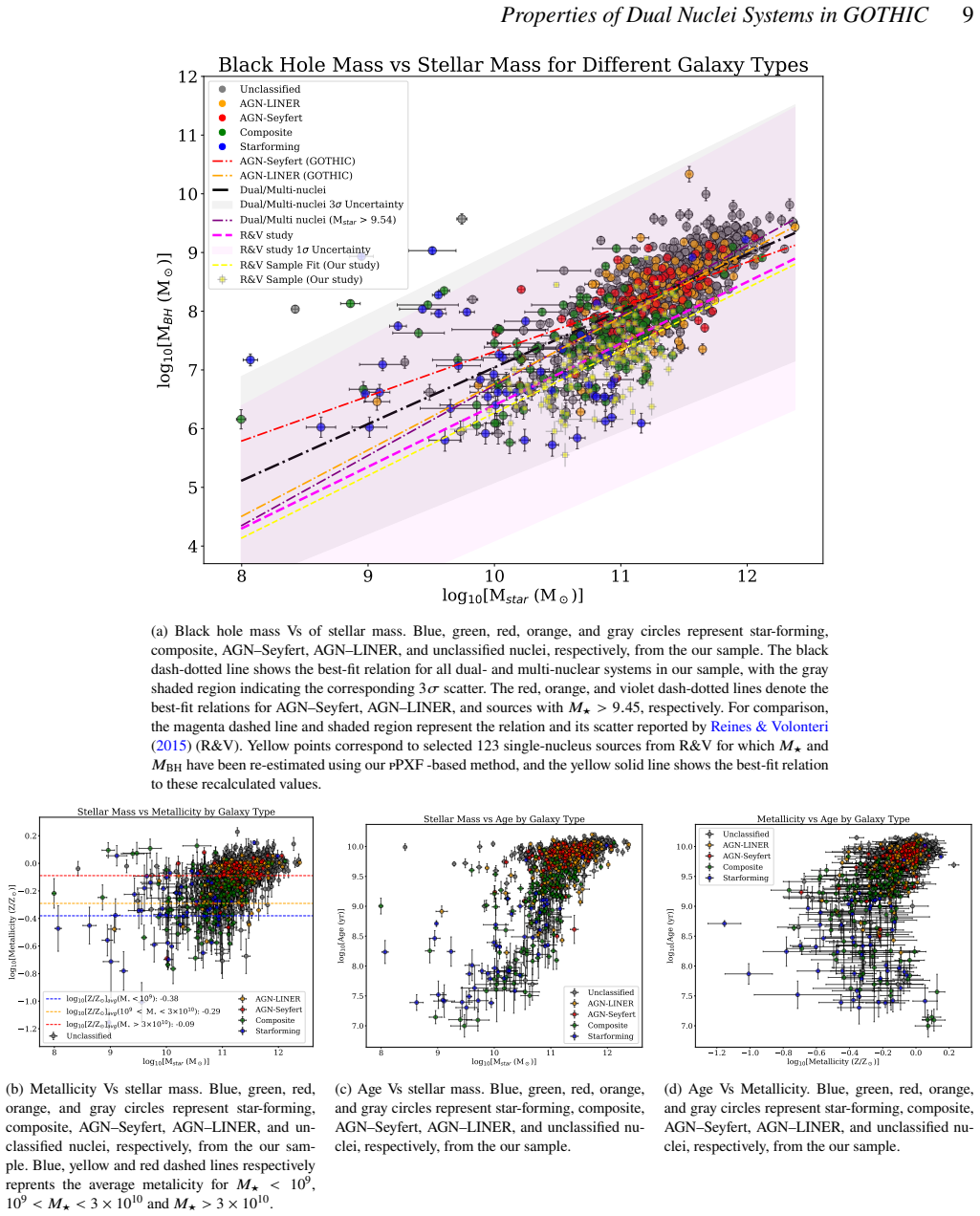
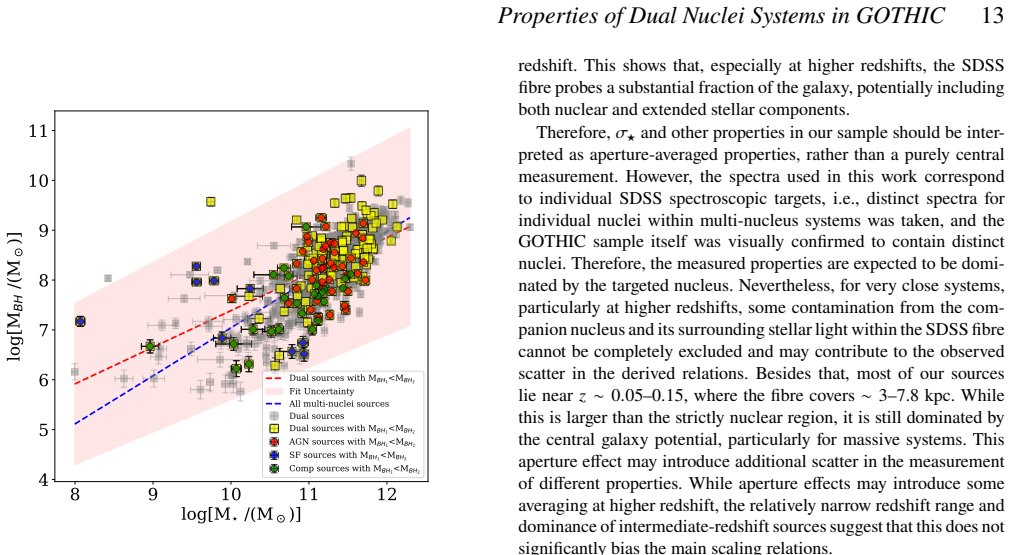
Spectroscopic analysis of dual nuclei shows that supermassive black hole masses are systematically higher in galaxy mergers than in single-nuclei galaxies when compared at fixed stellar mass, indicating that black holes grow during the merging process rather than solely through later black-hole coalescence.
What carries the argument
Penalized pixel-fitting (pPXF) applied to SDSS spectra to extract stellar velocity dispersion, stellar mass, star-formation history, metallicity, and black-hole mass via the M-sigma relation.
If this is right
- SMBH growth occurs during the galaxy merging process in addition to any later coalescence of the black holes themselves.
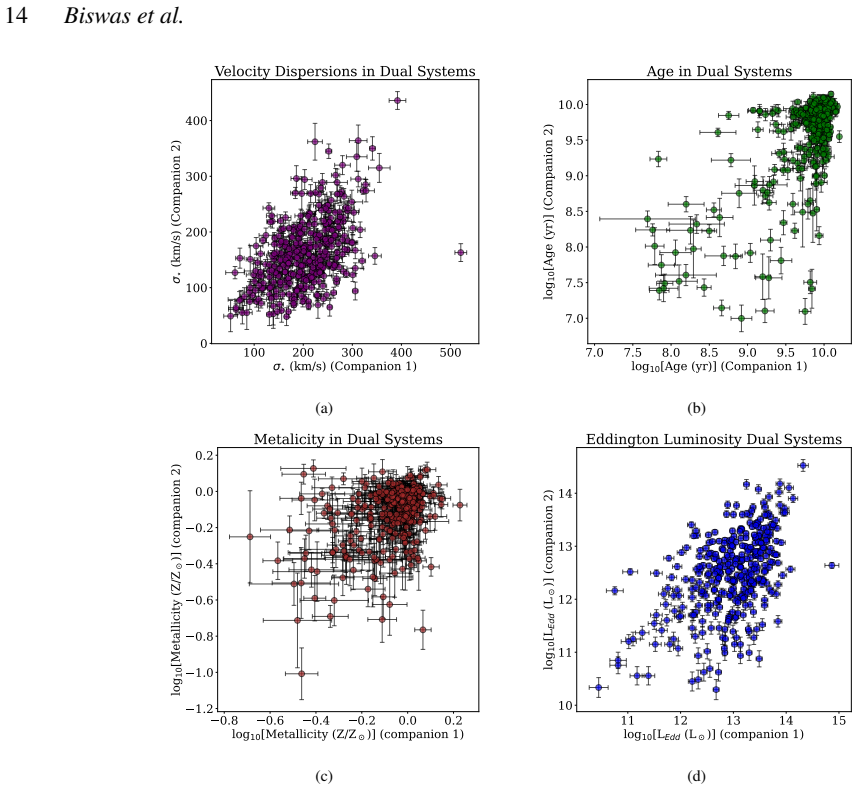
- Dual nuclei systems exhibit measurable differences in stellar velocity dispersion, stellar mass, black-hole mass, age, and metallicity between the two nuclei.
- Accretion rates and SMBH mass ratios can be extracted for star-forming pairs, dual AGN, and mixed pairs, providing direct constraints on co-evolution during mergers.
- Metal enrichment and star-formation histories in these systems differ from those in isolated galaxies, linking merger dynamics to chemical evolution.
Where Pith is reading between the lines
- If the mass offset holds, merger-driven gas inflows must supply a larger fraction of black-hole fuel than secular processes in isolated galaxies.
- Higher-resolution spectra could test whether the two nuclei in close pairs show synchronized or staggered accretion episodes.
- The reported metallicity patterns suggest that merger-triggered starbursts may dominate the chemical enrichment observed in the nuclei.
- Larger samples from future integral-field surveys could map how the mass offset scales with projected separation or merger stage.
Load-bearing premise
The single-nuclei comparison sample can be measured with the same pPXF procedure and selection cuts so that stellar-mass and black-hole-mass estimates carry no systematic offset relative to the dual-nuclei sample.
What would settle it
Re-deriving black-hole and stellar masses for the single-nuclei control sample with identical pPXF settings and selection criteria, then finding no mass offset or a reversed offset, would falsify the growth-during-merger claim.
Figures
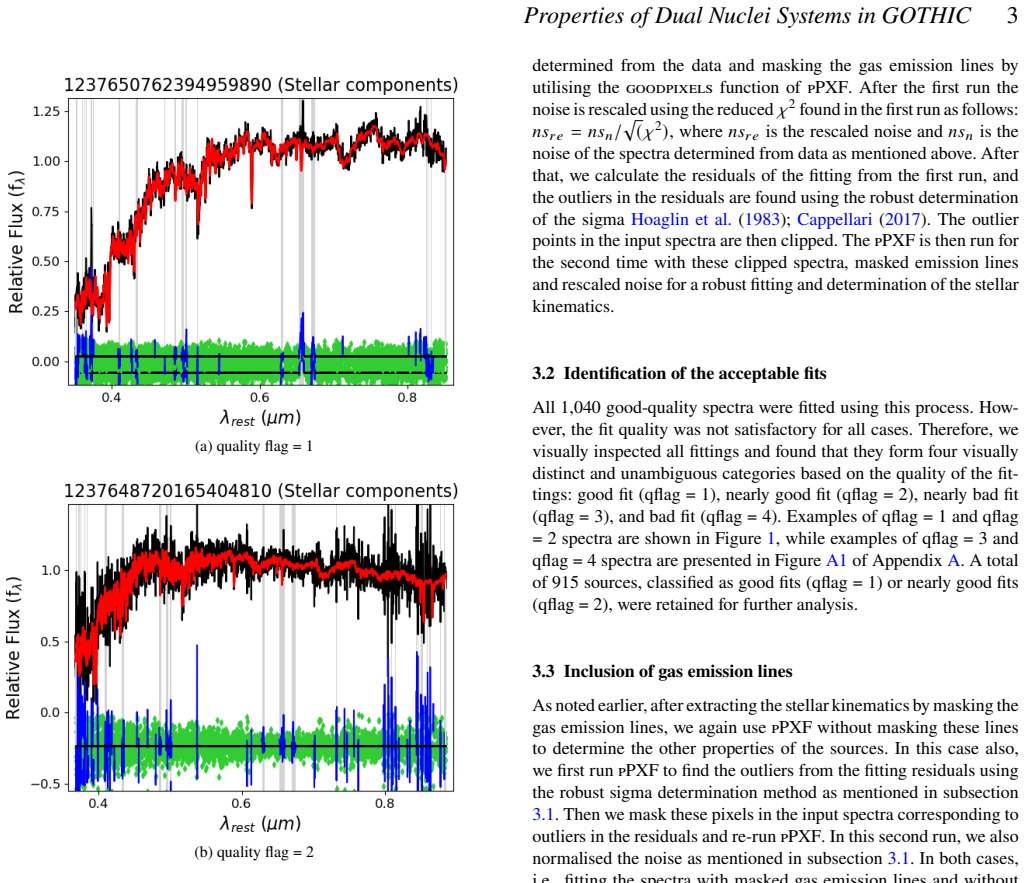
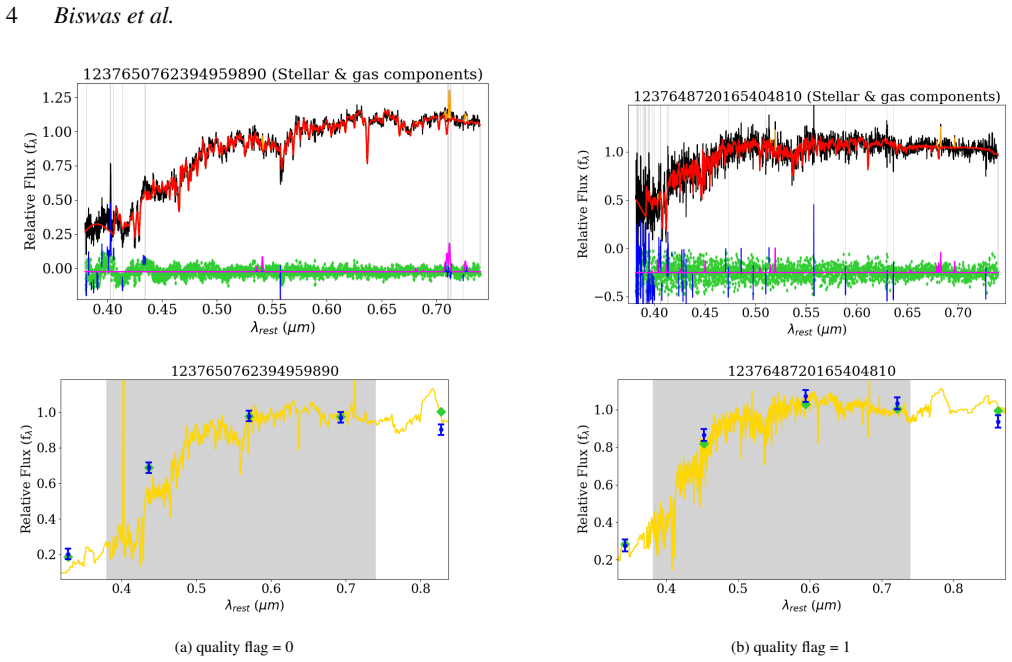
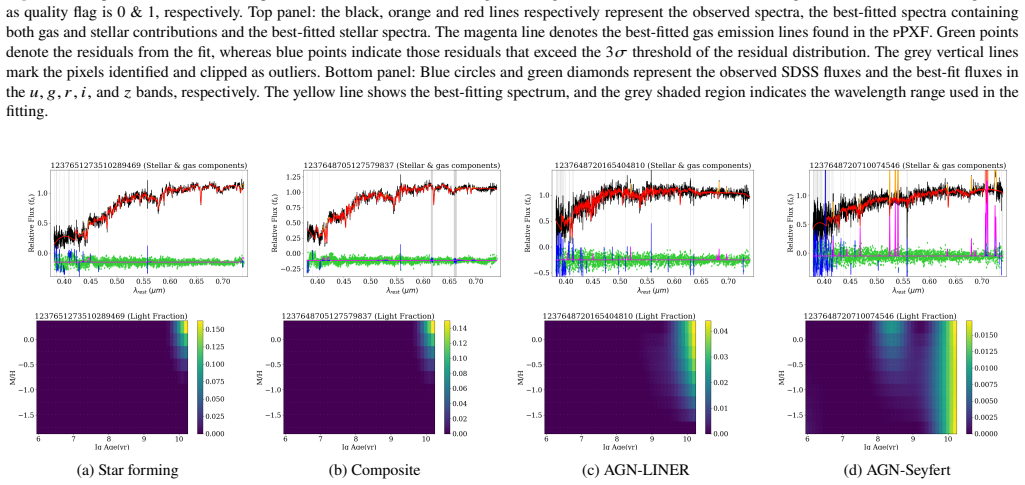
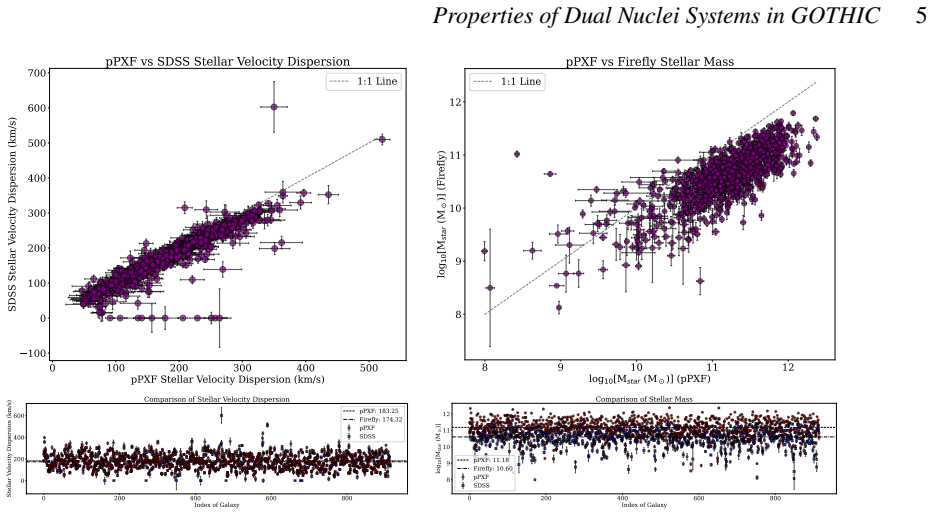
read the original abstract
Dual nuclei systems are galaxy merger remnants or closely merging galaxies that have two distinct stellar cores separated by ~ 10pc to 10kpc. They are important laboratories for probing the co-evolution of stellar populations, galaxy dynamics, and central black holes during the hierarchical assembly of galaxies. In this study, we present a spectroscopic analysis of a sample of dual nuclei from the GOTHIC survey, using the penalized pixel-fitting (pPXF) code. The sample consists of star forming nuclei pairs, dual active galactic nuclei (DAGN) and mixed pairs. Using the SDSS spectra, we extracted stellar kinematics, emission line fluxes, the star formation history, metallicity of the nuclei, and derived important properties such as the supermassive black hole (SMBH) masses, accretion rates and SMBH ratios. We compared different properties of the nuclei in the dual systems, such as stellar velocity dispersion, stellar masses, black hole masses, age and metallicity. Our results show that the SMBH masses are higher for BHs in galaxy mergers compared to single nuclei for a given stellar mass, thus revealing that SMBHs grow during the galaxy merging process and not only due to the merger of SMBHs. Our study provides new observational constraints on the dynamical and evolutionary states of dual-nuclei systems, offering a deeper understanding of the role these systems play in galaxy evolution and central black hole growth.
Editorial analysis
A structured set of objections, weighed in public.
Referee Report
Summary. The manuscript analyzes dual-nuclei systems (star-forming pairs, DAGN, and mixed) from the GOTHIC survey using pPXF on SDSS spectra to extract stellar kinematics, emission-line fluxes, star-formation histories, metallicities, SMBH masses (via M-σ), accretion rates, and mass ratios. It compares these quantities between the two nuclei and reports that SMBH masses are systematically higher in dual-nuclei systems than in single-nuclei galaxies at fixed stellar mass, implying SMBH growth occurs during the merger phase itself.
Significance. A robust demonstration that SMBH masses are elevated at fixed M_star in merging systems would supply direct observational evidence for merger-driven black-hole growth prior to final coalescence, tightening constraints on co-evolution models. The manuscript does not yet supply the sample sizes, selection functions, or identical-processing details required to evaluate that claim.
major comments (2)
- [Abstract] Abstract: the central claim that 'SMBH masses are higher for BHs in galaxy mergers compared to single nuclei for a given stellar mass' rests on an unspecified single-nuclei comparison sample. No information is given on its redshift distribution, stellar-mass range, selection criteria, or whether the identical pPXF pipeline (same IMF, aperture corrections, M-σ calibration) was applied; any mismatch in σ or M_star derivation would produce an apparent offset without physical growth during merging.
- [Abstract] Abstract / Results (assumed §4): the reported offset is presented without error bars, sample sizes, or a quantitative description of how the single-nuclei control sample was constructed and matched, rendering the statistical significance of the claimed difference impossible to assess from the provided text.
minor comments (1)
- [Abstract] Abstract: the separation range '~10 pc to 10 kpc' should be accompanied by the actual distribution or median value realized in the GOTHIC dual-nuclei sample.
Simulated Author's Rebuttal
We thank the referee for their careful and constructive review of our manuscript. We address the major comments point by point below and will incorporate revisions to strengthen the presentation of the comparison sample and statistical details.
read point-by-point responses
-
Referee: [Abstract] Abstract: the central claim that 'SMBH masses are higher for BHs in galaxy mergers compared to single nuclei for a given stellar mass' rests on an unspecified single-nuclei comparison sample. No information is given on its redshift distribution, stellar-mass range, selection criteria, or whether the identical pPXF pipeline (same IMF, aperture corrections, M-σ calibration) was applied; any mismatch in σ or M_star derivation would produce an apparent offset without physical growth during merging.
Authors: We agree that the abstract does not currently provide these details on the single-nuclei comparison sample. In the revised manuscript we will update the abstract to include a concise description of the control sample, specifying its redshift distribution, stellar-mass range, selection criteria, and explicit confirmation that the identical pPXF pipeline, IMF, aperture corrections, and M-σ calibration were applied to both the dual-nuclei and single-nuclei samples. revision: yes
-
Referee: [Abstract] Abstract / Results (assumed §4): the reported offset is presented without error bars, sample sizes, or a quantitative description of how the single-nuclei control sample was constructed and matched, rendering the statistical significance of the claimed difference impossible to assess from the provided text.
Authors: We acknowledge that the abstract lacks sample sizes, error bars on the offset, and a quantitative description of control-sample construction and matching. In the revision we will modify the abstract to report the sizes of both the dual-nuclei and single-nuclei samples, include the offset with associated uncertainties, and provide a brief quantitative summary of how the control sample was constructed and matched in stellar mass and redshift. revision: yes
Circularity Check
No circularity; empirical comparison relies on direct pPXF measurements and standard relations without self-referential reduction.
full rationale
The paper derives SMBH masses via pPXF velocity dispersions inserted into the standard M-σ relation and stellar masses from pPXF star-formation histories, then compares these quantities at fixed stellar mass between dual-nuclei systems and single-nuclei galaxies. No equations, fitted parameters, or self-citations are shown that would make the reported offset equivalent to its inputs by construction. The chain consists of standard spectral fitting applied to SDSS data plus an external comparison sample; it remains falsifiable against independent catalogs and does not invoke uniqueness theorems or ansatzes from the authors' prior work. This is the normal case of an observational result that does not reduce to tautology.
Axiom & Free-Parameter Ledger
Reference graph
Works this paper leans on
-
[1]
Lopsided galaxies. , keywords =. doi:10.1093/mnras/193.2.313 , adsurl =
-
[2]
Lopsided spiral galaxies: evidence for gas accretion
Lopsided spiral galaxies: evidence for gas accretion. , keywords =. doi:10.1051/0004-6361:20052631 , archivePrefix =. astro-ph/0503314 , primaryClass =
work page internal anchor Pith review Pith/arXiv arXiv doi:10.1051/0004-6361:20052631
-
[3]
Lopsided galaxies in a cosmological context: a new galaxy-halo connection. , keywords =. doi:10.1093/mnras/stad1724 , archivePrefix =. 2211.16577 , primaryClass =
-
[4]
Lopsidedness in WHISP galaxies. I. Rotation curves and kinematic lopsidedness. , keywords =. doi:10.1051/0004-6361/201016177 , archivePrefix =. 1103.4928 , primaryClass =
work page internal anchor Pith review Pith/arXiv arXiv doi:10.1051/0004-6361/201016177
-
[5]
NON-AXISYMMETRIC STRUCTURES IN THE STELLAR DISKS OF GALAXIES
Nonaxisymmetric Structures in the Stellar Disks of Galaxies. , keywords =. doi:10.1086/175858 , archivePrefix =. astro-ph/9505111 , primaryClass =
work page internal anchor Pith review Pith/arXiv arXiv doi:10.1086/175858
-
[6]
Large-Scale Asymmetry of Rotation Curves in Lopsided Spiral Galaxies
Large-scale asymmetry of rotation curves in lopsided spiral galaxies. , keywords =. doi:10.1051/0004-6361:20020832 , archivePrefix =. astro-ph/0207055 , primaryClass =
work page internal anchor Pith review Pith/arXiv arXiv doi:10.1051/0004-6361:20020832
-
[7]
Lopsidedness in WHISP galaxies. II. Morphological lopsidedness. , keywords =. doi:10.1051/0004-6361/201016178 , archivePrefix =. 1103.4929 , primaryClass =
work page internal anchor Pith review Pith/arXiv arXiv doi:10.1051/0004-6361/201016178
-
[8]
On the Origin of Lopsidedness in Galaxies as Determined from the Spitzer Survey of Stellar Structure in Galaxies (S ^ 4 G). , keywords =. doi:10.1088/0004-637X/772/2/135 , archivePrefix =. 1305.2940 , primaryClass =
work page internal anchor Pith review Pith/arXiv arXiv doi:10.1088/0004-637x/772/2/135
-
[9]
Local stellar kinematics from HIPPARCOS data. , keywords =. doi:10.1046/j.1365-8711.1998.01600.x , archivePrefix =. astro-ph/9710077 , primaryClass =
-
[10]
Research in Astronomy and Astrophysics , keywords =
Milky Way globular cluster dynamics: are they preferentially co-rotating?. Research in Astronomy and Astrophysics , keywords =. doi:10.1088/1674-4527/20/8/130 , archivePrefix =. 2003.12763 , primaryClass =
-
[11]
Massive star populations in Wolf-Rayet galaxies. , keywords =. doi:10.1111/j.1365-2966.2004.08352.x , archivePrefix =. astro-ph/0409114 , primaryClass =
-
[12]
Multiwavelength star formation indicators: Observations
Multiwavelength Star Formation Indicators: Observations. , keywords =. doi:10.1086/501529 , archivePrefix =. astro-ph/0602063 , primaryClass =
work page internal anchor Pith review Pith/arXiv arXiv doi:10.1086/501529
-
[13]
Kinematically lopsided spiral galaxies. , keywords =. doi:10.1046/j.1365-8711.1999.02332.x , archivePrefix =. astro-ph/9811424 , primaryClass =
-
[14]
How often? How strong?
Asymmetries in disk galaxies. How often? How strong?. , keywords =
-
[15]
Asymmetry in High-Precision Global H i Profiles of Isolated Spiral Galaxies. , keywords =. doi:10.1086/300166 , adsurl =
-
[16]
Self-Consistent Response of a Galactic Disk to an Elliptical Perturbation Halo Potential
Self-consistent Response of a Galactic Disk to an Elliptical Perturbation Halo Potential. , keywords =. doi:10.1086/309521 , archivePrefix =. astro-ph/0007364 , primaryClass =
work page internal anchor Pith review Pith/arXiv arXiv doi:10.1086/309521
-
[17]
The Spitzer Survey of Stellar Structure in Galaxies (S^4G)
The Spitzer Survey of Stellar Structure in Galaxies (S4G). , keywords =. doi:10.1086/657638 , archivePrefix =. 1010.1592 , primaryClass =
work page internal anchor Pith review Pith/arXiv arXiv doi:10.1086/657638
-
[18]
The impact of bars on disk breaks as probed by S4G imaging
The Impact of Bars on Disk Breaks as Probed by S ^ 4 G Imaging. , keywords =. doi:10.1088/0004-637X/771/1/59 , archivePrefix =. 1304.6083 , primaryClass =
work page internal anchor Pith review Pith/arXiv arXiv doi:10.1088/0004-637x/771/1/59
-
[19]
The Spitzer Survey of Stellar Structure in Galaxies (S ^ 4 G): Precise Stellar Mass Distributions from Automated Dust Correction at 3.6 m. , keywords =. doi:10.1088/0067-0049/219/1/5 , archivePrefix =. 1410.0009 , primaryClass =
work page internal anchor Pith review Pith/arXiv arXiv doi:10.1088/0067-0049/219/1/5
-
[20]
The Lopsidedness of Present-Day Galaxies: Connections to the Formation of Stars, the Chemical Evolution of Galaxies, and the Growth of Black Holes. , keywords =. doi:10.1088/0004-637X/691/2/1005 , archivePrefix =. 0809.3310 , primaryClass =
work page internal anchor Pith review Pith/arXiv arXiv doi:10.1088/0004-637x/691/2/1005
-
[21]
The Westerbork HI survey of spiral and irregular galaxies. I. HI imaging of late-type dwarf galaxies. , keywords =. doi:10.1051/0004-6361:20011755 , archivePrefix =. astro-ph/0204525 , primaryClass =
work page internal anchor Pith review Pith/arXiv arXiv doi:10.1051/0004-6361:20011755
-
[22]
, archivePrefix = "arXiv", eprint =
^ 3D BAROLO: a new 3D algorithm to derive rotation curves of galaxies. , archivePrefix = "arXiv", eprint =. doi:10.1093/mnras/stv1213 , adsurl =
-
[23]
Survey definition, methodology, and initial results from the pilot sample
The GMRT archive atomic gas survey - I. Survey definition, methodology, and initial results from the pilot sample. , keywords =. doi:10.1093/mnras/stac791 , archivePrefix =. 2203.16584 , primaryClass =
-
[24]
Monthly Notices of the Royal Astronomical Society , volume =
Biswas, Prerana and Kalinova, Veselina and Roy, Nirupam and Patra, Narendra Nath and Tyulneva, Nadezda , title = ". Monthly Notices of the Royal Astronomical Society , volume =. 2023 , month =. doi:10.1093/mnras/stad2285 , url =
-
[25]
2002, MNRAS, 334, 523, doi: 10.1046/j.1365-8711.2002.05478.x
Efficient multi-Gaussian expansion of galaxies. , keywords =. doi:10.1046/j.1365-8711.2002.05412.x , archivePrefix =. astro-ph/0201430 , primaryClass =
-
[26]
Automated kinematic modelling of warped galaxy discs in large H I surveys: 3D tilted-ring fitting of H I emission cubes. , keywords =. doi:10.1093/mnras/stv1480 , archivePrefix =. 1507.00413 , primaryClass =
work page internal anchor Pith review Pith/arXiv arXiv doi:10.1093/mnras/stv1480
-
[27]
Star formation quenching stages of active and non-active galaxies. , keywords =. doi:10.1051/0004-6361/202039896 , archivePrefix =. 2101.10019 , primaryClass =
-
[28]
Investigating the link between inner gravitational potential and star-formation quenching in CALIFA galaxies. , keywords =. doi:10.1051/0004-6361/202243541 , archivePrefix =. 2207.03872 , primaryClass =
-
[29]
Observatory Operations: Strategies, Processes, and Systems III , year = 2010, editor =
Spitzer Heritage Archive. Observatory Operations: Strategies, Processes, and Systems III , year = 2010, editor =. doi:10.1117/12.857728 , adsurl =
-
[30]
Sloan Digital Sky Survey IV: Mapping the Milky Way, Nearby Galaxies, and the Distant Universe
Sloan Digital Sky Survey IV: Mapping the Milky Way, Nearby Galaxies, and the Distant Universe. , keywords =. doi:10.3847/1538-3881/aa7567 , archivePrefix =. 1703.00052 , primaryClass =
work page internal anchor Pith review Pith/arXiv arXiv doi:10.3847/1538-3881/aa7567
-
[31]
The far-infrared properties of the most isolated galaxies
The Far-Infrared Properties of the Most Isolated Galaxies. Island Universes , year = 2007, series =. doi:10.1007/978-1-4020-5573-7_54 , archivePrefix =. astro-ph/0509131 , primaryClass =
work page internal anchor Pith review Pith/arXiv arXiv doi:10.1007/978-1-4020-5573-7_54 2007
-
[32]
A kinematic study of the irregular dwarf galaxy NGC 4861 using HI and Halpha observations
A kinematic study of the irregular dwarf galaxy NGC 4861 using H I and H observations. , keywords =. doi:10.1051/0004-6361/200911766 , archivePrefix =. 0907.4635 , primaryClass =
work page internal anchor Pith review Pith/arXiv arXiv doi:10.1051/0004-6361/200911766
-
[33]
First results from the TNG50 simulation: galactic outflows driven by supernovae and black hole feedback. , keywords =. doi:10.1093/mnras/stz2306 , archivePrefix =. 1902.05554 , primaryClass =
work page internal anchor Pith review Pith/arXiv arXiv doi:10.1093/mnras/stz2306 1902
-
[34]
, year = 1974, month = oct, volume =
Aperture-synthesis observations of H I in the galaxy M83. , year = 1974, month = oct, volume =. doi:10.1086/153164 , adsurl =
-
[35]
Automated detection of double nuclei galaxies using GOTHIC and the discovery of a large sample of dual AGN. , keywords =. doi:10.1093/mnras/stad2117 , archivePrefix =. 2011.12177 , primaryClass =
-
[36]
Parametric Recovery of Line-of-Sight Velocity Distributions from Absorption-Line Spectra of Galaxies via Penalized Likelihood. , keywords =. doi:10.1086/381875 , archivePrefix =. astro-ph/0312201 , primaryClass =
work page internal anchor Pith review Pith/arXiv arXiv doi:10.1086/381875
-
[37]
Improving the full spectrum fitting method: accurate convolution with Gauss-Hermite functions
Improving the full spectrum fitting method: accurate convolution with Gauss-Hermite functions. , keywords =. doi:10.1093/mnras/stw3020 , archivePrefix =. 1607.08538 , primaryClass =
work page internal anchor Pith review Pith/arXiv arXiv doi:10.1093/mnras/stw3020
-
[38]
Full spectrum fitting with photometry in PPXF: stellar population versus dynamical masses, non-parametric star formation history and metallicity for 3200 LEGA-C galaxies at redshift z 0.8. , keywords =. doi:10.1093/mnras/stad2597 , archivePrefix =. 2208.14974 , primaryClass =
-
[39]
Astronomical Data Analysis Software and Systems XVII , year = 2008, editor =
DER\_SNR: A Simple & General Spectroscopic Signal-to-Noise Measurement Algorithm. Astronomical Data Analysis Software and Systems XVII , year = 2008, editor =
2008
-
[40]
2007, MNRAS, 376, 1145, doi: 10.1111/j.1365-2966.2007.11495.x
Decoding the spectra of SDSS early-type galaxies: new indicators of age and recent star formation. , keywords =. doi:10.1111/j.1365-2966.2007.12446.x , archivePrefix =. 0709.0300 , primaryClass =
-
[41]
UV-extended E-MILES stellar population models: young components in massive early-type galaxies
UV-extended E-MILES stellar population models: young components in massive early-type galaxies. , keywords =. doi:10.1093/mnras/stw2231 , archivePrefix =. 1612.01187 , primaryClass =
work page internal anchor Pith review Pith/arXiv arXiv doi:10.1093/mnras/stw2231
-
[42]
Understanding robust and exploratory data anlysis
-
[43]
Firefly (Fitting IteRativEly For Likelihood analYsis): a full spectral fitting code
FIREFLY (Fitting IteRativEly For Likelihood analYsis): a full spectral fitting code. , keywords =. doi:10.1093/mnras/stx2215 , archivePrefix =. 1711.00865 , primaryClass =
work page internal anchor Pith review Pith/arXiv arXiv doi:10.1093/mnras/stx2215
-
[44]
Stellar velocity dispersions and emission line properties of SDSS-III/BOSS galaxies
Stellar velocity dispersions and emission line properties of SDSS-III/BOSS galaxies. , keywords =. doi:10.1093/mnras/stt261 , archivePrefix =. 1207.6115 , primaryClass =
work page internal anchor Pith review Pith/arXiv arXiv doi:10.1093/mnras/stt261
-
[45]
Spectral Classification and Redshift Measurement for the SDSS-III Baryon Oscillation Spectroscopic Survey. , keywords =. doi:10.1088/0004-6256/144/5/144 , archivePrefix =. 1207.7326 , primaryClass =
work page internal anchor Pith review Pith/arXiv arXiv doi:10.1088/0004-6256/144/5/144
-
[46]
Early-Type Galaxies in the Sloan Digital Sky Survey. I. The Sample. , keywords =. doi:10.1086/367776 , archivePrefix =. astro-ph/0301631 , primaryClass =
work page internal anchor Pith review Pith/arXiv arXiv doi:10.1086/367776
-
[47]
Modeling the Panchromatic Spectral Energy Distributions of Galaxies
Modeling the Panchromatic Spectral Energy Distributions of Galaxies. , keywords =. doi:10.1146/annurev-astro-082812-141017 , archivePrefix =. 1301.7095 , primaryClass =
work page internal anchor Pith review Pith/arXiv arXiv doi:10.1146/annurev-astro-082812-141017
-
[48]
Classification parameters for the emission-line spectra of extragalactic objects. , keywords =. doi:10.1086/130766 , adsurl =
-
[49]
The host galaxies of active galactic nuclei. , keywords =. doi:10.1111/j.1365-2966.2003.07154.x , archivePrefix =. astro-ph/0304239 , primaryClass =
-
[50]
M., Rodriguez, C., & Wright, G
The host galaxies and classification of active galactic nuclei. , keywords =. doi:10.1111/j.1365-2966.2006.10859.x , archivePrefix =. astro-ph/0605681 , primaryClass =
-
[51]
Alternative diagnostic diagrams and the `forgotten' population of weak line galaxies in the SDSS. , keywords =. doi:10.1111/j.1365-2966.2009.16185.x , archivePrefix =. 0912.1643 , primaryClass =
-
[52]
, year = 2005, month = apr, volume =
The SAURON project - V. Integral-field emission-line kinematics of 48 elliptical and lenticular galaxies. , keywords =. doi:10.1111/j.1365-2966.2005.09839.x , archivePrefix =. astro-ph/0511307 , primaryClass =
-
[53]
GANDALF: Gas AND Absorption Line Fitting
-
[54]
BASS. XXVI. DR2 Host Galaxy Stellar Velocity Dispersions. , keywords =. doi:10.3847/1538-4365/ac650b , archivePrefix =. 2207.12435 , primaryClass =
-
[55]
The velocity dispersion function of early-type galaxies
The Velocity Dispersion Function of Early-Type Galaxies. , keywords =. doi:10.1086/376794 , archivePrefix =. astro-ph/0303092 , primaryClass =
work page internal anchor Pith review Pith/arXiv arXiv doi:10.1086/376794
-
[56]
Coevolution (Or Not) of Supermassive Black Holes and Host Galaxies
Coevolution (Or Not) of Supermassive Black Holes and Host Galaxies. , keywords =. doi:10.1146/annurev-astro-082708-101811 , archivePrefix =. 1304.7762 , primaryClass =
work page internal anchor Pith review Pith/arXiv arXiv doi:10.1146/annurev-astro-082708-101811
-
[57]
Numerical Simulations of Super-Eddington Accretion Flows. arXiv e-prints , keywords =. doi:10.48550/arXiv.2408.16856 , archivePrefix =. 2408.16856 , primaryClass =
-
[58]
The Internal Constitution of the Stars
-
[59]
Revisiting the Scaling Relations of Black Hole Masses and Host Galaxy Properties
Revisiting the Scaling Relations of Black Hole Masses and Host Galaxy Properties. , keywords =. doi:10.1088/0004-637X/764/2/184 , archivePrefix =. 1211.2816 , primaryClass =
work page internal anchor Pith review Pith/arXiv arXiv doi:10.1088/0004-637x/764/2/184
-
[60]
Relations Between Central Black Hole Mass and Total Galaxy Stellar Mass in the Local Universe
Relations between Central Black Hole Mass and Total Galaxy Stellar Mass in the Local Universe. , keywords =. doi:10.1088/0004-637X/813/2/82 , archivePrefix =. 1508.06274 , primaryClass =
work page internal anchor Pith review Pith/arXiv arXiv doi:10.1088/0004-637x/813/2/82
-
[61]
The MaNGA FIREFLY value added catalogue: resolved stellar populations of 10 010 nearby galaxies. , keywords =. doi:10.1093/mnras/stac1260 , archivePrefix =. 2202.04082 , primaryClass =
-
[62]
Overview of the SDSS-IV MaNGA Survey: Mapping Nearby Galaxies at Apache Point Observatory
Overview of the SDSS-IV MaNGA Survey: Mapping nearby Galaxies at Apache Point Observatory. , keywords =. doi:10.1088/0004-637X/798/1/7 , archivePrefix =. 1412.1482 , primaryClass =
work page internal anchor Pith review Pith/arXiv arXiv doi:10.1088/0004-637x/798/1/7
-
[63]
The Sloan Digital Sky Survey Reverberation Mapping Project: The Black Hole Mass-Stellar Mass Relations at 0.2 z 0.8. , keywords =. doi:10.3847/1538-4357/acddda , archivePrefix =. 2301.04177 , primaryClass =
-
[64]
The Correlation between Black Hole Mass and Stellar Mass for Classical Bulges and the Cores of Ellipticals. , keywords =. doi:10.3847/1538-4357/abcaa1 , archivePrefix =. 2011.07216 , primaryClass =
-
[65]
No Significant Evolution of Relations between Black Hole Mass and Galaxy Total Stellar Mass Up to z 2.5. , keywords =. doi:10.3847/1538-4357/ab5f5f , archivePrefix =. 1912.02824 , primaryClass =
-
[66]
The Scaling of Stellar Mass and Central Stellar Velocity Dispersion for Quiescent Galaxies at z<0.7. , keywords =. doi:10.3847/0004-637X/832/2/203 , archivePrefix =. 1607.04275 , primaryClass =
work page internal anchor Pith review Pith/arXiv arXiv doi:10.3847/0004-637x/832/2/203
-
[67]
Stellar mass-metallicity relation throughout the large-scale structure of the Universe: CAVITY mother sample. , keywords =. doi:10.1051/0004-6361/202346884 , archivePrefix =. 2310.11412 , primaryClass =
-
[68]
, year = 2005, month = apr, volume =
The ages and metallicities of galaxies in the local universe. , keywords =. doi:10.1111/j.1365-2966.2005.09321.x , archivePrefix =. astro-ph/0506539 , primaryClass =
-
[69]
Galaxy Formation through Hierarchical Clustering. , keywords =. doi:10.1086/170483 , adsurl =
-
[70]
Chinese Journal of Astronomy and Astrophysics Supplement , keywords =
The Role of Mergers in Galaxy Evolution. Chinese Journal of Astronomy and Astrophysics Supplement , keywords =
-
[71]
Evolution of the most massive galaxies to z= 0.6 - I. A new method for physical parameter estimation. , keywords =. doi:10.1111/j.1365-2966.2011.20306.x , archivePrefix =. 1108.4719 , primaryClass =
-
[72]
The Propagation of Uncertainties in Stellar Population Synthesis Modeling. I. The Relevance of Uncertain Aspects of Stellar Evolution and the Initial Mass Function to the Derived Physical Properties of Galaxies. , keywords =. doi:10.1088/0004-637X/699/1/486 , archivePrefix =. 0809.4261 , primaryClass =
work page internal anchor Pith review Pith/arXiv arXiv doi:10.1088/0004-637x/699/1/486
-
[73]
The high-mass end of the red sequence at z 0.55 from SDSS-III/BOSS: completeness, bimodality and luminosity function. , keywords =. doi:10.1093/mnras/stw1352 , archivePrefix =. 1410.5854 , primaryClass =
work page internal anchor Pith review Pith/arXiv arXiv doi:10.1093/mnras/stw1352
-
[74]
The Mass-Metallicity Relation of Dwarf Galaxies at Cosmic Noon from JWST Observations. , keywords =. doi:10.3847/2041-8213/acf470 , archivePrefix =. 2211.01382 , primaryClass =
-
[75]
Foundations of High-Energy Astrophysics
-
[76]
Searching for Dual AGN in Galaxies with Double-Peaked Emission Line Spectra using Radio Observations
Searching for dual AGN in galaxies with double-peaked emission line spectra using radio observations. , keywords =. doi:10.1093/mnras/stz334 , archivePrefix =. 1902.00689 , primaryClass =
work page internal anchor Pith review Pith/arXiv arXiv doi:10.1093/mnras/stz334 1902
-
[77]
Searching for Dual Active Galactic Nuclei
Searching for dual active galactic nuclei. Journal of Astrophysics and Astronomy , keywords =. doi:10.1007/s12036-018-9512-y , archivePrefix =. 1801.03451 , primaryClass =
work page internal anchor Pith review Pith/arXiv arXiv doi:10.1007/s12036-018-9512-y
-
[78]
A candidate dual AGN in a double-peaked emission-line galaxy with precessing radio jets. , keywords =. doi:10.1093/mnras/stw2981 , adsurl =
-
[79]
Dual Active Galactic Nuclei in Nearby Galaxies
Dual Active Galactic Nuclei in Nearby Galaxies. Bulletin de la Societe Royale des Sciences de Liege , keywords =. doi:10.48550/arXiv.1708.01185 , archivePrefix =. 1708.01185 , primaryClass =
work page internal anchor Pith review Pith/arXiv arXiv doi:10.48550/arxiv.1708.01185
-
[80]
Investigating the bulge morphology of dual AGN host galaxies from the GOTHIC survey. , keywords =. doi:10.1093/mnras/staf1928 , archivePrefix =. 2509.19548 , primaryClass =
discussion (0)
Sign in with ORCID, Apple, or X to comment. Anyone can read and Pith papers without signing in.