SynCity 3000: Bootstrapping Scene-Scale 3D Diffusion
Reviewed by Pith T0 review T1 audit T2 compute T3 formal T4 reserved 2026-07-07 12:32 UTCglm-5.2pith:WZIWLPH6record.jsonopen to challenge →

The pith
Fine-tuning 3D diffusion to run like a convolution over sliding windows
A machine-rendered reading of the paper's core claim, the machinery that carries it, and where it could break.
Core claim
The key finding is that fine-tuning a 3D diffusion transformer to operate as a convolutional operator—processing overlapping spatial windows with shared weights and averaged denoising—allows it to scale from single objects to arbitrarily large scenes while maintaining geometric and visual coherence. The synthetic data engine, which assembles random objects on random terrains without semantic scene structure, provides sufficient training signal for the model to learn this windowed behavior and generalize to coherent scene generation at inference time.
What carries the argument
Convolutional inference: the 3D diffusion model is applied to overlapping sub-grids of a large latent volume, with each application conditioned on a masked image crop showing the corresponding scene region plus surrounding context. Denoising predictions from overlapping windows are averaged at each diffusion step, analogous to how convolutional filters share weights across spatial positions.
If this is right
- Scene-scale 3D generation becomes possible without curated scene-level 3D datasets, as long as a synthetic data engine can produce enough spatially diverse training samples—even random object placements suffice.
- The convolutional fine-tuning pattern could transfer to other object-centric generative models beyond TRELLIS, converting any single-object generator into a spatially scalable one.
- Since the 2D template and 3D generation stages are independent, artist-created templates or non-diffusion image generators could serve as inputs, making the 3D stage a general image-to-scene converter.
- Runtime scales roughly quadratically with scene size, making very large scenes tractable on single GPUs (31 minutes for a standard scene on one H100).
- The sliding-window averaging approach naturally suppresses artifacts from individual window predictions, similar to how MultiDiffusion smooths 2D generation boundaries.
Where Pith is reading between the lines
- The random-placement training data may encode spatial composition patterns (object density, scale distribution, terrain-object relationships) that implicitly teach the model plausible scene structure, even without explicit semantic layout rules.
- If the synthetic data engine were enriched with structured scene layouts (e.g., buildings arranged along streets), the fine-tuned model might produce scenes with stronger semantic coherence without changes to the architecture.
- The convolutional approach could be tested on other 3D representations (e.g., triplane or NeRF-based generators) to determine whether the windowed-inference pattern generalizes beyond the voxel/Gaussian Splat paradigm.
- The dimetric-perspective requirement is an artifact of the template generation stage; alternative camera models or multi-view templates could relax this constraint if the 3D generator were fine-tuned accordingly.
Load-bearing premise
The synthetic data engine places random Objaverse objects on random terrains with no semantic scene structure, and the paper assumes this provides sufficient training signal for the model to produce coherent, structured scenes at inference time.
What would settle it
If scenes generated from complex, semantically structured prompts (e.g., 'a medieval town square with a well in the center') exhibit geometric or semantic incoherence beyond what the 2D template already encodes—duplicated structures, broken geometry, or inability to maintain object identity across window boundaries—the convolutional fine-tuning would be shown to transfer spatial locality but not scene-level compositional understanding.
Figures






read the original abstract
We present SynCity 3000, a framework for generating 3D scenes that are globally coherent while enabling fine-grained layout control. Building on the ability of current image-to-3D generators to produce complex 3D assets from a single image, we extend this capability to the scale of entire scenes by adapting the generator to be applicable as a convolutional operator. We achieve this by fine-tuning the model on scene-like data generated by a new synthetic data engine, which we propose to address the scarcity of 3D scene data for training. The convolutional generator is then applied to a dimetric image of the entire scene, generated from the user prompt, resulting in 3D scenes of arbitrary size and complexity. Across diverse prompts and layouts, SynCity 3000 produces large, coherent, and detailed scenes, addressing the shortcomings of prior approaches to 3D scene generation.
Editorial analysis
A structured set of objections, weighed in public.
Referee Report
Summary. The paper presents SynCity 3000, a two-stage framework for text-to-3D scene generation. Stage 1 generates a 2D dimetric template using a latent diffusion model with overlapping windows (MultiDiffusion-style). Stage 2 converts the template into 3D Gaussian Splats by fine-tuning TRELLIS to operate convolutionally on overlapping windows, trained on a procedurally generated synthetic dataset of random Objaverse-XL objects placed on terrains. The method is compared against SynCity, 3DTown, NuiScene, and off-the-shelf object-centric 3D generators (TRELLIS, TripoSG, Hunyuan3D-2.1) via template faithfulness metrics (Table 1), geometric reconstruction quality on synthetic scenes (Table 3), and a user study (Table 2). The central claim is that fine-tuning enables globally coherent, large-scale 3D scene generation that is more faithful to templates than off-the-shelf baselines.
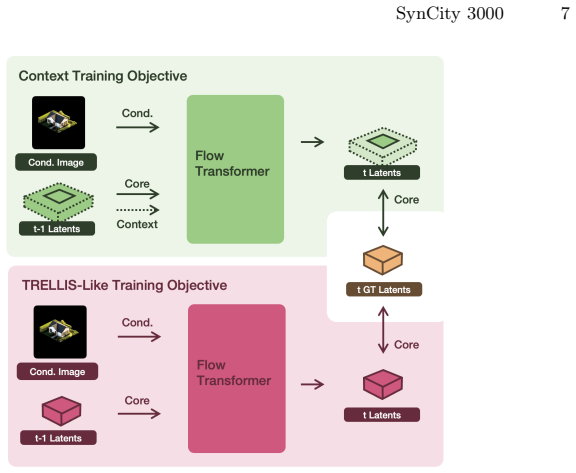
Significance. The paper addresses a genuine gap: extending object-centric 3D generators to scene scale without domain-specific scene datasets. The convolutional adaptation of TRELLIS with context tokens and the dual-objective fine-tuning scheme (Sec. 3.2) is a clean, well-motivated technical contribution. The synthetic data engine (Sec. 4) is a reasonable strategy for circumventing data scarcity, and the method produces visually compelling results at scales beyond what off-the-shelf models can handle. The ablations in Table 1 are informative and isolate the contributions of fine-tuning, context, and stride. The framework is practical, with reasonable inference times reported (Supp. A).
major comments (2)
- §5, Table 3: The geometric quality evaluation (Chamfer Distance, F-score) uses 25 scenes generated by the same synthetic data engine used to produce the 320k training samples. The paper acknowledges this ('we can leverage our synthetic dataset engine to obtain scene-like proxies'), but this constitutes an in-distribution evaluation: the model is trained on samples from this engine and evaluated on 25 more from the same distribution. This does not test geometric quality on actual text-generated scenes. The paper should either (a) obtain an independent geometric evaluation on held-out real or synthetic-out-of-distribution scenes, or (b) explicitly frame Table 3 as a sanity check on in-distribution generalization and add a quantitative geometric evaluation on at least a subset of the 35 LLM-generated templates used in Table 1 (e.g., by manually creating rough ground-truth geometry or using多
- Supp. C, 'Structure duplication': The paper acknowledges that the convolutional tiling can cause duplicated or partially broken structures, but provides no quantitative measure of frequency or severity. Since the central claim includes 'globally coherent' 3D scenes, this limitation is load-bearing. A simple quantitative assessment (e.g., reporting the fraction of generated scenes exhibiting visible duplication artifacts across the 35 test templates, or a user-study rating specifically for structural coherence) would substantially strengthen the claim. Without it, the coherence claim rests on qualitative figures and a modest plausibility rating (3.57/5, N=27).
minor comments (7)
- Table 1: The LPIPS improvement over TRELLIS (0.3993 vs. 0.4094) is small in absolute terms. Consider reporting per-scene variance or confidence intervals to establish significance, especially given N=35 templates.
- Table 2: The user study (N=27) uses forced binary choices but does not report confidence intervals or significance tests. Given the modest sample size, adding intervals or a binomial test would clarify whether the preference rates are statistically meaningful.
- References: TripoSG appears as both [35] and [36]; Hunyuan3D-2.1 appears as both [24] and [56]; 3DTown appears as both [80] and [81]; SceneCraft appears as both [22] and [65]; DiffuScene appears as both [54] and [55]; EchoScene appears as both [71] and [72]. Please consolidate.
- §3.2, Eq. for ε_w: The positional encoding extension from {0,...,M-1}^3 to {-V,...,M+V-1}^3 is described, but a small figure or diagram showing how context tokens are arranged relative to the core would help readers verify the construction.
- Supp. A, 'Color correction': The L*a*b* color statistics transfer is applied as a post-hoc fix. It would be useful to note whether this correction was applied in the quantitative evaluations (Tables 1, 3) or only for qualitative figures, since it could affect LPIPS/SSIM.
- Fig. 5 (data generation): The figure caption mentions DINOv2 feature extraction but does not clarify whether visibility-aware projection was used. The supplementary (Supp. A) notes visibility is not accounted for. A brief note in the main text would help readers understand this design choice.
- §5, 'Experimental details': The batch size of 1 is noted, but it is unclear whether gradient accumulation was used to achieve an effective larger batch size. Please clarify.
Simulated Author's Rebuttal
We thank the referee for the careful reading and constructive feedback. Both major comments identify legitimate gaps in our evaluation that we will address in revision.
read point-by-point responses
-
Referee: §5, Table 3: The geometric quality evaluation uses 25 scenes from the same synthetic data engine used for training, constituting in-distribution evaluation. The paper should either obtain independent geometric evaluation on held-out real or OOD scenes, or explicitly frame Table 3 as a sanity check and add quantitative geometric evaluation on at least a subset of the 35 LLM-generated templates.
Authors: The referee is correct that Table 3 constitutes an in-distribution evaluation: the 25 test scenes are generated by the same procedural engine that produced the 320k training samples, albeit with different random seeds and object placements. We agree this does not test geometric quality on text-generated scenes, and we will revise the manuscript to make this limitation explicit rather than leaving it implicit. We will reframe Table 3 as an in-distribution sanity check that isolates the effect of fine-tuning on geometric reconstruction quality relative to the off-the-shelf TRELLIS baseline, controlling for scene content. We would also note that Table 1 already provides an out-of-distribution evaluation on the 35 LLM-generated templates (which are text-generated and thus out-of-distribution relative to the synthetic training data), but it measures 2D template faithfulness via perceptual metrics rather than 3D geometric quality. The fundamental challenge for option (b) is that text-generated scenes have no ground-truth geometry, so Chamfer Distance and F-score cannot be computed. However, we can and will add a supplementary evaluation on a subset of the 35 LLM-generated templates using proxy geometric metrics that do not require ground truth—specifically, we will report mesh watertightness, the fraction of disconnected components, and surface completeness (absence of holes) as measured by rendering depth maps from novel viewpoints and checking for missing geometry. This will provide at least a partial geometric quality assessment on OOD, text-generated scenes. We cannot, within the revision timeframe, obtain ground-truth geometry for real scenes at the scale our method operates, so a full OOD geometric evaluation with Chamfer Distance remains future work. revision: partial
-
Referee: Supp. C, 'Structure duplication': The paper acknowledges that convolutional tiling can cause duplicated or partially broken structures but provides no quantitative measure. A quantitative assessment (fraction of scenes with duplication artifacts, or a user-study coherence rating) would strengthen the coherence claim.
Authors: We agree that the coherence claim should be supported by more than qualitative figures and a modest plausibility rating. We will add a quantitative assessment of structural duplication artifacts across the 35 test templates used in Table 1. Specifically, we will have annotators label each generated scene for the presence of visible duplication artifacts (binary: present/absent) and report the fraction of affected scenes. We will also add a dedicated structural coherence rating to the user study (on the same 1–5 scale as the existing plausibility rating) to complement the binary artifact count. We expect the duplication rate to be relatively low given the ablation results in Table 1 showing that smaller strides significantly reduce duplication, but we will report whatever the data shows. This will be added to the revised manuscript and supplementary materials. revision: yes
Circularity Check
Minor in-distribution evaluation concern in Tab. 3, but central claims are independently supported by Tab. 1 and Tab. 2; no circularity in the derivation chain.
full rationale
The paper's central claim — that fine-tuning TRELLIS to operate convolutionally on overlapping windows produces more faithful 3D scene reconstructions than off-the-shelf baselines — is supported by Tab. 1 (LPIPS/SSIM/PSNR on 35 LLM-generated templates, compared against TRELLIS, TripoSG, Hunyuan3D-2.1) and Tab. 2 (user study, N=27). These evaluations use externally generated templates and independent metrics; they are not circular. The one potential concern is Tab. 3 (geometric reconstruction quality via Chamfer Distance and F-score), which uses 25 scenes from the same synthetic data engine used for fine-tuning (Sec. 5: 'we can leverage our synthetic dataset engine to obtain scene-like proxies'). This is an in-distribution evaluation: the model is trained on 320k samples from the engine and evaluated on 25 more from the same engine. However, this is a limitation of evaluation scope, not a circularity in the derivation chain. The paper is transparent about this ('as if ground truth were available'), and Tab. 3 is supplementary to the main claims, not load-bearing for them. The fine-tuning data engine (Sec. 4) generates training targets procedurally from random Objaverse-XL objects on random terrains — these are not defined in terms of the model's outputs, so there is no self-defitional circularity. No step in the method reduces to its own inputs by construction.
Axiom & Free-Parameter Ledger
free parameters (8)
- Learning rate =
5e-6
- Task probability p =
0.5
- Context size V (stage 1) =
8
- Context size V (stage 2) =
32
- Template window width =
896px
- Mask extrusion height =
60px
- Stride during inference =
0.5 patches
- Number of training samples =
320k
axioms (4)
- domain assumption TRELLIS [62] produces high-quality 3D objects from images and its autoencoders are convolutional
- ad hoc to paper Dimetric projection provides sufficient geometric information for 3D scene reconstruction
- ad hoc to paper Random placement of Objaverse-XL objects on terrains produces scene-like data sufficient for fine-tuning
- domain assumption MultiDiffusion-style window averaging produces globally coherent latents
invented entities (1)
-
Synthetic data engine
independent evidence
Reference graph
Works this paper leans on
-
[1]
com / alimama - creative/FLUX-Controlnet-Inpainting(2024), gitHub repository
AlimamaCreative: Flux-controlnet-inpainting.https : / / github . com / alimama - creative/FLUX-Controlnet-Inpainting(2024), gitHub repository
work page 2024
-
[2]
Gen3DSR: Generalizable 3D Scene Reconstruction via Divide and Conquer from a Single View
Ardelean, A., Özer, M., Egger, B.: Gen3dsr: Generalizable 3d scene reconstruction via divide and conquer from a single view. arXiv2404.03421(2024)
work page internal anchor Pith review Pith/arXiv arXiv 2024
-
[3]
In: Proceedings of the IEEE/CVF international conference on computer vision
Armeni, I., He, Z.Y., Gwak, J., Zamir, A.R., Fischer, M., Malik, J., Savarese, S.: 3d scene graph: A structure for unified semantics, 3d space, and camera. In: Proceedings of the IEEE/CVF international conference on computer vision. pp. 5664–5673 (2019)
work page 2019
-
[4]
In: British Machine Vision Con- ference (BMVC) (2022)
Bae, G., Budvytis, I., Cipolla, R.: Irondepth: Iterative refinement of single-view depth using surface normal and its uncertainty. In: British Machine Vision Con- ference (BMVC) (2022)
work page 2022
-
[6]
MultiDiffusion: Fusing Diffusion Paths for Controlled Image Generation
Bar-Tal, O., Yariv, L., Lipman, Y., Dekel, T.: MultiDiffusion: Fusing diffusion paths for controlled image generation. arXiv.csabs/2302.08113(2023)
work page internal anchor Pith review Pith/arXiv arXiv 2023
-
[7]
ZoeDepth: Zero-shot Transfer by Combining Relative and Metric Depth
Bhat,S.F.,Birkl,R.,Wofk,D.,Wonka,P.,Müller,M.:Zoedepth:Zero-shottransfer by combining relative and metric depth. arXiv2302.12288(2023)
work page internal anchor Pith review Pith/arXiv arXiv 2023
- [8]
-
[9]
Beyond Surface Statistics: Scene Representations in a Latent Diffusion Model
Chen, Y., Viégas, F., Wattenberg, M.: Beyond surface statistics: Scene represen- tations in a latent diffusion model. arXiv2306.05720(2023)
work page internal anchor Pith review Pith/arXiv arXiv 2023
-
[10]
Chung, J., Lee, S., Nam, H., Lee, J., Lee, K.M.: LucidDreamer: Domain-free gen- eration of 3d gaussian splatting scenes. In: arXiv (2023)
work page 2023
- [11]
- [12]
-
[13]
Dai, T., Wong, J., Jiang, Y., Wang, C., Gokmen, C., Zhang, R., Wu, J., Fei-Fei, L.: Automatedcreationofdigitalcousinsforrobustpolicylearning.arXiv2410.07408 (2024)
work page internal anchor Pith review Pith/arXiv arXiv 2024
-
[14]
Objaverse-XL: A Universe of 10M+ 3D Objects
Deitke, M., Liu, R., Wallingford, M., Ngo, H., Michel, O., Kusupati, A., Fan, A., Laforte, C., Voleti, V., Gadre, S.Y., VanderBilt, E., Kembhavi, A., Vondrick, C., Gkioxari, G., Ehsani, K., Schmidt, L., Farhadi, A.: Objaverse-XL: A universe of 10M+ 3D objects. CoRRabs/2307.05663(2023)
work page internal anchor Pith review Pith/arXiv arXiv 2023
-
[15]
In: Proceedings of the International Con- ference on Computer Vision (ICCV) (2025) 16 P
Engstler, P., Shtedritski, A., Laina, I., Rupprecht, C., Vedaldi, A.: SynCity: Training-free generation of 3D worlds. In: Proceedings of the International Con- ference on Computer Vision (ICCV) (2025) 16 P. Engstler et al
work page 2025
-
[16]
In: International Conference on 3D Vision (2025)
Engstler, P., Vedaldi, A., Laina, I., Rupprecht, C.: Invisible stitch: Generating smooth 3d scenes with depth inpainting. In: International Conference on 3D Vision (2025)
work page 2025
-
[17]
Advances in Neural Information Processing Systems36, 18225–18250 (2023)
Feng, W., Zhu, W., Fu, T.j., Jampani, V., Akula, A., He, X., Basu, S., Wang, X.E., Wang, W.Y.: Layoutgpt: Compositional visual planning and generation with large language models. Advances in Neural Information Processing Systems36, 18225–18250 (2023)
work page 2023
-
[18]
International Journal of Computer Vision129(12), 3313–3337 (2021)
Fu, H., Jia, R., Gao, L., Gong, M., Zhao, B., Maybank, S., Tao, D.: 3d-future: 3d furniture shape with texture. International Journal of Computer Vision129(12), 3313–3337 (2021)
work page 2021
-
[19]
DiffCAD: Weakly-Supervised Probabilistic CAD Model Retrieval and Alignment from an RGB Image
Gao, D., Rozenberszki, D., Leutenegger, S., Dai, A.: DiffCAD: weakly-supervised probabilistic CAD model retrieval and alignment from an RGB image. arXiv 2311.18610(2024)
work page internal anchor Pith review Pith/arXiv arXiv 2024
- [20]
-
[21]
In: Proceedings of the IEEE/CVF International Conference on Computer Vision
Höllein, L., Cao, A., Owens, A., Johnson, J., Nießner, M.: Text2room: Extract- ing textured 3d meshes from 2d text-to-image models. In: Proceedings of the IEEE/CVF International Conference on Computer Vision. pp. 7909–7920 (2023)
work page 2023
- [22]
-
[23]
In: Proceedings of the Computer Vision and Pattern Recognition Conference
Huang, Z., Guo, Y.C., An, X., Yang, Y., Li, Y., Zou, Z.X., Liang, D., Liu, X., Cao, Y.P., Sheng, L.: Midi: Multi-instance diffusion for single image to 3D scene genera- tion. In: Proceedings of the Computer Vision and Pattern Recognition Conference. pp. 23646–23657 (2025)
work page 2025
-
[24]
Hunyuan3D 2.1: From Images to High-Fidelity 3D Assets with Production-Ready PBR Material
Hunyuan3D, T., Yang, S., Yang, M., Feng, Y., Huang, X., Zhang, S., He, Z., Luo, D., Liu, H., Zhao, Y., Lin, Q., Lai, Z., Yang, X., Shi, H., Zhao, Z., Zhang, B., Yan, H., Wang, L., Liu, S., Zhang, J., Chen, M., Dong, L., Jia, Y., Cai, Y., Yu, J., Tang, Y., Guo, D., Yu, J., Zhang, H., Ye, Z., He, P., Wu, R., Wei, S., Zhang, C., Tan, Y., Sun, Y., Niu, L., Hu...
work page internal anchor Pith review Pith/arXiv arXiv 2025
-
[25]
Standard, International Commission on Illumination, Vienna, AT (1976)
International Commission on Illumination: Colorimetry — part 4: Cie 1976 l*a*b* colour space. Standard, International Commission on Illumination, Vienna, AT (1976)
work page 1976
-
[26]
In: Proceedings of the IEEE/CVF conference on Computer Vision and Pattern Recog- nition
Ke, B., Obukhov, A., Huang, S., Metzger, N., Daudt, R.C., Schindler, K.: Re- purposing diffusion-based image generators for monocular depth estimation. In: Proceedings of the IEEE/CVF conference on Computer Vision and Pattern Recog- nition. pp. 9492–9502 (2024)
work page 2024
-
[27]
ACM Transactions on Graphics42(4) (2023)
Kerbl, B., Kopanas, G., Leimkühler, T., Drettakis, G.: 3d gaussian splatting for real-time radiance field rendering. ACM Transactions on Graphics42(4) (2023)
work page 2023
-
[28]
In: Proceedings of the IEEE/CVF Conference on Computer Vision and Pattern Recognition
Khanna, M., Mao, Y., Jiang, H., Haresh, S., Shacklett, B., Batra, D., Clegg, A., Undersander, E., Chang, A.X., Savva, M.: Habitat synthetic scenes dataset (hssd- 200): An analysis of 3d scene scale and realism tradeoffs for objectgoal navigation. In: Proceedings of the IEEE/CVF Conference on Computer Vision and Pattern Recognition. pp. 16384–16393 (2024)
work page 2024
-
[29]
In: IEEE Conference on Computer Vision and Pattern Recognition (CVPR) (2023) SynCity 3000 17
Kim, S.W., Brown, B., Yin, K., Kreis, K., Schwarz, K., Li, D., Rombach, R., Tor- ralba, A., Fidler, S.: Neuralfield-ldm: Scene generation with hierarchical latent dif- fusion models. In: IEEE Conference on Computer Vision and Pattern Recognition (CVPR) (2023) SynCity 3000 17
work page 2023
- [30]
- [31]
-
[32]
Diffusion Probabilistic Models for Scene-Scale 3D Categorical Data
Lee, J., Im, W., Lee, S., Yoon, S.E.: Diffusion probabilistic models for scene-scale 3d categorical data. arXiv2301.00527(2023)
work page internal anchor Pith review Pith/arXiv arXiv 2023
-
[33]
In: Proceedings of the IEEE/CVF conference on Computer Vision and Pattern Recognition
Lee, J., Lee, S., Jo, C., Im, W., Seon, J., Yoon, S.E.: Semcity: Semantic scene generation with triplane diffusion. In: Proceedings of the IEEE/CVF conference on Computer Vision and Pattern Recognition. pp. 28337–28347 (2024)
work page 2024
-
[34]
SceneDreamer360: Text-Driven 3D-Consistent Scene Generation with Panoramic Gaussian Splatting
Li, W., Cai, F., Mi, Y., Yang, Z., Zuo, W., Wang, X., Fan, X.: SceneDreamer360: text-driven 3D-consistent scene generation with panoramic Gaussian splatting. arXiv2408.13711(2024)
work page internal anchor Pith review Pith/arXiv arXiv 2024
-
[36]
TripoSG: High-Fidelity 3D Shape Synthesis using Large-Scale Rectified Flow Models
Li, Y., Zou, Z.X., Liu, Z., Wang, D., Liang, Y., Yu, Z., Liu, X., Guo, Y.C., Liang, D., Ouyang, W., et al.: Triposg: High-fidelity 3d shape synthesis using large-scale rectified flow models. arXiv2502.06608(2025)
work page internal anchor Pith review Pith/arXiv arXiv 2025
- [37]
-
[38]
Sparc3D: Sparse Representation and Construction for High-Resolution 3D Shapes Modeling
Li, Z., Wang, Y., Zheng, H., Luo, Y., Wen, B.: Sparc3d: Sparse representation and construction for high-resolution 3d shapes modeling. arXiv2505.14521(2025)
work page internal anchor Pith review Pith/arXiv arXiv 2025
-
[39]
In: International Conference on Learning Representations (ICLR) (2024)
Lin, C., MU, Y.: InstructScene: instruction-driven 3d indoor scene synthesis with semantic graph prior. In: International Conference on Learning Representations (ICLR) (2024)
work page 2024
-
[40]
InstructScene: Instruction-Driven 3D Indoor Scene Synthesis with Semantic Graph Prior
Lin, C., Mu, Y.: Instructscene: Instruction-driven 3d indoor scene synthesis with semantic graph prior. arXiv2402.04717(2024)
work page internal anchor Pith review Pith/arXiv arXiv 2024
-
[41]
In: Proceedings of the Computer Vision and Pattern Recognition Conference
Meng, Q., Li, L., Nießner, M., Dai, A.: Lt3sd: Latent trees for 3d scene diffusion. In: Proceedings of the Computer Vision and Pattern Recognition Conference. pp. 650–660 (2025)
work page 2025
-
[42]
Commu- nications of the ACM65(1), 99–106 (2021)
Mildenhall, B., Srinivasan, P.P., Tancik, M., Barron, J.T., Ramamoorthi, R., Ng, R.: Nerf: Representing scenes as neural radiance fields for view synthesis. Commu- nications of the ACM65(1), 99–106 (2021)
work page 2021
- [43]
-
[44]
DINOv2: Learning Robust Visual Features without Supervision
Oquab, M., Darcet, T., Moutakanni, T., Vo, H., Szafraniec, M., Khalidov, V., Fernandez, P., Haziza, D., Massa, F., El-Nouby, A., et al.: Dinov2: Learning robust visual features without supervision. arXiv2304.07193(2023)
work page internal anchor Pith review Pith/arXiv arXiv 2023
-
[45]
Text2Immersion: Generative Immersive Scene with 3D Gaussians
Ouyang, H., Heal, K., Lombardi, S., Sun, T.: Text2Immersion: Generative immer- sive scene with 3D gaussians. arXiv.csabs/2312.09242(2023)
work page internal anchor Pith review Pith/arXiv arXiv 2023
-
[46]
In: Proceedings of the IEEE/CVF International Conference on Computer Vision
Pan, X., Charron, N., Yang, Y., Peters, S., Whelan, T., Kong, C., Parkhi, O., Newcombe, R., Ren, Y.C.: Aria digital twin: A new benchmark dataset for ego- centric 3d machine perception. In: Proceedings of the IEEE/CVF International Conference on Computer Vision. pp. 20133–20143 (2023)
work page 2023
-
[47]
Compositional 3D Scene Generation using Locally Conditioned Diffusion
Po, R., Wetzstein, G.: Compositional 3d scene generation using locally conditioned diffusion. ArXivabs/2303.12218(2023),https://api.semanticscholar.org/ CorpusID:257663283
work page internal anchor Pith review Pith/arXiv arXiv 2023
-
[48]
Habitat-Matterport 3D Dataset (HM3D): 1000 Large-scale 3D Environments for Embodied AI
Ramakrishnan, S.K., Gokaslan, A., Wijmans, E., Maksymets, O., Clegg, A., Turner, J., Undersander, E., Galuba, W., Westbury, A., Chang, A.X., et al.: Habitat-matterport 3d dataset (hm3d): 1000 large-scale 3d environments for em- bodied ai. arXiv2109.08238(2021) 18 P. Engstler et al
work page internal anchor Pith review Pith/arXiv arXiv 2021
-
[49]
In: Proceedings of the IEEE/CVF conference on Computer Vision and Pattern Recognition
Ren, X., Huang, J., Zeng, X., Museth, K., Fidler, S., Williams, F.: Xcube: Large- scale 3d generative modeling using sparse voxel hierarchies. In: Proceedings of the IEEE/CVF conference on Computer Vision and Pattern Recognition. pp. 4209– 4219 (2024)
work page 2024
-
[50]
In: Proceedings of the IEEE/CVF international conference on computer vision
Roberts, M., Ramapuram, J., Ranjan, A., Kumar, A., Bautista, M.A., Paczan, N., Webb, R., Susskind, J.M.: Hypersim: A photorealistic synthetic dataset for holis- tic indoor scene understanding. In: Proceedings of the IEEE/CVF international conference on computer vision. pp. 10912–10922 (2021)
work page 2021
-
[51]
RealmDreamer: Text-Driven 3D Scene Generation with Inpainting and Depth Diffusion
Shriram, J., Trevithick, A., Liu, L., Ramamoorthi, R.: Realmdreamer: Text-driven 3d scene generation with inpainting and depth diffusion. arXiv2404.07199(2024)
work page internal anchor Pith review Pith/arXiv arXiv 2024
-
[52]
LDM3D: Latent Diffusion Model for 3D
Stan, G.B.M., Wofk, D., Fox, S., Redden, A., Saxton, W., Yu, J., Aflalo, E., Tseng, S.Y., Nonato, F., Muller, M., et al.: Ldm3d: Latent diffusion model for 3d. arXiv 2305.10853(2023)
work page internal anchor Pith review Pith/arXiv arXiv 2023
-
[53]
LayoutVLM: Differentiable Optimization of 3D Layout via Vision-Language Models
Sun, F.Y., Liu, W., Gu, S., Lim, D., Bhat, G., Tombari, F., Li, M., Haber, N., Wu, J.: LayoutVLM: differentiable optimization of 3d layout via vision-language models. arXiv2412.02193(2025)
work page internal anchor Pith review Pith/arXiv arXiv 2025
- [54]
-
[55]
In: Proceedings of the IEEE/CVF conference on Computer Vision and Pattern Recognition
Tang,J.,Nie,Y.,Markhasin,L.,Dai,A.,Thies,J.,Nießner,M.:Diffuscene:Denois- ing diffusion models for generative indoor scene synthesis. In: Proceedings of the IEEE/CVF conference on Computer Vision and Pattern Recognition. pp. 20507– 20518 (2024)
work page 2024
-
[56]
Team, T.H.: Hunyuan3d 2.1: From images to high-fidelity 3d assets with production-ready pbr material (2025)
work page 2025
-
[57]
IEEE Transactions on Pattern Analysis and Machine Intelligence (TPAMI) (2024)
Wang,G.,Wang,P.,Chen,Z.,Wang,W.,Loy,C.C.,Liu,Z.:Perf:Panoramicneural radiance field from a single panorama. IEEE Transactions on Pattern Analysis and Machine Intelligence (TPAMI) (2024)
work page 2024
-
[58]
In: Proceedings of the IEEE Conference on Computer Vision and Pattern Recognition (CVPR) (2025)
Wang, J., Chen, M., Karaev, N., Vedaldi, A., Rupprecht, C., Novotny, D.: VGGT: Visual geometry grounded transformer. In: Proceedings of the IEEE Conference on Computer Vision and Pattern Recognition (CVPR) (2025)
work page 2025
-
[59]
ProlificDreamer: High-Fidelity and Diverse Text-to-3D Generation with Variational Score Distillation
Wang, Z., Lu, C., Wang, Y., Bao, F., Li, C., Su, H., Zhu, J.: ProlificDreamer: High-fidelity and diverse text-to-3D generation with variational score distillation. arXiv.csabs/2305.16213(2023)
work page internal anchor Pith review Pith/arXiv arXiv 2023
-
[60]
Wu, T., Zheng, C., Cham, T.J.: Panodiffusion: 360-degree panorama outpainting via diffusion. arXiv2307.03177(2023)
-
[61]
Wu, Z., Li, Y., Yan, H., Shang, T., Sun, W., Wang, S., Cui, R., Liu, W., Sato, H., Li, H., Ji, P.: BlockFusion: Expandable 3D scene generation using latent tri-plane extrapolation. arXiv.cs (2024)
work page 2024
-
[62]
Structured 3D Latents for Scalable and Versatile 3D Generation
Xiang, J., Lv, Z., Xu, S., Deng, Y., Wang, R., Zhang, B., Chen, D., Tong, X., Yang, J.: Structured 3d latents for scalable and versatile 3d generation. arXiv 2412.01506(2024)
work page internal anchor Pith review Pith/arXiv arXiv 2024
- [63]
-
[64]
Depth Anything: Unleashing the Power of Large-Scale Unlabeled Data
Yang, L., Kang, B., Huang, Z., Xu, X., Feng, J., Zhao, H.: Depth anything: Un- leashing the power of large-scale unlabeled data. arXiv2401.10891(2024)
work page internal anchor Pith review Pith/arXiv arXiv 2024
-
[65]
In: Advances in Neural Information Processing Systems (2024) SynCity 3000 19
Yang, X., Man, Y., Chen, J.K., Wang, Y.X.: Scenecraft: Layout-guided 3d scene generation. In: Advances in Neural Information Processing Systems (2024) SynCity 3000 19
work page 2024
- [66]
-
[67]
ACM Transactions on Graphics (TOG)44(4), 1–19 (2025)
Yao, K., Zhang, L., Yan, X., Zeng, Y., Zhang, Q., Xu, L., Yang, W., Gu, J., Yu, J.: Cast: Component-aligned 3D scene reconstruction from an RGB image. ACM Transactions on Graphics (TOG)44(4), 1–19 (2025)
work page 2025
-
[68]
In: Proceedings of the IEEE/CVF International Conference on Computer Vision
Yeshwanth, C., Liu, Y.C., Nießner, M., Dai, A.: Scannet++: A high-fidelity dataset of 3d indoor scenes. In: Proceedings of the IEEE/CVF International Conference on Computer Vision. pp. 12–22 (2023)
work page 2023
-
[69]
WonderWorld: Interactive 3D Scene Generation from a Single Image
Yu, H.X., Duan, H., Herrmann, C., Freeman, W.T., Wu, J.: Wonderworld: Inter- active 3d scene generation from a single image. arXiv2406.09394(2024)
work page internal anchor Pith review Pith/arXiv arXiv 2024
-
[70]
In: Proceedings of the IEEE/CVF Conference on Computer Vision and Pattern Recognition
Yu, H.X., Duan, H., Hur, J., Sargent, K., Rubinstein, M., Freeman, W.T., Cole, F., Sun, D., Snavely, N., Wu, J., et al.: Wonderjourney: Going from anywhere to everywhere. In: Proceedings of the IEEE/CVF Conference on Computer Vision and Pattern Recognition. pp. 6658–6667 (2024)
work page 2024
- [71]
-
[72]
In: European Conference on Computer Vision
Zhai, G., Örnek, E.P., Chen, D.Z., Liao, R., Di, Y., Navab, N., Tombari, F., Busam, B.: Echoscene: Indoor scene generation via information echo over scene graph diffu- sion. In: European Conference on Computer Vision. pp. 167–184. Springer (2024)
work page 2024
-
[73]
In: The Thirty-eighth Annual Con- ference on Neural Information Processing Systems (2024)
Zhan, G., Zheng, C., Xie, W., Zisserman, A.: A general protocol to probe large vision models for 3d physical understanding. In: The Thirty-eighth Annual Con- ference on Neural Information Processing Systems (2024)
work page 2024
-
[74]
Zhang, B., Tang, J., Nießner, M., Wonka, P.: 3dshape2vecset: A 3d shape repre- sentation for neural fields and generative diffusion models. ACM Trans. Graph. 42(4) (jul 2023).https://doi.org/10.1145/3592442,https://doi.org/10. 1145/3592442
-
[75]
Text2NeRF: Text-Driven 3D Scene Generation with Neural Radiance Fields
Zhang, J., Li, X., Wan, Z., Wang, C., Liao, J.: Text2NeRF: Text-driven 3D scene generation with neural radiance fields. arXiv.csabs/2305.11588(2023)
work page internal anchor Pith review Pith/arXiv arXiv 2023
- [76]
- [77]
-
[79]
Hunyuan3D 2.0: Scaling Diffusion Models for High Resolution Textured 3D Assets Generation
Zhao, Z., Lai, Z., Lin, Q., Zhao, Y., Liu, H., Yang, S., Feng, Y., Yang, M., Zhang, S., Yang, X., et al.: Hunyuan3d 2.0: Scaling diffusion models for high resolution textured 3d assets generation. arXiv2501.12202(2025)
work page internal anchor Pith review Pith/arXiv arXiv 2025
-
[81]
Zheng, K., Zhang, R., Gu, J., Yang, J., Wang, X.E.: Constructing a 3d town from a single image. arXiv2505.15765(2025)
-
[82]
GALA3D: Towards Text-to-3D Complex Scene Generation via Layout-guided Generative Gaussian Splatting
Zhou, X., Ran, X., Xiong, Y., He, J., Lin, Z., Wang, Y., Sun, D., Yang, M.H.: Gala3d: Towards text-to-3d complex scene generation via layout-guided generative gaussian splatting. arXiv2402.07207(2024) SynCity 3000: Bootstrapping Scene-Scale 3D Diffusion (Supplementary Materials) Paul Engstler, Iro Laina, Christian Rupprecht, and Andrea Vedaldi Visual Geom...
work page internal anchor Pith review Pith/arXiv arXiv 2024
discussion (0)
Sign in with ORCID, Apple, or X to comment. Anyone can read and Pith papers without signing in.