Greybody factors, reflectionless scattering modes, and echoes of ultracompact horizonless objects
Pith reviewed 2026-05-23 04:40 UTC · model grok-4.3
The pith
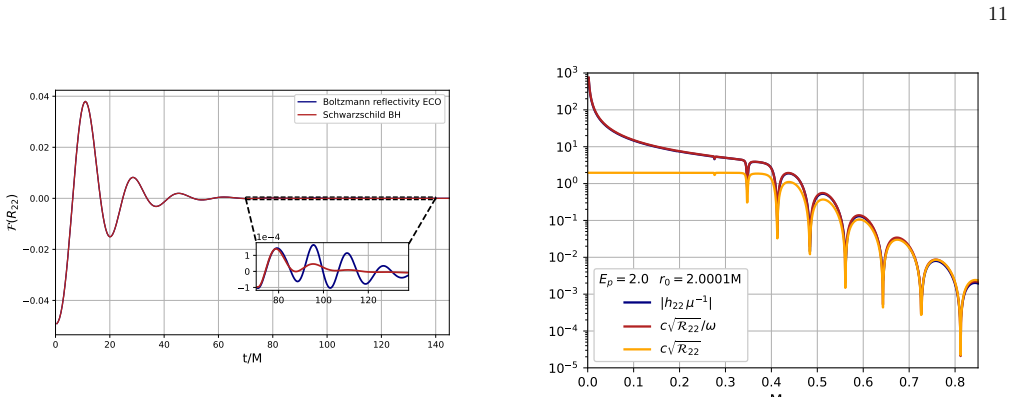
High-frequency quasi-reflectionless scattering modes produce the echoes observed from ultracompact horizonless objects.
A machine-rendered reading of the paper's core claim, the machinery that carries it, and where it could break.
Core claim
The greybody factor of ultracompact objects features both low-frequency resonances and high-frequency, quasi-reflectionless scattering modes, which become purely reflectionless in the presence of symmetric cavity potentials, as it might be the case for a wormhole. It is these high-frequency (quasi-)reflectionless scattering modes, rather than low-frequency resonances, to be directly responsible for the echoes in the time-domain response of ultracompact objects or of black holes surrounded by matter fields localized at large distances.
What carries the argument
Greybody factors of ultracompact horizonless objects, which encode both low-frequency resonances and high-frequency quasi-reflectionless scattering modes that drive time-domain echoes.
If this is right
- Echoes arise from high-frequency scattering modes rather than low-frequency resonances in both horizonless objects and black holes with distant matter shells.
- Symmetric cavity potentials, such as those of wormholes, turn the high-frequency modes into purely reflectionless scattering modes.
- The same greybody-to-echo link established for black holes carries over to horizonless objects.
- Time-domain echoes can be predicted from the high-frequency structure of the greybody factor alone.
Where Pith is reading between the lines
- Observational searches for echoes in gravitational-wave data could target the frequency band associated with these reflectionless modes rather than the quasinormal-mode spectrum.
- Models of ultracompact objects with asymmetric potentials would still exhibit quasi-reflectionless modes but with reduced echo amplitude compared to symmetric cases.
- The mechanism suggests echoes could appear in other wave equations with localized barriers, such as those describing scalar or electromagnetic perturbations around compact objects.
Load-bearing premise
The greybody factor analysis and its connection to time-domain echoes, previously established for black holes, extends directly to ultracompact horizonless objects without additional modifications to the scattering potential or wave equation.
What would settle it
A numerical computation of the time-domain waveform for a concrete ultracompact object model that produces clear echoes while its greybody factor lacks high-frequency quasi-reflectionless modes, or conversely shows such modes without producing echoes.
Figures




read the original abstract
Motivated by a recently discovered connection between the greybody factors of black holes and the ringdown signal, we investigate the greybody factors of ultracompact horizonless objects, also elucidating their connection to echoes. The greybody factor of ultracompact objects features both low-frequency resonances and high-frequency, quasi-reflectionless scattering modes, which become purely reflectionless in the presence of symmetric cavity potentials, as it might be the case for a wormhole. We show that it is these high-frequency (quasi-)reflectionless scattering modes, rather than low-frequency resonances, to be directly responsible for the echoes in the time-domain response of ultracompact objects or of black holes surrounded by matter fields localized at large distances.
Editorial analysis
A structured set of objections, weighed in public.
Referee Report
Summary. The paper investigates the greybody factors of ultracompact horizonless objects, motivated by a prior connection between greybody factors and black-hole ringdown signals. It identifies both low-frequency resonances and high-frequency quasi-reflectionless scattering modes in these factors; the latter become purely reflectionless for symmetric cavity potentials (e.g., wormholes). The central claim is that the high-frequency (quasi-)reflectionless modes, rather than the low-frequency resonances, are directly responsible for the echoes observed in the time-domain response of ultracompact objects or of black holes with matter localized at large distances.
Significance. If the result holds, the work supplies a frequency-domain mechanistic account of echoes that could help interpret gravitational-wave signals from exotic compact objects. It employs standard wave-scattering methods in GR without free parameters or invented entities, extending an existing black-hole result to horizonless cases and thereby offering a concrete, falsifiable link between greybody factors and time-domain echoes.
major comments (1)
- [Abstract] Abstract: the central claim that high-frequency quasi-reflectionless modes are directly responsible for echoes in generic ultracompact objects requires explicit verification that the time-domain mapping survives asymmetry in the scattering potential. The abstract states that purely reflectionless modes occur only for symmetric cavity potentials (as in wormholes), while generic objects yield only quasi-reflectionless modes; without a demonstration that the echo mechanism persists under asymmetry, the extension from the symmetric case remains unverified and load-bearing for the claim.
Simulated Author's Rebuttal
We thank the referee for their careful reading of the manuscript and for the constructive comment. We respond to the major comment below.
read point-by-point responses
-
Referee: [Abstract] Abstract: the central claim that high-frequency quasi-reflectionless modes are directly responsible for echoes in generic ultracompact objects requires explicit verification that the time-domain mapping survives asymmetry in the scattering potential. The abstract states that purely reflectionless modes occur only for symmetric cavity potentials (as in wormholes), while generic objects yield only quasi-reflectionless modes; without a demonstration that the echo mechanism persists under asymmetry, the extension from the symmetric case remains unverified and load-bearing for the claim.
Authors: We thank the referee for highlighting this point. The manuscript explicitly treats the generic (asymmetric) case through the quasi-reflectionless modes. Calculations of the greybody factors for asymmetric cavity potentials are compared directly to the corresponding time-domain signals, showing that the high-frequency quasi-reflectionless features produce the echo train. The small residual reflection coefficient at high frequencies damps the echoes but does not eliminate the repeated reflections that characterize them. This establishes that the time-domain mapping survives asymmetry, supporting the central claim for generic ultracompact objects as stated in the abstract. We are prepared to add a clarifying sentence or additional plot if the referee considers it necessary for emphasis. revision: no
Circularity Check
No significant circularity; derivation relies on standard scattering analysis.
full rationale
The paper motivates its investigation from a prior connection between greybody factors and ringdown (likely cited externally) but performs independent greybody factor computations and time-domain mapping for ultracompact objects using the wave equation and scattering potential. No equations reduce by construction to fitted parameters, self-definitions, or unverified self-citations; the extension to horizonless cases is presented as an application of existing methods rather than a tautology. The result is self-contained against external benchmarks of black-hole perturbation theory.
Axiom & Free-Parameter Ledger
axioms (2)
- standard math Wave propagation and scattering in stationary, asymptotically flat spacetimes obey the standard Klein-Gordon or Regge-Wheeler-type equations derived from the Einstein equations.
- domain assumption The connection between frequency-domain greybody factors and time-domain ringdown/echo signals established for black holes carries over to ultracompact horizonless objects.
Lean theorems connected to this paper
-
IndisputableMonolith/Cost/FunctionalEquation.leanwashburn_uniqueness_aczel unclear?
unclearRelation between the paper passage and the cited Recognition theorem.
We show that it is these high-frequency (quasi-)reflectionless scattering modes, rather than low-frequency resonances, to be directly responsible for the echoes...
-
IndisputableMonolith/Foundation/DimensionForcing.leanreality_from_one_distinction unclear?
unclearRelation between the paper passage and the cited Recognition theorem.
transfer matrix approach... R1 = R'2 e^{2iωL}
What do these tags mean?
- matches
- The paper's claim is directly supported by a theorem in the formal canon.
- supports
- The theorem supports part of the paper's argument, but the paper may add assumptions or extra steps.
- extends
- The paper goes beyond the formal theorem; the theorem is a base layer rather than the whole result.
- uses
- The paper appears to rely on the theorem as machinery.
- contradicts
- The paper's claim conflicts with a theorem or certificate in the canon.
- unclear
- Pith found a possible connection, but the passage is too broad, indirect, or ambiguous to say the theorem truly supports the claim.
Forward citations
Cited by 9 Pith papers
-
Novel ringdown tests of general relativity with black hole greybody factors
GreyRing model based on greybody factors reproduces numerical relativity ringdown signals with mismatches of order 10^{-6} and enables a new post-merger consistency test of general relativity applied to GW250114.
-
Modeling the frequency-domain ringdown amplitude of comparable-mass mergers with greybody factors
A four-parameter greybody factor model reproduces the frequency-domain ringdown amplitude of comparable-mass aligned-spin mergers with mismatches of order 10^{-5}, improving existing models by two orders of magnitude.
-
Total absorption of tailored incoming signals by black holes
Tailored temporal modulation of incoming signals enables complete absorption by black holes via excitation of complex-plane resonances, storing energy for later release through virtual absorption modes.
-
Excitation factors for horizonless compact objects: long-lived modes, echoes, and greybody factors
Excitation factors of long-lived quasinormal modes in horizonless compact objects scale with their small imaginary frequency, suppressing early contributions and producing a hierarchy where prompt ringdown uses ordina...
-
Reflectionless and echo modes in asymmetric Damour-Solodukhin wormholes
In asymmetric Damour-Solodukhin wormholes, reflectionless and echo modes share asymptotic spectral properties parallel to the real frequency axis with matching spacing, and reflectionless modes lie closer to the axis ...
-
On the universality of late-time ringdown tail
Analytical proof establishes universality of late-time ringdown tails for any effective potential decaying as 1/r², with different power-law behavior for 1/r^α (1<α<2), covering charged black holes, Kerr, exotic objec...
-
Resonant transmission of scalar waves through rotating traversable wormhole
Rotation enhances Breit-Wigner resonances in scalar wave transmission through Teo wormholes by trapping modes in the throat potential well.
-
Plunge spectra as discriminators of black hole mimickers
Plunge spectra of extreme mass ratio events onto black hole mimickers show a low-frequency resonance comb and a high-frequency deviation from black hole behavior above Mω_th ≈ 0.39.
-
Constraining Black Hole Parameters in Non-Commutative Geometry using Machine Learning
Machine learning constrains non-commutative black hole parameters and reports consistency with Sgr A* Keck observations.
Reference graph
Works this paper leans on
-
[1]
Small frequency resonances Let us focus on the small frequency behavior displayed in Fig. 2. We notice that Γ lm(ω) has a pole whenever Ain lmω = 0 (see Eq. (8)). This would correspond to QNM boundary conditions Xlmω = ( e−iωr∗ r∗ → −∞ e+iωr∗ r∗ → +∞ . (9) This pole does not occur exactly at the location of QNM frequencies, because the QNM frequency is co...
-
[2]
High-frequency oscillations Figure 3 also shows that the QNMs do not correspond to the resonances and oscillations displayed at high fre- 5 0.0 0.1 0.2 0.3 0.4 0.5 0.6 0.7 0.8 M 10 9 10 8 10 7 10 6 10 5 10 4 10 3 10 2 10 1 100 22 M Vmax Real part of Neumann modes Real part of Dirichlet modes r0=2.001M 0.1 0.2 0.3 0.4 0.5 0.6 M 10 15 10 13 10 11 10 9 10 7 ...
-
[3]
Boltzmann ECOs It was suggested that quantum effects at the horizon scale can be accounted for by considering an excited multi-level quantum system [108]. In this case the ef- fective surface reflection amplitude can be described by the Boltzmann factor, RECO = e−|ω|/TH, where TH is the temperature of a Schwarzschild BH with same mass of the ECO. Figure 7...
-
[4]
String Theory as a bridge between Gauge Theories and Quantum Gravity
ECOs with constant surface reflection amplitude It is interesting to analyze the feature of an ECO mod- eled by a potential barrier at the ECO radius with fre- quency independent reflectivity RECO. In Fig. 8 we show the reflectivity of the system for different values of RECO and of the ECO radius. We recall that the boundary conditions we are using are Xl...
work page 2023
-
[5]
General framework In this method one starts in a region where the poten- tial is negligible, and hence the master functions behave as a superposition of ingoing and outgoing plane waves. Since we are interested in asymptotically flat spacetimes, this is true at r∗ → −∞ (near the ECO surface, or infin- ity in the mirror universe), r∗ → ∞ (infinity in our u...
-
[6]
Wormhole case Specializing to the case of the Schwarzschild wormhole, where the two barriers are mirror symmetric of one an- other, in the right universe, for the transfer matrix M2, we can directly use the expressions in Eq. (B5). In the left universe, on the other hand, we need to exchange the primed and the unprimed quantities, since the potential is m...
-
[7]
Partially absorbing ECOs In the previous appendix, we have developed the transfer matrix approach and have applied it to a Schwarzschild ECO. In this appendix, we wish to ap- ply it to reflective compact objects, which consist of a photon sphere and a reflective surface near the horizon. We start with the case of Boltzmann ECO as a warm up example and the...
-
[8]
Γ(l + 1) Γ(2l + 2) . (C17) Using this identity, as well as the fact that the ratio (c2/c1) is related to the reflectivity of the compact object, we can obtain a closed form expression for the reflection and transmission amplitudes using Eq. (C9). This means that we are able to compute the reflectivity and GFs for various boundary conditions. These are sum...
- [9]
-
[10]
Chandrasekhar, The mathematical theory of black holes (1985)
S. Chandrasekhar, The mathematical theory of black holes (1985)
work page 1985
- [11]
-
[12]
B. P. Abbott et al. (LIGO Scientific, Virgo), Phys. Rev. Lett. 116, 061102 (2016), arXiv:1602.03837 [gr-qc]
work page internal anchor Pith review Pith/arXiv arXiv 2016
-
[13]
Abbottet al., PRL125, 101102 (2020), arXiv:2009.01075 [gr-qc]
R. Abbott et al. (LIGO Scientific, Virgo), Phys. Rev. Lett. 125, 101102 (2020), arXiv:2009.01075 [gr-qc]
-
[14]
Black Hole Spectroscopy: Testing General Relativity through Gravitational Wave Observations
O. Dreyer, B. J. Kelly, B. Krishnan, L. S. Finn, D. Gar- rison, and R. Lopez-Aleman, Class. Quant. Grav. 21, 787 (2004), arXiv:gr-qc/0309007
work page internal anchor Pith review Pith/arXiv arXiv 2004
-
[15]
S. L. Detweiler, Astrophys. J. 239, 292 (1980)
work page 1980
-
[16]
On gravitational-wave spectroscopy of massive black holes with the space interferometer LISA
E. Berti, V. Cardoso, and C. M. Will, Phys. Rev. D 73, 064030 (2006), arXiv:gr-qc/0512160
work page internal anchor Pith review Pith/arXiv arXiv 2006
-
[17]
Bayesian model selection for testing the no-hair theorem with black hole ringdowns
S. Gossan, J. Veitch, and B. S. Sathyaprakash, Phys. Rev. D 85, 124056 (2012), arXiv:1111.5819 [gr-qc]
work page internal anchor Pith review Pith/arXiv arXiv 2012
-
[18]
Tests of General Relativity with GWTC-3
R. Abbott et al. (LIGO Scientific, VIRGO, KAGRA), (2021), arXiv:2112.06861 [gr-qc]
work page internal anchor Pith review Pith/arXiv arXiv 2021
-
[19]
Testing General Relativity with Present and Future Astrophysical Observations
E. Berti et al., Class. Quant. Grav. 32, 243001 (2015), arXiv:1501.07274 [gr-qc]
work page internal anchor Pith review Pith/arXiv arXiv 2015
-
[20]
Extreme Gravity Tests with Gravitational Waves from Compact Binary Coalescences: (II) Ringdown
E. Berti, K. Yagi, H. Yang, and N. Yunes, Gen. Rel. Grav. 50, 49 (2018), arXiv:1801.03587 [gr-qc]
work page internal anchor Pith review Pith/arXiv arXiv 2018
-
[21]
Testing the nature of dark compact objects: a status report
V. Cardoso and P. Pani, Living Rev. Rel. 22, 4 (2019), arXiv:1904.05363 [gr-qc]
work page internal anchor Pith review Pith/arXiv arXiv 2019
-
[22]
M. Colpi et al. (LISA), (2024), arXiv:2402.07571 [astro- ph.CO]
work page internal anchor Pith review Pith/arXiv arXiv 2024
-
[23]
Science Case for the Einstein Telescope
M. Maggiore et al. (ET), JCAP 03, 050 (2020), arXiv:1912.02622 [astro-ph.CO]
work page internal anchor Pith review Pith/arXiv arXiv 2020
-
[24]
Kalogera et al., (2021), arXiv:2111.06990 [gr-qc]
V. Kalogera et al., (2021), arXiv:2111.06990 [gr-qc]
-
[25]
Sensitivity Studies for Third-Generation Gravitational Wave Observatories
S. Hild et al. , Class. Quant. Grav. 28, 094013 (2011), arXiv:1012.0908 [gr-qc]
work page internal anchor Pith review Pith/arXiv arXiv 2011
-
[26]
Science with the Einstein Telescope: a comparison of different designs
M. Branchesi et al. , JCAP 07, 068 (2023), arXiv:2303.15923 [gr-qc]
work page internal anchor Pith review Pith/arXiv arXiv 2023
-
[27]
B. P. Abbott et al. (LIGO Scientific), Class. Quant. Grav. 34, 044001 (2017), arXiv:1607.08697 [astro- ph.IM]
work page internal anchor Pith review Pith/arXiv arXiv 2017
-
[28]
Frequency-Dependent Responses in 3rd Generation Gravitational-Wave Detectors
R. Essick, S. Vitale, and M. Evans, Phys. Rev. D 96, 084004 (2017), arXiv:1708.06843 [gr-qc]
work page internal anchor Pith review Pith/arXiv arXiv 2017
-
[29]
Evans et al., (2023), arXiv:2306.13745 [astro-ph.IM]
M. Evans et al., (2023), arXiv:2306.13745 [astro-ph.IM]
-
[30]
Spectroscopy of Kerr black holes with Earth- and space-based interferometers
E. Berti, A. Sesana, E. Barausse, V. Cardoso, and K. Belczynski, Phys. Rev. Lett. 117, 101102 (2016), arXiv:1605.09286 [gr-qc]
work page internal anchor Pith review Pith/arXiv arXiv 2016
-
[31]
S. Bhagwat, C. Pacilio, E. Barausse, and P. Pani, Phys. Rev. D 105, 124063 (2022), arXiv:2201.00023 [gr-qc]
-
[32]
S. Bhagwat, C. Pacilio, P. Pani, and M. Mapelli, Phys. Rev. D 108, 043019 (2023), arXiv:2304.02283 [gr-qc]
-
[33]
C. V. Vishveshwara, Nature 227, 936 (1970)
work page 1970
-
[34]
K. D. Kokkotas and B. G. Schmidt, Living Rev. Rel. 2, 2 (1999), arXiv:gr-qc/9909058
work page internal anchor Pith review Pith/arXiv arXiv 1999
-
[35]
Quasinormal modes of black holes and black branes
E. Berti, V. Cardoso, and A. O. Starinets, Class. Quant. Grav. 26, 163001 (2009), arXiv:0905.2975 [gr-qc]
work page internal anchor Pith review Pith/arXiv arXiv 2009
-
[36]
R. A. Konoplya and A. Zhidenko, Rev. Mod. Phys. 83, 793 (2011), arXiv:1102.4014 [gr-qc]
work page internal anchor Pith review Pith/arXiv arXiv 2011
-
[37]
M. Isi, M. Giesler, W. M. Farr, M. A. Scheel, and S. A. Teukolsky, Phys. Rev. Lett. 123, 111102 (2019), arXiv:1905.00869 [gr-qc]
work page internal anchor Pith review Pith/arXiv arXiv 2019
-
[38]
N. Franchini and S. H. V¨ olkel, (2023), arXiv:2305.01696 [gr-qc]
- [39]
- [40]
-
[41]
E. Maggio, Lect. Notes Phys. 1017, 333 (2023), 19 0.00 0.05 0.10 0.15 0.20 0.25 0.30 M 10 15 10 13 10 11 10 9 10 7 10 5 10 3 22 SCHWARZSCHILD BH exact numerical result approximate analytical result 0.00 0.05 0.10 0.15 0.20 0.25 0.30 M 10 36 10 32 10 28 10 24 10 20 10 16 10 12 10 8 10 4 22 SCHWARZSCHILD-LIKE WORMHOLE exact numerical result approximate anal...
-
[42]
Can environmental effects spoil precision gravitational-wave astrophysics?
E. Barausse, V. Cardoso, and P. Pani, Phys. Rev. D 89, 104059 (2014), arXiv:1404.7149 [gr-qc]
work page internal anchor Pith review Pith/arXiv arXiv 2014
-
[43]
V. Cardoso, K. Destounis, F. Duque, R. P. Macedo, and A. Maselli, Phys. Rev. D 105, L061501 (2022), arXiv:2109.00005 [gr-qc]
-
[44]
V. Cardoso, K. Destounis, F. Duque, R. Panosso Macedo, and A. Maselli, Phys. Rev. Lett. 129, 241103 (2022), arXiv:2210.01133 [gr-qc]
-
[45]
K. Destounis, A. Kulathingal, K. D. Kokkotas, and G. O. Papadopoulos, Phys. Rev. D 107, 084027 (2023), arXiv:2210.09357 [gr-qc]
-
[46]
Environmental Effects for Gravitational-wave Astrophysics
E. Barausse, V. Cardoso, and P. Pani, J. Phys. Conf. Ser. 610, 012044 (2015), arXiv:1404.7140 [astro-ph.CO]
work page internal anchor Pith review Pith/arXiv arXiv 2015
- [47]
- [48]
- [49]
-
[50]
C. Singha and S. Biswas, Phys. Rev. D 109, 024043 (2024), arXiv:2309.01760 [gr-qc]
-
[51]
Is the gravitational-wave ringdown a probe of the event horizon?
V. Cardoso, E. Franzin, and P. Pani, Phys. Rev. Lett. 116, 171101 (2016), [Erratum: Phys.Rev.Lett. 117, 089902 (2016)], arXiv:1602.07309 [gr-qc]
work page internal anchor Pith review Pith/arXiv arXiv 2016
-
[52]
V. Cardoso, S. Hopper, C. F. B. Macedo, C. Palen- zuela, and P. Pani, Phys. Rev. D 94, 084031 (2016), arXiv:1608.08637 [gr-qc]
work page internal anchor Pith review Pith/arXiv arXiv 2016
-
[53]
Tests for the existence of horizons through gravitational wave echoes
V. Cardoso and P. Pani, Nature Astron. 1, 586 (2017), arXiv:1709.01525 [gr-qc]
work page internal anchor Pith review Pith/arXiv arXiv 2017
- [54]
-
[55]
H.-P. Nollert, Phys. Rev. D 53, 4397 (1996), arXiv:gr- qc/9602032
- [56]
-
[57]
J. L. Jaramillo, R. Panosso Macedo, and L. Al Sheikh, Phys. Rev. X 11, 031003 (2021), arXiv:2004.06434 [gr- qc]
work page internal anchor Pith review Pith/arXiv arXiv 2021
-
[58]
K. Destounis, R. P. Macedo, E. Berti, V. Cardoso, and J. L. Jaramillo, Phys. Rev. D 104, 084091 (2021), arXiv:2107.09673 [gr-qc]
-
[59]
E. Gasperin and J. L. Jaramillo, Class. Quant. Grav. 39, 115010 (2022), arXiv:2107.12865 [gr-qc]
-
[60]
V. Boyanov, K. Destounis, R. Panosso Macedo, V. Car- doso, and J. L. Jaramillo, Phys. Rev. D 107, 064012 (2023), arXiv:2209.12950 [gr-qc]
- [61]
- [62]
-
[63]
K. Destounis, V. Boyanov, and R. Panosso Macedo, Phys. Rev. D 109, 044023 (2024), arXiv:2312.11630 [gr- qc]
-
[64]
D. Are´ an, D. G. Fari˜ na, and K. Landsteiner, JHEP12, 187 (2023), arXiv:2307.08751 [hep-th]
-
[65]
B. Cownden, C. Pantelidou, and M. Zilh˜ ao, (2023), arXiv:2312.08352 [gr-qc]
- [66]
- [67]
-
[68]
V. Boyanov, V. Cardoso, K. Destounis, J. L. Jaramillo, and R. Panosso Macedo, Phys. Rev. D 109, 064068 (2024), arXiv:2312.11998 [gr-qc]
- [69]
-
[70]
V. Cardoso, S. Kastha, and R. Panosso Macedo, (2024), arXiv:2404.01374 [gr-qc]. 20
-
[71]
A. Ianniccari, A. J. Iovino, A. Kehagias, P. Pani, G. Perna, D. Perrone, and A. Riotto, Phys. Rev. Lett. 133, 211401 (2024), arXiv:2407.20144 [gr-qc]
- [72]
- [73]
-
[74]
R. J. Gleiser, C. O. Nicasio, R. H. Price, and J. Pullin, Phys. Rept. 325, 41 (2000), arXiv:gr-qc/9807077
work page internal anchor Pith review Pith/arXiv arXiv 2000
-
[75]
Second and higher-order quasi-normal modes in binary black hole mergers
K. Ioka and H. Nakano, Phys. Rev. D76, 061503 (2007), arXiv:0704.3467 [astro-ph]
work page internal anchor Pith review Pith/arXiv arXiv 2007
-
[76]
Second Order Quasi-Normal Mode of the Schwarzschild Black Hole
H. Nakano and K. Ioka, Phys. Rev. D76, 084007 (2007), arXiv:0708.0450 [gr-qc]
work page internal anchor Pith review Pith/arXiv arXiv 2007
-
[77]
D. Brizuela, J. M. Martin-Garcia, and M. Tiglio, Phys. Rev. D 80, 024021 (2009), arXiv:0903.1134 [gr-qc]
work page internal anchor Pith review Pith/arXiv arXiv 2009
-
[78]
Mode coupling of Schwarzschild perturbations: Ringdown frequencies
E. Pazos, D. Brizuela, J. M. Martin-Garcia, and M. Tiglio, Phys. Rev. D 82, 104028 (2010), arXiv:1009.4665 [gr-qc]
work page internal anchor Pith review Pith/arXiv arXiv 2010
- [79]
-
[80]
N. Loutrel, J. L. Ripley, E. Giorgi, and F. Pretorius, Phys. Rev. D 103, 104017 (2021), arXiv:2008.11770 [gr- qc]
discussion (0)
Sign in with ORCID, Apple, or X to comment. Anyone can read and Pith papers without signing in.