The Missing Hard Photons of Little Red Dots: Their Incident Ionizing Spectra Resemble Massive Stars
Pith reviewed 2026-05-18 21:00 UTC · model grok-4.3
The pith
Little Red Dots have soft incident ionizing spectra resembling massive stars rather than standard AGN.
A machine-rendered reading of the paper's core claim, the machinery that carries it, and where it could break.
Core claim
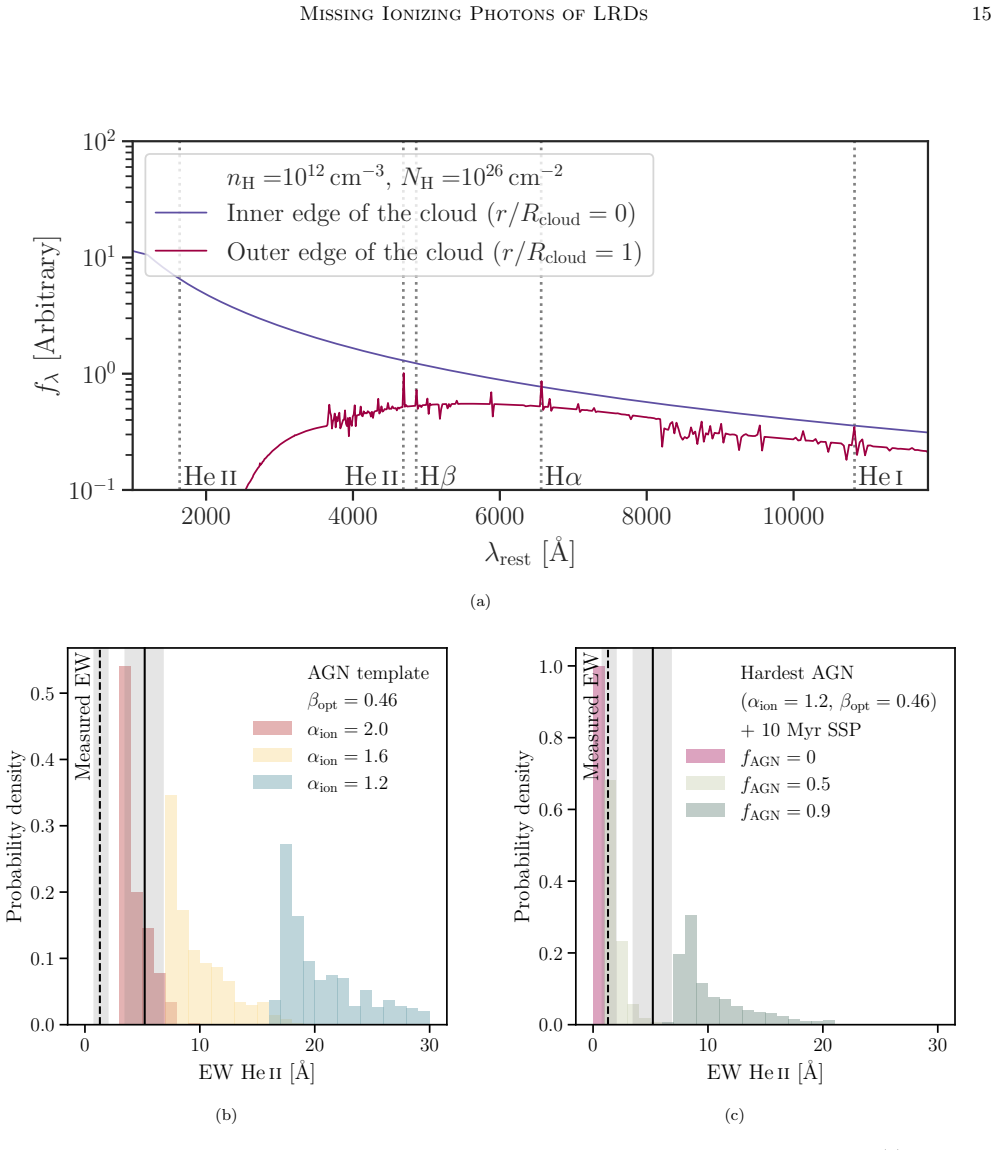
The incident ionizing spectra of Little Red Dots resemble those of massive stars. The low HeII/H-beta ratio near 10 to the minus 2, far below the local AGN median, combined with high H-alpha equivalent widths that exceed what standard AGN disks can produce, requires a soft spectrum rich in H-ionizing photons but poor in harder ones.
What carries the argument
HeII lambda 4686 as an optically thin tracer of the incident spectrum in dense gas envelopes where hydrogen recombination lines become optically thick and lose diagnostic power.
If this is right
- Standard AGN accretion-disk spectra are ruled out by Cloudy photoionization models for the observed line ratios.
- Viable alternatives are a cold accretion disk or a mix of AGN and massive stars.
- The high densities needed for the observed lines also favor star formation, consistent with nuclear star clusters around local massive black holes.
Where Pith is reading between the lines
- If stars supply most of the ionizing photons, LRDs may mark an early phase where nuclear star formation and black-hole growth occur together.
- Deep UV spectroscopy could test whether the continuum itself is as soft as the lines imply.
- Models of early galaxy feedback would need to account for softer radiation fields than assumed in pure-AGN scenarios.
Load-bearing premise
That the measured recombination lines, especially HeII, directly reflect the shape of the central engine's ionizing spectrum rather than being shaped mainly by the density and optical depth of surrounding gas or dust.
What would settle it
A measured HeII/H-beta ratio approaching the local AGN median, or a direct detection of a hard UV continuum slope, would show that the ionizing spectrum is not soft.
Figures



read the original abstract
The nature of Little Red Dots (LRDs) has largely been investigated through their continuum emission, with lines assumed to arise from a broad-line region. In this paper, we instead use recombination lines to infer the intrinsic properties of the central engine. Our analysis first reveals a tension between the ionizing properties implied from H$\alpha$ and HeII$\,\lambda$4686. The high H$\alpha$ EWs require copious H-ionizing photons, more than the bluest AGN ionizing spectra can provide. In contrast, HeII emission is marginally detected, and its low EW is, at most, consistent with the softest AGN spectra. The low HeII/H$\beta$ ($\sim10^{-2}$, $<20\times$ local AGN median) further points to an unusually soft ionizing spectrum. We extend our analysis to dense gas envelopes (``quasi-star''/``black-hole star''), and find that hydrogen recombination lines become optically thick and lose diagnostic power, but HeII remains optically thin and a robust tracer. Photoionization modeling with Cloudy rules out standard AGN accretion disk spectra. Alternative explanations include: exotic AGN with red rest-optical emission; high average optical depth ($>10$) from gas/dust; and/or soft ionizing spectra with abundant H-ionizing photons, consistent with e.g., a cold accretion disk or a composite of AGN and stars. The latter is an intriguing scenario since high hydrogen densities are highly conducive for star formation, and nuclear star clusters are found in the vicinity of local massive black holes. While previous studies have mostly focused on features dominated by the absorbing hydrogen cloud, the HeII-based diagnostic proposed here represents a crucial step toward understanding the central engine of LRDs.
Editorial analysis
A structured set of objections, weighed in public.
Referee Report
Summary. The paper claims that the incident ionizing spectra of Little Red Dots (LRDs) resemble those of massive stars rather than standard AGN accretion disks. This is inferred from the tension between high Hα equivalent widths (requiring abundant H-ionizing photons beyond what the bluest AGN spectra provide) and the low, marginally detected HeII λ4686 emission with HeII/Hβ ratios of ~10^{-2} (less than 20 times the local AGN median). The authors extend the analysis to dense gas envelopes (quasi-stars), arguing that H recombination lines become optically thick while HeII remains thin and thus diagnostic of the incident spectrum; Cloudy photoionization modeling is used to rule out standard AGN spectra, with alternatives including exotic AGN, high optical depth (>10), or soft spectra from cold disks or AGN+star composites.
Significance. If the central claim holds, the work would advance understanding of LRDs by providing a HeII-based diagnostic for the central engine that is less affected by the surrounding gas than hydrogen lines. The identification of the Hα–HeII tension and the application of Cloudy modeling to exclude standard AGN spectra are clear strengths, as is the suggestion that high densities favor nuclear star formation and a composite scenario. This could influence interpretations of black-hole growth at high redshift if the optical-depth assumptions are verified.
major comments (2)
- [dense gas envelopes analysis] In the extension to dense gas envelopes (abstract and associated analysis): the assertion that HeII remains optically thin (while H lines become thick) under LRD-relevant envelope conditions is load-bearing for interpreting the low HeII/Hβ ratio as evidence of a soft incident spectrum rather than radiative-transfer effects. No explicit optical-depth calculations (e.g., for density, column, or covering fraction) are provided to confirm τ_HeII < 1 specifically for LRD parameters; without this, the diagnostic power of HeII is not demonstrated to be robust against the skeptic concern.
- [Cloudy modeling] Cloudy photoionization modeling section: the exact grid parameters, input spectra, and quantitative thresholds used to rule out standard AGN accretion-disk spectra are not specified (e.g., no table of model outputs or comparison metrics). This limits assessment of how definitively the modeling excludes hard spectra and supports the stellar-like conclusion.
minor comments (2)
- Inclusion of full data tables listing individual line measurements, equivalent widths, error bars, and adopted Cloudy parameters would improve reproducibility and allow readers to evaluate the quantitative support for the claimed tension and exclusions.
- Notation for line ratios (e.g., HeII/Hβ) and equivalent widths should be defined consistently on first use and cross-checked against any figures or tables for clarity.
Simulated Author's Rebuttal
We thank the referee for their constructive and insightful comments, which have helped clarify several aspects of our analysis. We address each major comment in detail below and outline the revisions we will make to strengthen the manuscript.
read point-by-point responses
-
Referee: [dense gas envelopes analysis] In the extension to dense gas envelopes (abstract and associated analysis): the assertion that HeII remains optically thin (while H lines become thick) under LRD-relevant envelope conditions is load-bearing for interpreting the low HeII/Hβ ratio as evidence of a soft incident spectrum rather than radiative-transfer effects. No explicit optical-depth calculations (e.g., for density, column, or covering fraction) are provided to confirm τ_HeII < 1 specifically for LRD parameters; without this, the diagnostic power of HeII is not demonstrated to be robust against the skeptic concern.
Authors: We agree that explicit optical-depth calculations would make the argument more robust and directly address potential radiative-transfer concerns. In the current manuscript we rely on the large difference in ionization potentials and abundances between H and He to argue that HeII remains thin at the high densities and columns inferred for LRD envelopes, while H lines become thick. To strengthen this, we will add a dedicated subsection with quantitative τ calculations using LRD-typical parameters (n_H ~ 10^8–10^10 cm^{-3}, N_H ~ 10^{23}–10^{25} cm^{-2}, and covering fractions consistent with the observed EWs). These will explicitly show τ_HeII ≪ 1 while τ_Hα, τ_Hβ > 1, confirming HeII as a reliable tracer of the incident spectrum. revision: yes
-
Referee: [Cloudy modeling] Cloudy photoionization modeling section: the exact grid parameters, input spectra, and quantitative thresholds used to rule out standard AGN accretion-disk spectra are not specified (e.g., no table of model outputs or comparison metrics). This limits assessment of how definitively the modeling excludes hard spectra and supports the stellar-like conclusion.
Authors: We acknowledge that greater transparency in the modeling details is needed. The manuscript currently describes the overall setup and key conclusions from the Cloudy grids, but does not tabulate the full parameter ranges or output metrics. In the revised version we will include a table (or appendix) listing the explored grid (density, ionization parameter, metallicity, and input SEDs including standard AGN disk models and stellar atmospheres), together with predicted HeII/Hβ and Hα EW values for each case. This will allow readers to see the quantitative thresholds at which standard AGN spectra are excluded relative to the observed LRD line ratios. revision: yes
Circularity Check
No significant circularity; derivation grounded in external models and observed ratios
full rationale
The paper infers soft incident ionizing spectra for LRDs from measured high Hα EWs (requiring abundant H-ionizing photons) and low HeII/Hβ ratios (~10^{-2}), using standard Cloudy photoionization grids to rule out typical AGN accretion disk spectra. Analysis of dense quasi-star envelopes models that H recombination lines become optically thick while HeII remains thin, but this is presented as an extension of external radiative transfer considerations rather than a self-defined fit or parameter tuned to force the target conclusion. No self-citation load-bearing steps, ansatzes smuggled via prior work, or renaming of known results appear; the chain compares independent data to external benchmarks and remains self-contained.
Axiom & Free-Parameter Ledger
free parameters (1)
- average optical depth
axioms (2)
- domain assumption HeII lambda 4686 remains optically thin even in dense gas envelopes where hydrogen recombination lines become thick
- domain assumption Recombination lines trace the incident ionizing spectrum from the central engine
Forward citations
Cited by 7 Pith papers
-
The GlimmIr: Spectroscopic Variability in a z~7 LRD Indicates Rapid Changes in Both the Narrow and Broad Line Regions
First spectroscopic variability in a z~7 LRD shows rapid changes in both narrow and broad line regions, implying direct ionization from the central source to surrounding nebular gas.
-
(LRDs)$^2$: The Low-ReDshift Little Red Dots Survey. II. DESI DR1 Sample
The survey identifies 27 low-redshift LRDs with compact morphology, V-shaped continua, broad Balmer lines with extreme decrements, and ubiquitous outflows, matching high-z counterparts and yielding a number density lo...
-
A new sample of Little Red Dots at $z<0.45$ in DESI DR1: Broad Balmer lines, low ionization spectrum and no variability
Eight low-redshift Little Red Dots identified in DESI DR1 exhibit broad Balmer lines, steep decrements, compact shapes, and negligible variability, with a number density roughly 10,000 times lower than at z>4.
-
GLIMPSED: Direct evidence for a fast AGN-driven outflow from a z=6.64 Little Red Dot host galaxy
A z=6.64 LRD host galaxy exhibits a fast AGN-driven outflow with 5500 km/s velocities, dusty gas, and low metallicity, confirming AGN presence in these systems.
-
Spectral Appearance of Self-gravitating Disks Powered by Stellar Objects: Universal Effective Temperature in the Optical Continuum and Application to Little Red Dots
Self-gravitating disks heated by stars reach a universal optical effective temperature of 4000-4500 K independent of accretion rate, black hole mass, and viscosity, explaining Little Red Dots.
-
A Magnetized Black Hole Envelope Model for Little Red Dots
A theoretical model of a magnetized black hole envelope is developed to explain the broad emission lines and X-ray faintness observed in little red dots using co-rotating plasma clumps and limited X-ray sources.
-
Spectral Uniformity of Little Red Dots: A Natural Outcome of Coevolving Seed Black Holes and Nascent Starbursts
Coevolving super-Eddington black holes and nuclear starbursts in high-redshift halos naturally generate the V-shaped UV-to-optical spectra and weak high-energy emission of little red dots.
Reference graph
Works this paper leans on
-
[1]
Akins, H. B., Casey, C. M., Lambrides, E., et al. 2025a, ApJ, 991, 37, doi: 10.3847/1538-4357/ade984
-
[2]
Akins, H. B., Casey, C. M., Berg, D. A., et al. 2025b, ApJL, 980, L29, doi: 10.3847/2041-8213/adab76
-
[3]
Akins, H. B., Casey, C. M., Chisholm, J., et al. 2026, ApJ, 997, 218, doi: 10.3847/1538-4357/ae2c77
-
[4]
Ananna, T. T., Bogd´ an,´A., Kov´ acs, O. E., Natarajan, P., & Hickox, R. C. 2024, ApJL, 969, L18, doi: 10.3847/2041-8213/ad5669
-
[5]
2016, MNRAS, 456, 1424, doi: 10.1093/mnras/stv2758
Aret, A., Kraus, M., & ˇSlechta, M. 2016, MNRAS, 456, 1424, doi: 10.1093/mnras/stv2758
-
[6]
Asada, Y., Inayoshi, K., Fei, Q., Fujimoto, S., & Willott, C. 2026, arXiv e-prints, arXiv:2601.10573, doi: 10.48550/arXiv.2601.10573 Astropy Collaboration, Robitaille, T. P., Tollerud, E. J., et al. 2013, A&A, 558, A33, doi: 10.1051/0004-6361/201322068 Missing Ionizing Photons of LRDs25 T able A.1.Notable LRDs IDz spec JWST PID Reference for spectral mode...
work page internal anchor Pith review Pith/arXiv arXiv doi:10.48550/arxiv.2601.10573 2026
-
[7]
Baggen, J. F. W., van Dokkum, P., Brammer, G., et al. 2024, ApJL, 977, L13, doi: 10.3847/2041-8213/ad90b8
-
[8]
Baldwin, J. A., Phillips, M. M., & Terlevich, R. 1981, PASP, 93, 5, doi: 10.1086/130766
-
[9]
L., et al., 1999, @doi [ ] 10.1086/308056 , 527, 54
Balogh, M. L., Morris, S. L., Yee, H. K. C., Carlberg, R. G., & Ellingson, E. 1999, ApJ, 527, 54, doi: 10.1086/308056 B¨ ar, R. E., Weigel, A. K., Sartori, L. F., et al. 2017, MNRAS, 466, 2879, doi: 10.1093/mnras/stw3283
-
[10]
2010, ApJ, 708, 834, doi: 10.1088/0004-637X/708/1/834
Bartko, H., Martins, F., Trippe, S., et al. 2010, ApJ, 708, 834, doi: 10.1088/0004-637X/708/1/834
-
[11]
Begelman, M. C., & Dexter, J. 2026, ApJ, 996, 48, doi: 10.3847/1538-4357/ae274a 28Wang et al
-
[12]
Begelman, M. C., Rossi, E. M., & Armitage, P. J. 2008, MNRAS, 387, 1649, doi: 10.1111/j.1365-2966.2008.13344.x
-
[13]
2025, ApJL, 984, L55, doi: 10.3847/2041-8213/adce6c
Bellovary, J. 2025, ApJL, 984, L55, doi: 10.3847/2041-8213/adce6c
-
[14]
Stress testing ΛCDM with high -redshift galaxy candidates
Boylan-Kolchin, M. 2023, Nature Astronomy, 7, 731, doi: 10.1038/s41550-023-01937-7
-
[15]
2023,, 0.6.17 Zenodo, doi: 10.5281/zenodo.7299500
Brammer, G. 2023,, 0.6.17 Zenodo, doi: 10.5281/zenodo.7299500
-
[16]
2025, MNRAS, 544, L167, doi: 10.1093/mnrasl/slaf116
Brazzini, M., D’Eugenio, F., Maiolino, R., et al. 2025, MNRAS, 544, L167, doi: 10.1093/mnrasl/slaf116
-
[17]
2003, The Astrophysical Journal, 596, 34, doi: 10.1086/377529
Bromm, V., & Loeb, A. 2003, ApJ, 596, 34, doi: 10.1086/377529
-
[18]
2003, MNRAS, 339, 937, doi: 10.1046/j.1365-8711.2003.06241.x G¨ otberg, Y., de Mink, S
Bruzual, G., & Charlot, S. 2003, MNRAS, 344, 1000, doi: 10.1046/j.1365-8711.2003.06897.x Bruzual A., G. 1983, ApJ, 273, 105, doi: 10.1086/161352
-
[19]
Busche, J. R., & Hillier, D. J. 2005, AJ, 129, 454, doi: 10.1086/426362
-
[20]
Cameron, A. J., Saxena, A., Bunker, A. J., et al. 2023, A&A, 677, A115, doi: 10.1051/0004-6361/202346107
-
[21]
Casey, C. M., Akins, H. B., Finkelstein, S. L., et al. 2025, ApJL, 990, L61, doi: 10.3847/2041-8213/adfa91
-
[22]
Cenci, E., & Habouzit, M. 2025, MNRAS, 542, 2597, doi: 10.1093/mnras/staf1362
-
[23]
2003, PASP, 115, 763, doi: 10.1086/376392
Chabrier, G. 2003, PASP, 115, 763, doi: 10.1086/376392
-
[24]
2026, MNRAS, 545, staf2131, doi: 10.1093/mnras/staf2131
Chang, S.-J., Gronke, M., Matthee, J., & Mason, C. 2026, MNRAS, 545, staf2131, doi: 10.1093/mnras/staf2131
-
[25]
2023, RMxAA, 59, 327, doi: 10.22201/ia.01851101p.2023.59.02.12 9
Chatzikos, M., Bianchi, S., Camilloni, F., et al. 2023, RMxAA, 59, 327, doi: 10.22201/ia.01851101p.2023.59.02.12
-
[26]
Chen, C.-H., Ho, L. C., Li, R., & Zhuang, M.-Y. 2025, ApJ, 983, 60, doi: 10.3847/1538-4357/ada93a
-
[27]
2017, ApJ, 838, 159, doi: 10.3847/1538-4357/aa679f
Choi, J., Conroy, C., & Byler, N. 2017, ApJ, 838, 159, doi: 10.3847/1538-4357/aa679f
-
[28]
The Astrophysical Journal , year =
Choi, J., Dotter, A., Conroy, C., et al. 2016, ApJ, 823, 102, doi: 10.3847/0004-637X/823/2/102
work page internal anchor Pith review doi:10.3847/0004-637x/823/2/102 2016
-
[29]
Cleri, N. J., Olivier, G. M., Backhaus, B. E., et al. 2025, ApJ, 994, 146, doi: 10.3847/1538-4357/ae0f17
-
[30]
Conroy, C., & Gunn, J. E. 2010, ApJ, 712, 833, doi: 10.1088/0004-637X/712/2/833
-
[31]
Davis, S. W., & Laor, A. 2011, ApJ, 728, 98, doi: 10.1088/0004-637X/728/2/98 de Graaff, A., Rix, H.-W., Carniani, S., et al. 2024, A&A, 684, A87, doi: 10.1051/0004-6361/202347755 de Graaff, A., Rix, H.-W., Naidu, R. P., et al. 2025a, A&A, 701, A168, doi: 10.1051/0004-6361/202554681 de Graaff, A., Brammer, G., Weibel, A., et al. 2025b, A&A, 697, A189, doi:...
-
[32]
MESA Isochrones and Stellar Tracks (MIST) 0: Methods for the construction of stellar isochrones
Dotter, A. 2016, ApJS, 222, 8, doi: 10.3847/0067-0049/222/1/8
-
[33]
Eldridge, J. J., Stanway, E. R., Xiao, L., et al. 2017, PASA, 34, e058, doi: 10.1017/pasa.2017.51
-
[34]
2016, MNRAS, 456, 3354, doi: 10.1093/mnras/stv2794
Feltre, A., Charlot, S., & Gutkin, J. 2016, MNRAS, 456, 3354, doi: 10.1093/mnras/stv2794
-
[35]
Ferland, G. J. 2006, Hazy, A Brief Introduction to Cloudy 06.02
work page 2006
-
[36]
J., Done, C., Jin, C., Landt, H., & Ward, M
Ferland, G. J., Done, C., Jin, C., Landt, H., & Ward, M. J. 2020, MNRAS, 494, 5917, doi: 10.1093/mnras/staa1207
-
[37]
J., Netzer H., 1983, @doi [ ] 10.1086/160577 , 264, 105
Ferland, G. J., & Netzer, H. 1983, ApJ, 264, 105, doi: 10.1086/160577
-
[38]
J., Chatzikos, M., Guzm´ an, F., et al
Ferland, G. J., Chatzikos, M., Guzm´ an, F., et al. 2017, RMxAA, 53, 385, doi: 10.48550/arXiv.1705.10877
-
[39]
2014, MNRAS, 443, 2410, doi: 10.1093/mnras/stu1280
Ferrara, A., Salvadori, S., Yue, B., & Schleicher, D. 2014, MNRAS, 443, 2410, doi: 10.1093/mnras/stu1280
-
[40]
J., Labb´ e, I., Zitrin, A., et al
Furtak, L. J., Labb´ e, I., Zitrin, A., et al. 2024, Nature, 628, 57, doi: 10.1038/s41586-024-07184-8
-
[41]
Furtak, L. J., Secunda, A. R., Greene, J. E., et al. 2025, A&A, 698, A227, doi: 10.1051/0004-6361/202554110
-
[42]
Galavis, M. E., Mendoza, C., & Zeippen, C. J. 1997, A&AS, 123, 159, doi: 10.1051/aas:1997344
-
[43]
Genzel, R., Eisenhauer, F., & Gillessen, S. 2010, Reviews of Modern Physics, 82, 3121, doi: 10.1103/RevModPhys.82.3121
-
[44]
2019, MNRAS, 482, 321, doi: 10.1093/mnras/sty2514
Glatzle, M., Ciardi, B., & Graziani, L. 2019, MNRAS, 482, 321, doi: 10.1093/mnras/sty2514
-
[45]
Glikman, E., Helfand, D. J., & White, R. L. 2006, ApJ, 640, 579, doi: 10.1086/500098 Gonz´ alez-D´ ıaz, R., V´ ılchez, J. M., Kehrig, C., del
-
[46]
2025, A&A, 702, A3, doi: 10.1051/0004-6361/202555935
Moral-Castro, I., & Iglesias-P´ aramo, J. 2025, A&A, 702, A3, doi: 10.1051/0004-6361/202555935
-
[47]
2003, MNRAS, 339, 937, doi: 10.1046/j.1365-8711.2003.06241.x G¨ otberg, Y., de Mink, S
Goodman, J. 2003, MNRAS, 339, 937, doi: 10.1046/j.1365-8711.2003.06241.x G¨ otberg, Y., de Mink, S. E., Groh, J. H., et al. 2018, A&A, 615, A78, doi: 10.1051/0004-6361/201732274
-
[48]
Goulding, A. D., Greene, J. E., Setton, D. J., et al. 2023, ApJL, 955, L24, doi: 10.3847/2041-8213/acf7c5
-
[49]
Greene, J. E., & Ho, L. C. 2005, ApJ, 630, 122, doi: 10.1086/431897
-
[50]
Greene, J. E., Labbe, I., Goulding, A. D., et al. 2024, ApJ, 964, 39, doi: 10.3847/1538-4357/ad1e5f
-
[51]
Groves, B. A., Heckman, T. M., & Kauffmann, G. 2006, MNRAS, 371, 1559, doi: 10.1111/j.1365-2966.2006.10812.x
-
[52]
Hamann, W. R., & Gr¨ afener, G. 2003, A&A, 410, 993, doi: 10.1051/0004-6361:20031308
-
[53]
1985, ApJ, 297, 371, doi: 10.1086/163537 Missing Ionizing Photons of LRDs29
Hamilton, D. 1985, ApJ, 297, 371, doi: 10.1086/163537 Missing Ionizing Photons of LRDs29
-
[54]
Harris, C. R., Millman, K. J., van der Walt, S. J., et al. 2020, Nature, 585, 357, doi: 10.1038/s41586-020-2649-2
-
[55]
Hillier, D. J., & Miller, D. L. 1998, ApJ, 496, 407, doi: 10.1086/305350
-
[56]
Nine-Year Wilkinson Microwave Anisotropy Probe (WMAP) Observations: Cosmological Parameter Results
Hinshaw, G., Larson, D., Komatsu, E., et al. 2013, ApJS, 208, 19, doi: 10.1088/0067-0049/208/2/19
-
[57]
1995, ApJ, 439, 875, doi: 10.1086/175226
Hubeny, I., & Lanz, T. 1995, ApJ, 439, 875, doi: 10.1086/175226
-
[58]
Hunter, J. D. 2007, Computing in Science and Engineering, 9, 90, doi: 10.1109/MCSE.2007.55
-
[59]
Hviding, R. E., de Graaff, A., Miller, T. B., et al. 2025, A&A, 702, A57, doi: 10.1051/0004-6361/202555816
-
[60]
Inayoshi, K., Kimura, S. S., & Noda, H. 2025a, PASJ, 77, 811, doi: 10.1093/pasj/psaf050
-
[61]
2025, ApJL, 980, L27, doi: 10.3847/2041-8213/adaebd
Inayoshi, K., & Maiolino, R. 2025, ApJL, 980, L27, doi: 10.3847/2041-8213/adaebd
-
[62]
The Emergence of Little Red Dots from Binary Massive Black Holes
Haiman, Z. 2025b, arXiv e-prints, arXiv:2505.05322, doi: 10.48550/arXiv.2505.05322
work page internal anchor Pith review Pith/arXiv arXiv doi:10.48550/arxiv.2505.05322
-
[63]
2020, ARA&A, 58, 27, doi: 10.1146/annurev-astro-120419-014455
Inayoshi, K., Visbal, E., & Haiman, Z. 2020, ARA&A, 58, 27, doi: 10.1146/annurev-astro-120419-014455
-
[64]
Jeon, J., Liu, B., Bromm, V., et al. 2026, ApJ, 998, 148, doi: 10.3847/1538-4357/ae3725
-
[65]
Ji, X., Maiolino, R., ¨Ubler, H., et al. 2025, MNRAS, 544, 3900, doi: 10.1093/mnras/staf1867
-
[66]
2026, MNRAS, 545, staf2235, doi: 10.1093/mnras/staf2235
Ji, X., D’Eugenio, F., Juodˇ zbalis, I., et al. 2026, MNRAS, 545, staf2235, doi: 10.1093/mnras/staf2235
-
[67]
2012, MNRAS, 420, 1825, doi: 10.1111/j.1365-2966.2011.19805.x
Jin, C., Ward, M., Done, C., & Gelbord, J. 2012, MNRAS, 420, 1825, doi: 10.1111/j.1365-2966.2011.19805.x
-
[68]
Johnson, J. L., Whalen, D. J., Fryer, C. L., & Li, H. 2012, ApJ, 750, 66, doi: 10.1088/0004-637X/750/1/66 Juodˇ zbalis, I., Maiolino, R., Baker, W. M., et al. 2026, MNRAS, 546, stag086, doi: 10.1093/mnras/stag086
-
[69]
Kehrig, C., V´ ılchez, J. M., Guerrero, M. A., et al. 2018, MNRAS, 480, 1081, doi: 10.1093/mnras/sty1920
-
[70]
Kewley, L. J., Nicholls, D. C., & Sutherland, R. S. 2019, ARA&A, 57, 511, doi: 10.1146/annurev-astro-081817-051832
-
[71]
Kido, D., Ioka, K., Hotokezaka, K., Inayoshi, K., & Irwin, C. M. 2025, MNRAS, 544, 3407, doi: 10.1093/mnras/staf1898
-
[72]
Killi, M., Watson, D., Brammer, G., et al. 2024, A&A, 691, A52, doi: 10.1051/0004-6361/202348857
-
[73]
Kocevski, D. D., Finkelstein, S. L., Barro, G., et al. 2025, ApJ, 986, 126, doi: 10.3847/1538-4357/adbc7d
-
[74]
Kokorev, V., Chisholm, J., Naidu, R. P., et al. 2025, arXiv e-prints, arXiv:2511.07515, doi: 10.48550/arXiv.2511.07515 Kovaˇ cevi´ c-Dojˇ cinovi´ c, J., Dojˇ cinovi´ c, I., Laki´ cevi´ c, M., & Popovi´ c, L.ˇC. 2025, A&A, 694, A289, doi: 10.1051/0004-6361/202450516 Labb´ e, I., van Dokkum, P., Nelson, E., et al. 2023, Nature, 616, 266, doi: 10.1038/s41586...
-
[75]
Labbe, I., Greene, J. E., Matthee, J., et al. 2024, arXiv e-prints, arXiv:2412.04557, doi: 10.48550/arXiv.2412.04557
-
[76]
The case for super-Eddington accretion in JWST broad-line AGN during the first billion years
Lambrides, E., Garofali, K., Larson, R., et al. 2024, arXiv e-prints, arXiv:2409.13047, doi: 10.48550/arXiv.2409.13047
work page internal anchor Pith review Pith/arXiv arXiv doi:10.48550/arxiv.2409.13047 2024
-
[77]
Lanz, T., & Hubeny, I. 2003, ApJS, 146, 417, doi: 10.1086/374373
-
[78]
Laor, A., & Davis, S. W. 2014, MNRAS, 438, 3024, doi: 10.1093/mnras/stt2408
-
[79]
Leitherer, C., Schaerer, D., Goldader, J. D., et al. 1999, ApJS, 123, 3, doi: 10.1086/313233
-
[80]
Li, Y., Leja, J., Johnson, B. D., et al. 2025, ApJ, 986, 9, doi: 10.3847/1538-4357/adcab4
discussion (0)
Sign in with ORCID, Apple, or X to comment. Anyone can read and Pith papers without signing in.