Parameter inference of millilensed gravitational waves using neural spline flows
Pith reviewed 2026-05-19 13:17 UTC · model grok-4.3
The pith
Neural spline flows infer millilensed gravitational wave parameters with traditional accuracy but in seconds instead of days.
A machine-rendered reading of the paper's core claim, the machinery that carries it, and where it could break.
Core claim
A neural spline flow network can be trained to approximate the posterior distributions over eleven lens and source parameters from millilensed gravitational wave waveforms, yielding results similar in accuracy to traditional methods such as Bilby with dynesty sampling but with a reduction in inference time from about three days to 0.8 seconds on average.
What carries the argument
Neural spline flows used as a fast approximator to the posterior probability distribution over the combined source and lens parameters.
If this is right
- Parameter estimation for lensed events becomes feasible at scale for future gravitational wave catalogs.
- Low-latency searches for millilensed signals can be implemented in real-time analysis pipelines.
- The demonstrated generalization to spin parameters suggests the approach can handle variations in source properties without additional training.
- Similar techniques could be adapted for other waveform modifications that add parameters to the inference problem.
Where Pith is reading between the lines
- If the method holds for real data, it could enable statistical analyses of lens populations from gravitational wave observations.
- Extensions to strong lensing or other exotic propagation effects might benefit from the same speed advantage.
- Hybrid systems that use fast neural approximations for initial estimates and traditional methods for refinement could optimize both speed and precision.
Load-bearing premise
The simulated training waveforms and lens models are sufficiently representative of real millilensed events that the learned posterior approximation remains accurate when applied to actual detector data containing noise and unmodeled effects.
What would settle it
A direct comparison on injected millilensed signals with known parameters shows the NSF posteriors differing substantially in location or width from those recovered by exact sampling methods on the same data.
Figures




read the original abstract
When gravitational waves (GWs) propagate near massive objects, they undergo gravitational lensing that imprints lens model dependent modulations on the waveform. This effect provides a powerful tool for cosmological and astrophysical studies. Due to the added parameters of lenses and the uncertainty of lens models, parameter inference for lensed GW events using traditional methods is extremely time-consuming, thus requiring more efficient parameter inference methods. In this work, we explore the use of neural spline flows (NSFs) for posterior inference of millilensed GWs, and successfully apply NSFs to the inference of 11-dimensional lens parameters. Our results demonstrate that compared with traditional methods like Bilby dynesty that rely on Bayesian inference, the NSF network we built not only achieves inference accuracy comparable to traditional methods for most parameters, but also can reduce the inference time from approximately 3 days to 0.8 s on average. Additionally, the network exhibits strong generalization for the spin parameters of GW sources. It is anticipated to become a powerful tool for future low-latency searches for lensed GW signals.
Editorial analysis
A structured set of objections, weighed in public.
Referee Report
Summary. The manuscript presents a neural spline flow (NSF) approach for posterior inference on an 11-dimensional parameter space describing millilensed gravitational-wave signals. It reports that the trained NSF recovers posteriors with accuracy comparable to Bilby/dynesty nested sampling on simulated data while reducing inference time from approximately three days to 0.8 s on average, with notably good generalization on spin parameters, and positions the method as enabling low-latency searches for lensed events.
Significance. If the reported accuracy and generalization hold under realistic conditions, the work would provide a valuable computational tool for the expected increase in lensed-GW detections with future detectors. The demonstrated speedup addresses a genuine bottleneck in high-dimensional lensing analyses and could support both archival studies and real-time follow-up, extending the utility of machine-learning density estimators in gravitational-wave astronomy.
major comments (2)
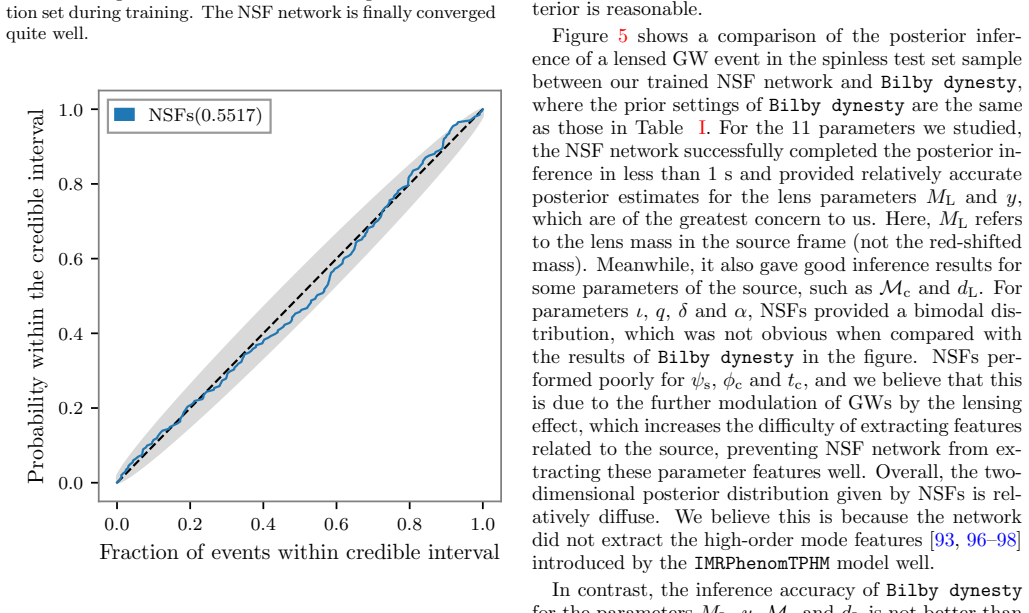
- [Abstract and results section] Abstract and results section: the claim that the NSF 'achieves inference accuracy comparable to traditional methods' is stated without quantitative metrics (e.g., median fractional errors, coverage probabilities, or Jensen-Shannon divergences between NSF and dynesty posteriors), error bars on the comparisons, or explicit description of the training/validation/test splits. This information is load-bearing for the central accuracy claim.
- [Results and discussion sections] Results and discussion sections: all reported benchmarks use simulated waveforms with chosen lens models and idealized noise realizations. No injection campaign into real LIGO/Virgo strain data, no tests with non-Gaussian glitches, and no analysis of any candidate event are described. Because the headline utility for 'future low-latency searches' requires the learned 11-dimensional posterior to remain accurate on actual detector data, this omission is a load-bearing limitation.
minor comments (2)
- [Figures] Figure captions and axis labels could more explicitly state the number of test injections and the precise definition of 'accuracy' used in each panel.
- [Methods] The NSF architecture hyperparameters (number of layers, spline knots, etc.) are listed as free parameters but their specific values and sensitivity study are not tabulated.
Simulated Author's Rebuttal
We thank the referee for their constructive and detailed comments. We address each major comment below, indicating where revisions have been made to the manuscript.
read point-by-point responses
-
Referee: [Abstract and results section] Abstract and results section: the claim that the NSF 'achieves inference accuracy comparable to traditional methods' is stated without quantitative metrics (e.g., median fractional errors, coverage probabilities, or Jensen-Shannon divergences between NSF and dynesty posteriors), error bars on the comparisons, or explicit description of the training/validation/test splits. This information is load-bearing for the central accuracy claim.
Authors: We agree that the accuracy claim would be strengthened by explicit quantitative metrics. In the revised manuscript we have added median fractional errors, coverage probabilities, and Jensen-Shannon divergences between the NSF and dynesty posteriors for the principal parameters, together with error bars on the relevant comparison figures. We have also inserted a clear description of the training/validation/test data splits, including sample sizes and partitioning procedure. revision: yes
-
Referee: [Results and discussion sections] Results and discussion sections: all reported benchmarks use simulated waveforms with chosen lens models and idealized noise realizations. No injection campaign into real LIGO/Virgo strain data, no tests with non-Gaussian glitches, and no analysis of any candidate event are described. Because the headline utility for 'future low-latency searches' requires the learned 11-dimensional posterior to remain accurate on actual detector data, this omission is a load-bearing limitation.
Authors: We accept that the current validation is limited to simulated data and that this restricts immediate claims about performance on real detector output. The revised discussion section now explicitly states this scope limitation, notes the idealized noise assumptions, and outlines planned future work on real-strain injections and glitch robustness. We have also moderated the language concerning low-latency applicability to reflect the simulation-based nature of the present results. revision: partial
Circularity Check
No circularity: NSF trained on external simulations and benchmarked against independent dynesty sampler
full rationale
The paper trains a neural spline flow on simulated millilensed GW waveforms (with chosen lens models) and reports posterior accuracy comparable to Bilby/dynesty plus a large speed-up. No load-bearing step reduces by construction to a fitted quantity defined inside the paper, nor does any uniqueness theorem or ansatz rest on self-citation. The central claims rest on an external sampler comparison and simulation-to-simulation tests, making the derivation self-contained against independent benchmarks.
Axiom & Free-Parameter Ledger
free parameters (1)
- NSF architecture hyperparameters
axioms (1)
- domain assumption Gravitational lensing of GWs follows the standard thin-lens approximation in GR
Forward citations
Cited by 1 Pith paper
-
Robust parameter inference for Taiji via time-frequency contrastive learning and normalizing flows
A glitch-robust amortized inference framework combining normalizing flows, time-frequency multimodal fusion, and contrastive learning outperforms MCMC for Taiji massive black hole binary parameter estimation under noi...
Reference graph
Works this paper leans on
-
[1]
B. P. Abbott, R. Abbott, T. D. Abbott, M. R. Aber- nathy, and others., Phys. Rev. Lett. 116, 221101 (2016), 1602.03841
work page internal anchor Pith review Pith/arXiv arXiv 2016
-
[2]
B. P. Abbott, B. P. Abbott, LIGO Scientific, and Virgo Collaboration, Phys. Rev. Lett. 121, 129902 (2018)
work page 2018
-
[3]
B. P. Abbott, R. Abbott, T. D. Abbott, S. Abraham, F. Acernese, and others., Phys. Rev. D 100, 104036 (2019), 1903.04467
work page internal anchor Pith review Pith/arXiv arXiv 2019
-
[4]
B. P. Abbott, R. Abbott, T. D. Abbott, F. Acernese, K. Ackley, and others., Phys. Rev. Lett. 123, 011102 (2019), 1811.00364
work page internal anchor Pith review Pith/arXiv arXiv 2019
-
[5]
R. Abbott, T. D. Abbott, S. Abraham, F. Acernese, K. Ackley, and others., Phys. Rev. D 103, 122002 (2021), 2010.14529
work page internal anchor Pith review Pith/arXiv arXiv 2021
-
[6]
Tests of General Relativity with GWTC-3
The LIGO Scientific Collaboration, the Virgo Collabo- ration, the KAGRA Collaboration, R. Abbott, H. Abe, Acernese, and others., arXiv e-prints arXiv:2112.06861 (2021), 2112.06861
work page internal anchor Pith review Pith/arXiv arXiv 2021
-
[7]
Abbottet al.(LIGO Scientific, Virgo, KAGRA), Astrophys
R. Abbott, H. Abe, F. Acernese, K. Ackley, and others., Astrophys. J. 949, 76 (2023), 2111.03604
-
[8]
E. Barausse, E. Berti, T. Hertog, and others., General Relativity and Gravitation 52, 81 (2020), 2001.09793
-
[9]
W.-H. Ruan, Z.-K. Guo, R.-G. Cai, and Y.-Z. Zhang, International Journal of Modern Physics A 35, 2050075 (2020)
work page 2020
- [10]
-
[11]
Science Case for the Einstein Telescope
M. Maggiore, C. Van Den Broeck, N. Bartolo, E. Bel- gacem, D. Bertacca, M. A. Bizouard, M. Branchesi, S. Clesse, S. Foffa, J. Garc´ ıa-Bellido, et al., J. Cosmol. Astropart. P. 2020, 050 (2020), 1912.02622
work page internal anchor Pith review Pith/arXiv arXiv 2020
-
[12]
A Horizon Study for Cosmic Explorer: Science, Observatories, and Community
M. Evans, R. X. Adhikari, C. Afle, S. W. Ballmer, S. Biscoveanu, S. Borhanian, D. A. Brown, Y. Chen, R. Eisenstein, A. Gruson, et al., arXiv e-prints arXiv:2109.09882 (2021), 2109.09882
work page internal anchor Pith review Pith/arXiv arXiv 2021
-
[13]
On the waveforms of gravitationally lensed gravitational waves
L. Dai and T. Venumadhav, arXiv e-prints arXiv:1702.04724 (2017), 1702.04724
work page internal anchor Pith review Pith/arXiv arXiv 2017
-
[14]
Detecting Lensing-Induced Diffraction in Astrophysical Gravitational Waves
L. Dai, S.-S. Li, B. Zackay, S. Mao, and Y. Lu, Phys. Rev. D 98, 104029 (2018), 1810.00003
work page internal anchor Pith review Pith/arXiv arXiv 2018
-
[15]
H. G. Choi, C. Park, and S. Jung, Phys. Rev. D 104, 063001 (2021)
work page 2021
- [16]
-
[17]
K.-H. Lai, O. A. Hannuksela, A. Herrera-Mart´ ın, J. M. Diego, T. Broadhurst, and T. G. F. Li, Phys. Rev. D 98, 083005 (2018), 1801.07840
work page internal anchor Pith review Pith/arXiv arXiv 2018
- [18]
- [19]
-
[20]
Wave diffraction by a cosmic string
I. Fern´ andez-N´ u˜ nez and O. Bulashenko, Physics Letters A 380, 2897 (2016), 1605.03176
work page internal anchor Pith review Pith/arXiv arXiv 2016
-
[21]
Emergence of Fresnel diffraction zones in gravitational lensing by a cosmic string
I. Fern´ andez-N´ u˜ nez and O. Bulashenko, Physics Letters A 381, 1764 (2017), 1612.07218
work page internal anchor Pith review Pith/arXiv arXiv 2017
-
[22]
B. Liu, Z. Li, and Z.-H. Zhu, Mon. Not. R. Astron. Soc. 487, 1980 (2019), 1904.11751
work page internal anchor Pith review Pith/arXiv arXiv 1980
-
[23]
Gravitational-Wave Fringes at LIGO: Detecting Compact Dark Matter by Gravitational Lensing
S. Jung and C. S. Shin, Phys. Rev. Lett. 122, 041103 (2019), 1712.01396
work page internal anchor Pith review Pith/arXiv arXiv 2019
-
[24]
J. Urrutia and V. Vaskonen, Mon. Not. R. Astron. Soc. 509, 1358 (2022), 2109.03213
- [25]
- [26]
-
[27]
M. Fairbairn, J. Urrutia, and V. Vaskonen, J. Cosmol. Astropart. P. 2023, 007 (2023), 2210.13436
-
[28]
M. C ¸ alı¸ skan, N. Anil Kumar, L. Ji, J. M. Ezquiaga, R. Cotesta, E. Berti, and M. Kamionkowski, Phys. Rev. D 108, 123543 (2023), 2307.06990
-
[29]
G. Tambalo, M. Zumalac´ arregui, L. Dai, and M. H.-Y. Cheung, Phys. Rev. D 108, 103529 (2023), 2212.11960
- [30]
- [31]
- [32]
- [33]
- [34]
-
[35]
S.-J. Huang, Y.-M. Hu, X. Chen, J.-d. Zhang, E.-K. Li, Z. Gao, and X.-y. Lin, J. Cosmol. Astropart. P. 2023, 003 (2023), 2304.10435
- [36]
- [37]
-
[38]
Abbottet al.(LIGO Scientific, KAGRA, VIRGO), Astrophys
R. Abbott, H. Abe, F. Acernese, K. Ackley, S. Adhicary, and others., Astrophys. J. 970, 191 (2024), 2304.08393
-
[39]
J. Janquart, M. Wright, S. Goyal, J. C. L. Chan, A. Ganguly, ´A. Garr´ on, D. Keitel, A. K. Y. Li, A. Liu, R. K. L. Lo, et al., Mon. Not. R. Astron. Soc. 526, 3832 (2023), 2306.03827
-
[40]
A. Barsode, S. Goyal, and P. Ajith, Astrophys. J. 980, 258 (2025), 2412.01278
- [41]
- [42]
- [43]
- [44]
-
[45]
S.-S. Li, S. Mao, Y. Zhao, and Y. Lu, Mon. Not. R. Astron. Soc. 476, 2220 (2018), 1802.05089
work page internal anchor Pith review Pith/arXiv arXiv 2018
-
[46]
K. K. Y. Ng, K. W. K. Wong, T. Broadhurst, and T. G. F. Li, Phys. Rev. D 97, 023012 (2018), 1703.06319
work page internal anchor Pith review Pith/arXiv arXiv 2018
- [47]
- [48]
- [49]
- [50]
- [51]
-
[52]
Wave Effects in Gravitational Lensing of Gravitational Waves from Chirping Binaries
R. Takahashi and T. Nakamura, Astrophys. J. 595, 1039 (2003), astro-ph/0305055
work page internal anchor Pith review Pith/arXiv arXiv 2003
-
[53]
Strong lensing of gravitational waves as seen by LISA
M. Sereno, A. Sesana, A. Bleuler, P. Jetzer, M. Volon- teri, and M. C. Begelman, Phys. Rev. Lett. 105, 251101 (2010), 1011.5238
work page internal anchor Pith review Pith/arXiv arXiv 2010
-
[54]
O. Bulashenko and H. Ubach, J. Cosmol. Astropart. P. 2022, 022 (2022), 2112.10773
-
[55]
H. Gabbard, C. Messenger, I. S. Heng, F. Tonolini, and R. Murray-Smith, Nature Physics 18, 112 (2022), 1909.06296
- [56]
- [57]
- [58]
- [59]
-
[60]
T. Whittaker, W. E. East, S. R. Green, L. Lehner, and H. Yang, Phys. Rev. D 105, 124021 (2022), 2201.06461
- [61]
- [62]
- [63]
- [64]
- [65]
- [66]
- [67]
-
[68]
C.-Y. Xiong, T.-Y. Sun, J.-F. Zhang, and X. Zhang, Phys. Rev. D 111, 024019 (2025), 2405.09475
- [69]
-
[70]
Inspiral-merger-ringdown waveforms for black-hole binaries with non-precessing spins
P. Ajith, M. Hannam, S. Husa, Y. Chen, B. Br¨ ugmann, N. Dorband, D. M¨ uller, F. Ohme, D. Pollney, C. Reis- swig, et al., Phys. Rev. Lett. 106, 241101 (2011), 0909.2867
work page internal anchor Pith review Pith/arXiv arXiv 2011
- [71]
-
[72]
S. Biscoveanu, T. A. Callister, C.-J. Haster, K. K. Y. Ng, S. Vitale, and W. M. Farr, Astrophys. J. Lett. 932, L19 (2022), 2204.01578
-
[73]
M. Fishbach, C. Kimball, and V. Kalogera, Astrophys. J. Lett. 935, L26 (2022), 2207.02924
- [74]
-
[75]
S. Biscoveanu, M. Isi, S. Vitale, and V. Varma, Phys. Rev. Lett. 126, 171103 (2021), 2007.09156
- [76]
-
[77]
J. Veitch, V. Raymond, B. Farr, W. Farr, P. Graff, S. Vitale, B. Aylott, K. Blackburn, N. Christensen, M. Coughlin, et al., Phys. Rev. D 91, 042003 (2015), 1409.7215
work page internal anchor Pith review Pith/arXiv arXiv 2015
-
[78]
Searching for Gravitational Waves from Compact Binaries with Precessing Spins
I. Harry, S. Privitera, A. Boh´ e, and A. Buonanno, Phys. Rev. D 94, 024012 (2016), 1603.02444
work page internal anchor Pith review Pith/arXiv arXiv 2016
- [79]
-
[80]
Y.-X. Wang, S.-J. Jin, T.-Y. Sun, J.-F. Zhang, and X. Zhang, Chinese Physics C 48, 125107 (2024), 2305.19003
discussion (0)
Sign in with ORCID, Apple, or X to comment. Anyone can read and Pith papers without signing in.