Recognition: unknown
Generalizing the CPL Parametrization through Dark Sector Interaction
Pith reviewed 2026-05-07 15:06 UTC · model grok-4.3
The pith
Interacting dark energy models generalized with a specific coupling kernel and CPL parametrization are not preferred over LambdaCDM by Bayesian evidence despite some frequentist tensions.
A machine-rendered reading of the paper's core claim, the machinery that carries it, and where it could break.
Core claim
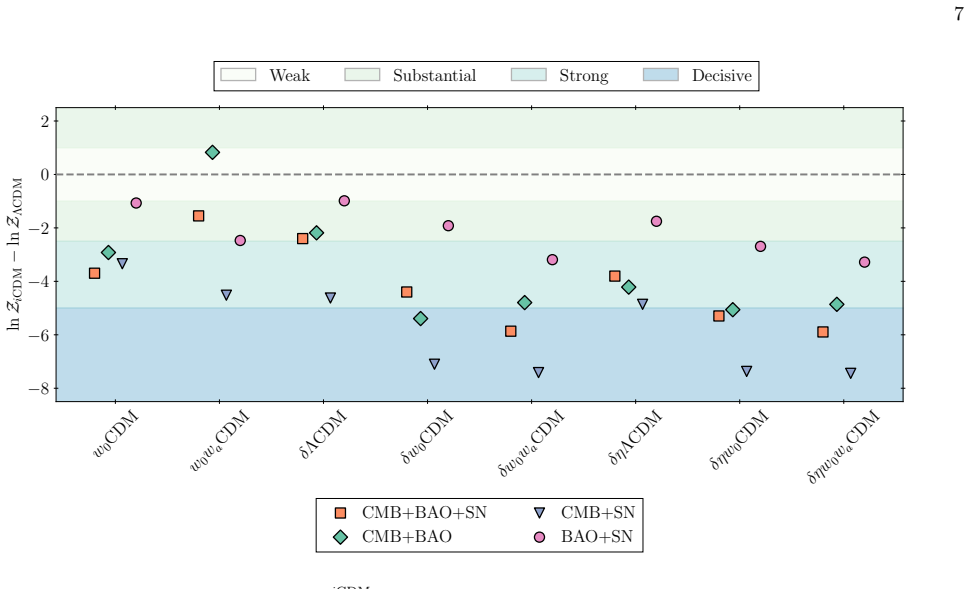
The authors assume an interaction rate between dark matter and dark energy given by Q equals 3H times (delta plus eta times a) times rho_de, paired with the CPL dark energy equation of state w_de equals w0 plus wa times (1 minus a). This combination yields closed analytical expressions for the dark matter and dark energy densities. Observational constraints from DESI DR2, Pantheon plus, and Planck plus ACT data sets reveal that constant-coupling models deviate from LambdaCDM at up to 2.9 sigma, while dynamical-coupling models deviate at up to 1.5 sigma. Bayesian evidence calculations show no preference for any of the interacting dark energy models over the concordance LambdaCDM model.
What carries the argument
The background interaction kernel Q = 3H(δ + η a)ρ_de combined with the CPL parametrization for w_de, which together permit closed analytical expressions for the dark sector energy densities.
If this is right
- Constant-coupling models produce 2.7 sigma to 2.9 sigma deviations from LambdaCDM in parameter constraints.
- Dynamical-coupling models reduce these deviations to the 1.3 sigma to 1.5 sigma range.
- Bayesian model comparison shows no statistical preference for any IDE scenario over LambdaCDM.
- The analytical solutions enable straightforward computation of model predictions for observables.
Where Pith is reading between the lines
- If future data maintain the current level of mild tension, the distinction between constant and dynamical coupling could become clearer with increased precision.
- The analytical approach demonstrated here could be used to explore interactions in other dark energy parametrizations.
- Combining frequentist significance levels with Bayesian evidence provides a more complete picture of model viability in cosmology.
Load-bearing premise
The interaction kernel is assumed to have the specific linear dependence on the scale factor that allows closed analytical solutions for the energy densities.
What would settle it
An independent analysis yielding a Bayes factor greater than one in favor of one of the interacting models over LambdaCDM would contradict the paper's model comparison result.
Figures


read the original abstract
We investigate a hierarchy of interacting dark energy (IDE) models featuring a non-gravitational coupling between dark matter and dark energy. Specifically, we examine scenarios where the background interaction kernel, $Q = 3H(\delta + \eta a)\rho_\mathrm{de}$, allows for both constant and dynamical coupling parameters. Adopting the CPL parametrization for the dark energy equation of state, $w_\mathrm{de} = w_0 + w_a(1-a)$, we derive closed analytical expressions for the energy densities of dark matter and dark energy. Afterwards, we obtain observational constraints using joint combinations of DESI DR2 baryon acoustic oscillations, Pantheon$+$ Type Ia supernovae, and Planck$+$ACT compressed cosmic microwave background likelihoods. For constant coupling models, we find parametric deviations from $\Lambda$ ranging from $2.7\sigma$ to $2.9\sigma$; however, for interactions with dynamical couplings, these significances are reduced to $1.3\sigma$--$1.5\sigma$. Ultimately, our Bayesian model comparison reveals that no investigated IDE scenario is statistically preferred over the concordance $\Lambda$CDM model. These results highlight the necessity of reporting Bayesian evidence alongside conventional frequentist maximum-likelihood analyses to ensure robust cosmological claims concerning dark energy evolution and interaction.
Editorial analysis
A structured set of objections, weighed in public.
Referee Report
Summary. The manuscript investigates interacting dark energy (IDE) models with the background interaction kernel Q = 3H(δ + η a)ρ_de, combined with the CPL parametrization w_de = w0 + wa(1-a). It derives closed analytical expressions for the dark matter and dark energy energy densities, constrains the parameters (δ, η, w0, wa) using DESI DR2 BAO, Pantheon+ supernovae, and Planck+ACT compressed CMB likelihoods, reports 2.7–2.9σ deviations from ΛCDM for constant-coupling cases (reduced to 1.3–1.5σ for dynamical couplings), and concludes via Bayesian model comparison that no IDE scenario is statistically preferred over ΛCDM.
Significance. If the closed-form derivations are correct and the compressed likelihoods remain valid, the work supplies a concrete analytical framework for testing scale-factor-dependent dark-sector couplings and usefully stresses the need to report Bayesian evidence alongside frequentist results. The absence of preference for any IDE model is consistent with much of the existing literature but adds a specific, analytically tractable example; the significance is reduced by the reliance on compressed CMB data whose validity for models that alter both background evolution and perturbations is not demonstrated.
major comments (2)
- [§4] §4 (observational constraints and Bayesian comparison): the headline result that no IDE model is preferred over ΛCDM rests on ΔlnZ values computed with Planck+ACT compressed CMB likelihoods. These compressions are calibrated under ΛCDM or minimal extensions and encode assumptions about perturbation evolution and parameter degeneracies; the chosen Q = 3H(δ + η a)ρ_de modifies both background densities and dark-sector perturbations, which can shift the CMB spectra outside the compression’s validity range. If the compressed likelihood misrepresents the true χ² or covariance, the reported evidences and the model-comparison conclusion become unreliable.
- [§2] §2 (analytical derivations): the closed expressions for ρ_dm(a) and ρ_de(a) follow directly from the assumed interaction kernel and the CPL form, but the manuscript does not provide an explicit check that the resulting perturbation equations remain consistent with the background solution when the same Q is used at the linear level; this consistency is load-bearing for the applicability of the compressed CMB likelihoods.
minor comments (2)
- Notation for the interaction parameters δ and η is introduced without a dedicated table summarizing their physical interpretation and prior ranges; adding this would improve readability.
- Figure captions for the posterior plots do not explicitly state whether the contours include the full joint posterior or marginalised subsets; clarify this to avoid ambiguity.
Simulated Author's Rebuttal
We thank the referee for their careful and constructive review of our manuscript. We address each major comment below, indicating where revisions will be incorporated and providing our reasoning on points of substance.
read point-by-point responses
-
Referee: [§4] §4 (observational constraints and Bayesian comparison): the headline result that no IDE model is preferred over ΛCDM rests on ΔlnZ values computed with Planck+ACT compressed CMB likelihoods. These compressions are calibrated under ΛCDM or minimal extensions and encode assumptions about perturbation evolution and parameter degeneracies; the chosen Q = 3H(δ + η a)ρ_de modifies both background densities and dark-sector perturbations, which can shift the CMB spectra outside the compression’s validity range. If the compressed likelihood misrepresents the true χ² or covariance, the reported evidences and the model-comparison conclusion become unreliable.
Authors: We agree that compressed CMB likelihoods carry assumptions calibrated primarily under ΛCDM and that our interaction kernel affects both background and perturbation sectors. Our analysis relies on these likelihoods as an established approximation in the IDE literature for background-driven constraints. The Bayesian evidences are reported together with frequentist significances (which show the same pattern of reduced tension for dynamical couplings), and the conclusion of no model preference is robust to the specific data combination used. In revision we will add an explicit paragraph in §4 discussing the limitations of the compressed likelihoods for interacting models and noting that a full uncompressed analysis would be desirable in future work. revision: partial
-
Referee: [§2] §2 (analytical derivations): the closed expressions for ρ_dm(a) and ρ_de(a) follow directly from the assumed interaction kernel and the CPL form, but the manuscript does not provide an explicit check that the resulting perturbation equations remain consistent with the background solution when the same Q is used at the linear level; this consistency is load-bearing for the applicability of the compressed CMB likelihoods.
Authors: Section 2 derives the exact background solutions for ρ_dm(a) and ρ_de(a). The linear perturbation equations we employ are the standard IDE continuity and Euler equations with the same Q inserted at the background level and no additional momentum exchange at first order. We will add a short appendix in the revised manuscript that explicitly verifies consistency between the background solution and the linear perturbation equations under this choice of Q, thereby strengthening the justification for using the compressed likelihoods. revision: yes
Circularity Check
No circularity; derivation solves assumed equations then fits external data
full rationale
The paper assumes the interaction kernel Q = 3H(δ + η a)ρ_de by construction to obtain closed-form density solutions via the continuity equations; this is explicit mathematical derivation, not a self-referential claim. Parameters (δ, η, w0, wa) are then constrained via standard Bayesian fitting to independent datasets (DESI DR2 BAO, Pantheon+ SNIa, Planck+ACT compressed CMB). Model comparison (no IDE preferred over ΛCDM) follows directly from the resulting evidences and posteriors. No load-bearing step reduces to a self-citation, fitted input renamed as prediction, or ansatz smuggled via prior work. The central results remain independent of the paper's own inputs once the assumption and data are granted.
Axiom & Free-Parameter Ledger
free parameters (4)
- δ
- η
- w0
- wa
axioms (1)
- ad hoc to paper The interaction rate takes the functional form Q = 3H(δ + η a) ρ_de
Reference graph
Works this paper leans on
-
[1]
It then follows from Eq
Background viability Regarding DE, we first note that, provided that ra- diation and matter do not exhaust the energy con- tent of the Universe—their current total energy den- sity does not amount to the critical energy densityρ c = 3H2 0 /(8πG)—the current energy density of DE remains positive,ρ de,0 >0. It then follows from Eq. (10) that ρde(a)>0 over a...
-
[2]
doom factor
Perturbative stability (the doom factord) While our study primarily focuses on the background evolution, the physical viability of IDE models is of- ten constrained by the stability of linear perturbations. To perform such analysis, a phenomenological covariant specification ofQ ν is required. Following [60], one can adopt the ansatz that the interaction ...
-
[3]
To miti- gate the impact of peculiar velocity uncertainties, which dominate at low redshifts, we restrict our analysis to the subset of SN atz >0.01 [67, 68]
Type Ia supernovae (Pantheon+) We rely on the Pantheon+ compilation [65, 66], con- sisting on a set of 1701 light curves of 1550 distinct SN covering the redshift range 0.001< z <2.26. To miti- gate the impact of peculiar velocity uncertainties, which dominate at low redshifts, we restrict our analysis to the subset of SN atz >0.01 [67, 68]. The theoretic...
-
[4]
Cosmic microwave background (compressed likelihood) To constrain the cosmological parameters at early times, we consider the shift parameters derived from 5 the CMB power spectrum [70]. This approach incorpo- rates the essential geometric information of the CMB into a compact data vector, avoiding the computational ex- pense of evaluating the full Boltzma...
-
[5]
Baryon acoustic oscillations (DESI DR 2) We utilize the latest BAO measurements from the Data Release 2 (DR2) of the DESI [21]. This dataset pro- vides constraints on the comoving distanceD M(z)/rd, the Hubble distanceD H(z)/rd, and the spherically aver- aged distanceD V(z)/rd across seven redshift bins span- ning 0.295≤z≤2.33. The theoretical prediction ...
-
[6]
Einstein, The Field Equations of Gravitation, Sitzungsber
A. Einstein, The Field Equations of Gravitation, Sitzungsber. Preuss. Akad. Wiss. Berlin (Math. Phys.) 1915, 844–847 (1915)
1915
-
[7]
Einstein, On the General Theory of Relativity, Sitzungsber
A. Einstein, On the General Theory of Relativity, Sitzungsber. Preuss. Akad. Wiss. Berlin (Math. Phys.) 1915, 778–786 (1915), [Addendum: Sitzungsber. Preuss. Akad. Wiss. Berlin (Math. Phys.)1915,799(1915)]
1915
-
[8]
C. M. Will, The Confrontation between General Rela- tivity and Experiment, Living Rev. Rel.17, 4 (2014), arXiv:1403.7377 [gr-qc]
work page internal anchor Pith review arXiv 2014
-
[9]
Tests of General Relativity with GWTC-3
R. Abbottet al.(LIGO Scientific, VIRGO, KAGRA), Tests of General Relativity with GWTC-3, Phys. Rev. D 112, 084080 (2025), arXiv:2112.06861 [gr-qc]
work page internal anchor Pith review arXiv 2025
-
[10]
A. G. Riesset al.(Supernova Search Team), Observa- tional evidence from supernovae for an accelerating uni- verse and a cosmological constant, Astron. J.116, 1009– 1038 (1998), arXiv:astro-ph/9805201
work page internal anchor Pith review arXiv 1998
-
[11]
Perlmutter and others (Supernova Cosmology Project), Astrophys
S. Perlmutteret al.(Supernova Cosmology Project), Measurements of Ω and Λ from 42 High Redshift Super- novae, Astrophys. J.517, 565–586 (1999), arXiv:astro- ph/9812133
-
[12]
D. J. Eisensteinet al.(SDSS), Detection of the Baryon Acoustic Peak in the Large-Scale Correlation Function of SDSS Luminous Red Galaxies, Astrophys. J.633, 560– 574 (2005), arXiv:astro-ph/0501171
work page Pith review arXiv 2005
- [13]
- [14]
- [15]
-
[16]
Planck 2018 results. VI. Cosmological parameters
N. Aghanimet al.(Planck), Planck 2018 results. VI. Cosmological parameters, Astron. Astrophys.641, A6 (2020), [Erratum: Astron.Astrophys. 652, C4 (2021)], arXiv:1807.06209 [astro-ph.CO]
work page internal anchor Pith review arXiv 2018
-
[17]
A. G. Riesset al., A Comprehensive Measurement of the Local Value of the Hubble Constant with 1 km s−1 Mpc−1 Uncertainty from the Hubble Space Telescope and the SH0ES Team, Astrophys. J. Lett.934, L7 (2022), arXiv:2112.04510 [astro-ph.CO]
work page internal anchor Pith review arXiv 2022
-
[18]
E. Camphuiset al.(SPT-3G), SPT-3G D1: CMB tem- perature and polarization power spectra and cosmology from 2019 and 2020 observations of the SPT-3G Main field (2025), arXiv:2506.20707 [astro-ph.CO]
work page internal anchor Pith review arXiv 2019
-
[19]
S. Casertanoet al.(H0DN), The Local Distance Net- work: a community consensus report on the measure- ment of the Hubble constant at 1% precision (2025), 13 arXiv:2510.23823 [astro-ph.CO]
work page internal anchor Pith review Pith/arXiv arXiv 2025
-
[20]
I. Pantos and L. Perivolaropoulos, Dissecting the Hubble tension: Insights from a diverse set of Sound Horizon- free H0 measurements (2026), arXiv:2601.00650 [astro- ph.CO]
-
[21]
Erbenet al., CFHTLenS: The Canada–France–Hawaii Telescope Lensing Survey – Imaging data and catalogue products, Mon
T. Erbenet al., CFHTLenS: The Canada–France–Hawaii Telescope Lensing Survey – Imaging data and catalogue products, Mon. Not. Roy. Astron. Soc.433, 2545–2563 (2013)
2013
-
[22]
P. A. R. Adeet al.(Planck), Planck 2013 results. XVI. Cosmological parameters, Astron. Astrophys.571, A16 (2014), arXiv:1303.5076 [astro-ph.CO]
work page Pith review arXiv 2013
- [23]
- [24]
-
[25]
A. G. Adameet al.(DESI), DESI 2024 VI: cosmologi- cal constraints from the measurements of baryon acous- tic oscillations, JCAP02, 021, arXiv:2404.03002 [astro- ph.CO]
work page internal anchor Pith review arXiv 2024
-
[26]
DESI DR2 Results II: Measurements of Baryon Acoustic Oscillations and Cosmological Constraints
M. Abdul Karimet al.(DESI), DESI DR2 results. II. Measurements of baryon acoustic oscillations and cos- mological constraints, Phys. Rev. D112, 083515 (2025), arXiv:2503.14738 [astro-ph.CO]
work page internal anchor Pith review arXiv 2025
-
[27]
D. D. Y. Ong, D. Yallup, and W. Handley, A Bayesian Perspective on Evidence for Evolving Dark Energy (2025), arXiv:2511.10631 [astro-ph.CO]
work page internal anchor Pith review arXiv 2025
- [28]
-
[29]
E. Di Valentinoet al.(CosmoVerse Network), The Cos- moVerse White Paper: Addressing observational tensions in cosmology with systematics and fundamental physics, Phys. Dark Univ.49, 101965 (2025), arXiv:2504.01669 [astro-ph.CO]
work page internal anchor Pith review arXiv 2025
-
[30]
Weinberg, The Cosmological Constant Problem, Rev
S. Weinberg, The Cosmological Constant Problem, Rev. Mod. Phys.61, 1–23 (1989)
1989
-
[31]
J. Martin, Everything You Always Wanted To Know About The Cosmological Constant Problem (But Were Afraid To Ask), Comptes Rendus Physique13, 566–665 (2012), arXiv:1205.3365 [astro-ph.CO]
work page Pith review arXiv 2012
-
[32]
Quintessence, Cosmic Coincidence, and the Cosmological Constant
I. Zlatev, L.-M. Wang, and P. J. Steinhardt, Quintessence, cosmic coincidence, and the cosmolog- ical constant, Phys. Rev. Lett.82, 896–899 (1999), arXiv:astro-ph/9807002
work page Pith review arXiv 1999
-
[33]
L. Amendola, Coupled quintessence, Phys. Rev. D62, 043511 (2000), arXiv:astro-ph/9908023
work page Pith review arXiv 2000
-
[34]
W. Zimdahl and D. Pavon, Interacting quintessence, Phys. Lett. B521, 133–138 (2001), arXiv:astro- ph/0105479
-
[35]
D. Comelli, M. Pietroni, and A. Riotto, Dark energy and dark matter, Phys. Lett. B571, 115–120 (2003), arXiv:hep-ph/0302080
- [36]
- [37]
-
[38]
P. Wang and X.-H. Meng, Can vacuum decay in our universe?, Class. Quant. Grav.22, 283–294 (2005), arXiv:astro-ph/0408495
-
[39]
G. Olivares, F. Atrio-Barandela, and D. Pavon, Matter density perturbations in interacting quintessence models, Phys. Rev. D74, 043521 (2006), arXiv:astro-ph/0607604
- [40]
-
[41]
M. Quartin, M. O. Calvao, S. E. Joras, R. R. R. Reis, and I. Waga, Dark Interactions and Cosmological Fine- Tuning, JCAP05, 007, arXiv:0802.0546 [astro-ph]
-
[42]
S. del Campo, R. Herrera, and D. Pavon, Interacting models may be key to solve the cosmic coincidence prob- lem, JCAP01, 020, arXiv:0812.2210 [gr-qc]
-
[43]
G. Caldera-Cabral, R. Maartens, and L. A. Urena-Lopez, Dynamics of interacting dark energy, Phys. Rev. D79, 063518 (2009), arXiv:0812.1827 [gr-qc]
- [44]
-
[45]
S. del Campo, R. Herrera, and D. Pav´ on, Interaction in the dark sector, Phys. Rev. D91, 123539 (2015), arXiv:1507.00187 [gr-qc]
-
[46]
R. von Marttens, L. Casarini, D. F. Mota, and W. Zim- dahl, Cosmological constraints on parametrized interact- ing dark energy, Phys. Dark Univ.23, 100248 (2019), arXiv:1807.11380 [astro-ph.CO]
-
[47]
M. van der Westhuizen, A. Abebe, and E. Di Valentino, I. Linear interacting dark energy: Analytical solutions and theoretical pathologies, Phys. Dark Univ.50, 102119 (2025), arXiv:2509.04495 [gr-qc]
-
[48]
M. van der Westhuizen, A. Abebe, and E. Di Valentino, II. Non-linear interacting dark energy: Analytical solu- tions and theoretical pathologies, Phys. Dark Univ.50, 102120 (2025), arXiv:2509.04494 [gr-qc]
-
[49]
M. van der Westhuizen, A. Abebe, and E. Di Valentino, III. Interacting Dark Energy: Summary of models, Pathologies, and Constraints, Phys. Dark Univ.50, 102121 (2025), arXiv:2509.04496 [gr-qc]
- [50]
-
[51]
Hagiwaraet al.(Particle Data Group), Review of par- ticle physics
K. Hagiwaraet al.(Particle Data Group), Review of par- ticle physics. Particle Data Group, Phys. Rev. D66, 010001 (2002)
2002
-
[52]
P. J. E. Peebles and B. Ratra, The Cosmological Con- stant and Dark Energy, Rev. Mod. Phys.75, 559–606 (2003), arXiv:astro-ph/0207347
work page Pith review arXiv 2003
-
[53]
B. Wang, E. Abdalla, F. Atrio-Barandela, and D. Pavon, Dark Matter and Dark Energy Interactions: Theoreti- cal Challenges, Cosmological Implications and Observa- tional Signatures, Rept. Prog. Phys.79, 096901 (2016), arXiv:1603.08299 [astro-ph.CO]
work page Pith review arXiv 2016
-
[54]
N. Aghanimet al.(Planck), Planck 2018 results. V. CMB power spectra and likelihoods, Astron. Astrophys.641, A5 (2020), arXiv:1907.12875 [astro-ph.CO]
- [55]
-
[56]
Kodama and M
H. Kodama and M. Sasaki, Cosmological Perturbation 14 Theory, Prog. Theor. Phys. Suppl.78, 1–166 (1984)
1984
- [57]
- [58]
- [59]
- [60]
- [61]
-
[62]
Accelerating Universes with Scaling Dark Matter
M. Chevallier and D. Polarski, Accelerating universes with scaling dark matter, Int. J. Mod. Phys. D10, 213– 224 (2001), arXiv:gr-qc/0009008
work page Pith review arXiv 2001
- [63]
- [64]
- [65]
-
[66]
Hu, Parametrized Post-Friedmann Signatures of Ac- celeration in the CMB, Phys
W. Hu, Parametrized Post-Friedmann Signatures of Ac- celeration in the CMB, Phys. Rev. D77, 103524 (2008), arXiv:0801.2433 [astro-ph]
-
[67]
W. Fang, W. Hu, and A. Lewis, Crossing the Phantom Divide with Parameterized Post-Friedmann Dark Energy, Phys. Rev. D78, 087303 (2008), arXiv:0808.3125 [astro- ph]
work page Pith review arXiv 2008
-
[68]
Parametrized Post-Friedmann Framework for Interact- ing Dark Energy,
Y.-H. Li, J.-F. Zhang, and X. Zhang, Parametrized Post-Friedmann Framework for Interacting Dark Energy, Phys. Rev. D90, 063005 (2014), arXiv:1404.5220 [astro- ph.CO]
-
[69]
Y.-H. Li, J.-F. Zhang, and X. Zhang, Exploring the full parameter space for an interacting dark energy model with recent observations including redshift-space distortions: Application of the parametrized post- Friedmann approach, Phys. Rev. D90, 123007 (2014), arXiv:1409.7205 [astro-ph.CO]
-
[70]
The Pantheon+ Analysis: The Full Dataset and Light-Curve Release
D. Scolnicet al., The Pantheon+ Analysis: The Full Data Set and Light-curve Release, Astrophys. J.938, 113 (2022), arXiv:2112.03863 [astro-ph.CO]
work page internal anchor Pith review arXiv 2022
-
[71]
The Pantheon+ Analysis: Cosmological Constraints
D. Broutet al., The Pantheon+ Analysis: Cosmo- logical Constraints, Astrophys. J.938, 110 (2022), arXiv:2202.04077 [astro-ph.CO]
work page internal anchor Pith review arXiv 2022
- [72]
-
[73]
A. Carr, T. M. Davis, D. Scolnic, D. Scolnic, K. Said, D. Brout, E. R. Peterson, and R. Kessler, The Pan- theon+ analysis: Improving the redshifts and peculiar velocities of Type Ia supernovae used in cosmological analyses, Publ. Astron. Soc. Austral.39, e046 (2022), arXiv:2112.01471 [astro-ph.CO]
-
[74]
A. Conleyet al., Supernova constraints and systematic uncertainties from the first three years of the supernova legacy survey, The Astrophysical Journal Supplement Se- ries192, 1 (2010)
2010
-
[75]
Observational Constraints on Dark Energy and Cosmic Curvature
Y. Wang and P. Mukherjee, Observational Constraints on Dark Energy and Cosmic Curvature, Phys. Rev.D76, 103533 (2007), arXiv:astro-ph/0703780 [astro-ph]
work page Pith review arXiv 2007
-
[76]
A. Aizpuru, R. Arjona, and S. Nesseris, Machine learning improved fits of the sound horizon at the baryon drag epoch, Phys. Rev. D104, 043521 (2021), arXiv:2106.00428 [astro-ph.CO]
-
[77]
P. Bansal and D. Huterer, Expansion-history preferences of DESI DR2 and external data, Phys. Rev. D112, 023528 (2025), arXiv:2502.07185 [astro-ph.CO]
- [78]
-
[79]
Sch¨ oneberg,The 2024 BBN baryon abundance update,JCAP06(2024) 006 [2401.15054]
N. Sch¨ oneberg, The 2024 BBN baryon abundance up- date, JCAP06, 006, arXiv:2401.15054 [astro-ph.CO]
-
[80]
Jeffreys,Theory of Probability, 3rd ed
H. Jeffreys,Theory of Probability, 3rd ed. (Oxford, Ox- ford, England, 1961)
1961
discussion (0)
Sign in with ORCID, Apple, or X to comment. Anyone can read and Pith papers without signing in.