Scalable Multi-Task Data Generation via Reinforcement Learning for Language-Conditioned Bimanual Dexterous Manipulation
Pith reviewed 2026-06-30 10:43 UTC · model grok-4.3
The pith
A reinforcement learning pipeline with generalizable rewards and domain randomization generates scalable synthetic datasets that improve generalization for language-conditioned bimanual dexterous manipulation policies.
A machine-rendered reading of the paper's core claim, the machinery that carries it, and where it could break.
Core claim
The paper claims that a systematic RL-based data generation pipeline integrating generalizable reward design, effective domain randomization, and language-conditioned task annotations synthesizes diverse, high-quality datasets for dexterous bimanual manipulation and enables training of language-conditioned multi-task policies that improve generalization across tasks.
What carries the argument
The RL-based data generation pipeline that integrates generalizable reward design, domain randomization, and language-conditioned task annotations to produce robot-executable trajectories.
If this is right
- The generated datasets enable training of policies that generalize better across the three representative manipulation tasks.
- Language conditioning supports multi-task policy learning from a unified synthetic dataset.
- The pipeline scales data generation beyond the limits of human teleoperation methods.
- It reduces the requirement for handcrafted task-specific rewards during data synthesis.
Where Pith is reading between the lines
- The pipeline could extend to generating data for additional bimanual tasks or different robot morphologies by varying the randomization parameters.
- Combining the synthetic data with limited real-world demonstrations might further improve real-robot performance.
- The method suggests a path toward creating much larger datasets through parallel simulation runs.
Load-bearing premise
A single generalizable reward design combined with domain randomization can produce robot-executable trajectories across diverse tasks without task-specific reward engineering.
What would settle it
An experiment in which policies trained on the generated data show no improvement in generalization on the three manipulation tasks compared to training without it, or where the trajectories cannot be executed on the physical robot.
Figures

read the original abstract
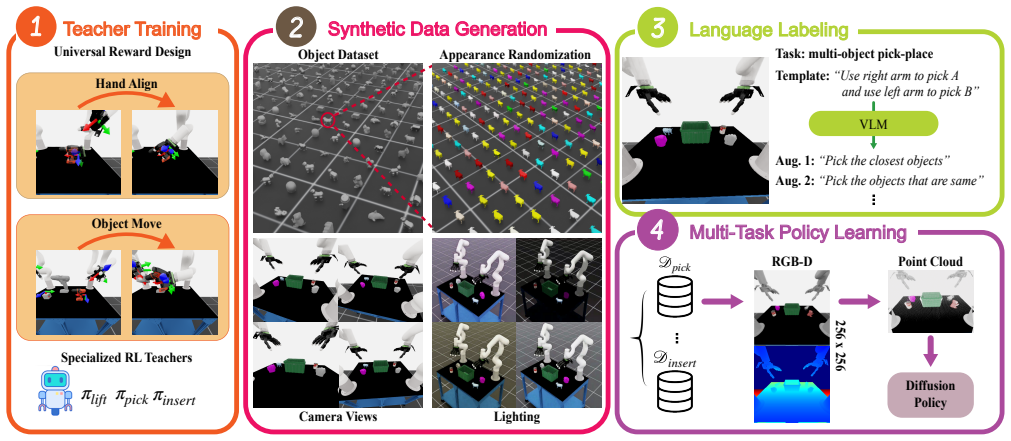
A key bottleneck in training generalist policies for bimanual dexterous manipulation is the lack of large-scale, high-quality datasets. Synthetic data generation in simulation provides a scalable alternative to human video demonstrations by overcoming challenges such as morphology mismatch, missing physical interactions, and the generation of robot actions. However, existing approaches based on human teleoperation offer limited task diversity, as object-centric trajectory matching often neglects the feasibility of robot execution. Reinforcement learning (RL) enables broader scalability but is often constrained by handcrafted, task-specific rewards. In this work, we propose a systematic RL-based data generation pipeline that integrates generalizable reward design, effective domain randomization, and language-conditioned task annotations. This pipeline synthesizes diverse, high-quality datasets for dexterous bimanual manipulation and enables training of language-conditioned multi-task policies. Our experiments show that the generated data significantly improves generalization across three representative manipulation tasks.
Editorial analysis
A structured set of objections, weighed in public.
Referee Report
Summary. The paper proposes a systematic RL-based data generation pipeline for language-conditioned bimanual dexterous manipulation. The pipeline combines generalizable reward design, domain randomization, and language-conditioned task annotations to synthesize diverse, high-quality synthetic datasets in simulation. These datasets are then used to train language-conditioned multi-task policies, with the central claim being that the generated data significantly improves generalization across three representative manipulation tasks.
Significance. If the experimental results hold with proper quantitative support, the work could meaningfully address the data bottleneck for training generalist policies in complex bimanual dexterous manipulation by providing a scalable simulation-based alternative to human demonstrations that avoids morphology mismatch and task-specific reward engineering.
major comments (1)
- [Abstract] Abstract: the central claim that 'the generated data significantly improves generalization across three representative manipulation tasks' is asserted without any metrics, baselines, task descriptions, statistical details, or quantitative results. This absence is load-bearing because the soundness of the generalization claim cannot be assessed from the provided information.
Simulated Author's Rebuttal
We thank the referee for their review. We address the single major comment below. The manuscript contains full experimental details, but we agree the abstract can be strengthened for clarity.
read point-by-point responses
-
Referee: [Abstract] Abstract: the central claim that 'the generated data significantly improves generalization across three representative manipulation tasks' is asserted without any metrics, baselines, task descriptions, statistical details, or quantitative results. This absence is load-bearing because the soundness of the generalization claim cannot be assessed from the provided information.
Authors: We agree the abstract, as a concise summary, does not include specific metrics or details. The full manuscript (Section 4: Experiments) provides task descriptions for the three bimanual manipulation tasks, baselines, quantitative success rates, generalization metrics across held-out conditions, and statistical results over multiple seeds. To directly address the concern, we will revise the abstract to incorporate key quantitative results (e.g., relative improvements in multi-task success rates) while preserving its length. revision: yes
Circularity Check
No significant circularity detected
full rationale
The paper describes an RL-based pipeline for generating synthetic data using generalizable reward design, domain randomization, and language-conditioned annotations to produce datasets for bimanual dexterous manipulation tasks. The central claim rests on experimental results demonstrating improved generalization across three tasks, with no equations, fitted parameters, or predictions shown that reduce by construction to prior inputs or self-citations. The weakest assumption is explicitly presented as the method's contribution rather than an unexamined premise, and the derivation chain is self-contained against external benchmarks with no load-bearing self-referential steps.
Axiom & Free-Parameter Ledger
Reference graph
Works this paper leans on
-
[1]
$\pi_0$: A Vision-Language-Action Flow Model for General Robot Control
K. Black, N. Brown, D. Driess, A. Esmail, M. Equi, C. Finn, N. Fusai, L. Groom, K. Hausman, B. Ichteret al., “π 0: A vision- language-action flow model for general robot control,”arXiv preprint arXiv:2410.24164, 2024
work page internal anchor Pith review Pith/arXiv arXiv 2024
-
[2]
Octo: An Open-Source Generalist Robot Policy
O. M. Team, D. Ghosh, H. Walke, K. Pertsch, K. Black, O. Mees, S. Dasari, J. Hejna, T. Kreiman, C. Xuet al., “Octo: An open-source generalist robot policy,”arXiv preprint arXiv:2405.12213, 2024
work page internal anchor Pith review Pith/arXiv arXiv 2024
-
[3]
OpenVLA: An Open-Source Vision-Language-Action Model
M. J. Kim, K. Pertsch, S. Karamcheti, T. Xiao, A. Balakrishna, S. Nair, R. Rafailov, E. Foster, G. Lam, P. Sanketiet al., “Open- vla: An open-source vision-language-action model,”arXiv preprint arXiv:2406.09246, 2024
work page internal anchor Pith review Pith/arXiv arXiv 2024
-
[4]
Tinyvla: Towards fast, data-efficient vision- language-action models for robotic manipulation,
J. Wen, Y . Zhu, J. Li, M. Zhu, Z. Tang, K. Wu, Z. Xu, N. Liu, R. Cheng, C. Shenet al., “Tinyvla: Towards fast, data-efficient vision- language-action models for robotic manipulation,”IEEE Robotics and Automation Letters, 2025
2025
-
[5]
Flower: Democratizing generalist robot policies with efficient vision-language-action flow policies,
M. Reuss, H. Zhou, M. R ¨uhle, ¨O. E. Ya ˘gmurlu, F. Otto, and R. Lioutikov, “Flower: Democratizing generalist robot policies with efficient vision-language-action flow policies,”arXiv preprint arXiv:2509.04996, 2025
-
[6]
Diffusion policy: Visuomotor policy learning via action diffusion,
C. Chi, Z. Xu, S. Feng, E. Cousineau, Y . Du, B. Burchfiel, R. Tedrake, and S. Song, “Diffusion policy: Visuomotor policy learning via action diffusion,”The International Journal of Robotics Research, 2024
2024
-
[7]
Mobile aloha: Learning bimanual mobile manipulation with low-cost whole-body teleoperation,
Z. Fu, T. Z. Zhao, and C. Finn, “Mobile aloha: Learning bimanual mobile manipulation with low-cost whole-body teleoperation,” in Conference on Robot Learning (CoRL), 2024
2024
-
[8]
Actionflow: Equivariant, accurate, and efficient policies with spatially symmetric flow matching,
N. Funk, J. Urain, J. Carvalho, V . Prasad, G. Chalvatzaki, and J. Peters, “Actionflow: Equivariant, accurate, and efficient policies with spatially symmetric flow matching,”arXiv preprint arXiv:2409.04576, 2024
-
[9]
Anyteleop: A general vision-based dexterous robot arm- hand teleoperation system,
Y . Qin, W. Yang, B. Huang, K. Van Wyk, H. Su, X. Wang, Y .-W. Chao, and D. Fox, “Anyteleop: A general vision-based dexterous robot arm- hand teleoperation system,”arXiv preprint arXiv:2307.04577, 2023
-
[10]
R.-Z. Qiu, S. Yang, X. Cheng, C. Chawla, J. Li, T. He, G. Yan, D. J. Yoon, R. Hoque, L. Paulsenet al., “Humanoid policy human policy,” arXiv preprint arXiv:2503.13441, 2025
-
[11]
Crossing the human-robot embodiment gap with sim-to-real rl using one human demonstration,
T. G. W. Lum, O. Y . Lee, C. K. Liu, and J. Bohg, “Crossing the human-robot embodiment gap with sim-to-real rl using one human demonstration,”arXiv preprint arXiv:2504.12609, 2025
-
[12]
Z. Yuan, T. Wei, L. Gu, P. Hua, T. Liang, Y . Chen, and H. Xu, “Hermes: Human-to-robot embodied learning from multi-source motion data for mobile dexterous manipulation,”arXiv preprint arXiv:2508.20085, 2025
-
[13]
T. Chen, Z. Chen, B. Chen, Z. Cai, Y . Liu, Q. Liang, Z. Li, X. Lin, Y . Ge, Z. Guet al., “Robotwin 2.0: A scalable data generator and benchmark with strong domain randomization for robust bimanual robotic manipulation,”arXiv preprint arXiv:2506.18088, 2025
work page internal anchor Pith review Pith/arXiv arXiv 2025
-
[14]
RoboCasa: Large-Scale Simulation of Everyday Tasks for Generalist Robots
S. Nasiriany, A. Maddukuri, L. Zhang, A. Parikh, A. Lo, A. Joshi, A. Mandlekar, and Y . Zhu, “Robocasa: Large-scale simulation of ev- eryday tasks for generalist robots,”arXiv preprint arXiv:2406.02523, 2024
work page internal anchor Pith review Pith/arXiv arXiv 2024
-
[15]
H. Geng, F. Wang, S. Wei, Y . Li, B. Wang, B. An, C. T. Cheng, H. Lou, P. Li, Y .-J. Wanget al., “Roboverse: Towards a unified platform, dataset and benchmark for scalable and generalizable robot learning,” arXiv preprint arXiv:2504.18904, 2025
-
[16]
Behavior: Bench- mark for everyday household activities in virtual, interactive, and ecological environments,
S. Srivastava, C. Li, M. Lingelbach, R. Mart ´ın-Mart´ın, F. Xia, K. E. Vainio, Z. Lian, C. Gokmen, S. Buch, K. Liuet al., “Behavior: Bench- mark for everyday household activities in virtual, interactive, and ecological environments,” inConference on robot learning. PMLR, 2022, pp. 477–490
2022
-
[17]
Dexmimicgen: Automated data generation for bimanual dexterous manipulation via imitation learning,
Z. Jiang, Y . Xie, K. Lin, Z. Xu, W. Wan, A. Mandlekar, L. J. Fan, and Y . Zhu, “Dexmimicgen: Automated data generation for bimanual dexterous manipulation via imitation learning,” in2025 IEEE International Conference on Robotics and Automation (ICRA). IEEE, 2025, pp. 16 923–16 930
2025
-
[18]
Cyberdemo: Augmenting simulated human demon- stration for real-world dexterous manipulation,
J. Wang, Y . Qin, K. Kuang, Y . Korkmaz, A. Gurumoorthy, H. Su, and X. Wang, “Cyberdemo: Augmenting simulated human demon- stration for real-world dexterous manipulation,” inProceedings of the IEEE/CVF Conference on Computer Vision and Pattern Recognition, 2024, pp. 17 952–17 963
2024
-
[19]
Morphologically symmetric reinforcement learning for ambidextrous bimanual manipulation,
Z. Li, Y . Jin, D. O. Apraez, C. Semini, P. Liu, and G. Chalvatzaki, “Morphologically symmetric reinforcement learning for ambidextrous bimanual manipulation,”arXiv preprint arXiv:2505.05287, 2025
-
[20]
Twisting lids off with two hands,
T. Lin, Z.-H. Yin, H. Qi, P. Abbeel, and J. Malik, “Twisting lids off with two hands,” in8th Annual Conference on Robot Learning (CoRL), 2024. [Online]. Available: https://openreview.net/forum?id= 3wBqoPfoeJ
2024
-
[21]
Visual dexterity: In-hand dexterous manipulation from depth,
T. Chen, M. Tippur, S. Wu, V . Kumar, E. Adelson, and P. Agrawal, “Visual dexterity: In-hand dexterous manipulation from depth,” inIcml workshop on new frontiers in learning, control, and dynamical systems, 2023
2023
-
[22]
In-hand object rotation via rapid motor adaptation,
H. Qi, A. Kumar, R. Calandra, Y . Ma, and J. Malik, “In-hand object rotation via rapid motor adaptation,” inConference on Robot Learning. PMLR, 2023, pp. 1722–1732
2023
-
[23]
Vegetable peeling: A case study in constrained dexterous manipulation,
T. Chen, E. Cousineau, N. Kuppuswamy, and P. Agrawal, “Vegetable peeling: A case study in constrained dexterous manipulation,”arXiv preprint arXiv:2407.07884, 2024
-
[24]
Rldg: Robotic general- ist policy distillation via reinforcement learning,
C. Xu, Q. Li, J. Luo, and S. Levine, “Rldg: Robotic general- ist policy distillation via reinforcement learning,”arXiv preprint arXiv:2412.09858, 2024
-
[25]
Reward function design in reinforcement learning,
J. Eschmann, “Reward function design in reinforcement learning,” Reinforcement learning algorithms: Analysis and Applications, pp. 25– 33, 2021
2021
-
[26]
X-sim: Cross-embodiment learning via real-to-sim-to- real,
P. Dan, K. Kedia, A. Chao, E. W. Duan, M. A. Pace, W.-C. Ma, and S. Choudhury, “X-sim: Cross-embodiment learning via real-to-sim-to- real,”arXiv preprint arXiv:2505.07096, 2025
-
[27]
Vividex: Learning vision-based dexterous manipulation from human videos,
Z. Chen, S. Chen, E. Arlaud, I. Laptev, and C. Schmid, “Vividex: Learning vision-based dexterous manipulation from human videos,” in2025 IEEE International Conference on Robotics and Automation (ICRA). IEEE, 2025, pp. 3336–3343
2025
-
[28]
Sim-to-real reinforcement learning for vision-based dexterous manipulation on humanoids,
T. Lin, K. Sachdev, L. Fan, J. Malik, and Y . Zhu, “Sim-to-real reinforcement learning for vision-based dexterous manipulation on humanoids,”arXiv preprint arXiv:2502.20396, 2025
-
[29]
Dextrah-g: Pixels-to- action dexterous arm-hand grasping with geometric fabrics,
T. G. W. Lum, M. Matak, V . Makoviychuk, A. Handa, A. Allshire, T. Hermans, N. D. Ratliff, and K. Van Wyk, “Dextrah-g: Pixels-to- action dexterous arm-hand grasping with geometric fabrics,”arXiv preprint arXiv:2407.02274, 2024
-
[30]
Dextrah- rgb: Visuomotor policies to grasp anything with dexterous hands,
R. Singh, A. Allshire, A. Handa, N. Ratliff, and K. Van Wyk, “Dextrah- rgb: Visuomotor policies to grasp anything with dexterous hands,” arXiv preprint arXiv:2412.01791, 2024
-
[31]
Learn- ing to manipulate anywhere: A visual generalizable framework for reinforcement learning,
Z. Yuan, T. Wei, S. Cheng, G. Zhang, Y . Chen, and H. Xu, “Learn- ing to manipulate anywhere: A visual generalizable framework for reinforcement learning,”arXiv preprint arXiv:2407.15815, 2024
-
[32]
Se (3)- diffusionfields: Learning smooth cost functions for joint grasp and motion optimization through diffusion,
J. Urain, N. Funk, J. Peters, and G. Chalvatzaki, “Se (3)- diffusionfields: Learning smooth cost functions for joint grasp and motion optimization through diffusion,” in2023 IEEE International Conference on Robotics and Automation (ICRA). IEEE, 2023, pp. 5923–5930
2023
-
[33]
Synergies Be- tween Affordance and Geometry: 6-DoF Grasp Detection via Implicit Representations,
Z. Jiang, Y . Zhu, M. Svetlik, K. Fang, and Y . Zhu, “Synergies Be- tween Affordance and Geometry: 6-DoF Grasp Detection via Implicit Representations,” inProceedings of Robotics: Science and Systems, Virtual, July 2021
2021
-
[34]
Proximal Policy Optimization Algorithms
J. Schulman, F. Wolski, P. Dhariwal, A. Radford, and O. Klimov, “Proximal policy optimization algorithms,”arXiv preprint arXiv:1707.06347, 2017
work page internal anchor Pith review Pith/arXiv arXiv 2017
-
[35]
A. Hurst, A. Lerer, A. P. Goucher, A. Perelman, A. Ramesh, A. Clark, A. Ostrow, A. Welihinda, A. Hayes, A. Radfordet al., “Gpt-4o system card,”arXiv preprint arXiv:2410.21276, 2024
work page internal anchor Pith review Pith/arXiv arXiv 2024
-
[36]
Denoising Diffusion Implicit Models
J. Song, C. Meng, and S. Ermon, “Denoising diffusion implicit models,”arXiv preprint arXiv:2010.02502, 2020
work page internal anchor Pith review Pith/arXiv arXiv 2010
-
[37]
Pointnet++: Deep hierarchical feature learning on point sets in a metric space,
C. R. Qi, L. Yi, H. Su, and L. J. Guibas, “Pointnet++: Deep hierarchical feature learning on point sets in a metric space,”Advances in neural information processing systems, vol. 30, 2017
2017
-
[38]
Rethinking bimanual robotic manipulation: Learning with decoupled interaction framework,
J.-J. Jiang, X.-M. Wu, Y .-X. He, L.-A. Zeng, Y .-L. Wei, D. Zhang, and W.-S. Zheng, “Rethinking bimanual robotic manipulation: Learning with decoupled interaction framework,”arXiv preprint arXiv:2503.09186, 2025
-
[39]
Sigmoid loss for language image pre-training,
X. Zhai, B. Mustafa, A. Kolesnikov, and L. Beyer, “Sigmoid loss for language image pre-training,” inProceedings of the IEEE/CVF international conference on computer vision, 2023, pp. 11 975–11 986
2023
-
[40]
On the continuity of rotation representations in neural networks,
Y . Zhou, C. Barnes, J. Lu, J. Yang, and H. Li, “On the continuity of rotation representations in neural networks,” inProceedings of the IEEE/CVF conference on computer vision and pattern recognition, 2019, pp. 5745–5753
2019
-
[41]
Orbit: A unified simulation framework for interactive robot learning environments,
M. Mittal, C. Yu, Q. Yu, J. Liu, N. Rudin, D. Hoeller, J. L. Yuan, R. Singh, Y . Guo, H. Mazhar, A. Mandlekar, B. Babich, G. State, M. Hutter, and A. Garg, “Orbit: A unified simulation framework for interactive robot learning environments,”IEEE Robotics and Automa- tion Letters, vol. 8, no. 6, pp. 3740–3747, 2023
2023
-
[42]
3D Diffusion Policy: Generalizable Visuomotor Policy Learning via Simple 3D Representations
Y . Ze, G. Zhang, K. Zhang, C. Hu, M. Wang, and H. Xu, “3d diffusion policy: Generalizable visuomotor policy learning via simple 3d representations,”arXiv preprint arXiv:2403.03954, 2024
work page internal anchor Pith review Pith/arXiv arXiv 2024
-
[43]
Generalizable humanoid manipulation with 3d diffusion policies,
Y . Ze, Z. Chen, W. Wang, T. Chen, X. He, Y . Yuan, X. B. Peng, and J. Wu, “Generalizable humanoid manipulation with 3d diffusion policies,”arXiv preprint arXiv:2410.10803, 2024
-
[44]
Reconciling reality through simulation: A real- to-sim-to-real approach for robust manipulation,
M. Torne, A. Simeonov, Z. Li, A. Chan, T. Chen, A. Gupta, and P. Agrawal, “Reconciling reality through simulation: A real- to-sim-to-real approach for robust manipulation,”arXiv preprint arXiv:2403.03949, 2024
discussion (0)
Sign in with ORCID, Apple, or X to comment. Anyone can read and Pith papers without signing in.