REVIEW 1 major objections 4 minor 347 cited by
Holistic Evaluation of Language Models
T0 review · 1 major / 4 minor · reviewed 2026-05-24 · grok-4.3
Pith's one-line read Language models are now densely benchmarked on the same 42 scenarios and 7 metrics under standardized conditions for all 30 models evaluated.
desk verdict HELM runs 30 models on a shared set of 16 scenarios and 7 metrics at 96% density with all raw outputs released, which directly improves comparability over prior scattered evaluations. read the letter →
The pith
A machine-rendered reading of the paper's core claim, the machinery that carries it, and where it could break.
The reading
What carries the argument
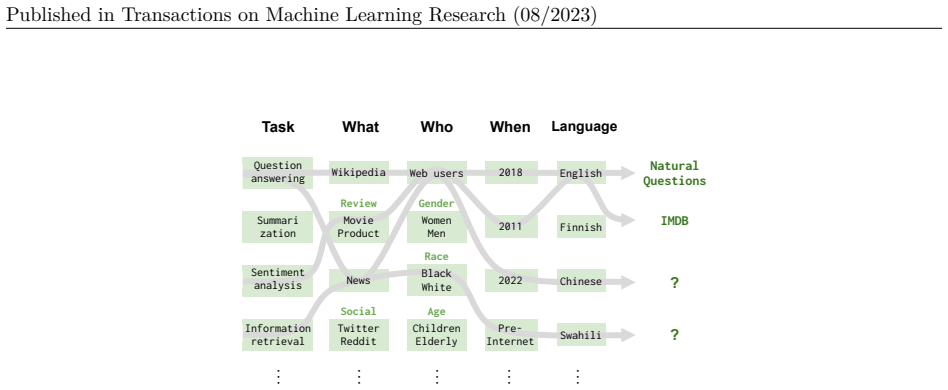
The HELM taxonomy of scenarios (use cases) and metrics (desiderata) combined with a multi-metric measurement protocol that applies accuracy plus six additional metrics to each core scenario.
What would settle it
Repeating the full set of evaluations on the same thirty models but with an alternate selection of scenarios that still meets the coverage criteria produces substantially different top-level findings or model rankings.
Extended reading notes
Core claim
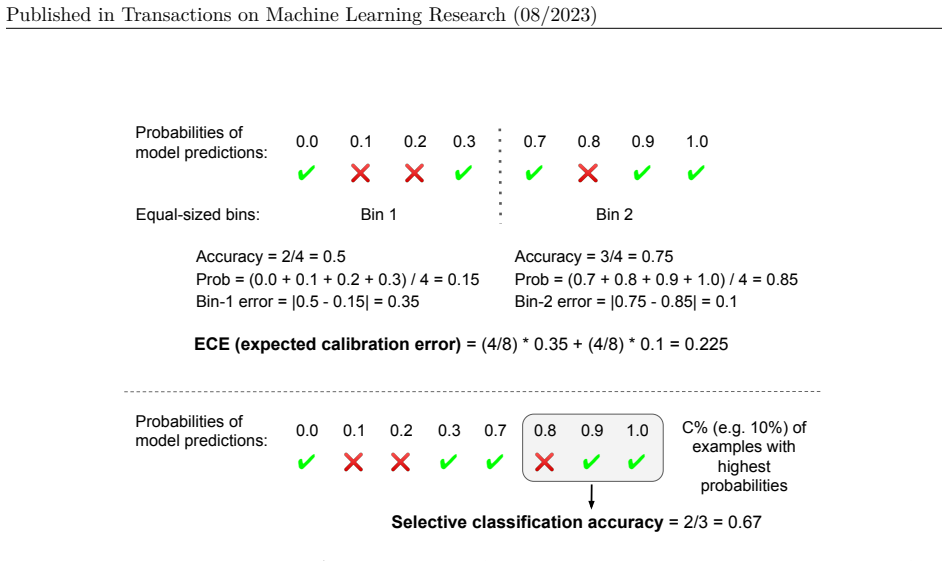
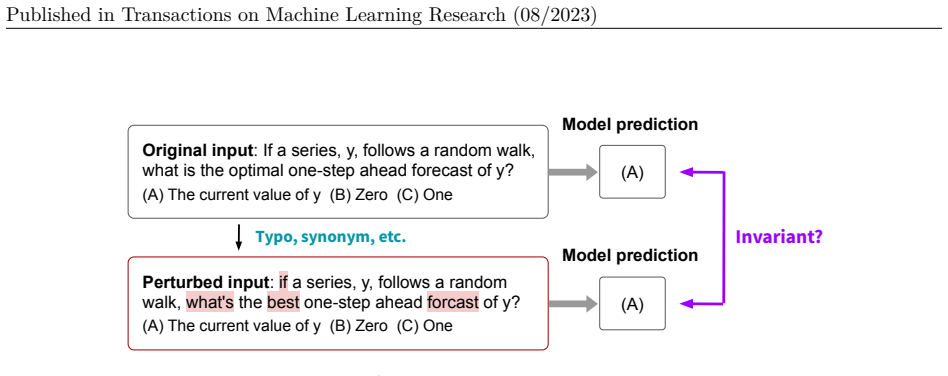
HELM taxonomizes the vast space of scenarios and metrics for language models, selects a broad subset based on coverage and feasibility while noting missing areas, adopts a multi-metric approach measuring seven metrics on sixteen core scenarios when possible, performs seven targeted evaluations, and conducts a large-scale evaluation of thirty prominent language models on all forty-two scenarios, improving coverage to 96 percent and surfacing twenty-five top-level findings, with full release of raw data and a modular toolkit.
Load-bearing premise
The chosen subset of scenarios and metrics is broad enough to give a holistic view of model capabilities, limitations, and risks even with acknowledged gaps in coverage.
Editorial extensions
If this is right
- Trade-offs across the seven metrics become visible for every model rather than accuracy alone determining perceived quality.
- All thirty models can be compared directly because they share the same core scenarios and metrics under identical conditions.
- Twenty-one previously unused scenarios enter mainstream evaluation, expanding the range of tested capabilities.
- The released raw prompts and completions enable independent further analysis by the community.
- A modular toolkit supports continuous addition of new scenarios, metrics, and models as a living benchmark.
Reading between the lines
- Developers might shift focus from maximizing accuracy to balancing multiple metrics when the standardized results show consistent trade-offs.
- The public data release could support targeted studies on specific failure modes that the top-level findings only flag.
- The approach of noting explicit gaps in the taxonomy could encourage parallel efforts to fill areas like trustworthiness metrics.
- Similar taxonomy-plus-multi-metric structures might apply to evaluating other foundation models beyond language.
Signed reviews
Editorial analysis
A structured set of objections, weighed in public.
Referee Report
Summary. The paper introduces HELM, a framework for holistic evaluation of language models. It first taxonomizes the space of scenarios (use cases) and metrics (desiderata), then selects a feasible subset of 16 core scenarios and 7 metrics (accuracy, calibration, robustness, fairness, bias, toxicity, efficiency) for multi-metric evaluation (achieved 87.5% of the time). It evaluates 30 models (open, limited-access, closed) on these plus 26 targeted scenarios, achieving 96% dense coverage on the core set (up from prior average of 17.9%), surfaces 25 top-level findings, and releases all raw prompts, completions, and a modular toolkit.
Significance. If the results hold, this provides a substantial advance in standardized, multi-metric LM evaluation that exposes trade-offs and improves transparency over prior fragmented benchmarks. Explicit credit is due for the public release of raw model outputs and the modular toolkit, which directly support reproducibility and community extensions. The documented gaps (e.g., QA for neglected dialects, trustworthiness metrics) and the 96% coverage claim are presented as concrete improvements rather than exhaustive holism.
major comments (1)
- [evaluation section / abstract] The central coverage claim (96.0% on 16 core scenarios across all 30 models) is a direct measurement and load-bearing for the contribution, but the manuscript should clarify in the evaluation section how the prior 17.9% average was computed (e.g., which models and scenarios were included in the baseline calculation) to allow readers to assess the improvement magnitude.
minor comments (4)
- [abstract] Abstract: the 87.5% multi-metric figure is stated without noting it corresponds to 14 out of 16 scenarios; adding this parenthetical would improve immediate clarity.
- [abstract / introduction] The 25 top-level findings are referenced but not summarized or enumerated in the abstract or introduction; a concise bullet list or table reference would help readers locate the key outputs.
- [taxonomy section] Notation for scenarios and metrics is introduced in the taxonomy section but could benefit from a single consolidated table early in the paper to reduce cross-referencing.
- [targeted evaluations section] The targeted evaluations (7 evaluations on 26 scenarios) are described at a high level; a brief table mapping each targeted evaluation to its scenarios and metrics would aid navigation.
Simulated Author's Rebuttal
We thank the referee for their positive assessment and recommendation for minor revision. We address the major comment below.
read point-by-point responses
-
Referee: [evaluation section / abstract] The central coverage claim (96.0% on 16 core scenarios across all 30 models) is a direct measurement and load-bearing for the contribution, but the manuscript should clarify in the evaluation section how the prior 17.9% average was computed (e.g., which models and scenarios were included in the baseline calculation) to allow readers to assess the improvement magnitude.
Authors: We agree that providing more detail on the baseline would improve clarity. The 17.9% average was computed by surveying the published evaluations of the 30 models against the 16 core scenarios prior to HELM (i.e., counting how many of the 16 scenarios each model had been evaluated on in the literature, then averaging). In the revised manuscript we will add an explicit paragraph in the evaluation section describing this survey methodology, the sources consulted, and the per-model counts that underlie the average. revision: yes
Circularity Check
No significant circularity identified
full rationale
The paper's central claims consist of (1) a taxonomy and feasibility-based selection of scenarios/metrics with explicit documentation of gaps, (2) direct empirical measurements of 7 metrics across 16 core scenarios for 30 models, and (3) descriptive coverage statistics (e.g., prior 17.9% to 96.0% dense benchmarking). These are factual outputs of running the evaluations under standardized conditions, not quantities derived from or fitted to the results themselves. No equations, parameter fitting, self-citation chains, or uniqueness theorems appear in the derivation; the 25 findings are reported measurements rather than premises. The selection process is presented as an improvement over prior fragmentation with acknowledged incompleteness, rendering the evaluation self-contained against external benchmarks.
Assumptions & free parameters
free parameters (2)
- Choice of 16 core scenarios
- Choice of 7 metrics
assumptions (1)
- domain assumption Standardized evaluation conditions produce comparable and meaningful metric values across open, limited-access, and closed models.
Cite this review
Pith. "Pith review of Holistic Evaluation of Language Models." pith.science (2026). https://pith.science/paper/4PQYXXNT
@misc{pith2026221109110,
  author       = {Pith},
  title        = {Pith review of: Holistic Evaluation of Language Models},
  year         = {2026},
  howpublished = {\url{https://pith.science/paper/4PQYXXNT}},
  note         = {Machine review of arXiv:2211.09110}
}
read the original abstract
Language models (LMs) are becoming the foundation for almost all major language technologies, but their capabilities, limitations, and risks are not well understood. We present Holistic Evaluation of Language Models (HELM) to improve the transparency of language models. First, we taxonomize the vast space of potential scenarios (i.e. use cases) and metrics (i.e. desiderata) that are of interest for LMs. Then we select a broad subset based on coverage and feasibility, noting what's missing or underrepresented (e.g. question answering for neglected English dialects, metrics for trustworthiness). Second, we adopt a multi-metric approach: We measure 7 metrics (accuracy, calibration, robustness, fairness, bias, toxicity, and efficiency) for each of 16 core scenarios when possible (87.5% of the time). This ensures metrics beyond accuracy don't fall to the wayside, and that trade-offs are clearly exposed. We also perform 7 targeted evaluations, based on 26 targeted scenarios, to analyze specific aspects (e.g. reasoning, disinformation). Third, we conduct a large-scale evaluation of 30 prominent language models (spanning open, limited-access, and closed models) on all 42 scenarios, 21 of which were not previously used in mainstream LM evaluation. Prior to HELM, models on average were evaluated on just 17.9% of the core HELM scenarios, with some prominent models not sharing a single scenario in common. We improve this to 96.0%: now all 30 models have been densely benchmarked on the same core scenarios and metrics under standardized conditions. Our evaluation surfaces 25 top-level findings. For full transparency, we release all raw model prompts and completions publicly for further analysis, as well as a general modular toolkit. We intend for HELM to be a living benchmark for the community, continuously updated with new scenarios, metrics, and models.
Figures


Figures from the paper (33 more)













Forward citations
Showing 60 of 347 Pith papers that cite this
-
A Pre-Registered Causal Partition of Self-Consistency Elicitation and Reward Design in RLVR
Derives an exact telescoping decomposition of the naive RLVR reward-design estimator into null, elicitation, and reward-design terms on a tabular-GRPO simulator, measures the components across prior strengths, and val...
-
Unsteady Metrics and Benchmarking Cultures of AI Model Builders
AI model builders mostly highlight unique benchmarks that act as flexible narrative tools for market positioning rather than standardized scientific measurements.
-
EnergyAgentBench: Benchmarking LLM Agents on Live Energy Infrastructure Data
EnergyAgentBench is a new benchmark with 70 task variants that evaluates LLM agents on live energy data for datacenter siting, long-horizon optimization, and causal grid diagnosis.
-
A Benchmark for Strategic Auditee Gaming Under Continuous Compliance Monitoring
Continuous compliance auditing is modeled as a T-round Stackelberg game in which static auditors face a provable coverage-versus-granularity trade-off, demonstrated with a simulator and five gaming strategies.
-
DF3DV-1K: A Large-Scale Dataset and Benchmark for Distractor-Free Novel View Synthesis
DF3DV-1K supplies 1,048 scenes with clean and cluttered image pairs plus a challenging 41-scene subset to benchmark and improve distractor-free radiance field methods.
-
MCP-Atlas: A Large-Scale Benchmark for Tool-Use Competency with Real MCP Servers
MCP-Atlas is a new benchmark with 1000 tasks on production MCP servers that uses claim-level scoring to evaluate LLM agents on realistic multi-step tool-use competency.
-
TRACES: A Benchmark for Epistemic Reliability in Scientific Reasoning by LLMs
TRACES probes 30 LLMs with 42 unreliable papers and finds that models design follow-up studies for impossible premises in 93% of agentic attempts and 81% of interactive attempts.
-
Actions Speak Louder than Words: Measuring Cross-Lingual Policy Retention in Tool-Using Agents
With five confounds corrected, four frontier tool-using models keep 71-73% of their action-policy consistency when the language changes, and the apparent small-model ordering is largely a chance-floor artifact.
-
Harmful Content Is Not Enough: Continuation Framing Moderates In-Context Emergent Misalignment
With harmful answer text held fixed, demonstration framing raises broad emergent misalignment by 30 to 32 percentage points over document framing on Gemini 3.1, and message role further modulates the effect on Grok.
-
L2-Bench: An Evaluation Benchmark for Measuring LLM Capabilities in Second Language Education
L2-Bench provides a 1,000-task, expert-validated rubric benchmark showing that frontier LLMs score 50–86% on applied second-language learning-design competencies, with notable weakness on open-ended tasks.
-
Meta-Benchmarks for Financial-Services LLM Evaluation
A meta-benchmarking framework organizes 452 LLM benchmarks into 41 O*NET Generalized Work Activities and 38 BIAN domains, using discrimination-coverage-recency weights to scale K-factors in an Elo tournament for compa...
-
CLQT: A Closed-Loop, Cost-Aware, Strategy-Consistent Benchmark for Diagnostic Evaluation of LLM Portfolio-Management Agents
CLQT is a new closed-loop, cost-aware benchmark that diagnoses LLM trading agent capabilities through strategy-consistent metrics and hash-verifiable trails rather than outcome rankings.
-
BehaviorBench: Benchmarking Foundation Models for Behavioral Science Tasks
BehaviorBench is a benchmark for foundation models on behavioral tasks that reveals fine-tuned behavioral models outperform general models on distributional alignment while general models lead on individual-level accuracy.
-
EnterpriseClawBench: Benchmarking Agents from Real Workplace Sessions
EnterpriseClawBench is a benchmark for enterprise agents constructed from proprietary real-world sessions, with the reusable contribution being the construction and evaluation protocol rather than the data itself.
-
Beyond Goodhart's Law: A Dynamic Benchmark for Evaluating Compliance in Multi-Agent Systems
MAC-Bench is a new adversarial benchmark that converts legal texts into executable scenarios via the SERV pipeline to measure procedural compliance in multi-agent LLM systems using CSR and MG metrics.
-
Invariant Gradient Alignment for Robust Reasoning Distillation
Invariant Gradient Alignment uses Logical Isomer Sets and a Continuous Gradient Conflict Mask to tighten OOD generalization bounds and boost empirical performance over ERM in reasoning distillation.
-
Toward Calibrated, Fair, and accurate Deepfake Detection
Face-Feature Tuning is a label-free logit remapping method that reduces FPR/TPR gaps across groups in deepfake detection while preserving overall accuracy.
-
RealClawBench: Live OpenClaw Benchmarks from Real Developer-Agent Sessions
RealClawBench turns 281 real OpenClaw sessions into reproducible tasks that preserve the original distribution and shows the best of 14 models solves only 65.8 percent.
-
OR-Space: A Full-Lifecycle Workspace Benchmark for Industrial Optimization Agents
OR-Space is a benchmark for LLM agents performing full-lifecycle optimization tasks across Build, Revise, and Explain modes in executable multi-artifact workspaces.
-
SiDP: Memory-Efficient Data Parallelism for Offline LLM Inference
SiDP distributes model weights across a DP group with WaS and CaS modes to increase KV cache capacity by up to 1.8x and end-to-end throughput by up to 1.5x over vLLM on H20/H200/B200 GPUs for offline LLM inference.
-
When Context Flips, Safety Breaks: Diagnosing Brittle Safety in Aligned Language Models
Language models display brittle safety by failing to adapt when context flips reverse action safety, with standard guardrails blind to consequence-flip scenarios.
-
Robotics-Inspired Guardrails for Foundation Models in Socially Sensitive Domains
Introduces the Grounded Observer framework that applies robotics-inspired formal constructs for runtime constraint enforcement on foundation model interaction trajectories in socially sensitive domains.
-
GRASP: Deterministic argument ranking in interaction graphs
GRASP aggregates stable local LLM interaction judgments into global argument rankings via a convergent attack-defense propagation operator on interaction graphs, yielding higher reproducibility than holistic judging a...
-
SpikeProphecy: A Large-Scale Benchmark for Autoregressive Neural Population Forecasting
SpikeProphecy decomposes spike-count forecasting performance into temporal fidelity, spatial pattern accuracy, and magnitude-invariant alignment, revealing reproducible brain-region predictability rankings and a sub-P...
-
Causal Bias Detection in Generative Artificial Intelligence
Develops a causal framework unifying generative AI fairness with standard ML, with new decompositions, identification conditions, and estimators demonstrated on LLM race and gender bias.
-
HEBATRON: A Hebrew-Specialized Open-Weight Mixture-of-Experts Language Model
Hebatron is the first open-weight Hebrew MoE LLM adapted from Nemotron-3, reaching 73.8% on Hebrew reasoning benchmarks while activating only 3B parameters per pass and supporting 65k-token context.
-
Causal Stories from Sensor Traces: Auditing Epistemic Overreach in LLM-Generated Personal Sensing Explanations
LLMs routinely produce unsupported causal stories for personal sensing anomalies, and richer evidence or constrained prompts do not reliably eliminate this epistemic overreach.
-
LLMSpace: Carbon Footprint Modeling for Large Language Model Inference on LEO Satellites
LLMSpace is the first modeling framework that jointly calculates operational and embodied carbon emissions for LLM inference on LEO satellites, incorporating radiation-hardened hardware, peripheral systems, and LLM wo...
-
The Partial Testimony of Logs: Evaluation of Language Model Generation under Confounded Model Choice
An identification theorem shows that a randomized experiment and simulator together recover causal model values from confounded logs, with logs used only afterward to reduce estimation error.
-
TRIP-Evaluate: An Open Multimodal Benchmark for Evaluating Large Models in Transportation
TRIP-Evaluate is a new open multimodal benchmark with 837 text, image, and point-cloud items organized by a role-task-knowledge taxonomy to evaluate large models on transportation workflows.
-
SPASM: Stable Persona-driven Agent Simulation for Multi-turn Dialogue Generation
SPASM introduces a stability-first framework with Egocentric Context Projection to maintain consistent personas and eliminate echoing in multi-turn LLM agent dialogues.
-
An Agentic Evaluation Architecture for Historical Bias Detection in Educational Textbooks
An agentic architecture with multimodal screening, a five-agent jury, meta-synthesis, and source attribution protocol detects biases in Romanian history textbooks more accurately than zero-shot baselines, achieving 83...
-
Dynamics of Learning under User Choice: Overspecialization and Peer-Model Probing
In competitive ML markets, standard gradient training can drive learners into overspecialized equilibria with arbitrarily poor global performance; a proposed 'peer probing' algorithm provably escapes this under inform...
-
PlotChain: Deterministic Checkpointed Evaluation of Multimodal LLMs on Engineering Plot Reading
PlotChain benchmark reports top MLLMs reaching ~80% field-level accuracy on engineering plot reading under human-like tolerances, but with persistent failures on frequency-domain tasks like bandpass and FFT spectra.
-
Results-Actionability Gap: Understanding How Practitioners Evaluate LLM Products in the Wild
Qualitative study of 19 practitioners reveals ten LLM product evaluation practices and introduces the results-actionability gap as a key barrier to turning findings into improvements.
-
Automatic Replication of LLM Mistakes in Medical Conversations
MedMistake automatically generates 3,390 single-shot QA pairs capturing LLM mistakes in medical conversations, with expert validation on a 211-question subset showing performance differences among 12 frontier models.
-
Classification Trees with Valid Inference via the Exponential Mechanism
Classification trees built with the exponential mechanism generate asymptotically valid inference pivots from sampling probabilities without major accuracy loss.
-
UQ: Assessing Language Models on Unsolved Questions
Unsolved Stack Exchange questions can serve as a dynamic benchmark: the best tested model passes validator screening on only 15% of 500 questions.
-
Systematic Evaluation of Knowledge Graph Repair with Large Language Models
A systematic VIO-based framework generates SHACL-violating graph test cases and shows that LLM repair systems perform best with concise, violation-focused prompts.
-
Identifying Fine-grained Forms of Populism in Political Discourse: A Case Study on Donald Trump's Presidential Campaigns
New sentence-level populism datasets and benchmarks show fine-tuned RoBERTa outperforms instruction-tuned LLMs in-domain, while LLMs are more robust out-of-domain.
-
Metritocracy: Representative Metrics for Lite Benchmarks
Defines positional representation and positional proportionality for metric subset selection, with nearly tight worst-case bounds, greedy algorithms, and case studies on LLM and hospital benchmarks.
-
The NordDRG AI Benchmark for Large Language Models
The paper releases the first public, rule-complete benchmark for LLM reasoning over NordDRG hospital payment logic, with top models scoring 13/13 on logic tasks and 7/13 on full grouper emulation.
-
Cross-Entropy Games for Language Models: From Implicit Knowledge to General Capability Measures
Xent Games formalize a large family of LLM evaluation tasks as games whose rewards and constraints are signed cross-entropy sums, and propose using them to build general capability measures.
-
SAGE-Eval: Evaluating LLMs for Systematic Generalizations of Safety Facts
Frontier LLMs pass fewer than 58% of systematically varied safety-fact scenarios, revealing weak generalization of critical safety knowledge to naive user queries.
-
Rethinking Predictive Modeling for LLM Routing: When Simple kNN Beats Complex Learned Routers
A well-tuned kNN router matches or exceeds state-of-the-art learned routers on new standardized benchmarks spanning instruction, QA, reasoning, and the first multi-modal visual routing dataset, due to locality of mode...
-
PRIMETIME : Limits of LLMs in Temporal Primitives
PRIMETIME generator reveals that LLM datetime parsing and arithmetic primitives are individually unreliable but fully learnable via fine-tuning, enabling frontier-level accuracy on event planning with small LoRA models.
-
Evaluation of LLM Vulnerabilities to Being Misused for Personalized Disinformation Generation
Most tested LLMs produced well-personalized disinformation, personalization requests slightly reduced safety-filter refusals, and personalized texts were slightly less detectable.
-
From Jack of All Trades to Master of One: Specializing LLM-based Autoraters to a Test Set
Using per-example in-context demonstrations built from historical same-source human MQM ratings makes an LLM judge dramatically better at fine-grained MT evaluation on WMT'23 and WMT'24.
-
GAIA: a benchmark for General AI Assistants
GAIA benchmark shows humans at 92% accuracy on simple real-world questions far outperform current AI systems at 15%, proposing this gap as a key milestone for general AI.
-
QLoRA: Efficient Finetuning of Quantized LLMs
QLoRA finetunes 4-bit quantized LLMs via LoRA adapters to match full-precision performance while using far less memory, enabling 65B-scale training on single GPUs and producing Guanaco models near ChatGPT level.
-
Language Models Don't Always Say What They Think: Unfaithful Explanations in Chain-of-Thought Prompting
Chain-of-thought explanations in LLMs are frequently unfaithful: models systematically omit mention of biasing prompt features that change their answers and instead produce rationalizations for those biased outputs.
-
Beyond Correctness: Benchmarking and Aligning Response Behaviors in Hybrid-Thinking MLLMs
Fast non-thinking inference in hybrid-thinking MLLMs produces far more response-pattern failures (CoT leakage, repetition, contradiction, performative reasoning) than thinking inference, and PatternRL reduces this gap...
-
The Wording Effect: Quantifying Two-Way Drift in LLM Benchmark Performance
Meaning-preserving rephrasing of benchmark problems flips model answers in both directions, and the net loss is larger for stronger models.
-
Deployment Decision Reliability: A Generalizability-Theory Framework for Sizing Long-Horizon Agent Evaluations
Across three enterprise agent benchmarks, agent main effects are under 3% of total score variance, so leaderboard order reflects task specialization rather than a general capability advantage.
-
Mapping and Measuring the Behavioral Evolution of Large Language Models
A label-free behavioral map of 32 LLMs shows stable family clusters, gpt-2 as a global outlier, and decreasing cross-family distances over time; a token-level MMD check and three alternative encoders reproduce the patterns.
-
Self-evolving Agentic Customer Support System at LinkedIn
A production customer-support agent that continuously evolves its prompts and retrieval in a closed evaluation loop improved live self-serve resolution and routing accuracy at LinkedIn.
-
Science Edge Evaluation: SEE the Missing Step Toward Real Scientific Discovery
A new expert-curated multimodal benchmark, SEE, shows the strongest AI models answer fewer than half of real-lab science questions correctly, and tool access brings only small gains.
-
Visual Grounding in Zero-Shot Vision-Language Control
Input-ablation tests show most current VLMs are not visually grounded controllers, though a small symmetry-consensus ensemble works as a hazard monitor.
-
Validity, Reliability, and Transparency in Artificial Intelligence Regulation
Validity of inference should be a gating precondition for AI deployment approval and proportionality assessment, alongside domain-based risk tiers.
-
When Memory Lies: An Empirical Study of Spatial Memory Staleness in VLM Agents
Spatial-memory staleness is a measurable safety failure for VLM agents: stale memory increases deaths, and visual auditing of stale entries is highly model-dependent.
Reference graph
Works this paper leans on
-
[1]
Language Models are Few-Shot Learners
Association for Computational Linguistics. doi: 10.18653/v1/2021.naacl-main.385. URL https: //www.aclweb.org/anthology/2021.naacl-main.385. Tom B. Brown, Benjamin Mann, Nick Ryder, Melanie Subbiah, Jared Kaplan, Prafulla Dhariwal, Arvind Neelakantan, Pranav Shyam, Girish Sastry, Amanda Askell, Sandhini Agarwal, Ariel Herbert-Voss, Gretchen Krueger, Tom He...
work page Pith review arXiv doi:10.18653/v1/2021.naacl-main.385 2021
-
[2]
doi: 10.18653/v1/2021.acl-long.150
Association for Computational Linguistics. doi: 10.18653/v1/2021.acl-long.150. URL https: //aclanthology.org/2021.acl-long.150. Frieda Goldman-Eisler. Speech production and the predictability of words in context.Quarterly Journal of Experimental Psychology, 10(2):96–106, 1958. doi: 10.1080/17470215808416261. URLhttps://doi.org/ 10.1080/17470215808416261. ...
-
[3]
URLhttps://glottolog.org/accessed2021-08-08
doi: 10.5281/zenodo.4761960. URLhttps://glottolog.org/accessed2021-08-08. Yiding Hao, William Merrill, Dana Angluin, Robert Frank, Noah Amsel, Andrew Benz, and Simon Mendel- sohn. Context-free transductions with neural stacks.EMNLP 2018, pp. 306, 2018. Gilbert Harman. Rationality. John Wiley & Sons, Ltd, 2013. Junxian He, Chunting Zhou, Xuezhe Ma, Taylor ...
-
[4]
Measuring Coding Challenge Competence With APPS
URL https://openreview.net/forum?id=0RDcd5Axok. Pengcheng He, Xiaodong Liu, Jianfeng Gao, and Weizhu Chen. {DEBERTA}: {DECODING}-{enhanced} {bert} {with} {disentangled} {attention}. InInternational Conference on Learning Representations, 2021. URL https://openreview.net/forum?id=XPZIaotutsD. 95 Published in Transactions on Machine Learning Research (08/20...
work page Pith review arXiv doi:10.18653/v1/2021.eacl-main.225 2021
-
[5]
URL https://www.oxfordhandbooks.com/view/10.1093/oxfordhb/9780199286546.001.0001/ oxfordhb-9780199286546-e-6. Abigail Z. Jacobs and Hanna Wallach. Measurement and fairness. InProceedings of the 2021 Conference on Fairness, Accountability, and Transparency, FAccT ’21, New York, NY, USA, 2021. Association for Computing Machinery. URLhttps://arxiv.org/abs/19...
-
[6]
doi: https://doi.org/10.1016/j.cognition.2007.05.006. URL https://www.sciencedirect.com/ science/article/pii/S0010027707001436. Mike Lewis, Yinhan Liu, Naman Goyal, Marjan Ghazvininejad, Abdelrahman Mohamed, Omer Levy, Ves Stoyanov, and Luke Zettlemoyer. Bart: Denoising sequence-to-sequence pre-training for natural language generation, translation, and co...
-
[7]
The Natural Language Decathlon: Multitask Learning as Question Answering
doi: 10.2466/pr0.1957.3.3.635. URLhttps://doi.org/10.2466/pr0.1957.3.3.635. Floyd G. Lounsburg. Transitional probability, linguistic structure and systems of habitfamily hierarchies. Psycholinguistics: a survey of theory and research, 1954. Henry P. Luhn. The automatic creation of literature abstracts.IBM Journal of Research and Development, 2:159–165, 19...
work page Pith review arXiv doi:10.2466/pr0.1957.3.3.635 1957
-
[8]
Red Teaming Language Models with Language Models
ISSN 2474-7394. URL https://online.ucpress.edu/collabra/article/7/1/25293/117809/ A-Practical-Guide-to-Doing-Behavioral-Research-on . 25293. Ethan Perez, Douwe Kiela, and Kyunghyun Cho. True few-shot learning with language models. In M. Ran- zato, A. Beygelzimer, Y. Dauphin, P.S. Liang, and J. Wortman Vaughan (eds.),Advances in Neural Information Processi...
work page Pith review arXiv 2021
Show all 21 references
-
[9]
URLhttps://www.aclweb.org/anthology/P19-1101
Association for Computational Linguistics. URLhttps://www.aclweb.org/anthology/P19-1101. Geoff Pleiss, Manish Raghavan, Felix Wu, Jon Kleinberg, and Kilian Q. Weinberger. On fairness and calibration. In Advances in Neural Information Processing Systems (NeurIPS), pp. 5684–5693...
-
[10]
URLhttps://arxiv.org/abs/2211.05100
doi: 10.48550/ARXIV.2211.05100. URLhttps://arxiv.org/abs/2211.05100. Anna Schmidt and Michael Wiegand. A survey on hate speech detection using natural language processing. In Proceedings of the Fifth International Workshop on Natural Language Processing for Social Media, pp. 1...
-
[11]
Yes” or “No
doi: 10.1145/2460276.2460278. URLhttp://doi.acm.org/10.1145/2460276.2460278. Christian Szegedy, Wojciech Zaremba, Ilya Sutskever, Joan Bruna, Dumitru Erhan, Ian Goodfellow, and Rob Fergus. Intriguing properties of neural networks. InInternational Conference on Learning Represe...
2014 doi
-
[12]
Dialect Perturbation: We currently support conversions between Standard American English (SAE) and African American English (AAE) using the mapping between lexical terms provided by Ziems et al. (2022)
2022
-
[13]
Gender Pronoun Perturbation: We support conversions between the gender neutral and gendered pronouns from Lauscher et al. (2022)
2022
-
[14]
Grandfather
Gender Term Perturbation: We convert gender terms of a source gender (e.g. “Grandfather”) to their counterparts in a target gender (e.g. “Grandmother”). We build our mapping by improving the union of the mappings from Garg et al. (2018) and Bolukbasi et al. (2016)
2018
-
[15]
(2017), which derives its list form Greenwald et al
FirstNamePerturbation: Weconvertfirstnamesinasourceraceorgendertothoseinthetargetrace or gender, using the names from Caliskan et al. (2017), which derives its list form Greenwald et al. (1998). The associations between demographic category and name are derived from US Census ...
2017
-
[16]
(2018), which derives its list form Chalabi & Flowers (2017)
Last Name Perturbation: We convert last names in a source race to those in the target race, using the last names from Garg et al. (2018), which derives its list form Chalabi & Flowers (2017). See the above discussion of the relationship between names and demographic informatio...
2018
-
[17]
It came from down here
subset of the scenario looks like: “It came from down here.” “What were you thinking bringing a stranger here?” “... look out for herself.” “I wouldn’t be alive if it wasn’t for her.” “Yeah, well, I’m protecting you now.” The textual output of a language model should be the sa...
2020
-
[18]
markup for the text itself,
-
[19]
parenthetical annotations provided by the authors, and 143 Published in Transactions on Machine Learning Research (08/2023)
2023
-
[20]
The capital of France is __
speaker tags for the spoken texts. Tags in the first category are removed with the enclosed text intact; tags in the second category are removed along with the enclosed text; and speaker tags are left as-is. The final preprocessed texts average 2046 tokens using the GPT-2 toke...
-
[21]
beach + beach−pear′′. In this case, we see that the pattern “A+A-B
B+-A, 144 Published in Transactions on Machine Learning Research (08/2023) Relation IDRelation Name PromptArtP136 genre The genre of [X] is a/anP1303 instrument The musical instrument [X] plays isP50 author The author of [X] isP170 creator The creator of [X] isP86 composer The...
2023 arXiv
Reviewed May 24, 2026 · model on record in the stance chip above.
Discussion (0). Continue with ORCID to comment.