REVIEW 4 major objections 5 minor 1 cited by
Data require weak-gravity effects to be confined to scales below roughly 30 Mpc.
Reviewed by Pith at T0; open to challenge. T0 means a machine referee read the full paper against a public rubric. the ladder, T0–T4 →
T0 review · deepseek-v4-flash
2026-08-02 13:24 UTC pith:OS3SCH6E
load-bearing objection A new constraint on the MG cutoff scale (λ_c ≲ 30 Mpc) that is worth taking seriously, but the abstract's numbers don't match the body, and the headline preference rests on 15 RSD points treated as independent without covariance. the 4 major comments →
Signatures of Modified Gravity on Linear Scales in a Dynamical Dark Energy Background
The pith
A machine-rendered reading of the paper's core claim, the machinery that carries it, and where it could break.
Core claim
The central claim is that the suppression of structure growth below z≈1 required by redshift-space distortion data can be explained by a scale-dependent effective gravitational coupling that is weaker than Newton's constant at late times, provided the deviation operates only on comoving scales below λ_c ≈ O(10) Mpc. On larger scales the coupling must return to the general-relativistic value, otherwise the CMB temperature power spectrum at low multipoles (via the late-time ISW effect) and the damping of acoustic peaks (via gravitational lensing) would be altered too much. The best-fit critical wavelength is around tens of Mpc, with a 95% upper limit near 28.8 Mpc. Including these modified-gra
What carries the argument
The key object is the binning function µ(z,k) that rescales the effective gravitational coupling, G_eff = µ(k,a) G, in the modified Poisson equation. It takes three redshift bins (µ1 for 0≤z<1, µ2 for 1<z≤3, and 1 beyond) smoothed with hyperbolic tangents, and multiplies the deviation from GR by the scale factor k²λ_c²/(1+k²λ_c²), so that µ→1 at large wavelengths. This scale cut-off is what allows a growth suppression at small scales without spoiling CMB ISW and lensing constraints.
Load-bearing premise
The conclusion rests on assuming the low-redshift growth measurements are accurate, independent, and free of systematic bias; if they are systematically low, the modified-gravity signal vanishes.
What would settle it
A single high-precision measurement of fσ12 at z≈0.5, from an independent survey with total uncertainty below 0.02, that agrees with the ΛCDM prediction would falsify the modified-gravity interpretation: the model's χ² to RSD would no longer improve, and the posterior for µ1 would return to 1. Equivalently, a re-analysis of the existing low-z RSD points that accounts for their correlations and survey-specific systematics and finds no net growth deficit would remove the drive toward µ1<1.
If this is right
- If the signal is real, modified gravity or any alternative with a weaker effective coupling below z≈1 must be a short-range effect, confined to scales below roughly 30 Mpc, placing it squarely in the regime probed by galaxy clustering.
- The preferred scale is about an order of magnitude smaller than the 100 Mpc cut-off used in some full-shape clustering analyses, meaning those analyses may be averaging away the interesting signature.
- The combination of dynamical dark energy plus scale-dependent modified gravity is preferred over ΛCDM at the 2.6σ level even after penalizing extra parameters; the inclusion of MG strengthens, rather than dilutes, the evidence for new physics.
- The high-redshift bin parameter µ2 stays consistent with general relativity, so any departure is a low-redshift, small-scale phenomenon.
- Consistency with the CMB forces the transition to GR above λ_c; hence the scale λ_c is pinned by both the low-ℓ ISW and high-ℓ lensing, not by growth data alone.
Where Pith is reading between the lines
- If the scale-dependence is interpreted as the reach of a fifth force, λ_c ≈ 10-30 Mpc suggests a force range of that order, intriguingly close to the scales where cosmic acceleration and screening mechanisms operate; the authors do not propose a specific theory, but symmetron or transient weak-gravity models could naturally produce such a scale.
- Because the effect is confined to scales below ~30 Mpc, where non-linear structure formation is already significant, the linear-theory treatment used here likely underestimates the required deviation; testing with N-body simulations or higher-order statistics could sharpen the constraints.
- The result hinges on the low-z RSD measurements; a future independent measurement of fσ12 at z≈0.5 with a different survey and a careful covariance treatment would either confirm the µ1<1 preference or reveal a systematics floor in the current compilation.
Editorial analysis
A structured set of objections, weighed in public.
Referee Report
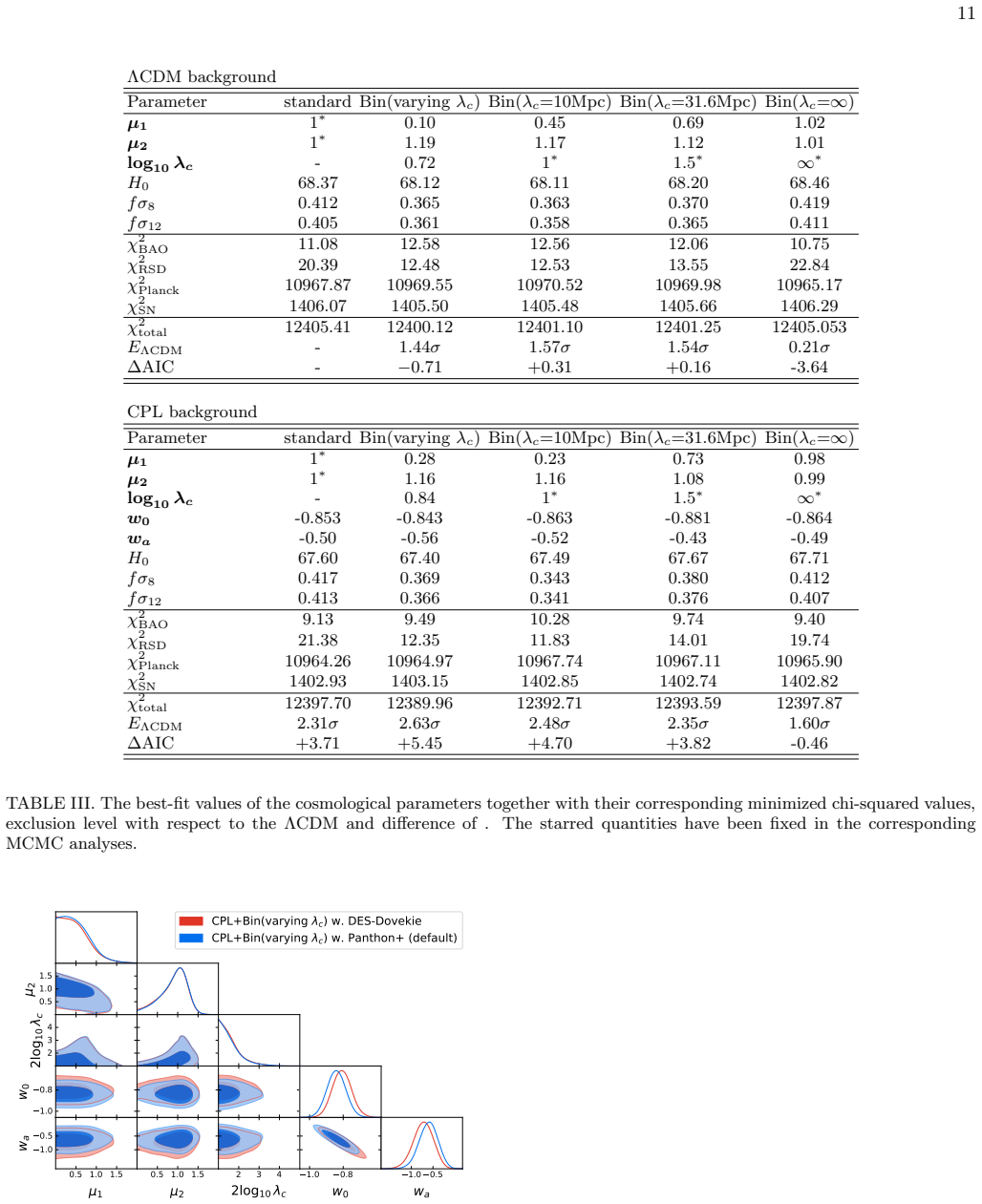
Summary. This Letter extends the CPL dynamical-dark-energy parametrization with a scale- and redshift-dependent effective gravitational coupling, μ(k,z), written as a tanh-smoothed step function in redshift times k²λ_c²/(1+k²λ_c²). The authors use MGCAMB+Cobaya to fit this model to Planck PR4, DESI DR2 BAO, Pantheon+ (or DES-Dovekie) supernovae, and 15 fσ12 RSD points. They find μ1<1 at z<1 and a 95% upper bound λ_c<28.84 Mpc for the ΛCDM background, slightly tighter for the CPL background. Adding the scale-dependent MG improves the fit: in the CPL+Bin(varying λ_c) case Δχ²_total=15.45 relative to ΛCDM, with ΔAIC=5.45, raising the preference over ΛCDM from 2.31σ to 2.63σ (2.80σ with DES-Dovekie). The paper interprets this as evidence that late-time suppression of gravitational growth must be confined to scales below O(10) Mpc, thereby reconciling low-z RSD measurements with CMB ISW and lensing constraints.
Significance. If the result holds, it is an interesting and falsifiable statement: the linear-scale cutoff of modified gravity is placed at O(10) Mpc, a scale directly accessible to galaxy surveys, and the model offers a possible resolution of the low-z growth deficit without large CMB tensions. The use of fσ12 instead of h-dependent σ8 is a methodological strength, and the χ² breakdown in Table III is transparent and useful. The statistical preference is modest, and the central evidence rests on a small set of RSD points whose survey correlations and systematics are not modeled; the significance should be read as conditional on that treatment. The paper is therefore potentially valuable but requires strengthening of the RSD robustness analysis and a correction of the inconsistent scale quoted in the abstract.
major comments (4)
- [Data & Methodology; Table I; Table III] The 15 fσ12 points in Table I are treated as independent, but several rows come from the same survey or the same anisotropic-clustering analysis: four WiggleZ, two BOSS DR12, two GAMA, and two VIPERS, plus the 6dFGS+SDSS peculiar-velocity point. The improvement in χ²_RSD from 20.39 (ΛCDM) to 12.35 (CPL+Bin, Table III) is driven mainly by the low-z points that pull μ1 below unity. If within-survey covariances or shared systematics (template, Alcock–Paczynski, covariance estimation) bias these points low, the μ1<1 preference and the λ_c bound could be substantially weakened or disappear. The authors should either include the published covariances or demonstrate robustness by dropping each survey/analysis in turn and by comparing with a full-shape RSD likelihood. This is the load-bearing issue for the central claim.
- [Abstract vs. Results & Discussion; Table II] The submitted abstract states λ_c≲150 Mpc (95% CL) with a best fit of 40 Mpc, but these numbers do not appear in the body. Table II gives log10λ_c<1.46 (95%, ΛCDM), i.e. 28.84 Mpc, and log10λ_c<1.34 (95%, CPL), i.e. about 21.9 Mpc, while the text and conclusions quote O(10) Mpc and λ_c≃10 Mpc. Moreover, the Table III best-fit values are log10λ_c=0.72–0.84, corresponding to λ_c≈5–7 Mpc. These are quantitatively different claims about the central result. The headline scale must be harmonized among the abstract, body, tables, and conclusions before the paper can be assessed by readers.
- [Binning Strategy (Eq. 3); Data & Methodology] The paper states that modified gravity is constrained at purely linear scales, but the inferred λ_c≈10 Mpc corresponds to k_c≈0.1 Mpc^{-1}, which at z<1 is in the quasi-nonlinear regime. The fσ12 measurements are made at R=12 Mpc and already involve nonlinear modeling (e.g., Fingers-of-God, window functions). The tanh×k²λ_c²/(1+k²λ_c²) form is a linear-theory ansatz, and the screening mechanisms that would operate on these scales are explicitly not modeled. The authors should justify that linear MGCAMB is reliable for k≳0.1 Mpc^{-1} at z≲1, or soften the 'linear scales' characterization and discuss how nonlinearities or screening could mimic or mask the inferred scale dependence.
- [Appendix A; Table III] The significance quoted as 2.63σ is computed from Δχ²=15.45 with the likelihood-ratio test, but the null model (GR, ΛCDM) lies on a boundary of the parameter space: λ_c is undefined when μ1=μ2=1, and w0=-1, wa=0 are boundary values for the CPL background. The asymptotic χ² distribution with 5 degrees of freedom is therefore not obviously valid. A profile-likelihood treatment or a posterior predictive calibration of the ΔAIC/σ claims would make the statistical statement more robust. This matters because the 'new physics' signal is the central quantitative result.
minor comments (5)
- [Abstract] The phrase 'we must require modified gravity effects to have a characteristic scale...' overstates the nature of the inference: λ_c is a fitted free parameter, not an externally imposed requirement. A phrase such as 'the data constrain...' would be more accurate.
- [Conclusions] The statement 'λ_c≃10 Mpc' is not the actual best fit; Table III gives log10λ_c≈0.72–0.84, i.e. 5–7 Mpc. The fixed λ_c=10 Mpc runs are representative, but the best-fit value should be quoted consistently.
- [Table III caption] The caption contains an incomplete phrase: '...difference of .' after 'exclusion level with respect to the ΛCDM'. The missing quantity (presumably ΔAIC) should be filled in.
- [Eq. (3)] The function in Eq. (3) is written in a compact form that is hard to parse at first reading. A short explicit check of the limits z=0, z=1, z=3 and k→0, k→∞ would help the reader verify that μ(a,k) reduces to the intended binned values.
- [General] Several references are formatted inconsistently (e.g., some entries have repeated arXiv identifiers and some have 'arXiv:XXXX' in the journal field). A careful bibliography cleanup is needed.
Circularity Check
No significant circularity: μ1, μ2, and λc are free parameters fitted to external data, so the central scale constraint is not built in by construction.
full rationale
The paper's derivation chain is a standard MCMC fitting exercise. The modified-gravity parametrization in Eqs. (2)-(3) introduces μ1, μ2, and λc as free parameters, with λc varied over [10, 10^5] Mpc^2; the data then pull it to small values (Table II). The conclusion that λc ≲ O(10) Mpc is a fitted constraint, not an input. Similarly, μ1 < 1 is not imposed: it is inferred from the low-redshift RSD points. The binning and tanh smoothing are explicitly presented as a phenomenological parametrization, not as a derived first-principles result, so no ansatz is being disguised as a derivation. The self-citations ([92] for RSD compression methodology and [127] for why σ8 can be misleading) are methodological and are not used to forbid alternatives or to supply the numerical result. No fitted parameter is renamed as an independent prediction; the χ² improvements and ΔAIC are model-comparison statistics. Potential issues such as unmodeled RSD covariance or the abstract/body discrepancy in the λc upper limit are statistical or reporting concerns, not circularity. The analysis is therefore self-contained with respect to the circularity definitions used here.
Axiom & Free-Parameter Ledger
free parameters (7)
- μ1 =
best fit 0.28–0.56 depending on background/scenario; prior [0,2]
- μ2 =
best fit 0.90–1.16
- λ_c =
best-fit log10λ_c≈0.72–0.84; 95% upper 28.84 Mpc in body; abstract says 40 Mpc/150 Mpc
- w0 =
-0.84±0.06 (CPL+Bin)
- wa =
-0.5 to -0.7 depending on SN sample
- β (smoothing width) =
5 (fixed)
- Redshift bin edges z=1 and z=3 =
fixed
axioms (6)
- domain assumption Linear perturbation theory with the Poisson equation modified only through μ(k,a), with no gravitational slip parameter η
- domain assumption Dark energy is a self-conserved perfect fluid with CPL equation of state
- domain assumption Screening mechanisms act only in the nonlinear regime, so linear-scale constraints are unaffected
- domain assumption Minimal normal neutrino mass hierarchy
- domain assumption RSD fσ12 measurements in Table I are statistically independent with negligible covariance
- ad hoc to paper The tanh-smoothed step function Eq. (3) with k²λ_c²/(1+k²λ_c²) faithfully represents any scale-dependent MG at linear scales
read the original abstract
Cosmological data from the cosmic microwave background (CMB), baryon acoustic oscillations, and Type Ia supernovae suggest that the component driving the accelerated expansion of the Universe may be dynamical at the $\sim 2.5$-$3\sigma$ CL. The best-fit CPL model produces a level of cosmic structure similar to that of $\Lambda$CDM, with both models exhibiting mild tension with redshift-space distortion data. In this {\it Letter}, we parametrize possible departures of the effective gravitational coupling from Newton's constant in the late Universe, below a comoving scale $\lambda_c$, using two redshift bins, $0 \leq z < 1$ and $1 \leq z \leq 3$. We then determine the optimal values of $\lambda_c$ and the amplitude of these deviations from General Relativity, assuming a background with dynamical dark energy in CPL form. We find that, in order to achieve the required suppression of structure growth at low redshifts while remaining consistent with CMB constraints -- primarily from the late-time ISW effect at low $\ell$ and lensing at high $\ell$ -- we must require modified gravity effects to have a characteristic scale of $\lambda_c \lesssim 150\,\mathrm{Mpc}$ (95\% CL). This places the relevant scales squarely within the range probed by galaxy surveys. The best-fit value is $\lambda_c \simeq 40\,\mathrm{Mpc}$, well below the 95\% CL upper limit. Using Planck PR4, DESI DR2, Pantheon+ (or DES-Dovekie) and redshift-space distortions data we confirm that a CPL background with standard gravity is moderately preferred over $\Lambda$CDM; this preference strengthens to a mildly strong level when modified gravity effects are included. This enhancement leaves the CPL parameters largely unchanged, but shifts them slightly further into the quintom region.
Figures


Forward citations
Cited by 1 Pith paper
-
Gravitational Wave Birefringence in generalized Palatini Chern Simons
Palatini f(R)+Chern–Simons gravity predicts amplitude and velocity birefringence in GW propagation, with the effect controlled by f_R and, under de-Sitter approximations, growing polynomially with redshift.
Reference graph
Works this paper leans on
-
[1]
la Caixa
The second arises from the suppression of gravita- tional lensing. Lensing smooths the acoustic peaks and when it is reduced due to a weaker effective gravitational coupling, the smoothing becomes less efficient, resulting in sharper acoustic features in the high-ℓregion. The effect of the MG parametersµon the RSD observ- ablef σ12(z) is shown in Fig. 2. ...
2020
-
[2]
D. Huterer and D. L. Shafer, Dark energy two decades after: observables, probes, consistency tests, Rept. Prog. Phys.81, 016901 (2018), arXiv:1709.01091 [astro- ph.CO]. 6
Pith/arXiv arXiv 2018
-
[3]
Weinberg, The Cosmological Constant Problem, Rev
S. Weinberg, The Cosmological Constant Problem, Rev. Mod. Phys.61, 1 (1989)
1989
-
[4]
V. Sahni and A. A. Starobinsky, The Case for a positive cosmological Lambda term, Int. J. Mod. Phys. D9, 373 (2000), arXiv:astro-ph/9904398
Pith/arXiv arXiv 2000
-
[5]
S. M. Carroll, The Cosmological constant, Living Rev. Rel.4, 1 (2001), arXiv:astro-ph/0004075
Pith/arXiv arXiv 2001
-
[6]
P. J. E. Peebles and B. Ratra, The Cosmological Con- stant and Dark Energy, Rev. Mod. Phys.75, 559 (2003), arXiv:astro-ph/0207347
Pith/arXiv arXiv 2003
-
[7]
Padmanabhan, Cosmological constant: The Weight of the vacuum, Phys
T. Padmanabhan, Cosmological constant: The Weight of the vacuum, Phys. Rept.380, 235 (2003), arXiv:hep- th/0212290
arXiv 2003
-
[8]
Sola, Cosmological constant and vacuum energy: old and new ideas, J
J. Sola, Cosmological constant and vacuum energy: old and new ideas, J. Phys. Conf. Ser.453, 012015 (2013), arXiv:1306.1527 [gr-qc]
Pith/arXiv arXiv 2013
-
[9]
J. Sol` a Peracaula, The cosmological constant prob- lem and running vacuum in the expanding universe, Phil. Trans. Roy. Soc. Lond. A380, 20210182 (2022), arXiv:2203.13757 [gr-qc]
Pith/arXiv arXiv 2022
-
[10]
N. Bozorgnia, J. Bramante, J. M. Cline, D. Curtin, D. McKeen, D. E. Morrissey, A. Ritz, S. Viel, A. C. Vincent, and Y. Zhang, Dark matter candi- dates and searches, Can. J. Phys.103, 671 (2025), arXiv:2410.23454 [hep-ph]
Pith/arXiv arXiv 2025
-
[11]
L. Perivolaropoulos and F. Skara, Challenges for ΛCDM: An update, New Astron. Rev.95, 101659 (2022), arXiv:2105.05208 [astro-ph.CO]
Pith/arXiv arXiv 2022
-
[12]
E. Di Valentinoet al.(CosmoVerse Network), The CosmoVerse White Paper: Addressing observational tensions in cosmology with systematics and funda- mental physics, Phys. Dark Univ.49, 101965 (2025), arXiv:2504.01669 [astro-ph.CO]
Pith/arXiv arXiv 2025
-
[13]
Abdul Karimet al.(DESI), DESI DR2 results
M. Abdul Karimet al.(DESI), DESI DR2 results. II. Measurements of baryon acoustic oscillations and cos- mological constraints, Phys. Rev. D112, 083515 (2025), arXiv:2503.14738 [astro-ph.CO]
Pith/arXiv arXiv 2025
-
[14]
Scolnicet al., The Pantheon+ Analysis: The Full Data Set and Light-curve Release, Astrophys
D. Scolnicet al., The Pantheon+ Analysis: The Full Data Set and Light-curve Release, Astrophys. J.938, 113 (2022), arXiv:2112.03863 [astro-ph.CO]
Pith/arXiv arXiv 2022
-
[15]
D. Rubinet al., Union Through UNITY: Cosmology with 2,000 SNe Using a Unified Bayesian Framework, Astrophys. J.986, 231 (2025), arXiv:2311.12098 [astro- ph.CO]
Pith/arXiv arXiv 2025
-
[16]
B. Popovicet al.(DES), The Dark Energy Survey Su- pernova Program: A Reanalysis Of Cosmology Results And Evidence For Evolving Dark Energy With An Up- dated Type Ia Supernova Calibration, arXiv:2511.07517 (2025), arXiv:2511.07517 [astro-ph.CO]
Pith/arXiv arXiv 2025
-
[17]
Aghanimet al.(Planck), Planck 2018 results
N. Aghanimet al.(Planck), Planck 2018 results. VI. Cosmological parameters, Astron. Astrophys.641, A6 (2020), [Erratum: Astron.Astrophys. 652, C4 (2021)], arXiv:1807.06209 [astro-ph.CO]
Pith/arXiv arXiv 2018
-
[18]
G. Efstathiou and S. Gratton, A Detailed Description of the CAMSPEC Likelihood Pipeline and a Reanalysis of the Planck High Frequency Maps, The Open Journal of Astrophysics4, 10.21105/astro.1910.00483 (2021)
Pith/arXiv arXiv 1910
-
[19]
E. Rosenberg, S. Gratton, and G. Efstathiou, CMB power spectra and cosmological parameters from Planck PR4 with CamSpec, Mon. Not. Roy. Astron. Soc.517, 4620 (2022), arXiv:2205.10869 [astro-ph.CO]
Pith/arXiv arXiv 2022
-
[20]
A. Chakraborty, T. Ray, S. Das, A. Banerjee, and V. Ganesan, Hint of Dark Matter–Dark Energy Interac- tion in DESI DR2 and Current Cosmological Dataset?, Astrophys. J.998, 83 (2026), arXiv:2403.14247 [astro- ph.CO]
arXiv 2026
-
[21]
A. G´ omez-Valent and J. Sol` a Peracaula, Phantom Mat- ter: A Challenging Solution to the Cosmological Ten- sions, Astrophys. J.975, 64 (2024), arXiv:2404.18845 [astro-ph.CO]
Pith/arXiv arXiv 2024
-
[22]
D. Benisty, S. Pan, D. Staicova, E. Di Valentino, and R. C. Nunes, Late-time constraints on interacting dark energy: Analysis independent of H0, rd, and MB, As- tron. Astrophys.688, A156 (2024), arXiv:2403.00056 [astro-ph.CO]
Pith/arXiv arXiv 2024
-
[23]
V. Poulin, T. L. Smith, R. Calder´ on, and T. Si- mon, Implications of the cosmic calibration tension be- yond H0 and the synergy between early- and late- time new physics, Phys. Rev. D111, 083552 (2025), arXiv:2407.18292 [astro-ph.CO]
Pith/arXiv arXiv 2025
-
[24]
G. Ye, M. Martinelli, B. Hu, and A. Silvestri, Hints of Nonminimally Coupled Gravity in DESI 2024 Baryon Acoustic Oscillation Measurements, Phys. Rev. Lett. 134, 181002 (2025), arXiv:2407.15832 [astro-ph.CO]
Pith/arXiv arXiv 2024
-
[25]
W. J. Wolf, C. Garc ´ ıa-Garc ´ ıa, D. J. Bartlett, and P. G. Ferreira, Scant evidence for thawing quintessence, Phys. Rev. D110, 083528 (2024), arXiv:2408.17318 [astro- ph.CO]
Pith/arXiv arXiv 2024
-
[26]
W. J. Wolf, P. G. Ferreira, and C. Garc ´ ıa-Garc ´ ıa, Matching current observational constraints with non- minimally coupled dark energy, Phys. Rev. D111, L041303 (2025), arXiv:2409.17019 [astro-ph.CO]
Pith/arXiv arXiv 2025
-
[27]
C.-G. Park, J. de Cruz P´ erez, and B. Ratra, Us- ing non-DESI data to confirm and strengthen the DESI 2024 spatially flat w0waCDM cosmological parametrization result, Phys. Rev. D110, 123533 (2024), arXiv:2405.00502 [astro-ph.CO]
Pith/arXiv arXiv 2024
-
[28]
A. G´ omez-Valent and J. Sol` a Peracaula, Composite dark energy and the cosmological tensions, Phys. Lett. B864, 139391 (2025), arXiv:2412.15124 [astro-ph.CO]
Pith/arXiv arXiv 2025
-
[29]
O. Seto and Y. Toda, DESI constraints on the varying electron mass model and axionlike early dark energy, Phys. Rev. D110, 083501 (2024), arXiv:2405.11869 [astro-ph.CO]
Pith/arXiv arXiv 2024
-
[30]
Y. Toda, W. Giar` e, E. ¨Oz¨ ulker, E. Di Valentino, and S. Vagnozzi, Combining pre- and post-recombination new physics to address cosmological tensions: Case study with varying electron mass and sign-switching cosmological constant, Phys. Dark Univ.46, 101676 (2024), arXiv:2407.01173 [astro-ph.CO]
Pith/arXiv arXiv 2024
-
[31]
S. D. Odintsov, D. S´ aez-Chill´ on G´ omez, and G. S. Sharov, Modified gravity/dynamical dark energy vs ΛCDM: is the game over?, Eur. Phys. J. C85, 298 (2025), arXiv:2412.09409 [gr-qc]
Pith/arXiv arXiv 2025
-
[32]
W. Giar` e, T. Mahassen, E. Di Valentino, and S. Pan, An overview of what current data can (and cannot yet) say about evolving dark energy, Phys. Dark Univ.48, 101906 (2025), arXiv:2502.10264 [astro-ph.CO]
Pith/arXiv arXiv 2025
-
[33]
R. E. Keeley, K. N. Abazajian, M. Kaplinghat, and A. Shafieloo, Preference for evolving dark energy from cosmological distance measurements and possible signa- tures in the growth rate of perturbations, Phys. Rev. D 112, 043501 (2025), arXiv:2502.12667 [astro-ph.CO]
Pith/arXiv arXiv 2025
-
[34]
J. Khoury, M.-X. Lin, and M. Trodden, Apparent w<-1 and a Lower S8 from Dark Axion and Dark Baryons Interactions, Phys. Rev. Lett.135, 181001 (2025), arXiv:2503.16415 [astro-ph.CO]. 7
arXiv 2025
-
[35]
J. Pan and G. Ye, Nonminimally coupled gravity con- straints from DESI DR2 data, Phys. Rev. D113, L041304 (2026), arXiv:2503.19898 [astro-ph.CO]
Pith/arXiv arXiv 2026
-
[36]
Z. Lu, T. Simon, and P. Zhang, Preference for evolv- ing dark energy in light of the galaxy bispectrum, arXiv:2503.04602 (2025), arXiv:2503.04602 [astro- ph.CO]
Pith/arXiv arXiv 2025
-
[37]
W. J. Wolf, C. Garc ´ ıa-Garc ´ ıa, T. Anton, and P. G. Ferreira, Assessing Cosmological Evidence for Nonmin- imal Coupling, Phys. Rev. Lett.135, 081001 (2025), arXiv:2504.07679 [astro-ph.CO]
Pith/arXiv arXiv 2025
-
[38]
E. Chaussidonet al., Early time solution as an al- ternative to the late time evolving dark energy with DESI DR2 BAO, Phys. Rev. D112, 063548 (2025), arXiv:2503.24343 [astro-ph.CO]
Pith/arXiv arXiv 2025
-
[39]
A. Chakraborty, P. K. Chanda, S. Das, and K. Dutta, DESI results: hint towards coupled dark matter and dark energy, JCAP11, 047, arXiv:2503.10806 [astro- ph.CO]
-
[40]
Y. Yang, Q. Wang, X. Ren, E. N. Saridakis, and Y.- F. Cai, Modified Gravity Realizations of Quintom Dark Energy after DESI DR2, Astrophys. J.988, 123 (2025), arXiv:2504.06784 [astro-ph.CO]
Pith/arXiv arXiv 2025
-
[41]
X. Chen and A. Loeb, Evolving dark energy or dark matter with an evolving equation-of-state?, JCAP07, 059, arXiv:2505.02645 [astro-ph.CO]
-
[42]
L. Giani, R. Von Marttens, and O. F. Piattella, The matter with(in) CPL, The Open Journal of Astrophysics 8, 10.33232/001c.142699 (2025)
-
[43]
Y. Cai, X. Ren, T. Qiu, M. Li, and X. Zhang, The Quintom theory of dark energy after DESI DR2, arXiv:2505.24732 10.1093/nsr/nwag115 (2025), arXiv: 2505.24732, arXiv:2505.24732 [astro-ph.CO]
Pith/arXiv arXiv 2025
-
[44]
M. Braglia, X. Chen, and A. Loeb, Exotic dark matter and the DESI anomaly, JCAP11, 064, arXiv:2507.13925 [astro-ph.CO]
-
[45]
E. ¨Oz¨ ulker, E. Di Valentino, and W. Giar` e, Dark En- ergy Crosses the Line: Quantifying and Testing the Ev- idence for Phantom Crossing, arXiv:2506.19053 (2025), arXiv:2506.19053 [astro-ph.CO]
Pith/arXiv arXiv 2025
-
[46]
V. Poulin, T. L. Smith, R. Calder´ on, and T. Simon, Impact of ACT DR6 and DESI DR2 for early dark en- ergy and the Hubble tension, Phys. Rev. D113, 063519 (2026), arXiv:2505.08051 [astro-ph.CO]
Pith/arXiv arXiv 2026
-
[47]
D. Camarena, K. Greene, J. Houghteling, and F.- Y. Cyr-Racine, Designing concordant distances in the age of precision cosmology: The impact of den- sity fluctuations, Phys. Rev. D112, 083526 (2025), arXiv:2507.17969 [astro-ph.CO]
arXiv 2025
-
[48]
A. G´ omez-Valent and A. Gonz´ alez-Fuentes, Effective phantom divide crossing with standard and nega- tive quintessence, Phys. Lett. B872, 140096 (2026), arXiv:2508.00621 [astro-ph.CO]
arXiv 2026
-
[49]
J.-Q. Wang, R.-G. Cai, Z.-K. Guo, and S.-J. Wang, Re- solving the Planck-DESI tension by nonminimally cou- pled quintessence, Phys. Rev. D113, 083534 (2026), arXiv:2508.01759 [astro-ph.CO]
Pith/arXiv arXiv 2026
-
[50]
W. Yang, S. Zhang, O. Mena, S. Pan, and E. Di Valentino, Dark Energy Is Not That Into You: Variable Couplings after DESI DR2 BAO, arXiv:2508.19109 (2025), arXiv:2508.19109, arXiv:2508.19109 [astro-ph.CO]
Pith/arXiv arXiv 2025
-
[51]
Z. Yao, G. Ye, and A. Silvestri, A general model for dark energy crossing the phantom divide, JCAP10, 078, arXiv:2508.01378 [gr-qc]
- [52]
- [53]
-
[54]
S. S. Mishra, W. L. Matthewson, V. Sahni, A. Shafieloo, and Y. Shtanov, Braneworld dark energy in light of DESI DR2, JCAP11, 018, arXiv:2507.07193 [astro- ph.CO]
-
[55]
L. W. K. Goh and A. N. Taylor, Phantom Crossing with Quintom Models, Mon. Not. Roy. Astron. Soc.3142, 3157 (2025), arXiv:2509.12335 [astro-ph.CO]
arXiv 2025
-
[56]
Tsujikawa, Crossing the phantom divide in scalar- tensor and vector-tensor theories, Phys
S. Tsujikawa, Crossing the phantom divide in scalar- tensor and vector-tensor theories, Phys. Rev. D113, L041301 (2026), arXiv:2508.17231 [astro-ph.CO]
arXiv 2026
-
[57]
W. J. Wolf, P. G. Ferreira, and C. Garc ´ ıa-Garc ´ ıa, Cos- mological constraints on Galileon dark energy with bro- ken shift symmetry, Phys. Rev. D113, 023551 (2026), arXiv:2509.17586 [astro-ph.CO]
Pith/arXiv arXiv 2026
-
[58]
T. Adi, Lowering the horizon on Dark Energy: A late- time response to early solutions for the Hubble tension, JCAP03, 015, arXiv:2509.12331 [astro-ph.CO]
-
[59]
G. Alestas, M. Caldarola, I. Ocampo, S. Nesseris, and S. Tsujikawa, DESI constraints on two- field quintessence with exponential potentials, arXiv:2510.21627 (2025), arXiv:2510.21627 [astro- ph.CO]
Pith/arXiv arXiv 2025
-
[60]
R. K. Sharma and J. Lesgourgues, Constraints on neu- trino mass and dark energy agnostic to the sound hori- zon, JCAP02, 034, arXiv:2510.15835 [astro-ph.CO]
-
[61]
D. Efstratiou, E. A. Paraskevas, and L. Perivolaropou- los, Addressing the DESI DR2 Phantom-Crossing Anomaly and EnhancedH 0 Tension with Reconstructed Scalar-Tensor Gravity, arXiv:2511.04610 (2025), arXiv:2511.04610 [astro-ph.CO]
arXiv 2025
- [62]
-
[63]
P. Ghedini, R. Hajjar, and O. Mena, Dark energy and neutrinos along the cosmic expansion history, Phys. Dark Univ.52, 102237 (2026), arXiv:2512.16781 [astro- ph.CO]
arXiv 2026
-
[64]
J. de Cruz P´ erez, A. G´ omez-Valent, and J. Sol` a Per- acaula, Dynamical dark energy models in light of the latest observations, Phys. Rev. D113, 083521 (2026), arXiv:2512.20616 [astro-ph.CO]
arXiv 2026
-
[65]
Y. Toda and O. Seto, Constraints on the simultaneous variation of the fine structure constant and the electron mass in light of DESI BAO data, Phys. Dark Univ.49, 102035 (2025), arXiv:2504.09136 [astro-ph.CO]
Pith/arXiv arXiv 2025
-
[66]
Y. Toda and O. Seto, Constraints on the varying elec- tron mass and early dark energy in light of ACT DR6 and DESI DR2 and the implications for inflation, JCAP 02, 019, arXiv:2508.09025 [astro-ph.CO]
-
[67]
T.-N. Li, W. Giar` e, G.-H. Du, Y.-H. Li, E. Di Valentino, J.-F. Zhang, and X. Zhang, Strong Evidence for Dark Sector Interactions, arXiv:2601.07361 (2026), arXiv:2601.07361, arXiv:2601.07361 [astro-ph.CO]. 8
Pith/arXiv arXiv 2026
-
[68]
B. Ibarra-Uriondo and M. Bouhmadi-L´ opez, Sign- Switching Dark Energy: Smooth Transitions with Re- cent\textitDESI DR2 Observations, arXiv:2602.12347 (2026), arXiv:2602.12347, arXiv:2602.12347 [astro- ph.CO]
Pith/arXiv arXiv 2026
-
[69]
¨O. Akarsu, M. Caruana, K. F. Dialektopoulos, L. A. Escamilla, E. O. Kahya, and J. Levi Said, Hints of sign- changing scalar field energy density and a transient ac- celeration phase atz∼2 from model-agnostic recon- structions, arXiv:2602.08928 (2026), arXiv:2602.08928, arXiv:2602.08928 [astro-ph.CO]
arXiv 2026
-
[70]
C.-G. Park, J. de Cruz P´ erez, and B. Ratra, Is thew 0waCDM cosmological parameterization evidence for dark energy dynamics partially caused by the excess smoothing of Planck PR4 CMB anisotropy data?, arXiv:2604.03756 (2026), arXiv:2604.03756, arXiv:2604.03756 [astro-ph.CO]
Pith/arXiv arXiv 2026
-
[71]
T. Jhaveri, T. Karwal, T. Crawford, W. Hu, A. R. Khalife, L. Balkenhol, and F. Ge, Disentangling cosmic distance tensions with early and late dark energy, arXiv:2604.08530 (2026), arXiv:2604.08530, arXiv:2604.08530 [astro-ph.CO]
Pith/arXiv arXiv 2026
-
[72]
J.-Q. Wang, R.-G. Cai, Z.-K. Guo, Y.-H. Li, S.-J. Wang, and X. Zhang, Non-minimally coupled quintessence with sign-switching interaction, arXiv:2604.02204 (2026), arXiv:2604.02204, arXiv:2604.02204 [astro- ph.CO]
Pith/arXiv arXiv 2026
-
[73]
A. G´ omez-Valent, Z. Zheng, and L. Amendola, Con- straints on Coupled Dark Energy in the DESI Era, arXiv:2604.12032 (2026), arXiv:2604.12032 [astro- ph.CO]
Pith/arXiv arXiv 2026
-
[74]
M. Artola, R. Lazkoz, and V. Salzano, Generalizing the CPL Parametrization through Dark Sector Interac- tion, arXiv:2604.25373 (2026), arXiv:2604.25373 [astro- ph.CO]
Pith/arXiv arXiv 2026
-
[75]
J. Wang, H. Yu, and P. Wu, Coupled quintessence with a potential from supergravity exhibits sign-changing in- teraction, arXiv:2605.17754 (2026), arXiv:2605.17754 [astro-ph.CO]
Pith/arXiv arXiv 2026
-
[76]
R. Calderonet al.(DESI), DESI 2024: Reconstructing Dark Energy using Crossing Statistics with DESI DR1 BAO data, JCAP2410, 048, arXiv:2405.04216 [astro- ph.CO]
Pith/arXiv arXiv 2024
-
[77]
J.-Q. Jiang, D. Pedrotti, S. S. da Costa, and S. Vagnozzi, Nonparametric late-time expansion history reconstruction and implications for the Hubble tension in light of recent DESI and type Ia supernovae data, Phys. Rev. D110, 123519 (2024), arXiv:2408.02365 [astro-ph.CO]
Pith/arXiv arXiv 2024
-
[78]
Lodhaet al.(DESI), Extended dark energy analy- sis using DESI DR2 BAO measurements, Phys
K. Lodhaet al.(DESI), Extended dark energy analy- sis using DESI DR2 BAO measurements, Phys. Rev. D 112, 083511 (2025), arXiv:2503.14743 [astro-ph.CO]
Pith/arXiv arXiv 2025
-
[79]
M. Berti, E. Bellini, C. Bonvin, M. Kunz, M. Viel, and M. Zumalacarregui, Reconstructing the dark energy density in light of DESI BAO observations, Phys. Rev. D112, 023518 (2025), arXiv:2503.13198 [astro-ph.CO]
Pith/arXiv arXiv 2025
- [80]
discussion (0)
Sign in with ORCID, Apple, or X to comment. Anyone can read and Pith papers without signing in.