Reconstructing ACT-compatible and GW170817-compatible Einstein-Gauss-Bonnet Inflation from the Observational Indices
Pith reviewed 2026-06-29 15:12 UTC · model grok-4.3
The pith
Inverse reconstruction from the tensor-to-scalar ratio yields four Einstein-Gauss-Bonnet inflation models compatible with ACT and GW170817 data.
A machine-rendered reading of the paper's core claim, the machinery that carries it, and where it could break.
Core claim
Starting from a given tensor-to-scalar ratio, the inverse reconstruction technique determines the scalar Gauss-Bonnet coupling function and the scalar potential that together produce the desired ratio, consistent slow-roll evolution, and the observed scalar perturbation amplitude. Four such models are explicitly constructed and shown to remain compatible with ACT and GW170817 constraints after all tests, including the non-trivial amplitude check.
What carries the argument
Inverse reconstruction technique that derives the Gauss-Bonnet coupling function and scalar potential directly from a specified tensor-to-scalar ratio.
If this is right
- The four models exhibit consistent slow-roll dynamics.
- The scalar perturbation amplitude matches observations without further parameter adjustment.
- Compatibility with ACT and GW170817 constraints holds after the full suite of tests.
- Multiple distinct viable inflation scenarios can be generated from the same reconstruction procedure.
Where Pith is reading between the lines
- The same reconstruction procedure could be applied to other modified-gravity actions to generate observationally viable models.
- Future tighter bounds on the tensor-to-scalar ratio would directly limit the allowed forms of the coupling function.
- The generated models could be checked against additional observables such as the running of the spectral index or non-Gaussianity parameters.
Load-bearing premise
The assumption that a coupling function and potential derived solely from the tensor-to-scalar ratio will automatically produce consistent slow-roll dynamics and the correct scalar amplitude without extra tuning.
What would settle it
An explicit computation for any of the four reconstructed models in which the scalar power spectrum amplitude deviates from the observed value.
Figures
read the original abstract
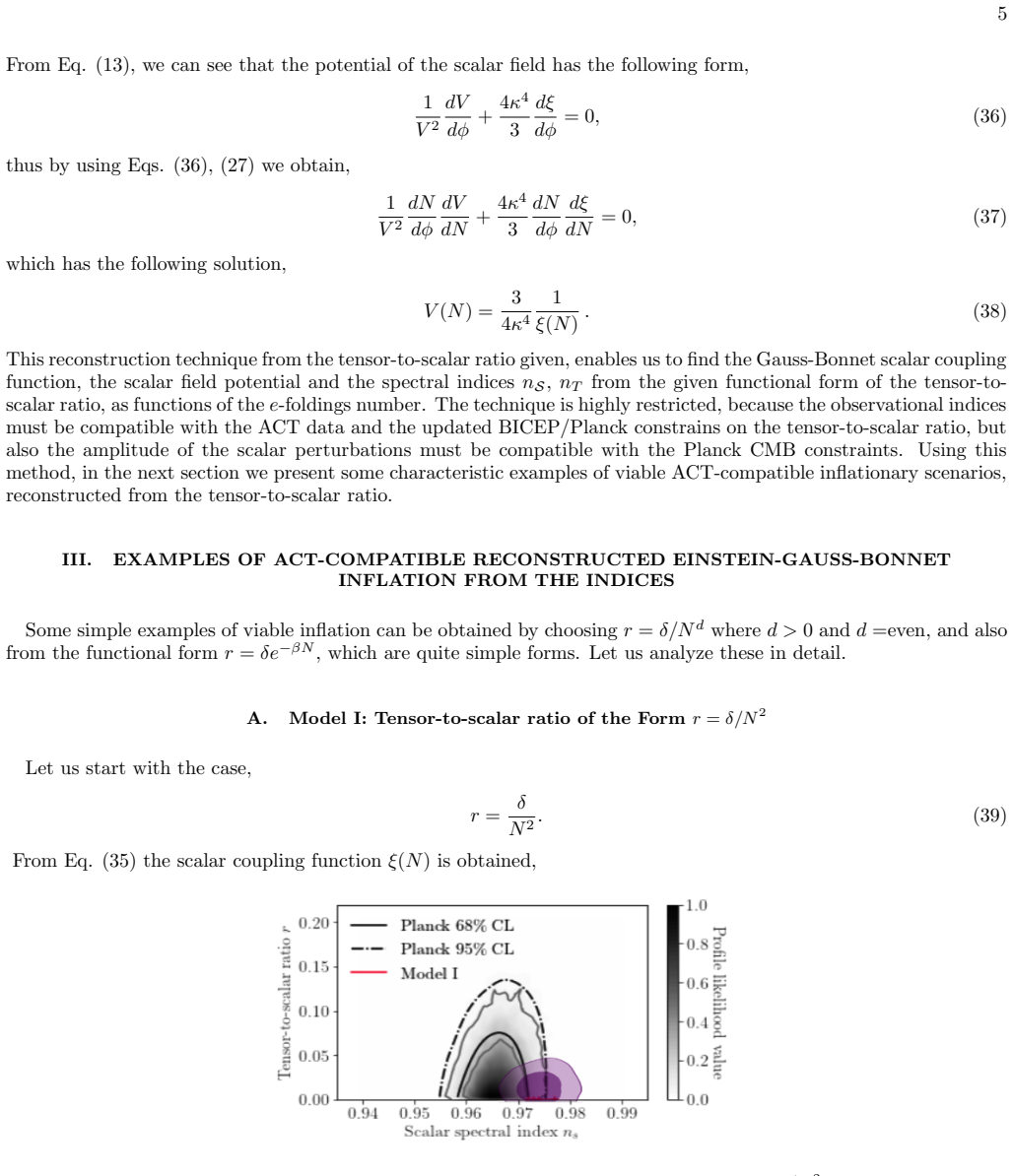
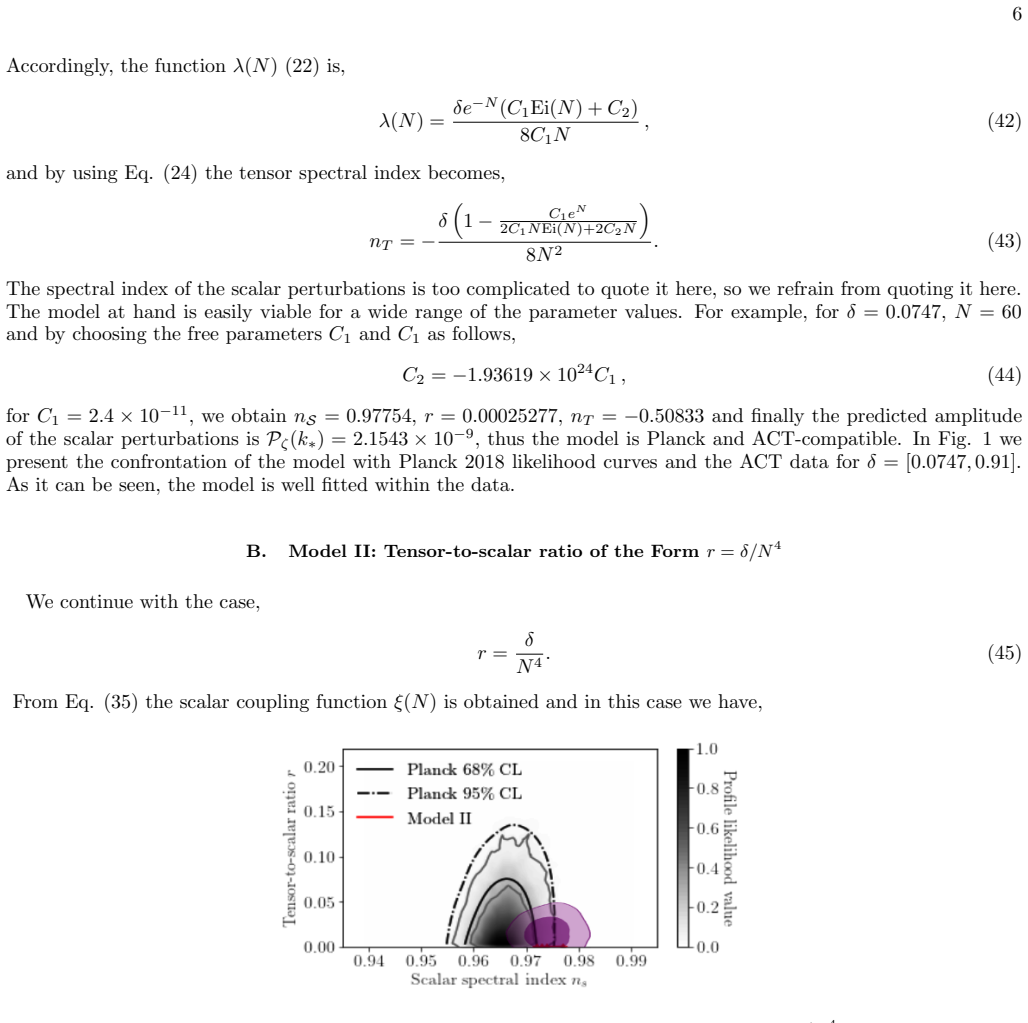
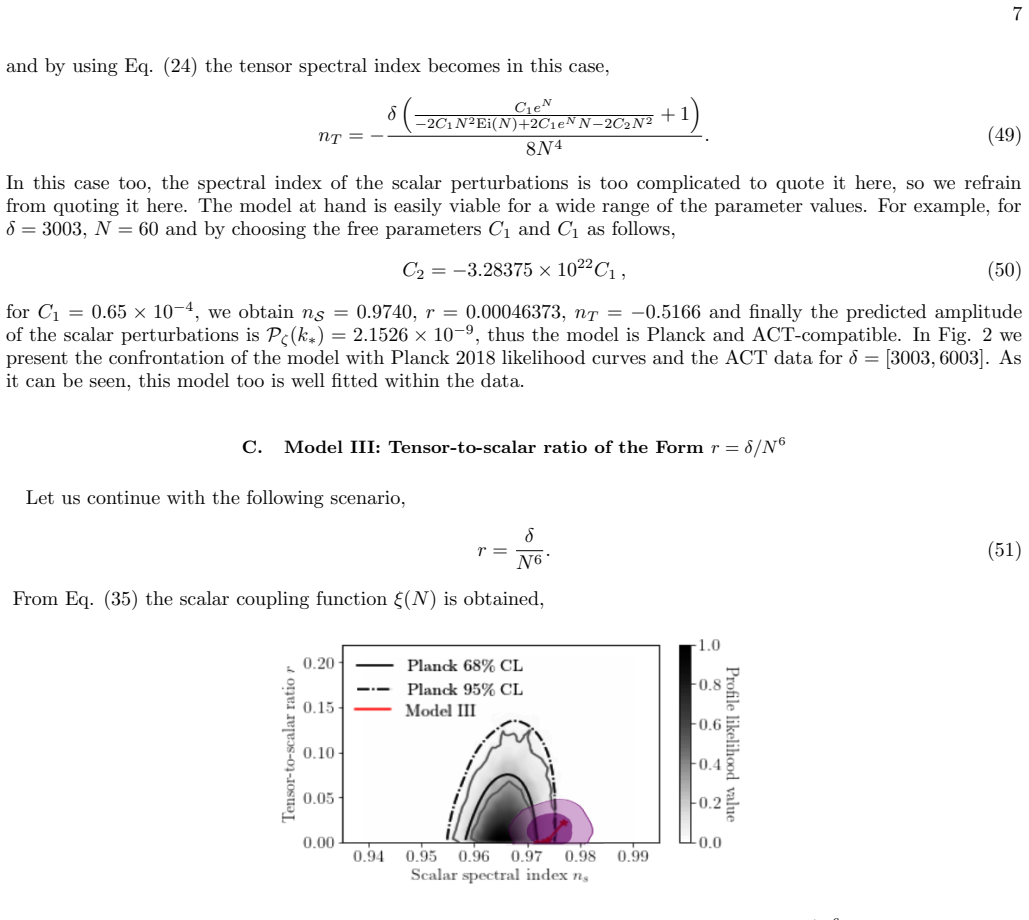
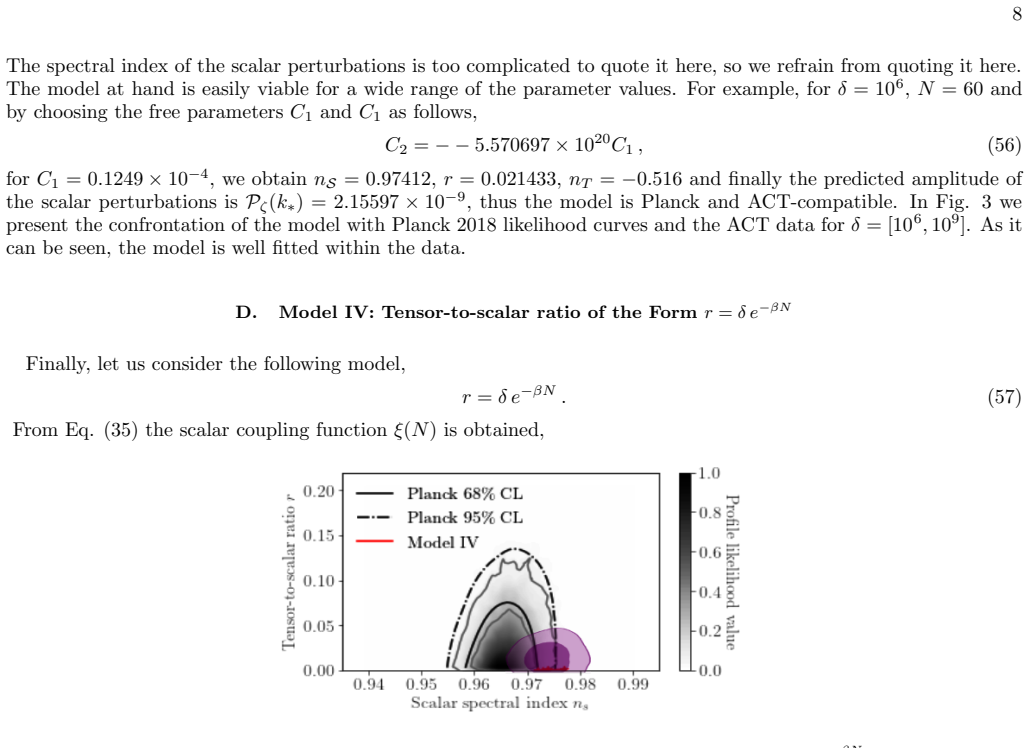
In this work we use an inverse reconstruction technique for constructing ACT-compatible and GW170817-compatible Einstein-Gauss-Bonnet inflationary theories. From a given tensor-to-scalar ratio using the reconstruction technique, we find which scalar Gauss-Bonnet coupling function and which scalar potential can yield the given tensor-to-scalar ratio. We present the formalism and the viable theories pass a series of observational tests, including the amplitude of the scalar perturbations, which is non-trivial for Einstein-Gauss-Bonnet theories. We present four viable models of inflation that pass all the observational tests.
Editorial analysis
A structured set of objections, weighed in public.
Referee Report
Summary. The paper develops an inverse reconstruction technique for Einstein-Gauss-Bonnet (EGB) inflation. Given a target tensor-to-scalar ratio r compatible with ACT and GW170817, the authors derive the Gauss-Bonnet coupling function ξ(φ) and potential V(φ) that reproduce this r, then verify that the resulting models also satisfy the scalar perturbation amplitude and other slow-roll indices. Four explicit viable models are presented that pass the full set of observational tests.
Significance. If the amplitude constraint is shown to be satisfied independently of the input r choice, the method supplies a systematic route to construct observationally viable EGB models without ad-hoc parameter tuning. Concrete examples of such models would be useful for exploring modified-gravity inflation scenarios consistent with current data.
major comments (1)
- [Abstract and §2] Abstract and §2 (reconstruction formalism): the central claim that the scalar amplitude match is 'non-trivial' requires explicit demonstration that the amplitude expression, once the functions are reconstructed from r, is not automatically satisfied by construction. The manuscript should derive the amplitude in terms of the reconstructed ξ(φ) and V(φ) and show the independent constraint it imposes.
minor comments (2)
- [Abstract] The abstract states that four models pass all tests but does not list the explicit functional forms or the numerical values of the slow-roll indices; these should be tabulated for reproducibility.
- [§3] Notation for the reconstructed functions should be introduced once and used consistently; the transition between the general reconstruction equations and the specific models is abrupt.
Simulated Author's Rebuttal
We thank the referee for the careful reading and the constructive suggestion regarding the non-triviality claim for the scalar amplitude. We address the major comment below and will revise the manuscript accordingly.
read point-by-point responses
-
Referee: [Abstract and §2] Abstract and §2 (reconstruction formalism): the central claim that the scalar amplitude match is 'non-trivial' requires explicit demonstration that the amplitude expression, once the functions are reconstructed from r, is not automatically satisfied by construction. The manuscript should derive the amplitude in terms of the reconstructed ξ(φ) and V(φ) and show the independent constraint it imposes.
Authors: We agree that the claim of non-triviality for the scalar amplitude in EGB theories requires explicit support. In the revised version we will add, in §2, the full derivation of the scalar power spectrum amplitude A_s expressed directly in terms of the reconstructed ξ(φ) and V(φ) obtained from the chosen r. We will then demonstrate that A_s is not fixed by the reconstruction procedure alone and that an additional independent constraint arises, which is satisfied only for specific functional forms or parameter choices. This will be illustrated with the four explicit models already presented, confirming that the amplitude constraint is imposed separately from the input r. revision: yes
Circularity Check
No significant circularity; reconstruction from r followed by independent amplitude verification
full rationale
The paper describes an inverse reconstruction that takes an observed tensor-to-scalar ratio r as input and solves for the Gauss-Bonnet coupling ξ(φ) and potential V(φ) that reproduce it. The abstract explicitly states that the subsequent verification of the scalar perturbation amplitude is non-trivial for Einstein-Gauss-Bonnet theories, indicating that this check is not automatically satisfied by the choice of r and therefore constitutes an independent constraint. No self-citation is invoked as a load-bearing uniqueness theorem, no fitted parameter is relabeled as a prediction, and no ansatz is smuggled via prior work. The derivation chain therefore remains self-contained against external observational benchmarks rather than reducing to its own inputs by construction.
Axiom & Free-Parameter Ledger
Reference graph
Works this paper leans on
-
[1]
Center for Theoretical Physics, Khazar University, 41 Mehseti Str., Baku, AZ-1096, Azerbaijan In this work we use an inverse reconstruction technique for constructing ACT-compatible and GW170817-compatible Einstein-Gauss-Bonnet inflationary theories. From a given tensor-to-scalar ratio using the reconstruction technique, we find which scalar Gauss-Bonnet ...
work page internal anchor Pith review Pith/arXiv arXiv 2017
-
[2]
B. P. Abbottet al.[LIGO Scientific and Virgo], Phys. Rev. Lett.119(2017) no.16, 161101 doi:10.1103/PhysRevLett.119.161101 [arXiv:1710.05832 [gr-qc]]
work page internal anchor Pith review Pith/arXiv arXiv doi:10.1103/physrevlett.119.161101 2017
-
[3]
B. P. Abbottet al.[LIGO Scientific, Virgo, Fermi-GBM and INTEGRAL], Astrophys. J. Lett.848(2017) no.2, L13 doi:10.3847/2041-8213/aa920c [arXiv:1710.05834 [astro-ph.HE]]
work page internal anchor Pith review Pith/arXiv arXiv doi:10.3847/2041-8213/aa920c 2017
-
[4]
Multi-messenger Observations of a Binary Neutron Star Merger
B. P. Abbottet al.“Multi-messenger Observations of a Binary Neutron Star Merger,” Astrophys. J.848(2017) no.2, L12 doi:10.3847/2041-8213/aa91c9 [arXiv:1710.05833 [astro-ph.HE]]
work page internal anchor Pith review Pith/arXiv arXiv doi:10.3847/2041-8213/aa91c9 2017
-
[5]
J. M. Ezquiaga and M. Zumalac´ arregui, Phys. Rev. Lett.119(2017) no.25, 251304 doi:10.1103/PhysRevLett.119.251304 [arXiv:1710.05901 [astro-ph.CO]]
work page internal anchor Pith review Pith/arXiv arXiv doi:10.1103/physrevlett.119.251304 2017
-
[6]
Strong constraints on cosmological gravity from GW170817 and GRB 170817A
T. Baker, E. Bellini, P. G. Ferreira, M. Lagos, J. Noller and I. Sawicki, Phys. Rev. Lett.119(2017) no.25, 251301 doi:10.1103/PhysRevLett.119.251301 [arXiv:1710.06394 [astro-ph.CO]]
work page internal anchor Pith review Pith/arXiv arXiv doi:10.1103/physrevlett.119.251301 2017
-
[7]
Dark Energy after GW170817 and GRB170817A
P. Creminelli and F. Vernizzi, Phys. Rev. Lett.119(2017) no.25, 251302 doi:10.1103/PhysRevLett.119.251302 [arXiv:1710.05877 [astro-ph.CO]]
work page internal anchor Pith review Pith/arXiv arXiv doi:10.1103/physrevlett.119.251302 2017
-
[8]
Implications of the Neutron Star Merger GW170817 for Cosmological Scalar-Tensor Theories
J. Sakstein and B. Jain, Phys. Rev. Lett.119(2017) no.25, 251303 doi:10.1103/PhysRevLett.119.251303 [arXiv:1710.05893 [astro-ph.CO]]
work page internal anchor Pith review Pith/arXiv arXiv doi:10.1103/physrevlett.119.251303 2017
-
[9]
P. G. S. Fernandes, P. Carrilho, T. Clifton and D. J. Mulryne, Class. Quant. Grav.39(2022) no.6, 063001 doi:10.1088/1361-6382/ac500a [arXiv:2202.13908 [gr-qc]]
-
[10]
J. c. Hwang and H. Noh, Phys. Rev. D71(2005) 063536 doi:10.1103/PhysRevD.71.063536 [gr-qc/0412126]
work page internal anchor Pith review Pith/arXiv arXiv doi:10.1103/physrevd.71.063536 2005
-
[11]
Dark energy cosmology from higher-order, string-inspired gravity and its reconstruction
S. Nojiri, S. D. Odintsov and M. Sami, Phys. Rev. D74(2006) 046004 doi:10.1103/PhysRevD.74.046004 [hep-th/0605039]
work page internal anchor Pith review Pith/arXiv arXiv doi:10.1103/physrevd.74.046004 2006
-
[12]
G. Cognola, E. Elizalde, S. Nojiri, S. Odintsov and S. Zerbini, Phys. Rev. D75(2007) 086002 doi:10.1103/PhysRevD.75.086002 [hep-th/0611198]
work page internal anchor Pith review Pith/arXiv arXiv doi:10.1103/physrevd.75.086002 2007
-
[13]
S. Nojiri, S. D. Odintsov and M. Sasaki, Phys. Rev. D71(2005) 123509 doi:10.1103/PhysRevD.71.123509 [hep- th/0504052]
-
[14]
Modified Gauss-Bonnet theory as gravitational alternative for dark energy
S. Nojiri and S. D. Odintsov, Phys. Lett. B631(2005) 1 doi:10.1016/j.physletb.2005.10.010 [hep-th/0508049]
work page internal anchor Pith review Pith/arXiv arXiv doi:10.1016/j.physletb.2005.10.010 2005
-
[15]
Circular Polarization of Primordial Gravitational Waves in String-inspired Inflationary Cosmology
M. Satoh, S. Kanno and J. Soda, Phys. Rev. D77(2008) 023526 doi:10.1103/PhysRevD.77.023526 [arXiv:0706.3585 [astro-ph]]
work page internal anchor Pith review Pith/arXiv arXiv doi:10.1103/physrevd.77.023526 2008
-
[16]
Bounce universe from string-inspired Gauss-Bonnet gravity
K. Bamba, A. N. Makarenko, A. N. Myagky and S. D. Odintsov, JCAP1504(2015) 001 doi:10.1088/1475- 7516/2015/04/001 [arXiv:1411.3852 [hep-th]]
work page internal anchor Pith review Pith/arXiv arXiv doi:10.1088/1475- 2015
-
[17]
Z. Yi, Y. Gong and M. Sabir, Phys. Rev. D98(2018) no.8, 083521 doi:10.1103/PhysRevD.98.083521 [arXiv:1804.09116 [gr-qc]]
work page internal anchor Pith review Pith/arXiv arXiv doi:10.1103/physrevd.98.083521 2018
-
[18]
Z. K. Guo and D. J. Schwarz, Phys. Rev. D80(2009) 063523 doi:10.1103/PhysRevD.80.063523 [arXiv:0907.0427 [hep-th]]
work page internal anchor Pith review Pith/arXiv arXiv doi:10.1103/physrevd.80.063523 2009
-
[19]
Z. K. Guo and D. J. Schwarz, Phys. Rev. D81(2010) 123520 doi:10.1103/PhysRevD.81.123520 [arXiv:1001.1897 [hep-th]]
work page internal anchor Pith review Pith/arXiv arXiv doi:10.1103/physrevd.81.123520 2010
-
[20]
P. X. Jiang, J. W. Hu and Z. K. Guo, Phys. Rev. D88(2013) 123508 doi:10.1103/PhysRevD.88.123508 [arXiv:1310.5579 [hep-th]]
work page internal anchor Pith review Pith/arXiv arXiv doi:10.1103/physrevd.88.123508 2013
-
[21]
Gauss-Bonnet-coupled Quintessential Inflation
C. van de Bruck, K. Dimopoulos, C. Longden and C. Owen, arXiv:1707.06839 [astro-ph.CO]
work page internal anchor Pith review Pith/arXiv arXiv
-
[22]
E. O. Pozdeeva, M. R. Gangopadhyay, M. Sami, A. V. Toporensky and S. Y. Vernov, Phys. Rev. D102(2020) no.4, 043525 doi:10.1103/PhysRevD.102.043525 [arXiv:2006.08027 [gr-qc]]
-
[23]
S. Vernov and E. Pozdeeva, Universe7(2021) no.5, 149 doi:10.3390/universe7050149 [arXiv:2104.11111 [gr-qc]]
-
[24]
E. O. Pozdeeva and S. Y. Vernov, Eur. Phys. J. C81(2021) no.7, 633 doi:10.1140/epjc/s10052-021-09435-8 [arXiv:2104.04995 [gr-qc]]
-
[25]
I. Fomin, Eur. Phys. J. C80(2020) no.12, 1145 doi:10.1140/epjc/s10052-020-08718-w [arXiv:2004.08065 [gr-qc]]. 10
-
[26]
Cosmological inflation in $F(R,\mathcal{G})$ gravity
M. De Laurentis, M. Paolella and S. Capozziello, Phys. Rev. D91(2015) no.8, 083531 doi:10.1103/PhysRevD.91.083531 [arXiv:1503.04659 [gr-qc]]
work page internal anchor Pith review Pith/arXiv arXiv doi:10.1103/physrevd.91.083531 2015
-
[27]
Scalar Field Cosmology, S. Chervon, I. Fomin, V. Yurov and A. Yurov, World Scientific 2019, doi:10.1142/11405
-
[28]
Perturbation, Non-Gaussianity and Reheating in a GB-$\alpha$-Attractor Model
K. Nozari and N. Rashidi, Phys. Rev. D95(2017) no.12, 123518 doi:10.1103/PhysRevD.95.123518 [arXiv:1705.02617 [astro-ph.CO]]
work page internal anchor Pith review Pith/arXiv arXiv doi:10.1103/physrevd.95.123518 2017
-
[29]
S. D. Odintsov and V. K. Oikonomou, Phys. Rev. D98(2018) no.4, 044039 doi:10.1103/PhysRevD.98.044039 [arXiv:1808.05045 [gr-qc]]
work page internal anchor Pith review Pith/arXiv arXiv doi:10.1103/physrevd.98.044039 2018
-
[30]
Instability of 1-loop superstring cosmology
S. Kawai, M. a. Sakagami and J. Soda, Phys. Lett. B437, 284 (1998) doi:10.1016/S0370-2693(98)00925-3 [gr-qc/9802033]
work page internal anchor Pith review Pith/arXiv arXiv doi:10.1016/s0370-2693(98)00925-3 1998
-
[31]
Gauss-Bonnet inflation and swampland
Z. Yi and Y. Gong, Universe5(2019) no.9, 200 doi:10.3390/universe5090200 [arXiv:1811.01625 [gr-qc]]
work page internal anchor Pith review Pith/arXiv arXiv doi:10.3390/universe5090200 2019
-
[32]
Reheating in Gauss-Bonnet-coupled inflation
C. van de Bruck, K. Dimopoulos and C. Longden, Phys. Rev. D94(2016) no.2, 023506 doi:10.1103/PhysRevD.94.023506 [arXiv:1605.06350 [astro-ph.CO]]
work page internal anchor Pith review Pith/arXiv arXiv doi:10.1103/physrevd.94.023506 2016
-
[33]
K. i. Maeda, N. Ohta and R. Wakebe, Eur. Phys. J. C72(2012) 1949 doi:10.1140/epjc/s10052-012-1949-6 [arXiv:1111.3251 [hep-th]]
work page internal anchor Pith review Pith/arXiv arXiv doi:10.1140/epjc/s10052-012-1949-6 2012
-
[34]
W. Y. Ai, Commun. Theor. Phys.72(2020) no.9, 095402 doi:10.1088/1572-9494/aba242 [arXiv:2004.02858 [gr-qc]]
-
[35]
One-Loop Superstring Cosmology and the Non-Singular Universe
R. Easther and K. i. Maeda, Phys. Rev. D54(1996) 7252 doi:10.1103/PhysRevD.54.7252 [hep-th/9605173]
work page internal anchor Pith review Pith/arXiv arXiv doi:10.1103/physrevd.54.7252 1996
-
[36]
On the covariant formalism of the effective field theory of gravity and leading order corrections
A. Codello and R. K. Jain, Class. Quant. Grav.33(2016) no.22, 225006 doi:10.1088/0264-9381/33/22/225006 [arXiv:1507.06308 [gr-qc]]
work page internal anchor Pith review Pith/arXiv arXiv doi:10.1088/0264-9381/33/22/225006 2016
-
[37]
V. K. Oikonomou, Class. Quant. Grav.38(2021) no.19, 195025 doi:10.1088/1361-6382/ac2168 [arXiv:2108.10460 [gr-qc]]
-
[38]
V. K. Oikonomou, Astropart. Phys.141(2022), 102718 doi:10.1016/j.astropartphys.2022.102718 [arXiv:2204.06304 [gr- qc]]
-
[39]
S. D. Odintsov, V. K. Oikonomou and F. P. Fronimos, Nucl. Phys. B958(2020), 115135 doi:10.1016/j.nuclphysb.2020.115135 [arXiv:2003.13724 [gr-qc]]
-
[40]
V. K. Oikonomou, Phys. Lett. B856(2024), 138890 doi:10.1016/j.physletb.2024.138890 [arXiv:2407.12155 [gr-qc]]
- [41]
-
[42]
V. K. Oikonomou, P. D. Katzanis and I. C. Papadimitriou, Class. Quant. Grav.39(2022) no.9, 095008 doi:10.1088/1361- 6382/ac5eba [arXiv:2203.09867 [gr-qc]]
-
[43]
A. D. Linde, Lect. Notes Phys.738(2008) 1 [arXiv:0705.0164 [hep-th]]
work page internal anchor Pith review Pith/arXiv arXiv 2008
-
[44]
Introduction to the theory of the early universe: Cosmological perturbations and inflationary theory,
D. S. Gorbunov and V. A. Rubakov, “Introduction to the theory of the early universe: Cosmological perturbations and inflationary theory,” Hackensack, USA: World Scientific (2011) 489 p
2011
-
[45]
Inflationary Cosmology after Planck 2013
A. Linde, arXiv:1402.0526 [hep-th]
work page internal anchor Pith review Pith/arXiv arXiv
-
[46]
D. H. Lyth and A. Riotto, Phys. Rept.314(1999) 1 [hep-ph/9807278]
work page internal anchor Pith review Pith/arXiv arXiv 1999
- [47]
-
[48]
E. Allyset al.[LiteBIRD], PTEP2023(2023) no.4, 042F01 doi:10.1093/ptep/ptac150 [arXiv:2202.02773 [astro-ph.IM]]
-
[49]
S. Hild, M. Abernathy, F. Acernese, P. Amaro-Seoane, N. Andersson, K. Arun, F. Barone, B. Barr, M. Barsuglia and M. Beker,et al.Class. Quant. Grav.28(2011), 094013 doi:10.1088/0264-9381/28/9/094013 [arXiv:1012.0908 [gr-qc]]
work page internal anchor Pith review Pith/arXiv arXiv doi:10.1088/0264-9381/28/9/094013 2011
-
[50]
The Laser Interferometer Space Antenna: Unveiling the Millihertz Gravitational Wave Sky
J. Baker, J. Bellovary, P. L. Bender, E. Berti, R. Caldwell, J. Camp, J. W. Conklin, N. Cornish, C. Cutler and R. DeRosa, et al.[arXiv:1907.06482 [astro-ph.IM]]
work page internal anchor Pith review Pith/arXiv arXiv 1907
-
[51]
T. L. Smith and R. Caldwell, Phys. Rev. D100(2019) no.10, 104055 doi:10.1103/PhysRevD.100.104055 [arXiv:1908.00546 [astro-ph.CO]]
-
[52]
Beyond LISA: Exploring Future Gravitational Wave Missions
J. Crowder and N. J. Cornish, Phys. Rev. D72(2005), 083005 doi:10.1103/PhysRevD.72.083005 [arXiv:gr-qc/0506015 [gr-qc]]
work page internal anchor Pith review Pith/arXiv arXiv doi:10.1103/physrevd.72.083005 2005
-
[53]
T. L. Smith and R. Caldwell, Phys. Rev. D95(2017) no.4, 044036 doi:10.1103/PhysRevD.95.044036 [arXiv:1609.05901 [gr-qc]]
work page internal anchor Pith review Pith/arXiv arXiv doi:10.1103/physrevd.95.044036 2017
-
[54]
N. Seto, S. Kawamura and T. Nakamura, Phys. Rev. Lett.87(2001), 221103 doi:10.1103/PhysRevLett.87.221103 [arXiv:astro-ph/0108011 [astro-ph]]
work page internal anchor Pith review Pith/arXiv arXiv doi:10.1103/physrevlett.87.221103 2001
-
[55]
Current status of space gravitational wave antenna DECIGO and B-DECIGO
S. Kawamura, M. Ando, N. Seto, S. Sato, M. Musha, I. Kawano, J. Yokoyama, T. Tanaka, K. Ioka and T. Akutsu,et al. [arXiv:2006.13545 [gr-qc]]
work page internal anchor Pith review Pith/arXiv arXiv 2006
-
[56]
A. Weltman, P. Bull, S. Camera, K. Kelley, H. Padmanabhan, J. Pritchard, A. Raccanelli, S. Riemer-Sørensen, L. Shao and S. Andrianomena,et al.Publ. Astron. Soc. Austral.37(2020), e002 doi:10.1017/pasa.2019.42 [arXiv:1810.02680 [astro-ph.CO]]
-
[57]
Auclairet al.(LISA Cosmology Working Group), Living Rev
P. Auclairet al.[LISA Cosmology Working Group], [arXiv:2204.05434 [astro-ph.CO]]
-
[58]
The NANOGrav 15-year Data Set: Evidence for a Gravitational-Wave Background
G. Agazieet al.[NANOGrav], Astrophys. J. Lett.951(2023) no.1, L8 doi:10.3847/2041-8213/acdac6 [arXiv:2306.16213 [astro-ph.HE]]
work page internal anchor Pith review Pith/arXiv arXiv doi:10.3847/2041-8213/acdac6 2023
-
[59]
Vagnozzi, JHEAp39(2023), 81-98 doi:10.1016/j.jheap.2023.07.001 [arXiv:2306.16912 [astro-ph.CO]]
S. Vagnozzi, JHEAp39(2023), 81-98 doi:10.1016/j.jheap.2023.07.001 [arXiv:2306.16912 [astro-ph.CO]]
-
[60]
V. K. Oikonomou, Phys. Rev. D108(2023) no.4, 043516 doi:10.1103/PhysRevD.108.043516 [arXiv:2306.17351 [astro- ph.CO]]
-
[61]
Modified Gravity Theories on a Nutshell: Inflation, Bounce and Late-time Evolution
S. Nojiri, S. D. Odintsov and V. K. Oikonomou, Phys. Rept.692(2017) 1 [arXiv:1705.11098 [gr-qc]]
work page internal anchor Pith review Pith/arXiv arXiv 2017
-
[62]
Capozziello, M
S. Capozziello, M. De Laurentis, Phys. Rept.509, 167 (2011); V. Faraoni and S. Capozziello, Fundam. Theor. Phys.170(2010)
2011
-
[63]
Nojiri, S.D
S. Nojiri, S.D. Odintsov, eConfC0602061, 06 (2006) [Int. J. Geom. Meth. Mod. Phys.4, 115 (2007)]
2006
-
[64]
Nojiri, S.D
S. Nojiri, S.D. Odintsov, Phys. Rept.505, 59 (2011)
2011
-
[65]
The Atacama Cosmology Telescope: DR6 Power Spectra, Likelihoods and $\Lambda$CDM Parameters
T. Louiset al.[ACT], [arXiv:2503.14452 [astro-ph.CO]]
work page internal anchor Pith review Pith/arXiv arXiv
-
[66]
The Atacama Cosmology Telescope: DR6 Constraints on Extended Cosmological Models
E. Calabreseet al.[ACT], [arXiv:2503.14454 [astro-ph.CO]]. 11
work page internal anchor Pith review Pith/arXiv arXiv
-
[67]
P. A. R. Adeet al.[BICEP and Keck], Phys. Rev. Lett.127(2021) no.15, 151301 doi:10.1103/PhysRevLett.127.151301 [arXiv:2110.00483 [astro-ph.CO]]
- [68]
- [69]
-
[70]
L. Liu, Z. Yi and Y. Gong, [arXiv:2505.02407 [astro-ph.CO]]
work page internal anchor Pith review Pith/arXiv arXiv
-
[71]
Yogesh, A. Mohammadi, Q. Wu and T. Zhu, [arXiv:2505.05363 [astro-ph.CO]]
- [72]
- [73]
- [74]
- [75]
- [76]
- [77]
- [78]
- [79]
- [80]
discussion (0)
Sign in with ORCID, Apple, or X to comment. Anyone can read and Pith papers without signing in.