REVIEW 1 major objections 1 cited by
Dynamical tidal deformations of neutron stars contribute measurably to late-inspiral gravitational-wave signals.
Reviewed by Pith at T0; open to challenge. T0 means a machine referee read the full paper against a public rubric. the ladder, T0–T4 →
T0 review · grok-4.3
2026-06-26 19:54 UTC pith:RRMCP6YX
load-bearing objection The paper delivers the complete leading-order dynamical tidal corrections including scheme-dependent finite terms via EFT-stellar matching, and shows they matter for late-inspiral waveforms even at 8PN. the 1 major comments →
Dynamical Tidal Response of Neutron Stars: from Effective Field Theory to Gravitational Waveforms
The pith
A machine-rendered reading of the paper's core claim, the machinery that carries it, and where it could break.
Core claim
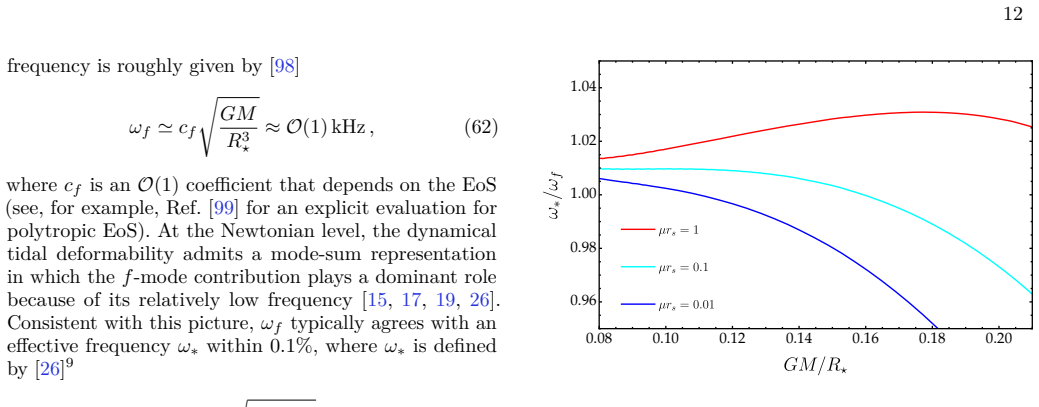
Combining worldline effective field theory with relativistic stellar perturbation theory in dimensional regularization produces the full leading-order dynamical tidal corrections to both the conservative dynamics and the gravitational-wave phase of compact binaries. The resulting dynamical Love numbers, which include scheme-dependent finite terms in addition to the running, are significantly larger than their static counterparts for small compactness. Mode excitations alone do not capture the complete relativistic dynamical effects, whose magnitude depends on compactness, the equation of state, and the running term. These corrections remain observationally relevant in the late inspiral despi
What carries the argument
The consistent matching procedure between worldline effective field theory and relativistic stellar perturbation theory that isolates the complete leading-order dynamical tidal corrections including scheme-dependent finite terms.
Load-bearing premise
The consistent matching procedure between the worldline EFT and relativistic stellar perturbation theory that isolates the complete leading-order dynamical corrections, including scheme-dependent finite terms, is valid and free of uncontrolled higher-order contributions.
What would settle it
A mismatch between observed late-inspiral gravitational-wave phases from neutron-star binaries and waveforms computed with only static tides, resolved when the predicted dynamical corrections are restored.
If this is right
- Dynamical tidal effects cannot be fully captured by mode excitations in the relativistic regime.
- The size of the dynamical corrections depends on stellar compactness, the equation of state, and the running term.
- Third-generation detectors can measure dynamical Love numbers across a range of neutron-star masses and equations of state.
- Neglecting dynamical tides produces significant biases in the inferred static Love numbers and therefore in the nuclear equation of state.
Where Pith is reading between the lines
- The enhancement at low compactness suggests dynamical signatures may be strongest for lower-mass neutron stars.
- The presence of scheme-dependent finite terms underscores the need for consistent regularization choices when comparing effective-theory predictions to numerical waveforms.
- The same matching framework could be applied to other compact objects to test whether similar dynamical corrections appear.
Editorial analysis
A structured set of objections, weighed in public.
Referee Report
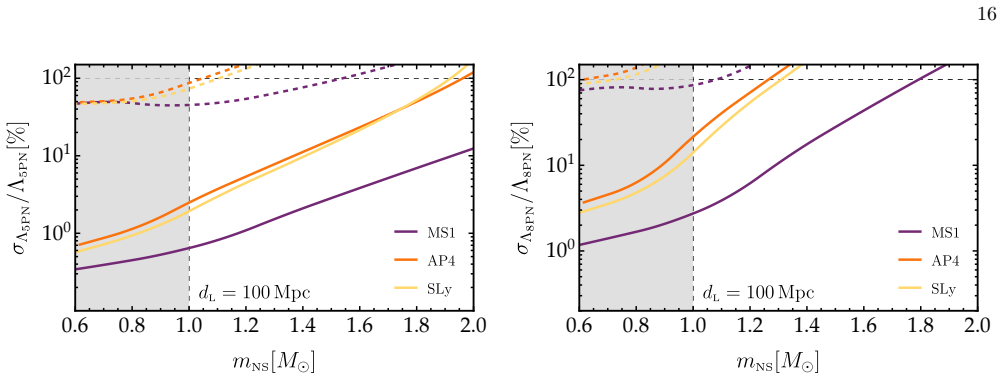
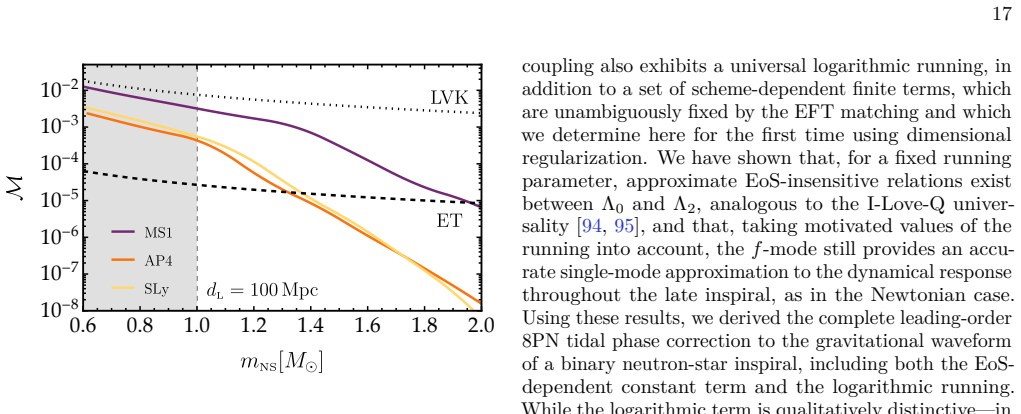
Summary. The manuscript investigates the fully relativistic dynamical tidal response of neutron stars up to second order in the frequency. By combining the worldline effective field theory for extended gravitating bodies with perturbation theory of relativistic stellar models, the authors derive the tidal deformation induced by an external time-dependent field, including a universal logarithmic running term. Through a consistent matching procedure in dimensional regularization, they obtain the complete leading-order dynamical tidal corrections to both the conservative dynamics and the gravitational-wave signal, including scheme-dependent finite terms. They demonstrate that dynamical effects cannot be fully captured by mode excitations alone in the relativistic regime, with the magnitude depending on compactness, equation of state, and the running term. Dynamical Love numbers are significantly enhanced for relatively small compactness, yielding non-negligible contributions during the late inspiral despite entering at 8th post-Newtonian order. A Fisher-matrix analysis indicates that third-generation detectors like the Einstein Telescope could measure these dynamical Love numbers, while neglecting them leads to biases in static Love-number inference and thus the nuclear equation of state.
Significance. If the matching procedure is shown to be robust, this work would be significant for high-precision gravitational-wave modeling with future detectors such as the Einstein Telescope. The explicit derivation of complete leading-order dynamical corrections (including finite terms beyond mode excitations) and the demonstration of their non-negligible impact on the late inspiral and potential biases in equation-of-state inference are notable strengths. The combination of EFT and stellar perturbation theory provides a systematic framework that could improve waveform templates.
major comments (1)
- [Matching procedure (as described in the derivation of dynamical corrections)] The central claim that dynamical Love numbers yield non-negligible contributions and are measurable by ET (with biases if neglected) rests on the matching procedure isolating the complete LO dynamical corrections, including all scheme-dependent finite terms and without O(ω³) leakage. The manuscript asserts this is achieved 'for the first time' via consistent matching between the worldline EFT and relativistic stellar models, but does not explicitly verify that the tidal response functions capture all compactness- and EOS-dependent finite pieces or exclude higher-order relativistic corrections. This is load-bearing for the Fisher-matrix projections and the 'significantly enhanced' magnitude claim for small compactness.
Simulated Author's Rebuttal
We thank the referee for the careful reading and constructive feedback on our manuscript. We appreciate the recognition of the work's potential significance for high-precision gravitational-wave modeling. We address the major comment below.
read point-by-point responses
-
Referee: [Matching procedure (as described in the derivation of dynamical corrections)] The central claim that dynamical Love numbers yield non-negligible contributions and are measurable by ET (with biases if neglected) rests on the matching procedure isolating the complete LO dynamical corrections, including all scheme-dependent finite terms and without O(ω³) leakage. The manuscript asserts this is achieved 'for the first time' via consistent matching between the worldline EFT and relativistic stellar models, but does not explicitly verify that the tidal response functions capture all compactness- and EOS-dependent finite pieces or exclude higher-order relativistic corrections. This is load-bearing for the Fisher-matrix projections and the 'significantly enhanced' magnitude claim for small compactness.
Authors: We thank the referee for emphasizing the need to clearly establish the robustness of the matching. Sections III and IV detail the procedure: the relativistic stellar perturbation equations are solved for the tidal response up to O(ω²) for specified compactness and EOS, directly yielding the full response functions that include all compactness- and EOS-dependent finite contributions. These are matched to the worldline EFT coefficients in dimensional regularization, separating the universal running from the scheme-dependent finite terms. By construction, the truncation at second order in frequency excludes O(ω³) leakage, and higher-order relativistic or post-Newtonian corrections lie beyond the leading-order scope. The stellar-model solutions ensure completeness of the finite pieces at this order. To make this verification more explicit, we will add a clarifying paragraph in the revised manuscript. revision: yes
Circularity Check
No circularity: matching uses external stellar models; central results not forced by self-inputs
full rationale
The derivation proceeds by combining worldline EFT with independent relativistic stellar perturbation theory via a matching procedure that draws on external stellar models. No quoted step reduces a claimed prediction or dynamical correction to a quantity fitted inside the same calculation, nor does any load-bearing premise rest on a self-citation chain that itself lacks independent verification. The abstract and described procedure treat the stellar models as external inputs, and the subsequent Fisher-matrix projections follow from those matched quantities without re-using the same data as both input and output. This is the normal non-circular case.
Axiom & Free-Parameter Ledger
axioms (2)
- domain assumption Worldline effective field theory for extended gravitating bodies
- domain assumption Perturbation theory of relativistic stellar models
read the original abstract
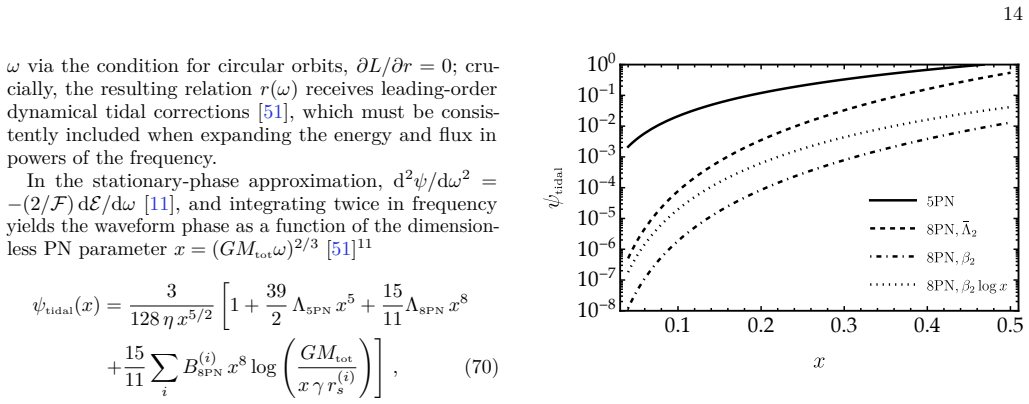
We investigate the fully relativistic dynamical tidal response of neutron stars up to second order in the frequency. Combining the worldline effective field theory for extended gravitating bodies with perturbation theory of relativistic stellar models, we derive the tidal deformation induced by an external time-dependent field, including a universal logarithmic running term. In the effective theory, we work in dimensional regularization and, through a consistent matching procedure, obtain for the first time the complete leading-order dynamical tidal corrections to both the conservative dynamics and the gravitational-wave signal of compact binaries, including the scheme-dependent finite terms in addition to the running. We show that, in the relativistic regime, dynamical effects cannot be fully captured by mode excitations alone. The magnitude of the additional contribution depends on the stellar compactness, the equation of state, and the running term. Dynamical Love numbers are significantly enhanced with respect to their static counterparts for relatively small compactness. As a result, although they formally enter the gravitational-wave phase at 8th post-Newtonian order, dynamical tidal effects yield a non-negligible contribution during the late inspiral. Using a Fisher-matrix analysis, we show that third-generation detectors such as the Einstein Telescope could measure dynamical Love numbers for a range of neutron-star masses and equations of state. Conversely, neglecting these effects can lead to significant biases in the inference of static Love numbers, and hence on the nuclear equation of state. Our results highlight the importance of dynamical tidal effects for high-precision gravitational-wave modeling with future detectors.
Figures
Forward citations
Cited by 1 Pith paper
-
A Bound on the Dynamical Love Number
Schwarz–Pick applied to the rescaled retarded tidal response bounds dynamical Love numbers for neutron stars by the static Love number and spectral gap, and constrains black-hole tidal heating.
Reference graph
Works this paper leans on
-
[1]
near zone
Gravito-electric one-point function On the EFT side, we work in the de Donder gauge, defined by ∂µhµν= 1 2∂νh,(A9) withh≡hµµ. Hereafter,hµνdenotes the canonically normalized graviton field, defined viagµν=ηµν+2hµν/M(D−2)/2 Pl in D spacetime dimensions. Indices are raised and lowered using the Minkowski metricηµν. In this gauge, the linearized equations of...
-
[2]
near zone
Including gravitational nonlinearities The solution(A17) was obtained from a tree-level calculation in the EFT and captures the leading-r behavior of theE field. To match it to the full relativistic solution, however, we must include the coupling to gravity, which generates subleading terms. For this purpose, we closely follow the procedure described in R...
-
[3]
J. M. Lattimer, Ann. Rev. Nucl. Part. Sci.71, 433 (2021)
2021
- [4]
-
[5]
L. Baiotti, Prog. Part. Nucl. Phys.109, 103714 (2019), arXiv:1907.08534 [astro-ph.HE]
-
[6]
Chatziioannou,Neutron star tidal deformability and equation of state constraints,Gen
K. Chatziioannou, Gen. Rel. Grav.52, 109 (2020), arXiv:2006.03168 [gr-qc]
-
[7]
Poisson and C
E. Poisson and C. M. Will,Gravity: Newtonian, Post- Newtonian, Relativistic(Cambridge University Press, 2014)
2014
-
[8]
Tidal Love numbers of neutron stars
T. Hinderer, Astrophys. J.677, 1216 (2008), arXiv:0711.2420 [astro-ph]
work page internal anchor Pith review Pith/arXiv arXiv 2008
-
[9]
Constraining neutron star tidal Love numbers with gravitational wave detectors
E. E.Flanagan andT. Hinderer,Phys. Rev.D77,021502 (2008), arXiv:0709.1915 [astro-ph]
work page internal anchor Pith review Pith/arXiv arXiv 2008
-
[10]
Relativistic tidal properties of neutron stars
T. Damour and A. Nagar, Phys. Rev. D80, 084035 (2009), arXiv:0906.0096 [gr-qc]
work page internal anchor Pith review Pith/arXiv arXiv 2009
-
[11]
Relativistic theory of tidal Love numbers
T. Binnington and E. Poisson, Phys. Rev.D80, 084018 (2009), arXiv:0906.1366 [gr-qc]
work page internal anchor Pith review Pith/arXiv arXiv 2009
-
[12]
T. Hinderer, B. D. Lackey, R. N. Lang, and J. S. Read, Phys. Rev. D81, 123016 (2010), arXiv:0911.3535 [astro- ph.HE]
work page internal anchor Pith review Pith/arXiv arXiv 2010
-
[13]
Post-1-Newtonian tidal effects in the gravitational waveform from binary inspirals
J. Vines, E. E. Flanagan, and T. Hinderer, Phys. Rev. D83, 084051 (2011), arXiv:1101.1673 [gr-qc]
work page internal anchor Pith review Pith/arXiv arXiv 2011
-
[14]
B. P. Abbottet al.(LIGO Scientific, Virgo), Phys. Rev. Lett.119, 161101 (2017), arXiv:1710.05832 [gr-qc]
work page internal anchor Pith review Pith/arXiv arXiv 2017
-
[15]
Tidal Response of Compact Objects
S. Chakraborty and P. Pani, (2026), arXiv:2604.08679 [gr-qc]
work page internal anchor Pith review Pith/arXiv arXiv 2026
-
[16]
M. J. Rodríguez, L. Santoni, and A. R. Solomon, (2026), arXiv:2604.08653 [gr-qc]
work page internal anchor Pith review Pith/arXiv arXiv 2026
-
[17]
Resonant Oscillations and Tidal Heating in Coalescing Binary Neutron Stars
D. Lai, Mon. Not. Roy. Astron. Soc.270, 611 (1994), arXiv:astro-ph/9404062
work page internal anchor Pith review Pith/arXiv arXiv 1994
- [18]
-
[19]
W. C. G. Ho and D. Lai, Mon. Not. Roy. Astron. Soc. 308, 153 (1999), arXiv:astro-ph/9812116
work page internal anchor Pith review Pith/arXiv arXiv 1999
-
[20]
Effective action and linear response of compact objects in Newtonian gravity
S. Chakrabarti, T. Delsate, and J. Steinhoff, Phys. Rev. D88, 084038 (2013), arXiv:1306.5820 [gr-qc]
work page internal anchor Pith review Pith/arXiv arXiv 2013
-
[21]
The sum of Love: Exploring the effective tidal deformability of neutron stars
N. Andersson and P. Pnigouras, Phys. Rev. D101, 083001 (2020), arXiv:1906.08982 [astro-ph.HE]
work page Pith review arXiv 2020
-
[22]
N. Andersson and P. Pnigouras, Mon. Not. Roy. Astron. Soc.503, 533 (2021), arXiv:1905.00012 [gr-qc]
-
[23]
Dynamical tides in neutron stars: The impact of the crust
A. Passamonti, N. Andersson, and P. Pnigouras, Mon. Not. Roy. Astron. Soc.504, 1273 (2021), arXiv:2012.09637 [astro-ph.HE]
work page Pith review arXiv 2021
-
[24]
A. Passamonti, N. Andersson, and P. Pnigouras, Mon. Not. Roy. Astron. Soc.514, 1494 (2022), arXiv:2202.05161 [astro-ph.HE]
-
[25]
Rotating Love: The dynamical tides of spinning Newtonian stars
P. Pnigouras, F. Gittins, A. Nanda, N. Andersson, and D. I. Jones, Mon. Not. Roy. Astron. Soc.527, 8409 (2024), arXiv:2205.07577 [gr-qc]
work page Pith review arXiv 2024
-
[26]
H. Yu, P. Arras, and N. N. Weinberg, Phys. Rev. D 110, 024039 (2024), arXiv:2404.00147 [gr-qc]
work page Pith review arXiv 2024
-
[27]
Dynamical neutron-star tides: The signature of a mode resonance
P. Pnigouras, N. Andersson, F. Gittins, and A. R. Coun- sell, Mon. Not. Roy. Astron. Soc.542, 1375 (2025), arXiv:2508.06416 [gr-qc]
work page Pith review arXiv 2025
-
[28]
General relativistic dynamical tides in binary inspirals, without modes
T. Pitre and E. Poisson, Phys. Rev. D109, 064004 (2024), arXiv:2311.04075 [gr-qc]
work page Pith review arXiv 2024
- [29]
- [30]
- [31]
-
[32]
R. Counsell, F. Gittins, N. Andersson, and P. Pnigouras, Mon. Not. Roy. Astron. Soc.536, 1967 (2024), arXiv:2409.20178 [gr-qc]
-
[33]
J. A. Saes, A. Hegade K. R., and N. Yunes, Phys. Rev. D113, 104045 (2026), arXiv:2511.19626 [gr-qc]
work page internal anchor Pith review Pith/arXiv arXiv 2026
-
[34]
The Good, the Bad, and the Subtle: Relativistic mode sums for neutron-star tidal response
A. Hegade K. R., K. J. Kwon, T. Venumadhav, H. Yu, and N. Yunes, (2026), arXiv:2605.08569 [gr-qc]
work page internal anchor Pith review Pith/arXiv arXiv 2026
-
[35]
W. D. Goldberger and I. Z. Rothstein, Phys. Rev. D73, 104029 (2006), arXiv:hep-th/0409156
work page internal anchor Pith review Pith/arXiv arXiv 2006
-
[36]
W. D. Goldberger, inLes Houches Summer School - Session 86: Particle Physics and Cosmology: The Fabric of Spacetime(2007) arXiv:hep-ph/0701129
work page internal anchor Pith review Pith/arXiv arXiv 2007
- [37]
-
[38]
New perspectives on neutron star and black hole spectroscopy and dynamic tides
S. Chakrabarti, T. Delsate, and J. Steinhoff, (2013), arXiv:1304.2228 [gr-qc]
work page internal anchor Pith review Pith/arXiv arXiv 2013
-
[39]
Dynamical Tides in General Relativity: Effective Action and Effective-One-Body Hamiltonian
J. Steinhoff, T. Hinderer, A. Buonanno, and A. Tarac- chini, Phys. Rev. D94, 104028 (2016), arXiv:1608.01907 [gr-qc]
work page internal anchor Pith review Pith/arXiv arXiv 2016
- [40]
-
[41]
M. K. Mandal, P. Mastrolia, H. O. Silva, R. Patil, and J. Steinhoff, JHEP02, 188 (2024), arXiv:2308.01865 [hep-th]
work page Pith review arXiv 2024
-
[42]
M. K. Mandal, P. Mastrolia, H. O. Silva, R. Patil, and J. Steinhoff, JHEP11, 067 (2023), arXiv:2304.02030 [hep-th]
work page Pith review arXiv 2023
- [43]
-
[44]
G. Jarequi, S. Mitra, and V. Vaidya, (2026), arXiv:2603.12331 [gr-qc]
-
[45]
P. Charalambous, S. Dubovsky, and M. M. Ivanov, JHEP05, 038 (2021), arXiv:2102.08917 [hep-th]
- [46]
- [47]
- [48]
-
[49]
T. Katagiri, K. Yagi, and V. Cardoso, Phys. Rev. D 29 111, 084080 (2025), arXiv:2409.18034 [gr-qc]
- [50]
-
[51]
S. Caron-Huot, M. Correia, G. Isabella, and M. Solon, Phys. Rev. Lett.135, 191601 (2025), arXiv:2503.13593 [hep-th]
-
[52]
Dynamical Tidal Response of Schwarzschild Black Holes
O. Combaluzier-Szteinsznaider, D. Glazer, A. Joyce, M. J. Rodriguez, and L. Santoni, JHEP06, 032 (2026), arXiv:2511.02372 [gr-qc]
work page internal anchor Pith review Pith/arXiv arXiv 2026
-
[53]
S. Chakraborty, V. De Luca, L. Gualtieri, and P. Pani, Phys. Rev. D112, 104015 (2025), arXiv:2507.22994 [gr- qc]
- [54]
-
[55]
T. Hindereret al., Phys. Rev. Lett.116, 181101 (2016), arXiv:1602.00599 [gr-qc]
work page internal anchor Pith review Pith/arXiv arXiv 2016
-
[56]
E. Poisson, Phys. Rev. D103, 064023 (2021), arXiv:2012.10184 [gr-qc]
-
[57]
Dynamical Tidal Response of Non-rotating Black Holes: Connecting the MST Formalism and Worldline EFT
H. Kobayashi, S. Mukohyama, N. Oshita, K. Takahashi, andV.Yingcharoenrat,Phys.Rev.D113,084011(2026), arXiv:2511.12580 [gr-qc]
work page internal anchor Pith review Pith/arXiv arXiv 2026
- [58]
- [59]
-
[60]
Impact of high-order tidal terms on binary neutron-star waveforms
X. Jiménez Forteza, T. Abdelsalhin, P. Pani, and L. Gualtieri, Phys. Rev. D98, 124014 (2018), arXiv:1807.08016 [gr-qc]
work page internal anchor Pith review Pith/arXiv arXiv 2018
-
[61]
Guptaet al., (2024), 10.21468/SciPostPhysComm- Rep.5, arXiv:2405.02197 [gr-qc]
A. Guptaet al., (2024), 10.21468/SciPostPhysComm- Rep.5, arXiv:2405.02197 [gr-qc]
-
[62]
The Science of the Einstein Telescope
A. Abacet al.(ET), JCAP03, 081 (2026), arXiv:2503.12263 [gr-qc]
work page internal anchor Pith review Pith/arXiv arXiv 2026
-
[63]
Black hole stereotyping: Induced gravito-static polarization
B. Kol and M. Smolkin, JHEP02, 010 (2012), arXiv:1110.3764 [hep-th]
work page internal anchor Pith review Pith/arXiv arXiv 2012
- [64]
- [65]
-
[66]
P. Charalambous and M. M. Ivanov, JHEP07, 222 (2023), arXiv:2303.16036 [hep-th]
-
[67]
Testing strong-field gravity with tidal Love numbers
V. Cardoso, E. Franzin, A. Maselli, P. Pani, and G. Ra- poso, Phys. Rev.D95, 084014 (2017), [Addendum: Phys. Rev.D95,no.8,089901(2017)], arXiv:1701.01116 [gr-qc]
work page internal anchor Pith review Pith/arXiv arXiv 2017
-
[68]
V. De Luca, J. Khoury, and S. S. C. Wong, Phys. Rev. D108, 044066 (2023), arXiv:2211.14325 [hep-th]
-
[69]
S. Barbosa, P. Brax, S. Fichet, and L. de Souza, JCAP 07, 071 (2025), arXiv:2501.18684 [hep-th]
-
[70]
J. E. Vines and E. E. Flanagan, Phys. Rev. D88, 024046 (2013), arXiv:1009.4919 [gr-qc]
work page internal anchor Pith review Pith/arXiv arXiv 2013
-
[71]
I. Z. Rothstein, Gen. Rel. Grav.46, 1726 (2014)
2014
-
[72]
R. A. Porto, Phys. Rept.633, 1 (2016), arXiv:1601.04914 [hep-th]
work page internal anchor Pith review Pith/arXiv arXiv 2016
-
[73]
M. Levi, Rept. Prog. Phys.83, 075901 (2020), arXiv:1807.01699 [hep-th]
- [74]
-
[75]
W. D. Goldberger and I. Z. Rothstein, Phys. Rev. D73, 104030 (2006), arXiv:hep-th/0511133
work page internal anchor Pith review Pith/arXiv arXiv 2006
- [76]
- [77]
-
[78]
V. De Luca, J. Khoury, and S. S. C. Wong, Phys. Rev. D108, 024048 (2023), arXiv:2305.14444 [gr-qc]
- [79]
- [80]
discussion (0)
Sign in with ORCID, Apple, or X to comment. Anyone can read and Pith papers without signing in.