REVIEW 3 major objections 8 minor 106 references
Reviewed by Pith at T0; open to challenge.
T0 means a machine referee read the full paper against a public rubric. The mark states how deep the mechanical check went, never who wrote it. the ladder, T0–T4 →
T0 review · glm-5.2
Lorentz-violating gravity boosts primordial black holes but breaks its own rules
2026-07-09 21:37 UTC pith:4EFQ23BU
load-bearing objection The tachyonic inconsistency result is clean and likely correct, but the derivation of the mass matrix M₂₂ is underdetermined, and the PBH abundance numbers are built on foundations the paper itself proves inconsistent. the 3 major comments →
Primordial black hole in Lorentz-violating theories: Insights from Bumblebee gravity
The pith
A machine-rendered reading of the paper's core claim, the machinery that carries it, and where it could break.
Core claim
The central finding is a no-go result: in the minimal Bumblebee gravity model with a timelike vector vacuum expectation value, the condition V''(0) > 0 that defines a stable symmetry-breaking minimum simultaneously produces a tachyonic mass squared m^2 = -4 b_0^2 V''(0) / M_p^2 < 0 for the vector perturbation, while the requirement V''(0) < 0 needed to avoid this tachyon destroys the minimum itself. This creates a logical contradiction at the level of the model's definition, independent of parameter choices. The ghost instability in the vector sector is a separate pathology arising from the Maxwell kinetic term's incompatibility with timelike condensates. Together, these instabilities mean B
What carries the argument
The argument proceeds through three layers. At the background level, the non-minimal coupling xi B^mu B^nu R_{mu nu} modifies the Friedmann equations via the combination lambda = xi b_0^2, changing the radiation-era scale factor to a(t) ~ t^{1/2 - lambda/8} and the effective gravitational constant to G_eff = 2G/(2+lambda). At the perturbation level, the modified growth exponent n = 2 + lambda for superhorizon density contrasts suppresses the collapse threshold as delta_c^{BG} ~ delta_c^{GR} exp(-lambda N), while the curvature power spectrum acquires an enhancement factor E(lambda) ~ 1 + 9 lambda / (16 epsilon). At the stability level, the quadratic action in uniform inflaton gauge yields a 2
Load-bearing premise
The ghost instability in the vector perturbation sector is asserted to be a physical pathology rather than an artifact of gauge choice or incomplete constraint analysis. This rests on the claim that all constraint equations in the uniform inflaton gauge have been correctly identified and solved, so that the wrong-sign kinetic term for the longitudinal vector mode survives all field redefinitions and cannot be eliminated.
What would settle it
A more careful or complete treatment of the full constraint structure of the Bumblebee model could potentially remove the ghost degree of freedom through a secondary constraint or degeneracy relation not captured in the quadratic action as written. Additionally, if the potential can be constructed such that the symmetry-breaking condition is enforced through a mechanism other than a local minimum (e.g., a non-analytic constraint or a non-standard kinetic structure), the tachyonic instability might be avoided while preserving the vacuum expectation value.
If this is right
- If a ghost-free, non-tachyonic extension of Lorentz-violating vector gravity exists (e.g., via generalized Proca or Horndeski-type couplings with appropriate degeneracy conditions), the same three enhancement mechanisms could operate without theoretical inconsistency, potentially producing observable PBH abundances testable against gravitational-wave and microlensing data.
- The no-go result provides a concrete diagnostic: any Lorentz-violating model using a timelike vector VEV with a standard potential must demonstrate that its symmetry-breaking minimum and its perturbation mass spectrum are simultaneously stable, a requirement that constrains model-building beyond mere phenomenological viability.
- The mapping between the Lorentz-violating parameter lambda and PBH abundance means that future PBH searches (or non-detections) in the asteroid-mass window can be translated into bounds on Lorentz-violating couplings, even though the minimal model itself is inconsistent.
- The tachyonic timescale tau ~ M_p^{-1} ~ 10^{-43} s sets a hard upper bound on the validity of any cosmological calculation in this framework: no inflationary or radiation-dominated epoch can last long enough for the background to be physically meaningful.
Editorial analysis
A structured set of objections, weighed in public.
Referee Report
Summary. The manuscript investigates primordial black hole (PBH) formation in Bumblebee gravity (BG), a Lorentz-violating extension of GR with a vector field non-minimally coupled to curvature. The paper pursues two objectives: (1) deriving the phenomenological consequences for PBH abundance—modified Friedmann equations, modified density contrast evolution, modified power spectrum, and the resulting PBH mass function—and (2) assessing the theoretical consistency of the minimal BG model via a quadratic action analysis. The authors find that modest Lorentz-violating couplings ($0 < λ < 2/3$) enhance PBH production by 2–4 orders of magnitude, potentially making PBHs viable dark matter candidates in the asteroid-mass window. However, they also identify a tachyonic instability: the condition $V''(0) > 0$ required for a stable symmetry-breaking minimum simultaneously produces $m^2_{ghost} = -4b_0^2 V''(0)/M_p^2 < 0$, rendering the model cosmologically unviable. The authors conclude that the phenomenological enhancements are symptoms of an underlying theoretical inconsistency.
Significance. The paper tackles a timely and important question—whether Lorentz-violating gravity can enhance PBH production—and provides a candid assessment of the theoretical price. The systematic derivation of modified Friedmann equations (Eqs. 2.21), the density contrast evolution (Eq. 3.28), and the curvature power spectrum (Eq. 4.65) constitutes a useful contribution. The central inconsistency argument—that a stable minimum requires $V''(0)>0$ while stability of the $δb$ perturbation requires $V''(0)<0$—is logically compelling if the mass matrix element $M_{22}$ is correctly derived. The numerical PBH abundance calculations (Tables I–III, Fig. 1) provide a falsifiable mapping between Lorentz-violating parameters and PBH observables. The paper's honesty in presenting both the phenomenological promise and the theoretical pathology is commendable.
major comments (3)
- §IV.C, Eq. (4.31): The mass matrix element $M_{22} ≈ -2M_p^2 b_0^2 V''(0)$ is the load-bearing quantity for the paper's central claim of tachyonic instability. Yet its derivation is not shown. The constraint equation (4.24) is solved only in the subhorizon limit (Eq. 4.25: $δb_0 = δ̇b - ξb_0 α$), but $M_{22}$ is a mass term (no spatial derivatives) whose value should not depend on the subhorizon approximation. Tracing the origin of a bare $δb^2$ mass term proportional to $V''(0)$ is non-trivial: the potential term $L_V^{(2)}$ (Eq. 4.12–4.13) gives gradient terms via $V'(0)·a^{-2}(∂δb)^2$ and $(δb_0)^2$ terms via $V''(0)·(2b_0 δb_0)^2$, but after substituting the constraint $δb_0 = δ̇b - ξb_0 α$ and $α = ζ̇/H$, these become kinetic and mixing terms, not a bare $δb^2$ mass. The intermediate steps from the full quadratic action to Eq. (4.31) must be provided, or an explicit argument must be
- §IV.C, Eq. (4.31): The expression for $M_{22}$ contains a correction factor $(1 - λ^2/(2M_p^2(1+λ)))$ that appears dimensionally inconsistent: $λ$ is dimensionless while $M_p^2$ carries dimensions of mass$^2$, so $λ^2/M_p^2$ cannot be subtracted from 1. This needs correction or clarification. Given that $M_{22}$ is the quantity from which the tachyonic mass $m^2_{ghost} = M_{22}/G_{22}$ is derived (Eq. 4.38), this dimensional issue directly affects the quantitative claim $m^2_{ghost} = -4b_0^2 V''(0)/M_p^2$.
- §IV.C, Eq. (4.11) and surrounding text: The paper asserts that the ghost in the $δb$ sector is physical ('This ghost is not a gauge artifact; it is a physical pathology'). However, the subsequent analysis shows that after constraint elimination, $G_{22} = M_p^2/2·[1+λ] > 0$ (Eq. 4.31) and $det G > 0$ is satisfiable (Eq. 4.36). The paper itself concedes the ghost is 'mixed away into a heavy eigenstate.' This internal tension should be resolved: either the ghost is physical and cannot be removed (in which case $det G < 0$ should be unavoidable), or it is removable (in which case the framing in §IV.C and the abstract overstates the issue). The authors acknowledge in §IV.F that the ghost is 'secondary to the tachyon issue,' but the abstract and introduction still present it as an independent fatal pathology.
minor comments (8)
- §V.A: The choice $σ_{GR}(M) = 0.1$ is used throughout the numerical analysis but is not motivated. In standard cosmology, $σ ∼ 10^{-5}$ on CMB scales; $σ = 0.1$ implies a power spectrum enhancement of $P_ζ ∼ 10^{-2}$, which is enormous. The paper should clarify whether this represents a pre-enhanced spectrum (i.e., already tuned for PBH production in GR) or a specific model prediction.
- §III.B, Eq. (3.50): The expression $δ_c^{BG} ≈ δ_c^{GR} exp[-λN]$ is derived heuristically. The relation $a_h/a_i ∼ e^N$ is stated without specifying what $N$ represents precisely (e-folds from perturbation generation to horizon crossing). For PBH formation during radiation domination, this should be the number of e-folds between horizon exit during inflation and horizon re-entry, which depends on the comoving scale. This should be clarified.
- §II, Eq. (2.7): The text states $B_μ = (b(t), 0, 0, 0)$ but then says $b(t) = b_0$ (constant). The notation $b(t)$ is misleading if $b$ is constant; consider writing $B_μ = (b_0, 0, 0, 0)$ directly.
- §IV.E, Eq. (4.65): The power spectrum $P_ζ(k) = H^2/(16π^2 ε M_p^2 (1+λ)) · [1 + 9λ/(8ε(1+λ))]^{1/2}$ reduces to the standard result when $λ = 0$. However, the enhancement factor $E(λ) ≈ 1 + 9λ/(16ε)$ (Eq. 4.70) diverges as $ε → 0$, which would be problematic near the end of inflation. The paper should comment on the regime of validity.
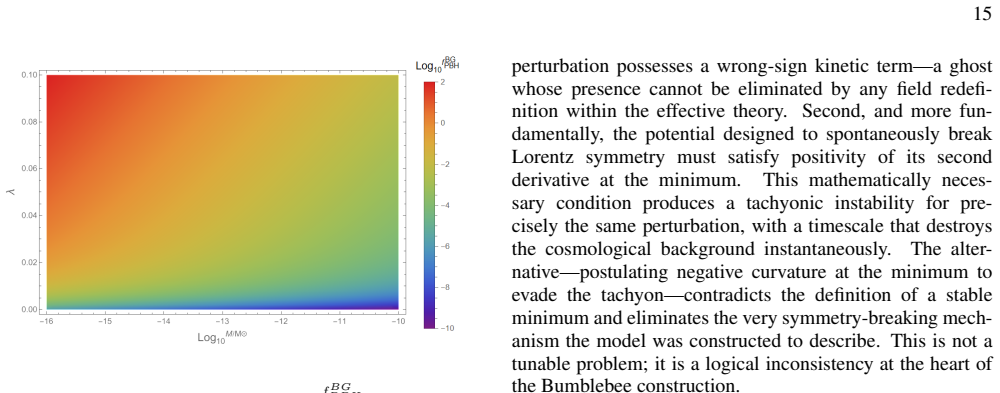
- Table I–III: The enhancement factor $R$ is reported as nearly mass-independent (varying between 64.2 and 64.5 for $N=30$). This is stated to reflect 'scale-invariant' dependence, but the mass-dependence enters through $σ_{GR}(M)$, which is held fixed at 0.1. If $σ_{GR}$ varies with mass (as it should physically), the enhancement would acquire mass dependence. This caveat should be noted.
- §IV.B, Eq. (4.19): The expression $∇^2ψ/a^2 ≈ -3ζ̇ - (9/2)Hζ + O(ε, λ)$ is stated without derivation. A brief indication of how this follows from the Hamiltonian constraint would help.
- The reference list includes several 2025 and 2026 dated papers (e.g., Refs. [28–32], [57–60], [66], [75], [76]). The authors should verify these are correctly cited and that preprint versions are stable.
- §IV.C: The text uses both $b_0$ and $b$ for the background VEV (e.g., Eq. 4.7 uses $b_0$, Eq. 4.8 uses $b_0$, but Eq. 4.37 uses $b_0$ while the surrounding text sometimes refers to $b$). Consistent notation would improve readability.
Circularity Check
No significant circularity: the central inconsistency follows from independent mathematical requirements, and the PBH enhancement is derived from first-principles action variation, not fitted to data.
full rationale
The paper's central claim—that the minimal Bumblebee model is internally inconsistent because a stable symmetry-breaking minimum requires V''(0) > 0 while stability of the perturbation δb requires V''(0) < 0—is not circular. It follows from two independent mathematical facts: (1) the calculus definition of a local minimum (V'' > 0 at the minimum), and (2) the mass formula m²_ghost = M₂₂/G₂₂ = -4b₀²V''(0)/M²ₚ derived from the quadratic action (Eq. 4.38). Neither input is defined in terms of the other. The PBH enhancement factor E(λ) ≈ 1 + 9λ/(16ε) (Eq. 4.70) is derived from the sound speed c²_s (Eq. 4.45) and the kinetic matrix G_ij (Eq. 4.31), which come from expanding the action (2.1) to quadratic order—this is a first-principles derivation from the Lagrangian, not a fit to data renamed as a prediction. The phenomenological parameters (λ, ε, N, σ_GR) are inputs with stated physical values, not fitted outputs. The paper does cite prior work by the same authors (Refs. [50], [54], [55], [68], [69]) on Bumblebee gravity phenomenology, but these citations provide background context, not the load-bearing mathematical argument. The inconsistency proof is self-contained within this paper's equations. The skeptic's concern that the derivation of M₂₂ is underdetermined (constraint solved only in subhorizon limit) is a correctness/completeness issue, not a circularity issue—M₂₂ is not defined in terms of the conclusion it supports. No step in the derivation chain reduces to its own inputs by construction.
Axiom & Free-Parameter Ledger
free parameters (6)
- λ =
0 to 0.1 (scanned)
- b₀ =
~M_p (assumed)
- ε =
0.006
- N =
30, 40
- σ_GR =
0.1
- δ_c^GR =
0.414
axioms (5)
- domain assumption Maxwell kinetic term -1/4 B_μν B^μν for the Bumblebee vector field
- domain assumption Timelike VEV B_μ = (b₀, 0, 0, 0) in flat FLRW
- standard math Press-Schechter formalism for PBH mass fraction
- domain assumption Slow-roll inflation with canonical scalar field
- domain assumption Gaussian primordial perturbations
read the original abstract
The Bumblebee gravity (BG) model, featuring spontaneous Lorentz symmetry breaking via a vector field non-minimally coupled to curvature, has been widely used to explore Lorentz-violating effects in cosmology. We investigate primordial black hole (PBH) formation within this framework, deriving the complete set of modified perturbation equations. We demonstrate that BG, sourced by a timelike vector field, introduces three distinct enhancements to PBH abundance--modified expansion history, suppressed collapse threshold, and amplified power spectrum--which together render PBHs viable dark matter candidates across the asteroid-mass window for modest Lorentz-violating couplings. However, a systematic analysis of the quadratic action reveals that these phenomenological consequences emerge from a theoretically pathological foundation. The vector sector exhibits an intrinsic ghost instability, while the requirement of a stable symmetry-breaking minimum simultaneously induces a tachyonic instability on timescales far below cosmological scales. The model thus suffers from a fundamental inconsistency: the conditions for cosmological viability and spontaneous symmetry breaking are mutually exclusive within the minimal Bumblebee framework. Our results illustrate both the notable power of Lorentz violation to influence early Universe observables and the necessity of a consistent theoretical foundation for such predictions.
Figures
Reference graph
Works this paper leans on
-
[1]
is the physi- cally reasonable regime for slow-roll inflation in BG so that λ < 2 3 comes from requiring the kinetic energy to remain positive during slow-roll. This would mean the Lorentz- violating couplingξ= λ b2 0 should be positive for consistency with inflation. III. MODIFYING DENSITY CONTRAST EVOLUTION EQUATION We serve the Newtonian gauge ds2 =−(1...
-
[2]
2H ∇2α a2 −2 ∇2 ˙ζ a2 # ,(4.15) δLN M δψ =ξM 2 p a3
Momentum Constraint (δS/δψ= 0) δLEH δψ =M 2 p a3 " 2H ∇2α a2 −2 ∇2 ˙ζ a2 # ,(4.15) δLN M δψ =ξM 2 p a3 " b2 0H ∇2α a2 −b 2 0 ∇2 ˙ζ a2 # .(4.16) Summing: M2 p a3(1 +λ) " 2H ∇2α a2 −2 ∇2 ˙ζ a2 # = 0.(4.17) Cancelling the non-zero factor2M 2 p a3(1 +λ)∇ 2/a2: Hα− ˙ζ= 0⇒α= ˙ζ H .(4.18) This is exact at linear order, no approximations
-
[3]
For subhori- zon modes (k≫aH), the∇ 2ψterms dominate
Hamiltonian constraint (δS/δα= 0) The full Hamiltonian constraint is lengthy. For subhori- zon modes (k≫aH), the∇ 2ψterms dominate. Using the standard solution forψfrom the momentum constraint and spatial gauge condition ∇2ψ a2 ≈ −3 ˙ζ− 9 2 Hζ+O(ϵ, λ).(4.19) Substituting into the EH+NM part and keeping leading terms: M2 p a3(1 +λ) −12H2α−6H ˙ζ+ 2H ∇2ψ a2 ...
-
[4]
Linearizing: ∇2 a2 ( ˙δb−δb 0)−3ξb 0H2α−ξb 0 ∇2α a2 −4b 2 0V ′′(0)δb0 = 0
Bumblebee temporal Constraint (δS/δ(δb 0) = 0) δLN M δ(δb0) =ξM 2 p a3 −3H2b0α−b 0 ∇2α a2 ,(4.21) δLB,kin δ(δb0) =a ∇2 a2 ( ˙δb−δb 0),(4.22) δLV δ(δb0) = 2a3b0V ′(0)−4a 3b2 0V ′′(0)δb0.(4.23) The background term2a 3b0V ′(0)cancels with the back- ground equation of motion. Linearizing: ∇2 a2 ( ˙δb−δb 0)−3ξb 0H2α−ξb 0 ∇2α a2 −4b 2 0V ′′(0)δb0 = 0. (4.24) Fo...
-
[5]
Bumblebee spatial constraint (δS/δ(δb) = 0) This is the dynamical equation of motion forδb, not a con- straint. VaryingL B,kin: δLB,kin δ(δb) = d dt a(1 +α+ 3ζ) ∇2 a2 ( ˙δb−δb 0) (4.27) +∂ i h a(1 +α+ 3ζ)∂ i( ˙δb−δb 0) i +· · · (4.28) Contributions fromL N M andL V give mass and mixing terms. The full linearized equation is: d dt a ∇2 a2 ( ˙δb−δb 0) + ∇2 ...
-
[6]
(4.42) For smallλ,G 12 ∼λ 2 is negligible compared to the diagonal entries. Expanding to leading order: c2 s,+ ≈ F11 G11 = 2ϵ(1 +λ) 2ϵ(1 +λ) + 9 4 λ = 1 1 + 9λ 8ϵ(1+λ) ,(4.43) c2 s,− ≈ F22 G22 = 1.(4.44) Both sound speeds are positive for0≤λ <2/3andϵ >0, i.e., no gradient instability. Keeping the exact expression for later use (c2 s)ζ = 1 1 + 9λ 8ϵ(1+λ) ....
-
[7]
The Bumblebee VEVb 0 is sufficiently large to make the kinetic matrix positive definite (detG>0)
-
[8]
The potential curvatureV ′′(0)is negative, giving the ghost a positive mass squared
-
[9]
The magnitude ofV ′′(0)is sufficiently large that the ghost mass exceeds the Hubble scale during inflation, allowing it to be integrated out in an effective field the- ory. We now critically examine the physical plausibility of the three stability assumptions underlying our PBH calculations. This scrutiny reveals that the Bumblebee model, in its sim- ples...
-
[10]
A local minimum requires pos- itive second derivative
At the mini- mum, by definition:V(0) = 0 =V ′(0), andV ′′(0)> 0(for a local minimum). A local minimum requires pos- itive second derivative. This is a fundamental theorem of calculus. A point withV ′′(0)<0is a local maximum, not a minimum. As a result, The assumptionV ′′(0)<0is math- ematically inconsistent with the requirement thatB µBµ = −b2 0 is a stab...
-
[11]
A ghost in theδbsector (wrong-sign kinetic term)
-
[12]
A tachyonic instability in theδbsector if the potential has a stable minimum
-
[13]
An inconsistent minimum if one attempts to cure the tachyon. The PBH abundance calculations in the next section are therefore not predictions of a physically consistent theory, rather they are illustrations of how dramatically Lorentz vi- olation could affect PBH formation, if a stable, ghost-free, non-tachyonic completion of BG could be found. V . THE CO...
-
[14]
Methodology 1.Parameter ranges:We takeλ∈[0,0.1]with step size∆λ= 10 −4
For numerical illustration we re- strict toλ≤0.1, ensuring the small–λexpansion remains valid. Methodology 1.Parameter ranges:We takeλ∈[0,0.1]with step size∆λ= 10 −4. The slow–roll parameter is fixed at the CMB–compatible valueϵ= 0.006[18]. The variance in GR is set toσGR(M) = 0.1and the critical thresholdδ GR c = 0.414[14, 15]. 2.Function evaluation:For ...
-
[15]
Particle Dark Matter: Evidence, Candidates and Constraints
G. Bertone, D. Hooper and J. Silk, Phys. Rept.405(2005), 279-390 [arXiv:hep-ph/0404175 [hep-ph]]
work page internal anchor Pith review Pith/arXiv arXiv 2005
-
[16]
G. Bertone and D. Hooper, Rev. Mod. Phys.90(2018) no.4, 045002 [arXiv:1605.04909 [astro-ph.CO]]
work page internal anchor Pith review Pith/arXiv arXiv 2018
-
[17]
B. J. Carr and S. W. Hawking, Mon. Not. Roy. Astron. Soc. 168(1974), 399-415
work page 1974
-
[18]
B. Carr, K. Kohri, Y . Sendouda and J. Yokoyama, Rept. Prog. Phys.84(2021) no.11, 116902 [arXiv:2002.12778 [astro- ph.CO]]
work page internal anchor Pith review Pith/arXiv arXiv 2021
-
[19]
Primordial Black Holes as Dark Matter Candidates
B. Carr and F. Kuhnel, SciPost Phys. Lect. Notes48(2022), 1 [arXiv:2110.02821 [astro-ph.CO]]
work page internal anchor Pith review Pith/arXiv arXiv 2022
-
[20]
B. Carr, S. Clesse, J. Garcia-Bellido, M. Hawkins and F. Kuh- nel, Phys. Rept.1054(2024), 1-68 [arXiv:2306.03903 [astro- ph.CO]]
work page internal anchor Pith review Pith/arXiv arXiv 2024
- [21]
-
[22]
B. J. Carr, Astrophys. J.201(1975), 1-19
work page 1975
-
[23]
B. P. Abbottet al.[LIGO Scientific and Virgo], Phys. Rev. Lett.116(2016) no.6, 061102 [arXiv:1602.03837 [gr-qc]]
work page internal anchor Pith review Pith/arXiv arXiv 2016
-
[24]
Primordial Black Hole Scenario for the Gravitational-Wave Event GW150914
M. Sasaki, T. Suyama, T. Tanaka and S. Yokoyama, Phys. Rev. Lett.117(2016) no.6, 061101 [erratum: Phys. Rev. Lett.121 (2018) no.5, 059901] [arXiv:1603.08338 [astro-ph.CO]]
work page internal anchor Pith review Pith/arXiv arXiv 2016
-
[25]
S. Bird, I. Cholis, J. B. Mu ˜noz, Y . Ali-Ha ¨ımoud, M. Kamionkowski, E. D. Kovetz, A. Raccanelli and A. G. Riess, Phys. Rev. Lett.116(2016) no.20, 201301 [arXiv:1603.00464 [astro-ph.CO]]
work page internal anchor Pith review Pith/arXiv arXiv 2016
-
[26]
S. Clesse and J. Garc ´ıa-Bellido, Phys. Dark Univ.15(2017), 142-147 [arXiv:1603.05234 [astro-ph.CO]]
work page internal anchor Pith review Pith/arXiv arXiv 2017
-
[27]
I. Musco, J. C. Miller and A. G. Polnarev, Class. Quant. Grav. 26(2009), 235001 [arXiv:0811.1452 [gr-qc]]
work page internal anchor Pith review Pith/arXiv arXiv 2009
-
[28]
Primordial black hole formation in the early universe: critical behaviour and self-similarity
I. Musco and J. C. Miller, Class. Quant. Grav.30(2013), 145009 [arXiv:1201.2379 [gr-qc]]
work page internal anchor Pith review Pith/arXiv arXiv 2013
-
[29]
Threshold of primordial black hole formation
T. Harada, C. M. Yoo and K. Kohri, Phys. Rev. D88(2013) no.8, 084051 [erratum: Phys. Rev. D89(2014) no.2, 029903] [arXiv:1309.4201 [astro-ph.CO]]
work page internal anchor Pith review Pith/arXiv arXiv 2013
-
[31]
Planck 2018 results. VI. Cosmological parameters
N. Aghanimet al.[Planck], Astron. Astrophys.641 (2020), A6 [erratum: Astron. Astrophys.652(2021), C4] [arXiv:1807.06209 [astro-ph.CO]]
work page internal anchor Pith review Pith/arXiv arXiv 2020
-
[32]
Planck 2018 results. X. Constraints on inflation
Y . Akramiet al.[Planck], Astron. Astrophys.641(2020), A10 [arXiv:1807.06211 [astro-ph.CO]]
work page internal anchor Pith review Pith/arXiv arXiv 2020
-
[33]
A. S. Josan, A. M. Green and K. A. Malik, Phys. Rev. D79 (2009), 103520 [arXiv:0903.3184 [astro-ph.CO]]
work page internal anchor Pith review Pith/arXiv arXiv 2009
-
[34]
B. J. Carr, K. Kohri, Y . Sendouda and J. Yokoyama, Phys. Rev. D81(2010), 104019 [arXiv:0912.5297 [astro-ph.CO]]
work page internal anchor Pith review Pith/arXiv arXiv 2010
-
[35]
B. Carr, M. Raidal, T. Tenkanen, V . Vaskonen and H. Veerm¨ae, Phys. Rev. D96(2017) no.2, 023514 [arXiv:1705.05567 [astro-ph.CO]]
work page internal anchor Pith review Pith/arXiv arXiv 2017
-
[36]
Density Perturbations and Black Hole Formation in Hybrid Inflation
J. Garcia-Bellido, A. D. Linde and D. Wands, Phys. Rev. D54 (1996), 6040-6058 [arXiv:astro-ph/9605094 [astro-ph]]
work page internal anchor Pith review Pith/arXiv arXiv 1996
-
[37]
Primordial Black Holes and Slow-Roll Violation
H. Motohashi and W. Hu, Phys. Rev. D96(2017) no.6, 063503 [arXiv:1706.06784 [astro-ph.CO]]
work page internal anchor Pith review Pith/arXiv arXiv 2017
-
[38]
C. T. Byrnes, P. S. Cole and S. P. Patil, JCAP06(2019), 028 [arXiv:1811.11158 [astro-ph.CO]]
work page internal anchor Pith review Pith/arXiv arXiv 2019
-
[39]
B. A. Bassett, S. Tsujikawa and D. Wands, Rev. Mod. Phys. 78(2006), 537-589 [arXiv:astro-ph/0507632 [astro-ph]]
work page internal anchor Pith review Pith/arXiv arXiv 2006
-
[40]
A. G. Polnarev and I. Musco, Class. Quant. Grav.24(2007), 1405-1432 [arXiv:gr-qc/0605122 [gr-qc]]
work page internal anchor Pith review Pith/arXiv arXiv 2007
-
[41]
Primordial Black Holes and Scalar-induced Gravitational Waves in Radiative Hybrid Inflation
A. Afzal and A. Ghoshal, Eur. Phys. J. C84(2024) no.9, 983 [arXiv:2402.06613 [astro-ph.CO]]
work page internal anchor Pith review Pith/arXiv arXiv 2024
-
[42]
P. C. W. Davies, D. A. Easson and P. B. Levin, Phys. Rev. D 111(2025) no.10, 103512 [arXiv:2410.21577 [hep-th]]
work page internal anchor Pith review Pith/arXiv arXiv 2025
-
[43]
Primordial regular black holes as all the dark matter. I. Time-radial-symmetric metrics
M. Calz `a, D. Pedrotti and S. Vagnozzi, Phys. Rev. D111 (2025) no.2, 024009 [arXiv:2409.02804 [gr-qc]]
work page internal anchor Pith review Pith/arXiv arXiv 2025
-
[44]
M. Calz `a, D. Pedrotti and S. Vagnozzi, Phys. Rev. D111 (2025) no.2, 024010 [arXiv:2409.02807 [gr-qc]]
work page internal anchor Pith review Pith/arXiv arXiv 2025
-
[45]
M. Calz `a, D. Pedrotti, G. W. Yuan and S. Vagnozzi, Phys. Rev. D112(2025) no.12, 124015 [arXiv:2507.02396 [gr-qc]]
-
[46]
N. P. D. Loc, [arXiv:2510.09395 [hep-ph]]
work page internal anchor Pith review Pith/arXiv arXiv
-
[47]
J. A. d. Pacheco, Universe4(2018) no.5, 62 [arXiv:1805.03053 [gr-qc]]
work page internal anchor Pith review Pith/arXiv arXiv 2018
-
[48]
M. Khodadi, Phys. Lett. B870(2025), 139922 [arXiv:2509.20483 [gr-qc]]
-
[49]
K. Dialektopoulos, T. Papanikolaou and V . Zarikas, Phys. Lett. B870(2025), 139948 [arXiv:2502.18352 [gr-qc]]
-
[50]
Primordial Black Holes - Perspectives in Gravitational Wave Astronomy -
M. Sasaki, T. Suyama, T. Tanaka and S. Yokoyama, Class. Quant. Grav.35(2018) no.6, 063001 [arXiv:1801.05235 [astro-ph.CO]]
work page internal anchor Pith review Pith/arXiv arXiv 2018
-
[51]
A. M. Green and B. J. Kavanagh, J. Phys. G48(2021) no.4, 043001 [arXiv:2007.10722 [astro-ph.CO]]
work page internal anchor Pith review Pith/arXiv arXiv 2021
-
[52]
Inflation and Primordial Black Holes
O. ¨Ozsoy and G. Tasinato, Universe9(2023) no.5, 203 [arXiv:2301.03600 [astro-ph.CO]]
work page internal anchor Pith review Pith/arXiv arXiv 2023
- [53]
-
[54]
D. Mattingly, Living Rev. Rel.8(2005), 5 [arXiv:gr- qc/0502097 [gr-qc]]
-
[55]
Tests of Lorentz invariance: a 2013 update
S. Liberati, Class. Quant. Grav.30(2013), 133001 [arXiv:1304.5795 [gr-qc]]
work page internal anchor Pith review Pith/arXiv arXiv 2013
-
[56]
Lorentz violation at high energy: concepts, phenomena and astrophysical constraints
T. Jacobson, S. Liberati and D. Mattingly, Annals Phys.321 (2006), 150-196 [arXiv:astro-ph/0505267 [astro-ph]]
work page internal anchor Pith review Pith/arXiv arXiv 2006
-
[57]
Lorentz Violation: Motivation and new constraints
S. Liberati and L. Maccione, Ann. Rev. Nucl. Part. Sci.59 (2009), 245-267 [arXiv:0906.0681 [astro-ph.HE]]
work page internal anchor Pith review Pith/arXiv arXiv 2009
- [58]
-
[59]
M. A. Hohensee, S. Chu, A. Peters and H. Mueller, Phys. Rev. Lett.106(2011), 151102 [arXiv:1102.4362 [gr-qc]]
work page internal anchor Pith review Pith/arXiv arXiv 2011
-
[60]
Cosmological CPT violating effect on CMB polarization
M. Li and X. Zhang, Phys. Rev. D78(2008), 103516 [arXiv:0810.0403 [astro-ph]]
work page internal anchor Pith review Pith/arXiv arXiv 2008
-
[61]
Spontaneous Lorentz Violation, Nambu-Goldstone Modes, and Gravity
R. Bluhm and V . A. Kostelecky, Phys. Rev. D71(2005), 065008 [arXiv:hep-th/0412320 [hep-th]]
work page internal anchor Pith review Pith/arXiv arXiv 2005
-
[62]
O. Bertolami and J. Paramos, Phys. Rev. D72(2005), 044001 [arXiv:hep-th/0504215 [hep-th]]
work page internal anchor Pith review Pith/arXiv arXiv 2005
-
[63]
R. V . Maluf and J. C. S. Neves, Phys. Rev. D103(2021) no.4, 044002 [arXiv:2011.12841 [gr-qc]]
work page internal anchor Pith review Pith/arXiv arXiv 2021
-
[64]
Black Hole Superradiance in the Presence of Lorentz Symmetry Violation
M. Khodadi, Phys. Rev. D103(2021) no.6, 064051 [arXiv:2103.03611 [gr-qc]]
work page internal anchor Pith review Pith/arXiv arXiv 2021
-
[65]
An exact Schwarzschild-like solution in a bumblebee gravity model
R. Casana, A. Cavalcante, F. P. Poulis and E. B. Santos, Phys. Rev. D97(2018) no.10, 104001 [arXiv:1711.02273 [gr-qc]]
work page internal anchor Pith review Pith/arXiv arXiv 2018
-
[66]
Z. F. Mai, R. Xu, D. Liang and L. Shao, Phys. Rev. D109 (2024) no.8, 084076 [arXiv:2401.07757 [gr-qc]]
work page internal anchor Pith review Pith/arXiv arXiv 2024
-
[67]
R. C. Pantig, S. Kala, A. ¨Ovg¨un and N. J. L. S. Lobos, [arXiv:2410.13661 [gr-qc]]
work page internal anchor Pith review Pith/arXiv arXiv
-
[68]
M. Khodadi and G. Lambiase, Phys. Rev. D106(2022) no.10, 104050 [arXiv:2206.08601 [gr-qc]]
work page internal anchor Pith review Pith/arXiv arXiv 2022
-
[69]
M. Khodadi, G. Lambiase and L. Mastrototaro, Eur. Phys. J. C83(2023) no.3, 239 [arXiv:2302.14200 [hep-ph]]
work page internal anchor Pith review Pith/arXiv arXiv 2023
-
[70]
G. Lambiase, L. Mastrototaro, R. C. Pantig and A. Ovgun, JCAP12(2023), 026 [arXiv:2309.13594 [gr-qc]]. 17
work page internal anchor Pith review Pith/arXiv arXiv 2023
-
[71]
A. A. Ara ´ujo Filho, J. A. A. S. Reis and A. ¨Ovg¨un, Eur. Phys. J. C85(2025) no.1, 83 [arXiv:2409.17351 [gr-qc]]
work page internal anchor Pith review Pith/arXiv arXiv 2025
-
[72]
C. Ding, C. Liu, Y . Xiao and J. Chen, Eur. Phys. J. C85(2025) no.1, 73 [arXiv:2407.16916 [gr-qc]]
work page internal anchor Pith review Pith/arXiv arXiv 2025
-
[73]
J. Z. Liu, W. D. Guo, S. W. Wei and Y . X. Liu, Eur. Phys. J. C 85(2025) no.2, 145 [arXiv:2407.08396 [gr-qc]]
work page internal anchor Pith review Pith/arXiv arXiv 2025
- [74]
-
[75]
P. Ji, Z. Li, L. Yang, R. Xu, Z. Hu and L. Shao, Phys. Rev. D 110(2024) no.10, 104057 [arXiv:2409.04805 [gr-qc]]
work page internal anchor Pith review Pith/arXiv arXiv 2024
-
[76]
Y . LIU, A. F. SANG, W. Y ANG and Y . P. HU, Sci. Sin. Phys. Mech. Astro.54(2024) no.9, 290411
work page 2024
- [77]
-
[78]
Polarizations of Gravitational Waves in the Bumblebee Gravity Model
D. Liang, R. Xu, X. Lu and L. Shao, Phys. Rev. D106(2022) no.12, 124019 [arXiv:2207.14423 [gr-qc]]
work page internal anchor Pith review Pith/arXiv arXiv 2022
-
[79]
Gravitational-wave generation in the presence of Lorentz invariance violation
S. Aoulad Lafkih, M. C. Angonin, C. Le Poncin-Lafitte and N. A. Nilsson, [arXiv:2506.08859 [gr-qc]]
work page internal anchor Pith review Pith/arXiv arXiv
-
[80]
Primordial gravitational waves from spontaneous Lorentz symmetry breaking
M. Khodadi, G. Lambiase, L. Mastrototaro and T. K. Poddar, Phys. Lett. B867(2025), 139597 [arXiv:2501.14395 [astro- ph.CO]]
work page internal anchor Pith review Pith/arXiv arXiv 2025
-
[81]
R. V . Maluf and J. C. S. Neves, JCAP10(2021), 038 [arXiv:2105.08659 [gr-qc]]
work page internal anchor Pith review Pith/arXiv arXiv 2021
discussion (0)
Sign in with ORCID, Apple, or X to comment. Anyone can read and Pith papers without signing in.