REVIEW 2 major objections 5 minor 54 references
Reviewed by Pith at T0; open to challenge.
T0 means a machine referee read the full paper against a public rubric. The mark states how deep the mechanical check went, never who wrote it. the ladder, T0–T4 →
T0 review · glm-5.2
Hadrons persist in hot QCD matter up to 250 MeV
2026-07-09 19:03 UTC pith:B5Y7PD2K
load-bearing objection Three-parameter EoS fits lattice QCD well, but the headline claim about hadronic persistence to ~250 MeV is model-dependent on an ad hoc switching function the 2 major comments →
Hadronic and partonic composition of QCD matter across the crossover
The pith
A machine-rendered reading of the paper's core claim, the machinery that carries it, and where it could break.
Core claim
The central finding is quantitative: when a hadron gas with meson excluded-volume repulsion is smoothly matched to a quark-gluon gas with a phenomenological interaction term, the temperature at which the partonic component takes over is not the chiral pseudocritical temperature of 155 MeV but rather about 216 MeV, with hadronic matter still contributing roughly 43% of the pressure at 250 MeV. This means the conventional identification of the chiral crossover temperature with the hadron-to-quark transition temperature is misleading for thermodynamic purposes.
What carries the argument
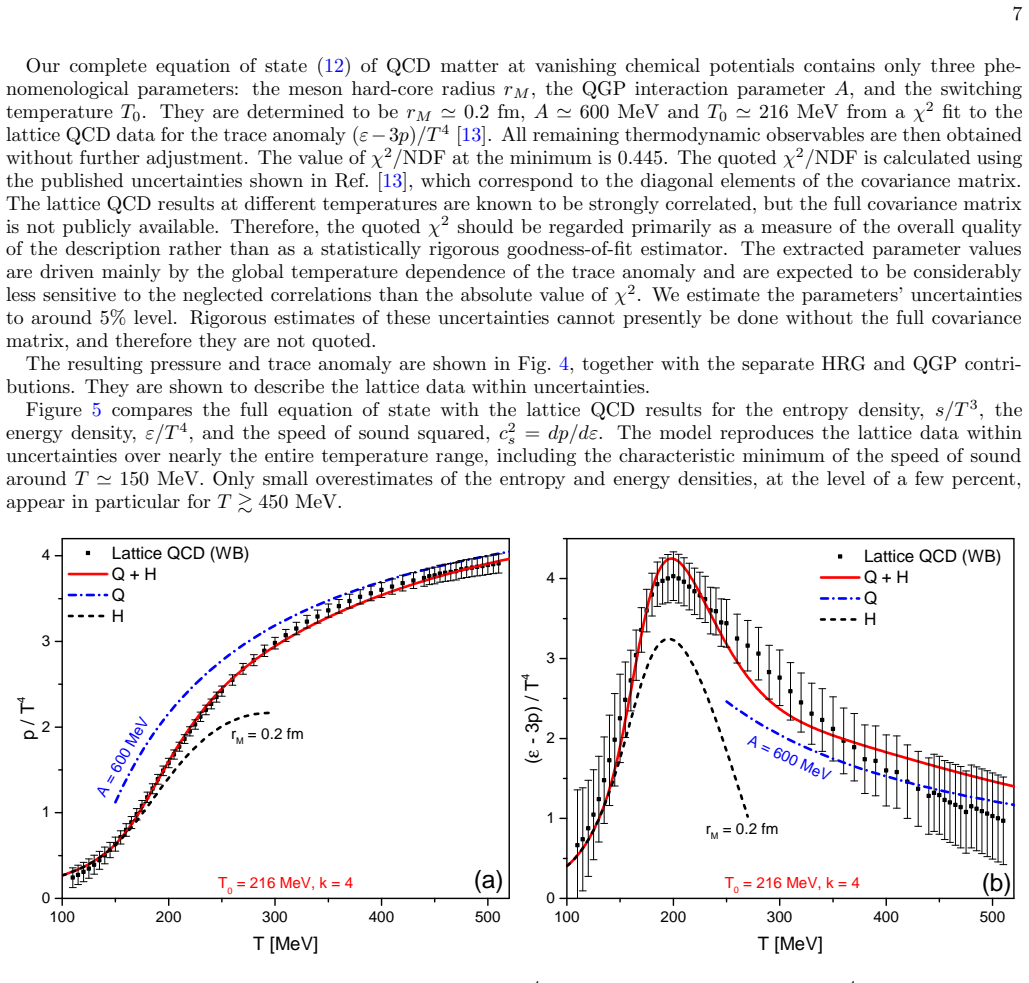
The mechanism carrying the argument is the switching function K(T) = exp[-(T0/T)^4], which smoothly weights the QGP and hadronic pressures. Its temperature derivative generates crossing terms in the entropy density, but these remain below 10% of the total, so the thermodynamics is dominated by the two physical components rather than by the interpolation artifact. The three fitted parameters (meson radius, QGP interaction strength, switching temperature) are overdetermined by the requirement of simultaneously reproducing pressure, trace anomaly, entropy density, energy density, and speed of sound.
Load-bearing premise
The switching function K(T) = exp[-(T0/T)^4] is an ad hoc interpolation formula. A different smooth crossover function could fit the same lattice data equally well while yielding a different switching temperature and a different hadronic weight at a given temperature. The extracted value of T0 = 216 MeV is therefore conditional on this specific functional choice.
What would settle it
If an alternative, equally smooth switching function fitted to the same lattice trace anomaly data produced a switching temperature near 155 MeV with negligible hadronic weight above 200 MeV, the central claim that hadrons persist to 250 MeV would be an artifact of the chosen interpolation rather than a physical result.
If this is right
- If hadronic degrees of freedom persist to 250 MeV, then thermal photon and dilepton emission from the crossover region may receive substantial hadronic contributions that current QGP-only calculations miss.
- The meson hard-core radius of 0.2 fm, being negligible below 160 MeV, should not affect chemical freeze-out fits to hadron yields, preserving the consistency of existing thermal-model analyses.
- The phenomenological interaction parameter A ~ 600 MeV, being of order the QCD scale, supports the picture that nonperturbative confining correlations survive in the QGP well above the crossover, connecting to proposals about chirally symmetric but still confined matter.
- The result motivates using conserved-charge susceptibilities as an additional constraint, since at finite chemical potential the switching function and QGP interaction term will contribute to baryon-number fluctuations that the current zero-chemical-potential fit cannot constrain.
Editorial analysis
A structured set of objections, weighed in public.
Referee Report
Summary. This manuscript constructs a phenomenological equation of state (EoS) for QCD matter at zero chemical potentials by interpolating between a quantum van der Waals hadron resonance gas (with meson excluded-volume repulsion) and an ideal quark-gluon gas supplemented by a $-AT^3$ interaction term. The interpolation uses a switching function $K(T) = e^{-(T_0/T)^k}$. Three parameters ($r_M$, $A$, $T_0$) are fitted to the Wuppertal-Budapest lattice QCD trace anomaly, yielding $r_M{=}0.2$ fm, $A{=}600$ MeV, and $T_0{=}216$ MeV. The EoS reproduces lattice data for pressure, entropy density, energy density, and speed of sound over $T=100$–$500$ MeV. The central physical claim is that $T_0$ substantially exceeds the chiral pseudocritical temperature $T_{pc}{=}155$ MeV, implying hadronic degrees of freedom persist up to $T{=}250$ MeV.
Significance. The paper provides a simple, thermodynamically consistent EoS that accurately reproduces lattice QCD thermodynamics across a broad temperature range with only three fitted parameters. The observation that the trace anomaly peak can be reproduced by hadronic interactions alone (Fig. 1b) is a useful and non-trivial point. The finding that $T_0$ exceeds $T_{pc}$ aligns with emerging theoretical pictures (chiralspin symmetry, quarkyonic matter) in which hadronic correlations survive well above the chiral crossover. The model is falsifiable: alternative switching functions or statistical-mixture approaches could yield different $T_0$ values, and the authors acknowledge this. The code base (Thermal-FIST) is publicly available, supporting reproducibility.
major comments (2)
- §IV, Eq. (13) and surrounding discussion: The headline claim that hadronic degrees of freedom persist to $T{=}250$ MeV rests on interpreting $1{-}K(T)$ as the physical hadronic fraction, where $K(T){=}e^{-(T_0/T)^4}$ is an ad hoc interpolation formula. The paper itself acknowledges the choice of switching function is an open question. Since the three parameters are fitted to the trace anomaly and the crossing terms in entropy are $<10$% of the total, a different smooth functional form (e.g., Fermi function, tanh, or the statistical-mixture approach of Ref. [40]) could redistribute weight between HRG and QGP components while fitting the same lattice data comparably well, potentially shifting $T_0$ and the hadronic fraction at 250 MeV. The paper should either (a) demonstrate robustness of $T_0$ by refitting with at least one alternative switching function, or (b) more prominently qualify $
- §IV, Fig. 1(b) and discussion of $r_M$: The trace anomaly peak near $T{=}200$ MeV is already reproduced by the HRG alone for $r_M{=}0.14$ fm, yet the fit yields $r_M{=}0.2$ fm. This suggests partial degeneracy between $r_M$, $A$, and $T_0$: the QGP component and switching function absorb the difference between the HRG-only peak and the lattice data. The paper should discuss this degeneracy explicitly and explain what drives the fit toward $r_M{=}0.2$ fm rather than $0.14$ fm. Without this, it is unclear whether $r_M$ is independently constrained or merely compensates for the QGP/switching contributions.
minor comments (5)
- §IV: The statement that crossing terms are 'below approximately 10% of the total entropy density' should specify the temperature range where this maximum is reached, to clarify whether the bound holds across the entire crossover region or only at specific temperatures.
- §IV, Eq. (14): The crossing term $dK/dT (p_Q - p_H)$ could change sign depending on the relative magnitudes of $p_Q$ and $p_H$. A brief comment on its sign and magnitude across the temperature range would help readers interpret Fig. 3(b).
- §III, Eq. (11): The relation $A {=} 1.8 Lambda_{MS}$ is quoted using a value from Ref. [44]. The numerical value of $Lambda_{MS}$ used should be stated explicitly to make the comparison self-contained.
- §II: The meson excluded-volume prescription (Eqs. 6–7) treats all meson species with a single hard-core radius. A brief comment on whether this simplification is motivated by lack of species-specific data or by a physical argument would contextualize the approach relative to multi-component excluded-volume formulations.
- Abstract and §V: The phrase 'hadronic states remaining an important component' could be read as a direct QCD prediction. Adding a qualifier such as 'within this model' or 'as inferred from this EoS parametrization' would prevent misinterpretation.
Circularity Check
Mild circularity: 'reproduction' of pressure, entropy, energy density, and speed of sound is a thermodynamic consequence of the trace-anomaly fit, not independent validation.
specific steps
-
fitted input called prediction
[Sec. IV, Eqs. (8), (12), (14); abstract]
"The three model parameters—the meson hard-core radius, the strength of the partonic interaction term, and the switching temperature—are determined from a fit to lattice QCD results for the trace anomaly. The resulting equation of state reproduces the lattice data on the pressure, entropy density, energy density, and speed of sound in the temperature range T=100–500 MeV. [...] All remaining thermodynamic observables are then obtained without further adjustment."
The trace anomaly I(T) = (ε−3p)/T⁴ = T·d(p/T⁴)/d(ln T) is the logarithmic derivative of the scaled pressure. Fitting the three model parameters to the trace anomaly determines p(T) up to the boundary condition p→0 as T→0, which the model satisfies by construction (K→0, HRG pressure vanishes). Once p(T) is fixed, Eq. (8) yields s = dp/dT, ε = T·dp/dT − p, and c²ₛ = dp/dε as mathematical identities. The 'reproduction' of these quantities is therefore a consequence of thermodynamic consistency, not an independent test of the model. The paper presents this as validation ('without further adjustment'), but the only genuinely fitted quantity is the trace anomaly; the rest follow by construction. This is mild because (a) the paper is transparent about using Eq. (8), (b) it is standard practice in
full rationale
The paper's central physical claim — T₀ ≃ 216 MeV and the persistence of hadronic degrees of freedom to ~250 MeV — is not circular: T₀ is a genuinely fitted parameter, and its interpretation, while model-dependent (the switching function form is ad hoc and the paper acknowledges this), does not reduce to its inputs by definition. The QvdW-HRG model (Ref. [20], co-authored by Vovchenko and Gorenstein) is a model choice validated against nuclear matter properties, not a self-citation invoked to prove uniqueness. The Thermal-FIST package (Ref. [25]) is a computational tool. No uniqueness theorem is invoked. The only circularity is the mild one above: fitting the trace anomaly and then 'reproducing' p, s, ε, c²ₛ, which are all derived from the same p(T) via standard thermodynamic identities. This is standard practice in EoS modeling and the paper is transparent about it, so the score remains low.
Axiom & Free-Parameter Ledger
free parameters (5)
- r_M (meson hard-core radius) =
0.2 fm
- A (QGP interaction scale) =
600 MeV
- T_0 (switching temperature) =
216 MeV
- k (switching function exponent) =
4
- a, b (baryon van der Waals parameters) =
a=329 MeV fm³, b=3.42 fm³
axioms (5)
- domain assumption Lattice QCD data from the Wuppertal-Budapest Collaboration (Ref. [13]) are correct and represent physical QCD thermodynamics at zero chemical potential.
- ad hoc to paper The switching function K(T) = exp[−(T₀/T)^k] provides a physically meaningful interpolation between hadronic and partonic phases.
- ad hoc to paper The −AT³ correction to the QGP pressure is an adequate phenomenological parametrization of nonperturbative effects in the temperature range 100–500 MeV.
- domain assumption Van der Waals parameters fitted to nuclear matter at T=0 are universal for all baryon species at all temperatures.
- domain assumption The PDG2020 hadron list is complete enough for thermodynamic calculations in the considered temperature range.
invented entities (2)
-
Meson hard-core radius r_M
no independent evidence
-
QGP interaction scale A
no independent evidence
read the original abstract
We construct a simple equation of state of strongly interacting matter at zero chemical potentials that provides a unified description of lattice QCD thermodynamics in terms of hadronic and partonic degrees of freedom. The hadronic phase is described by the quantum van der Waals hadron resonance gas, extended by excluded-volume repulsion between mesons, while the quark-gluon plasma is modeled as an ideal gas of quarks and gluons supplemented with a phenomenological interaction term proportional to $T^3$. The two regimes are connected by a smooth crossover switching function. The three model parameters - the meson hard-core radius, the strength of the partonic interaction term, and the switching temperature - are determined from a fit to lattice QCD results for the trace anomaly. The resulting equation of state reproduces the lattice data on the pressure, entropy density, energy density, and speed of sound in the temperature range $T=100$-$500$ MeV. The fit yields a meson hard-core radius $r_M \simeq 0.2$ fm, a partonic interaction scale $A \simeq 600$ MeV, and a switching temperature $T_0 \simeq 216$ MeV, substantially exceeding both the pseudocritical temperature of the QCD chiral crossover and the chemical freeze-out temperature. This finding suggests that the transition from hadronic to partonic degrees of freedom is considerably more gradual than indicated by the chiral pseudocritical temperature alone, with hadronic states remaining an important component of strongly interacting matter up to temperatures of about 250 MeV, well above the QCD chiral crossover.
Figures



Reference graph
Works this paper leans on
- [1]
- [2]
-
[3]
Bayesian location of the QCD critical point from a holographic perspective
M. Hippert, J. Grefa, T. A. Manning, J. Noronha, J. Noronha-Hostler, I. Portillo Vazquez, C. Ratti, R. Rougemont, and M. Trujillo, Bayesian location of the QCD critical point from a holographic perspective, Phys. Rev. D110, 094006 (2024), arXiv:2309.00579 [nucl-th]
work page internal anchor Pith review Pith/arXiv arXiv 2024
- [4]
- [5]
-
[6]
Y. Aoki, G. Endrodi, Z. Fodor, S. D. Katz, and K. K. Szabo, The Order of the quantum chromodynamics transition predicted by the standard model of particle physics, Nature443, 675 (2006), arXiv:hep-lat/0611014
work page internal anchor Pith review Pith/arXiv arXiv 2006
-
[7]
The chiral and deconfinement aspects of the QCD transition
A. Bazavovet al., The chiral and deconfinement aspects of the QCD transition, Phys. Rev. D85, 054503 (2012), arXiv:1111.1710 [hep-lat]
work page internal anchor Pith review Pith/arXiv arXiv 2012
-
[8]
The QCD crossover at finite chemical potential from lattice simulations
S. Borsanyi, Z. Fodor, J. N. Guenther, R. Kara, S. D. Katz, P. Parotto, A. Pasztor, C. Ratti, and K. K. Szabo, QCD Crossover at Finite Chemical Potential from Lattice Simulations, Phys. Rev. Lett.125, 052001 (2020), arXiv:2002.02821 [hep-lat]
work page internal anchor Pith review Pith/arXiv arXiv 2020
-
[9]
S. Borsanyiet al., Calculation of the axion mass based on high-temperature lattice quantum chromodynamics, Nature 539, 69 (2016), arXiv:1606.07494 [hep-lat]
work page internal anchor Pith review Pith/arXiv arXiv 2016
-
[10]
Decoding the phase structure of QCD via particle production at high energy
A. Andronic, P. Braun-Munzinger, K. Redlich, and J. Stachel, Decoding the phase structure of QCD via particle production at high energy, Nature561, 321 (2018), arXiv:1710.09425 [nucl-th]. 10
work page internal anchor Pith review Pith/arXiv arXiv 2018
-
[11]
Exploring the QCD phase diagram through correlations and fluctuations
V. Koch and V. Vovchenko, Exploring the QCD phase diagram through correlations and fluctuations (2025), arXiv:2512.04288 [nucl-th]
work page internal anchor Pith review Pith/arXiv arXiv 2025
-
[12]
P. Braun-Munzinger, K. Redlich, and J. Stachel, The quark-gluon plasma: diagnosis with thermal hadron production from the early history until detailed characterization at high energy colliders (2025) arXiv:2506.04733 [nucl-th], arXiv:2506.04733 [nucl-th]
work page internal anchor Pith review Pith/arXiv arXiv 2025
-
[13]
Full result for the QCD equation of state with 2+1 flavors
S. Borsanyi, Z. Fodor, C. Hoelbling, S. D. Katz, S. Krieg, and K. K. Szabo, Full result for the QCD equation of state with 2+1 flavors, Phys. Lett. B730, 99 (2014), arXiv:1309.5258 [hep-lat]
work page internal anchor Pith review Pith/arXiv arXiv 2014
-
[14]
The equation of state in (2+1)-flavor QCD
A. Bazavovet al.(HotQCD), Equation of state in ( 2+1 )-flavor QCD, Phys. Rev. D90, 094503 (2014), arXiv:1407.6387 [hep-lat]
work page internal anchor Pith review Pith/arXiv arXiv 2014
-
[15]
Matching Excluded Volume Hadron Resonance Gas Models and Perturbative QCD to Lattice Calculations
M. Albright, J. Kapusta, and C. Young, Matching Excluded Volume Hadron Resonance Gas Models and Perturbative QCD to Lattice Calculations, Phys. Rev. C90, 024915 (2014), arXiv:1404.7540 [nucl-th]
work page internal anchor Pith review Pith/arXiv arXiv 2014
-
[16]
L. Y. Glozman, Chiralspin symmetry and QCD at high temperature, Eur. Phys. J. A54, 117 (2018), arXiv:1712.05168 [hep-ph]
work page internal anchor Pith review Pith/arXiv arXiv 2018
-
[17]
L. Y. Glozman, A. V. Nefediev, and R. F. Wagenbrunn, Confined but chirally and chiral spin symmetric hot matter, Eur. Phys. J. C85, 462 (2025), arXiv:2410.13297 [hep-ph]
work page internal anchor Pith review Pith/arXiv arXiv 2025
-
[18]
Phases of Dense Quarks at Large N_c
L. McLerran and R. D. Pisarski, Phases of cold, dense quarks at large N(c), Nucl. Phys. A796, 83 (2007), arXiv:0706.2191 [hep-ph]
work page internal anchor Pith review Pith/arXiv arXiv 2007
-
[19]
Two Lectures on the Phase Diagram of QCD
L. McLerran, Two Lectures on the Phase Diagram of QCD, Acta Phys. Polon. B57, 4 (2026), arXiv:2604.03849 [hep-ph]
work page internal anchor Pith review Pith/arXiv arXiv 2026
-
[20]
van der Waals Interactions in Hadron Resonance Gas: From Nuclear Matter to Lattice QCD
V. Vovchenko, M. I. Gorenstein, and H. Stoecker, van der Waals Interactions in Hadron Resonance Gas: From Nuclear Matter to Lattice QCD, Phys. Rev. Lett.118, 182301 (2017), arXiv:1609.03975 [hep-ph]
work page internal anchor Pith review Pith/arXiv arXiv 2017
-
[21]
M. Albright, J. Kapusta, and C. Young, Baryon Number Fluctuations from a Crossover Equation of State Compared to Heavy-Ion Collision Measurements in the Beam Energy Range √sN N = 7.7 to 200 GeV, Phys. Rev. C92, 044904 (2015), arXiv:1506.03408 [nucl-th]
work page internal anchor Pith review Pith/arXiv arXiv 2015
-
[22]
S. Borsanyi, Z. Fodor, C. Hoelbling, S. D. Katz, S. Krieg, C. Ratti, and K. K. Szabo (Wuppertal-Budapest), Is there still anyT c mystery in lattice QCD? Results with physical masses in the continuum limit III, JHEP09, 073, arXiv:1005.3508 [hep-lat]
work page internal anchor Pith review Pith/arXiv arXiv
-
[23]
V. Vovchenko and H. St¨ ocker, Surprisingly large uncertainties in temperature extraction from thermal fits to hadron yield data at LHC, J. Phys. G44, 055103 (2017), arXiv:1512.08046 [hep-ph]
work page internal anchor Pith review Pith/arXiv arXiv 2017
-
[24]
Finite resonance widths influence the thermal-model description of hadron yields
V. Vovchenko, M. I. Gorenstein, and H. Stoecker, Finite resonance widths influence the thermal-model description of hadron yields, Phys. Rev. C98, 034906 (2018), arXiv:1807.02079 [nucl-th]
work page internal anchor Pith review Pith/arXiv arXiv 2018
-
[25]
Thermal-FIST: A package for heavy-ion collisions and hadronic equation of state
V. Vovchenko and H. Stoecker, Thermal-FIST: A package for heavy-ion collisions and hadronic equation of state, Comput. Phys. Commun.244, 295 (2019), arXiv:1901.05249 [nucl-th]
work page internal anchor Pith review Pith/arXiv arXiv 2019
-
[26]
Scaled variance, skewness, and kurtosis near the critical point of nuclear matter
V. Vovchenko, D. V. Anchishkin, M. I. Gorenstein, and R. V. Poberezhnyuk, Scaled variance, skewness, and kurtosis near the critical point of nuclear matter, Phys. Rev. C92, 054901 (2015), arXiv:1506.05763 [nucl-th]
work page internal anchor Pith review Pith/arXiv arXiv 2015
-
[27]
Lattice QCD constraints on the critical point from an improved precision equation of state
S. Borsanyi, Z. Fodor, J. N. Guenther, P. Parotto, A. Pasztor, C. Ratti, V. Vovchenko, and C. H. Wong, Lattice QCD constraints on the critical point from an improved precision equation of state, Phys. Rev. D112, L111505 (2025), arXiv:2502.10267 [hep-lat]
work page internal anchor Pith review Pith/arXiv arXiv 2025
-
[28]
L. D. Landau and E. M. Lifshitz,Statistical Physics, Part 1, Course of Theoretical Physics, Vol. 5 (Butterworth-Heinemann, Oxford, 1980)
work page 1980
-
[29]
An effective chiral Hadron-Quark Equation of State
J. Steinheimer, S. Schramm, and H. Stocker, An Effective chiral Hadron-Quark Equation of State, J. Phys. G38, 035001 (2011), arXiv:1009.5239 [hep-ph]
work page internal anchor Pith review Pith/arXiv arXiv 2011
-
[30]
Hadron Resonance Gas Equation of State from Lattice QCD
V. Vovchenko, D. V. Anchishkin, and M. I. Gorenstein, Hadron Resonance Gas Equation of State from Lattice QCD, Phys. Rev. C91, 024905 (2015), arXiv:1412.5478 [nucl-th]
work page internal anchor Pith review Pith/arXiv arXiv 2015
-
[31]
Equation of state for hot QCD and compact stars from a mean field approach
A. Motornenko, J. Steinheimer, V. Vovchenko, S. Schramm, and H. Stoecker, Equation of state for hot QCD and compact stars from a mean field approach, Phys. Rev. C101, 034904 (2020), arXiv:1905.00866 [hep-ph]
work page internal anchor Pith review Pith/arXiv arXiv 2020
-
[32]
R. V. Poberezhnyuk, V. Vovchenko, D. V. Anchishkin, and M. I. Gorenstein, Limiting temperature of pion gas with the van der Waals equation of state, J. Phys. G43, 095105 (2016), arXiv:1508.04585 [nucl-th]
work page internal anchor Pith review Pith/arXiv arXiv 2016
-
[33]
Thermodynamics of Van der Waals Fluids with quantum statistics
K. Redlich and K. Zalewski, Thermodynamics of Van der Waals Fluids with quantum statistics, Acta Phys. Polon. B47, 1943 (2016), arXiv:1605.09686 [cond-mat.quant-gas]
work page internal anchor Pith review Pith/arXiv arXiv 1943
-
[34]
R. Dashen, S.-K. Ma, and H. J. Bernstein, S Matrix formulation of statistical mechanics, Phys. Rev.187, 345 (1969)
work page 1969
-
[35]
What Thermodynamics tells about QCD Plasma near Phase Transition
M. Asakawa and T. Hatsuda, What thermodynamics tells about QCD plasma near phase transition, Phys. Rev. D55, 4488 (1997), arXiv:hep-ph/9508360
work page internal anchor Pith review Pith/arXiv arXiv 1997
-
[36]
H. Satz, The Quark-Gluon Plasma: A Short Introduction, Nucl. Phys. A862-863, 4 (2011), arXiv:1101.3937 [hep-ph]
work page internal anchor Pith review Pith/arXiv arXiv 2011
-
[37]
M. Xu, M. Yu, and Y. Wu, Investigation on the contribution of the particle mass to the interaction measure, J. Phys. G 40, 015107 (2013), arXiv:1211.4653 [hep-ph]
work page internal anchor Pith review Pith/arXiv arXiv 2013
-
[38]
Navaset al.(Particle Data Group), Review of particle physics, Phys
S. Navaset al.(Particle Data Group), Review of particle physics, Phys. Rev. D110, 030001 (2024)
work page 2024
-
[39]
Equation of state at finite densities for QCD matter in nuclear collisions
A. Monnai, B. Schenke, and C. Shen, Equation of state at finite densities for QCD matter in nuclear collisions, Phys. Rev. C100, 024907 (2019), arXiv:1902.05095 [nucl-th]
work page internal anchor Pith review Pith/arXiv arXiv 2019
-
[40]
Y. Yang, P. Garella, M. R. Khan, T. E. Restrepo, J. Grefa, J. Jahan, M. Hippert, J. Noronha, C. Ratti, and R. Rougemont, Merging multidimensional equations of state of strongly interacting matter via a statistical mixture, Phys. Rev. D113, 114018 (2026), arXiv:2601.07987 [nucl-th]
-
[41]
R. Poberezhnyuk, V. Vovchenko, A. Motornenko, M. I. Gorenstein, and H. Stoecker, Chemical freeze-out conditions and fluctuations of conserved charges in heavy-ion collisions within quantum van der Waals model, Phys. Rev. C100, 054904 (2019), arXiv:1906.01954 [hep-ph]. 11
work page internal anchor Pith review Pith/arXiv arXiv 2019
-
[42]
Repulsive properties of hadrons in lattice QCD data and neutron stars
A. Motornenko, S. Pal, A. Bhattacharyya, J. Steinheimer, and H. Stoecker, Repulsive properties of hadrons in lattice QCD data and neutron stars, Phys. Rev. C103, 054908 (2021), arXiv:2009.10848 [hep-ph]
work page internal anchor Pith review Pith/arXiv arXiv 2021
-
[43]
V. A. Kuznietsov, O. S. Stashko, O. V. Savchuk, and M. I. Gorenstein, Critical point and Bose-Einstein condensation in pion matter, Phys. Rev. C104, 055202 (2021), arXiv:2108.08140 [hep-ph]
work page internal anchor Pith review Pith/arXiv arXiv 2021
-
[44]
Y. Aokiet al.(Flavour Lattice Averaging Group (FLAG)), FLAG Review 2021, Eur. Phys. J. C82, 869 (2022), arXiv:2111.09849 [hep-lat]
work page internal anchor Pith review Pith/arXiv arXiv 2021
- [45]
-
[46]
R. D. Pisarski, Fuzzy Bags and Wilson Lines, Prog. Theor. Phys. Suppl.168, 276 (2007), arXiv:hep-ph/0612191
work page internal anchor Pith review Pith/arXiv arXiv 2007
-
[47]
Trace Anomaly, Thermal Power Corrections and Dimension Two condensates in the deconfined phase
E. Megias, E. Ruiz Arriola, and L. L. Salcedo, Trace Anomaly, Thermal Power Corrections and Dimension Two condensates in the deconfined phase, Phys. Rev. D80, 056005 (2009), arXiv:0903.1060 [hep-ph]
work page internal anchor Pith review Pith/arXiv arXiv 2009
-
[48]
The pressure of hot QCD up to g^6 ln(1/g)
K. Kajantie, M. Laine, K. Rummukainen, and Y. Schroder, The Pressure of hot QCD up to g6 ln(1/g), Phys. Rev. D67, 105008 (2003), arXiv:hep-ph/0211321
work page internal anchor Pith review Pith/arXiv arXiv 2003
- [49]
-
[50]
A. Peshier, B. Kampfer, O. P. Pavlenko, and G. Soff, An Effective model of the quark - gluon plasma with thermal parton masses, Phys. Lett. B337, 235 (1994)
work page 1994
-
[51]
M. I. Gorenstein and S.-N. Yang, Gluon plasma with a medium dependent dispersion relation, Phys. Rev. D52, 5206 (1995)
work page 1995
-
[52]
A. Peshier, B. Kampfer, O. P. Pavlenko, and G. Soff, A Massive quasiparticle model of the SU(3) gluon plasma, Phys. Rev. D54, 2399 (1996)
work page 1996
-
[53]
Massive gluons and quarks and the equation of state obtained from SU(3) lattice QCD
P. Levai and U. W. Heinz, Massive gluons and quarks and the equation of state obtained from SU(3) lattice QCD, Phys. Rev. C57, 1879 (1998), arXiv:hep-ph/9710463
work page internal anchor Pith review Pith/arXiv arXiv 1998
-
[54]
Hagedorn bag-like model with a crossover transition meets lattice QCD
V. Vovchenko, M. I. Gorenstein, C. Greiner, and H. Stoecker, Hagedorn bag-like model with a crossover transition meets lattice QCD, Phys. Rev. C99, 045204 (2019), arXiv:1811.05737 [hep-ph]
work page internal anchor Pith review Pith/arXiv arXiv 2019
discussion (0)
Sign in with ORCID, Apple, or X to comment. Anyone can read and Pith papers without signing in.