REVIEW 2 major objections 7 minor 62 references
Natural-language prompts yield robot-ready 3D worlds
Reviewed by Pith at T0; open to challenge. T0 means a machine referee read the full paper against a public rubric. the ladder, T0–T4 →
T0 review · glm-5.2
2026-07-09 10:10 UTC pith:5TU4Y7WW
load-bearing objection Solid systems paper with a real evaluation gap on VLM-inferred physics the 2 major comments →
EmbodiedGen V2: An Agentic, Simulation-Ready 3D World Engine for Embodied AI
The pith
A machine-rendered reading of the paper's core claim, the machinery that carries it, and where it could break.
Core claim
The paper's central claim is that coupling metric geometry, physical validity, interaction semantics, and cross-simulator portability into one representation — enforced as constraints during generation rather than added afterward — produces 3D worlds that are directly executable by robot policies. The evidence offered is threefold: 96.5% of generated assets pass human acceptance for simulation use, 83.3% of task-driven worlds require no manual modification before downstream simulation, and most consequentially, online reinforcement learning trained purely in these generated environments raises simulation task success from 9.7% to 79.8% and real-robot task success from 21.7% to 75.0%. The sim
What carries the argument
The sim-ready representation is the load-bearing object. At the object level, each asset bundles visual mesh, collision mesh (via convex decomposition), VLM-inferred physical properties, and affordance annotations (part segmentation + graspable regions + simulation-validated grasps). At the scene level, a typed Scene Graph encodes entities (robot, background, context, manipulated objects, distractors) and their spatial relations (ON, IN, FLOOR), which are grounded into collision-free, physically stable 6-DoF poses via BFS traversal and gravity settling. A format converter translates the unified URDF intermediate into simulator-specific formats. The Vibe Coding layer exposes this as an agent–
Load-bearing premise
The paper assumes that its automated quality metrics — particularly the human acceptance rate and the scripted top-down grasp-and-lift collision test — accurately capture whether generated assets will perform correctly under the diverse, unpredictable contact dynamics that learned robot policies produce. A scripted grasp-and-lift is a highly constrained interaction; if collision meshes or physical properties have flaws that only surface during lateral pushing, multi-finger re
What would settle it
If a learned manipulation policy trained in EmbodiedGen V2 environments fails to transfer to real robots at rates no better than policies trained on hand-built scenes, or if generated environments require manual correction rates far higher than the reported 16.7% failure rate when tested across a broader and more adversarial task distribution, the core claim that this system produces scalable, directly-usable training infrastructure would be undermined.
If this is right
- If generated environments can reliably support online RL that transfers to real robots, the cost of producing training environments for embodied AI shifts from manual scene authoring to natural-language specification, potentially enabling much larger and more diverse training curricula.
- The cross-simulator portability claim means that policies and environments become decoupled from specific simulation platforms, reducing the lock-in that currently fragments the embodied AI research ecosystem.
- The affordance autolabeling pipeline (part segmentation + VLM semantic annotation + physics-validated grasps) suggests a path toward objects that carry their own interaction instructions, bridging language-level task descriptions and executable robot contact.
- The stateful Vibe Coding interface implies that iterative environment design — adding objects, adjusting spatial relations, validating physics — could become accessible to non-experts who specify intent conversationally while deterministic solvers enforce feasibility.
Where Pith is reading between the lines
- The collision success metric (98.6%) is validated via scripted top-down grasp-and-lift trials, which test a narrow interaction mode. Whether the generated collision meshes and physical properties hold up under diverse, learned-policy-driven contact dynamics — lateral sliding, multi-contact grasping, pushing — remains an open question that the paper's own evaluation does not address.
- The 50% end-to-end affordance pass rate means half of generated assets lack valid part-level semantics and executable grasps after the full pipeline. If the system is used at scale for autonomous curriculum generation, this yield may require either large over-generation or a fallback path for assets that fail affordance labeling.
- The real-robot improvement (21.7% to 75.0%) is reported from a separate downstream study, not from controlled experiments within this paper. The extent to which the improvement stems from environment diversity versus domain randomization versus the RL training method itself is not fully disentangled here.
- If the sim-ready representation becomes a standard, it could function as an interchange format for embodied AI the way URDF already does for robot descriptions — but with physics, affordances, and task semantics bundled in, which would raise the bar for what 'sim-ready' means across the field.
Editorial analysis
A structured set of objections, weighed in public.
Referee Report
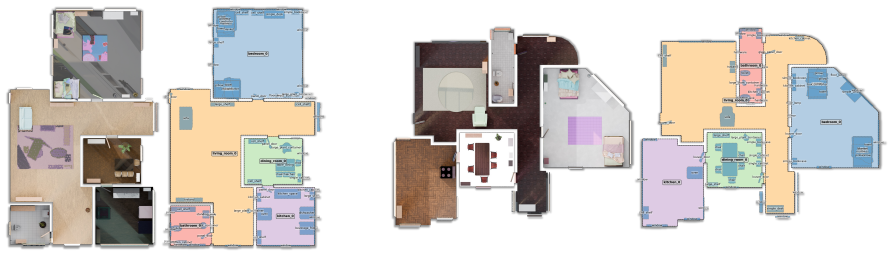
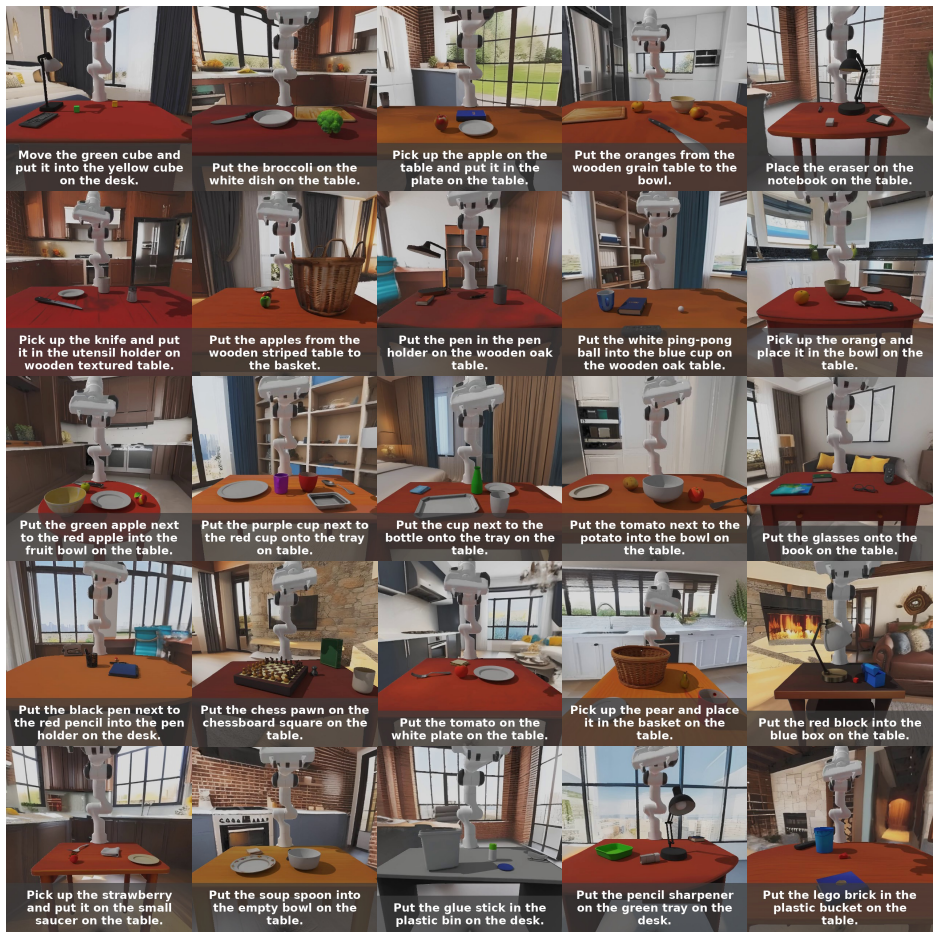
Summary. EmbodiedGen V2 presents a generative 3D world engine designed to produce executable, simulation-ready environments for embodied AI. The system extends beyond isolated 3D asset generation by introducing a unified representation that couples metric geometry, physical parameters, interaction affordances, and cross-simulator portability (URDF, MJCF, USD). The pipeline includes sim-ready asset generation with hierarchical quality gating, an affordance autolabeling pipeline for part-level interaction semantics, task-driven interactive world generation via Scene Graphs, large-scale multi-room scene synthesis, and a stateful natural-language editing interface termed 'Vibe Coding'. The authors evaluate the system on asset quality (96.5% human acceptance, 98.6% collision success), world usability (83.3% direct usability), and downstream closed-loop policy training, citing a separate study showing real-robot task success improvements from 21.7% to 75.0%.
Significance. The manuscript presents a comprehensive and well-engineered system addressing a practical bottleneck in embodied AI: the manual effort required to assemble policy-ready simulation environments. The unified sim-ready representation and the modular, pluggable asset pipeline are significant contributions. The system ships with reproducible code and a webpage, and the cross-simulator deployment capability (spanning SAPIEN, MuJoCo, Genesis, Isaac Sim/Gym, and Bullet) is a strong practical feature. The task-driven Scene Graph formulation and the stateful Vibe Coding interface represent meaningful steps toward scalable, language-conditioned environment generation. The inclusion of downstream RL validation, while summarized from a companion study, strengthens the claim that the generated environments are usable for closed-loop policy training.
major comments (2)
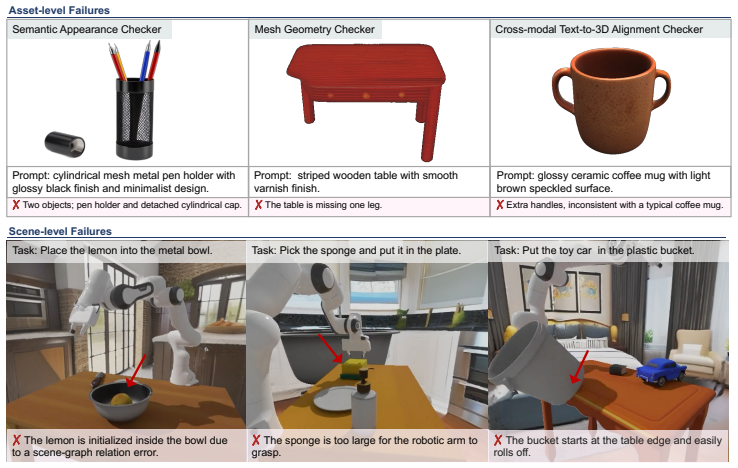
- §2.2 (stage iv) and §3.1 (Table 2): The 'sim-ready' contract centrally relies on VLM-inferred physical properties (mass, friction, scale). However, the Collision Success metric (98.6%) only validates that a scripted top-down grasp can lift the object above an adaptive height threshold. This verifies liftability, not physical accuracy. A mass or friction error of an order of magnitude would still pass this test if gripper force is sufficient. The manuscript does not validate VLM-inferred physical parameters against any ground truth. This is a load-bearing gap for the 'sim-ready' claim. The authors should either (a) report quantitative error of VLM-inferred mass/friction/scale against a ground-truth benchmark, or (b) explicitly scope the 'sim-ready' claim to geometric/collision readiness and clarify that physical parameters are approximate priors intended for domain randomization rather än
- §3.4 and Table 5: The downstream RL results (sim success 9.7%→79.8%, real-robot success 21.7%→75.0%) are summarized from a separate study [6] co-authored by overlapping authors. While this is not inherently circular, the manuscript does not isolate whether the downstream improvements stem from scene diversity, RL training dynamics, or physical fidelity of the generated assets. Since domain randomization is applied, systematic physics errors in the generated environments could be masked. The authors should clarify what specific aspects of EmbodiedGen V2 environments drove the improvement (e.g., via an ablation in [6] or by referencing specific results from that study) and acknowledge that the 75% real-robot success rate does not, by itself, validate the physical accuracy of individual asset parameters.
minor comments (7)
- §2.6: The term 'Vibe Coding' is introduced without a clear formal definition beyond an analogy to AI coding assistants. Consider providing a more precise definition or framing it as 'stateful natural-language world editing' to improve searchability and clarity.
- Table 2: The 'Collision Success' metric uses an 'adaptive height threshold proportional to its bounding-box height.' The exact proportionality constant and its justification are not specified. Please state the threshold formula.
- Table 3: The Grasp Coverage Rate treats objects 'intrinsically unsuitable for mechanical parallel-jaw grasping' as satisfying the criterion. Please report what fraction of the 200 assets received this exemption, as it affects interpretability of the 72.5% conditional rate.
- Table 4: The 'Final environment acceptance rate' of 83.3% is based on manual inspection of 150 worlds. The inter-annotator agreement or the number of annotators is not reported. Please include this information.
- Figure 2: The physical property recovery stage shows '0.04 kg' and 'CoF' as outputs, but the pipeline by which the VLM produces these values (e.g., prompt structure, output format, range vs. point estimate) is not described in sufficient detail in §2.2 for reproducibility.
- References [6] and [7] are cited as arXiv preprints from 2026. Ensure these are accessible and properly formatted.
- §2.2: The aesthetic scoring threshold is mentioned as 'predefined' but its value is not stated. Please specify the threshold used.
Simulated Author's Rebuttal
We thank the referee for a careful and constructive review. Both major comments identify genuine gaps in how the 'sim-ready' claim and downstream validation are scoped. We address each below and commit to revisions in the next manuscript version.
read point-by-point responses
-
Referee: §2.2 (stage iv) and §3.1 (Table 2): The 'sim-ready' contract centrally relies on VLM-inferred physical properties (mass, friction, scale). However, the Collision Success metric (98.6%) only validates that a scripted top-down grasp can lift the object above an adaptive height threshold. This verifies liftability, not physical accuracy. A mass or friction error of an order of magnitude would still pass this test if gripper force is sufficient. The manuscript does not validate VLM-inferred physical parameters against any ground truth. This is a load-bearing gap for the 'sim-ready' claim. The authors should either (a) report quantitative error of VLM-inferred mass/friction/scale against a ground-truth benchmark, or (b) explicitly scope the 'sim-ready' claim to geometric/collision readiness and clarify that physical parameters are approximate priors intended for domain randomization rather än
Authors: The referee is correct on both counts. The Collision Success metric in Table 2 verifies that generated assets can be physically grasped and lifted without contact or stability failures—it does not validate the accuracy of VLM-inferred mass, friction, or scale against ground-truth values. We agree that an order-of-magnitude error in mass or friction could pass this test if the gripper force is sufficient, and that this gap is load-bearing for the 'sim-ready' label as currently stated in §2.1 and §2.2. We will adopt option (b) in the revision. Specifically, we will: (1) add an explicit statement in §2.1 that the 'sim-ready' contract as currently implemented guarantees geometric validity, collision compatibility, and simulation executability, while physical parameters (mass, friction, scale) are approximate VLM-inferred priors intended as initialization points for domain randomization rather than physically calibrated values; (2) rename or qualify the Collision Success metric in Table 2 to 'Grasp-and-Lift Success' to avoid implying physical-parameter validation; and (3) add a limitation paragraph in §5 acknowledging that quantitative validation of VLM-inferred physical properties against ground-truth measurements (e.g., from a benchmark with measured masses and friction coefficients) is an important direction for future work that the current manuscript does not address. We believe option (b) is the honest and appropriate scoping given the current evidence, and we will not claim physical accuracy that the experiments do not support. revision: yes
-
Referee: §3.4 and Table 5: The downstream RL results (sim success 9.7%→79.8%, real-robot success 21.7%→75.0%) are summarized from a separate study [6] co-authored by overlapping authors. While this is not inherently circular, the manuscript does not isolate whether the downstream improvements stem from scene diversity, RL training dynamics, or physical fidelity of the generated assets. Since domain randomization is applied, systematic physics errors in the generated environments could be masked. The authors should clarify what specific aspects of EmbodiedGen V2 environments drove the improvement (e.g., via an ablation in [6] or by referencing specific results from that study) and acknowledge that the 75% real-robot success rate does not, by itself, validate the physical accuracy of individual asset parameters.
Authors: We agree that the downstream RL results, as summarized in §3.4, do not isolate which aspects of EmbodiedGen V2 environments drove the improvement, and that domain randomization could mask systematic physics errors. This is a fair limitation of the current presentation. In the revision we will: (1) add an explicit caveat in §3.4 stating that the real-robot success rate (75.0%) demonstrates that generated environments are usable for closed-loop policy training and sim-to-real transfer, but does not by itself validate the physical accuracy of individual asset parameters such as mass or friction; (2) reference the scene-distribution scaling result from [6] (Table 5, N=1 to N=50, OOD success 53.2%→77.9%) as evidence that scene diversity is a significant driver of the improvement, since scaling the number of distinct generated scenes closes the ID–OOD gap; and (3) add a sentence noting that [6] does not contain an ablation isolating physical fidelity from scene diversity, and that such an ablation (e.g., comparing policies trained on scenes with VLM-inferred physics vs. manually calibrated physics) would be needed to disentangle these factors. We will not overstate what the downstream results imply about physical accuracy. We note that the hand-built scene comparison in Table 5 (36.0% transfer from SimplerEnv to EmbodiedGen scenes) does suggest that scene distribution matters, but it does not speak to physical parameter accuracy, and we will frame it accordingly. revision: yes
Circularity Check
No significant circularity; one load-bearing self-citation for downstream RL results, but the cited claim is independently falsifiable.
full rationale
The paper's central claims about asset quality (96.5% human acceptance, 98.6% collision success) and world usability (83.3%) are direct empirical measurements on held-out data, not predictions derived from fitted parameters or self-referential definitions. The downstream RL results (Table 5, 21.7% to 75.0%) are summarized from [6] (Choi et al.), which has overlapping authors (Andrew Choi, Xinjie Wang, Zhizhong Su, Wei Xu). This self-citation is load-bearing for the 'Closed-loop policy validation' contribution, but it is not circular in the strict sense: the cited study's claim that RL improves success is falsifiable and not equivalent to 'environments are sim-ready' by construction — the RL training could have failed even with valid environments. The paper is transparent about summarizing a 'separate downstream study.' The VLM-inferred physical properties (mass, friction, scale) that are never validated against ground truth represent a correctness risk, not circularity, since the paper does not claim to derive these from first principles or rename a fitted parameter as a prediction. Score 2 reflects the one minor self-citation that, while load-bearing for a secondary contribution, does not reduce to its inputs by construction.
Axiom & Free-Parameter Ledger
free parameters (3)
- Aesthetic scoring threshold =
predefined threshold
- Grasp validation slip thresholds =
5 cm or 30 degrees
- Adaptive height threshold =
proportional to bounding-box height
axioms (3)
- domain assumption VLMs can accurately infer real-world scale, mass, and friction from multi-view renderings.
- ad hoc to paper Scripted top-down grasp-and-lift trials are a valid proxy for simulation asset quality.
- domain assumption LLMs can reliably decompose natural-language tasks into the five semantic categories (ROBOT, BACKGROUND, CONTEXT, MANIPULATED_OBJS, DISTRACTOR_OBJS).
invented entities (2)
-
Vibe Coding
no independent evidence
-
Sim-ready representation contract
no independent evidence
read the original abstract
We present EmbodiedGen V2, a generative 3D world engine for building executable sim-ready environments for embodied intelligence. Sim-ready 3D asset generation has advanced rapidly, yet assembling such assets into policy-ready task environments remains largely manual, limiting scalable closed-loop learning. EmbodiedGen V2 addresses this gap through a unified sim-ready representation that connects cross-simulator assets, interaction affordances, task-driven worlds, large-scale multi-room scenes, and stateful Vibe Coding into a generative, editable, and reusable simulation pipeline. The generated environments support manipulation, navigation, mobile manipulation, cross-simulator deployment, and embodied policy training. In evaluation, the asset pipeline achieves 96.5% human acceptance and 98.6% collision success, and 83.3% of task-driven worlds are directly usable for downstream simulation without manual modification. Online reinforcement learning with generated environments further improves simulation success from 9.7% to 79.8%, and transfers to real robots with task success increasing from 21.7% to 75.0%. These results establish EmbodiedGen V2 as scalable simulation infrastructure for training, evaluating, and deploying embodied policies.
Figures



Reference graph
Works this paper leans on
-
[1]
Embodiedgen: Towards a generative 3d world engine for embodied intelligence, 2025
Xinjie Wang, Liu Liu, Yu Cao, Ruiqi Wu, Wenkang Qin, Dehui Wang, Wei Sui, and Zhizhong Su. Embodiedgen: Towards a generative 3d world engine for embodied intelligence, 2025. URL https://arxiv.org/abs/2506. 10600
work page 2025
-
[2]
Structured 3D Latents for Scalable and Versatile 3D Generation
Jianfeng Xiang, Zelong Lv, Sicheng Xu, Yu Deng, Ruicheng Wang, Bowen Zhang, Dong Chen, Xin Tong, and Jiaolong Yang. Structured 3d latents for scalable and versatile 3d generation. arXiv preprint arXiv:2412.01506 , 2024
work page internal anchor Pith review Pith/arXiv arXiv 2024
-
[3]
SAM 3D: 3Dfy Anything in Images
SAM 3D Team, Xingyu Chen, Fu-Jen Chu, Pierre Gleize, Kevin J Liang, Alexander Sax, Hao Tang, Weiyao Wang, Michelle Guo, Thibaut Hardin, Xiang Li, Aohan Lin, Jiawei Liu, Ziqi Ma, Anushka Sagar, Bowen Song, Xiaodong Wang, Jianing Yang, Bowen Zhang, Piotr Dollár, Georgia Gkioxari, Matt Feiszli, and Jitendra Malik. Sam 3d: 3dfy anything in images. arXiv prepr...
work page internal anchor Pith review Pith/arXiv arXiv 2025
-
[4]
Hunyuan3d 2.1: From images to high-fidelity 3d assets with production-ready pbr material, 2025
Tencent Hunyuan3D Team. Hunyuan3d 2.1: From images to high-fidelity 3d assets with production-ready pbr material, 2025
work page 2025
-
[5]
3d-fixer: Coarse-to-fine in-place completion for 3d scenes from a single image
Ze-Xin Yin, Liu Liu, Xinjie Wang, Wei Sui, Zhizhong Su, Jian Yang, and jin Xie. 3d-fixer: Coarse-to-fine in-place completion for 3d scenes from a single image. In Proceedings of the Computer Vision and Pattern Recognition Conference, 2026
work page 2026
-
[6]
Scaling sim-to-real reinforcement learning for robot vlas with generative 3d worlds
Andrew Choi, Xinjie Wang, Zhizhong Su, and Wei Xu. Scaling sim-to-real reinforcement learning for robot vlas with generative 3d worlds. arXiv preprint arXiv:2603.18532 , 2026
-
[7]
RankQ: Offline-to-Online Reinforcement Learning via Self-Supervised Action Ranking
Andrew Choi and Wei Xu. Rankq: Offline-to-online reinforcement learning via self-supervised action ranking. arXiv preprint arXiv:2605.11151 , 2026
work page internal anchor Pith review Pith/arXiv arXiv 2026
-
[8]
Hunyuan3D 2.0: Scaling Diffusion Models for High Resolution Textured 3D Assets Generation
Zibo Zhao, Zeqiang Lai, Qingxiang Lin, Yunfei Zhao, Haolin Liu, Shuhui Yang, Yifei Feng, Mingxin Yang, Sheng Zhang, Xianghui Yang, Huiwen Shi, Sicong Liu, Junta Wu, Yihang Lian, Fan Yang, Ruining Tang, Zebin He, Xinzhou Wang, Jian Liu, Xuhui Zuo, Zhuo Chen, Biwen Lei, et al. Hunyuan3d 2.0: Scaling diffusion models for high resolution textured 3d assets ge...
work page internal anchor Pith review Pith/arXiv arXiv 2025
-
[9]
Step1X-3D: Towards High-Fidelity and Controllable Generation of Textured 3D Assets
Weiyu Li, Xuanyang Zhang, Zheng Sun, Di Qi, Hao Li, Wei Cheng, Weiwei Cai, Shihao Wu, Jiarui Liu, Zihao Wang, Xiao Chen, Feipeng Tian, Jianxiong Pan, Zeming Li, Gang Yu, Xiangyu Zhang, Daxin Jiang, and Ping Tan. Step1x-3d: Towards high-fidelity and controllable generation of textured 3d assets. arXiv preprint arXiv:2505.07747, 2025
work page internal anchor Pith review Pith/arXiv arXiv 2025
-
[10]
Hunyuan3D 2.5: Towards High-Fidelity 3D Assets Generation with Ultimate Details
Zeqiang Lai, Yunfei Zhao, Haolin Liu, Zibo Zhao, Qingxiang Lin, Huiwen Shi, Xianghui Yang, Mingxin Yang, Shuhui Yang, Yifei Feng, Sheng Zhang, Xin Huang, Di Luo, Fan Yang, Fang Yang, Lifu Wang, Sicong Liu, Yixuan Tang, Yulin Cai, Zebin He, Tian Liu, Yuhong Liu, Jie Jiang, Linus, Jingwei Huang, and Chunchao Guo. Hun- yuan3d 2.5: Towards high-fidelity 3d as...
work page internal anchor Pith review Pith/arXiv arXiv 2025
-
[11]
Native and Compact Structured Latents for 3D Generation
Jianfeng Xiang, Xiaoxue Chen, Sicheng Xu, Ruicheng Wang, Zelong Lv, Yu Deng, Hongyuan Zhu, Yue Dong, Hao Zhao, Nicholas Jing Yuan, and Jiaolong Yang. Native and compact structured latents for 3d generation. arXiv preprint arXiv:2512.14692 , 2025
work page internal anchor Pith review Pith/arXiv arXiv 2025
-
[12]
Scaling Rectified Flow Transformers for High-Resolution Image Synthesis
Patrick Esser, Sumith Kulal, Andreas Blattmann, Rahim Entezari, Jonas Müller, Harry Saini, Yam Levi, Do- minik Lorenz, Axel Sauer, Frederic Boesel, Dustin Podell, Tim Dockhorn, Zion English, Kyle Lacey, Alex Goodwin, Yannik Marek, and Robin Rombach. Scaling rectified flow transformers for high-resolution image synthesis. arXiv preprint arXiv:2403.03206 , ...
work page internal anchor Pith review Pith/arXiv arXiv doi:10.48550/arxiv.2403.03206 2024
-
[13]
Kolors: Effective training of diffusion model for photorealistic text-to-image synthesis
Kolors Team. Kolors: Effective training of diffusion model for photorealistic text-to-image synthesis. arXiv preprint, 2024
work page 2024
-
[14]
Daniel Gatis. rembg. https://github.com/danielgatis/rembg, 2025. A tool to remove images background
work page 2025
-
[15]
Alexander Kirillov, Eric Mintun, Nikhila Ravi, Hanzi Mao, Chloe Rolland, Laura Gustafson, Tete Xiao, Spencer Whitehead, Alexander C. Berg, Wan-Yen Lo, Piotr Dollár, and Ross Girshick. Segment anything. arXiv:2304.02643, 2023
work page internal anchor Pith review Pith/arXiv arXiv 2023
-
[16]
Rmbg-1.4: Background removal model
BRIA AI. Rmbg-1.4: Background removal model. https://huggingface.co/briaai/RMBG-1.4, 2023. Accessed: 2025-05-19. 21
work page 2023
-
[17]
3D Gaussian Splatting for Real-Time Radiance Field Rendering
Bernhard Kerbl, Georgios Kopanas, Thomas Leimkühler, and George Drettakis. 3d gaussian splatting for real- time radiance field rendering, 2023. URL https://arxiv.org/abs/2308.04079
work page internal anchor Pith review Pith/arXiv arXiv 2023
-
[18]
Aesthetic subsets in laion 2170337258 samples, 2025
Christoph Schuhmann. Aesthetic subsets in laion 2170337258 samples, 2025. URL http://captions. christoph-schuhmann.de/aesthetic_viz_laion_sac+logos+ava1-l14-linearMSE-en-2.37B.html . Retrieved May 16, 2025
work page 2025
-
[19]
Approximate convex decomposition for 3d meshes with collision-aware concavity and tree search
Xinyue Wei, Minghua Liu, Zhan Ling, and Hao Su. Approximate convex decomposition for 3d meshes with collision-aware concavity and tree search. ACM Transactions on Graphics (TOG) , 41(4):1–18, 2022
work page 2022
-
[20]
Fanbo Xiang, Yuzhe Qin, Kaichun Mo, Yikuan Xia, Hao Zhu, Fangchen Liu, Minghua Liu, Hanxiao Jiang, Yifu Yuan, He Wang, Li Yi, Angel X. Chang, Leonidas J. Guibas, and Hao Su. SAPIEN: A simulated part-based interactive environment. In The IEEE Conference on Computer Vision and Pattern Recognition (CVPR) , June 2020
work page 2020
-
[21]
Pybullet, a python module for physics simulation for games, robotics and machine learning
Erwin Coumans and Yunfei Bai. Pybullet, a python module for physics simulation for games, robotics and machine learning. http://pybullet.org, 2016–2021
work page 2016
-
[22]
Isaac gym: High performance gpu-based physics simulation for robot learning, 2021
Viktor Makoviychuk, Lukasz Wawrzyniak, Yunrong Guo, Michelle Lu, Kier Storey, Miles Macklin, David Hoeller, Nikita Rudin, Arthur Allshire, Ankur Handa, and Gavriel State. Isaac gym: High performance gpu-based physics simulation for robot learning, 2021
work page 2021
-
[23]
Mujoco: A physics engine for model-based control
Emanuel Todorov, Tom Erez, and Yuval Tassa. Mujoco: A physics engine for model-based control. In 2012 IEEE/RSJ International Conference on Intelligent Robots and Systems , pages 5026–5033. IEEE, 2012. doi: 10.1109/IROS.2012.6386109
-
[24]
Genesis: A generative and universal physics engine for robotics and beyond, December 2024
Genesis Authors. Genesis: A generative and universal physics engine for robotics and beyond, December 2024. URL https://github.com/Genesis-Embodied-AI/Genesis
work page 2024
- [25]
-
[26]
Haoran Geng, Feishi Wang, Songlin Wei, Yuyang Li, Bangjun Wang, Boshi An, Charlie Tianyue Cheng, Haozhe Lou, Peihao Li, Yen-Jen Wang, Yutong Liang, Dylan Goetting, Chaoyi Xu, Haozhe Chen, Yuxi Qian, Yiran Geng, Jiageng Mao, Weikang Wan, Mingtong Zhang, Jiangran Lyu, Siheng Zhao, Jiazhao Zhang, Jialiang Zhang, Chengyang Zhao, Haoran Lu, Yufei Ding, Ran Gon...
work page internal anchor Pith review Pith/arXiv arXiv 2025
-
[27]
3D AffordanceNet: A benchmark for visual object affordance understanding
Shengheng Deng, Xun Xu, Chaozheng Wu, Ke Chen, and Kui Jia. 3D AffordanceNet: A benchmark for visual object affordance understanding. In Proceedings of the IEEE/CVF Conference on Computer Vision and Pattern Recognition, 2021
work page 2021
-
[28]
Where2Act: From pixels to actions for articulated 3D objects
Kaichun Mo, Leonidas J Guibas, Mustafa Mukadam, Abhinav Gupta, and Shubham Tulsiani. Where2Act: From pixels to actions for articulated 3D objects. In Proceedings of the IEEE/CVF International Conference on Computer Vision , 2021
work page 2021
-
[29]
Changfeng Ma, Yang Li, Xinhao Yan, Jiachen Xu, Yunhan Yang, Chunshi Wang, Zibo Zhao, Yanwen Guo, Zhuo Chen, and Chunchao Guo. P3-SAM: Native 3D part segmentation. arXiv preprint arXiv:2509.06784 , 2025
-
[30]
OpenAI. gpt-5.4 model. https://developers.openai.com/api/docs/models/gpt-5.4, 2026. Accessed: 2026- 06-24
work page 2026
-
[31]
GraspGen: A Diffusion-based Framework for 6-DOF Grasping with On-Generator Training
Adithyavairavan Murali, Balakumar Sundaralingam, Yu-Wei Chao, Wentao Yuan, Jun Yamada, Mark Carlson, Fabio Ramos, Stan Birchfield, Dieter Fox, and Clemens Eppner. GraspGen: A diffusion-based framework for 6-DOF grasping with on-generator training. arXiv preprint arXiv:2507.13097 , 2025
work page internal anchor Pith review Pith/arXiv arXiv 2025
-
[32]
Holodeck: Language guided generation of 3d embodied ai environments
Yue Yang, Fan-Yun Sun, Luca Weihs, Eli VanderBilt, Alvaro Herrasti, Winson Han, Jiajun Wu, Nick Haber, Ranjay Krishna, Lingjie Liu, Chris Callison-Burch, Mark Yatskar, Aniruddha Kembhavi, and Christopher Clark. Holodeck: Language guided generation of 3d embodied ai environments. In Proceedings of the IEEE/CVF Conference on Computer Vision and Pattern Reco...
work page 2024
-
[33]
Layoutgpt: Compositional visual planning and generation with large language models
Weixi Feng, Wanrong Zhu, Tsu-Jui Fu, Varun Jampani, Arjun Akula, Xuehai He, Sugato Basu, Xin Eric Wang, and William Yang Wang. Layoutgpt: Compositional visual planning and generation with large language models. In Advances in Neural Information Processing Systems , 2023. 22
work page 2023
-
[34]
Infinigen indoors: Photorealistic indoor scenes using procedural generation
Alexander Raistrick, Lingjie Mei, Karhan Kayan, David Yan, Yiming Zuo, Beining Han, Hongyu Wen, Meenal Parakh, Stamatis Alexandropoulos, Lahav Lipson, Zeyu Ma, and Jia Deng. Infinigen indoors: Photorealistic indoor scenes using procedural generation. In Proceedings of the IEEE/CVF Conference on Computer Vision and Pattern Recognition (CVPR) , pages 21783–...
work page 2024
-
[35]
OpenAI. OpenAI Codex CLI. https://github.com/openai/codex, 2025. Accessed: 2026-05-11
work page 2025
-
[36]
Google. Gemini CLI. https://github.com/google-gemini/gemini-cli , 2025. Accessed: 2026-05-11
work page 2025
-
[37]
BridgeData V2: A dataset for robot learning at scale
Homer Walke, Kevin Black, Abraham Lee, Moo Jin Kim, Max Du, Chongyi Zheng, Tony Zhao, Philippe Hansen- Estruch, Quan Vuong, Andre He, et al. BridgeData V2: A dataset for robot learning at scale. In Conference on Robot Learning (CoRL) , 2023
work page 2023
-
[38]
Evaluating Real-World Robot Manipulation Policies in Simulation
Xuanlin Li, Kyle Hsu, Jiayuan Gu, Karl Pertsch, Oier Mees, Homer Rich Walke, Chuyuan Fu, Ishikaa Lunawat, Isabel Sieh, Sean Kirmani, Sergey Levine, Jiajun Wu, Chelsea Finn, Hao Su, Quan Vuong, and Ted Xiao. Evaluating real-world robot manipulation policies in simulation. arXiv preprint arXiv:2405.05941 , 2024
work page internal anchor Pith review Pith/arXiv arXiv 2024
-
[39]
DreamFusion: Text-to-3D using 2D diffusion
Ben Poole, Ajay Jain, Jonathan T Barron, and Ben Mildenhall. DreamFusion: Text-to-3D using 2D diffusion. In International Conference on Learning Representations , 2023
work page 2023
-
[40]
Zero-1-to-3: Zero-shot one image to 3D object
Ruoshi Liu, Rundi Wu, Basile Van Hoorick, Pavel Tokmakov, Sergey Zakharov, and Carl Vondrick. Zero-1-to-3: Zero-shot one image to 3D object. In Proceedings of the IEEE/CVF International Conference on Computer Vision, pages 9298–9309, 2023
work page 2023
-
[41]
LRM: Large reconstruction model for single image to 3D
Yicong Hong, Kai Zhang, Jiuxiang Gu, Sai Bi, Yang Zhou, Difan Liu, Feng Liu, Kalyan Sunkavalli, Trung Bui, and Hao Tan. LRM: Large reconstruction model for single image to 3D. In International Conference on Learning Representations, 2024
work page 2024
-
[42]
Gen2Sim: Scaling up robot learning in simulation with generative models
Pushkal Katara, Zhou Xian, and Katerina Fragkiadaki. Gen2Sim: Scaling up robot learning in simulation with generative models. In International Conference on Robotics and Automation , 2024
work page 2024
-
[43]
PhysX-3D: Physical-grounded 3D asset generation
Ziang Cao, Zhaoxi Chen, Liang Pan, and Ziwei Liu. PhysX-3D: Physical-grounded 3D asset generation. In Advances in Neural Information Processing Systems , 2025
work page 2025
-
[44]
PhysX-Anything: Simulation-ready physical 3D assets from single image
Ziang Cao, Fangzhou Hong, Zhaoxi Chen, Liang Pan, and Ziwei Liu. PhysX-Anything: Simulation-ready physical 3D assets from single image. arXiv preprint arXiv:2511.13648 , 2025
-
[45]
PhysForge: Generating Physics-Grounded 3D Assets for Interactive Virtual World
Yunhan Yang, Chunshi Wang, Junliang Ye, Yang Li, Zanxin Chen, Zehuan Huang, Yao Mu, Zhuo Chen, Chun- chao Guo, and Xihui Liu. PhysForge: Generating physics-grounded 3D assets for interactive virtual world. arXiv preprint arXiv:2605.05163 , 2026
work page internal anchor Pith review Pith/arXiv arXiv 2026
-
[46]
PhyScene: Physically interactable 3D scene synthesis for embodied AI
Yandan Yang, Baoxiong Jia, Peiyuan Zhi, and Siyuan Huang. PhyScene: Physically interactable 3D scene synthesis for embodied AI. In Proceedings of the IEEE/CVF Conference on Computer Vision and Pattern Recognition, 2024
work page 2024
-
[47]
Rein3D: Reinforced 3D Indoor Scene Generation with Panoramic Video Diffusion Models
Dehui Wang, Congsheng Xu, Rong Wei, Yue Shi, Shoufa Chen, Dingxiang Luo, Tianshuo Yang, Xiaokang Yang, Yusen Qin, Rui Tang, and Yao Mu. Rein3D: Reinforced 3D indoor scene generation with panoramic video diffusion models. arXiv preprint arXiv:2604.10578 , 2026
work page internal anchor Pith review Pith/arXiv arXiv 2026
-
[48]
Agentic 3D Scene Generation with Spatially Contextualized VLMs
Xinhang Liu, Yu-Wing Tai, and Chi-Keung Tang. Agentic 3D scene generation with spatially contextualized VLMs. arXiv preprint arXiv:2505.20129 , 2025
work page internal anchor Pith review Pith/arXiv arXiv 2025
-
[49]
SegviGen: Repurposing 3D Generative Model for Part Segmentation
Lin Li, Haoran Feng, Zehuan Huang, Haohua Chen, Wenbo Nie, Shaohua Hou, Keqing Fan, Pan Hu, Sheng Wang, Buyu Li, and Lu Sheng. SegViGen: Repurposing 3D generative model for part segmentation. arXiv preprint arXiv:2603.16869 , 2026
work page internal anchor Pith review Pith/arXiv arXiv 2026
-
[50]
ManiTwin: Scaling data-generation-ready digital object dataset to 100K
Kaixuan Wang, Tianxing Chen, Jiawei Liu, Honghao Su, Shaolong Zhu, Minxuan Wang, Zixuan Li, Yue Chen, Huan-ang Gao, Yusen Qin, Jiawei Wang, Qixuan Zhang, Lan Xu, Jingyi Yu, Yao Mu, and Ping Luo. ManiTwin: Scaling data-generation-ready digital object dataset to 100K. arXiv preprint arXiv:2603.16866 , 2026
-
[51]
Chat-Edit-3D: Interactive 3D scene editing via text prompts
Shuangkang Fang, Yufeng Wang, Yi-Hsuan Tsai, Yi Yang, Wenrui Ding, Shuchang Zhou, and Ming-Hsuan Yang. Chat-Edit-3D: Interactive 3D scene editing via text prompts. In European Conference on Computer Vision, 2024
work page 2024
-
[52]
Blender – a 3D modelling and rendering package
Blender Online Community. Blender – a 3D modelling and rendering package. https://www.blender.org, 2024
work page 2024
-
[53]
Autodesk Inc. Autodesk Maya. https://www.autodesk.com/products/maya, 2024
work page 2024
-
[54]
RT-2: Vision-Language-Action Models Transfer Web Knowledge to Robotic Control
Anthony Brohan, Noah Brown, Justice Carbajal, Yevgen Chebotar, Xi Chen, Krzysztof Choromanski, Tianli Ding, Danny Driess, A vinava Dubey, Chelsea Finn, et al. RT-2: Vision-language-action models transfer web knowledge to robotic control. arXiv preprint arXiv:2307.15818 , 2023. 23
work page internal anchor Pith review Pith/arXiv arXiv 2023
-
[55]
OpenVLA: An Open-Source Vision-Language-Action Model
Moo Jin Kim, Karl Pertsch, Siddharth Karamcheti, Oier Mees, Suraj Gupta, Homer Walke, Joey Hejna, Ayzaan Wahid, Quan Vuong, Adam Gleave, et al. OpenVLA: An open-source vision-language-action model. arXiv preprint arXiv:2406.09246 , 2024
work page internal anchor Pith review Pith/arXiv arXiv 2024
-
[56]
$\pi_0$: A Vision-Language-Action Flow Model for General Robot Control
Kevin Black, Noah Brown, Danny Driess, Adnan Esmail, Michael Equi, Chelsea Finn, Niccolo Fusai, Lachy Groom, Karol Hausman, Brian Ichter, et al. π0: A vision-language-action flow model for general robot control. arXiv preprint arXiv:2410.24164 , 2024
work page internal anchor Pith review Pith/arXiv arXiv 2024
-
[57]
GigaBrain-0: A World Model-Powered Vision-Language-Action Model.arXiv2025, arXiv:2510.19430
Angen Ye, Boyuan Wang, Chaojun Ni, Guan Huang, Guosheng Zhao, Haoyun Li, Jie Li, Jiagang Zhu, Lv Feng, Peng Li, et al. GigaBrain-0: A world model-powered vision-language-action model. arXiv preprint arXiv:2510.19430, 2025
-
[58]
Xuewu Lin, Tianwei Lin, Yun Du, Hongyu Xie, Yiwei Jin, Jiawei Li, Shijie Wu, Qingze Wang, Mengdi Li, Mengao Zhao, Ziang Li, Chaodong Huang, Hongzhe Bi, Lichao Huang, and Zhizhong Su. HoloBrain-0 technical report. arXiv preprint arXiv:2602.12062 , 2026
-
[59]
Stephen James, Zicong Ma, David Rovick Arrojo, and Andrew J. Davison. RLBench: The robot learning benchmark & learning environment. IEEE Robotics and Automation Letters , 5(2):3019–3026, 2020
work page 2020
-
[60]
ManiSkill3: GPU Parallelized Robotics Simulation and Rendering for Generalizable Embodied AI
Stone Tao, Fanbo Xiang, Arth Shukla, Yuzhe Qin, Xander Hinrichsen, Xiaodi Yuan, Chen Bao, Xinsong Lin, Yulin Liu, Tse-kai Chan, et al. ManiSkill3: GPU parallelized robotics simulation and rendering for generalizable embodied AI. arXiv preprint arXiv:2410.00425 , 2024
work page internal anchor Pith review Pith/arXiv arXiv 2024
-
[61]
Domain random- ization for transferring deep neural networks from simulation to the real world
Josh Tobin, Rachel Fong, Alex Ray, Jonas Schneider, Wojciech Zaremba, and Pieter Abbeel. Domain random- ization for transferring deep neural networks from simulation to the real world. In IEEE/RSJ International Conference on Intelligent Robots and Systems (IROS) , pages 23–30, 2017
work page 2017
-
[62]
Embody4D: A Generalist Data Engine for Embodied 4D World Modeling
Peiyan Tu, Hanxin Zhu, Jingwen Sun, Shaojie Ren, Cong Wang, Jiayi Luo, Xiaoqian Cheng, and Zhibo Chen. Embody4D: A generalist 4D world model for embodied AI. arXiv preprint arXiv:2605.01799 , 2026. 24
work page internal anchor Pith review Pith/arXiv arXiv 2026
discussion (0)
Sign in with ORCID, Apple, or X to comment. Anyone can read and Pith papers without signing in.