Computer Vision and Pattern Recognition · arXiv:2610.22200 v1 · submitted 15 Oct 2026 · 204 references
OpenGCUA: Toward a Fully Open Stack for Generalist Computer Use
The paper says
“Computer use has reached a turning point: the focus is expanding from GUI-only interaction to systems that complete tasks on users' computers through visual and programmatic interfaces.”
more of the abstract
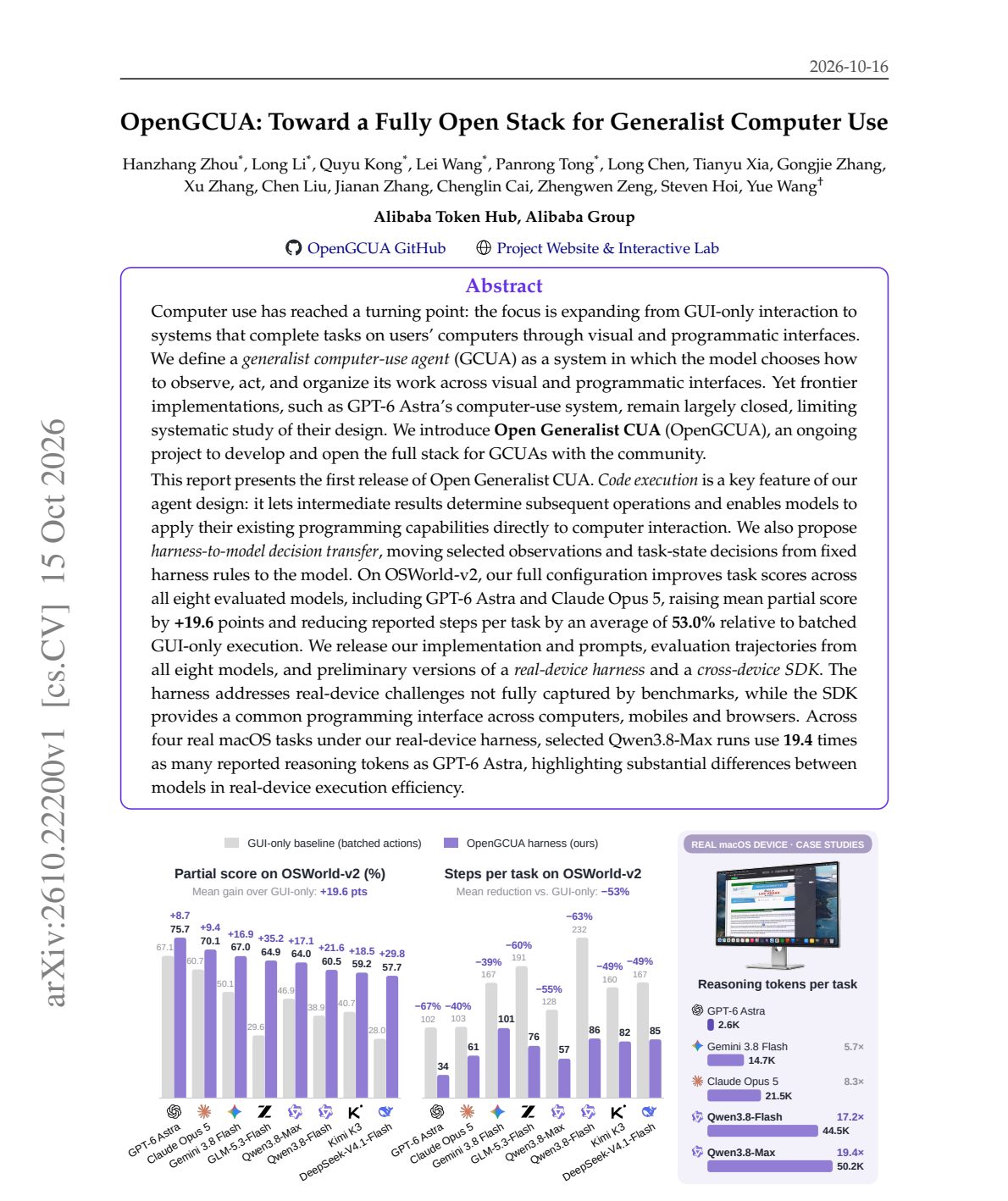
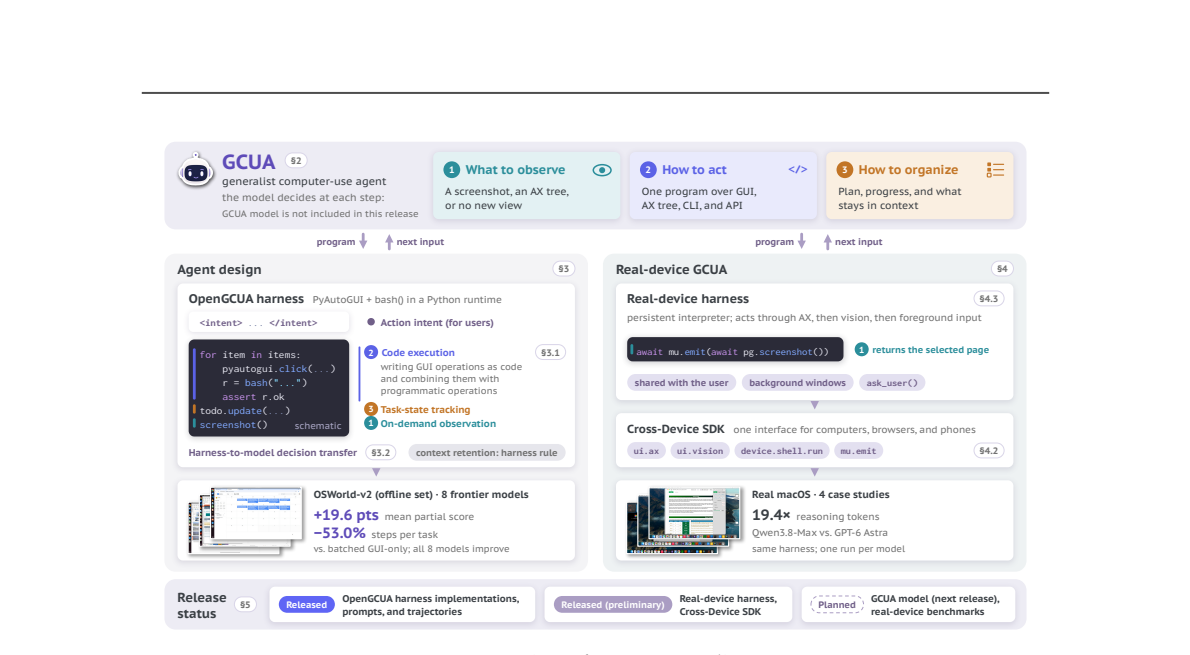
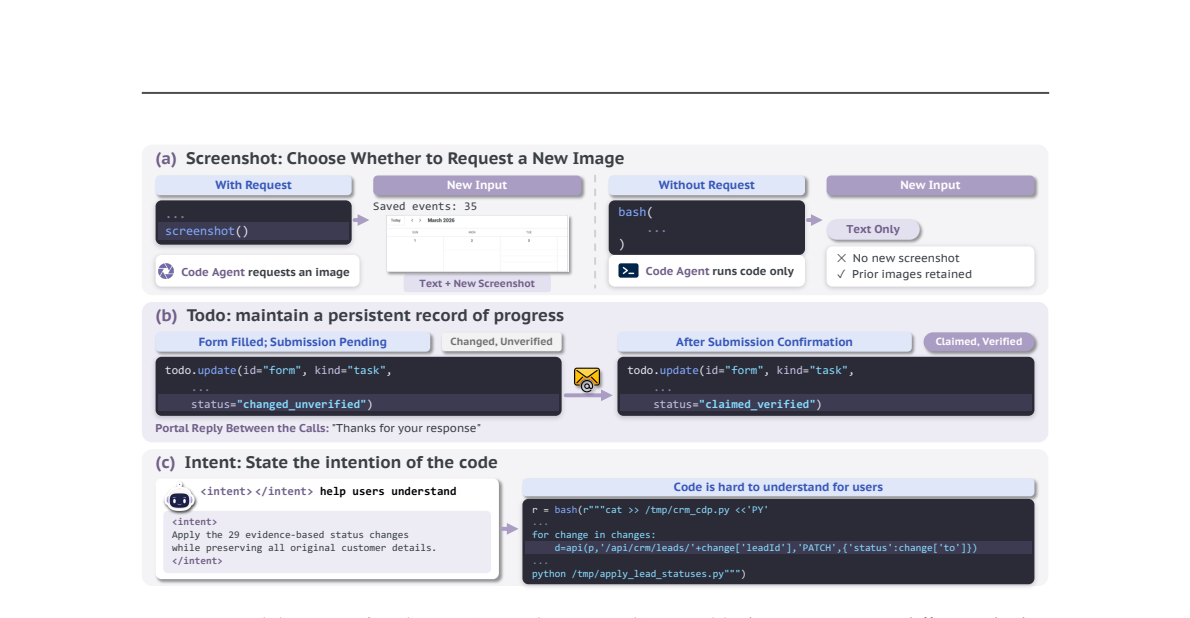
We define a generalist computer-use agent (GCUA) as a system in which the model chooses how to observe, act, and organize its work across visual and programmatic interfaces. Yet frontier implementations, such as GPT-6 Astra's computer-use system, remain largely closed, limiting systematic study of their design. We introduce Open Generalist CUA (OpenGCUA), an ongoing project to develop and open the full stack for GCUAs with the community. This report presents the first release of OpenGCUA. Code execution is a key feature of our agent design: it lets intermediate results determine subsequent operations and enables models to apply their existing programming capabilities directly to computer interaction. We also propose harness-to-model decision transfer, moving selected observations and task-state decisions from fixed harness rules to the model. On OSWorld-v2, our full configuration improves task scores across all eight evaluated models, including GPT-6 Astra and Claude Opus 5, raising mean partial score by +19.6 points and reducing reported steps per task by an average of 53.0% relative to batched GUI-only execution. We release our implementation and prompts, evaluation trajectories from all eight models, and preliminary versions of a real-device harness and a cross-device SDK. The harness addresses real-device challenges not fully captured by benchmarks, while the SDK provides a common programming interface across computers, mobiles and browsers. Across four real macOS tasks under our real-device harness, selected Qwen3.8-Max runs use 19.4 times as many reported reasoning tokens as GPT-6 Astra, highlighting substantial differences between models in real-device execution efficiency.
from the abstract
Pith says
Machine review · deepseek-v4-flash · 16 Oct 2026 · what was read was not recorded · not checked by a person
It can be wrong. Challenge this review or reply to it.
Holds up, with conditions. Open-sourced GCUA harness with large, consistent OSWorld-v2 gains across eight frontier models, but headline numbers rest on selected single runs without variance reporting. This line is wrong
2 major objections · 5 minor
How often objections from reviews like this one are right: not yet measured
Not checked: figures, code, what the 204 references say.
The paper says, at §3.3.2, Table 2; Appendix A
The review did not quote this passage.
Pith says: Objection 1 of 2 · major
The headline claim — mean partial score +19.6 points and 53.0% fewer steps across all eight models — rests on runs the paper itself calls 'selected' without specifying the selection rule or the number of runs recorded. §3.3.3, §3.3.4, and §3.3.5 qualify results as 'in the selected runs', and §3.3.6 states that the resource curves use 'the same selected full-setting …
more of objection 1
… runs as the main evaluation', but Appendix A describes only intra-run attempt retention (latest attempt with an evaluator result, not the highest-scoring attempt) and never states how many runs per model/task were recorded, how runs were chosen, or whether Table 2's numbers are single-run point estimates or averages. If runs were selected after inspecting outcomes, the reported gains — including GLM-5.3-Flash +35.2 and the 53.0% step reduction — could be within selection noise. Since evaluation trajectories are released, the authors can resolve this by reporting run counts, a pre-specified selection rule, and run-level statistics for Table 2 and for the single-run ablation claims in Tables 3-4 and Figure 6.
The paper says, at §3.3.4, Figure 6; Table 2 baseline
The review did not quote this passage.
Pith says: Objection 2 of 2 · major
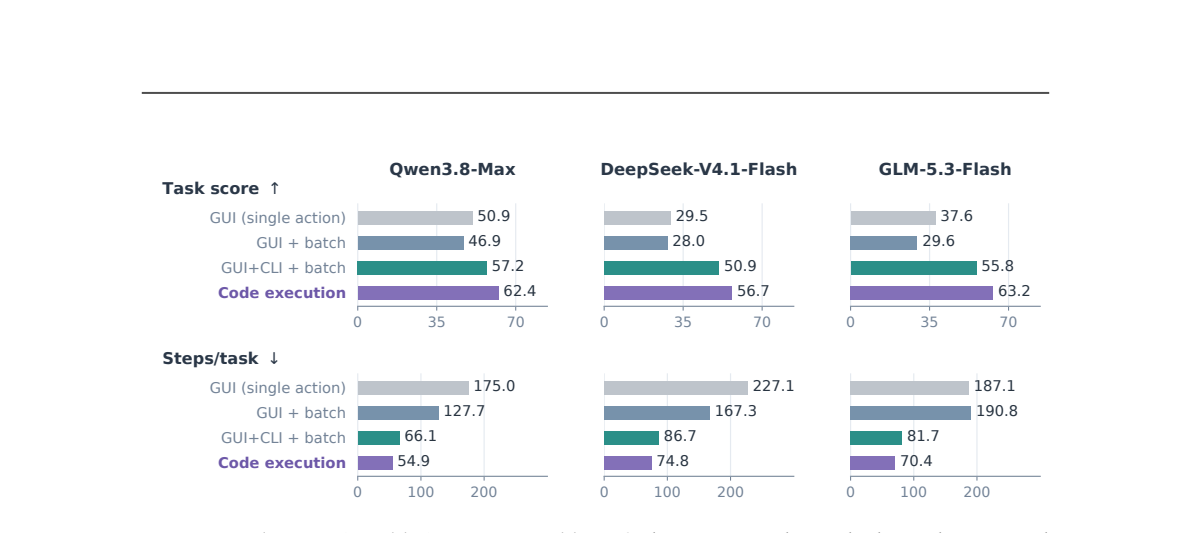
The batched GUI-only baseline against which the headline gain is measured is not stable across settings: in Figure 6 it scores below the single-action GUI configuration for all three ablated models (Qwen3.8-Max 46.9 vs 50.9; DeepSeek-V4.1-Flash 28.0 vs 29.5; GLM-5.3-Flash 29.6 vs 37.6).
more of objection 2
This raises the possibility that part of the +19.6-point gain in Table 2 reflects a suboptimally calibrated baseline — long blind batched sequences that the authors' own prompt guidance warns against — rather than the GCUA design itself. Using the single-action GUI values from Figure 6 instead would shrink the gains (e.g., GLM-5.3-Flash from +35.2 to +27.3; Qwen3.8-Max code execution from +15.5 to +11.5), though they would remain positive. The authors should explain why batching lowers scores in these comparisons and report how the Table 2 gains change relative to a stronger baseline.
5 minor objections
The paper says, at Abstract; §4.3.3, Table 5
Pith says: minor objection 1 of 5
The abstract and Figure 1 feature the 19.4x reasoning-token comparison as a headline result, while the body correctly states that real-device results use a single selected run (run 1) per task on four tasks and 'characterize the evaluated configurations rather than establish a general model ranking'. Since Table 5 reports that up to three runs were recorded, the abstract should carry the same single-run qualifier.
The paper says, at §4.3.3, Table 5
Pith says: minor objection 2 of 5
The text says seven model configurations were studied, but Table 5 shows five and notes only that DeepSeek lacks a hotel trajectory; a sentence stating why the remaining two configurations are excluded would prevent confusion.
show 3 more
The paper says, at §3.3.6, Figure 7
Pith says: minor objection 3 of 5
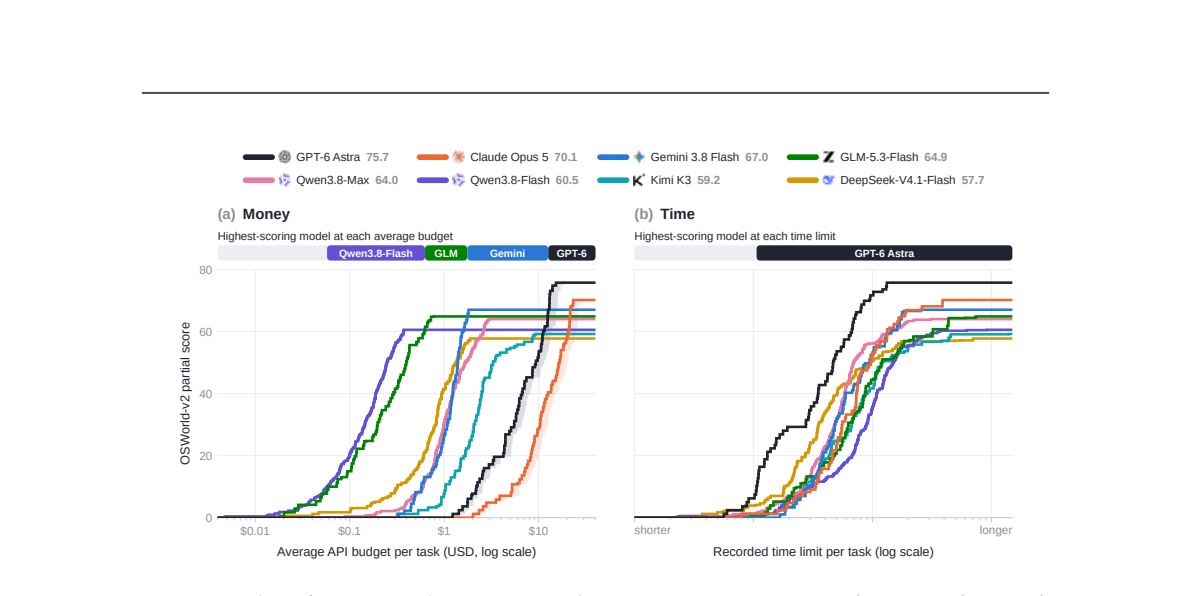
The monetary curves depend on published API prices 'including cache discounts' and on cache-write cost bounds shown as shading; citing the archived price snapshot used would make the cost curves reproducible.
The paper says, at Appendix A
Pith says: minor objection 4 of 5
Retaining the latest attempt rather than the highest-scoring attempt per task is an unusual and commendable choice; one sentence justifying it (e.g., avoiding inflated success from lucky attempts) would help readers.
The paper says, at §2.3
Pith says: minor objection 5 of 5
The phrase 'route flip' in the section title is informal; consider 'shift toward code execution' for consistency with the rest of the manuscript.
What would settle it
Use the released trajectory bundle to recompute Table 2 over every recorded run, not only the selected run, for both the batched GUI-only baseline and the full OpenGCUA configuration; report per-model mean, min/max, and a bootstrap or standard-error interval for score and steps. If the intervals for the eight per-model gains exclude zero and the 53.0% step reduction holds across runs, the concern is resolved; if trajectories contain only one baseline run per model, instead rerun at least five independent runs of each configuration on the 82-task offline subset and compare the full distributions.
from the skeptic's reading
How the review went
4 readings by deepseek-v4-flash · 16 Oct 2026
- Reader holds up, with conditions
- Skeptic partly agrees
- Editor wrote the verdict above
- Referee major revision: 2 major objections, 5 minor
Not run on this paper: the simulated authors' defence.
Pith did not check this review's objections against the paper.
The review in full
The review in brief, machine-written
Jonathan,
Read the OpenGCUA paper so you know what it is before the numbers get quoted around. It defines GCUA as three model-side decisions—what to observe, how to act, how to organize—and builds an open harness that lets existing frontier models write Python programs over GUI plus shell, request screenshots on demand, and keep a todo-style task ledger. The full configuration is compared against batched GUI-only and GUI+CLI baselines on the OSWorld-v2 offline set with eight models. They release prompts, implementation, and full trajectories.
What is genuinely new: a reproducible, code-execution-based harness with the GCUA formalization, plus the first open multi-model trajectory release for this style of computer use. Code execution itself is already recommended by vendors and explored in GUI+CLI agents; the measured comparison and the released artifacts are the contribution. The gains are large and internally consistent: +19.6 mean points, −53% steps across all eight models, and code execution adds 6.1 points over a GUI+CLI baseline. They also disclose real limitations—no trained model, exploratory time curves, one-run real-device results—which is more honest than the field average.
Where it gets soft: Tables 2 and 4 report point estimates with no run counts, variance, or confidence intervals, and the text repeatedly says 'selected runs.' The stress-test note is fair: selecting runs after inspecting outcomes would leave the all-model gains unprotected against selection noise. The paper is not hiding this—it openly says 'selected runs'—but it never quantifies what was selected from. Appendix A describes attempt retention within a run, not run selection. That is the load-bearing weakness. The second issue is baseline integrity: Figure 6 shows batched GUI-only scoring below single-action GUI for two of three models, so the reference point itself looks unstable. I hope the authors post all runs and recompute Table 2 over them; it would take them an afternoon and would settle the question. There is also no design-freeze protocol, so the prompt and harness choices may have been tuned on OSWorld-v2 itself.
One place I disagree with the skeptic: the definitional framing is fine. The formalization in Eq. (1)–(2) is clean, the relation to GUI, CLI, and hybrid agents is correct, and citing Qwen-UI-Agent as lineage is not circular—the gains are measured on an external benchmark. Cited results from published sources are used properly.
My take: this belongs at a serious venue if the run-level evidence is provided. It is infrastructure-first research, the kind that actually shifts how evaluations are done in this subfield. Right now it is a design study with very promising but not fully pinned-down measurements. If I were refereeing, I would request all runs, per-task distributions, and the selection rule before accepting. Would I cite it? Yes, for the harness and the GCUA framing. Bring it to reading group if you want to argue about single-run claims.
Best, [Your name]
The strongest objection
The central result, Table 2 in §3.3.2, reports point estimates for all eight models, but the surrounding text repeatedly qualifies results as coming from 'selected runs' (§3.3.3, §3.3.4, Table 3 caption, Figure 6 caption), and §3.3.6 says the resource curves use 'the same selected full-setting runs as the main evaluation'. Appendix A describes only intra-run attempt retention, not how runs were selected or how many runs were recorded. No per-run distributions or confidence intervals are given. If the reported runs were chosen after inspecting outcomes, the observed all-model gains, including GLM-5.3-Flash +35.2 and the 53.0% step reduction, could be within selection noise. This is a measurement-stability concern, not an accusation: the paper openly uses the word 'selected', but does not quantify what was selected from. Figure 6 reinforces the concern because the batched GUI-only baseline scores below the single-action GUI baseline for all three ablated models (Qwen3.8-Max 46.9 vs 50.9; DeepSeek-V4.1-Flash 28.0 vs 29.5; GLM-5.3-Flash 29.6 vs 37.6), so the baseline against which gains are measured is not shown to be stable across runs and settings.
The paper is a transparent systems study: it releases prompts, trajectories, and implementation, clearly states that no trained model is included, labels real-device results as preliminary, and flags the time-curve comparisons as exploratory. Those are real strengths. The load-bearing condition for the headline claim is that the OSWorld-v2 measurements are stable representatives of each configuration. That condition is least secure because the paper's own language says the headline numbers come from 'selected runs' without documenting the selection rule, the number of runs, or run-level variance. The reader's weakest assumption identifies this same measurement-stability issue; I agree with it, though I do not treat baseline fairness as an equally decisive separate concern. My objection is not that the authors are hiding results, but that the released evidence, as reported in the text, does not yet let a reader distinguish a robust design effect from favorable run selection. The released trajectories make the missing check feasible without retraining models, and the proposed recomputation would settle it. Because this is a verification gap rather than a demonstrated error, and because the authors already release the materials needed to close it, the CONDITIONAL verdict stands; no change in verdict is needed.
The referee's report
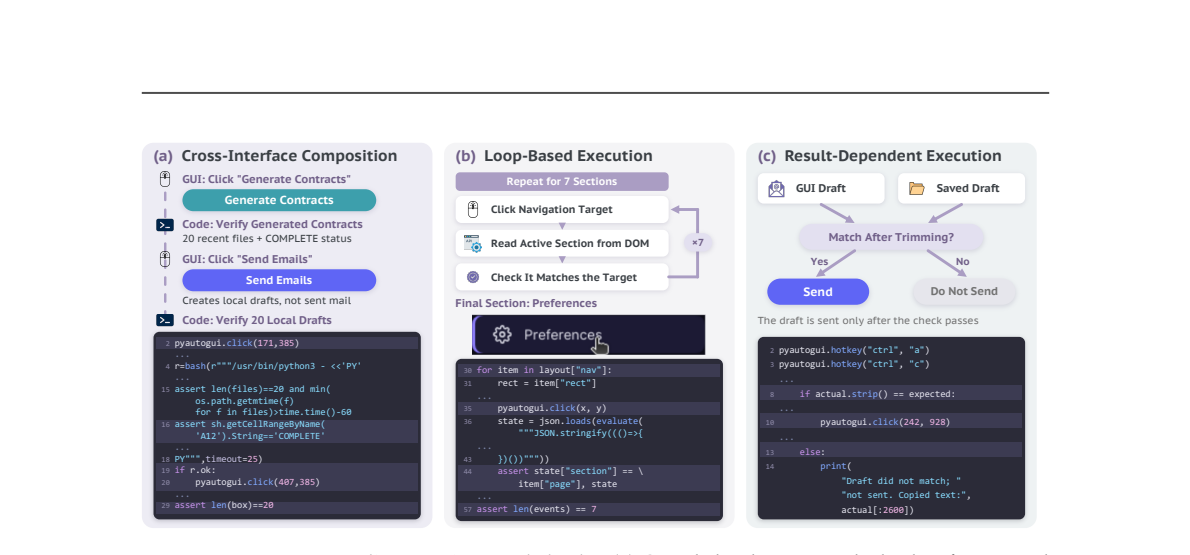
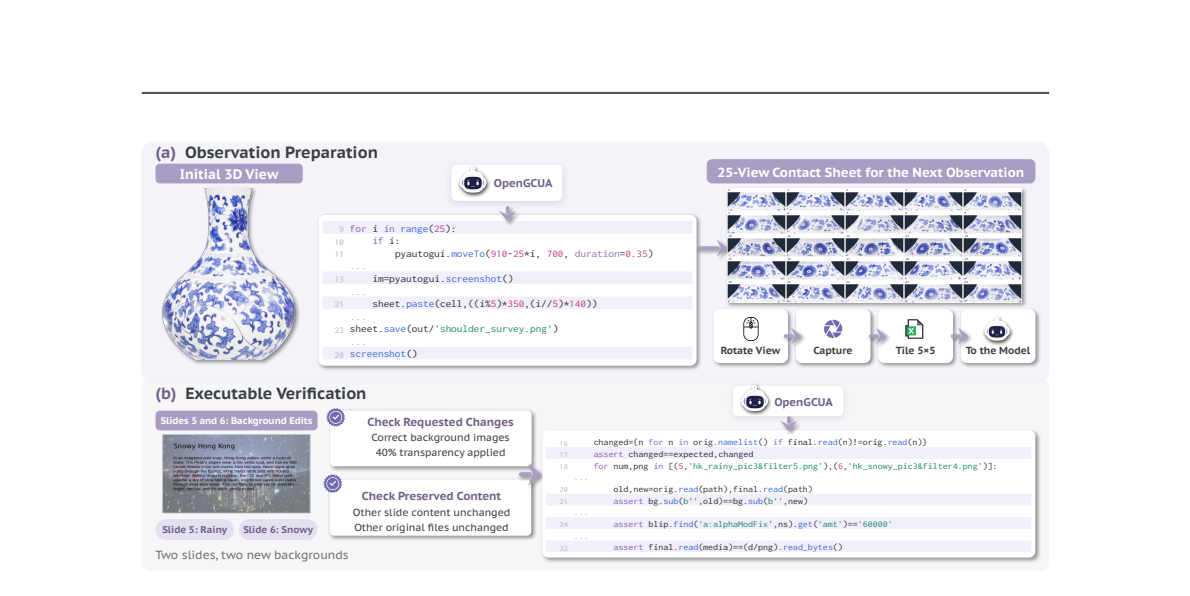
If the empirical claims hold, the paper makes three contributions worth publishing. First, the GCUA formulation gives the community a clean, notation-level way to compare agent families, and the special-case analysis of batched GUI+CLI agents (Eq. 3) is instructive. Second, the release is genuinely open: full prompts are reproduced verbatim in Appendix C, trajectories carry run and attempt identifiers (Appendix D), and implementations are public, so the paper's strongest claims are independently checkable. Third, the design evidence — code-execution patterns (loops, conditionals, verification, observation preparation) and the cache-hit gains from on-demand observation — is concrete and well-illustrated with trajectory excerpts. The paper is also unusually candid: it states that no trained model is included, that the harness and SDK are preliminary, that real-device results use one run per model, and that the time-resource curves are exploratory. The manuscript's internal arithmetic is consistent across Tables 2-4 and Figure 6.
Pith's reading of the paper (a machine's summary, not the authors')
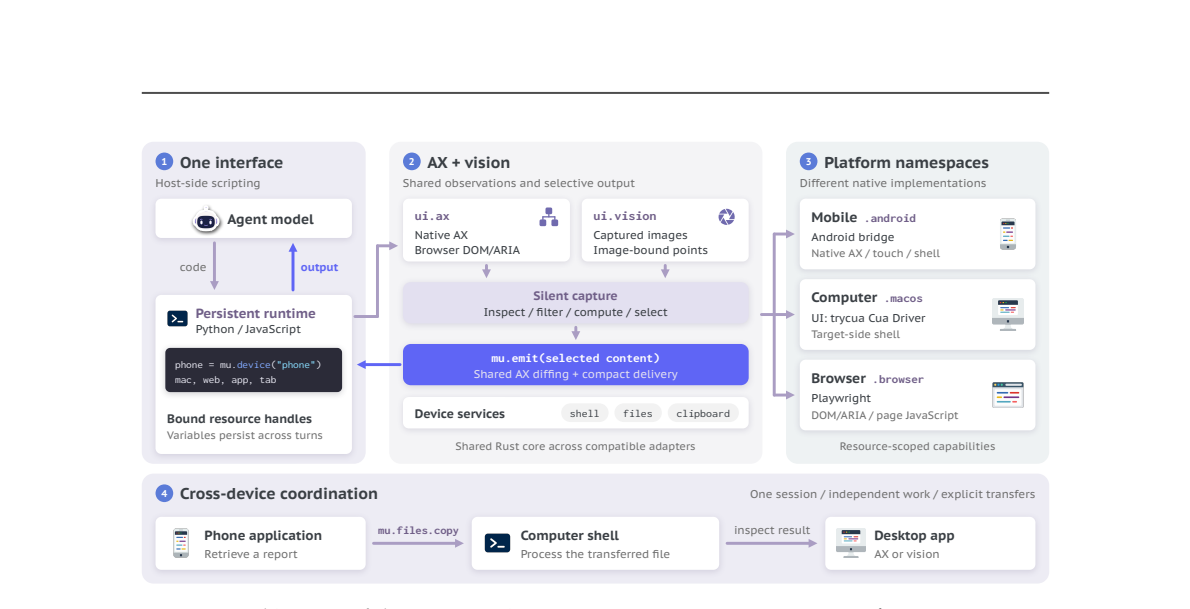
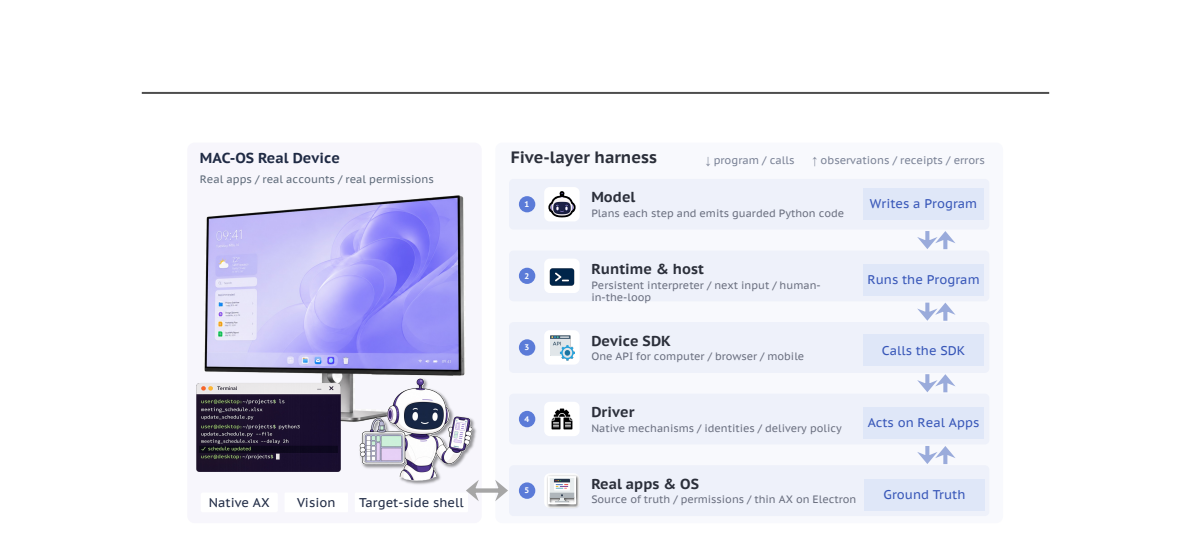
This paper argues that the biggest near-term lever in computer-use agents is not the model alone but how the surrounding system lets the model work. It defines a generalist computer-use agent (GCUA) as one that decides at every step what to observe, how to act, and how to organize its work, and it builds an open harness that gives frontier models code execution (one Python program per step, mixing clicks, shell commands, loops, and checks) plus model-controlled observation and task-state tracking instead of fixed harness rules. On the 82-task offline subset of OSWorld-v2, this combination raises the mean partial score from 45.3 to 64.9 across eight frontier models and cuts steps per task by an average of 53.0% relative to batched GUI-only execution, with code execution alone adding 6.1 points over a GUI+CLI baseline that has the same interface access. The authors release the harness, prompts, and evaluation trajectories, and give preliminary real-macOS evidence that the remaining gap between models is in reasoning efficiency and task coverage rather than in interface access.
What carries the argument. The load-bearing object is the GCUA policy equation $(q_t, p_t, m_{t+1}) \sim \pi_\theta(\cdot \mid m_t, o_t)$, which makes what to observe, how to act, and how to organize the model's joint decision at every step, where the action $p_t$ is a program whose statements call primitives from $A = A_{\mathrm{GUI}} \cup A_{\mathrm{AX}} \cup A_{\mathrm{CLI}} \cup A_{\mathrm{API}}$ with loops, branches, and variables. Two mechanisms carry the empirical argument: code execution, in which one Python program per model call combines PyAutoGUI actions, `bash()` shell commands, and assertions so that intermediate results determine later operations without another model call; and harness-to-model decision transfer, in which a `screenshot()` call requests a new image only when needed, a `todo.update()` ledger tracks task state with statuses such as changed_unverified and claimed_verified, and an `<intent>` block states each program's purpose. The paper also releases the harness implementation, prompts, and evaluation trajectories from all eight models, alongside preliminary versions of a real-device harness and a cross-device SDK that binds every operation to an explicit device, application, window, or tab.
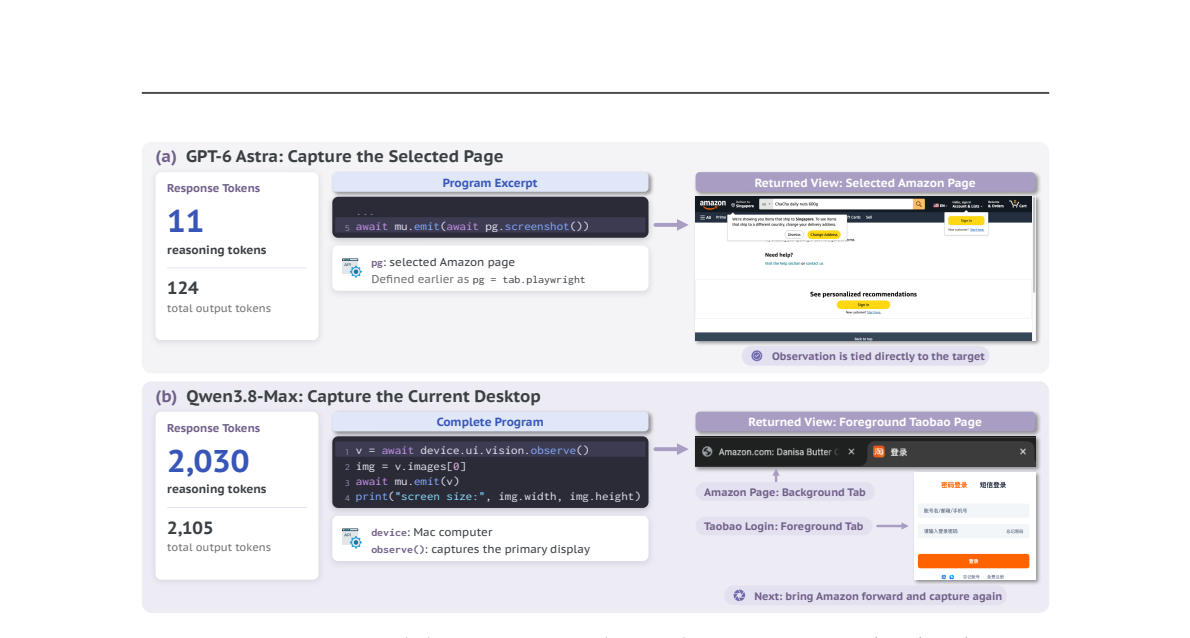
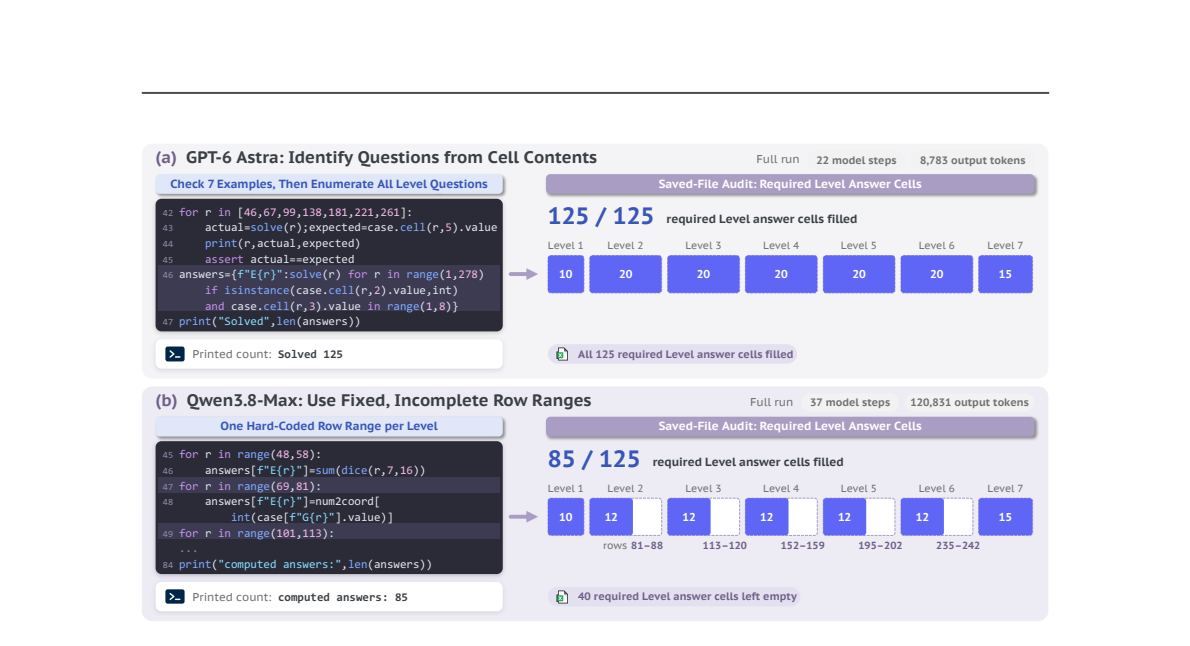
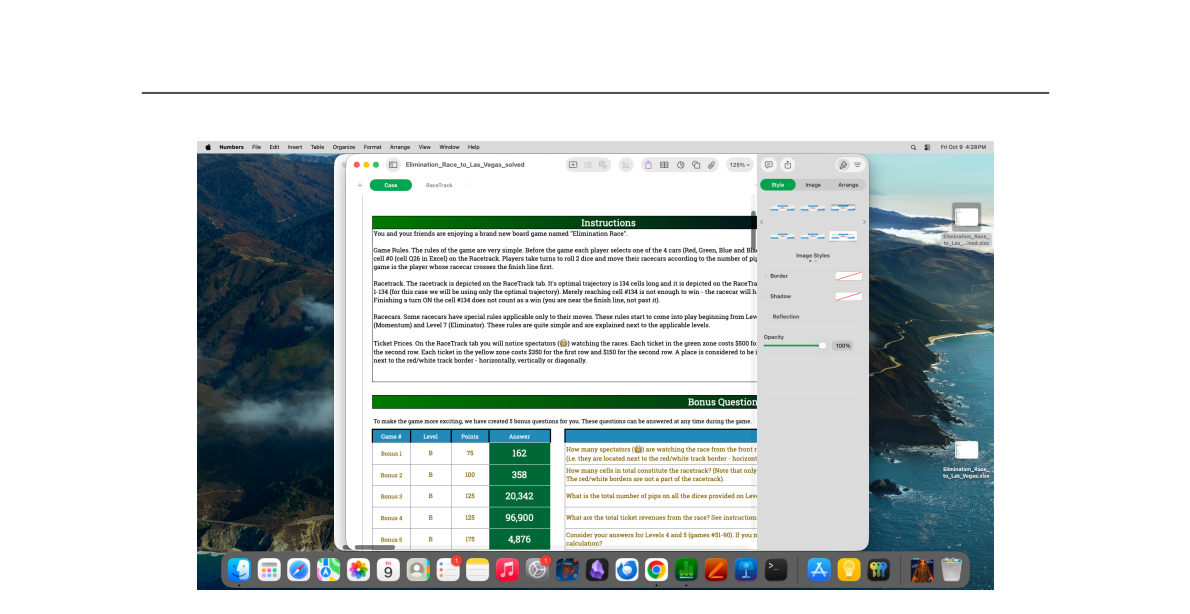
Core claim. The central claim, stated on the paper's own terms, is that a generalist computer-use agent should be defined by who makes the decisions, not by which components it contains. A GCUA policy at each step jointly chooses the observation views, a program over GUI, accessibility-tree, shell, and API primitives, and an updated working state, formalized as $(q_t, p_t, m_{t+1}) \sim \pi_\theta(\cdot \mid m_t, o_t)$. On the 82-task offline subset of OSWorld-v2 v2.1, the full OpenGCUA configuration improves every one of eight evaluated frontier models, including GPT-6 Astra and Claude Opus 5, raising the mean partial score by +19.6 points and reducing steps per task by an average of 53.0% relative to batched GUI-only execution, while narrowing the score gap between the strongest and weakest models by more than half. Code execution specifically, not just shell access, is credited with 6.1 of those points and a 14.8% step reduction against the batched GUI+CLI baseline. On four real macOS tasks with the harness held fixed, Qwen3.8-Max uses 19.4 times as many reported reasoning tokens as GPT-6 Astra and completes fewer tasks, which the case studies trace to model-side choices: large reasoning cost for simple operations, difficulty selecting the correct observation target, and code that covers only part of the task.
The premise it rests on. The headline gains assume the recorded OSWorld-v2 trajectories are stable, representative measurements: the paper reports point estimates without confidence intervals or the number of independent runs, so if single-run variance is material the +19.6-point gain and the 53.0% step reduction could be overstated, and the in-house GUI-only baseline they are measured against is a second unverified premise.
If the paper is right (Pith's inferences, not the authors')
If the OSWorld-v2 numbers hold, execution design matters as much as model choice: every one of the eight models scored higher and used fewer steps, including the strongest model tested.
Code execution, not just interface access, is a large part of the gain: with identical GUI and shell access it added 6.1 mean points and cut steps by 14.8% against the batched GUI+CLI baseline.
The 53.0% average step reduction and 27.2% average output-token reduction imply lower per-task latency and API cost, the conditions that would make delegating real work to a computer-use agent practical.
Harness-to-model decision transfer can be layered on existing frontier models without retraining, and on-demand observation raised cache hit rates by 10.5 and 14.4 percentage points for two models without lowering task scores.
The released prompts, harness, and full trajectories make the design reproducible, so other groups can test whether the gains transfer beyond OSWorld-v2 and to real devices.
If the design gains generalize beyond OSWorld-v2, the GUI-only evaluation paradigm itself becomes the bottleneck: a benchmark that only permits clicks cannot measure an agent that solves the same task with a three-line script, so future benchmarks may need to allow programmatic completion or explicitly forbid it.
The paper's principle that workflow decisions should migrate from fixed harness rules to the model as models improve implies a testable trajectory: later releases could hand the model the context-retention and compaction policies the harness currently owns, and measure whether task scores survive the move.
The 19.4x reasoning-token gap between models on identical real-device tasks suggests that overthinking, not benchmark capability, may dominate real-device cost; a cheap extension would be to test whether capping or compressing reasoning tokens closes the cost gap without hurting completion rates.
The 6.1-point code-execution margin over the GUI+CLI baseline is measured on three to four models in selected runs, so its most direct test is to widen that ablation to all eight models and to repeated runs before treating it as a settled effect.
Check this review
Pith stored no record of this review's passes and took no fingerprint of it. Reviews made by code from 13 Nov 2026 on carry both.
How often reviews like this one are right
Reviews like this one: written by deepseek-v4-flash, where what was read was not recorded.
How often objections from reviews like this one are right: not yet measured
Reviews by people
This review was written by a machine. No person has reviewed this paper on Pith yet. A scientist listed on Pith can review it for a fee, and their review is published here whatever it concludes.
The paper
Abstract
Computer use has reached a turning point: the focus is expanding from GUI-only interaction to systems that complete tasks on users' computers through visual and programmatic interfaces. We define a generalist computer-use agent (GCUA) as a system in which the model chooses how to observe, act, and organize its work across visual and programmatic interfaces. Yet frontier implementations, such as GPT-6 Astra's computer-use system, remain largely closed, limiting systematic study of their design. We introduce Open Generalist CUA (OpenGCUA), an ongoing project to develop and open the full stack for GCUAs with the community. This report presents the first release of OpenGCUA. Code execution is a key feature of our agent design: it lets intermediate results determine subsequent operations and enables models to apply their existing programming capabilities directly to computer interaction. We also propose harness-to-model decision transfer, moving selected observations and task-state decisions from fixed harness rules to the model. On OSWorld-v2, our full configuration improves task scores across all eight evaluated models, including GPT-6 Astra and Claude Opus 5, raising mean partial score by +19.6 points and reducing reported steps per task by an average of 53.0% relative to batched GUI-only execution. We release our implementation and prompts, evaluation trajectories from all eight models, and preliminary versions of a real-device harness and a cross-device SDK. The harness addresses real-device challenges not fully captured by benchmarks, while the SDK provides a common programming interface across computers, mobiles and browsers. Across four real macOS tasks under our real-device harness, selected Qwen3.8-Max runs use 19.4 times as many reported reasoning tokens as GPT-6 Astra, highlighting substantial differences between models in real-device execution efficiency.
The paper's own sentences, arranged, kept beside the review and separate from it. Each label is drawn from a closed vocabulary; the number beside it is the probability the classifier gave that label. No sentence in this record was written by a model.
abstract compiled · 2026-10-16
The authors' main claim, as the classifier picked it out 1.00
“On OSWorld-v2, our full configuration improves task scores across all eight evaluated models, including GPT-6 Astra and Claude Opus 5, raising mean partial score by +19.6 points and reducing reported steps per task by an average of 53.0% relative to batched GUI-only execution.”
How the main claim is stated: asserted 1.00
What the abstract itself states, as probabilities: claims first 0.41 · states limitation 0.69 · human participants 0.07 · controlled comparison 0.90 · randomized assignment 0.02 · states quantitative result 0.99 · compares with prior results 0.96 · mentions code or data availability 0.98
The abstract, sentence by sentence
This table labels the abstract only (arXiv listing abstract v1). The number is the probability the classifier gave the label.
| Sentence | Role | The authors' own work | States the main conclusion | Strength |
|---|---|---|---|---|
| Computer use has reached a turning point: the focus is expanding from GUI-only interaction to systems that complete tasks on users' computers through visual and programmatic interfaces. | background 1.00 | 0.06 | 0.04 | asserted 1.00 |
| We define a generalist computer-use agent (GCUA) as a system in which the model chooses how to observe, act, and organize its work across visual and programmatic interfaces. | background 0.76 | 0.24 | 0.04 | asserted 0.99 |
| Yet frontier implementations, such as GPT-6 Astra's computer-use system, remain largely closed, limiting systematic study of their design. | gap 0.87 | 0.07 | 0.03 | asserted 1.00 |
| We introduce Open Generalist CUA (OpenGCUA), an ongoing project to develop and open the full stack for GCUAs with the community. | contribution 1.00 | 0.74 | 0.08 | asserted 0.99 |
| This report presents the first release of OpenGCUA. | contribution 0.99 | 0.74 | 0.05 | asserted 1.00 |
| Code execution is a key feature of our agent design: it lets intermediate results determine subsequent operations and enables models to apply their existing programming capabilities directly to computer interaction. | method 0.73 | 0.32 | 0.06 | asserted 1.00 |
| We also propose harness-to-model decision transfer, moving selected observations and task-state decisions from fixed harness rules to the model. | method 0.56 | 0.71 | 0.06 | asserted 0.82 |
| On OSWorld-v2, our full configuration improves task scores across all eight evaluated models, including GPT-6 Astra and Claude Opus 5, raising mean partial score by +19.6 points and reducing reported steps per task by an average of 53.0% relative to batched GUI-only execution. | result 1.00 | 0.96 | 0.52 | asserted 1.00 |
| We release our implementation and prompts, evaluation trajectories from all eight models, and preliminary versions of a real-device harness and a cross-device SDK. | contribution 1.00 | 0.92 | 0.09 | asserted 1.00 |
| The harness addresses real-device challenges not fully captured by benchmarks, while the SDK provides a common programming interface across computers, mobiles and browsers. | contribution 0.55 | 0.74 | 0.05 | asserted 1.00 |
| Across four real macOS tasks under our real-device harness, selected Qwen3.8-Max runs use 19.4 times as many reported reasoning tokens as GPT-6 Astra, highlighting substantial differences between models in real-device execution efficiency. | result 0.98 | 0.94 | 0.07 | asserted 0.97 |
What kind of paper the classifier reports this is: method or tool 1.00 · evidence from observation or experiment 0.99
What was examined, and what was not
Sources read
- arXiv listing abstract v1
Not examined
- full text
- figures and tables
- references and citing sentences
- relations to other papers
Levels run
- P abstract
Not run
- S sections
- T body sentences
- C citations
- R cross-paper relations
How the labels were made
Compiled by classifier-1.13.0 via TypeSafe API, question bank abstract-p1-20260923, 2026-10-16: 1 request, 8,365 input tokens.
Every quoted sentence on this record is the authors'. Every label is from Pith's closed vocabulary, with the probability shown beside it. This record as JSON
Figures (15)


Figures are the authors', reproduced from the paper.
References (204)
- [1] GPT-5 Model Overview , author =. 2025 , howpublished = on Pith
- [2] 2026 , howpublished = on Pith
- [3] 2025 , howpublished = on Pith
- [4] Direct Preference Optimization: Your Language Model is Secretly a Reward Model , author=. 2024 , eprint= on Pith
- [6] Androidworld: A dynamic benchmarking environment for autonomous agents , author=. arXiv preprint arXiv:2405.14573 , year= on PithPith's reviewarXiv
- [7] Mobile-agent-v3: Fundamental agents for gui automation , author=. arXiv preprint arXiv:2508.15144 , year= on PithPith's reviewarXiv
- [8] Ponder & Press: Advancing Visual GUI Agent towards General Computer Control , author=. 2024 , eprint= on Pith
- [9] InfiGUI-R1: Advancing Multimodal GUI Agents from Reactive Actors to Deliberative Reasoners , author=. 2025 , eprint= on Pith
- [10] UI-Venus Technical Report: Building High-performance UI Agents with RFT , author=. 2025 , eprint= on Pith
- [11] MMBench-GUI: Hierarchical Multi-Platform Evaluation Framework for GUI Agents , author =. arXiv preprint arXiv:2507.19478 , year = on PithPith's reviewarXiv
- [12] LPO: Towards Accurate GUI Agent Interaction via Location Preference Optimization , author=. 2025 , eprint= on Pith
- [13] ShowUI: One Vision-Language-Action Model for GUI Visual Agent , author=. 2024 , eprint= on Pith
- [14] Qwen2 Technical Report , author=. 2024 , eprint= on Pith
- [15] SeeClick: Harnessing GUI Grounding for Advanced Visual GUI Agents , author=. 2024 , eprint= on Pith
- [16] The Showdown Computer Control Evaluation Suite , author=. 2025 , url= on Pith
- [17] OSWorld: Benchmarking Multimodal Agents for Open-Ended Tasks in Real Computer Environments , author=. 2024 , eprint= on Pith
- [18] OmniACT: A Dataset and Benchmark for Enabling Multimodal Generalist Autonomous Agents for Desktop and Web , author=. 2024 , eprint= on Pith
- [19] Widget Captioning: Generating Natural Language Description for Mobile User Interface Elements , author=. 2020 , eprint= on Pith
- [20] Chai, Yuxiang and Huang, Siyuan and Niu, Yazhe and Xiao, Han and Liu, Liang and Wang, Guozhi and Zhang, Dingyu and Ren, Shuai and Li, Hongsheng , year=. AMEX: Android Multi-annotation Expo Dataset for Mobile GUI Agents , url=. doi:10.18653/v1/2025.findings-acl.110 , booktitle= on Pithdoi:10.18653/v1/2025.findings-acl.110
- [21] Scaling Computer-Use Grounding via User Interface Decomposition and Synthesis , author=. 2025 , eprint= on Pith
show 80 more
- [22] Aguvis: Unified Pure Vision Agents for Autonomous GUI Interaction , author=. 2025 , eprint= on Pith
- [23] GPT-4o System Card , author=. 2024 , eprint= on Pith
- [24] Claude 3.7 Sonnet , author =. 2024 , howpublished = on Pith
- [25] OpenAI , title =. 2025 , note = on Pith
- [26] EcoAgent: An Efficient Edge-Cloud Collaborative Multi-Agent Framework for Mobile Automation , author=. arXiv preprint arXiv:2505.05440 , year= on PitharXiv
- [27] Ponder & press: Advancing visual gui agent towards general computer control , author=. arXiv preprint arXiv:2412.01268 , year= on PithPith's reviewarXiv
- [28] Mirage-1: Augmenting and Updating GUI Agent with Hierarchical Multimodal Skills , author=. arXiv preprint arXiv:2506.10387 , year= on PithPith's reviewarXiv
- [29] Symbolic Learning Enables Self-Evolving Agents , author=. 2024 , eprint= on Pith
- [30] Deepseekmath: Pushing the limits of mathematical reasoning in open language models, 2024 , author=. URL https://arxiv. org/abs/2402.03300 , volume= on PithPith's reviewarXiv
- [31] Deepseek-r1: Incentivizing reasoning capability in llms via reinforcement learning , author=. arXiv preprint arXiv:2501.12948 , year= on PithPith's reviewarXiv
- [32] Boyu Gou and Ruohan Wang and Boyuan Zheng and Yanan Xie and Cheng Chang and Yiheng Shu and Huan Sun and Yu Su , booktitle=. Navigating the Digital World as Humans Do: Universal Visual Grounding for. 2025 , url= on Pith
- [33] UI-TARS-1.5 , author = on Pith
- [35] InternVL3: Exploring Advanced Training and Test-Time Recipes for Open-Source Multimodal Models , author=. 2025 , eprint= on Pith
- [36] InfiGUI-G1: Advancing GUI Grounding with Adaptive Exploration Policy Optimization , author=. arXiv preprint arXiv:2508.05731 , year= on PitharXiv
- [37] Anthropic , title =. 2024 , month = on Pith
- [38] Redroid: A Multi-Arch, GPU-Enabled Android in Cloud Container Solution , author=. 2024 , howpublished= on Pith
- [39] UI-R1: Enhancing Action Prediction of GUI Agents by Reinforcement Learning , author=. arXiv preprint arXiv:2503.21620 , year= on PithPith's reviewarXiv
- [40] ZonUI-3B: A Lightweight Vision-Language Model for Cross-Resolution GUI Grounding , author =. 2025 , howpublished = on Pith
- [41] GUI-R1: A Generalist R1-Style Vision-Language Action Model For GUI Agents , author=. arXiv preprint arXiv:2504.10458 , year= on PithPith's reviewarXiv
- [42] UI-AGILE: Advancing GUI Agents with Effective Reinforcement Learning and Precise Inference-Time Grounding , author=. 2025 , eprint= on Pith
- [43] GUI-G ^2 : Gaussian Reward Modeling for GUI Grounding , author=. 2025 , eprint= on Pith
- [44] Phi-Ground Tech Report: Advancing Perception in GUI Grounding , author=. arXiv preprint arXiv:2507.23779 , year= on PithPith's reviewarXiv
- [45] OpenCUA: Open Foundations for Computer-Use Agents , author=. 2025 , eprint= on Pith
- [46] GUI-Actor: Coordinate-Free Visual Grounding for GUI Agents , author=. arXiv preprint arXiv:2506.03143 , year= on PithPith's reviewarXiv
- [47] Enhancing Visual Grounding for GUI Agents via Self-Evolutionary Reinforcement Learning , author=. arXiv preprint arXiv:2505.12370 , year= on PithPith's reviewarXiv
- [48] Qwen2. 5-vl technical report , author=. arXiv preprint arXiv:2502.13923 , year= on PithPith's reviewarXiv
- [49] GUI-G1: Understanding R1-Zero-Like Training for Visual Grounding in GUI Agents , author=. 2025 , eprint= on Pith
- [50] CogAgent: A Visual Language Model for GUI Agents , author=. 2024 , eprint= on Pith
- [51] Seg-Zero: Reasoning-Chain Guided Segmentation via Cognitive Reinforcement , author =. arXiv preprint arXiv:2503.06520 , year = on PithPith's reviewarXiv
- [52] Vision-R1: Incentivizing Reasoning Capability in Multimodal Large Language Models , author=. 2025 , eprint= on Pith
- [53] Time-R1: Post-Training Large Vision Language Model for Temporal Video Grounding , author=. 2025 , eprint= on Pith
- [54] VisionReasoner: Unified Visual Perception and Reasoning via Reinforcement Learning , author =. arXiv preprint arXiv:2505.12081 , year = on PitharXiv
- [55] Aria-UI: Visual Grounding for GUI Instructions , author=. 2024 , eprint= on Pith
- [56] Mind2Web: Towards a Generalist Agent for the Web , author=. 2023 , eprint= on Pith
- [57] AndroidWorld: A Dynamic Benchmarking Environment for Autonomous Agents , author=. 2024 , eprint= on Pith
- [58] WebGen-Bench: Evaluating LLMs on Generating Interactive and Functional Websites from Scratch , author=. 2025 , eprint= on Pith
- [59] WebVoyager: Building an End-to-End Web Agent with Large Multimodal Models , author=. 2024 , eprint= on Pith
- [60] GTA1: GUI Test-time Scaling Agent , author=. 2025 , eprint= on Pith
- [61] OmniParser for Pure Vision Based GUI Agent , author=. 2024 , eprint= on Pith
- [62] GUI-ReWalk: Massive Data Generation for GUI Agent via Stochastic Exploration and Intent-Aware Reasoning , author=. arXiv preprint arXiv:2509.15738 , year= on PitharXiv
- [63] Ui-venus technical report: Building high-performance ui agents with rft , author=. arXiv preprint arXiv:2508.10833 , year= on PithPith's reviewarXiv
- [64] Efficient Multi-turn RL for GUI Agents via Decoupled Training and Adaptive Data Curation , author=. arXiv preprint arXiv:2509.23866 , year= on PitharXiv
- [65] Androidlab: Training and systematic benchmarking of android autonomous agents , author=. Proceedings of the 63rd Annual Meeting of the Association for Computational Linguistics (Volume 1: Long Papers) , pages= on Pith
- [67] UI-Ins: Enhancing GUI Grounding with Multi-Perspective Instruction-as-Reasoning , author=. arXiv preprint arXiv:2510.20286 , year= on PitharXiv
- [68] Single-Rollout Asynchronous Optimization for Agentic Reinforcement Learning , author=. arXiv preprint arXiv:2607.07508 , year= on PithPith's reviewarXiv
- [69] A Survey on LLM-as-a-Judge , author=. 2025 , eprint= on Pith
- [70] OpenAI , title =. 2025 , url = on Pith
- [71] Gui agents with foundation models: A comprehensive survey , author=. arXiv preprint arXiv:2411.04890 , year= on PithPith's reviewarXiv
- [72] Google DeepMind , title =. 2025 , url = on Pith
- [73] Ferret-ui lite: Lessons from building small on-device gui agents , author=. arXiv preprint arXiv:2509.26539 , year= on PitharXiv
- [74] Qwen3-VL Technical Report , author=. arXiv preprint arXiv:2511.21631 , year= on PithPith's reviewarXiv
- [75] Efficient Agent Training for Computer Use , author=. arXiv preprint arXiv:2505.13909 , year= on PitharXiv
- [76] UI-E2I-Synth: Advancing GUI Grounding with Large-Scale Instruction Synthesis , author=. 2025 , eprint= on Pith
- [77] On the Effects of Data Scale on UI Control Agents , author=. 2024 , eprint= on Pith
- [78] Kaixin Li and Meng Ziyang and Hongzhan Lin and Ziyang Luo and Yuchen Tian and Jing Ma and Zhiyong Huang and Tat-Seng Chua , booktitle=. ScreenSpot-Pro:. 2025 , url= on Pith
- [79] OS-ATLAS: A Foundation Action Model for Generalist GUI Agents , author=. 2024 , eprint= on Pith
- [80] GUI Odyssey: A Comprehensive Dataset for Cross-App GUI Navigation on Mobile Devices , author=. arXiv preprint arXiv:2406.08451 , year= on PithPith's reviewarXiv
- [81] Google , title =. 2025 , url = on Pith
- [82] AgentCPM-GUI: Building Mobile-Use Agents with Reinforcement Fine-Tuning , author=. arXiv preprint arXiv:2506.01391 , year= on PithPith's reviewarXiv
- [83] Infiguiagent: A multimodal generalist gui agent with native reasoning and reflection , author=. arXiv preprint arXiv:2501.04575 , year= on PithPith's reviewarXiv
- [84] Os-genesis: Automating gui agent trajectory construction via reverse task synthesis , author=. Proceedings of the 63rd Annual Meeting of the Association for Computational Linguistics (Volume 1: Long Papers) , pages= on Pith
- [85] Aguvis: Unified pure vision agents for autonomous gui interaction , author=. arXiv preprint arXiv:2412.04454 , year= on PithPith's reviewarXiv
- [86] Seed1. 5-vl technical report , author=. arXiv preprint arXiv:2505.07062 , year= on PithPith's reviewarXiv
- [87] Mobile-agent: Autonomous multi-modal mobile device agent with visual perception , author=. arXiv preprint arXiv:2401.16158 , year= on PithPith's reviewarXiv
- [88] LightAgent: Mobile Agentic Foundation Models , author=. arXiv preprint arXiv:2510.22009 , year= on PithPith's reviewarXiv
- [90] UI-Vision: A Desktop-centric GUI Benchmark for Visual Perception and Interaction , author=. 2025 , eprint= on Pith
- [91] HybridFlow: A Flexible and Efficient RLHF Framework , author =. 2024 , journal = on Pith
- [93] Seed1.8 Model Card: Towards Generalized Real-World Agency , author=. arXiv preprint , year= on Pith
- [95] Dapo: An open-source llm reinforcement learning system at scale , author=. arXiv preprint arXiv:2503.14476 , year= on PithPith's reviewarXiv
- [96] Mobileworld: Benchmarking autonomous mobile agents in agent-user interactive and mcp-augmented environments , author=. Proceedings of the 64th Annual Meeting of the Association for Computational Linguistics (Volume 1: Long Papers) , pages= on Pith
- [97] Introducing. 2026 , month = may, howpublished = on Pith
- [98] 2026 , month = apr, howpublished = on Pith
- [99] 2026 , month = feb, howpublished = on Pith
- [100] 2026 , month = jun, howpublished = on Pith
- [102] Mobile-Agent-v3.5: Multi-platform Fundamental GUI Agents , author =. arXiv preprint arXiv:2602.16855 , year =. 2602.16855 , archivePrefix = on PitharXiv
- [103] Lian, Niu and Chen, Alan and Yu, Zhehao and Duan, Chengzhen and Liu, Fazhan and Liu, Hui and Fu, Pei and Luan, Jian and Wang, Yaowei and Xia, Shu-Tao and Wang, Jinpeng , journal =. 2026 , eprint = on Pith
- [104] Hu, Xuhao and Zhang, Xi and Xu, Haiyang and Qiao, Kyle and Yang, Jingyi and Huang, Xuanjing and Shao, Jing and Yan, Ming and Ye, Jieping , journal =. 2026 , eprint = on Pith
- [105] Li, Chenxin and Fang, Zhengyao and Tang, Zhengyang and Lyu, Pengyuan and Zhou, Xingran and Lai, Xin and Tang, Fei and Wu, Liang and Guo, Yiduo and Wang, Weinong and Li, Junyi and Zhang, Yi and Ding, Yang and Shen, Huawen and Fan, Sunqi and Peng, Shangpin and Ruan, Zheng and Zh... on Pith
- [106] MobileForge: Annotation-Free Adaptation for Mobile GUI Agents with Hierarchical Feedback-Guided Policy Optimization , author =. arXiv preprint arXiv:2606.19930 , year =. 2606.19930 , archivePrefix = on PithPith's reviewarXiv
- [107] Introducing. 2026 , month = apr, howpublished = on Pith
The first 100 of 204 references are listed here. All of them are in this paper's citation record.
Cited by 1 Pith paper
Reviewed papers on Pith that cite this one. The full citation record
Challenges and discussion
Disagree with the review, or know something it missed? Leave a comment, or challenge this review formally: a challenge becomes a permanent entry in this paper's record, and its decision is published here.
Come back by email
A short list of the week's newly reviewed papers. Nothing is sent until you confirm from your inbox, and every email has a link that stops it. No account.
No comments yet.
Sign in to comment