Artificial Intelligence · arXiv:2610.34260 v1 · submitted 25 Oct 2026 · 93 references
MultiEvoSkill: Structure-Aware Multi-Agent Skill Evolution for Generalizable Skill Artifacts
The paper says
“Skill documents are becoming the default adaptation surface for frozen large language model (LLM) agents, but current skill generators face two key limitations. First, humans and different LLMs differ in how they organize procedural knowledge and approach task solving.”
more of the abstract
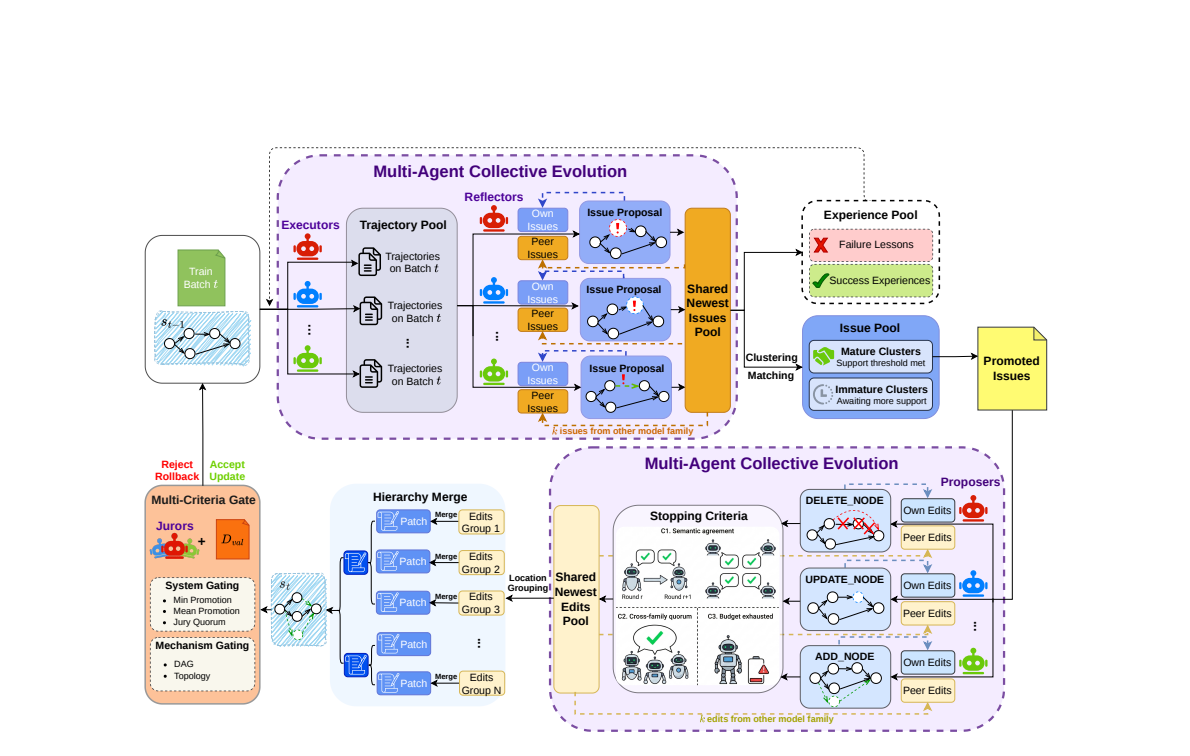
Skills authored from a human or single-model perspective may therefore fail to align with the reasoning behaviors of other backbones, limiting cross-model generalization. Second, sequential skill descriptions inadequately represent procedures with parallel branches and explicit dependencies, while existing skill optimizers primarily operate on prose and lack explicit support for graph-structured skill evolution. We introduce MultiEvoSkill, a skill-optimization framework comprising three core components: 1) Skill compiler casts the skill as a typed graph with tailored operators, producing a compact, informative representation with explicit procedural topology; 2) Heterogeneous agent system proposes revision advices using collective intelligence, where minimal and informative issues are identified based on multiple sets of experiences. 3) Structure-aware debate and evolution mechanism organizes candidate edits into a heterogeneous graph, resolves them under dependency and importance constraints, and distills the collective proposal into the artifact. Multi-dimensional gating ensures the information gain and topological correctness of each evolution. Optimal skills are then obtained when the system converges at a consistent state. Various experiments and ablations against SOTA methods validate the effectiveness and generalization of MultiEvoSkill.
from the abstract
Pith says
Machine review · deepseek-v4-flash · 27 Oct 2026 · what was read was not recorded · not checked by a person
It can be wrong. Challenge this review or reply to it.
Holds up, with conditions. Strong framework design, but empirical comparison undercuts the headline results. This line is wrong
2 major objections · 6 minor
How often objections from reviews like this one are right: not yet measured
Not checked: figures, code, what the 93 references say.
The paper says, at §4.2, sentence b148
The review did not quote this passage.
Pith says: Objection 1 of 2 · major
The paper claims that all methods are compared 'within the scope of budget-equivalent comparisons' but provides no cost or token accounting. MultiEvoSkill uses three additional proposer models (Gemini-3.8-Flash, MinMax-M3, DeepSeek-V4-Flash) beyond the common authoring backbone GPT-5.6-LUNA. The ablation in Table 4 shows that removing any proposer, especially GPT-5.6-LUNA, causes large drops (e.g., 26.17 points on ToolAlpaca).
more of objection 1
This indicates that the proposer panel's diversity and individual capabilities are major performance drivers. Without evidence that total query/token budgets are equivalent across methods, the headline claim of state-of-the-art performance conflates method with model capability and compute. A controlled experiment that equates total compute or isolates the graph representation from the model panel is needed to support the main claim.
The paper says, at §3.3, sentence b97
The review did not quote this passage.
A classifier read this sentence of the paper as acknowledging the concern (probability 0.87):
“A shared failure is evidence of a recurring problem, not proof that the skill rather than shared model limitations caused it.”
Pith says: Objection 2 of 2 · major
The reflection system treats a shared failure across multiple LLM executors as evidence of a skill deficiency. The authors acknowledge this is 'not proof that the skill rather than shared model limitations caused it.' This is a clear limitation, but the paper does not evaluate how often the system wastes edits on model-specific biases. An analysis of false-positive issue proposals (e.g., how many edits prompted by shared failures were later rejected by the gate) would strengthen the evaluation.
6 minor objections
The paper says, at §4.1, RQ3
Pith says: minor objection 1 of 6
The research question reads 'Does the heterogeneous intelligence brings performance gains?'. Grammar: 'brings' should be 'bring'.
The paper says, at Abstract
Pith says: minor objection 2 of 6
The abstract states '1) Skill compiler casts the skill as a typed graph with tailored operators, producing a compact, informative representation with explicit procedural topology.' The phrase 'compact, informative' is vague; consider providing a quantitative measure of compactness (e.g., node count vs. word count).
show 4 more
The paper says, at §4.4.1, Table 4
Pith says: minor objection 3 of 6
The variants are labeled 'w/oδ1', 'w/oδ2', etc. In the caption and text, define δ1–δ4 explicitly as the four proposer models. Currently the definitions appear only in the narrative after the table; adding them directly to the table caption would improve readability.
The paper says, at §4.2, paragraph on datasets
Pith says: minor objection 4 of 6
The description says 'SpreadsheetBench uses hard instance accuracy'. It would be helpful to clarify what 'hard instance' means in this context (e.g., a specific difficulty split).
The paper says, at §3.5, Eq. (13)
Pith says: minor objection 5 of 6
The gating condition uses tolerance ϵ, threshold τ, and quota q₀. These parameters are listed in Table 7 but their tuning is not discussed. A brief sensitivity analysis or justification for the chosen values would be helpful.
The paper says, at Conclusion
Pith says: minor objection 6 of 6
The conclusion states 'MultiEvoSkill achieves the highest reported scores across the five benchmarks.' This is accurate only if budget-equivalence is assumed; please qualify the statement to reflect the comparison limitations.
What would settle it
Run a controlled experiment where MultiEvoSkill uses only GPT-5.6-LUNA for all roles (executor, reflector, proposer) and compare its test-set scores against the full MultiEvoSkill and the strongest baseline (SkillOpt or CoEvoSkills). If the single-model variant performs comparably to or below baselines, the reported advantage is due to stronger proposer models, not the method. Report total API tokens or costs for all methods to verify budget-equivalence.
from the skeptic's reading
How the review went
4 readings by deepseek-v4-flash · 27 Oct 2026
- Reader holds up, with conditions
- Skeptic partly agrees
- Editor wrote the verdict above
- Referee major revision: 2 major objections, 6 minor
Not run on this paper: the simulated authors' defence.
Pith did not check this review's objections against the paper.
The review in full
The review in brief, machine-written
Hi [Name],
You asked about 2610.34260. Bottom line: the paper sketches a sensible architecture for evolving skill graphs via multi-agent reflection and debate, and the ablation studies are informative. But the central claim—state-of-the-art scores on five benchmarks—rests on a comparison that likely conflates method with model budget.
What is new: the typed graph representation for skills, the heterogeneous agent pipeline that separates execution, reflection, proposal, merging, and gating into roles, and the multi-dimensional gating based on selection-set performance and structural validity. These design choices are well-motivated and the ablations show each component contributes. The paper reads as a serious engineering effort.
Where it softens: the 'budget-equivalent' comparison (b148) is asserted without accounting. MultiEvoSkill uses GPT-5.6-LUNA plus three other models as proposers; baselines use only the first model. The ablation in Table 4 makes the worry concrete—removing GPT-5.6-LUNA drops scores by 26 points on ToolAlpaca. That suggests proposer capability, not just graph evolution, is driving the gains. Without a compute-controlled experiment or an ablation that equates total queries, we don't know whether the graph representation adds value beyond the extra models.
A secondary concern: no error bars or statistical tests on the main results. Given the small selection sets (e.g., 19–53 samples per domain), variance could be high. The authors acknowledge overfitting risk (b187) but don't report variance.
The paper's own limitations section is honest but does not address the fairness threat. That limits the strength of the empirical contribution.
Who it's for: researchers working on skill optimization for LLM agents. The architecture is worth studying, even if the headline numbers are provisional.
Recommendation: deserves a serious referee. The core approach is novel and the writing is clear. But the reviewer should ask for a budget-controlled comparison and, at minimum, error bars. With those fixed, the paper would be considerably stronger.
Best.
The strongest objection
The central claim—MultiEvoSkill achieves the highest scores on every benchmark—depends on a fair comparison that controls for total compute and model capability. The paper states that all methods share a common authoring backbone (GPT-5.6-LUNA) but MultiEvoSkill additionally employs three stronger proposer models (Gemini-3.8-Flash, MinMax-M3, DeepSeek-V4-Flash). The ablation in Table 4 shows that removing any proposer, especially the authoring backbone itself, causes large drops (e.g., 26.17 points on ToolAlpaca when removing GPT-5.6-LUNA). This suggests that the proposer panel's diversity and individual capabilities are primary drivers of performance. Yet the paper's comparison with baselines (which use only GPT-5.6-LUNA) is labeled 'within the scope of budget-equivalent comparisons' (§4.2, sentence b148) without any cost or token accounting. If MultiEvoSkill uses substantially more compute per training item (multiple proposers, multiple debate rounds, multiple executors per sample), the comparison is not budget-equivalent and the performance advantage may stem from greater computational resources rather than the graph-based evolution method. The paper's own Limitations (§5) acknowledge overfitting risk but do not address this fairness threat. Without a controlled experiment equating total query/token budgets or isolating the graph representation from the model panel, the headline claim is unsubstantiated.
The reader's weakest_assumption focused on the reflection system's difficulty distinguishing skill deficiencies from shared model biases—a limitation the paper acknowledges. That concern is valid but internal to the method's effectiveness, not its fairness. The load-bearing concern I identify is about the fairness of the comparison to baselines: MultiEvoSkill uses stronger, additional LLMs as proposers, and the claim of budget-equivalence is unsubstantiated. If the advantage is due to model capability rather than the graph-evolution design, the central claim of methodological superiority is invalid. The reader's rationale also mentions 'budget-equivalent comparison claim needs explicit justification,' so there is partial agreement. However, the reader did not emphasize the proposer-model asymmetry as the primary threat. My concrete test directly isolates this confound, and my verdict remains CONDITIONAL because the concern is serious but resolvable with additional experiments. I keep UNCHANGED because I do not recommend a different verdict; the reader's CONDITIONAL is appropriate.
The referee's report
If substantiated, the paper makes a strong contribution to skill evolution for LLM agents. The typed-graph representation and the multi-model evidence consolidation pipeline are novel and address genuine limitations of prose-based skills (branching, dependencies, cross-model generalization). The ablation studies (Tables 4 and 5) provide useful insights about the contribution of each proposer model and each gating component.
Pith's reading of the paper (a machine's summary, not the authors')
MultiEvoSkill aims to solve two problems in optimizing skill documents for frozen LLM agents: linear prose obscures parallel branches and dependencies, and single-model optimization produces skills that fail to transfer to other backbones. The paper claims that representing skills as typed directed graphs (with action, decision, artifact, and constraint nodes) and evolving them through a heterogeneous multi-agent pipeline—where different LLMs collect contrasting trajectories, reflect on graph-grounded failures, debate edits, and merge compatible patches under a multi‑dimensional gate—produces a single reusable skill that outperforms existing methods on every tested benchmark. If true, this means skill optimization can be both structurally explicit and cross‑model generalizable without requiring inference‑time ensembles.
What carries the argument. The central object is the typed attributed skill graph (Definition 3.1), a directed multigraph whose node types (action, decision, artifact, constraint) and edge types (ordering, branching, production, consumption, constraint) make procedural topology explicitly addressable by the optimizer. This graph is coupled with a heterogeneous multi‑agent pipeline: executors from different LLM families collect trajectories on the same training items; reflectors extract graph‑grounded issues; proposers debate and produce bounded edits per issue; a hierarchical revisor merges compatible patches; and a multi‑dimensional gate (min/mean jury score change, structural DAG check, topological jury) accepts or rejects the candidate. The pipeline iterates until a consistency stopping rule, producing a single skill graph that has been evolved through collective intelligence.
Core claim. The paper claims that encoding a skill as a typed, attributed directed multigraph—where nodes represent actions, decisions, artifacts, and constraints, and edges encode ordering, branching, production, and dependency relations—makes procedural topology and sample‑conditioned branches explicit targets for revision. When this graph representation is coupled with a heterogeneous multi‑agent evolution pipeline (multiple LLM executors, reflection agents that extract graph‑grounded failures, proposers that debate bounded edits, a hierarchical revisor, and a multi‑dimensional gate that checks behavioral gain, structural validity, and topological coherence), the resulting artifact absorbs complementary evidence from different LLM families and achieves the highest reported scores on WikiHow, ToolAlpaca, WebShop, SearchQA, and SpreadsheetBench, outperforming baselines such as SkillOpt, CoEvoSkills, SkillBoost, SkillGen, and Trace2Skill.
The premise it rests on. The reflection system assumes that a shared failure across multiple LLM executors on the same training item is evidence of a skill deficiency, but as the paper acknowledges, it could instead reflect common model limitations rather than a skill bug.
If the paper is right (Pith's inferences, not the authors')
Skill artifacts evolved through MultiEvoSkill can be loaded by a frozen LLM at run time without inference‑time ensembles, reducing cost while maintaining cross‑backbone performance.
The typed graph representation allows one skill to express multiple task families (e.g., lookup, aggregation, formula preservation) via explicit branch guards, improving cross‑sample generalization within a domain.
Heterogeneous peer debate (Section 3.3) identifies issue‑specific edits that would be missed by a single model, as shown by the 26‑point drop on ToolAlpaca when the GPT proposer is removed.
The multi‑dimensional gate (behavioral + structural + topological checks) prevents regressive or malformed updates, and ablations show every gate component is necessary for monotonic improvement.
If MultiEvoSkill's approach to heterogeneous collective intelligence is sound, then skill optimization may have moved from a single‑model bottleneck to a resource that benefits directly from model diversity: adding a new LLM family with complementary strengths could raise performance further without retraining the system.
The typed graph representation might enable formal verification of procedural properties (e.g., reachability,dead‑lock freedom) beyond what the current LLM‑based topology jury provides, a direction the authors acknowledge as future work in their limitations.
The paper's ablation shows the GPT proposer contributes most on complex tasks; an editor could test whether the method generalises to open‑source proposers with different architectural trade‑offs (e.g., Mixture‑of‑Experts vs. dense models).
Check this review
Pith stored no record of this review's passes and took no fingerprint of it. Reviews made by code from 13 Nov 2026 on carry both.
How often reviews like this one are right
Reviews like this one: written by deepseek-v4-flash, where what was read was not recorded.
How often objections from reviews like this one are right: not yet measured
Reviews by people
This review was written by a machine. No person has reviewed this paper on Pith yet. A scientist listed on Pith can review it for a fee, and their review is published here whatever it concludes.
The paper
Abstract
Skill documents are becoming the default adaptation surface for frozen large language model (LLM) agents, but current skill generators face two key limitations. First, humans and different LLMs differ in how they organize procedural knowledge and approach task solving. Skills authored from a human or single-model perspective may therefore fail to align with the reasoning behaviors of other backbones, limiting cross-model generalization. Second, sequential skill descriptions inadequately represent procedures with parallel branches and explicit dependencies, while existing skill optimizers primarily operate on prose and lack explicit support for graph-structured skill evolution. We introduce MultiEvoSkill, a skill-optimization framework comprising three core components: 1) Skill compiler casts the skill as a typed graph with tailored operators, producing a compact, informative representation with explicit procedural topology; 2) Heterogeneous agent system proposes revision advices using collective intelligence, where minimal and informative issues are identified based on multiple sets of experiences. 3) Structure-aware debate and evolution mechanism organizes candidate edits into a heterogeneous graph, resolves them under dependency and importance constraints, and distills the collective proposal into the artifact. Multi-dimensional gating ensures the information gain and topological correctness of each evolution. Optimal skills are then obtained when the system converges at a consistent state. Various experiments and ablations against SOTA methods validate the effectiveness and generalization of MultiEvoSkill.
The paper's own sentences, arranged, kept beside the review and separate from it. Each label is drawn from a closed vocabulary; the number beside it is the probability the classifier gave that label. No sentence in this record was written by a model.
abstract compiled · 2026-10-27
The authors' main claim, as the classifier picked it out 1.00
“Various experiments and ablations against SOTA methods validate the effectiveness and generalization of MultiEvoSkill.”
How the main claim is stated: asserted 1.00
What the abstract itself states, as probabilities: claims first 0.09 · states limitation 0.10 · human participants 0.15 · controlled comparison 0.71 · randomized assignment 0.01 · states quantitative result 0.04 · compares with prior results 0.90 · mentions code or data availability 0.03
The abstract, sentence by sentence
This table labels the abstract only (arXiv listing abstract v1). The number is the probability the classifier gave the label.
| Sentence | Role | The authors' own work | States the main conclusion | Strength |
|---|---|---|---|---|
| Skill documents are becoming the default adaptation surface for frozen large language model (LLM) agents, but current skill generators face two key limitations. | background 0.90 | 0.06 | 0.03 | asserted 1.00 |
| First, humans and different LLMs differ in how they organize procedural knowledge and approach task solving. | background 0.80 | 0.09 | 0.02 | asserted 1.00 |
| Skills authored from a human or single-model perspective may therefore fail to align with the reasoning behaviors of other backbones, limiting cross-model generalization. | background 0.49 | 0.07 | 0.03 | hedged possibility 1.00 |
| Second, sequential skill descriptions inadequately represent procedures with parallel branches and explicit dependencies, while existing skill optimizers primarily operate on prose and lack explicit support for graph-structured skill evolution. | gap 0.77 | 0.07 | 0.03 | asserted 1.00 |
| We introduce MultiEvoSkill, a skill-optimization framework comprising three core components: 1) Skill compiler casts the skill as a typed graph with tailored operators, producing a compact, informative representation with explicit procedural topology; 2) Heterogeneous agent system proposes revision advices using collective intelligence, where minimal and informative issues are identified based on multiple sets of experiences. 3) Structure-aware debate and evolution mechanism organizes candidate edits into a heterogeneous graph, resolves them under dependency and importance constraints, and distills the collective proposal into the artifact. | method 0.54 | 0.88 | 0.12 | asserted 1.00 |
| Multi-dimensional gating ensures the information gain and topological correctness of each evolution. | method 0.98 | 0.77 | 0.05 | asserted 0.99 |
| Optimal skills are then obtained when the system converges at a consistent state. | method 0.91 | 0.55 | 0.12 | asserted 1.00 |
| Various experiments and ablations against SOTA methods validate the effectiveness and generalization of MultiEvoSkill. | result 0.94 | 0.93 | 0.48 | asserted 1.00 |
What kind of paper the classifier reports this is: method or tool 1.00 · evidence from observation or experiment 0.99
What was examined, and what was not
Sources read
- arXiv listing abstract v1
Not examined
- full text
- figures and tables
- references and citing sentences
- relations to other papers
Levels run
- P abstract
Not run
- S sections
- T body sentences
- C citations
- R cross-paper relations
How the labels were made
Compiled by classifier-1.13.0 via TypeSafe API, question bank abstract-p1-20260923, 2026-10-27: 1 request, 6,288 input tokens.
Every quoted sentence on this record is the authors'. Every label is from Pith's closed vocabulary, with the probability shown beside it. This record as JSON
Figures (2)

Figures are the authors', reproduced from the paper.
References (93)
- [1] Agent. 2025 , month = on Pith
- [2] Engineering with. 2025 , howpublished = on Pith
- [10] Mert Y. Optimizing generative. Nature , volume=. 2025 , month=mar, publisher=. doi:10.1038/s41586-025-08661-4 , url= on Pithdoi:10.1038/s41586-025-08661-4
- [11] SkillAxe: Sharpening LLM-Authored Agent Skills Through Evaluation-Guided Self-Refinement , author=. arXiv preprint arXiv:2606.10546 , year= on PithPith's reviewarXiv
- [12] More Skills, Worse Agents? Skill Shadowing Degrades Performance When Expanding Skill Libraries , author=. arXiv preprint arXiv:2605.24050 , year= on PithPith's reviewarXiv
- [13] Toward User Comprehension Supports for LLM Agent Skill Specifications , author=. arXiv preprint arXiv:2605.19362 , year= on PithPith's reviewarXiv
- [14] SkCC: Portable and Secure Skill Compilation for Cross-Framework LLM Agents , author=. arXiv preprint arXiv:2605.03353 , year= on PithPith's reviewarXiv
- [15] SkillsInjector: Dynamic Skill Context Construction for LLM Agents , author=. arXiv preprint arXiv:2605.29794 , year= on PithPith's reviewarXiv
- [16] SkillsVote: Lifecycle Governance of Agent Skills from Collection, Recommendation to Evolution , author=. arXiv preprint arXiv:2605.18401 , year= on PithPith's reviewarXiv
- [17] Agent Skills for Large Language Models: Architecture, Acquisition, Security, and the Path Forward , author=. arXiv preprint arXiv:2602.12430 , year= on PithPith's reviewarXiv
- [18] ClawTrace: Cost-Aware Tracing for LLM Agent Skill Distillation , author=. arXiv preprint arXiv:2604.23853 , year= on PithPith's reviewarXiv
- [19] Improving Factuality and Reasoning in Language Models through Multiagent Debate , author=. Proceedings of the 41st International Conference on Machine Learning (. 2024 , publisher= on Pith
- [20] Encouraging Divergent Thinking in Large Language Models through Multi-Agent Debate , author=. Proceedings of the 2024 Conference on Empirical Methods in Natural Language Processing (. 2024 , address=. doi:10.18653/v1/2024.emnlp-main.992 , note= on Pithdoi:10.18653/v1/2024.emnlp-main.992
- [21] ChatEval: Towards Better LLM-based Evaluators through Multi-Agent Debate , author=. Proceedings of the 12th International Conference on Learning Representations (. 2024 , url= on Pith
- [22] Akbir Khan and John Hughes and Dan Valentine and Laura Ruis and Kshitij Sachan and Ansh Radhakrishnan and Edward Grefenstette and Samuel R. Bowman and Tim Rockt. Debating with More Persuasive. Proceedings of the 41st International Conference on Machine Learning (. 2024 , publisher= on Pith
- [23] More Agents Is All You Need , author=. Transactions on Machine Learning Research (. 2024 , url= on Pith
- [24] Are LLM-Judges Robust to Expressions of Uncertainty? Investigating the Effect of Epistemic Markers on LLM-based Evaluation , author=. arXiv preprint arXiv:2410.20774 , year= on PithPith's reviewarXiv
- [26] SWE-Debate: Competitive Multi-Agent Debate for Software Issue Resolution , author=. arXiv preprint arXiv:2507.23348 , year= on PithPith's reviewarXiv
- [27] Dongfu Jiang and Xiang Ren and Bill Yuchen Lin , booktitle=. 2023 , address=. doi:10.18653/v1/2023.acl-long.792 , note= on Pithdoi:10.18653/v1/2023.acl-long.792
- [28] Mixture-of-Agents Enhances Large Language Model Capabilities , author=. Proceedings of the 13th International Conference on Learning Representations (. 2025 , url= on Pith
show 73 more
- [29] Large Language Model Routing with Benchmark Datasets , author=. arXiv preprint arXiv:2309.15789 , year= on PithPith's reviewarXiv
- [30] RouterBench: A Benchmark for Multi-LLM Routing System , author=. arXiv preprint arXiv:2403.12031 , year= on PithPith's reviewarXiv
- [33] SKILLFOUNDRY: Building Self-Evolving Agent Skill Libraries from Heterogeneous Scientific Resources , author=. arXiv preprint arXiv:2604.03964 , year= on PithPith's reviewarXiv
- [34] FederatedSkill: Federated Learning for Agentic Skill Evolution , author=. arXiv preprint arXiv:2606.03143 , year= on PithPith's reviewarXiv
- [35] Voyager: An Open-Ended Embodied Agent with Large Language Models , author=. Transactions on Machine Learning Research (. 2024 , url= on Pith
- [38] Agentic Skill Discovery , author=. arXiv preprint arXiv:2405.15019 , year= on PithPith's reviewarXiv
- [39] AutoSkill: Experience-Driven Lifelong Learning via Skill Self-Evolution , author=. arXiv preprint arXiv:2603.01145 , year= on PitharXiv
- [41] When Safe Skills Collide: Measuring Compositional Risk in Agent Skill Ecosystems , author=. arXiv preprint arXiv:2606.00448 , year= on PithPith's reviewarXiv
- [42] Permission Manifests for Web Agents , author=. arXiv preprint arXiv:2601.02371 , year= on PitharXiv
- [43] Cybersecurity AI Benchmark (CAIBench): A Meta-Benchmark for Evaluating Cybersecurity AI Agents , author=. arXiv preprint arXiv:2510.24317 , year= on PitharXiv
- [44] When Skills Don't Help: A Negative Result on Procedural Knowledge for Tool-Grounded Agents in Offensive Cybersecurity , author=. arXiv preprint arXiv:2605.20023 , year= on PithPith's reviewarXiv
- [45] Counterfactual Trace Auditing of LLM Agent Skills , author=. arXiv preprint arXiv:2605.11946 , year= on PithPith's reviewarXiv
- [48] AutoGen: Enabling Next-Gen LLM Applications via Multi-Agent Conversation , author=. arXiv preprint arXiv:2308.08155 , year= on PithPith's reviewarXiv
- [49] Toolink: Linking Toolkit Creation and Using through Chain-of-Solving on Open-Source Models , author=. Proceedings of the 2024 Conference of the North American Chapter of the Association for Computational Linguistics: Human Language Technologies (Volume 1: Long Papers) (. 2024 ... on Pithdoi:10.18653/v1/2024.naacl-long.48
- [50] Xiao Liu and Hao Yu and Hanchen Zhang and Yifan Xu and Xuanyu Lei and Hanyu Lai and Yu Gu and Hangliang Ding and Kaiwen Men and Kejuan Yang and Shudan Zhang and Xiang Deng and Aohan Zeng and Zhengxiao Du and Chenhui Zhang and Sheng Shen and Tianjun Zhang and Yu Su and Huan Sun... on Pith
- [51] Shuofei Qiao and Runnan Fang and Zhisong Qiu and Xiaobin Wang and Ningyu Zhang and Yong Jiang and Pengjun Xie and Fei Huang and Huajun Chen , booktitle= on Pith
- [52] SkillZip: Contract-Preserving Graph Compression for Scalable Agent Skill Libraries , author=. arXiv preprint arXiv:2608.05604 , year= on PithPith's reviewarXiv
- [53] Self-Evolving Neuro-Symbolic Skills for Tool-Augmented Spatial Reasoning , author=. arXiv preprint arXiv:2608.07955 , year= on PithPith's reviewarXiv
- [54] Jiang, Zhiyuan and Huang, Fangrui and Xing, Hanwen and Wu, Xander and Gao, Yipeng and Cao, Rui and Wang, Mengdi and Liu, Shilong and Li, Yijiang , journal =. 2026 , eprint = on Pith
- [55] Ying, Zonghao and Wu, Xiangfan and Wu, Huiyu and Zheng, Xing and Cheng, Huangsheng and Shi, Xiaorong and Guo, Jing , journal =. 2026 , eprint = on Pith
- [56] Wen, Xiaoyu and Li, Jiajia and He, Zhida and Yu, Peng and Wang, Chenxu and Qi, Han and Zhou, Ziyuan and Jin, Cheng and Wen, Ying and Xu, Xingcheng and Hu, Shuyue and Zheng, Tianhang and Lu, Chaochao and Zhang, Qiaosheng , journal =. 2026 , eprint = on Pith
- [62] He, Yu and Yang, Weikai , year =. doi:10.48550/arXiv.2608.15165 , url =. 2608.15165 , archivePrefix = on PithPith's reviewarXivdoi:10.48550/arxiv.2608.15165
- [66] Graph-of-Skills: Dependency-Aware Structural Retrieval for Massive Agent Skills , author =. 2026 , eprint =. doi:10.48550/arXiv.2604.05333 , url = on PithPith's reviewarXivdoi:10.48550/arxiv.2604.05333
- [70] Tang, Liyan and Rashtchian, Cyrus and Ferng, Chun-Sung and Tomkins, Andrew and Juan, Da-Cheng and Vu, Tu , journal =. 2026 , url = on Pith
- [71] Agent Skill Evaluation and Evolution: Frameworks and Benchmarks , author =. 2026 , eprint = on Pith
- [72] A Comprehensive Survey on Agent Skills: Taxonomy, Techniques, and Applications , author =. 2026 , eprint = on Pith
- [78] He, Linyang and Yu, Qiyao and Dong, Hanze and Liao, Baohao and Xu, Xinxing and Goldblum, Micah and Bian, Jiang and Mesgarani, Nima , year =. doi:10.48550/arXiv.2604.01754 , url =. 2604.01754 , archivePrefix = on PithPith's reviewarXivdoi:10.48550/arxiv.2604.01754
- [79] Ma, Zeyao and Zhang, Bohan and Zhang, Jing and Yu, Jifan and Zhang, Xiaokang and Zhang, Xiaohan and Luo, Sijia and Wang, Xi and Tang, Jie , booktitle =. 2024 , publisher =. doi:10.52202/079017-3007 , url = on Pithdoi:10.52202/079017-3007
- [81] Lakshya A Agrawal, Shangyin Tan, Dilara Soylu, Noah Ziems, Rishi Khare, Krista Opsahl-Ong, Arnav Singhvi, Herumb Shandilya, Michael J Ryan, Meng Jiang, Christopher Potts, Koushik Sen, Alexandros G. Dimakis, Ion Stoica, Dan Klein, Matei Zaharia, and Omar Khattab. 2025. Gepa: Re... on PithPith's reviewarXiv
- [82] Salaheddin Alzubi, Noah Provenzano, Jaydon Bingham, Weiyuan Chen, and Tu Vu. 2026. Evoskill: Automated skill discovery for multi-agent systems. arXiv preprint arXiv:2603.02766. Verified via OpenAlex on 2026-06-12 on PithPith's reviewarXiv
- [83] Anthropic . 2025 a . Agent S kills: A standard for portable agent capabilities. https://www.anthropic.com/engineering/agent-skills. Anthropic engineering blog and developer documentation on Pith
- [84] Anthropic . 2025 b . Engineering with A gent S kills: Progressive disclosure and skill authoring. https://docs.anthropic.com/. Companion engineering documentation to Anthropic Agent Skills on Pith
- [85] Tong Bai, Zhenglin Wan, Pengfei Zhou, Xingrui Yu, Wangbo Zhao, Yang You, and Ivor W. Tsang. 2026. Skilldag: Self-evolving typed skill graphs for llm skill selection at scale. arXiv preprint arXiv:2606.03056 on PithPith's reviewarXiv
- [86] Chi-Min Chan, Weize Chen, Yusheng Su, Jianxuan Yu, Wei Xue, Shanghang Zhang, Jie Fu, and Zhiyuan Liu. 2024. https://openreview.net/forum?id=FQepisCUWu Chateval: Towards better llm-based evaluators through multi-agent debate . In Proceedings of the 12th International Conference... on PithPith's reviewarXiv
- [87] Kunfeng Chen, Qihuang Zhong, Juhua Liu, and Bo Du. 2026. https://doi.org/10.48550/arXiv.2606.13317 SkillCAT : Contrastive, assessment-augmented and topology-aware skill self-evolution for LLM agents . Preprint, arXiv:2606.13317 on PithPith's reviewarXivdoi:10.48550/arxiv.2606.13317
- [88] Kexin Ding, Yang Zhou, Can Jin, Feng Tong, Mu Zhou, and Dimitris N. Metaxas. 2026. https://arxiv.org/abs/2606.11435 Agent skill evaluation and evolution: Frameworks and benchmarks . Preprint, arXiv:2606.11435 on PithPith's reviewarXiv
- [89] Yilun Du, Shuang Li, Antonio Torralba, Joshua B. Tenenbaum, and Igor Mordatch. 2024. https://proceedings.mlr.press/v235/du24e.html Improving factuality and reasoning in language models through multiagent debate . In Proceedings of the 41st International Conference on Machine L... on PithPith's reviewarXiv
- [90] Matthew Dunn, Levent Sagun, Mike Higgins, V. Ugur G \"u ney, Volkan Cirik, and Kyunghyun Cho. 2017. https://arxiv.org/abs/1704.05179 SearchQA : A new Q&A dataset augmented with context from a search engine . arXiv preprint arXiv:1704.05179. DBLP: journals/corr/DunnSHGCC17 on PithPith's reviewarXiv
- [91] Tianyu Hu, Zhen Tan, Song Wang, Huaizhi Qu, and Tianlong Chen. 2025. https://doi.org/10.48550/arXiv.2510.12697 Multi-agent debate for LLM judges with adaptive stability detection . Preprint, arXiv:2510.12697 on Pithdoi:10.48550/arxiv.2510.12697
- [92] Ken Huang and Jerry Huang. 2025. https://doi.org/10.48550/arXiv.2512.23760 Audited skill-graph self-improvement for agentic LLM s via verifiable rewards, experience synthesis, and continual memory . Preprint, arXiv:2512.23760 on Pithdoi:10.48550/arxiv.2512.23760
- [93] Hyunmin Hwang, Jaemin Kim, Choonghan Kim, Hangeol Chang, and Jong Chul Ye. 2026. https://doi.org/10.48550/arXiv.2605.08704 AgentPSO : Evolving agent reasoning skill via multi-agent particle swarm optimization . Preprint, arXiv:2605.08704 on PithPith's reviewarXivdoi:10.48550/arxiv.2605.08704
- [94] Dongfu Jiang, Xiang Ren, and Bill Yuchen Lin. 2023. https://doi.org/10.18653/v1/2023.acl-long.792 LLM -blender: Ensembling large language models with pairwise ranking and generative fusion . In Proceedings of the 61st Annual Meeting of the Association for Computational Linguis... on PithPith's reviewarXiv
- [95] Ruofei Ju, Xinrui Wang, Xin Ding, Yifan Yang, Hao Wu, Shiqi Jiang, Qianxi Zhang, Hao Wen, Xiangyu Li, Weijun Wang, Kun Li, Yunxin Liu, Haipeng Dai, Wei Wang, and Ting Cao. 2026. Embodiskill: Skill-aware reflection for self-evolving embodied agents. arXiv preprint arXiv:2605.10332 on PithPith's reviewarXiv
- [96] Akbir Khan, John Hughes, Dan Valentine, Laura Ruis, Kshitij Sachan, Ansh Radhakrishnan, Edward Grefenstette, Samuel R. Bowman, Tim Rockt \"a schel, and Ethan Perez. 2024. https://proceedings.mlr.press/v235/khan24a.html Debating with more persuasive LLM s leads to more truthful... on PithPith's reviewarXiv
- [97] Xinze Li, Yuhang Zang, Yixin Cao, and Aixin Sun. 2026 a . Skill-as-pseudocode: Refactoring skill libraries to pseudocode for llm agents. arXiv preprint arXiv:2605.27955 on PithPith's reviewarXiv
- [98] Yixuan Li, Mingshu Cai, Ziyang Xiao, Wanyuan Wang, Yanchen Deng, and Bo An. 2026 b . https://doi.org/10.48550/arXiv.2605.08670 MIND-Skill : Quality-guaranteed skill generation via multi-agent induction and deduction . Preprint, arXiv:2605.08670 on PithPith's reviewarXivdoi:10.48550/arxiv.2605.08670
- [99] Zhiwei Li and Yong Hu. 2026. Skillhone: A harness for continual agent skill evolution through persistent decision history. arXiv preprint arXiv:2606.08671. Verified via OpenAlex on 2026-06-12. Persistent decision-history harness for continual skill refinement on PithPith's reviewarXiv
- [100] Tian Liang, Zhiwei He, Wenxiang Jiao, Xing Wang, Yan Wang, Rui Wang, Yujiu Yang, Shuming Shi, and Zhaopeng Tu. 2024. https://doi.org/10.18653/v1/2024.emnlp-main.992 Encouraging divergent thinking in large language models through multi-agent debate . In Proceedings of the 2024 ... on PithPith's reviewarXiv
- [102] Yuxuan Liu, Zhaochen Su, Lingyun Xie, Yuhao Zhang, Qing Zong, Jiahe Guo, Zhongwei Xie, Yiyan Ji, Yauwai Yim, Hongyu Luo, Xiyu Ren, Chenyu Ruan, Haoran Li, and Yangqiu Song. 2026. Skillrevise: Improving llm-authored agent skills via trace-conditioned skill revision. arXiv prepr... on PithPith's reviewarXiv
- [103] Yuchen Ma, Yue Huang, Han Bao, Haomin Zhuang, Swadheen Shukla, Michel Galley, Xiangliang Zhang, and Stefan Feuerriegel. 2026. https://doi.org/10.48550/arXiv.2605.10999 SkillGen : Verified inference-time agent skill synthesis . Preprint, arXiv:2605.10999 on PithPith's reviewarXivdoi:10.48550/arxiv.2605.10999
- [104] Zeyao Ma, Bohan Zhang, Jing Zhang, Jifan Yu, Xiaokang Zhang, Xiaohan Zhang, Sijia Luo, Xi Wang, and Jie Tang. 2024. https://doi.org/10.52202/079017-3007 SpreadsheetBench : Towards challenging real world spreadsheet manipulation . In Advances in Neural Information Processing Sy... on PithPith's reviewarXiv
- [105] Quim Motger, Marc Oriol, Jordi Marco, and Xavier Franch. 2026. https://doi.org/10.48550/arXiv.2607.26212 Multi-agent debate strategies: Survey, taxonomy, and challenges . Preprint, arXiv:2607.26212. Under review at ACM Computing Surveys on PithPith's reviewarXivdoi:10.48550/arxiv.2607.26212
- [106] Jingwei Ni, Yihao Liu, Xinpeng Liu, Yutao Sun, Mengyu Zhou, Pengyu Cheng, Dexin Wang, Erchao Zhao, Xiaoxi Jiang, and Guanjun Jiang. 2026. Trace2skill: Distill trajectory-local lessons into transferable agent skills. arXiv preprint arXiv:2603.25158 on PithPith's reviewarXiv
- [107] Siru Ouyang, Jun Yan, Yanfei Chen, Rujun Han, Zifeng Wang, Bhavana Dalvi Mishra, Rui Meng, Chun-Liang Li, Yizhu Jiao, Kaiwen Zha, Maohao Shen, Vishy Tirumalashetty, George Lee, Jiawei Han, Tomas Pfister, and Chen-Yu Lee. 2026. https://doi.org/10.48550/arXiv.2605.06614 SkillOS ... on PithPith's reviewarXivdoi:10.48550/arxiv.2605.06614
- [108] Shuofei Qiao, Runnan Fang, Zhisong Qiu, Xiaobin Wang, Ningyu Zhang, Yong Jiang, Pengjun Xie, Fei Huang, and Huajun Chen. 2024. Benchmarking agentic workflow generation. arXiv preprint arXiv:2410.07869 on PithPith's reviewarXiv
- [109] Haochen Shi, Xingdi Yuan, and Bang Liu. 2026 a . https://doi.org/10.48550/arXiv.2601.03509 Evolving programmatic skill networks . Preprint, arXiv:2601.03509 on PithPith's reviewarXivdoi:10.48550/arxiv.2601.03509
- [110] Yaorui Shi, Yuxin Chen, Zhengxi Lu, Yuchun Miao, Shugui Liu, Qi Gu, Xunliang Cai, Xiang Wang, and An Zhang. 2026 b . https://doi.org/10.48550/arXiv.2605.06130 Skill1 : Unified evolution of skill-augmented agents via reinforcement learning . Preprint, arXiv:2605.06130 on PithPith's reviewarXivdoi:10.48550/arxiv.2605.06130
- [111] Liyan Tang, Cyrus Rashtchian, Chun-Sung Ferng, Andrew Tomkins, Da-Cheng Juan, and Tu Vu. 2026. https://arxiv.org/abs/2608.27454 WikiSkill : Compiling agent experience into persistent knowledge for skill evolution . arXiv preprint arXiv:2608.27454 on PithPith's reviewarXiv
- [112] Md Mehrab Tanjim, Jayakumar Subramanian, Xiang Chen, Branislav Kveton, Subhojyoti Mukherjee, Anlan Zhang, Sungchul Kim, Somdeb Sarkhel, and Sunav Choudhury. 2026. Mocha: Multi-objective chebyshev annealing for agent skill optimization. arXiv preprint arXiv:2605.19330 on PithPith's reviewarXiv
- [113] Songjun Tu, Chengdong Xu, Qichao Zhang, Yaocheng Zhang, Xiangyuan Lan, Linjing Li, Dong Li, and Dongbin Zhao. 2026. https://doi.org/10.48550/arXiv.2603.28716 Dynamic dual-granularity skill bank for agentic RL . Preprint, arXiv:2603.28716 on PithPith's reviewarXivdoi:10.48550/arxiv.2603.28716
- [114] Guanzhi Wang, Yuqi Xie, Yunfan Jiang, Ajay Mandlekar, Chaowei Xiao, Yuke Zhu, Linxi Fan, and Anima Anandkumar. 2024. https://openreview.net/forum?id=ehfRiF0R3a Voyager: An open-ended embodied agent with large language models . Transactions on Machine Learning Research ( TMLR )... on PithPith's reviewarXiv
- [115] Hanyu Wang, Yifan Lan, Bochuan Cao, Lu Lin, and Jinghui Chen. 2026. Skillgrad: Optimizing agent skills like gradient descent. arXiv preprint arXiv:2605.27760 on PithPith's reviewarXiv
- [116] Junlin Wang, Jue Wang, Ben Athiwaratkun, Ce Zhang, and James Zou. 2025. https://openreview.net/forum?id=h0ZfDIrj7T Mixture-of-agents enhances large language model capabilities . In Proceedings of the 13th International Conference on Learning Representations ( ICLR ) . Original... on PithPith's reviewarXiv
- [117] Peng Xia, Jianwen Chen, Hanyang Wang, Jiaqi Liu, Kaide Zeng, Yu Wang, Siwei Han, Yiyang Zhou, Xujiang Zhao, Haifeng Chen, Zeyu Zheng, Cihang Xie, and Huaxiu Yao. 2026 a . https://doi.org/10.48550/arXiv.2602.08234 SkillRL : Evolving agents via recursive skill-augmented reinforc... on PithPith's reviewarXivdoi:10.48550/arxiv.2602.08234
- [118] Tianle Xia, Lingxiang Hu, Yiding Sun, Ming Xu, Lan Xu, Siying Wang, Wei Xu, and Jie Jiang. 2026 b . Grasp: Graph-structured skill compositions for llm agents. arXiv preprint arXiv:2604.17870 on PithPith's reviewarXiv
- [119] Yifan Yang, Ziyang Gong, Weiquan Huang, Qihao Yang, Ziwei Zhou, Zisu Huang, Yan Li, Xuemei Gao, Qi Dai, Bei Liu, Kai Qiu, Yuqing Yang, Dongdong Chen, Xue Yang, and Chong Luo. 2026. Skillopt: Executive strategy for self-evolving agent skills. arXiv preprint arXiv:2605.23904 on PithPith's reviewarXiv
- [120] Iris Yazici, Mert Kayaalp, Stefan Taga, and Ali H. Sayed. 2026. Opinion consensus formation among networked large language models. arXiv preprint arXiv:2601.21540 on PitharXiv
- [121] Genrui Zhang, Erle Zhu, Jinfeng Zhou, Caiyan Jia, and Hongning Wang. 2026 a . Skillevolver: Skill learning as a meta-skill. arXiv preprint arXiv:2605.10500 on PithPith's reviewarXiv
- [122] Hanrong Zhang, Shicheng Fan, Henry Peng Zou, Yankai Chen, Zhenting Wang, Jiayu Zhou, Chengze Li, Wei-Chieh Huang, Yifei Yao, Kening Zheng, Xue (Steve) Liu, Xiaoxiao Li, and Philip S. Yu. 2026 b . https://doi.org/10.48550/arXiv.2604.01687 CoEvoSkills : Self-evolving agent skill... on PithPith's reviewarXivdoi:10.48550/arxiv.2604.01687
- [123] Huichi Zhou, Siyuan Guo, Anjie Liu, Zhongwei Yu, Ziqin Gong, Bowen Zhao, Zhixun Chen, Menglong Zhang, Yihang Chen, Jinsong Li, Runyu Yang, Qiangbin Liu, Xinlei Yu, Jianmin Zhou, Na Wang, Chunyang Sun, and Jun Wang. 2026 a . https://arxiv.org/abs/2603.18743 Memento-skills: Let ... on PitharXiv
- [124] Yingli Zhou, Shu Wang, Yaodong Su, Wenchuan Du, Yixiang Fang, and Xuemin Lin. 2026 b . https://arxiv.org/abs/2605.07358 A comprehensive survey on agent skills: Taxonomy, techniques, and applications . Preprint, arXiv:2605.07358 on PithPith's reviewarXiv
- [125] Xiaochen Zhu, Caiqi Zhang, Yizhou Chi, Tom Stafford, Nigel Collier, and Andreas Vlachos. 2026. https://doi.org/10.48550/arXiv.2601.19921 Demystifying multi-agent debate: The role of confidence and diversity . Preprint, arXiv:2601.19921 on PithPith's reviewarXivdoi:10.48550/arxiv.2601.19921
- [126] Rethinking Self-Evolution: A Constrained Exploration--Exploitation Process for Mitigating Skill Overfitting , author =. 2026 , eprint =. doi:10.48550/arXiv.2607.26643 , url = on PithPith's reviewarXivdoi:10.48550/arxiv.2607.26643
Challenges and discussion
Disagree with the review, or know something it missed? Leave a comment, or challenge this review formally: a challenge becomes a permanent entry in this paper's record, and its decision is published here.
Come back by email
A short list of the week's newly reviewed papers. Nothing is sent until you confirm from your inbox, and every email has a link that stops it. No account.
No comments yet.
Sign in to comment