Artificial Intelligence · arXiv:2608.31075 v2 · submitted 31 Aug 2026 · 178 references
Scaling Large Reasoning Models beyond Human Supervision: A Path toward Superintelligence
The paper says
“Recent advances in large reasoning models (LRMs) have shown that reinforcement learning with verifiable rewards (RLVR) can substantially improve reasoning in mathematics and code, where outcomes can be checked automatically.”
more of the abstract
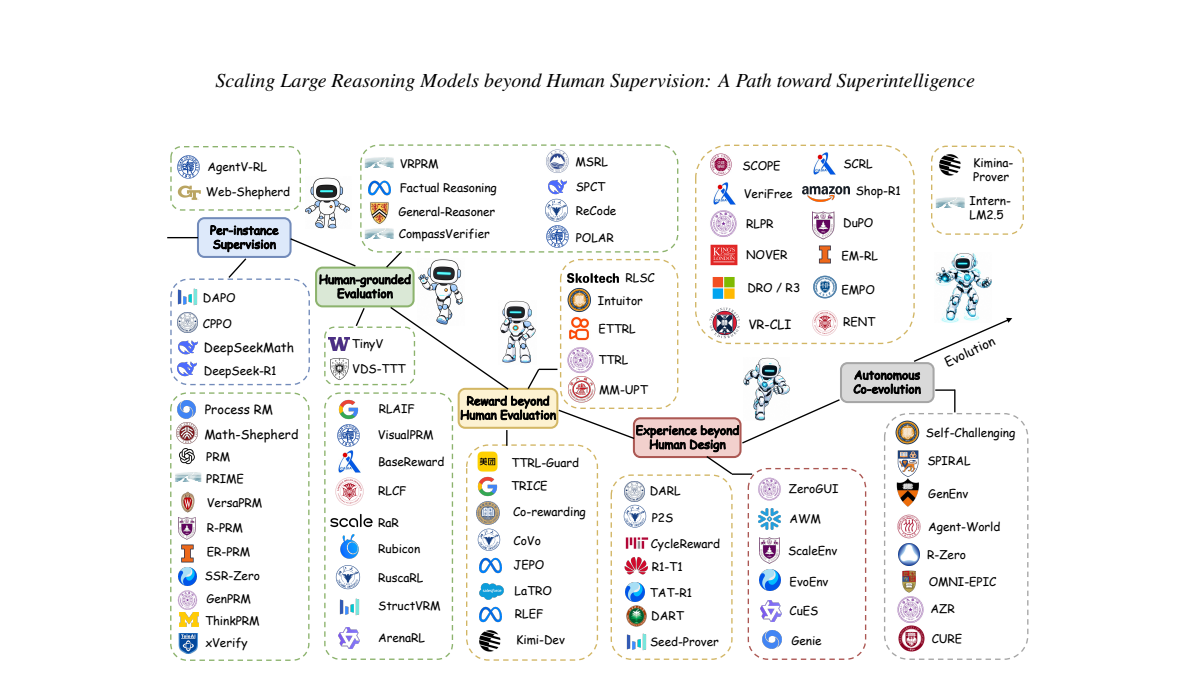
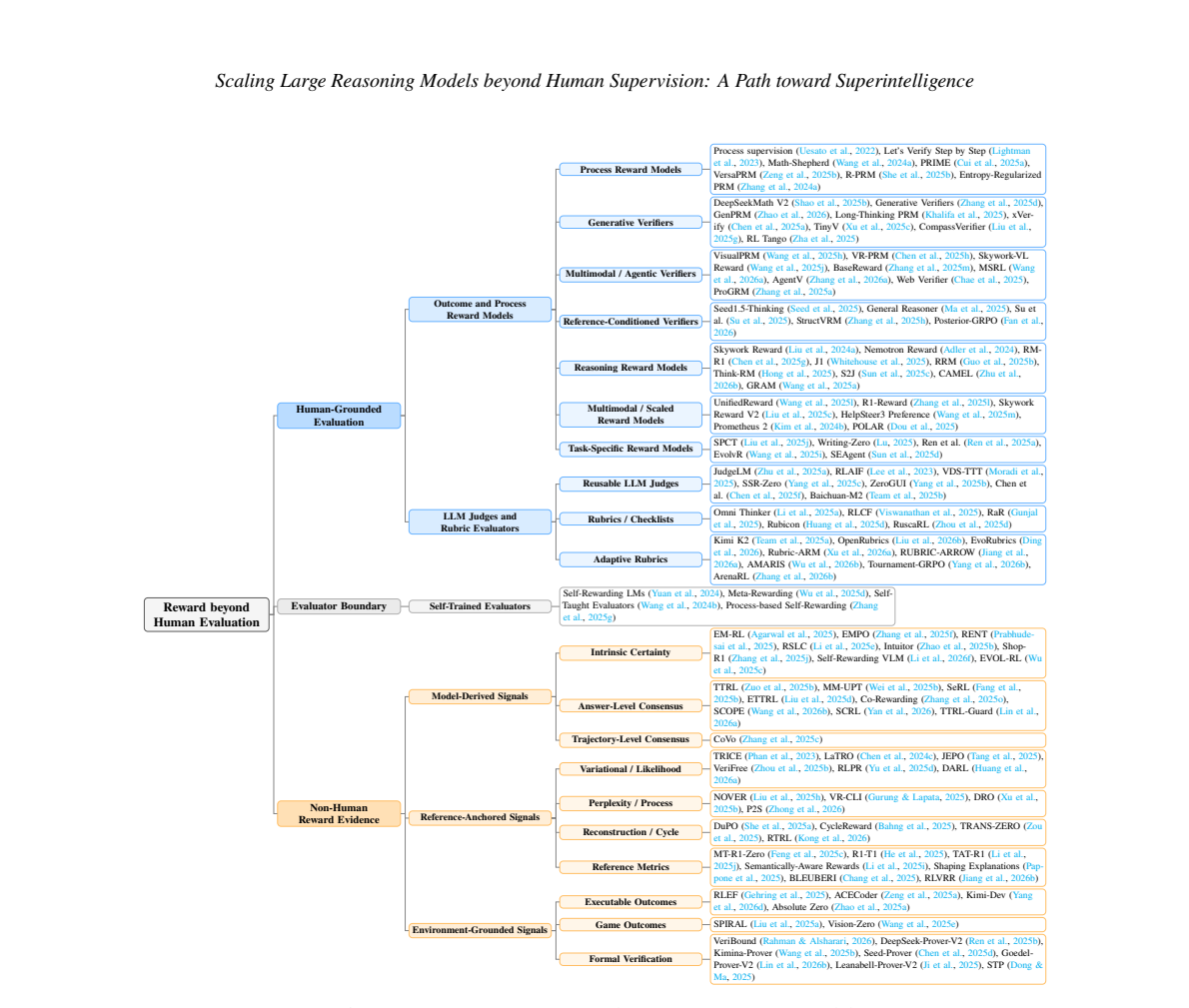
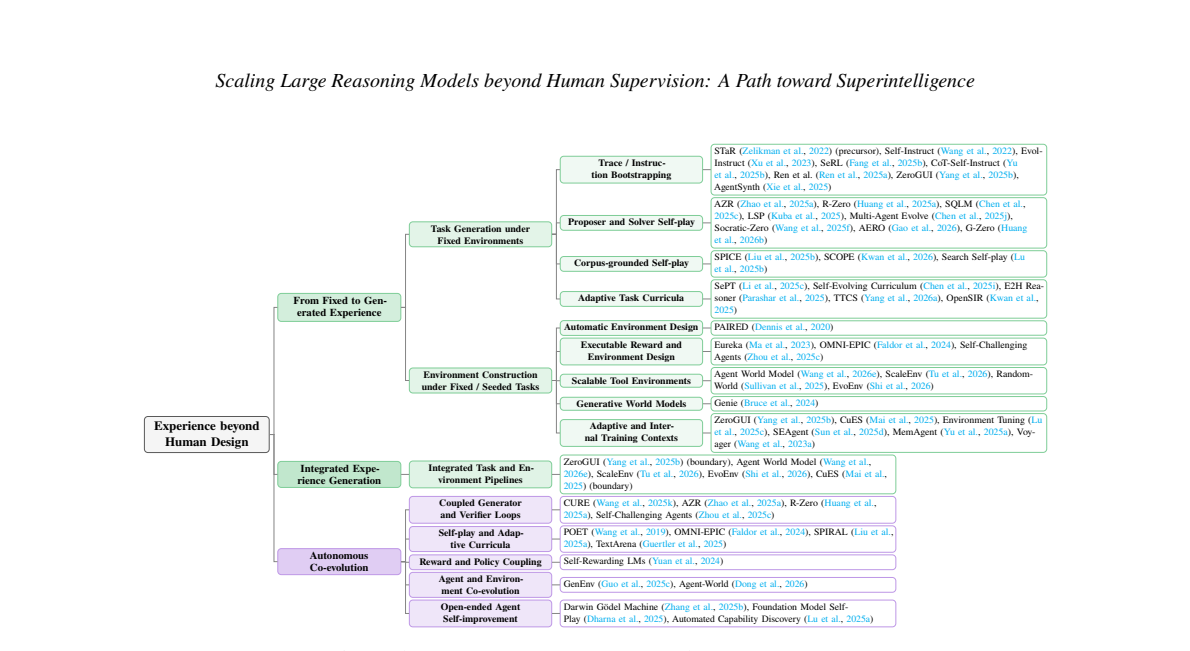
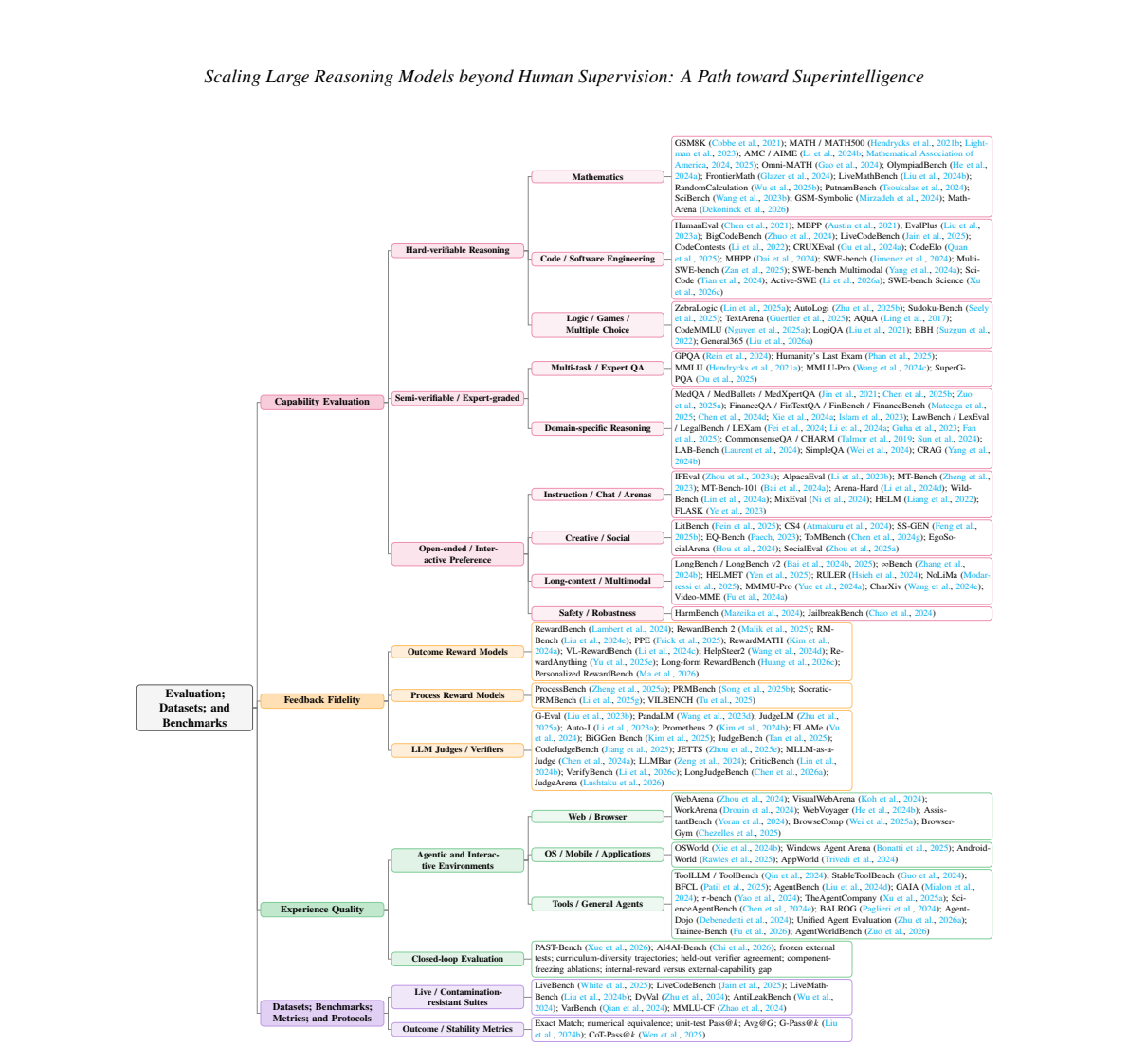
Extending this progress to open-ended and agentic tasks remains difficult because reliable rewards are harder to obtain and direct human supervision cannot keep pace with the scale and complexity of model-generated experience. This paper studies how LRMs can continue to improve as human supervision gradually recedes from the learning loop. We examine two connected dimensions of this problem. The reward axis traces the development from per-instance human judgments to reusable verifiers and rewards that operate even without human feedback. The experience axis examines how learning can progress from human-curated tasks and environments toward self-generated curricula, constructed environments, and autonomous co-evolution. We connect these dimensions through a five-level ladder from L0 to L4 that identifies which parts of the learning process remain under continued human control. Our analysis further highlights the risks introduced by increasingly autonomous rewards and experience generation, including reward hacking, feedback drift, curriculum collapse, and environment errors. Consequently, we also provide the evaluation around three complementary objects: policy capability, feedback fidelity, and experience quality. This analysis provides a structured account of current approaches to scaling LRMs beyond human supervision and the open problems involved in developing self-sustaining learning systems toward superintelligence. Furthermore, we maintain a continuously updated \hrefhttps://github.com/visitworld123/Awesome-Scaling-LRM-Beyond-Human-SupervisionGitHub repository to track the latest advances.
from the abstract
Pith says
Machine review · deepseek-v4-flash · 9 Sep 2026 · what was read was not recorded · not checked by a person
It can be wrong. Challenge this review or reply to it.
Holds up, with conditions. Useful vocabulary and evaluation checklist, but the framework is untested—needs an inter-rater study and a worked audit before it can be prescriptive. This line is wrong
3 major objections · 5 minor
How often objections from reviews like this one are right: not yet measured
Not checked: figures, code, what the 178 references say.
The paper says, at Section 2.5, Figure 1
The review did not quote this passage.
Pith says: Objection 1 of 3 · major
The ladder is presented as characterizing 'operational responsibility during learning,' but no inter-rater reliability experiment is conducted to show that independent researchers can consistently assign a method to a level. Without such evidence, the ladder is a plausible taxonomy, not an operationalized characteristic. The paper's claim would be strengthened by a small inter-rater study or by clarifying that the ladder is intentionally qualitative and does not yet claim operational reliability.
The paper says, at Section 5, Table 6
The review did not quote this passage.
Pith says: Objection 2 of 3 · major
The evaluation framework prescribes 'minimum evaluation evidence' for each ladder level but gives no worked example applying it to a known failure mode, such as majority-vote collapse (Shafayat et al., 2025, cited in §3.4.1) or reward hacking in self-play (§4.5). As the paper's central normative claim is that 'capability gains alone are insufficient,' a demonstration that the framework would detect such collapse would substantially strengthen the argument. I suggest adding a case study.
The paper says, at Section 1
The review did not quote this passage.
Pith says: Objection 3 of 3 · major
The paper acknowledgs that the reward axis and experience axis 'ultimately converge' yet the ladder treats them as independent dimensions (e.g., the ordering from L0-L4 assumes monotonic receding along both axes). This tension is load-bearing because the ladder's ordinal structure requires the axes to be sufficiently separable.
more of objection 3
The authors should discuss conditions under which the separation breaks down or how a method that is at L2 on reward but L0 on experience (e.g., consensus rewards on fixed tasks) fits the ladder.
5 minor objections
The paper says, at Section 2.5, Figure 2
Pith says: minor objection 1 of 5
The figure labels 'Human-free Reward' and 'Human-free Experience' even though the text immediatly cautions that these do not imply complete absence of human influence. Consider using quotes or a more cautious label such as 'Reward beyond Human Evaluation' consistently, or add an explicit note in the caption repeating the caveat.
The paper says, at Section 3.3.1
Pith says: minor objection 2 of 5
The distinction between 'intrinsic' certainty rewards and classic novelty-seeking intrinsic motivation (Section 3.3.1, final paragraph) is helpful but would benefit from being introduced earlier in the subsection, perhaps with a brief sentence at the start.
show 3 more
The paper says, at Section 5
Pith says: minor objection 3 of 5
The lists of benchmarks in Section 5 are very long and could be condensed into a summary table with representative entries, leaving the full extens list to an appendix or the GitHub repository. The current format makes the section hard to scan.
The paper says, at Section 2.5
Pith says: minor objection 4 of 5
The ladder levels (L0-L4) are defined qualitatively. A brief example classification of two or three well-known methods (e.g., DeepSeek-R1, Self-Rewarding LMs, SPIRAL) at the end of the section would help readers understand the classification criteria.
The paper says, at Overall
Pith says: minor objection 5 of 5
The paper uses many acronyms (RLVR, PRM, GRPO, POMDP, UED, etc.). A dedicated glossary abbrevations table beyond Table 1 would improve readability, especially for readers new to the area.
What would settle it
Inter-rater reliabilty test: Select 25 representative methods spanning the paper's taxonomy (e.g., TTRL, EM-RL, SeRL, R-Zero, CURE, SPIRAL, Aero, G-Zero). Provide each to 5 independent researchers familier with the paper's definitions, without labels. Measure Fleiss' kappa for L-level assignment and for axis discretization. If κ < 0.6, the ladder lacks the operationality claimed. This directly tests whether the ladder can serve as a shared coordinate system.
from the skeptic's reading
How the review went
4 readings by deepseek-v4-flash · 9 Sep 2026
- Reader holds up, with conditions
- Skeptic partly agrees
- Editor wrote the verdict above
- Referee major revision: 3 major objections, 5 minor
Not run on this paper: the simulated authors' defence.
Pith did not check this review's objections against the paper.
The review in full
The review in brief, machine-written
This paper gives the field a clean vocabulary for talking about scaling LRMs beyond human supervision, and its Table 6 evaluation checklist is a sensible suggestion that could improve reporting standards. The mathematical setup is correct, the catalog of ~200 methods is comprehensive, and the three-part evaluation framework (policy capability, feedback fidelity, experience quality) is a good proposal.
Where the paper is soft: the central L0–L4 ladder and the evaluation framework are presented as prescriptive but have not been validated. There is no inter-rater reliability test—I cannot tell whether independent researchers would consistently place a given method at L2 vs L3. More importantly, Table 6 recommends "minimum evaluation evidence" but no worked example applies it to a known failure mode like consensus collapse or reward hacking in self-play. The paper concedes in Section 7 that the framework is "analytical rather than predictive," but then recommends it for auditing—that is a real gap.
The paper also does not sharply differentiate itself from the closest survey of self-evolving agents. The reward and experience axes map onto existing research programs (reward modeling, self-rewarding, consensus, curriculum generation, unsupervised environment design). The novelty is in the packaging and the evaluation standard, not in the underlying categorization.
This paper is for researchers working on RLVR, self-evolution, or autonomous learning who want a structured way to think about supervision reduction and a reporting checklist. It is not an empirical paper and does not claim to be.
I would accept this for peer review. It deserves a serious referee. But I would recommend major revision: add an inter-rater reliability experiment for the ladder (even a small one with 3–5 raters on 20 methods) and a worked audit showing that Table 6 would actually detect a known failure mode. Without those, the framework remains a plausible opinion rather than an operationalizable tool.
The strongest objection
The central claim—that the L0-L4 ladder correctly characterizes continued human provision and that the three-part evaluation framework (Table 6) is sufficient for auditing scaling beyond human supervision—rests on two untested premises. First, the ladder's levels are defined qualitatively (Section 2.5, Figure 1) but no experiment measures whether independent researchers can consistently assign a method to a level. Without inter-rater reliability, the ladder is a plausible taxonomy, not an operationalizable characteristic. Second, the evaluation framework (Table 6) is presented as prescriptive ("minimum evaluation evidence") but no worked example applies it to a known failure mode—e.g., consensus majority-vote collapse (Shafayat et al., 2025, cited in §3.4.1) or reward hacking in self-play (§4.5). Without a demonstration that the framework would detect such collapse, the paper's recommendation that "capability gains alone are insufficient" is an unvalidated normative claim. The paper's Limitations (§7) concede the framework is "analytical rather than predictive," but the paper's core argument is that it usefully organizes progress; that claim requires evidence of operational usefulness, not just self-consistency.
The concern sharpens the reader's identified weakest assumption: the axes' separability and the evaluation framework's unvalidated status. The reader noted 'categorical placements are unoperationalized' and 'the recommended evidence standard is not validated by any worked example.' I agree partially, but I argue the load-bearing problem is deeper: the paper's central claim depends on the ladder being a usable coordinate system and the evaluation framework being sufficient to catch failure modes. Neither has been demonstrated. The concrete test (inter-rater agreement) would settle whether the ladder is reliably applicable. This does not invalidate the paper's survey value or its internal consistency, so the verdict remains CONDITIONAL. The concern is a gap in operational support, not a flaw in the argument itself. No change to the verdict is needed because the reader already flagged this as a condition. Agreement is partial because I emphasize the lack of operationality more centrally than the reader's focus on axes independance.
The referee's report
If the ladder and evaluation framework prove useful, they could provide a shared coordinate system and a minimal evidence checklist for the growing research area of LRM training with reduced human oversight. The survey is broad, current, and carefully hedged: the paper distinguishes its analytical claims from empirical validation. The dual-axis perspective (reward and experience) is a clarifying contribution that goes beyond prior surveys focused on either evaluators or curricula alone. The paper also explicitly catalogs failure modes (reward hacking, curriculum collapse, generator-verifier collusion) that are often glossed over in method papers, which is valuable for the community.
Pith's reading of the paper (a machine's summary, not the authors')
This paper asks how large reasoning models can keep improving when human annotators can no longer judge every training instance, and it answers with a coordinate system for the problem. Progress is organized along two axes — where the reward signal comes from and where the training experience comes from — folded into a five-level ladder, L0 to L4, that locates which parts of the learning loop still depend on continued human provision. The paper then adds a three-part evaluation standard — policy capability, feedback fidelity, and experience quality — and argues that rising benchmark scores alone cannot certify progress once feedback or experience is produced inside the learning loop. A fair reader would take the contribution to be a shared language for comparing methods plus a minimal evidence checklist that makes reported self-improvement gains auditable.
What carries the argument. The central object is the receding-supervision ladder: a five-level ordinal classification, L0 through L4, built from the reward axis (where the evidence used to score a rollout comes from) and the experience axis (who supplies the tasks and environments that generate trajectories). Each level names which component of the learning loop still requires continued human provision — per-instance judgments, reusable human criteria, rewards beyond human evaluation, experience beyond human design, and finally a closed co-evolution loop. The ladder does its work by converting a vague talk of autonomy into a concrete question about operational responsibility, and it is paired with a three-part evaluation framework whose operational form is a per-level checklist of minimum evidence: source-matched reward audits, curriculum-diversity and environment-validity measures, and longitudinal tracking of internal reward against frozen external tests.
Core claim. The central claim is that scaling beyond human supervision should be understood as a shift in operational responsibility along two connected axes, not as a single measure of autonomy. The reward axis runs from per-instance human judgments (L0) through reusable human-grounded evaluators (L1) to rewards drawn from model confidence, consensus, references, or environment outcomes (L2), while the experience axis runs from fixed, human-curated tasks and environments toward self-generated curricula and constructed environments (L3) and finally autonomous co-evolution of policy, rewards, tasks, and environments (L4). The ladder is explicitly not a measure of capability, reliability, alignment, or the historical amount of human knowledge embedded in the infrastructure; it characterizes operational responsibility during learning. The companion claim is that capability gains alone are insufficient when feedback or experience is produced within the same learning loop, so evaluation must separate policy capability, feedback fidelity, and experience quality.
The premise it rests on. The load-bearing premise is that the reward axis and the experience axis are separable enough to support an ordinal ladder, so that the degree of continued human provision is the variable that actually organizes progress, with a second premise being that independent external grounding can be preserved at every ladder level even though the paper asserts rather than demonstrates that its evidence checklist detects drift and collapse.
If the paper is right (Pith's inferences, not the authors')
Reported RLVR gains should be audited with a source-matched feedback check — preference-data probes for reward models, step-error detection for process rewards, calibration and consensus-fragility checks for certainty signals — before they are read as evidence of real capability.
Methods that generate their own tasks or environments must report task-supply and environment quality — solve-rate distributions and learnability scores $\bar{p}(1-\bar{p})$, diversity, novelty, executability, and transfer to frozen public suites — or their capability claims stay incomplete.
Claims approaching L4 autonomous co-evolution require longitudinal evidence: internal reward and frozen external capability tracked over time, agreement between training and held-out verifiers, and component-freezing ablations that show which part of the loop is doing the work.
The same data, evaluator, or environment must not serve as both training experience and final assessment; contamination-resistant and refreshed suites become progressively more important as the training stream becomes self-generated.
Safety evaluation must mirror the three-part structure: policy tests for harmful behavior and over-refusal, feedback audits for evaluator reliability under adversarial optimization, and experience audits for coverage of risk-relevant states.
A testable prediction follows from the framework: the gap between internal reward and frozen external capability should widen as methods move up the ladder, and feedback-fidelity audits should detect drift earlier than capability benchmarks do; a systematic comparison across L0–L4 systems would validate or refute the ladder's usefulness.
Adopting the ladder as a reporting convention would change practice before any new algorithm appears: papers claiming self-improvement would have to disclose which components of their loop were externally supplied, a detail currently buried in method descriptions.
Because the paper concedes the two axes converge — a generated task needs an evaluable outcome, and a scalable reward needs fresh experience — a one-dimensional supervision-remaining index might prove more honest than the two-axis ladder, though the paper does not collapse the two.
The L4 vision implies a governance design problem the paper leaves open: if humans remain only as sparse external auditors, the audit schedule, its independence from the training loop, and the threshold for intervention become design parameters as consequential as the learning algorithm.
Check this review
Pith stored no record of this review's passes and took no fingerprint of it. Reviews made by code from 13 Nov 2026 on carry both.
How often reviews like this one are right
Reviews like this one: written by deepseek-v4-flash, where what was read was not recorded.
How often objections from reviews like this one are right: not yet measured
Reviews by people
This review was written by a machine. No person has reviewed this paper on Pith yet. A scientist listed on Pith can review it for a fee, and their review is published here whatever it concludes.
The paper
Abstract
Recent advances in large reasoning models (LRMs) have shown that reinforcement learning with verifiable rewards (RLVR) can substantially improve reasoning in mathematics and code, where outcomes can be checked automatically. Extending this progress to open-ended and agentic tasks remains difficult because reliable rewards are harder to obtain and direct human supervision cannot keep pace with the scale and complexity of model-generated experience. This paper studies how LRMs can continue to improve as human supervision gradually recedes from the learning loop. We examine two connected dimensions of this problem. The reward axis traces the development from per-instance human judgments to reusable verifiers and rewards that operate even without human feedback. The experience axis examines how learning can progress from human-curated tasks and environments toward self-generated curricula, constructed environments, and autonomous co-evolution. We connect these dimensions through a five-level ladder from L0 to L4 that identifies which parts of the learning process remain under continued human control. Our analysis further highlights the risks introduced by increasingly autonomous rewards and experience generation, including reward hacking, feedback drift, curriculum collapse, and environment errors. Consequently, we also provide the evaluation around three complementary objects: policy capability, feedback fidelity, and experience quality. This analysis provides a structured account of current approaches to scaling LRMs beyond human supervision and the open problems involved in developing self-sustaining learning systems toward superintelligence. Furthermore, we maintain a continuously updated \hrefhttps://github.com/visitworld123/Awesome-Scaling-LRM-Beyond-Human-SupervisionGitHub repository to track the latest advances.
The paper's own sentences, arranged, kept beside the review and separate from it. Each label is drawn from a closed vocabulary; the number beside it is the probability the classifier gave that label. No sentence in this record was written by a model.
abstract compiled · 2026-09-23
The authors' main claim, as the classifier picked it out 0.98
“This analysis provides a structured account of current approaches to scaling LRMs beyond human supervision and the open problems involved in developing self-sustaining learning systems toward superintelligence.”
How the main claim is stated: asserted 1.00
What the abstract itself states, as probabilities: claims first 0.04 · states limitation 0.36 · human participants 0.13 · controlled comparison 0.04 · randomized assignment 0.01 · states quantitative result 0.04 · compares with prior results 0.12 · mentions code or data availability 0.52
The abstract, sentence by sentence
This table labels the abstract only (arXiv listing abstract v2). The number is the probability the classifier gave the label.
| Sentence | Role | The authors' own work | States the main conclusion | Strength |
|---|---|---|---|---|
| Recent advances in large reasoning models (LRMs) have shown that reinforcement learning with verifiable rewards (RLVR) can substantially improve reasoning in mathematics and code, where outcomes can be checked automatically. | background 1.00 | 0.05 | 0.04 | asserted 0.98 |
| Extending this progress to open-ended and agentic tasks remains difficult because reliable rewards are harder to obtain and direct human supervision cannot keep pace with the scale and complexity of model-generated experience. | gap 0.70 | 0.06 | 0.04 | asserted 1.00 |
| This paper studies how LRMs can continue to improve as human supervision gradually recedes from the learning loop. | contribution 0.97 | 0.53 | 0.07 | asserted 0.82 |
| We examine two connected dimensions of this problem. | contribution 0.79 | 0.63 | 0.02 | asserted 0.63 |
| The reward axis traces the development from per-instance human judgments to reusable verifiers and rewards that operate even without human feedback. | contribution 0.69 | 0.20 | 0.04 | asserted 0.93 |
| The experience axis examines how learning can progress from human-curated tasks and environments toward self-generated curricula, constructed environments, and autonomous co-evolution. | contribution 0.74 | 0.20 | 0.04 | asserted 0.93 |
| We connect these dimensions through a five-level ladder from L0 to L4 that identifies which parts of the learning process remain under continued human control. | contribution 0.67 | 0.84 | 0.08 | asserted 0.99 |
| Our analysis further highlights the risks introduced by increasingly autonomous rewards and experience generation, including reward hacking, feedback drift, curriculum collapse, and environment errors. | contribution 0.44 | 0.45 | 0.09 | asserted 0.93 |
| Consequently, we also provide the evaluation around three complementary objects: policy capability, feedback fidelity, and experience quality. | contribution 0.82 | 0.80 | 0.09 | asserted 0.99 |
| This analysis provides a structured account of current approaches to scaling LRMs beyond human supervision and the open problems involved in developing self-sustaining learning systems toward superintelligence. | contribution 0.93 | 0.71 | 0.48 | asserted 1.00 |
| Furthermore, we maintain a continuously updated \href{https://github.com/visitworld123/Awesome-Scaling-LRM-Beyond-Human-Supervision}{GitHub repository} to track the latest advances. | future work 0.55 | 0.82 | 0.02 | asserted 0.98 |
What kind of paper the classifier reports this is: position or commentary 0.83 · evidence from argument 0.83
What was examined, and what was not
Sources read
- arXiv listing abstract v2
Not examined
- full text
- figures and tables
- references and citing sentences
- relations to other papers
Levels run
- P abstract
Not run
- S sections
- T body sentences
- C citations
- R cross-paper relations
How the labels were made
Compiled by classifier-1.13.0 via TypeSafe API, question bank abstract-p1-20260923, 2026-09-23: 1 request, 8,255 input tokens.
Every quoted sentence on this record is the authors'. Every label is from Pith's closed vocabulary, with the probability shown beside it. This record as JSON
Figures (5)

Figures are the authors', reproduced from the paper.
References (178)
- [4] Austin, J., Odena, A., Nye, M., Bosma, M., Michalewski, H., Dohan, D., Jiang, E., Cai, C., Terry, M., Le, Q., et al. Program synthesis with large language models.arXiv preprint arXiv:2108.07732, on PithPith's reviewarXiv
- [5] Badshah,S.andSajjad,H. Reference-guidedverdict: Llms-as-judgesinautomaticevaluationoffree-form text.arXiv preprint arXiv:2408.09235, on PitharXiv
- [6] Bai, G., Liu, J., Bu, X., He, Y., Liu, J., Zhou, Z., Lin, Z., Su, W., Ge, T., Zheng, B., and Ouyang, W. MT-Bench-101: A fine-grained benchmark for evaluating large language models in multi-turn dialogues. InProceedingsofthe62ndAnnualMeetingoftheAssociationforComputationalLingu... on PithPith's reviewarXiv
- [7] Brown, B., Juravsky, J., Ehrlich, R., Clark, R., Le, Q. V., Ré, C., and Mirhoseini, A. Large language monkeys: Scaling inference compute with repeated sampling.arXiv preprint arXiv:2407.21787, on PithPith's reviewarXiv
- [8] 44 Scaling Large Reasoning Models beyond Human Supervision: A Path toward Superintelligence Cai, Y., Hao, Y., Zhou, J., Yan, H., Lei, Z., Zhen, R., Han, Z., Yang, Y., Li, J., Pan, Q., et al. Building self-evolving agents via experience-driven lifelong learning: A framework and... on PitharXiv
- [9] Cao, S., Li, D., Zhao, F., Yuan, S., Hegde, S. R., Chen, C., Ruan, C., Griggs, T., Liu, S., Tang, E., et al. Skyrl-agent: Efficient rl training for multi-turn llm agent.arXiv preprint arXiv:2511.16108, on PitharXiv
- [10] Casper, S., Davies, X., Shi, C., Gilbert, T. K., Scheurer, J., Rando, J., Freedman, R., Korbak, T., Lindner, D., Freire, P., et al. Open problems and fundamental limitations of reinforcement learning from human feedback.arXiv preprint arXiv:2307.15217, on PithPith's reviewarXiv
- [11] Chao,P.,Debenedetti,E.,Robey,A.,etal. Jailbreakbench: Anopenrobustnessbenchmarkforjailbreaking large language models.arXiv preprint arXiv:2404.01318, on PithPith's reviewarXiv
- [12] Chen, D., Chen, R., Zhang, S., Wang, Y., Liu, Y., Zhou, H., Zhang, Q., Wan, Y., Zhou, P., and Sun, L. Mllm-as-a-judge: Assessing multimodal llm-as-a-judge with vision-language benchmark. InForty-first International Conference on Machine Learning, 2024a. Chen, D., Yu, Q., Wang,... on PitharXiv
- [14] Chi, Y., Li, W., Hong, D., Wang, X., Gao, M., Yang, K., He, B., Zheng, Y., Xiao, C., and Na, Q. Ai4ai-bench: Benchmarking llm agents in algorithmic design for recursive self-improvement.arXiv preprint arXiv:2608.20318, on PithPith's reviewarXiv
- [16] Comanici, G., Bieber, E., Schaekermann, M., Pasupat, I., Sachdeva, N., Dhillon, I., Blistein, M., Ram, O., Zhang, D., Rosen, E., et al. Gemini 2.5: Pushing the frontier with advanced reasoning, multimodality, long context, and next generation agentic capabilities.arXiv preprin... on PithPith's reviewarXiv
- [17] Coste, T., Anwar, U., Kirk, R., and Krueger, D. Reward model ensembles help mitigate overoptimization. arXiv preprint arXiv:2310.02743, on PithPith's reviewarXiv
- [18] 46 Scaling Large Reasoning Models beyond Human Supervision: A Path toward Superintelligence Cui, G., Yuan, L., Wang, Z., Wang, H., Zhang, Y., Chen, J., Li, W., He, B., Fan, Y., Yu, T., et al. Process reinforcement through implicit rewards.arXiv preprint arXiv:2502.01456, 2025a... on PithPith's reviewarXiv
- [19] Damani, M., Puri, I., Slocum, S., Shenfeld, I., Choshen, L., Kim, Y., and Andreas, J. Beyond binary rewards: Training lms to reason about their uncertainty.arXiv preprint arXiv:2507.16806, on PithPith's reviewarXiv
- [20] Debenedetti, E., Zhang, J., Balunovic, M., et al. Agentdojo: A dynamic environment to evaluate prompt injection attacks and defenses for LLM agents.arXiv preprint arXiv:2406.13352, on PithPith's reviewarXiv
- [21] Dekoninck, J., Mueller, M. N., and Vechev, M. Constat: Performance-based contamination detection in large language models.arXiv preprint arXiv:2405.16281, on PithPith's reviewarXiv
- [22] Dekoninck, J., Jovanović, N., Gehrunger, T., Rögnvaldsson, K., Petrov, I., Sun, C., and Vechev, M. Beyond benchmarks: Matharena as an evaluation platform for mathematics with llms.arXiv preprint arXiv:2605.00674, on PithPith's reviewarXiv
- [23] Deng, J., Chen, J., Chen, Z., Cheng, D., Bai, F., Zhang, B., Min, Y., Gao, Y., Zhao, W. X., and Wen, J.-R. From trial-and-error to improvement: A systematic analysis of llm exploration mechanisms in rlvr. arXiv preprint arXiv:2508.07534, on PithPith's reviewarXiv
- [24] Dennis,M.,Jaques,N.,Vinitsky,E.,Bayen,A.,Russell,S.,Critch,A.,andLevine,S. Emergentcomplexity and zero-shot transfer via unsupervised environment design.arXiv preprint arXiv:2012.02096, on PithPith's reviewarXiv
- [26] Ding, H., Huang, B., Fang, Y., Liao, W., Li, Z., Zhang, J., Wu, Z., Zhao, J., and Wang, Y. Evorubrics: Dynamic rubrics as rewards via adversarial co-evolution for llm reinforcement learning.arXiv preprint arXiv:2606.23038, on PithPith's reviewarXiv
show 80 more
- [27] Dong, G. et al. Agent-world: Scaling real-world environment synthesis for evolving general agent intelligence.arXiv preprint arXiv:2604.18292, on PithPith's reviewarXiv
- [28] Dou, S., Liu, S., Yang, Y., Zou, Y., Zhou, Y., Xing, S., Huang, C., Ge, Q., Song, D., Lv, H., et al. Pre-trained policy discriminators are general reward models.arXiv preprint arXiv:2507.05197, on PitharXiv
- [29] Drouin, A., Gasse, M., Caccia, M., et al. Workarena: How capable are web agents at solving common knowledge work tasks?arXiv preprint arXiv:2403.07718, on PithPith's reviewarXiv
- [30] Du, X., Yao, Y., et al. Supergpqa: Scaling llm evaluation across 285 graduate disciplines.arXiv preprint arXiv:2502.14739, on PithPith's reviewarXiv
- [31] 47 Scaling Large Reasoning Models beyond Human Supervision: A Path toward Superintelligence Dubois, Y., Galambosi, B., Liang, P., and Hashimoto, T. B. Length-controlled alpacaeval: A simple way to debias automatic evaluators.arXiv preprint arXiv:2404.04475, on PithPith's reviewarXiv
- [32] Egashira,K.,Vero,M.,Dekoninck,J.,Dorner,F.E.,Staab,R.,andVechev,M. Delay,plateau,orcollapse: Evaluating the impact of systematic verification error on rlvr.arXiv preprint arXiv:2605.02909, on PithPith's reviewarXiv
- [33] Eisenstein, J., Nagpal, C., Agarwal, A., Beirami, A., D’Amour, A., Dvijotham, K., Fisch, A., Heller, K., Pfohl, S., Ramachandran, D., et al. Helping or herding? reward model ensembles mitigate but do not eliminate reward hacking.arXiv preprint arXiv:2312.09244, on PithPith's reviewarXiv
- [34] Ethayarajh, K., Xu, W., Muennighoff, N., Jurafsky, D., and Kiela, D. KTO: Model alignment as prospect theoretic optimization.arXiv preprint arXiv:2402.01306, on PithPith's reviewarXiv
- [35] Faldor, M., Zhang, J., Cully, A., and Clune, J. Omni-epic: Open-endedness via models of human notions of interestingness with environments programmed in code.arXiv preprint arXiv:2405.15568, on PithPith's reviewarXiv
- [36] Fan, Y., Ni, J., Merane, J., Salimbeni, E., Tian, Y., Hermstrüwer, Y., Huang, Y., Akhtar, M., Geering, F., Dreyer, O., et al. Lexam: Benchmarking legal reasoning on 340 law exams.arXiv preprint arXiv:2505.12864, on PitharXiv
- [37] Fang, J., Peng, Y., Zhang, X., Wang, Y., Yi, X., Zhang, G., Xu, Y., Wu, B., Liu, S., Li, Z., et al. A comprehensive survey of self-evolving ai agents: A new paradigm bridging foundation models and lifelong agentic systems.arXiv preprint arXiv:2508.07407, 2025a. Fang, W., Liu, ... on PithPith's reviewarXiv
- [38] Fein, D., Russo, S., Xiang, V., Jolly, K., Rafailov, R., and Haber, N. Litbench: A benchmark and dataset for reliable evaluation of creative writing.arXiv preprint arXiv:2507.00769, on PithPith's reviewarXiv
- [39] Feng, J., Huang, S., Qu, X., Zhang, G., Qin, Y., Zhong, B., Jiang, C., Chi, J., and Zhong, W. Retool: Reinforcement learning for strategic tool use in llms.arXiv preprint arXiv:2504.11536, 2025a. Feng, Y., Song, M., Wang, J., Chen, Z., Bi, G., Huang, M., Jing, L., and Yu, J. S... on PithPith's reviewarXiv
- [40] Fu, C., Dai, Y., Luo, Y., et al. Video-mme: The first-ever comprehensive evaluation benchmark of multi-modal LLMs in video analysis.arXiv preprint arXiv:2405.21075, 2024a. 48 Scaling Large Reasoning Models beyond Human Supervision: A Path toward Superintelligence Fu, D., Mei, ... on PithPith's reviewarXiv
- [41] Fu, Y., Uzuner, O., Yetisgen, M., and Xia, F. Does data contamination detection work (well) for LLMs? a survey and evaluation on detection assumptions.arXiv preprint arXiv:2410.18966, 2024b. Gao, B., Song, F., Yang, Z., Cai, Z., Miao, Y., Dong, Q., Li, L., Ma, C., Chen, L., Xu... on PithPith's reviewarXiv
- [42] Gao, H.-a., Geng, J., Hua, W., Hu, M., Juan, X., Liu, H., Liu, S., Qiu, J., et al. A survey of self-evolving agents: What,when,how,andwheretoevolveonthepathtoartificialsuperintelligence.arXivpreprint arXiv:2507.21046, 2025a. Gao, J., Fu, W., Xie, M., Xu, S., He, C., Mei, Z., Z... on PithPith's reviewarXiv
- [43] Gao, Z., Ma, J., Li, X., Li, P., Qu, N., Wu, Y., Liu, H., and Liu, J. Aero: Autonomous evolutionary reasoning optimization via endogenous dual-loop feedback.arXiv preprint arXiv:2602.03084, on PitharXiv
- [44] Glazer, E., Erdil, E., Besiroglu, T., Chicharro, D., Chen, E., Gunning, A., Falkman Olsson, C., Denain, J.-S., Ho, A., Santos, E. d. O., et al. Frontiermath: A benchmark for evaluating advanced mathematical reasoning in AI.arXiv preprint arXiv:2411.04872, on PithPith's reviewarXiv
- [45] Gu, A., Rozière, B., Leather, H., Solar-Lezama, A., Synnaeve, G., and Wang, S. I. Cruxeval: a benchmark for code reasoning, understanding and execution. InProceedings of the 41st International Conference on Machine Learning, pp. 16568–16621, 2024a. Gu, J., Jiang, X., Shi, Z., ... on PithPith's reviewarXiv
- [46] Gulcehre, C., Paine, T. L., Srinivasan, S., Konyushkova, K., Weerts, L., Sharma, A., Siddhant, A., Ahern, A., Wang, M., Gu, C., et al. Reinforced self-training (ReST) for language modeling.arXiv preprint arXiv:2308.08998, on PithPith's reviewarXiv
- [47] Gunjal, A., Wang, A., Lau, E., Nath, V., Liu, B., and Hendryx, S. Rubrics as rewards: Reinforcement learning beyond verifiable domains.arXiv preprint arXiv:2507.17746, on PithPith's reviewarXiv
- [48] Guo, D., Yang, D., Zhang, H., Song, J., Zhang, R., Xu, R., Zhu, Q., Ma, S., Wang, P., Bi, X., et al. Deepseek-r1: Incentivizing reasoning capability in llms via reinforcement learning.arXiv preprint arXiv:2501.12948, 2025a. 49 Scaling Large Reasoning Models beyond Human Superv... on PithPith's reviewarXiv
- [49] Gurung, A. and Lapata, M. Learning to reason for long-form story generation.arXiv preprint arXiv:2503.22828, on PithPith's reviewarXiv
- [50] He, C., Luo, R., Bai, Y., Hu, S., Thai, Z. L., Shen, J., Hu, J., Liu, Y., Liu, Y., Zhong, W., et al. Olympiadbench: AchallengingbenchmarkforpromotingAGIwitholympiad-levelbilingualmultimodal scientific problems.arXiv preprint arXiv:2402.14008, 2024a. He, H., Yao, W., Ma, K., et... on PithPith's reviewarXiv
- [51] Helff, L., Delfosse, Q., Steinmann, D., Härle, R., Shindo, H., Schramowski, P., Stammer, W., Kersting, K., and Friedrich, F. LLMs gaming verifiers: RLVR can lead to reward hacking.arXiv preprint arXiv:2604.15149, on PithPith's reviewarXiv
- [52] Hendrycks, D., Burns, C., Basart, S., Zou, A., Mazeika, M., Song, D., and Steinhardt, J. Measuring massive multitask language understanding. InInternational Conference on Learning Representations, 2021a. Hendrycks, D., Burns, C., Kadavath, S., Arora, A., Basart, S., Tang, E., ... on PithPith's reviewarXiv
- [53] Hong, J., Lee, N., and Thorne, J. ORPO: Monolithic preference optimization without reference model. arXiv preprint arXiv:2403.07691, on PithPith's reviewarXiv
- [54] Hou, G., Zhang, W., Shen, Y., Tan, Z., Shen, S., and Lu, W. Egosocialarena: Benchmarking the social intelligence of large language models from a first-person perspective.arXiv preprint arXiv:2410.06195, on PithPith's reviewarXiv
- [55] Hsieh, C.-P., Sun, S., Kryscinski, W., Cohen, N., Yu, T., Kaplan, J., Wu, F., et al. RULER: What’s the real context size of your long-context language models?arXiv preprint arXiv:2404.06654, on PithPith's reviewarXiv
- [56] 50 Scaling Large Reasoning Models beyond Human Supervision: A Path toward Superintelligence Huang,C.,Yu,W.,Wang,X.,Zhang,H.,Li,Z.,Li,R.,Huang,J.,Mi,H.,andYu,D. R-zero: Self-evolving reasoning llm from zero data.arXiv preprint arXiv:2508.05004, 2025a. Huang, C., Lin, L., Shi, X... on PithPith's reviewarXiv
- [57] Islam, P., Kannappan, A., Kiela, D., Qian, R., Scherrer, N., and Vidgen, B. Financebench: A new benchmark for financial question answering.arXiv preprint arXiv:2311.11944, on PithPith's reviewarXiv
- [58] Jaech, A., Kalai, A., Lerer, A., Richardson, A., El-Kishky, A., Low, A., Helyar, A., Madry, A., Beutel, A., Carney, A., et al. Openai o1 system card.arXiv preprint arXiv:2412.16720, on PithPith's reviewarXiv
- [59] Ji, X., Liu, Y., Wang, Q., Zhang, J., Yue, Y., Shi, R., Sun, C., Zhang, F., Zhou, G., and Gai, K. Leanabell-prover-v2: Verifier-integrated reasoning for formal theorem proving via reinforcement learning.arXiv preprint arXiv:2507.08649, on PithPith's reviewarXiv
- [60] Jiang, H., Chen, Y., Cao, Y., Lee, H.-y., and Tan, R. T. Codejudgebench: Benchmarking llm-as-a-judge for coding tasks.arXiv preprint arXiv:2507.10535, on PithPith's reviewarXiv
- [61] Jiang,H.,Dong,Z.,Liu,T.,Wang,W.,Xu,R.,Yu,T.,Zhang,L.,andWang,H. Rubric-arrow: Alternating pointwise rubric reward modeling for llm post-training in non-verifiable domains.arXiv preprint arXiv:2605.29156, 2026a. Jiang, Y., Wang, Y., Zhang, Q., Zeng, X., Li, L., Chen, J., Tao, C... on PithPith's reviewarXiv
- [62] Kang, Z., Zhao, X., and Song, D. Scalable best-of-n selection for large language models via self-certainty. arXiv preprint arXiv:2502.18581, on PitharXiv
- [63] Khalifa, M., Khan, Z., Tafveez, O., Peng, H., and Wang, L. Countdown-code: A testbed for studying the emergence and generalization of reward hacking in RLVR.arXiv preprint arXiv:2603.07084, on PithPith's reviewarXiv
- [64] Kim, S., Kang, D., Kwon, T., et al. Evaluating robustness of reward models for mathematical reasoning. arXiv preprint arXiv:2410.01729, 2024a. Kim, S., Suk, J., Longpre, S., Lin, B. Y., Shin, J., Welleck, S., Neubig, G., Lee, M., Lee, K., and Seo, M. Prometheus 2: An open sour... on PithPith's reviewarXiv
- [65] Kuba, J. G., Gu, M., Ma, Q., Tian, Y., Mohan, V., and Chen, J. Language self-play for data-free training. arXiv preprint arXiv:2509.07414, on PitharXiv
- [66] Kwan, W.-C., Gema, A. P., Leang, J. O. J., Vougiouklis, P., Pan, J. Z., Valentino, M., and Minervini, P. Opensir: Open-ended self-improving reasoner.arXiv preprint arXiv:2511.00602, on PithPith's reviewarXiv
- [67] Kwan, W.-C., Gema, A. P., Leang, J. O. J., and Minervini, P. Scope: Self-play via co-evolving policies for open-ended tasks.arXiv preprint arXiv:2605.31433, on PithPith's reviewarXiv
- [68] Kwiatkowski, A., Butt, N., Labiad, I., Kempe, J., and Ollivier, Y. Likelihood-based reward designs for general llm reasoning.arXiv preprint arXiv:2602.03979, on PitharXiv
- [69] Lambert, N., Pyatkin, V., Morrison, J., Miranda, L., Lin, B. Y., Chandu, K., Dziri, N., Kumar, S., Zick, T., Choi, Y., et al. Rewardbench: Evaluating reward models for language modeling.arXiv preprint arXiv:2403.13787, on PithPith's reviewarXiv
- [70] 52 Scaling Large Reasoning Models beyond Human Supervision: A Path toward Superintelligence Laurent, J. M., Janizek, J. D., Ruzo, M., et al. LAB-Bench: Measuring capabilities of language models for biology research.arXiv preprint arXiv:2407.10362, on PithPith's reviewarXiv
- [71] Lee, H., Phatale, S., Mansoor, H., Mesnard, T., Ferret, J., Lu, K., Bishop, C., Hall, E., Carbune, V., Rastogi, A., et al. Rlaif vs. rlhf: Scaling reinforcement learning from human feedback with ai feedback. arXiv preprint arXiv:2309.00267, on PithPith's reviewarXiv
- [72] Li, D., Zhou, J., Kazemi, A., Sun, Q., Ghaddar, A., Ma, L., Luo, Y., Li, D., HAO, J., and Zhang, Y. Omni-thinker: Scaling cross-domain generalization in llms via multi-task rl with hybrid rewards. In 2nd AI for Math Workshop@ ICML, 2025a. Li, H., Chen, Y., Ai, Q., Wu, Y., Zhan... on PithPith's reviewarXiv
- [74] Lin, B. Y., Deng, Y., Chandu, K., Brahman, F., Ravichander, A., Pyatkin, V., Dziri, N., Bras, R. L., and Choi, Y. Wildbench: Benchmarking LLMs with challenging tasks from real users in the wild.arXiv preprint arXiv:2406.04770, 2024a. Lin, B. Y., Bras, R. L., Richardson, K., Sa... on PithPith's reviewarXiv
- [75] Lin, Y., Tang, S., Lyu, B., Yang, Z., Chung, J.-H., Zhao, H., Jiang, L., Geng, Y., Ge, J., Sun, J., et al. Goedel-prover-v2: Scaling formal theorem proving with scaffolded data synthesis and self-correction. InInternational Conference on Learning Representations, volume 2026, ... on PithPith's reviewarXiv
- [77] Liu, J., Xia, C. S., Wang, Y., and Zhang, L. Is your code generated by chatgpt really correct? rigorous evaluationoflargelanguagemodelsforcodegeneration. InAdvancesinNeuralInformationProcessing Systems, volume 36, 2023a. Liu, J., Liu, H., Xiao, L., Wang, Z., Liu, K., Gao, S., ... on PithPith's reviewarXiv
- [78] 56 Scaling Large Reasoning Models beyond Human Supervision: A Path toward Superintelligence Luo, R., Wang, L., He, W., Chen, L., Li, J., and Xia, X. Gui-r1: A generalist r1-style vision-language action model for gui agents.arXiv preprint arXiv:2504.10458, on PithPith's reviewarXiv
- [79] Lushtaku, E., Kargi, B., Elganzory, A., Ferreira, F., Salamanca, A. R., Kreutzer, J., and Sali- nas, D. Judgearena: A unified framework for reproducible llm-judge evaluation.arXiv preprint arXiv:2608.02620, on PithPith's reviewarXiv
- [80] Ma, X., Liu, Q., Jiang, D., Zhang, G., Ma, Z., and Chen, W. General-reasoner: Advancing llm reasoning across all domains.arXiv preprint arXiv:2505.14652, on PithPith's reviewarXiv
- [81] Ma, Y. J., Liang, W., Wang, G., Huang, D.-A., Bastani, O., Jayaraman, D., Zhu, Y., Fan, L., and Anandkumar,A. Eureka: Human-levelrewarddesignviacodinglargelanguagemodels.arXivpreprint arXiv:2310.12931, on PithPith's reviewarXiv
- [82] Mai, S., Zhai, Y., Chen, Z., Chen, C., Zou, A., Tao, S., Liu, Z., and Ding, B. Cues: A curiosity-driven and environment-grounded synthesis framework for agentic rl.arXiv preprint arXiv:2512.01311, on PitharXiv
- [83] Malik, S., Pyatkin, V., Land, S., Morrison, J., Smith, N. A., Hajishirzi, H., and Lambert, N. Rewardbench 2: Advancing reward model evaluation.arXiv preprint arXiv:2506.01937, on PithPith's reviewarXiv
- [84] Mateega, S., Georgescu, C., and Tang, D. Financeqa: A benchmark for evaluating financial analysis capabilities of large language models.arXiv preprint arXiv:2501.18062, on PithPith's reviewarXiv
- [85] Mathematical Association of America. AIME 2024, on Pith
- [86] Mathematical Association of America. AIME 2025, on Pith
- [87] Mazeika, M., Phan, L., Yin, X., et al. Harmbench: A standardized evaluation framework for automated red teaming and robust refusal.arXiv preprint arXiv:2402.04249, on PithPith's reviewarXiv
- [88] Mei, L., Yu, X., Chen, C., Liu, L., Chen, X., Ma, J., Feng, C., Huang, L., Mo, S., Kang, S., et al. Searchart: Training long-horizon search agent with scalable synthetic and verified task.arXiv preprint arXiv:2607.24850, on PithPith's reviewarXiv
- [89] Meng, Y., Xia, M., and Chen, D. SimPO: Simple preference optimization with a reference-free reward. arXiv preprint arXiv:2405.14734, on PithPith's reviewarXiv
- [90] Min, S., Krishna, K., Lyu, X., Lewis, M., Yih, W.-t., Koh, P.W., Iyyer, M., Zettlemoyer, L., andHajishirzi, H. FActScore: Fine-grained atomic evaluation of factual precision in long form text generation.arXiv preprint arXiv:2305.14251, on PithPith's reviewarXiv
- [91] Mirzadeh, I., Alizadeh, K., Shahrokhi, H., et al. GSM-Symbolic: Understanding the limitations of mathematical reasoning in large language models.arXiv preprint arXiv:2410.05229, on PithPith's reviewarXiv
- [92] Modarressi, A., Deilamsalehy, H., Dernoncourt, F., et al. Nolima: Long-context evaluation beyond literal matching.arXiv preprint arXiv:2502.05167, on PithPith's reviewarXiv
- [93] Moradi, M. M., Amer, H., Mudur, S., Zhang, W., Liu, Y., and Ahmed, W. Continuous self-improvement of large language models by test-time training with verifier-driven sample selection.arXiv preprint arXiv:2505.19475, on PithPith's reviewarXiv
- [94] 57 Scaling Large Reasoning Models beyond Human Supervision: A Path toward Superintelligence Mu,Y.,Zeng,J.,Li,B.,Guan,X.,Meng,F.,Zhou,J.,Xiao,T.,andZhu,J.Dissectinglong-chain-of-thought reasoning models: An empirical study.arXiv preprint arXiv:2506.04913, on PitharXiv
- [95] Nguyen, D. M., Phan, T. C., Le Hai, N., Doan, T.-T., Nguyen, N. V., Pham, Q., and Bui, N. D. Codemmlu: A multi-task benchmark for assessing code understanding & reasoning capabilities of codellms. InThe Thirteenth International Conference on Learning Representations, 2025a. Ng... on PithPith's reviewarXiv
- [96] Paech, S. J. Eq-bench: An emotional intelligence benchmark for large language models.arXiv preprint arXiv:2312.06281, on PithPith's reviewarXiv
- [97] Paglieri, D., Cupial, B., Coward, S., et al. BALROG: Benchmarking agentic LLM and VLM reasoning on games.arXiv preprint arXiv:2411.13543, on PithPith's reviewarXiv
- [98] Pappone, F., Lazzaroni, R. M., Califano, F., Gentile, N., and Marras, R. Shaping explanations: Semantic reward modeling with encoder-only transformers for grpo.arXiv preprint arXiv:2509.13081, on PitharXiv
- [99] Parashar, S., Gui, S., Li, X., Ling, H., Vemuri, S., Olson, B., Li, E., Zhang, Y., Caverlee, J., Kalathil, D., and Ji, S. Curriculum reinforcement learning from easy to hard tasks improves llm reasoning.arXiv preprint arXiv:2506.06632, on PitharXiv
- [100] Phan, L., Gatti, A., Han, Z., Li, N., Hu, J., Zhang, H., Zhang, C. B. C., Shaaban, M., Ling, J., Shi, S., et al. Humanity’s last exam.arXiv preprint arXiv:2501.14249, on PithPith's reviewarXiv
- [101] Plesner, A., Guzmán, F., and Athalye, A. An imperfect verifier is good enough: Learning with noisy rewards.arXiv preprint arXiv:2604.07666, on PithPith's reviewarXiv
- [102] Prabhudesai, M., Chen, L., Ippoliti, A., Fragkiadaki, K., Liu, H., and Pathak, D. Maximizing confidence alone improves reasoning.arXiv preprint arXiv:2505.22660, on PithPith's reviewarXiv
- [103] Qi,Y.,Fu,P.,Li,H.,Liu,Y.,Jiang,C.,Qin,B.,Luo,Z.,andLuan,J. Patchcue: Enhancingvision-language model reasoning with patch-based visual cues.arXiv preprint arXiv:2603.05869, 2026a. Qi, Z., Baby, S. M., Baby, S. A., Yuan, K., Tomkins, A., Vu, T., Juan, D.-C., and Rashtchian, C. O... on PitharXiv
- [104] Qian, K., Wan, S., Tang, C., et al. Varbench: Robust language model benchmarking through dynamic variable perturbation.arXiv preprint arXiv:2406.17681, on PithPith's reviewarXiv
- [105] Qin, Y., Ye, Y., Fang, J., Wang, H., Liang, S., Tian, S., Zhang, J., Li, J., Li, Y., Huang, S., et al. Ui-tars: Pioneering automated gui interaction with native agents.arXiv preprint arXiv:2501.12326, on PithPith's reviewarXiv
- [106] Quan, S., Yang, J., Yu, B., Zheng, B., Liu, D., Yang, A., Ren, X., Gao, B., Miao, Y., Feng, Y., et al. Codeelo: Benchmarking competition-level code generation of llms with human-comparable elo ratings. arXiv preprint arXiv:2501.01257, on PithPith's reviewarXiv
- [107] Rahman, A. and Alsharari, M. S. Veribound: Pac-bayesian generalization bounds for process reward models trained with formal verification tools.arXiv preprint arXiv:2606.20740, on PithPith's reviewarXiv
- [108] Ray, J. Before the model learns the bug: Fuzzing RLVR verifiers.arXiv preprint arXiv:2606.01066, on PithPith's reviewarXiv
The first 100 of 178 references are listed here. All of them are in this paper's citation record.
Cited by 3 Pith papers
Reviewed papers on Pith that cite this one. OpenAlex reports about 5 citations worldwide. The full citation record
- Rethinking Faithfulness in LLMs: A Pairwise Context-Sensitive Perspective cs.CL · Oct 2026
- Test-time Calibration Learning for Large Language Model Reasoning cs.LG · Oct 2026
- Advances in Agentic Computer Graphics cs.CV · Nov 2026
How the literature uses it
What this paper does with the arXiv papers it cites
What it cites · 244 sentences without a confident label
Builds on 1 paper
-
Writing-Zero adapts the same procedure to the evaluation of creative writing [ref] .
Writing-Zero: Bridge the Gap Between Non-verifiable Tasks and Verifiable Rewards · Outcome and Process Reward Models · 0.89
Compares with 2 papers
-
SPIN, ReST, and Self-Rewarding Language Models likewise differ in how they refresh and filter policy data [ref] .
Reinforced Self-Training (ReST) for Language Modeling · Self-Trained Evaluators and Boundary Cases · 0.82
-
SPIN, ReST, and Self-Rewarding Language Models likewise differ in how they refresh and filter policy data [ref] .
Self-Play Fine-Tuning Converts Weak Language Models to Strong Language Models · Self-Trained Evaluators and Boundary Cases · 0.82
Cites as support 30 papers
-
Under prolonged majority-vote training, proxy reward may separate from task accuracy and produce template answers or collapse [ref] .
2505.21444 · Failures of the Reward Signal · 0.99
-
These errors can transfer across judges from different model families [ref] .
More Convincing, Not More Correct: Self-Play Reward Hacking of Reference-Free LLM Judges · Failures of the Reward Signal · 0.99
-
Improvements can follow superficial heuristics in combinatorial optimization [ref] , and reasoning traces learned through RLVR contribute much less to general question answering than to verifiable reasoning [ref] .
2510.27044 · Capability Expansion and Transfer · 0.98
Cites as background 14 papers
-
Process reward models and step-wise critiques were first developed extensively for mathematical reasoning [ref] .
Math-Shepherd: Verify and Reinforce LLMs Step-by-step without Human Annotations · Outcome and Process Reward Models · 0.90
-
Process reward models and step-wise critiques were first developed extensively for mathematical reasoning [ref] .
Solving math word problems with process- and outcome-based feedback · Outcome and Process Reward Models · 0.90
-
Related work has approached this area from model-centric [ref] and environment-centric [ref] perspectives.
A Survey of Self-Evolving Agents: What, When, How, and Where to Evolve on the Path to Artificial Super Intelligence · Experience beyond Human Design · 1.00
Challenges and discussion
Disagree with the review, or know something it missed? Leave a comment, or challenge this review formally: a challenge becomes a permanent entry in this paper's record, and its decision is published here.
Come back by email
A short list of the week's newly reviewed papers. Nothing is sent until you confirm from your inbox, and every email has a link that stops it. No account.
No comments yet.
Sign in to comment